


What is the Asia-Pacific Cannabidiol (CBD) Oil Market Size and Growth Rate?
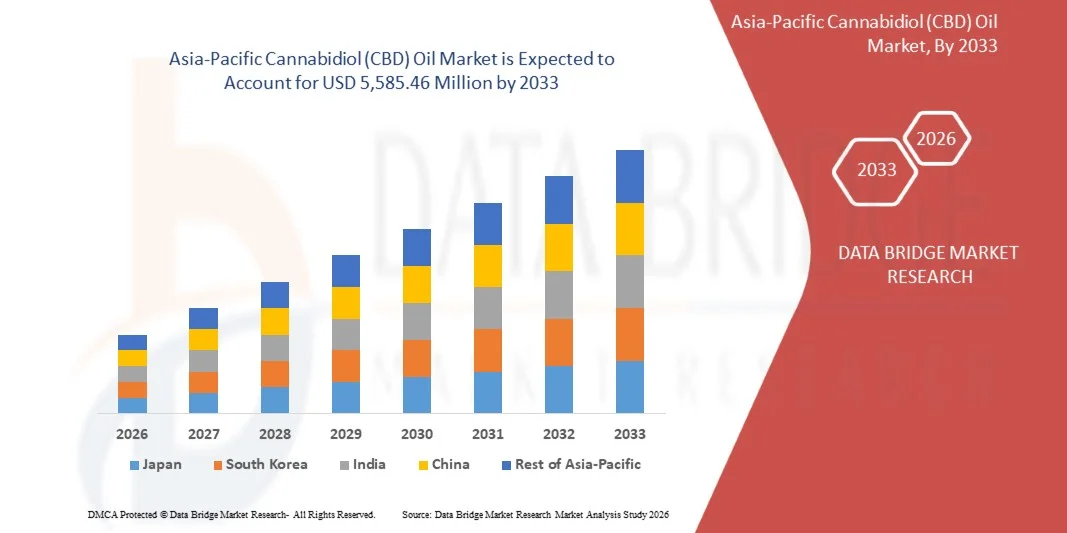
- As per Data Bridge Market Research analysis, the Asia-Pacific Cannabidiol (CBD) oil market was valued at USD 551.63 million in 2025 and is projected to reach USD 5,585.46 million by 2033, growing at a CAGR of 33.56% from 2026 to 2033.
- The market is experiencing consistent growth driven by increasing acceptance of cannabidiol-based products, expanding applications in pharmaceutical and wellness products, rising consumer awareness of CBD's potential health benefits, and gradual developments in regulatory frameworks across Asia-Pacific.
- The growing legalization and regulatory acceptance of hemp-derived CBD products, combined with rising demand for natural wellness solutions, is encouraging manufacturers to expand their presence across the region. Countries such as China, Japan, India, South Korea, and Australia are contributing to market development through increasing research, product innovation, and the expansion of online and retail distribution channels
Market Size & Forecast
- Global Market Value (2025): USD 551.63 Million
- Expected Market Value (2033): USD 5,585.46 Million
- Forecast CAGR (2026–2033): 33.56%
- Leading Country in 2025: China
- Fastest Growing Country: India
What are the Major Takeaways of the Asia-Pacific Cannabidiol (CBD) Oil Market?
- China dominated the Asia-Pacific Cannabidiol (CBD) oil market with the largest revenue share of 47.7% in 2025, supported by its large-scale hemp cultivation, substantial CBD exports, and permitted use of CBD in cosmetics.
- India is expected to be the fastest-growing country at a CAGR of 30.3% from 2026 to 2033, fueled by increasing consumer awareness, expanding availability of CBD-based wellness products, and growing interest in plant-based health solutions
- The hemp oil segment led the market with a 77% share in 2025, driven by the growing availability of hemp-derived CBD products and increasing consumer acceptance of hemp-based wellness solutions.
- Marijuana oil are the fastest-growing type, projected to register a CAGR of 25%, reflecting the surge in interest in cannabis-derived products for pharmaceutical and therapeutic applications.
- The original segment dominated the product type category with a 62% revenue share in 2025, led by strong consumer preference for pure and straightforward CBD oil formulations
- Unflavored accounted for 60% of the market share in 2025, preferred by consumer preference for neutral-tasting CBD oil that can be consumed directly or incorporated into other products.
- The personal care/cosmetics segment is the fastest-growing application category, with a CAGR of 29%, driven by increasing consumer interest in CBD-infused skincare and beauty products
Report Scope and Asia-Pacific Cannabidiol (CBD) Oil Market Segmentation
|
Attributes |
Asia-Pacific Cannabidiol (CBD) Oil Key Market Insights |
|
Segments Covered |
|
|
Countries Covered |
Asia-Pacific
|
|
Key Market Players |
|
|
Market Opportunities |
|
|
Value Added Data Infosets |
In addition to the insights on market scenarios such as market value, growth rate, segmentation, geographical coverage, and major players, the market reports curated by the Data Bridge Market Research also include import export analysis, production capacity overview, production consumption analysis, price trend analysis, climate change scenario, supply chain analysis, value chain analysis, raw material/consumables overview, vendor selection criteria, PESTLE Analysis, Porter Analysis, and regulatory framework. |
What is the Key Trend in the Asia-Pacific Cannabidiol (CBD) Oil Market?
- CBD oil is increasingly shifting toward wellness, beauty, and personal-care applications across Asia-Pacific, as consumers seek plant-based products for relaxation, sleep, pain management, and everyday health and wellness.
- For instance, in November 2025, Indian medical-cannabis wellness startup Awshad launched a 6,500 mg CBD oil formulation after reporting profitability in FY2025, demonstrating growing product innovation in India.
- CBD-infused skincare and beauty products are gaining traction as manufacturers incorporate cannabidiol into creams, moisturizers, lotions, serums, and other personal-care formulations targeting wellness-conscious consumers.
- Pharmaceutical and therapeutic applications are also expanding, with companies developing cannabidiol formulations targeting conditions such as epilepsy and other neurological disorders, increasing the medical relevance of CBD products.
- For instance, in June 2025, Avata Biosciences signed a co-development and licensing agreement covering Japan and other Asian markets for oral cannabidiol therapies targeting treatment-resistant epilepsy and schizophrenia.
- As wellness, beauty, and therapeutic applications continue expanding across Asia-Pacific, manufacturers are expected to diversify CBD oil formulations and distribution channels, strengthening cannabidiol's role across consumer health and personal-care markets.
What are the Key Drivers of the Asia-Pacific Cannabidiol (CBD) Oil Market?
- The growing consumer interest in natural wellness products is increasing demand for CBD oils across Asia-Pacific, particularly for applications associated with stress management, sleep, pain relief, relaxation, and preventive health and wellness.
- For instance, in September 2025, growing demand for cannabis-based wellness products in India was reported, with CBD oils being used for stress relief and CBD-based products being marketed for muscle pain, reflecting increasing consumer interest in natural and holistic wellness solutions.
- Expanding applications in cosmetics and personal care are encouraging manufacturers to develop CBD-infused skincare, beauty, and haircare products, creating additional demand for cannabidiol oil as an ingredient.
- Increasing pharmaceutical research and product development is supporting market expansion as companies investigate cannabidiol-based therapies for neurological and other therapeutic applications across countries with developing medical-cannabis frameworks.
- For instance, in September 2025, SPIC Corporation expanded general sales of its Lypo-C CBD supplement in Japan after launching the product through medical institutions in June, responding to consumer demand for convenient CBD-based self-care products.
- With consumer wellness demand, cosmetic applications, and pharmaceutical research expanding simultaneously, cannabidiol oil manufacturers are expected to increase product innovation and distribution throughout Asia-Pacific markets.
Which Factors are Challenging the Growth of the Asia-Pacific Cannabidiol (CBD) Oil Market?
- Complex and frequently changing regulations surrounding cannabis, THC limits, product imports, medical use, and CBD commercialization continue to create significant barriers for manufacturers operating across Asia-Pacific markets.
- For instance, in June 2025, Thailand restricted cannabis use to medical purposes only, requiring prescriptions for access and banning online sales and advertising, creating tighter operating conditions for cannabis and CBD-related businesses.
- Different regulatory requirements between countries increase compliance costs and complicate regional product launches, particularly for companies seeking to distribute CBD oils across multiple jurisdictions with different cannabis policies.
- Consumer stigma and limited awareness surrounding cannabis also restrict broader adoption, particularly in markets where cannabis remains socially sensitive or where consumers remain uncertain about CBD's safety, legality, and therapeutic applications.
- For instance, in May 2025, Japan's Ministry of Health, Labour and Welfare warned that a CBD gummy product had been found to contain Δ9-THC above the permitted residual limit, highlighting the strict testing and compliance requirements facing CBD-product manufacturers and sellers
- Regulatory uncertainty, varying THC requirements, import restrictions, and social perceptions therefore continue to slow market penetration, particularly for smaller companies that lack the resources required to navigate complex country-specific compliance requirements.
How is the Asia-Pacific Cannabidiol (CBD) Oil Market Segmented?
The Asia-Pacific Cannabidiol (CBD) oil market is segmented on the basis of type, product type, product category, application, and distribution channel.
- By Type
On the basis of type, the Asia-Pacific cannabidiol (CBD) oil market is segmented into hemp oil and marijuana oil. The hemp oil segment dominated the market with 77% share in 2025, owing to the growing availability of hemp-derived CBD products and increasing consumer acceptance of hemp-based wellness solutions. Hemp-derived CBD oil is widely used across pharmaceutical, nutraceutical, personal care, and food and beverage applications. The segment is also benefiting from the expanding cultivation and processing of industrial hemp across Asia-Pacific. Increasing awareness regarding the potential health and wellness benefits of hemp-derived CBD is supporting its adoption. The availability of hemp-based products through pharmacies, specialty retailers, and online channels is further strengthening demand.
The marijuana oil segment is expected to witness the fastest growth at 25% CAGR during the forecast period, driven by increasing interest in cannabis-derived products for pharmaceutical and therapeutic applications. Expanding research into cannabinoid-based treatments is encouraging manufacturers to explore marijuana-derived formulations. Medical cannabis programs in selected Asia-Pacific countries are also creating opportunities for regulated marijuana-based products. Rising awareness of the potential therapeutic applications of cannabinoids is supporting product development. Pharmaceutical companies are increasingly evaluating cannabinoid formulations for specialized healthcare applications.
- By Product Type
On the basis of product type, the Asia-Pacific cannabidiol (CBD) oil market is segmented into original and blended. The original segment dominated the market with 62% share in 2025, supported by strong consumer preference for pure and straightforward CBD oil formulations. Original CBD oil is widely preferred by consumers seeking products without additional active ingredients or blended formulations. The segment benefits from established consumer familiarity and broad availability across different distribution channels. Original formulations are also suitable for pharmaceutical, nutraceutical, personal care, and wellness applications. Manufacturers can use these products as base formulations for multiple downstream applications.
The blended segment is expected to witness the fastest growth at 27% CAGR during the forecast period, driven by increasing demand for customized and multifunctional CBD formulations. Blended CBD oils can combine CBD with other natural ingredients to target specific consumer preferences and wellness requirements. Manufacturers are increasingly developing differentiated formulations to improve product functionality and consumer appeal. The segment is also benefiting from innovation in personal care, nutraceutical, and food and beverage products. Growing consumer interest in personalized wellness solutions is encouraging the development of blended formulations.
- By Product Category
On the basis of product category, the Asia-Pacific cannabidiol (CBD) oil market is segmented into unflavored and flavored. The unflavored segment dominated the market with 60% share in 2025, supported by consumer preference for neutral-tasting CBD oil that can be consumed directly or incorporated into other products. Unflavored formulations provide greater flexibility for manufacturers developing CBD-infused food, beverages, nutraceuticals, and personal care products. The segment is particularly suitable for consumers who prefer the natural characteristics of CBD oil without additional flavoring. Its versatility also enables incorporation into a broad range of formulations. Increasing availability through online and offline distribution channels is improving access to unflavored products.
The flavored segment is expected to witness the fastest growth at 28% CAGR during the forecast period, driven by rising demand for more convenient and palatable CBD products. Flavored formulations are increasingly being developed to improve the consumer experience associated with CBD oil consumption. Manufacturers are introducing different flavor profiles to differentiate products and attract new consumers. The segment is particularly relevant to food and beverage applications where taste plays an important role in product acceptance. Increasing innovation in CBD-infused beverages and wellness products is further supporting demand.
- By Application
On the basis of application, the Asia-Pacific cannabidiol (CBD) oil market is segmented into food and beverages, personal care/cosmetics, pharma and nutraceuticals, and industrial application. The pharma and nutraceuticals segment dominated the market with 42% share in 2025, driven by increasing interest in CBD for health, wellness, and therapeutic applications. CBD oil is being explored across applications associated with pain relief, sleep management, mental health, neurological conditions, and skin health. Growing research into the potential therapeutic properties of cannabinoids is supporting pharmaceutical and nutraceutical product development. The segment is also benefiting from increasing consumer awareness of plant-based wellness ingredients. Expansion of regulated medical-cannabis frameworks in selected markets is creating additional opportunities for cannabinoid-based products.
The personal care/cosmetics segment is expected to witness the fastest growth at 29% CAGR during the forecast period, driven by increasing consumer interest in CBD-infused skincare and beauty products. CBD oil is being incorporated into lotions, creams, haircare products, and other personal care formulations. Manufacturers are increasingly positioning CBD-based products around wellness, skin-care, and botanical ingredient trends. Growing consumer interest in natural and plant-derived cosmetic ingredients is creating opportunities for CBD formulations. Product innovation is also encouraging companies to develop specialized CBD-infused personal care products.
- By Distribution Channel
On the basis of distribution channel, the Asia-Pacific cannabidiol (CBD) oil market is segmented into direct and indirect. The indirect segment dominated the market with 64% share in 2025, supported by the increasing availability of CBD oil through pharmacies, specialty retailers, supermarkets, and other retail outlets. Indirect distribution enables manufacturers to reach broader consumer groups through established retail networks. Pharmacies and specialized health stores are particularly important for products positioned around wellness and therapeutic applications. Online retailers within indirect distribution are also expanding access to CBD oil across geographically dispersed markets. Increasing consumer familiarity with CBD products is encouraging retailers to expand their product offerings.
The direct segment is expected to witness the fastest growth at 26% CAGR during the forecast period, driven by increasing adoption of direct-to-consumer sales models and digital commerce. Direct distribution allows manufacturers to communicate product information and usage guidance directly to consumers. Company-owned websites and digital sales platforms can provide greater control over product presentation and customer engagement. The expansion of e-commerce is making direct purchasing increasingly accessible across Asia-Pacific markets. Digital marketing is also helping CBD brands reach consumers interested in specialized wellness products.
Which Country Holds the Largest Share of the Asia-Pacific Cannabidiol (CBD) Oil Market?
- China dominated the Asia-Pacific Cannabidiol (CBD) oil market with the largest revenue share of 47.7% in 2025, supported by its large-scale hemp cultivation, substantial CBD exports, and permitted use of CBD in cosmetics.
- The country also benefits from growing awareness of CBD-based products, expanding applications in cosmetics and wellness, and established supply networks for hemp-derived ingredients. Increasing demand for CBD oil, extracts, and other cannabinoid products is supporting market development. China's large-scale hemp production and processing capabilities continue to strengthen its position in the Asia-Pacific market
Japan Cannabidiol (CBD) Oil Market Insight
The Japan cannabidiol (CBD) oil market is witnessing consistent growth due to rising consumer interest in wellness products, increasing adoption of cannabinoid-based formulations, and expanding availability of CBD products through specialized and online channels. Companies are increasingly developing CBD-based supplements, personal care products, and wellness formulations to address growing consumer demand. Moreover, increasing awareness regarding alternative wellness solutions and continued product innovation are supporting market development. The country’s growing interest in functional and health-oriented consumer products is further contributing to CBD oil adoption.
India Cannabidiol (CBD) Oil Market Insight
The India cannabidiol (CBD) oil market is growing rapidly, driven by increasing consumer awareness of cannabis-based wellness products, expanding interest in natural health solutions, and growing availability of CBD-infused products. Rising demand for CBD oil in wellness, personal care, and nutraceutical applications is significantly supporting market development. In addition, increasing online product availability, growing interest in plant-based ingredients, and expanding consumer awareness regarding potential CBD applications are contributing to market demand. The country’s expanding wellness industry and increasing product innovation are further supporting the development of the CBD oil market.
Australia Cannabidiol (CBD) Oil Market Insight
The Australia cannabidiol (CBD) oil market is experiencing steady growth, supported by increasing consumer interest in medicinal and wellness applications of cannabinoids and growing availability of regulated CBD products. Increasing adoption of CBD formulations across pharmaceutical, nutraceutical, and personal care applications is contributing to market expansion. Furthermore, continued development of cannabinoid-based products and growing consumer awareness of alternative wellness solutions are supporting demand. Increasing accessibility through pharmacies and online channels is also contributing to the development of the Australian CBD oil market.
South Korea Cannabidiol (CBD) Oil Market Insight
The South Korea cannabidiol (CBD) oil market is expanding steadily due to growing interest in functional wellness products, increasing research into cannabinoid applications, and rising consumer demand for innovative personal care and health products. CBD-related formulations are gaining attention across cosmetics, nutraceuticals, and wellness applications as manufacturers explore plant-derived ingredients. Continuous product innovation and increasing consumer awareness are supporting market development. In addition, the country’s advanced cosmetics and healthcare industries provide opportunities for the development of CBD-based formulations and specialized wellness products.
Which are the Top Companies in Asia-Pacific Cannabidiol (CBD) Oil Market?
The Asia-Pacific Cannabidiol (CBD) oil industry is primarily led by well-established companies, including:
- Canopy Growth Corporation (Canada)
- Tilray Brands, Inc. (Canada)
- Aurora Cannabis Inc. (Canada)
- Cann Group Limited (Australia)
- ECS Botanics Holdings Ltd (Australia)
- Little Green Pharma Ltd (Australia)
- Medcan Australia Pty Ltd (Australia)
- Montu Group Pty Ltd (Australia)
- Cannatrek Medical Pty Ltd (Australia)
- Canngea Pty Ltd (Australia)
- Althea Group Holdings Limited (Australia)
- BOD Science Limited (Australia)
- Entoura Pty Ltd (Australia)
- Phytoca Pty Ltd (Australia)
- MediPharm Labs Corp. (Canada)
- Charlotte’s Web Holdings, Inc. (U.S.)
- CV Sciences, Inc. (U.S.)
- NuLeaf Naturals, LLC (U.S.)
- Curaleaf Holdings, Inc. (U.S.)
- Organigram Global Inc. (Canada)
What are Latest Developments in Asia-Pacific Cannabidiol (CBD) Oil Market?
- In June 2025, Avata Biosciences announced a co-development and licensing agreement with Oceanus Bio for exclusive rights in Japan and other Asian markets for its oral cannabidiol therapies, including AVAT-021 for treatment-resistant epilepsy and schizophrenia and AVAT-022, a water-soluble CBD powder for pediatric development. The agreement supports the development and regional commercialization of cannabidiol-based therapies across Asia-Pacific.
- In January 2024, CURE announced plans to introduce its CBD-focused functional beverages and dietary supplements in Japan, while adapting its formulations to comply with regulatory requirements for expansion into other Asian markets. The company's planned Japanese launch included CBD beverages and supplements, highlighting increasing interest in regulated CBD wellness products across the Asia-Pacific region
- In November 2023, CURE announced a partnership with Hirokazu Yamura of Adam Jones Partners to introduce its portfolio of CBD products into retail and e-commerce marketplaces in Japan. The initial portfolio included CBD-infused sparkling waters, wellness shots, gummies, creams, beverages, supplements, and other products, supporting the expansion of CBD consumer products into the Japanese market.
- In May 2023, Biophore and its subsidiary Zenara Pharma received approval from India's Central Drugs Standard Control Organisation (CDSCO) for the manufacturing and marketing of a cannabidiol oral solution for neurological disorders. The product was developed for seizures associated with Lennox-Gastaut syndrome, Dravet syndrome, and tuberous sclerosis complex, representing an important development for regulated cannabidiol-based pharmaceutical products in India.
- In February 2021, Australia's Therapeutic Goods Administration (TGA) allowed low-dose cannabidiol products to be sold over the counter through pharmacies following the down-scheduling of CBD to a pharmacist-only medicine. The regulatory change opened a pathway for low-dose CBD products, including oil-based formulations, to enter Australia's pharmacy channel subject to applicable regulatory requirements.

- Interactive Data Analysis Dashboard
- Company Analysis Dashboard for high growth potential opportunities
- Research Analyst Access for customization & queries
- Competitor Analysis with Interactive dashboard
- Latest News, Updates & Trend analysis
- Harness the Power of Benchmark Analysis for Comprehensive Competitor Tracking
Asia Pacific Cbd Oil Market, Supply Chain Analysis and Ecosystem Framework
To support market growth and help clients navigate the impact of geopolitical shifts, DBMR has integrated in-depth supply chain analysis into its Asia Pacific Cbd Oil Market research reports. This addition empowers clients to respond effectively to global changes affecting their industries. The supply chain analysis section includes detailed insights such as Asia Pacific Cbd Oil Market consumption and production by country, price trend analysis, the impact of tariffs and geopolitical developments, and import and export trends by country and HSN code. It also highlights major suppliers with data on production capacity and company profiles, as well as key importers and exporters. In addition to research, DBMR offers specialized supply chain consulting services backed by over a decade of experience, providing solutions like supplier discovery, supplier risk assessment, price trend analysis, impact evaluation of inflation and trade route changes, and comprehensive market trend analysis.
Data collection and base year analysis are done using data collection modules with large sample sizes. The stage includes obtaining market information or related data through various sources and strategies. It includes examining and planning all the data acquired from the past in advance. It likewise envelops the examination of information inconsistencies seen across different information sources. The market data is analysed and estimated using market statistical and coherent models. Also, market share analysis and key trend analysis are the major success factors in the market report. To know more, please request an analyst call or drop down your inquiry.
The key research methodology used by DBMR research team is data triangulation which involves data mining, analysis of the impact of data variables on the market and primary (industry expert) validation. Data models include Vendor Positioning Grid, Market Time Line Analysis, Market Overview and Guide, Company Positioning Grid, Patent Analysis, Pricing Analysis, Company Market Share Analysis, Standards of Measurement, Global versus Regional and Vendor Share Analysis. To know more about the research methodology, drop in an inquiry to speak to our industry experts.
Data Bridge Market Research is a leader in advanced formative research. We take pride in servicing our existing and new customers with data and analysis that match and suits their goal. The report can be customized to include price trend analysis of target brands understanding the market for additional countries (ask for the list of countries), clinical trial results data, literature review, refurbished market and product base analysis. Market analysis of target competitors can be analyzed from technology-based analysis to market portfolio strategies. We can add as many competitors that you require data about in the format and data style you are looking for. Our team of analysts can also provide you data in crude raw excel files pivot tables (Fact book) or can assist you in creating presentations from the data sets available in the report.













