


Circuit Breaker Market Size
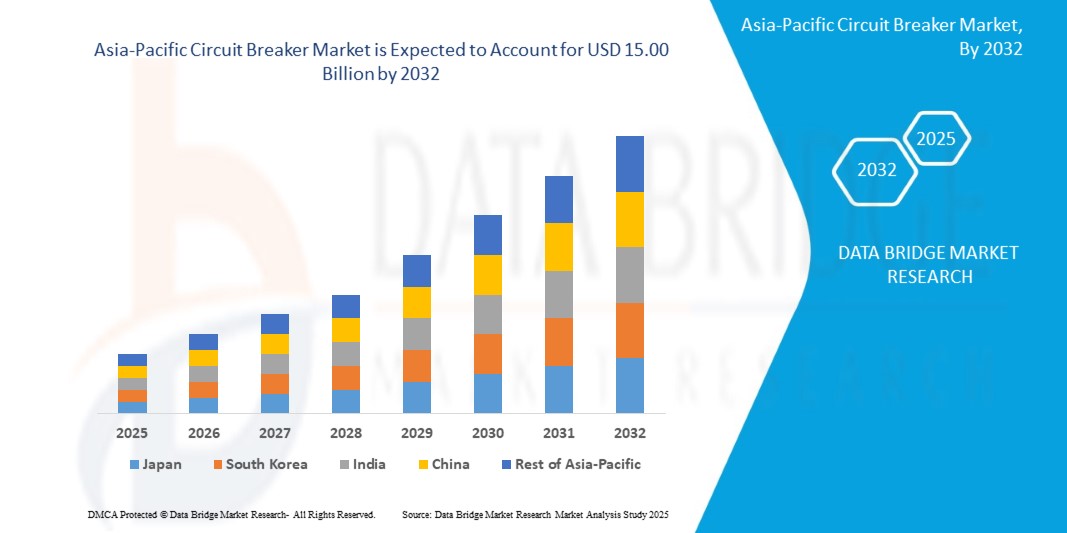
- The Asia-Pacific Circuit Breaker market size was valued at USD 8.78 billion in 2024 and is expected to reach USD 15.00 billion by 2032, at a CAGR of 10.4% during the forecast period
- The region's market growth is predominantly fueled by rapid urbanization, industrialization, and the ongoing electrification of residential and commercial infrastructures across emerging economies like China, India, and Southeast Asia. As governments invest heavily in expanding and upgrading power distribution networks, demand for low-voltage, medium-voltage, and high-voltage circuit breakers continues to surge.
- Moreover, the integration of renewable energy sources, including solar PV and onshore/offshore wind, necessitates advanced circuit protection systems to ensure grid stability and fault tolerance. For example, countries like China and India have set ambitious clean energy targets, creating a parallel demand for smart circuit breakers and intelligent switchgear systems.
Circuit Breaker Market Analysis
- Circuit Breakers are emerging as pivotal components in Asia-Pacific’s rapidly transforming electrical infrastructure, playing a crucial role in protecting systems from overcurrent, faults, and equipment failure across residential, industrial, and utility-scale applications. Their deployment is central to the region’s expanding focus on power reliability, safety, and smart energy distribution
- The demand for Circuit Breakers in Asia-Pacific is strongly propelled by the massive electrification of rural and urban areas, particularly in China, India, and Southeast Asia, alongside the region's increasing investment in renewable energy, industrial automation, and smart grid development
- China dominates the Asia-Pacific Circuit Breaker market with the largest revenue share in 2025, owing to large-scale investments in urban infrastructure, high-speed rail networks, renewable energy projects, and state-backed electrification initiatives. As the largest producer and consumer of electricity in the region, China’s need for both low- and high-voltage Circuit Breakers continues to rise, particularly with the expansion of solar and wind energy installations
- India is projected to be the fastest-growing country in the regional market, driven by government-led programs such as “Power for All,” “Smart Cities Mission,” and “Make in India,” which emphasize grid modernization, electrification of underserved areas, and the establishment of robust industrial zones. Rising industrial automation and growth in residential construction further amplify the demand for modern circuit protection solutions
- Additionally, countries like Japan and South Korea are focusing heavily on electrical safety, smart home technologies, and energy efficiency, spurring adoption of intelligent and IoT-enabled Circuit Breakers in both residential and commercial installations
- The Low Voltage segment is expected to dominate the Asia-Pacific market with a 45.0% share in 2025, supported by its extensive use in residential buildings, commercial complexes, and small-scale industrial facilities. This dominance is attributed to rapid urbanization and the rise in middle-income households investing in safer, automated electrical systems
Report Scope and Circuit Breaker Market Segmentation
|
Attributes |
Circuit Breaker Key Market Insights |
|
Segments Covered |
|
|
Countries Covered |
Asia Pacific
|
|
Key Market Players |
|
|
Market Opportunities |
|
|
Value Added Data Infosets |
In addition to the insights on market scenarios such as market value, growth rate, segmentation, geographical coverage, and major players, the market reports curated by the Data Bridge Market Research also include in-depth expert analysis, pricing analysis, brand share analysis, consumer survey, demography analysis, supply chain analysis, value chain analysis, raw material/consumables overview, vendor selection criteria, PESTLE Analysis, Porter Analysis, and regulatory framework. |
Circuit Breaker Market Trends
“Integration of AI-Driven Monitoring and Predictive Maintenance”
- A key trend driving the Asia-Pacific Circuit Breaker market is the increasing integration of AI and IoT technologies for predictive diagnostics and real-time monitoring, especially in industrial and utility-grade circuit protection systems. These innovations help anticipate faults, reduce downtime, and improve overall grid reliability.
- For instance, Siemens introduced its SIRIUS 3RV2 smart circuit breakers in India, equipped with communication-capable modules that enable real-time data logging, predictive maintenance, and condition-based monitoring—ideal for digitally transforming factories under India’s “Smart Manufacturing” initiative.
- In February 2024, Mitsubishi Electric launched its MelSmart circuit breaker series in Japan, featuring AI algorithms that analyze historical current data to predict equipment degradation—supporting proactive maintenance in high-demand environments like data centers and industrial parks.
- Moreover, Schneider Electric’s partnership with Chinese utility companies to roll out its EcoStruxure-enabled breakers highlights a growing trend toward smart energy management systems in China, with AI playing a central role in improving energy efficiency and grid resilience.
- The trend is further catalyzed by government-backed initiatives such as Japan’s Green Transformation (GX) policy and India’s National Smart Grid Mission, which emphasize AI-driven, reliable electrical infrastructure across sectors.
Circuit Breaker Market Dynamics
Driver
“Rapid Infrastructure Expansion and Industrial Electrification”
- The Asia-Pacific region is undergoing massive infrastructure development and industrial electrification, driving robust demand for circuit protection systems across manufacturing, construction, energy, and transportation sectors.
- According to a 2024 report by the International Energy Agency (IEA), Asia accounted for over 55% of global electricity demand growth, led by China, India, and Southeast Asia. Circuit Breakers are vital for securing these expanding grids.
- In March 2024, L&T Electrical & Automation secured a contract to supply smart LV and MV circuit breakers for 15 industrial zones in India as part of the “Make in India” push, aimed at boosting domestic production and industrial safety.
- Similarly, China’s State Grid Corporation is actively deploying smart switchgear and circuit breakers in ultra-high-voltage (UHV) transmission lines, reinforcing its efforts toward carbon neutrality by 2060.
- The ongoing development of EV charging infrastructure also contributes to demand. For example, Delta Electronics and TGOOD China expanded their offerings of circuit-protected EV fast chargers in 2024, targeting urban centers in Beijing, Tokyo, and New Delhi.
Restraint/Challenge
“High Costs of Smart Circuit Breakers and Technological Complexity”
- While adoption is accelerating, the high initial cost of intelligent and AI-integrated circuit breakers poses a barrier in price-sensitive markets such as India, Indonesia, and Vietnam. These markets often prefer basic or semi-automated models due to budget constraints.
- Additionally, the technological complexity involved in setting up and integrating smart circuit breakers into existing infrastructure requires skilled technicians—posing a challenge in rural and less-developed areas of the region.
- For example, ABB’s Tmax XT digital circuit breakers, launched across Southeast Asia in 2023, offer superior protection but require specialized training for configuration and maintenance—limiting uptake among small-scale contractors.
- In response, regional governments and OEMs are investing in upskilling initiatives. The Singapore Smart Industry Readiness Index (SIRI), for example, promotes training in smart energy infrastructure to support such advanced installations.
- Cost-effective models from companies like Havells India and LS Electric (South Korea) are gaining traction by offering modular circuit breakers with essential safety features and basic IoT integration—targeting the mass residential segment while reducing price sensitivity.
- Overcoming this restraint will depend on government subsidies, strategic pricing, local manufacturing incentives, and expanding consumer education about the long-term ROI and safety benefits of smart circuit breakers.
Circuit Breaker Market Scope
The market is segmented on the basis type, voltage, installation, end-user.
By Type
The Asia-Pacific Circuit Breaker market is segmented into Low Voltage Circuit Breaker (MCB, MCCB, ACB), Medium Voltage Circuit Breaker (Gas, Vacuum), and High Voltage Circuit Breaker (Gas, Oil, Hybrid).
- Low Voltage Circuit Breakers (MCB, MCCB, ACB) hold the largest revenue share in 2025, driven by mass deployment in residential buildings, commercial complexes, and small industries. These circuit breakers are crucial for protecting appliances, lighting systems, and HVAC units. With increased real estate activity and smart city developments across India, China, and Southeast Asia, the demand for MCBs and MCCBs has surged. In 2024, Legrand and Schneider Electric expanded their MCB production lines in India and Vietnam, reflecting regional demand.
- Medium Voltage Circuit Breakers (Gas, Vacuum) are witnessing the fastest growth rate, supported by rapid electrification and renewable energy integration. Vacuum circuit breakers are being adopted in substations and manufacturing units due to their eco-friendly operation and long lifecycle. For instance, in 2024, Eaton supplied vacuum circuit breakers for solar park installations in Indonesia, marking a shift toward sustainable medium-voltage systems.
- High Voltage Circuit Breakers (Gas, Oil, Hybrid) are critical in utility-scale transmission and power infrastructure. The growing focus on grid expansion and inter-country interconnections (like China-Myanmar and India-Bangladesh) is accelerating the adoption of gas and hybrid circuit breakers. In 2024, Siemens Energy commissioned multiple hybrid GIS breakers in high-altitude Chinese provinces, showcasing resilience in extreme environments.
By Voltage
The market is segmented into Less Than 500V, 500V–1kV, 1kV–15kV, 15kV–50kV, 50kV–150kV, and Above 150kV.
- Less Than 500V dominated in 2024 due to the high usage of low-voltage systems in household electrical circuits, retail spaces, and schools. Smart MCBs and MCCBs under this range are widely used in Japan’s smart home segment and in India’s housing schemes like PMAY (Pradhan Mantri Awas Yojana).
- The 500V–1kV and 1kV–15kV segments are expanding rapidly with increased deployment in commercial and small industrial applications such as hospitals, shopping centers, and factories. Countries like Thailand and Malaysia are adopting circuit breakers in this range as part of their industrial parks and digital manufacturing zones.
- 15kV–50kV and 50kV–150kV voltage levels are extensively used in renewable energy and grid modernization projects, especially in wind farms and solar utility plants. For example, South Korea’s Jeju Smart Grid Project utilizes circuit breakers in the 50kV range for managing bi-directional power flow.
- The Above 150kV segment supports ultra-high voltage (UHV) transmission across countries like China, which is pioneering UHV deployment for cross-provincial power delivery. In 2024, Hitachi Energy and State Grid Corporation of China collaborated on multiple 800kV gas-insulated circuit breaker installations.
By Installation
The market is segmented into Indoor and Outdoor.
- Indoor Circuit Breakers account for the larger market share in 2025, due to their application in residential buildings, data centers, and commercial offices. Rapid construction of urban infrastructure and the preference for compact, modular circuit breaker panels support growth. For example, ABB India announced the launch of a new series of indoor modular circuit breaker units tailored for smart buildings in early 2024.
- Outdoor Circuit Breakers are witnessing strong adoption in utilities, rural electrification, and renewable energy setups. Outdoor installations, especially of pole-mounted and hybrid systems, are critical for grid stability in extreme weather conditions. In 2024, Mitsubishi Electric supplied outdoor gas circuit breakers for utility projects in the Philippines and northern Australia.
By End-User
The market is segmented into Residential, Commercial, Industrial, Utilities, and Renewables.
- Residential remains the largest end-user segment in 2024, attributed to the rise in smart homes, electrification of urban housing, and home automation. The proliferation of government-subsidized housing in India, China, and Vietnam, along with IoT-enabled circuit breaker installations, is driving growth.
- Commercial applications are growing rapidly, supported by the construction of hotels, IT parks, and hospitals across urban Asia. Circuit breakers enable centralized energy control, overload protection, and remote diagnostics in these setups. For instance, in 2024, Panasonic deployed ACBs in a large commercial tech park project in Singapore to ensure uninterrupted operations.
- Industrial remains a core segment, driven by stringent electrical safety standards in factories, refineries, and process plants. In 2024, Fuji Electric deployed high-speed circuit breakers in semiconductor fabrication plants across Taiwan, emphasizing operational continuity and worker safety.
- Utilities form a substantial portion of demand, given large-scale projects for grid digitization, rural electrification, and power transmission. Government programs like Australia’s Rewiring the Nation plan and India’s RDSS are fostering utility-grade circuit breaker installations for load balancing and fault isolation.
- Renewables are emerging as a high-growth end-user segment, driven by the massive deployment of solar farms, wind turbines, and energy storage systems. In 2024, Toshiba Energy provided hybrid circuit breakers to manage energy fluctuations in a 200 MW solar farm in Western China.
By Application
On the basis of application, the Circuit Breaker market is segmented into commercial, residential, industrial, government institution, and others. The residential segment accounted for the largest market revenue share in 2024, driven by the increasing adoption of smart home ecosystems, rising awareness about home security, and the convenience of remote locking/unlocking. Real estate developments and the boom in short-term rentals also encourage adoption.
The commercial segment is expected to witness the fastest CAGR from 2025 to 2032, driven by the growing need for centralized security, employee access control, and audit trails. Businesses benefit from keyless solutions that can be managed remotely, offering flexibility for multiple users and locations.
Circuit Breaker Market Regional Analysis
- The Asia-Pacific Circuit Breaker market is expected to witness substantial growth throughout the forecast period, fueled by rapid urbanization, expanding infrastructure development, and growing investment in smart grid and renewable energy initiatives.
- Across countries such as China, India, Japan, and Australia, the increasing adoption of smart homes, EV charging infrastructure, and stringent electrical safety regulations are accelerating the demand for advanced Circuit Breaker solutions.
- The region is also witnessing a surge in retrofitting of aging electrical infrastructure, particularly in industrial zones and urban buildings, where circuit breakers are being integrated into energy-efficient and intelligent protection systems.
- Government-backed programs such as India’s Smart Cities Mission, China’s Belt and Road energy investments, and Australia’s Rewiring the Nation plan are reinforcing market expansion.
- Consumers and utilities in the region are increasingly opting for IoT-enabled, low-maintenance, and environmentally compliant circuit breakers, with growing demand for vacuum and hybrid technologies in renewable energy setups
China Circuit Breaker Market Insight
- The China Circuit Breaker market is leading the Asia-Pacific region in terms of volume and innovation, supported by:
- Massive investments in ultra-high-voltage (UHV) power transmission lines and smart grid deployments. In 2024, State Grid Corporation of China announced new UHV transmission corridors equipped with hybrid and gas circuit breakers to support western renewable generation and eastern consumption hubs.
- Expansion of EV infrastructure and battery manufacturing facilities is driving demand for low-voltage and medium-voltage circuit breakers in both public charging networks and industrial plants.
- China’s “Dual Carbon” targets and electrification policies are pushing the replacement of outdated switchgear with energy-efficient vacuum circuit breakers, particularly in industrial and municipal sectors.
- Growing demand from urban residential areas, especially in megacities like Shanghai and Shenzhen, is supporting the uptake of MCBs and MCCBs for smart energy management systems.
India Circuit Breaker Market Insight
- The India Circuit Breaker market is set to grow rapidly, driven by:
- Government-led rural electrification programs such as Saubhagya and grid modernization efforts under the RDSS (Revamped Distribution Sector Scheme). In 2024, Bharat Heavy Electricals Ltd. (BHEL) announced a supply contract for high-voltage circuit breakers in smart substation projects across Rajasthan and Maharashtra.
- Rising real estate and construction activity, along with a growing middle class, is fueling residential adoption of low-voltage circuit breakers for safety, load management, and device protection.
- Demand from the renewable energy sector, particularly solar and wind farms in states like Gujarat, Tamil Nadu, and Andhra Pradesh, is boosting medium and high-voltage circuit breaker installations.
- The growth of industrial automation and smart manufacturing under India’s “Make in India” initiative is pushing demand for robust protection systems in electrical networks and machinery.
Japan Circuit Breaker Market Insight
- The Japan Circuit Breaker market is mature and technologically advanced, with growth characterized by:
- An increasing focus on disaster-resilient smart grid systems, leading to deployment of vacuum and hybrid circuit breakers across earthquake-prone regions.
- Integration of IoT and AI-enabled breakers into home automation systems in urban apartments and aging population dwellings to ensure reliability and safety. In 2024, Panasonic and Omron introduced intelligent circuit breakers with predictive fault analytics for Tokyo’s smart housing market.
- Strong regulatory focus on energy efficiency and low carbon emissions, reinforcing demand for compact, low-loss circuit breaker solutions in both residential and commercial buildings.
- Japan’s leadership in EV and hydrogen mobility infrastructure is also creating new opportunities for customized circuit breakers designed for high-current and high-frequency switching environments.
Circuit Breaker Market Share
The Circuit Breaker industry is primarily led by well-established companies, including:
- ABB Ltd. (Switzerland)
- Schneider Electric SE (France)
- Mitsubishi Electric Corporation (Japan)
- Siemens AG (Germany)
- Eaton Corporation plc (Ireland)
- General Electric Company (U.S.)
- Toshiba International Corporation (Japan)
- CG Power and Industrial Solutions Ltd. (India)
- Larsen & Toubro Limited (India)
- Fuji Electric Co., Ltd. (Japan)
Latest Developments in Asia-Pacific Circuit Breaker Market
- In March 2024, Mitsubishi Electric Corporation introduced a new range of low-voltage circuit breakers under its "No-Fuse Breaker" series for the Asia-Pacific market. The updated series includes models with enhanced arc flash protection and real-time monitoring capabilities, targeting growing demand from industrial and commercial segments in Japan, India, and Southeast Asia.
- In February 2024, Schneider Electric India launched its SmartPanel 3.0 solution featuring IoT-enabled circuit breakers for industrial automation and smart manufacturing. The SmartPanel platform supports predictive maintenance, load optimization, and remote energy monitoring—aligning with India’s digitalization push under the Smart Manufacturing and Digital India initiatives.
- In January 2024, Fuji Electric Co., Ltd. unveiled its new series of vacuum circuit breakers designed for medium-voltage applications across renewable energy and utility sectors. The product was introduced in the ASEAN region, especially targeting grid modernization projects in Vietnam, Thailand, and the Philippines.
- In December 2023, LS Electric (South Korea) expanded its Susol ACB (Air Circuit Breaker) lineup to include models with enhanced AI-based protection and fault analysis. These breakers are being deployed in smart substations and green buildings across South Korea and Singapore, in response to increasing demand for sustainable and automated electrical protection systems.
- In November 2023, CHINT Electric, a key Chinese electrical equipment manufacturer, announced the deployment of smart molded case circuit breakers (MCCBs) integrated with NB-IoT modules in China’s residential and commercial real estate projects. The move aligns with the country’s New Infrastructure Plan, promoting digitized and energy-efficient construction.

- Interactive Data Analysis Dashboard
- Company Analysis Dashboard for high growth potential opportunities
- Research Analyst Access for customization & queries
- Competitor Analysis with Interactive dashboard
- Latest News, Updates & Trend analysis
- Harness the Power of Benchmark Analysis for Comprehensive Competitor Tracking
Asia Pacific Circuit Breaker Market, Supply Chain Analysis and Ecosystem Framework
To support market growth and help clients navigate the impact of geopolitical shifts, DBMR has integrated in-depth supply chain analysis into its Asia Pacific Circuit Breaker Market research reports. This addition empowers clients to respond effectively to global changes affecting their industries. The supply chain analysis section includes detailed insights such as Asia Pacific Circuit Breaker Market consumption and production by country, price trend analysis, the impact of tariffs and geopolitical developments, and import and export trends by country and HSN code. It also highlights major suppliers with data on production capacity and company profiles, as well as key importers and exporters. In addition to research, DBMR offers specialized supply chain consulting services backed by over a decade of experience, providing solutions like supplier discovery, supplier risk assessment, price trend analysis, impact evaluation of inflation and trade route changes, and comprehensive market trend analysis.
Data collection and base year analysis are done using data collection modules with large sample sizes. The stage includes obtaining market information or related data through various sources and strategies. It includes examining and planning all the data acquired from the past in advance. It likewise envelops the examination of information inconsistencies seen across different information sources. The market data is analysed and estimated using market statistical and coherent models. Also, market share analysis and key trend analysis are the major success factors in the market report. To know more, please request an analyst call or drop down your inquiry.
The key research methodology used by DBMR research team is data triangulation which involves data mining, analysis of the impact of data variables on the market and primary (industry expert) validation. Data models include Vendor Positioning Grid, Market Time Line Analysis, Market Overview and Guide, Company Positioning Grid, Patent Analysis, Pricing Analysis, Company Market Share Analysis, Standards of Measurement, Global versus Regional and Vendor Share Analysis. To know more about the research methodology, drop in an inquiry to speak to our industry experts.
Data Bridge Market Research is a leader in advanced formative research. We take pride in servicing our existing and new customers with data and analysis that match and suits their goal. The report can be customized to include price trend analysis of target brands understanding the market for additional countries (ask for the list of countries), clinical trial results data, literature review, refurbished market and product base analysis. Market analysis of target competitors can be analyzed from technology-based analysis to market portfolio strategies. We can add as many competitors that you require data about in the format and data style you are looking for. Our team of analysts can also provide you data in crude raw excel files pivot tables (Fact book) or can assist you in creating presentations from the data sets available in the report.













