


What is the Asia-Pacific Cold Plasma Market Size and Growth Rate ?
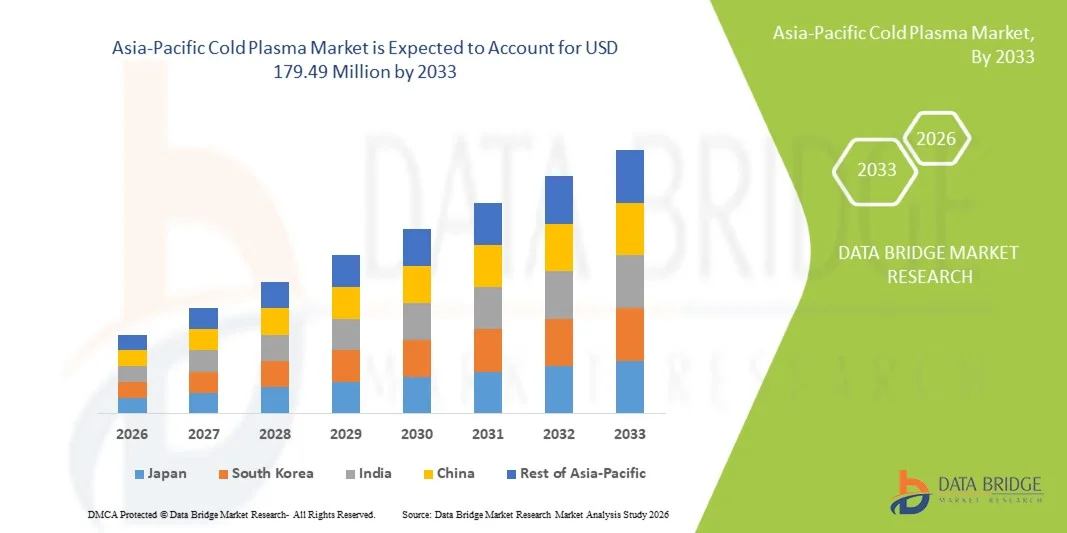
- As per Data Bridge Market Research Analysis the Asia-Pacific cold plasma market size was valued at USD 50.08 million in 2025 and is expected to reach USD 179.49 million by 2033, at a CAGR of 17.3% during the forecast period
- The market growth is largely fueled by rapid industrialization, increasing utilization of cold plasma across electronics, medical, textile, and polymer sectors, and rising adoption for surface treatment, sterilization, and advanced material processing applications in the region
- Furthermore, growing demand for clean, eco‑friendly processing technologies, significant investments in healthcare infrastructure, and increasing awareness of hygiene‑related and quality‑enhancing solutions are positioning cold plasma technologies as preferred solutions across industrial and clinical use cases, thereby accelerating market expansion in Asia‑Pacific
Market Size & Forecast
- Global Market Value (2025): USD 50.08 million
- Expected Market Value (2033): USD 179.49 million
- Forecast CAGR (2026–2033): 17.3%
What are the Major Takeaways of Asia-Pacific Cold Plasma Market ?
- Cold plasma technology, providing ionized gas treatments for surface modification, sterilization, and material processing, is increasingly recognized as a critical tool across industrial, medical, and electronics applications in Asia‑Pacific countries due to its non-thermal, eco-friendly, and efficient processing capabilities
- The rising adoption of cold plasma is primarily driven by increasing industrialization, growing demand for clean and sustainable processing technologies, expanding healthcare infrastructure, and heightened utilization in electronics, textile, polymer, and food processing sectors for surface treatment, sterilization, and quality enhancement applications
- China dominated the Asia‑Pacific cold plasma market in 2025, capturing the largest revenue share of 28.5%, due to its strong industrial base, substantial R&D investments, and growing applications in electronics, medical devices, and polymer manufacturing
- India is expected to be the fastest-growing country during the forecast period driven by rising industrial investments, growing awareness of hygiene and sterilization solutions, and adoption across textiles, food processing, and healthcare applications
- The Atmospheric Pressure segment dominated the Asia‑Pacific cold plasma market in 2025 with a market share of 46.7%, driven by its versatility, ease of integration into existing production lines, and suitability for direct treatment applications across textile, polymer, electronics, and food processing industries
Report Scope and Asia-Pacific Cold Plasma Market Segmentation
|
Attributes |
Asia-Pacific Cold Plasma Key Market Insights |
|
Segments Covered |
|
|
Countries Covered |
Asia-Pacific
|
|
Key Market Players |
|
|
Market Opportunities |
|
|
Value Added Data Infosets |
In addition to the insights on market scenarios such as market value, growth rate, segmentation, geographical coverage, and major players, the market reports curated by the Data Bridge Market Research also include in-depth expert analysis, patient epidemiology, pipeline analysis, pricing analysis, and regulatory framework |
What is the Key Trend in the Asia-Pacific Cold Plasma Market ?
“Expansion Through Industrial and Medical Integration”
- A significant and accelerating trend in the Asia‑Pacific cold plasma market is the increasing integration of cold plasma technology across industrial, medical, and food processing applications, enhancing efficiency, sustainability, and surface treatment capabilities
- For instance, atmospheric pressure cold plasma is being adopted in polymer manufacturing and electronics fabrication to improve surface adhesion, sterilization, and coating uniformity without damaging sensitive materials
- Cold plasma integration enables applications such as sterilizing medical instruments, modifying textile surfaces, and enhancing food safety, providing more effective and eco-friendly solutions than traditional thermal or chemical treatments
- The seamless adoption of cold plasma across multiple industries allows centralized process improvements, enabling manufacturers to integrate treatment systems into existing production lines, reducing processing time, and enhancing operational efficiency
- This trend towards versatile, non-thermal, and environmentally sustainable processing technologies is fundamentally reshaping industrial and medical treatment standards. Consequently, companies such as Diener Electronics and Tantec are developing plasma systems tailored for specific industrial and medical applications
- The demand for cold plasma solutions that offer efficient, scalable, and environmentally friendly processing is growing rapidly across both manufacturing and healthcare sectors, as organizations increasingly prioritize sustainability and precision in production and sterilization processes
- Additionally, the growing focus on research and development collaborations between technology providers and academic institutions is accelerating innovation in cold plasma applications, particularly in advanced healthcare sterilization and high-tech manufacturing
Asia-Pacific Cold Plasma Market Dynamics
Driver
“Growing Adoption Across Industries Due to Process Efficiency and Sustainability”
- The increasing utilization of cold plasma for surface treatment, sterilization, and material modification across industrial and medical sectors is a significant driver for the heightened market demand
- For instance, in March 2025, Tantec announced the launch of a new cold plasma system for electronics and polymer industries, highlighting enhanced energy efficiency and improved adhesion outcomes
- As companies seek sustainable and non-thermal alternatives to chemical treatments, cold plasma offers advanced features such as sterilization, surface activation, and improved material performance, providing a compelling upgrade over conventional processes
- Furthermore, rising investments in healthcare, food safety, and advanced manufacturing are making cold plasma an integral component of these operations, enabling seamless integration with existing production workflows
- The scalability of cold plasma systems, compatibility with diverse materials, and ability to deliver uniform treatment across complex surfaces are key factors propelling adoption in industrial, medical, and food processing sectors, while increased awareness of eco-friendly technologies further contributes to market growth
- For instance, in May 2025, Diener Electronics reported increased demand for their plasma treatment units in India’s polymer and textile sectors, indicating strong growth potential in emerging markets
- The expansion of government initiatives and incentives for sustainable manufacturing processes is also encouraging businesses to adopt cold plasma solutions as part of their environmental compliance strategies
- Additionally, rising collaborations between technology providers and end-users for custom plasma solutions are enabling industry-specific applications, further driving adoption and market penetration
Restraint/Challenge
“High Initial Cost and Technical Complexity”
- Concerns surrounding the relatively high initial investment required for cold plasma systems, as well as the technical complexity involved in operation, pose significant challenges to broader market penetration
- For instance, small and medium-sized manufacturers may be hesitant to adopt plasma treatment solutions due to the upfront cost and need for specialized training to operate the equipment effectively
- Addressing these barriers through modular system designs, training programs, and cost-effective solutions is crucial for expanding adoption. Companies such as Diener Electronics emphasize user-friendly systems and service support to reassure potential buyers
- Additionally, while atmospheric and low-pressure plasma systems offer versatility, the technical knowledge required for optimal parameter settings can be a barrier for new users, limiting uptake in developing markets
- Overcoming these challenges through affordable system options, standardized training, and increased awareness of operational efficiency benefits will be vital for sustained market growth in Asia‑Pacific
- For instance, in February 2025, Tantec highlighted the development of simplified cold plasma units with automated controls to reduce dependency on specialized operators
- The lack of standardization in cold plasma treatment protocols across different industries can also hinder adoption, as companies may be reluctant to invest without clear operational guidelines
- Furthermore, limited awareness of cold plasma benefits in smaller manufacturing and healthcare facilities can slow market penetration, making educational campaigns and demonstrations essential for wider adoption
How is the Asia-Pacific Cold Plasma Market Segmented ?
The market is segmented on the basis of regime type, technology, and industry.
- By Regime Type
On the basis of regime type, the cold plasma market is segmented into low pressure and atmospheric pressure. The Atmospheric Pressure segment dominated the market in 2025 with the largest revenue share of 46.7%, driven by its versatility and ease of integration into existing industrial and medical production lines. Atmospheric pressure plasma systems do not require vacuum chambers, reducing operational costs and simplifying installation in manufacturing, electronics, and medical facilities. These systems are widely adopted for surface treatment of polymers, sterilization of medical instruments, and improving food safety standards, particularly in countries such as China, India, and Japan. Additionally, atmospheric pressure plasma allows for direct treatment of large or complex-shaped surfaces, enhancing efficiency and scalability. Its compatibility with automated production lines and non-thermal operation makes it suitable for heat-sensitive materials, further solidifying its dominance in the Asia-Pacific region. Companies such as Diener Electronics and Tantec leverage atmospheric pressure plasma systems for industrial and healthcare applications, highlighting its broad applicability.
The Low Pressure segment is expected to witness the fastest growth during 2026–2033, fueled by increasing adoption in advanced electronics, semiconductor, and precision medical applications. Low pressure plasma offers better uniformity, control, and reproducibility of surface treatments, making it ideal for high-value products requiring stringent quality standards. Industries such as semiconductor fabrication, thin-film coatings, and specialized polymer processing benefit from the precise environment offered by low pressure systems. Furthermore, R&D investments and growing awareness of the benefits of controlled plasma regimes are accelerating adoption in countries like Japan, South Korea, and Australia. Emerging healthcare applications, including sterilization of delicate instruments and wound treatment, are also driving demand for low pressure systems.
- By Technology
On the basis of technology, the market is segmented into remote treatment, direct treatment, and electrode contact. The Direct Treatment segment dominated the market in 2025 with the largest revenue share of 44.3%, driven by its direct and effective interaction with surfaces requiring sterilization or surface modification. Direct treatment plasma systems are widely used in polymer, textile, and electronics applications, where precise and uniform modification is required. For instance, medical device manufacturers utilize direct plasma treatment to enhance surface wettability and sterilize instruments efficiently without heat damage. The technology is favored in high-volume production due to its scalability, compatibility with automated lines, and faster treatment times. Direct treatment also enables improved adhesion of coatings, inks, or adhesives in industrial applications. Asia-Pacific manufacturers, particularly in China and India, are increasingly adopting direct plasma technology to improve product quality and maintain competitiveness in global markets.
The Remote Treatment segment is anticipated to witness the fastest CAGR during 2026–2033, fueled by rising adoption in delicate or heat-sensitive applications. Remote plasma systems allow the active plasma species to interact with surfaces without direct contact, protecting sensitive electronics, medical devices, and thin polymers from damage. This technology is gaining traction in electronics and semiconductor industries in Japan, South Korea, and Taiwan, where precision and non-contact treatment are critical. Remote treatment also finds applications in wound healing, surface sterilization of medical instruments, and food safety. Its ability to deliver uniform treatment across complex surfaces without physical interaction makes it attractive for R&D and specialty industrial applications. Emerging awareness of remote plasma’s advantages in non-destructive treatment is accelerating adoption in Asia-Pacific manufacturing hubs.
- By Industry
On the basis of industry, the market is segmented into textile, polymer and plastic, electronics and semiconductor, food & agriculture, and medical. The Polymer and Plastic industry dominated the market in 2025 with the largest revenue share of 41.5%, driven by widespread use of plasma treatment for improving surface adhesion, coating, and sterilization. Cold plasma enhances wettability and bonding properties of plastics used in packaging, automotive components, and medical devices. The ability to treat heat-sensitive polymers without chemical agents or thermal damage makes plasma highly effective and environmentally friendly. Companies in China, India, and Japan are increasingly deploying plasma systems to meet global quality standards and environmental regulations. Plasma-treated polymers also benefit electronics and medical applications, improving performance and reliability of coated or bonded components. The high compatibility with automated production lines and diverse materials ensures that polymer and plastic applications remain a core segment of the cold plasma market.
The Medical industry segment is expected to witness the fastest growth during 2026–2033, fueled by increasing adoption of cold plasma for sterilization, wound healing, and surface treatment of medical devices. Hospitals, clinics, and medical device manufacturers in Japan, South Korea, and India are increasingly integrating plasma systems to maintain hygiene and comply with stringent safety standards. For instance, cold plasma treatment is used for sterilizing surgical instruments, catheters, and implantable devices without the use of harsh chemicals or high temperatures. The rising focus on patient safety, infection control, and eco-friendly sterilization technologies is driving growth in this segment. Additionally, research initiatives on plasma-based wound healing and antimicrobial treatments are accelerating adoption and technological advancements, making medical applications a key driver of future market growth.
Which Region Holds the Largest Share of the Asia-Pacific Cold Plasma Market ?
- China dominated the Asia‑Pacific cold plasma market in 2025, capturing the largest revenue share of 28.5%, due to its strong industrial base, substantial R&D investments, and growing applications in electronics, medical devices, and polymer manufacturing
- Organizations in China highly value the efficiency, eco-friendliness, and precision offered by cold plasma systems for surface treatment, sterilization, and material modification, making them preferred solutions across multiple industries
- This widespread adoption is further supported by significant R&D investments, government initiatives promoting sustainable manufacturing, and increasing awareness of advanced sterilization and quality-enhancing processes, establishing cold plasma as a key technology in industrial and healthcare operations across the country
The China Cold Plasma Market Insight
The China cold plasma market captured the largest revenue share of 28.5% in 2025, driven by rapid industrialization, strong manufacturing infrastructure, and widespread adoption across electronics, polymer, and medical industries. Companies and research institutions are increasingly integrating plasma systems for surface treatment, sterilization, and material modification. Government initiatives promoting sustainable and energy-efficient manufacturing further accelerate adoption. Moreover, rising R&D investments and industrial automation support large-scale deployment of cold plasma systems. China’s position as a manufacturing hub for high-tech components ensures both affordability and accessibility of plasma systems, expanding their usage across industrial and healthcare applications.
Japan Cold Plasma Market Insight
The Japan cold plasma market is gaining momentum due to the country’s focus on precision manufacturing, advanced electronics, and medical innovations. Japanese industries prioritize sterilization, surface modification, and eco-friendly processing solutions, driving the adoption of cold plasma. The integration of plasma systems with automated production lines and high-tech equipment enhances operational efficiency and product quality. Furthermore, research in medical and semiconductor applications is contributing to technology adoption. The Japanese market’s emphasis on quality, precision, and environmental compliance supports steady growth in both industrial and healthcare sectors.
India Cold Plasma Market Insight
The India cold plasma market accounted for a significant market revenue share in Asia‑Pacific in 2025, fueled by rapid urbanization, increasing industrial investments, and growing awareness of sustainable processing technologies. Cold plasma systems are being adopted across textiles, polymers, food processing, and medical applications. Government initiatives supporting smart manufacturing and eco-friendly technologies further propel market growth. Rising domestic manufacturing and affordable plasma solutions make the technology accessible to small and medium-sized enterprises. The expanding healthcare infrastructure and focus on sterilization in medical facilities are additional factors driving adoption in India.
South Korea Cold Plasma Market Insight
The South Korea cold plasma market is expected to expand at a considerable CAGR during the forecast period, driven by the country’s advanced electronics, semiconductor, and medical device industries. Plasma technology is extensively applied in precision surface treatment, sterilization, and polymer modification. South Korea’s emphasis on technological innovation and R&D supports rapid adoption of advanced plasma systems. Industrial automation and government initiatives promoting sustainable manufacturing further contribute to growth. The increasing integration of plasma systems in high-value applications ensures South Korea remains a key market within Asia‑Pacific.
Which are the Top Companies in Asia-Pacific Cold Plasma Market?
The Asia-Pacific Cold Plasma industry is primarily led by well-established companies, including:
- Nordson Corporation (U.S.)
- Cold Plasma Group Inc. (Canada)
- Adtec Plasma Technology Co., Ltd. (Japan)
- Surfx Technologies, LLC (U.S.)
- US Medical Innovations LLC (U.S.)
- Cold Plasma Technologies (U.S.)
- Apyx Medical Corp. (U.S.)
- Enercon Industries Corporation (U.S.)
- TRI‑STAR TECHNOLOGIES (U.S.)
- Plasmatreat USA, Inc. (U.S.)
- UNIQAIR Technologies Ltd. (Canada)
- AcXys Plasma Technologies (France)
- Europlasma NV (Belgium)
- Neoplas GmbH (Germany)
- Relyon Plasma GmbH (Germany)
- Tantec A/S (Denmark)
- SOFTAL Corona & Plasma GmbH (Germany)
- Coating Plasma Innovation (France)
- Ferrarini & Benelli Srl (Italy)
- Molecular Plasma Group (Luxembourg)
What are the Recent Developments in Asia-Pacific Cold Plasma Market ?
- In December 2025, the International Workshop on Cold Plasma and Pulse Power Technologies for Food, Health and Agriculture (COFHA‑2025) was inaugurated, bringing together researchers, industry experts, and stakeholders in the Asia‑Pacific region to discuss emerging cold plasma technologies and their cross‑sector applications
- In September 2025, a study published in Scientific Reports demonstrated that cold plasma treatment of rice seeds and Cold Plasma‑Activated Water (PAW) significantly reduced growth and development of the fall armyworm pest, suggesting novel sustainable pest management applications for cold plasma in agriculture
- In September 2025, the 9th Asia‑Pacific Conference on Plasma Physics in Fukuoka documented research showing that cold plasma seed treatment significantly enhanced rice germination and early growth under stress conditions. This research reflects rising scientific interest in using cold plasma for agricultural productivity improvements in Asia, indicating a transition from laboratory studies toward real applications in crop resilience
- In March 2024, Taiwan News reported on the expanding use of cold plasma across diverse industries in Asia‑Pacific, including wound healing, sterilization, textile processing, and polymer manufacturing. The article noted that cold plasma’s ability to inactivate multidrug‑resistant bacteria and viruses was driving interest in healthcare and industrial settings across countries like Taiwan, Japan, and South Korea, underscoring real adoption trends beyond just market projection
- In February 2024, Adtec Healthcare visited Taiwan to expand its SteriPlas cold plasma technology for sterilization applications, aiming to strengthen its presence in the Asian market and address the rising demand for advanced healthcare sterilization solutions. This initiative reflects Adtec’s strategic focus on improving sterilization standards using cold plasma technology in key Asia‑Pacific healthcare markets like Taiwan and neighboring regions

- Interactive Data Analysis Dashboard
- Company Analysis Dashboard for high growth potential opportunities
- Research Analyst Access for customization & queries
- Competitor Analysis with Interactive dashboard
- Latest News, Updates & Trend analysis
- Harness the Power of Benchmark Analysis for Comprehensive Competitor Tracking
Data collection and base year analysis are done using data collection modules with large sample sizes. The stage includes obtaining market information or related data through various sources and strategies. It includes examining and planning all the data acquired from the past in advance. It likewise envelops the examination of information inconsistencies seen across different information sources. The market data is analysed and estimated using market statistical and coherent models. Also, market share analysis and key trend analysis are the major success factors in the market report. To know more, please request an analyst call or drop down your inquiry.
The key research methodology used by DBMR research team is data triangulation which involves data mining, analysis of the impact of data variables on the market and primary (industry expert) validation. Data models include Vendor Positioning Grid, Market Time Line Analysis, Market Overview and Guide, Company Positioning Grid, Patent Analysis, Pricing Analysis, Company Market Share Analysis, Standards of Measurement, Global versus Regional and Vendor Share Analysis. To know more about the research methodology, drop in an inquiry to speak to our industry experts.
Data Bridge Market Research is a leader in advanced formative research. We take pride in servicing our existing and new customers with data and analysis that match and suits their goal. The report can be customized to include price trend analysis of target brands understanding the market for additional countries (ask for the list of countries), clinical trial results data, literature review, refurbished market and product base analysis. Market analysis of target competitors can be analyzed from technology-based analysis to market portfolio strategies. We can add as many competitors that you require data about in the format and data style you are looking for. Our team of analysts can also provide you data in crude raw excel files pivot tables (Fact book) or can assist you in creating presentations from the data sets available in the report.












