


Asia-Pacific Collaborative Robot Market Size
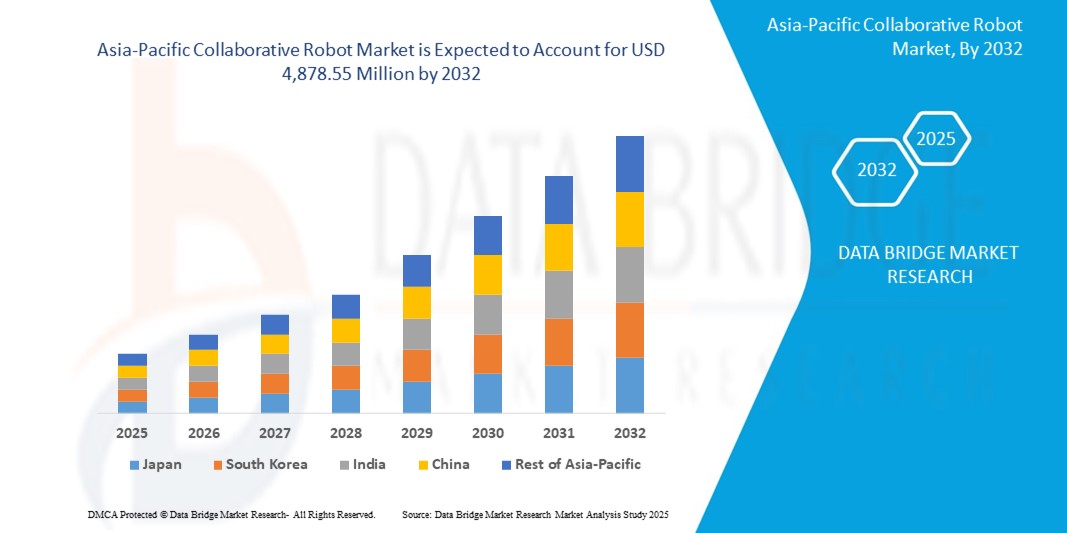
- The Asia-Pacific Collaborative Robot market size was valued at USD 504.32 Million in 2024 and is expected to reach USD 4,878.55 Million by 2032, at a CAGR of 32.80% during the forecast period
- The increased ease of programming of collaborative robots and rising investments for automation in the manufacturing processes across the globe emerge as the major factors driving market growth.
Asia-Pacific Collaborative Robot Market Analysis
- Collaborative robots (cobots) are designed to work alongside humans, equipped with advanced features like hand guiding, speed and separation monitoring, safety-rated monitored stop, and power and force limiting. They are utilized across industries such as manufacturing, logistics, and healthcare.
- Rising software advancements, higher return on investment (ROI), affordability of cobots, and their integration with Autonomous Mobile Robots (AMRs) and Automated Guided Vehicles (AGVs) are boosting market value.
- China dominates the Asia Pacific collaborative robot market with a revenue share of 38.75% in 2025, driven by its robust manufacturing sector, government initiatives for Industry 4.0, and high demand in electronics and automotive industries.
- India is expected to be the fastest-growing region during the forecast period, fueled by increasing industrialization, labor shortages, and government support for automation in manufacturing and logistics.
- The hardware segment is anticipated to hold the largest market share of 60.8% during the forecast period, driven by advancements in robotic arms, sensors, and grippers, which enhance precision and safety across industries.
Report Scope and Asia-Pacific Collaborative Robot Market Segmentation
|
Attributes |
Asia-Pacific Collaborative Robot Key Market Insights |
|
Segments Covered |
|
|
Countries Covered |
Asia Pacific:
|
|
Key Market Players |
|
|
Market Opportunities |
|
|
Value Added Data Infosets |
In addition to the insights on market scenarios such as market value, growth rate, segmentation, geographical coverage, and major players, the market reports curated by the Data Bridge Market Research also include import export analysis, production capacity overview, production consumption analysis, price trend analysis, climate change scenario, supply chain analysis, value chain analysis, raw material/consumables overview, vendor selection criteria, PESTLE Analysis, Porter Analysis, and regulatory framework. |
Asia-Pacific Collaborative Robot Market Trends
“Driving Automation and Efficiency in Manufacturing and Logistics”
- A key trend shaping the Asia-Pacific Collaborative Robot (robot) market is the increasing demand for automation solutions in manufacturing and logistics. Robot s are gaining traction in sectors such as automotive, electronics, and consumer goods, where they assist in tasks like assembly, welding, and packaging, improving operational efficiency and reducing labor costs.
- The integration of AI and machine learning in robot s is enhancing their capabilities, allowing them to perform more complex tasks with higher precision. This trend is fueling the adoption of collaborative robots in industries that require flexibility and adaptability in their production lines.
- The push for safer and more sustainable work environments is driving the demand for robot s. These robots work alongside human operators without the need for safety cages, fostering safer work environments while maintaining high productivity.
- Robots are becoming increasingly affordable due to advancements in technology and increased competition, making them more accessible to small and medium-sized enterprises (SMEs) across Asia-Pacific.
Asia-Pacific Collaborative Robot Market Dynamics
Driver
“Rising Demand for Automation and Flexible Manufacturing”
- The Asia Pacific region is experiencing a growing need for automation due to rising labor costs, shortages, and the push for Industry 4.0. Cobots provide cost-effective, flexible solutions to enhance productivity and maintain quality standards.
- Industry 4.0 initiatives, particularly in China and Japan, are accelerating cobot adoption through real-time data analytics and AI integration, optimizing production processes.
- Cobots are increasingly used in logistics and warehousing for tasks like picking, sorting, and palletizing, reducing labor dependency and improving operational efficiency.
Restraint/Challenge
“High Initial Investment and Integration Complexities”
- High upfront costs for purchasing and integrating cobots into existing systems pose challenges, particularly for SMEs in the Asia Pacific region.
- Retrofitting manufacturing processes to accommodate cobots requires technical expertise and custom solutions, increasing implementation costs and time.
- Ensuring seamless human-robot collaboration without disrupting workflows remains a challenge, necessitating training and process optimization.
Asia-Pacific Collaborative Robot Market Scope
The market is segmented on the component, solution, safety method, payload capacity, application, and end-user.
|
Segmentation |
Sub-Segmentation |
|
By Component |
|
|
By Solution |
|
|
By Safety Method |
|
|
By Payload Capacity |
|
|
By Application |
|
|
By End-User |
|
Asia-Pacific Collaborative Robot Market Scope
The market is segmented on the basis component, solution, safety method, payload capacity, application, end-user.
- By Component
On the basis of component, the Asia-Pacific collaborative robot market is segmented into hardware and software. The hardware segment dominates the largest market revenue share of 54.3% in 2025, driven by advancements in robotic arms, sensors, and end-effectors. Continuous improvements in precision, durability, and flexibility of these components enhance robot performance, enabling broader adoption across industries like manufacturing, logistics, and healthcare, thus boosting market growth.
The software segment is anticipated to witness the fastest growth rate of 22.6% from 2025 to 2032, the software component segment in the Asia-Pacific Collaborative Robot market is driven by advancements in AI, machine learning, and real-time data processing. These technologies enable robots to adapt to various tasks, improve operational efficiency, and enhance human-robot collaboration, making them more versatile and attractive for industries adopting automation.
- By Solution
On the basis of solution, the Asia-Pacific Collaborative Robot market is segmented into safety light curtain, safety laser scanner, camera-based 3D space monitoring system and safe gripping. The driven by stringent safety regulations and the increasing integration of automation across industries. These optical sensing devices create non-intrusive barriers, enhancing worker protection by detecting intrusions within hazardous zones and halting robotic operations to prevent accidents. Their adoption is particularly prominent in sectors like automotive manufacturing, where collaborative robots perform tasks such as assembly, welding, and material handling.
The safety laser scanner segment is expected to witness the fastest CAGR from 2025 to 2032, The automotive industry's emphasis on worker safety and compliance with safety standards has significantly contributed to the demand for safety laser scanners. Additionally, advancements in sensor technology and the development of AI-powered safety analytics have further incentivized their adoption, enabling improved protection and productivity for machine operators. As industries continue to embrace automation, the role of safety laser scanners in ensuring safe human-robot collaboration becomes increasingly vital, positioning them as a key driver in the expansion of the robot market in Asia-Pacific.
- By Safety Method
On the basis of safety method, the Asia-Pacific Collaborative Robot market is segmented speed and separation monitoring, power and force limiting, safety-rated monitored stop and hand guiding. The speed and separation monitoring held the largest market revenue share in 2025, The speed and separation monitoring (SSM) safety method is a key enabler of dynamic human-robot collaboration in Asia-Pacific’s robot market. By utilizing sensors such as safety laser scanners, SSM adjusts robot speed based on proximity to human operators, slowing down or stopping to maintain a safe distance. This proactive approach enhances productivity without compromising safety, making it ideal for flexible, high-speed applications in sectors like automotive and electronics assembly.
The power and force limiting segment held a significant market share in 2025. The power and force limiting (PFL) safety method is a pivotal enabler in Asia-Pacific's collaborative robot market. By restricting the force and torque exerted by robots during human-robot interactions, PFL ensures that any contact remains within safe thresholds, thereby preventing injuries. This approach aligns with ISO/TS 15066 standards, facilitating seamless integration of robots into shared workspaces without the need for physical barriers. The emphasis on human safety and compliance with stringent EU regulations has significantly accelerated the adoption of PFL-equipped robots across industries such as automotive, electronics, and logistics.
- By Payload Capacity
On the basis of payload capacity, the Asia-Pacific Collaborative Robot market is segmented into up to 5kg, 5Kg to 10Kg and above 15Kg. The up to 5kg segment accounted for the largest market revenue share in 2024 and it is expected to witness the fastest CAGR from 2025 to 2032. The up to 5kg payload capacity segment is a key driver in Asia-Pacific's collaborative robot market. These lightweight robots are ideal for precision tasks such as assembly, pick-and-place, and quality inspection, especially in electronics and small parts manufacturing. Their compact design allows easy integration into existing production lines, making them accessible for small and medium-sized enterprises (SMEs).
- By Application
On the basis of application, the Asia-Pacific Collaborative Robot market is segmented material handling, quality inspection, pick and place/drop, packaging and pelletizing, machine tending, molding operations, gluing and welding, test and inspection, assembly, polishing, lab analysis, entertainment and others. The material handling held the largest market revenue share in 2025, The material handling application segment in Asia-Pacific's collaborative robot market is driven by the need for automation in tasks like picking, sorting, and palletizing. Robot s enhance efficiency, reduce labor costs, and improve workplace safety, making them ideal for dynamic, high-demand environments like logistics and warehousing.
The quality inspection segment held a significant market share in 2025. The quality inspection application segment in Asia-Pacific's collaborative robot (robot) market is driven by advancements in AI and machine learning, enabling precise visual inspections. Robot s equipped with deep learning algorithms can detect defects with high accuracy and consistency, reducing human error. Their flexibility allows integration into dynamic production lines, enhancing efficiency and product quality across industries like automotive and electronics.
- By End-User
On the basis of end-user, the Asia-Pacific Collaborative Robot market is segmented into electrical and electronics, furniture and equipment, automotive, aerospace and defense, pharmaceuticals, plastics and polymers, metals and machining, food and beverages, cosmetics and others. The electrical and electronics segment accounted for the largest market revenue share in 2024 and it is expected to witness the fastest CAGR from 2025 to 2032. The electrical and electronics sector in Asia-Pacific is a significant driver of the collaborative robot market. Robot s enhance precision in tasks like PCB assembly, component insertion, and soldering, addressing challenges posed by miniaturization and component complexity. Their flexibility and adaptability make them ideal for dynamic production lines, ensuring consistent quality and efficiency. The increasing demand for electronic devices and the need for rapid innovation further propel the adoption of robot s in this industry. As a result, the electrical and electronics sector continues to be a key end-user segment in the Asia-Pacifican robot market.
China Collaborative Robot Market Insight
The China Collaborative Robot market captured the largest revenue share of 42.41% within Germany in 2025, Germany collaborative robot market is driven by its advanced manufacturing sector and strong focus on Industry 4.0 adoption. High demand for automation in automotive, electronics, and metal industries fuels robot deployment. Government support, skilled labor, and emphasis on productivity and safety further accelerate robot integration across German industrial operations.
India Asia-Pacific Collaborative Robot Market Insight
The India Collaborative Robot market is poised to grow at the fastest CAGR of over 22.9% in 2025, The automotive sector, in France, is leveraging robot s to enhance production efficiency and reduce costs. For instance, PSA Group has implemented collaborative robots from Universal Robots for vehicle assembly tasks such as screwdriving.
Asia-Pacific Collaborative Robot Market Share
The Asia-Pacific Collaborative Robot industry is primarily led by well-established companies, including:
- ABB
- Universal Robots
- Nachi Robotic Systems, Inc
- Rethink Robotics GmbH
- Shenzhen Han's Robot Co., Ltd
- FANUC Corporation
- Robert Bosch GmbH
- Kawasaki Heavy Industries, Ltd
- Precise Automation.
- MRK-Systeme Gmbh
- Energid Technologies Corporation
- F&P Robotics AG
- Productive Robotics, Inc.
- MABI ROBOTIC AG
- Quanta Computer Inc.
- Franka Emika GmbH
- AUBO (BEIJING) ROBOTICS TECHNOLOGY CO., LTD
- TECHMAN ROBOT INC
- Stäubli International AG
- YASKAWA ELECTRIC CORPORATION
- Comau
- Teradyne Inc.
- Kassow Robots ApS
- Vecna Technologies, Inc
Latest Developments in Asia-Pacific Collaborative Robot Market
- In August 2024 Conducted a survey revealing that over 50% of manufacturers in North America and Asia-Pacific are already utilizing AI and machine learning in their production processes. Additionally, 48% plan to further invest in these technologies by 2025, highlighting the growing importance of AI in manufacturing.
- October 24, 2024 Hosted the Partner Innovation Day in Allschwil, Switzerland, focusing on providing innovative solutions for small-batch production in the pharmaceutical industry. The event highlighted Stäubli's complete portfolio of hygienic SCARA and 6-axis industrial robots, mobile robot systems, and automated guided vehicles (AGVs).
- September 2023 ABB Entered a strategic partnership with a leading Asia-Pacifican university to foster innovative research in robotics and automation technologies, aiming to develop next-generation robotic solutions and enhance AI integration in industrial applications.
- April 2025, ABB announced plans to spin off its robotics division, the world's second-largest industrial robot manufacturer, aiming to list it as an independent entity by Q2 2026. This move is intended to sharpen focus and improve governance for both ABB and its robotics business

- Interactive Data Analysis Dashboard
- Company Analysis Dashboard for high growth potential opportunities
- Research Analyst Access for customization & queries
- Competitor Analysis with Interactive dashboard
- Latest News, Updates & Trend analysis
- Harness the Power of Benchmark Analysis for Comprehensive Competitor Tracking
Asia Pacific Collaborative Robot Market, Supply Chain Analysis and Ecosystem Framework
To support market growth and help clients navigate the impact of geopolitical shifts, DBMR has integrated in-depth supply chain analysis into its Asia Pacific Collaborative Robot Market research reports. This addition empowers clients to respond effectively to global changes affecting their industries. The supply chain analysis section includes detailed insights such as Asia Pacific Collaborative Robot Market consumption and production by country, price trend analysis, the impact of tariffs and geopolitical developments, and import and export trends by country and HSN code. It also highlights major suppliers with data on production capacity and company profiles, as well as key importers and exporters. In addition to research, DBMR offers specialized supply chain consulting services backed by over a decade of experience, providing solutions like supplier discovery, supplier risk assessment, price trend analysis, impact evaluation of inflation and trade route changes, and comprehensive market trend analysis.
Data collection and base year analysis are done using data collection modules with large sample sizes. The stage includes obtaining market information or related data through various sources and strategies. It includes examining and planning all the data acquired from the past in advance. It likewise envelops the examination of information inconsistencies seen across different information sources. The market data is analysed and estimated using market statistical and coherent models. Also, market share analysis and key trend analysis are the major success factors in the market report. To know more, please request an analyst call or drop down your inquiry.
The key research methodology used by DBMR research team is data triangulation which involves data mining, analysis of the impact of data variables on the market and primary (industry expert) validation. Data models include Vendor Positioning Grid, Market Time Line Analysis, Market Overview and Guide, Company Positioning Grid, Patent Analysis, Pricing Analysis, Company Market Share Analysis, Standards of Measurement, Global versus Regional and Vendor Share Analysis. To know more about the research methodology, drop in an inquiry to speak to our industry experts.
Data Bridge Market Research is a leader in advanced formative research. We take pride in servicing our existing and new customers with data and analysis that match and suits their goal. The report can be customized to include price trend analysis of target brands understanding the market for additional countries (ask for the list of countries), clinical trial results data, literature review, refurbished market and product base analysis. Market analysis of target competitors can be analyzed from technology-based analysis to market portfolio strategies. We can add as many competitors that you require data about in the format and data style you are looking for. Our team of analysts can also provide you data in crude raw excel files pivot tables (Fact book) or can assist you in creating presentations from the data sets available in the report.













