


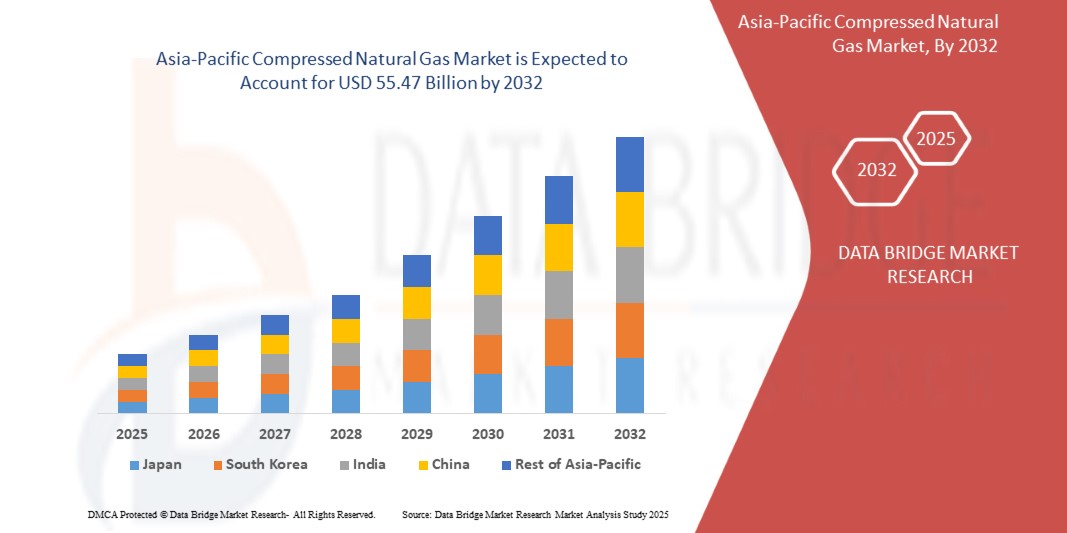
Asia-Pacific Compressed Natural Gas Market Size
- The Asia-Pacific compressed natural gas (CNG) market size was valued at USD 41.1 billion in 2024 and is projected to reach USD 55.47 billion by 2032, registering a CAGR of 3.8% during the forecast period
- The Market growth is largely fueled by rapid urbanization, increasing demand for clean transportation fuels, and government initiatives to reduce greenhouse gas emissions. Countries such as China, India, and Pakistan are leading in compressed natural gas adoption due to strong policy support and growing vehicle fleets
- Furthermore, rising cost of conventional fuels such as petrol and diesel has encouraged both individual consumers and fleet operators to shift toward compressed natural gas as a more economical and environmentally friendly alternative
- Collectively, these drivers are positioning compressed natural gas as a pivotal fuel in Asia-Pacific’s clean energy transition, particularly within the transport sector where demand for affordable and sustainable mobility solutions continues to rise
Asia-Pacific Compressed Natural Gas Market Analysis
- The Asia-Pacific compressed natural gas market is witnessing strong growth due to the region’s heavy reliance on road transportation, combined with government-backed clean fuel initiatives and financial incentives for consumers and manufacturers
- China and India collectively dominate the regional market, with large-scale investments in compressed natural gas distribution networks, vehicle conversion programs, and policies mandating clean fuel usage in public transport fleets
- The rising adoption of compressed natural gas -powered light motor vehicles (LMVs), such as passenger cars and three-wheelers, is a key growth driver, supported by affordability, lower running costs, and expanding availability of refueling stations
- India is the fastest-growing market, projected to grow at a compressed natural gas of 8.9% (2025–2032), supported by rapid fueling infrastructure expansion, subsidies for CNG vehicles, and increasing demand from passenger and commercial fleets
- China dominates the Asia-Pacific compressed natural gas market in 2024, valued at USD 13.6 billion, owing to its vast natural gas reserves, large-scale adoption in public transport, and government-backed emission reduction policies
- The non-associated gas segment dominated the market in 2024, holding the largest revenue share, supported by vast reserves in countries such as China, India, and Indonesia
Report Scope and Asia-Pacific Compressed Natural Gas Market Segmentation
|
Attributes |
Asia-Pacific Compressed Natural Gas Key Market Insights |
|
Segments Covered |
|
|
Countries Covered |
Asia-Pacific
|
|
Key Market Players |
|
|
Market Opportunities |
|
|
Value Added Data Infosets |
In addition to market value, growth rate, segmentation, regional coverage, and major players, the report includes in-depth expert analysis, pricing and cost analysis, consumer demand patterns, policy and regulatory framework, technology adoption trends, supply chain and value chain insights, and PESTLE & Porter’s Five Forces analysis. |
Asia-Pacific Compressed Natural Gas Market Trends
Rising Adoption of CNG Vehicles Driven by Clean Energy Initiatives
- A significant trend in the Asia-Pacific compressed natural gas market is the increasing adoption of compressed natural gas -powered vehicles, supported by government-led clean energy initiatives, stricter emission norms, and rising fuel cost advantages compared to gasoline and diesel
- For instance, India and China are expanding their compressed natural gas refueling station networks rapidly, with India’s GAIL and Indraprastha Gas Limited investing heavily in urban and highway corridors. Similarly, China’s CNPC and Sinopec are scaling up compressed natural gas infrastructure to align with carbon reduction targets
- Automakers are launching more compressed natural gas -compatible vehicles across light, medium, and heavy-duty categories to cater to growing demand, particularly in urban public transport fleets and commercial logistics sectors. Companies such as Maruti Suzuki in India and Hyundai in South Korea are strengthening their compressed natural gas vehicle portfolios
- Environmental benefits such as lower greenhouse gas emissions and reduced particulate matter are drawing significant support from regulatory authorities, making compressed natural gas a preferred transitional fuel in the Asia-Pacific region’s energy shift
- In addition, the affordability of compressed natural gas compared to conventional fuels is stimulating demand among cost-sensitive consumers and businesses. Subsidies, tax benefits, and incentives for fleet operators are further accelerating adoption
- The rising focus on sustainable transportation, supported by technological advancements in sequential compressed natural gas kits and high-capacity storage systems, is reshaping consumer preferences and promoting large-scale deployment across the region
Asia-Pacific Compressed Natural Gas Market Dynamics
Driver
Government Incentives and Infrastructure Expansion Fueling CNG Adoption
- The Asia-Pacific compressed natural gas market is significantly driven by strong government support in the form of subsidies, incentives, and favorable policies aimed at reducing dependency on conventional fossil fuels and lowering carbon emissions. Countries such as India, China, and Pakistan are heavily investing in compressed natural gas refueling infrastructure, making compressed natural gas more accessible to consumers and fleet operators
- For instance, India’s National Gas Grid expansion and city gas distribution (CGD) projects are promoting widespread adoption of compressed natural gas in both light and heavy vehicles. Similarly, China is prioritizing natural gas as part of its clean energy transition, supported by large-scale investments in pipelines and storage infrastructure
- The affordability of compressed natural gas compared to gasoline and diesel is another strong driver. With rising global crude oil prices, cost-sensitive consumers and commercial fleet operators are increasingly shifting toward compressed natural gas -powered vehicles to reduce operating costs
- Moreover, the lower carbon footprint of compressed natural gas is aligning with global and regional climate targets. Environmental benefits, including reduced greenhouse gas emissions and particulate matter, are boosting adoption in public transport, logistics, and private mobility
- Technological advancements in sequential compressed natural gas kits, composite cylinder storage, and dual-fuel systems are further enhancing performance and safety, increasing consumer confidence and adoption across the Asia-Pacific market
Restraint/Challenge
Infrastructure Gaps and High Initial Conversion Costs
- Despite strong growth prospects, the Asia-Pacific compressed natural gas market faces challenges due to inadequate infrastructure in several emerging economies. While major cities are witnessing a rapid expansion of compressed natural gas refueling stations, rural and semi-urban areas continue to experience limited accessibility, deterring widespread adoption
- For instance, high upfront conversion costs for retrofitting vehicles with compressed natural gas kits also act as a restraint, particularly in price-sensitive markets. For many consumers, the long-term savings in fuel costs are offset by the significant initial investment required for conversion.
- Safety concerns related to storage and handling of compressed natural gas cylinders remain a barrier in some regions. Although technological improvements have reduced risks, public perception and lack of awareness continue to influence consumer hesitation
- In addition, fluctuating natural gas prices and supply chain uncertainties can impact affordability and availability, limiting the market’s potential. Countries that depend heavily on imports for natural gas face volatility risks, which can hinder long-term adoption strategies
- Overcoming these challenges requires coordinated efforts from governments and industry stakeholders to expand infrastructure, provide subsidies for retrofitting, and invest in awareness campaigns that emphasize both cost savings and environmental benefits of compressed natural gas
Asia-Pacific Compressed Natural Gas Market Scope
The market is segmented on the basis of source, kits, distribution type, and end use.
• By Source
On the basis of source, the Asia-Pacific compressed natural gas market is segmented into associated gas, non-associated gas, and unconventional sources. The non-associated gas segment dominated the market in 2024, holding the largest revenue share, supported by vast reserves in countries such as China, India, and Indonesia. Abundant production, coupled with government policies to maximize the utilization of domestic reserves, has made non-associated gas the primary contributor to CNG supply in the region.
The unconventional sources segment is anticipated to witness the fastest growth from 2025 to 2032, fueled by increasing investments in shale gas and coal bed methane projects, particularly in China and Australia. Advancements in extraction technologies, along with growing demand for diversified natural gas sources, are accelerating the adoption of unconventional gas for CNG production
• By Kits
On the basis of kits, the Asia-Pacific compressed natural gas market is segmented into OEM-fitted kits and retrofitted kits. The OEM-fitted kits segment held the largest revenue share in 2024, driven by the rising adoption of factory-fitted CNG vehicles offered by leading automakers such as Maruti Suzuki, Hyundai, and Toyota. Growing consumer preference for reliable, warranty-covered solutions has strengthened the dominance of this segment.
The retrofitted kits segment is expected to witness the fastest CAGR from 2025 to 2032, supported by increasing affordability, large volumes of existing gasoline vehicles, and strong demand in developing countries such as India, Pakistan, and Bangladesh. Retrofitted kits are becoming a cost-effective solution for individual owners and fleet operators, particularly in markets with high fuel price volatility
• By Distribution Type
On the basis of distribution, the Asia-Pacific compressed natural gas market is segmented into pipeline distribution and cascades/truck delivery. The pipeline distribution segment dominated the market in 2024, accounting for the largest share due to robust investments in gas pipeline networks in China, India, and Australia. Pipeline connectivity ensures a reliable and cost-efficient supply for urban fueling stations, supporting large-scale adoption of CNG.
The cascades/truck delivery segment is projected to grow at the fastest rate from 2025 to 2032, driven by rising demand in remote and rural areas where pipeline infrastructure remains underdeveloped. Increasing deployment of mobile cascades and virtual pipelines is bridging infrastructure gaps, making compressed natural gas more accessible to underserved regions
• By End Use
On the basis of end-use, the Asia-Pacific compressed natural gas market is segmented into transportation, industrial, and power generation. The transportation segment dominated the market in 2024, holding more than 70% of the total market share, driven by large-scale adoption of compressed natural gas in passenger cars, taxis, buses, and logistics fleets. Strong government incentives, urban pollution reduction programs, and growing awareness of cost savings have reinforced transportation as the leading end-use sector.
The power generation segment is expected to witness the fastest CAGR from 2025 to 2032, especially in Pakistan and Bangladesh, where governments are actively promoting natural gas-based electricity generation. Rising demand for clean, reliable, and affordable power sources, coupled with efforts to reduce dependence on imported fuels, is accelerating the shift toward CNG in the power sector.
Asia-Pacific Compressed Natural Gas Market Regional Analysis
- Asia-Pacific dominated the global compressed natural gas market with the largest revenue share of over 55% in 2024, supported by high demand for alternative fuels in transportation and industrial applications, and strong government initiatives to reduce carbon emissions
- The region’s extensive natural gas reserves, rapid expansion of compressed natural gas fueling infrastructure, and large-scale adoption of compressed natural gas in public transport and logistics fleets are accelerating market penetration
- Increasing urbanization, cost-effectiveness of compressed natural gas compared to conventional fuels, and supportive policies such as subsidies and tax incentives are driving strong consumption across key economies including China, India, Pakistan, and Thailand
- Rising investments in bio- compressed natural gas and renewable natural gas projects, coupled with the presence of major industry players and rapidly growing vehicle fleets, further strengthen Asia-Pacific’s dominant position in the global compressed natural gas market
China Compressed Natural Gas Market Insight
China holds a significant share of USD 13.6 billion of the Asia-Pacific compressed natural gas market, driven by its strong focus on reducing carbon emissions and dependence on imported oil. The country’s large logistics and public transport sectors are at the forefront of compressed natural gas adoption, with buses, taxis, and trucks increasingly powered by natural gas. Regional governments are incentivizing fleet conversions, while domestic manufacturers are scaling up vehicle production and refueling infrastructure. Moreover, China’s investments in advanced compressed natural gas storage and distribution systems, coupled with its vast domestic natural gas resources, ensure consistent supply and competitive pricing.
India Compressed Natural Gas Market Insight
India is one of the largest and fastest-growing markets for compressed natural gas in Asia-Pacific with a CAGR of 8.9%. The government’s strong commitment to expanding clean mobility, including subsidies for compressed natural gas vehicles and the rapid rollout of compressed natural gas refueling corridors, is fueling market expansion. Rising urban air pollution levels and increasing fuel costs are also pushing both consumers and fleet operators toward affordable compressed natural gas alternatives. Domestic auto manufacturers such as Maruti Suzuki, Tata Motors, and Hyundai are expanding their factory-fitted compressed natural gas portfolios, making compressed natural gas adoption more mainstream. The Indian market benefits from ongoing pipeline infrastructure development and expanding partnerships between public and private players to meet growing demand.
Japan Compressed Natural Gas Market Insight
Japan’s compressed natural gas market, while smaller compared to India and China, is gradually growing due to the country’s emphasis on sustainability and reducing greenhouse gas emissions. The Japanese government is encouraging alternative fuel adoption alongside hydrogen and electric mobility. CNG adoption is particularly strong in specific commercial fleets, such as municipal transport and logistics. Advanced cylinder technology, safety features, and integration with smart refueling systems characterize the Japanese market, reflecting its innovation-driven approach.
South Korea Compressed Natural Gas Market Insight
South Korea has established itself as an active participant in the Asia-Pacific CNG market, particularly in the public transportation sector. The government has promoted the use of compressed natural gas buses and taxis to address urban air quality issues. Local manufacturers, including Hyundai and Kia, are expanding their compressed natural gas vehicle offerings, which is strengthening domestic adoption. South Korea also benefits from strong infrastructure readiness and consumer trust in clean mobility solutions.
Asia-Pacific Compressed Natural Gas Market Share
The Asia-Pacific compressed natural gas industry is primarily led by well-established companies, including:
- Indraprastha Gas Limited (India)
- GAIL (India) Limited (India)
- China National Petroleum Corporation (China)
- Sinopec (China)
- PTT Public Company Limited (Thailand)
- Tokyo Gas Co., Ltd. (Japan)
- SK E&S (South Korea)
- ENN Energy Holdings Limited (China)
- Petronas (Malaysia)
- Osaka Gas Co., Ltd. (Japan)
Latest Developments in Asia-Pacific Compressed Natural Gas Market
- In March 2024, Indraprastha Gas Limited (India) announced the expansion of over 150 new CNG filling stations across key Indian cities to meet surging demand from passenger and commercial vehicle segments. The initiative aligns with India’s target to increase CNG penetration nationwide.
- In January 2024, China National Petroleum Corporation (CNPC) upgraded its large-scale CNG refueling hub in Beijing to support heavy-duty vehicle fleets. This expansion is part of China’s broader energy diversification strategy and its commitment to reduce transport sector emissions.
- In December 2023, PT Pertamina (Indonesia) launched a public-private partnership aimed at rolling out advanced CNG storage and distribution facilities. This project is designed to increase adoption in logistics fleets while reducing dependence on imported fuels.
- In October 2023, Korea Gas Corporation (KOGAS) partnered with Hyundai Motor Group to enhance CNG infrastructure for public buses and municipal fleets. The collaboration focuses on deploying next-generation, safer composite cylinders and refueling systems.
- In September 2023, Tokyo Gas Co., Ltd. (Japan) introduced a pilot program for smart CNG refueling stations equipped with digital payment systems and real-time monitoring to enhance consumer convenience and safety.
- In August 2023, PTT Public Company Limited (Thailand) announced an investment in building new CNG retail stations in Bangkok and surrounding regions, targeting greater adoption in taxis and ride-sharing fleets.
- In July 2023, Philippine National Oil Company (PNOC) announced a strategic plan to establish CNG bus corridors in Metro Manila as part of its effort to address worsening urban air quality and rising diesel costs.

- Interactive Data Analysis Dashboard
- Company Analysis Dashboard for high growth potential opportunities
- Research Analyst Access for customization & queries
- Competitor Analysis with Interactive dashboard
- Latest News, Updates & Trend analysis
- Harness the Power of Benchmark Analysis for Comprehensive Competitor Tracking
Asia Pacific Compressed Natural Gas Cng Market, Supply Chain Analysis and Ecosystem Framework
To support market growth and help clients navigate the impact of geopolitical shifts, DBMR has integrated in-depth supply chain analysis into its Asia Pacific Compressed Natural Gas Cng Market research reports. This addition empowers clients to respond effectively to global changes affecting their industries. The supply chain analysis section includes detailed insights such as Asia Pacific Compressed Natural Gas Cng Market consumption and production by country, price trend analysis, the impact of tariffs and geopolitical developments, and import and export trends by country and HSN code. It also highlights major suppliers with data on production capacity and company profiles, as well as key importers and exporters. In addition to research, DBMR offers specialized supply chain consulting services backed by over a decade of experience, providing solutions like supplier discovery, supplier risk assessment, price trend analysis, impact evaluation of inflation and trade route changes, and comprehensive market trend analysis.
Data collection and base year analysis are done using data collection modules with large sample sizes. The stage includes obtaining market information or related data through various sources and strategies. It includes examining and planning all the data acquired from the past in advance. It likewise envelops the examination of information inconsistencies seen across different information sources. The market data is analysed and estimated using market statistical and coherent models. Also, market share analysis and key trend analysis are the major success factors in the market report. To know more, please request an analyst call or drop down your inquiry.
The key research methodology used by DBMR research team is data triangulation which involves data mining, analysis of the impact of data variables on the market and primary (industry expert) validation. Data models include Vendor Positioning Grid, Market Time Line Analysis, Market Overview and Guide, Company Positioning Grid, Patent Analysis, Pricing Analysis, Company Market Share Analysis, Standards of Measurement, Global versus Regional and Vendor Share Analysis. To know more about the research methodology, drop in an inquiry to speak to our industry experts.
Data Bridge Market Research is a leader in advanced formative research. We take pride in servicing our existing and new customers with data and analysis that match and suits their goal. The report can be customized to include price trend analysis of target brands understanding the market for additional countries (ask for the list of countries), clinical trial results data, literature review, refurbished market and product base analysis. Market analysis of target competitors can be analyzed from technology-based analysis to market portfolio strategies. We can add as many competitors that you require data about in the format and data style you are looking for. Our team of analysts can also provide you data in crude raw excel files pivot tables (Fact book) or can assist you in creating presentations from the data sets available in the report.













