


Asia-Pacific Critical Care Equipment Market Size
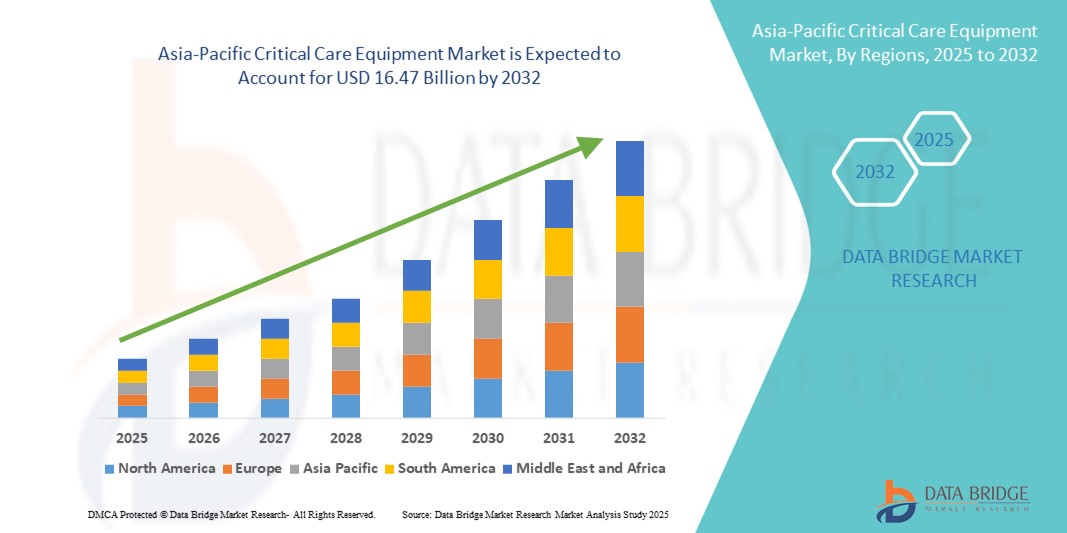
- The Asia-Pacific critical care equipment market size was valued at USD 7.91 billion in 2024 and is expected to reach USD 16.47 billion by 2032, at a CAGR of 9.6% during the forecast period
- The market growth is largely driven by the rising burden of chronic diseases, increasing frequency of critical illnesses, and expanding access to advanced healthcare facilities across Asia-Pacific, which are fueling the demand for critical care equipment. Rapidly developing economies such as China, India, and Indonesia are witnessing significant increases in intensive care unit (ICU) admissions due to aging populations, higher incidences of cardiovascular and respiratory conditions, and growing trauma cases, thereby boosting the adoption of advanced monitoring, ventilation, and life-support systems
- In addition, growing investments in hospital infrastructure, expansion of critical care services into rural and semi-urban regions, and government-led initiatives to strengthen emergency preparedness are enhancing the availability and accessibility of modern critical care technologies. The increasing presence of multinational medical device companies, coupled with local manufacturing and favorable regulatory reforms, is fostering innovation and competitive pricing in the Asia-Pacific critical care equipment market
Asia-Pacific Critical Care Equipment Market Analysis
- The Asia-Pacific critical care equipment market is experiencing robust growth, driven by increasing investments in healthcare infrastructure, rising prevalence of chronic diseases, and growing demand for advanced critical care devices across countries like China, India, Japan, South Korea, Australia, Thailand, Indonesia, and Vietnam
- Rising health awareness, expanding healthcare access, and urbanization are fueling demand for ventilators, infusion pumps, patient monitoring systems, and other critical care equipment
- China dominated the Asia-Pacific critical care equipment market, accounting for the largest revenue share of 43.7% in 2024, supported by rapid urbanization, a large patient population, strong domestic manufacturing capabilities, and extensive healthcare spending. The country’s expanding hospital infrastructure and government initiatives to improve critical care facilities further strengthen its market position
- India is projected to register the fastest CAGR of 12.8% in the Asia-Pacific critical care equipment market during the forecast period, driven by increasing government healthcare expenditure, rising incidence of chronic diseases, expanding private healthcare sector, and rapid adoption of technologically advanced critical care devices across urban and semi-urban areas
- The hospital segment dominated the Asia-Pacific critical care equipment market with a market share of 68.5% in 2024, driven by increasing investments in hospital infrastructure, rising number of critical care units, and the growing demand for state-of-the-art equipment to manage critically ill patients
Report Scope and Asia-Pacific Critical Care Equipment Market Segmentation
|
Attributes |
Asia-Pacific Critical Care Equipment Key Market Insights |
|
Segments Covered |
|
|
Countries Covered |
Asia-Pacific
|
|
Key Market Players |
|
|
Market Opportunities |
|
|
Value Added Data Infosets |
In addition to the insights on market scenarios such as market value, growth rate, segmentation, geographical coverage, and major players, the market reports curated by the Data Bridge Market Research also include in-depth expert analysis, pricing analysis, brand share analysis, consumer survey, demography analysis, supply chain analysis, value chain analysis, raw material/consumables overview, vendor selection criteria, PESTLE Analysis, Porter Analysis, and regulatory framework. |
Asia-Pacific Critical Care Equipment Market Trends
Advancements in Patient Monitoring and Tele-ICU Technologies
- A significant and accelerating trend in the Asia-Pacific critical care equipment market is the growing focus on advanced patient monitoring systems and tele-ICU technologies that enhance real-time critical care management. These innovations aim to improve patient outcomes by enabling continuous remote monitoring and timely clinical interventions
- Leading manufacturers across the region are partnering with healthcare providers and technology firms to develop integrated monitoring platforms featuring AI-driven analytics, wireless connectivity, and user-friendly interfaces. These solutions address the increasing demand for efficient ICU workflows and reduced clinician workload
- Expansion of telemedicine infrastructure in countries such as India, China, Japan, and Australia is further driving the adoption of remote critical care equipment, allowing specialist access in underserved and rural areas, thereby broadening the reach of high-quality intensive care
- Academic and research institutions in the region are actively involved in validating the effectiveness of novel monitoring devices and tele-ICU systems, contributing to clinical guidelines and technology refinement tailored to diverse patient populations
- As healthcare systems in Asia-Pacific continue to prioritize critical care capacity building and digital transformation, the market is poised for sustained growth—fueled by innovation in monitoring technology, increasing government support, and rising awareness of critical care best practices
Asia-Pacific Critical Care Equipment Market Dynamics
Driver
Growing Demand Due to Rising Health Awareness and Advancements in Critical Care
- The Asia-Pacific critical care equipment market is witnessing substantial growth driven by increasing consumer and healthcare provider focus on advanced medical technologies, improved patient outcomes, and expanding critical care infrastructure. Countries such as China, India, Japan, and Australia are experiencing rising demand for ventilators, infusion pumps, patient monitoring devices, and other life-support equipment, fueled by growing awareness of chronic diseases and critical care needs
- For instance, in April 2024, a leading Indian medical device manufacturer expanded its product portfolio by launching a new range of smart infusion pumps designed for enhanced accuracy and ease of use, targeting urban hospitals and critical care centers seeking advanced therapeutic solutions
- The surge in respiratory illnesses, cardiovascular diseases, and post-surgical care requirements has accelerated demand for sophisticated critical care equipment, especially among aging populations and patients with complex medical conditions in metropolitan hospitals
- Government-led initiatives aimed at upgrading healthcare infrastructure, coupled with increased funding for critical care units, are boosting market growth. Expansion of regulatory frameworks and certifications for medical devices across Asia-Pacific markets are encouraging manufacturers to innovate and improve device safety and efficacy
- The rapid growth of e-commerce and direct-to-hospital (DTH) procurement models is transforming market accessibility, enabling suppliers to reach both urban and semi-urban healthcare facilities with customizable, easy-to-order critical care equipment through platforms like Alibaba Health, IndiaMART, and other regional online marketplaces
Restraint/Challenge
Limited Access in Budget-Constrained and Remote Healthcare Regions
- The high acquisition and maintenance costs of advanced critical care equipment present significant barriers to adoption in price-sensitive segments and rural healthcare facilities, especially across Southeast Asia and South Asia
- Infrastructural challenges, such as inadequate hospital facilities and lack of trained healthcare professionals in non-urban regions, limit the effective utilization and deployment of critical care devices
- Fragmented distribution networks and logistical difficulties in delivering bulky and sensitive medical equipment to remote areas impact timely installations and servicing, constraining market penetration
- In addition, dependence on imports for key components in several countries increases production costs and limits the competitiveness of locally manufactured devices against international brands
- To overcome these challenges, market players are increasingly investing in localized manufacturing hubs, training programs for healthcare workers, awareness campaigns, and the development of cost-effective, scalable critical care solutions designed for emerging markets
Asia-Pacific Critical Care Equipment Market Scope
The market is segmented based on product type, patient population, end user, and distribution channel.
- By Product Type
On the basis of product type, the Asia-Pacific critical care equipment market is segmented into therapeutic devices, patient monitoring devices, diagnostic devices, ICU units & systems, and other devices. Therapeutic devices commanded the largest revenue share of 38.7% in 2024, driven by the increasing demand for advanced life-support and treatment technologies in hospitals and critical care settings throughout the region. These devices play a crucial role in managing severe health conditions, improving patient outcomes, and reducing mortality rates.
Concurrently, the patient monitoring devices segment is expected to witness the fastest CAGR of 9.4% from 2025 to 2032, propelled by the growing emphasis on continuous, remote, and real-time monitoring of patients, enabling healthcare providers to deliver timely and effective interventions in critical care environments.
- By Patient Population
On the basis of patient population, the Asia-Pacific critical care equipment market is segmented into neonatal, pediatric, adults, and geriatric. The adults segment held the dominant market position with a substantial revenue share of 52.3% in 2024, reflecting the widespread prevalence of chronic illnesses such as cardiovascular diseases, respiratory disorders, and diabetes that require intensive and continuous critical care among adult populations throughout the Asia-Pacific region. Moreover, increasing healthcare infrastructure and awareness have contributed to heightened demand for critical care equipment tailored for adult patients.
The geriatric segment is projected to record the fastest CAGR of 10.1% during the forecast period, driven by the rapid aging of the population in countries like Japan, China, and India. This demographic shift has led to a higher incidence of age-related health complications such as stroke, Alzheimer’s disease, and mobility impairments, which in turn fuels the need for specialized critical care solutions and technologies designed specifically to address the complex requirements of elderly patients.
- By End User
On the basis of end user, the Asia-Pacific critical care equipment market is segmented into hospitals, specialty clinics, ambulatory surgical centers, and others. Hospitals accounted for the largest share of 68.5% in 2024, supported by their comprehensive infrastructure, availability of specialized medical professionals, and capacity to manage high volumes of critically ill patients requiring sophisticated equipment and multi-disciplinary care. The extensive use of ICU units and therapeutic devices in hospital settings continues to drive this segment’s dominance. Meanwhile, Specialty Clinics and
Ambulatory Surgical Centers is expected to witness the fastest CAGR from 2025 to 2032. This is attributed to the expanding scope of specialized healthcare services such as cardiac rehabilitation, outpatient surgeries, and chronic disease management, which demand flexible, portable, and cost-effective critical care devices. Increasing investments in these outpatient settings, coupled with growing patient preference for shorter hospital stays and home-based care, are further propelling growth in this segment.
- By Distribution Channel
On the basis of distribution channel, the Asia-Pacific critical care equipment market is segmented into direct tenders, retail sales, third party distribution, and others. Direct tenders held a leading market share of 47.8% in 2024, primarily due to bulk procurement practices by government healthcare organizations and large private hospital chains aiming to equip their critical care units with the latest advanced technologies in a cost-effective manner. This channel benefits from formalized purchasing processes and long-term supplier agreements that ensure steady supply and maintenance services.
The retail sales segment is forecasted to register the fastest CAGR of 8.7% from 2025 to 2032, driven by rising demand from smaller hospitals, clinics, and emerging markets seeking easy and quick access to critical care equipment. Growth in retail sales is also supported by the increasing presence of online medical equipment distributors and e-commerce platforms, which offer a wide range of products with convenient ordering and delivery options, enabling healthcare providers in remote and underserved regions to acquire necessary critical care devices without delay.
Asia-Pacific Critical Care Equipment Market Regional Analysis
- Asia-Pacific dominated the global critical care equipment market, accounting for the largest revenue share of 44% in 2024. This strong regional position is primarily driven by the vast and growing population base, coupled with significant investments in expanding and upgrading healthcare infrastructure. In addition, rising demand for sophisticated critical care technologies across a wide range of healthcare facilities, including hospitals and specialty clinics, has propelled market growth
- The expansion of intensive care units (ICUs), increased healthcare spending by governments and private sectors, and initiatives aimed at improving critical care access in both urban and underserved rural areas have further reinforced the region’s dominance. Furthermore, the integration of innovative technologies such as tele-ICU and remote patient monitoring systems is enhancing patient outcomes and driving adoption rates across Southeast Asia
- The market’s robust growth is also underpinned by strong domestic manufacturing hubs in key countries such as China, India, and South Korea. These countries benefit from expanding distribution networks and rising acceptance of advanced critical care devices, contributing to the overall momentum in the Asia-Pacific region
China Asia-Pacific Critical Care Equipment Market Insight
The China critical care equipment market accounted for the largest share within the Asia-Pacific region at 43.7% in 2024. This leadership position stems from rapid urbanization, extensive government healthcare reforms, and a rising burden of chronic and acute illnesses that necessitate critical care interventions. The country’s domestic manufacturers are heavily investing in research and development to innovate and produce state-of-the-art critical care equipment, catering to the growing demand from both public hospitals and private healthcare providers. In addition, China’s expanding exports and strategic partnerships with international companies are solidifying its dominance in the regional market.
India Asia-Pacific Critical Care Equipment Market Insight
India critical care equipment market is expected to register the fastest CAGR of 12.8% from 2025 to 2032 in the Asia-Pacific Critical Care Equipment market. This rapid growth is driven by the country’s expanding healthcare infrastructure and rising awareness of critical care needs, especially in tier 2 and tier 3 cities. Government initiatives focusing on increasing ICU capacity, alongside growing participation from the private healthcare sector, are pivotal to this expansion. The accelerating adoption of advanced critical care technologies, combined with increasing medical tourism and investments in telemedicine services, further fuel India’s dynamic market growth.
Asia-Pacific Critical Care Equipment Market Share
The Asia-Pacific critical care equipment industry is primarily led by well-established companies, including:
- Koninklijke Philips N.V. (Netherlands)
- Abbott (U.S.)
- GE Company (U.S.)
- Baxter (U.S.)
- Medtronic (U.S.)
- Drägerwerk AG & Co. KGaA (Germany)
- Boston Scientific Corporation (U.S.)
- Fresenius Medical Care AG & Co. KGaA (Germany)
- Getinge AB (Sweden)
- NIHON KOHDEN CORPORATION (Japan)
- Shenzhen Mindray Bio-Medical Electronics Co., Ltd. (China)
- ICU Medical, Inc. (U.S.)
- Skanray Technologies Ltd. (India)
- Dixion distribution of medical devices GmbH (Germany)
- heyer medical AG (Germany)
- Compumedics Limited (Australia)
- SCHILLER (Switzerland)
- SS TECHNOMED (P) LTD. (India)
- STERIS (U.S.)
- Masimo (U.S.)
- Advin Health Care (India)
Latest Developments in Asia-Pacific Critical Care Equipment market
- In June 2024, Becton Dickinson (BD) agreed to acquire Edwards Lifesciences' Critical Care Product Group in an all-cash deal valued at USD 4.2 billion. This strategic acquisition adds advanced patient monitoring technologies—such as hemodynamic monitoring systems, AI-enabled clinical decision tools, and leading sensors—to BD’s smart connected care portfolio, reinforcing its position in intensive care unit and operating room environments
- In December 2024, Express Healthcare published a feature titled “Smart ICUs: Redefining Critical Care in India,” highlighting the transformative role of Smart Intensive Care Units (ICUs). These units integrate advanced technologies like AI-driven analytics, real-time monitoring, Internet of Medical Things (IoMT), and telemedicine-based virtual care teams. The Smart ICU model empowers clinicians to manage critical patients more efficiently—optimizing workflows, enhancing patient outcomes, and extending quality care to rural and under-resourced hospitals
- In September 2021, SensaCore announced the launch of ST-200 CC Blood Gas Analyzer-Ultra Smart, which is the highly advanced blood gas model of Sensacore, and it is a fully automated, microprocessor-controlled electrolyte system that uses current direct measurement with ION selective electrode (ISE), impedance (Hct), and amperometry (pO2) technology to make arterial blood gas analysis and electrolyte measurements.
- In August 2021, Dixion distribution of medical devices GMBH announced that they had successfully completed registration by the FDA. The first series of equipment, namely Operating Tables Surgery and Surgical Lights Convelar had received FDA certifications in addition to the already existing CE certification

- Interactive Data Analysis Dashboard
- Company Analysis Dashboard for high growth potential opportunities
- Research Analyst Access for customization & queries
- Competitor Analysis with Interactive dashboard
- Latest News, Updates & Trend analysis
- Harness the Power of Benchmark Analysis for Comprehensive Competitor Tracking
Data collection and base year analysis are done using data collection modules with large sample sizes. The stage includes obtaining market information or related data through various sources and strategies. It includes examining and planning all the data acquired from the past in advance. It likewise envelops the examination of information inconsistencies seen across different information sources. The market data is analysed and estimated using market statistical and coherent models. Also, market share analysis and key trend analysis are the major success factors in the market report. To know more, please request an analyst call or drop down your inquiry.
The key research methodology used by DBMR research team is data triangulation which involves data mining, analysis of the impact of data variables on the market and primary (industry expert) validation. Data models include Vendor Positioning Grid, Market Time Line Analysis, Market Overview and Guide, Company Positioning Grid, Patent Analysis, Pricing Analysis, Company Market Share Analysis, Standards of Measurement, Global versus Regional and Vendor Share Analysis. To know more about the research methodology, drop in an inquiry to speak to our industry experts.
Data Bridge Market Research is a leader in advanced formative research. We take pride in servicing our existing and new customers with data and analysis that match and suits their goal. The report can be customized to include price trend analysis of target brands understanding the market for additional countries (ask for the list of countries), clinical trial results data, literature review, refurbished market and product base analysis. Market analysis of target competitors can be analyzed from technology-based analysis to market portfolio strategies. We can add as many competitors that you require data about in the format and data style you are looking for. Our team of analysts can also provide you data in crude raw excel files pivot tables (Fact book) or can assist you in creating presentations from the data sets available in the report.













