What is the Asia-Pacific Dairy Herd Management Market Size and Growth Rate?
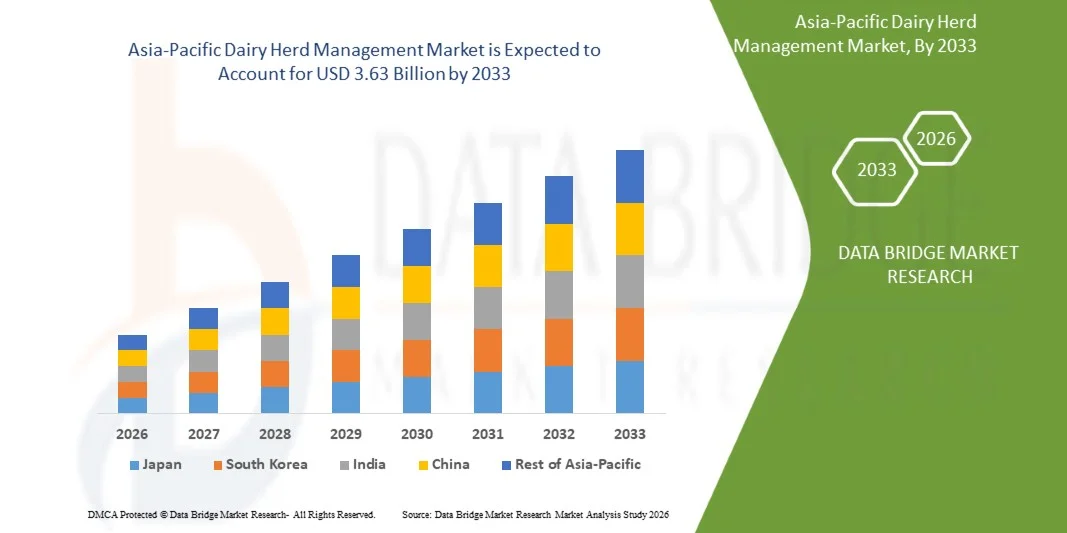
- As per Data Bridge Market Research Analysis the Asia-Pacific Dairy Herd Management Market size was valued at USD 1.82 Billion in 2025 and is expected to reach USD 3.63 Billion by 2033, at a CAGR of 9.4% during the forecast period
- The rising adoption of automation and IoT-enabled herd management systems is significantly improving productivity by enabling real-time monitoring of animal health, feeding, breeding, and milk yield, thereby driving demand across the region.
- The growing focus on animal health and welfare has elevated the importance of precision herd monitoring and data-driven interventions among dairy producers, further strengthening market reach.
Market Size & Forecast
- Asia-Pacific Market Value (2025): USD 1.82 Billion
- Expected Market Value (2033): USD 3.63 Billio
- Forecast CAGR (2026–2033): 9.4%
What are the Major Takeaways of Asia-Pacific Dairy Herd Management Market?
- The global Asia-Pacific Dairy Herd Management Market is witnessing strong momentum as dairy producers increasingly prioritize precision farming, animal welfare, and data-driven decision-making to enhance farm-level efficiency. Growth is primarily driven by rising global milk consumption, herd size expansion, labor shortages, and the need to improve reproductive performance and animal health outcomes.
- Dairy herd management solutions enable farmers to systematically track milk production, feeding behavior, activity levels, and health indicators, supporting proactive herd optimization rather than reactive farm management. Large commercial dairy farms, in particular, are accelerating adoption to ensure consistent output quality, cost control, and long-term operational sustainability.
- Rapid technological advancements in sensors, IoT-enabled devices, automation, artificial intelligence, and cloud-based analytics are reshaping dairy herd management practices. Innovations in real-time monitoring, predictive health analytics, automated milking systems, and integrated farm management platforms are improving accuracy, reliability, and scalability across diverse farming environments.
- Enhanced data integration allows dairy operators to gain actionable insights on fertility cycles, disease risks, feed efficiency, and milk yield trends, enabling timely interventions and reducing productivity losses. These advancements are expanding the application of herd management systems across both developed and emerging dairy markets.
- In 2026, the hardware segment dominates the market with a 52.18% share, driven by the widespread adoption of sensors, RFID tags, automated milking systems, and monitoring devices. Increasing demand for real-time tracking of animal health, milk yield, and reproductive performance has accelerated hardware deployment. Additionally, large-scale dairy farms are investing heavily in advanced on-farm infrastructure to enhance productivity and operational efficiency.
- The India Asia-Pacific Dairy Herd Management Market is poised to grow at the fastest CAGR of 10.0% during 2026 to 2033 and is expected to dominate with a 34.73% market share in 2026, driven by increasing adoption of advanced herd monitoring technologies, strong government support for precision livestock farming, rising investments in automation across dairy farms, and a growing focus on improving animal health, productivity, and operational efficiency.
Report Scope and Global Asia-Pacific Dairy Herd Management Market Segmentation
|
Attributes |
Asia-Pacific Dairy Herd Management Key Market Insights |
|
Segments Covered |
|
|
Countries Covered |
|
|
Key Market Players |
|
|
Market Opportunities |
|
|
Value Added Data Infosets |
|
What is the Key Trend in the Asia-Pacific Dairy Herd Management Market?
“Rising Adoption of Automation And IOT-Enabled Herd Management Systems Is Improving Productivity, Enabling Real-Time Monitoring of Animal Health, Feeding, Breeding and Milk Yield.”
- The global Asia-Pacific Dairy Herd Management Market is increasingly driven by automation and IoT-enabled systems, which enable real-time monitoring of animal health, feeding, reproduction, and milk yield, improving productivity, traceability, and animal welfare while reducing labor dependency.
- National policies, research institutions, and academic initiatives are promoting precision livestock farming through investments in AI, smart sensors, real-time monitoring, and robotics, reinforcing sustainable, efficient, and technology-driven dairy operations.
- Companies and farms are deploying automated milking systems, connected collars, ear/leg tags, and integrated platforms like GEA’s DairyNet to optimize herd management, predictive disease detection, and feeding schedules, resulting in enhanced productivity and operational efficiency.
- Initiatives such as India’s smart dairy monitoring systems, Punjab’s mobile milk testing vans, and global adoption of IoT-enabled analytics demonstrate real-world deployment of technology to modernize dairy farming, reduce disease risk, and boost milk yield.
Asia-Pacific Dairy Herd Management Market Dynamics
Driver
Growing Focus on Animal Health and Welfare Has Elevated The Importance Of Precision Herd Monitoring And Data-Driven Interventions Among Dairy Producers
- The growing emphasis on herd health and welfare has made precision monitoring and data-driven interventions critical for the global Asia-Pacific Dairy Herd Management Market, as healthier herds lead to improved productivity, sustainability, and product quality.
- IoT sensors, wearable devices, automated analytics, and machine-learning systems allow early disease detection, stress reduction, optimized feeding, and welfare-focused decision-making, aligning dairy operations with global standards and regulations.
- Examples include the EU ClearFarm project, FAO-Australian Government partnerships, vision-transformer multi-camera tracking systems, and IoT sensor networks for real-time welfare monitoring, demonstrating broad adoption of precision livestock farming.
- These technology-driven, welfare-oriented approaches enhance operational efficiency, reduce antibiotic use, support ethical production, and are expected to remain a key driver of growth in the Global Asia-Pacific Dairy Herd Management Market.
Restraint/Challenge
High Initial Cost of System Adoption and Investment in Automation and Software Solutions Can Limit Uptake, Particularly Among Small and Resource-Constrained Farms
- The substantial upfront cost of automation, precision feeding systems, herd monitoring sensors, and farm management software limits adoption, particularly among small and resource-constrained dairy farms.
- Expensive hardware, software licenses, infrastructure upgrades, and the need for skilled personnel make these technologies less accessible to smallholders, with ROI often taking multiple years to realize.
- Studies and reports highlight that smallholder farmers worldwide face prohibitive costs—such as USD 262,960 robotic milking systems in Korea—and limited access to credit or financing, restricting adoption of modern herd management technologies.
- Without targeted subsidies, financing mechanisms, or scalable technology solutions, smaller farms continue to rely on traditional methods, slowing the widespread uptake of precision and automated dairy herd management solutions globally.
How is the Asia-Pacific Dairy Herd Management Market Segmented?
The global Asia-Pacific Dairy Herd Management Market is segmented into six notable segments based on the product, farm size, herd size, farm type, interface and application.
By Product
On the basis of product, the market is segmented into hardware, software, and services. In 2026, the hardware segment is anticipated to dominate the Market due to its critical role in enabling automation, real-time data capture, and labor efficiency, along with increasing adoption of automated milking and monitoring equipment across large and commercial dairy farms.
The software segment in the market is expected to grow the fastest with CAGR of 9.8% from 2026 to 2033, driven by increasing adoption of cloud-based herd management platforms, advanced analytics, AI-driven decision-making tools, and real-time monitoring applications that help dairy producers optimize animal health, milk yield, breeding, and operational efficiency.
By Farm Size
On the basis of farm size, the market is segmented into large-scale dairy farms, medium-scale dairy farms, and small-scale dairy farms. In 2026 the large-scale dairy farms segment is expected to dominate the Global Asia-Pacific Dairy Herd Management Market, due to higher herd volumes, greater financial capability to invest in advanced herd management systems, and a stronger need for automation to manage operational complexity and labor constraints.
The large scale Dairy Farms segment in the market is expected to grow the fastest with CAGR of 9.7% from 2026 to 2033, driven by increasing investments in automation, IoT-enabled herd monitoring, precision feeding, and data-driven management systems that enhance productivity, operational efficiency, and herd health across high-volume dairy operations.
By Herd Size
On the basis of herd size, the market is segmented into below 100 animals, between 100 and 1,000 animals, and above 1,000 animals. In 2026, the above 1,000 animals segment is expected to hold the largest market share due to higher reliance on integrated herd management solutions to monitor productivity, health, and reproduction efficiently across very large herds, while minimizing operational risks and costs.
The between 100 and 1,000 animals herd size segment in market is expected to grow fastest with CAGR of 9.6% from 2026–2033 due to adoption of automated herd management technologies, improving productivity and animal health, and addressing labor shortages.
By Farm Type
On the basis of farm type, the market is segmented into conventional dairy farms, organic dairy farms, and robotic dairy farms. In 2026, the conventional dairy farms segment is expected to dominate due to its widespread global presence and gradual adoption of digital herd management tools, while robotic dairy farms are anticipated to witness faster growth driven by rising labor shortages, efficiency gains, and increasing investment in fully automated dairy operations.
The robotic dairy farms type segment in the Asia-Pacific Dairy Herd Management Market is expected to grow the fastest with CAGR of 10.0% from 2026 to 2033 due to increasing adoption of automated milking and robotics technologies to reduce labor dependency and operational costs, advancements in precision dairy automation (e.g., sensors, AI, IoT) that improve milk yield and herd health monitoring, and growing demand for efficiency, sustainability, and data‑driven herd management on modern dairy farms.
By Interface
On the basis of interface, the market is segmented into web-based platforms and app/software-based platforms. In 2026, the app/software-based segment is expected to dominate due to increasing smartphone penetration, real-time accessibility of herd data, ease of use for farm operators, and growing demand for on-the-go monitoring and decision-making.
The app/software based segment in the market is expected to grow the fastest with CAGR of 9.6% from 2026 to 2033 due to increasing demand for cloud‑based, data‑driven herd management tools that enable real‑time monitoring and remote decision‑making, advancements in AI and predictive analytics for productivity and animal health optimization, and greater adoption of digital platforms that improve operational efficiency, traceability, and sustainability across dairy farms.
By Application
On the basis of application, the market is segmented into preventative care, comfort and heat stress management, calf management, health management, feeding management, heat detection, milk quality management, milk harvesting, breeding management, and others. In 2026, the health management segment is expected to dominate due to increasing focus on early disease detection, reduction of mortality and treatment costs, improvement in animal welfare, and the direct impact of herd health on milk yield and farm profitability.
The heat detection segment in the market is expected to grow the fastest with CAGR of 10.1% from 2026 to 2033 due to rising adoption of advanced sensor‑based and automated heat detection technologies that improve reproductive efficiency and conception rates, increasing emphasis on optimizing breeding cycles to boost milk yield and reduce economic losses from missed estrus, and greater use of real‑time data analytics and wearable monitoring systems on dairy farms.
Asia-Pacific Dairy Herd Management Market Country-wise Analysis
- The India dominated the Asia-Pacific Dairy Herd Management Market with a 34.73% revenue share in 2026, driven by high adoption of advanced herd management technologies, large-scale dairy farming, strong focus on automation and precision farming, and well-established dairy infrastructure, along with government support and increasing demand for efficient, sustainable milk production.
- The adoption of convenient, lightweight, and durable Dairy Herd Management solutions is being driven by dairy farmers’ need for easy-to-use, portable technologies that simplify herd monitoring, reduce labor, and improve productivity, while ensuring long-term reliability and efficiency in daily farm operations.
India Asia-Pacific Dairy Herd Management Market Insight
India Asia-Pacific Dairy Herd Management Market is the fastest-growing in Asia-Pacific over the forecast period, driven by increasing adoption of digital and automated herd management solutions, rising focus on improving milk yield and animal health, and growing investments in modern dairy farm technologies, along with government initiatives supporting sustainable and efficient dairy farming practices.
China Asia-Pacific Dairy Herd Management Market Insight
The China Asia-Pacific Dairy Herd Management Market is expected to register steady growth over the forecast period due to gradual adoption of herd management technologies, increasing awareness of dairy farm efficiency, and growing demand for milk and dairy products, supported by small- and medium-sized farms investing in automation and monitoring solutions to improve productivity and herd health.
The Major Market Leaders Operating in the Market Are:
- GEA Group Aktiengesellschaft (Germany)
- Afimilk Ltd. (Israel)
- Merck & Co., Inc. (U.S.)
- Alta Genetics Inc. (Canada)
- BouMatic (U.S.)
- Cowmanager (Netherlands)
- Dairymaster (Ireland)
- Datamars (Switzerland)
- DeLaval (Sweden)
- Delmer Group (U.K.)
- Fullwood JOZ (Netherlands)
- Herdlync (Ireland)
- Herdwatch (Ireland)
- BoviSync LLC (U.S.)
- Hokofarm Group (Denmark)
- Lely (Netherlands)
- Madero Dairy Systems, Inc. (U.S.)
- Milkline (Italy)
- Pru Apps Pvt. Ltd. (India)
- miRobot (Netherlands)
- FarmLogics (U.S.)
- Nedap N.V. (Netherlands)
- Orchid Farmtech (India)
- Pearson Milking Technology’s (U.S.)
- SUM-IT (Netherlands)
- Triolet (Netherlands)
- Vansun Technologies Private Limited (India)
- Dairykhata (India)
- Milkrite | InterPuls (U.K.)
- Censortec (Denmark)
- AgriWebb (Australia)
- FarmLog, Inc. (U.S.)
- SEMEX (Canada)
- Uniform-Agri (Netherlands)
- Vansun Milking (India)
What are Latest Developments in Asia-Pacific Dairy Herd Management Market?
- In July 2025, Merck agreed to acquire Verona Pharma plc for approximately USD 10 Billion, adding its COPD therapy Ohtuvayre to Merck’s cardio‑pulmonary portfolio and expanding its respiratory treatment capabilities
- In July 2025, GEA entered into a strategic collaboration with Baladna Food Industries and the Algerian government to engineer and supply the world’s largest integrated dairy farm and milk powder production facility, strengthening its global position in dairy processing and farm technologies.
- In April 2025, DeLaval launched the BioSensors Milk Cell Analysis (MCA) sensor, an advanced device that integrates with DeLaval robotic milking systems to provide real‑time somatic cell monitoring for early detection of mastitis, improving udder health management and overall herd productivity.
- In January 2021, Namyaa now offers combined “Period Care Kits” that bundle their reusable menstrual cup with complementary products such as a cleansing wash and post-period care items — offering a more holistic period-care solution than just a standalone cup.
- In June 2024, Afimilk highlighted its Afi.Cloud platform, offering cloud‑based tools for remote dashboards (Today), advanced analytics (Cockpit), and automatic cloud backups of AfiFarm data to support disaster recovery and remote decision-making.

- Interactive Data Analysis Dashboard
- Company Analysis Dashboard for high growth potential opportunities
- Research Analyst Access for customization & queries
- Competitor Analysis with Interactive dashboard
- Latest News, Updates & Trend analysis
- Harness the Power of Benchmark Analysis for Comprehensive Competitor Tracking
Table of Content
1 INTRODUCTION
1.1 OBJECTIVES OF THE STUDY
1.2 MARKET DEFINITION
1.3 OVERVIEW OF ASIA-PACIFIC DAIRY HERD MANAGEMENT MARKET
1.4 CURRENCY AND PRICING
1.5 LIMITATIONS
1.6 MARKETS COVERED
2 MARKET SEGMENTATION
2.1 MARKETS COVERED
2.2 GEOGRAPHICAL SCOPE
2.3 YEARS CONSIDERED FOR THE STUDY
2.4 DBMR TRIPOD DATA VALIDATION MODEL
2.5 PRIMARY INTERVIEWS WITH KEY OPINION LEADERS
2.6 DBMR MARKET POSITION GRID
2.7 VENDOR SHARE ANALYSIS
2.8 MULTIVARIATE MODELING
2.9 PRODUCT TIMELINE CURVE
2.1 MARKET APPLICATION COVERAGE GRID
2.11 SECONDARY SOURCES
2.12 ASSUMPTIONS
3 EXECUTIVE SUMMARY
4 PREMIUM INSIGHTS
4.1 PORTERS FIVE FORCES ANALYSIS
4.2 COW POPULATION AND NUMBER OF FARMS
4.2.1 COW POPULATION
4.2.2 NUMBER OF FARMS
4.3 ANIMAL EXPENDITURE & SPENDING ANALYSIS
4.3.1 ANIMAL HEALTH SPENDING/COW
4.3.2 ANIMAL NUTRITION SPENDING/COW
4.3.3 FEED ADDITIVES SPENDING/COW
4.4 INNOVATION TRACKER AND STRATEGIC ANALYSIS
4.4.1 MAJOR DEALS AND STRATEGIC ALLIANCES ANALYSIS
4.4.2 PRODUCTS IN DEVELOPMENT
4.4.3 STAGE OF DEVELOPMENT
4.4.4 TIMELINES AND MILESTONES
4.4.4.1 EARLY FOUNDATIONS (LATE 19TH–EARLY 20TH CENTURY)
4.4.4.2 MID-CENTURY GROWTH OF HERD PERFORMANCE SYSTEMS (1950S–1970S)
4.4.4.3 ASIA-PACIFIC ORGANIZATIONAL AND COOPERATIVE DEVELOPMENT (1970S–1990S)
4.4.4.4 DIGITAL TRANSITION & PRECISION HERD MONITORING (2000S–2010S)
4.4.4.5 RECENT MILESTONES (DECADE OF 2020)
4.4.5 INNOVATION STRATEGIES AND METHODOLOGIES
4.4.5.1 RISK ASSESSMENT AND MITIGATION
4.4.5.2 HEALTH & DISEASE RISKS
4.4.5.3 REPRODUCTIVE & GENETIC RISKS
4.4.5.4 FEED & NUTRITION RISKS
4.4.5.5 ENVIRONMENTAL & CLIMATE RISKS
4.4.5.6 OPERATIONAL & TECHNOLOGY RISKS
4.4.5.7 FINANCIAL & MARKET RISKS
4.4.5.8 REGULATORY & COMPLIANCE RISKS
4.4.5.9 FUTURE OUTLOOK
4.5 PRICING ANALYSIS
4.6 INDUSTRY ECOSYSTEM ANALYSIS
4.6.1 PROMINENT COMPANIES
4.6.2 SMALL & MEDIUM SIZE COMPANIES
4.6.3 END USERS
4.7 TAM, SAM, SOM FRAMEWORK
4.7.1 TOTAL ADDRESSABLE MARKET (TAM)
4.7.2 SERVICEABLE AVAILABLE MARKET (SAM)
4.7.3 SERVICEABLE OBTAINABLE MARKET (SOM)
4.8 TECHNOLOGICAL ADVANCEMENTS
4.8.1 SENSOR BASED MONITORING AND AI INTEGRATION
4.8.2 COMPUTER VISION AND MULTI CAMERA MONITORING SYSTEMS
4.8.3 AI FOR DISEASE DETECTION AND PREDICTIVE ALERTS
4.8.4 EARLY WARNING SYSTEMS AND REAL TIME DISEASE DETECTION
4.8.5 ROBOTICS AND AUTONOMOUS SYSTEMS IN LIVESTOCK MANAGEMENT
4.8.6 INTEGRATION OF CLOUD COMPUTING AND DATA ECOSYSTEMS
4.8.7 WEARABLES AND PRECISION LIVESTOCK TAGS
4.8.8 ROBOTICS AND SMART FEEDING SYSTEMS
4.8.9 STANDARDIZATION AND MARKET MOMENTUM
4.8.10 CONCLUSION
4.9 VALUE CHAIN ANALYSIS
4.9.1 RAW MATERIALS & COMPONENTS
4.9.2 TECHNOLOGY DEVELOPMENT, R&D & SYSTEM MANUFACTURING
4.9.3 DATA PROCESSING, SOFTWARE UPDATES & MAINTENANCE
4.9.4 PACKAGING & REGULATORY COMPLIANCE
4.9.5 DISTRIBUTION, IMPLEMENTATION & SUPPORT
4.9.6 CONCLUSION
5 MARKET OVERVIEW
5.1 DRIVERS
5.1.1 RISING ADOPTION OF AUTOMATION AND IOT-ENABLED HERD MANAGEMENT SYSTEMS IS IMPROVING PRODUCTIVITY, ENABLING REAL-TIME MONITORING OF ANIMAL HEALTH, FEEDING, BREEDING AND MILK YIELD.
5.1.2 GROWING FOCUS ON ANIMAL HEALTH AND WELFARE HAS ELEVATED THE IMPORTANCE OF PRECISION HERD MONITORING AND DATA-DRIVEN INTERVENTIONS AMONG DAIRY PRODUCERS.
5.1.3 INCREASING LABOR COST PRESSURES IN DAIRY FARMING HAVE ACCELERATED THE SHIFT TOWARD AUTOMATED HERD MANAGEMENT TECHNOLOGIES
5.1.4 RISING ASIA-PACIFIC DEMAND FOR MILK AND DAIRY PRODUCTS HAS BEEN CITED AS A PRIMARY FACTOR INCREASING THE ADOPTION OF DAIRY HERD MANAGEMENT SOLUTIONS
5.2 RESTRAINTS
5.2.1 HIGH INITIAL COST OF SYSTEM ADOPTION AND INVESTMENT IN AUTOMATION AND SOFTWARE SOLUTIONS CAN LIMIT UPTAKE, PARTICULARLY AMONG SMALL AND RESOURCE-CONSTRAINED FARMS
5.2.2 RESISTANCE TO CHANGE FROM TRADITIONAL MANUAL HERD-MANAGEMENT PRACTICES REMAINS A BARRIER TO WIDESPREAD ADOPTION AMONG OLDER OR CONSERVATIVE FARMING SEGMENTS.
5.3 OPPORTUNITIES
5.3.1 RAPID DIGITALIZATION OF AGRICULTURE, INCLUDING BROADBAND RURAL CONNECTIVITY AND AFFORDABLE IOT SOLUTIONS, WILL SUPPORT BROADER PENETRATION OF HERD MANAGEMENT SYSTEMS IN UNDERSERVED REGIONS
5.3.2 EXPANSION OF CLOUD-BASED ANALYTICS AND ARTIFICIAL INTELLIGENCE (AI) PLATFORMS IS EXPECTED TO ENABLE MORE PREDICTIVE AND PRESCRIPTIVE HERD HEALTH AND PRODUCTION INSIGHTS.
5.3.3 DEVELOPMENT OF INTEROPERABLE DATA ECOSYSTEMS AND STANDARDIZATION EFFORTS ACROSS FARM MANAGEMENT PLATFORMS CAN ENABLE INTEGRATED SUPPLY-CHAIN VISIBILITY AND ENHANCE DECISION SUPPORT FOR PRODUCERS.
5.4 CHALLENGES
5.4.1 DATA PRIVACY, CYBERSECURITY CONCERNS AND REGULATORY UNCERTAINTY AROUND THE USE AND OWNERSHIP OF FARM-GENERATED LIVESTOCK DATA
5.4.2 DIFFICULTY IN MANAGING ORGANIZATIONAL CHANGE AND ADDRESSING SKILL GAPS REQUIRED FOR EFFECTIVE ADOPTION AND USE OF DIGITAL DAIRY HERD MANAGEMENT TECHNOLOGIES
6 ASIA-PACIFIC DAIRY HERD MANAGEMENT MARKET, BY PRODUCT
6.1 OVERVIEW
6.2 ASIA-PACIFIC DAIRY HERD MANAGEMENT MARKET, BY PRODUCT, 2018-2033 (USD THOUSAND)
6.2.1 HARDWARE
6.2.2 SOFTWARE
6.2.3 SERVICE
6.3 ASIA-PACIFIC HARDWARE IN DAIRY HERD MANAGEMENT MARKET, BY TYPE, 2018-2033 (USD THOUSAND)
6.3.1 AUTOMATED MILKING SYSTEMS
6.3.2 FODDER GRINDER
6.3.3 CHAFF CUTTER
6.3.4 CLEANING EQUIPMENT
6.3.5 OTHERS
6.4 ASIA-PACIFIC AUTOMATED MILKING SYSTEMS IN DAIRY HERD MANAGEMENT MARKET, BY SEGMENT, 2018-2033 (USD THOUSAND)
6.4.1 MILKING MANAGEMENT
6.4.2 FEEDING / NUTRITION MANAGEMENT
6.5 ASIA-PACIFIC AUTOMATED MILKING SYSTEMS IN DAIRY HERD MANAGEMENT MARKET, BY UNIT TYPE, 2018-2033 (USD THOUSAND)
6.5.1 MULTIPLE-STALL UNITS
6.5.2 STANDALONE UNITS
6.6 ASIA-PACIFIC HARDWARE IN DAIRY HERD MANAGEMENT MARKET, BY REGION, 2018-2033 (USD THOUSAND)
6.6.1 EUROPE
6.6.2 NORTH AMERICA
6.6.3 ASIA-PACIFIC
6.6.4 MIDDLE EAST & AFRICA
6.6.5 SOUTH AMERICA
6.7 ASIA-PACIFIC SOFTWARE IN DAIRY HERD MANAGEMENT MARKET, BY TECHNOLOGY, 2018-2033 (USD THOUSAND)
6.7.1 DATA ANALYTICS
6.7.2 AI (ARTIFICIAL INTELLIGENCE)
6.8 ASIA-PACIFIC SOFTWARE IN DAIRY HERD MANAGEMENT MARKET, BY DATA EXTRACTION METHOD, 2018-2033 (USD THOUSAND)
6.8.1 NECK BAND / COLLAR
6.8.2 EAR TAG
6.9 ASIA-PACIFIC SOFTWARE IN DAIRY HERD MANAGEMENT MARKET, BY DEPLOYMENT, 2018-2033 (USD THOUSAND)
6.9.1 ON-PREMISE
6.9.2 CLOUD (SAAS)
6.1 ASIA-PACIFIC SOFTWARE IN DAIRY HERD MANAGEMENT MARKET, BY REGION, 2018-2033 (USD THOUSAND)
6.10.1 EUROPE
6.10.2 NORTH AMERICA
6.10.3 ASIA-PACIFIC
6.10.4 MIDDLE EAST & AFRICA
6.10.5 SOUTH AMERICA
6.11 ASIA-PACIFIC SERVICE IN DAIRY HERD MANAGEMENT MARKET, BY TYPE, 2018-2033 (USD THOUSAND)
6.11.1 IMPLEMENTATION, INTEGRATION & CONSULTING
6.11.2 MAINTENANCE & SUPPORT
6.11.3 TRAINING & EDUCATION
6.12 ASIA-PACIFIC SERVICE IN DAIRY HERD MANAGEMENT MARKET, BY REGION, 2018-2033 (USD THOUSAND)
6.12.1 EUROPE
6.12.2 NORTH AMERICA
6.12.3 ASIA-PACIFIC
6.12.4 MIDDLE EAST & AFRICA
6.12.5 SOUTH AMERICA
7 ASIA-PACIFIC DAIRY HERD MANAGEMENT MARKET, BY FARM SIZE
7.1 OVERVIEW
7.2 ASIA-PACIFIC DAIRY HERD MANAGEMENT MARKET, BY FARM SIZE, 2018-2033 (USD THOUSAND)
7.2.1 LARGE SCALE DAIRY FARMS
7.2.2 MEDIUM SCALE DAIRY FARMS
7.2.3 SMALL SCALE DAIRY FARMS
7.3 ASIA-PACIFIC LARGE SCALE DAIRY FARMS IN DAIRY HERD MANAGEMENT MARKET, BY REGION, 2018-2033 (USD THOUSAND)
7.3.1 EUROPE
7.3.2 NORTH AMERICA
7.3.3 ASIA-PACIFIC
7.3.4 MIDDLE EAST & AFRICA
7.3.5 SOUTH AMERICA
7.4 ASIA-PACIFIC MEDIUM SCALE DAIRY FARMS IN DAIRY HERD MANAGEMENT MARKET, BY REGION, 2018-2033 (USD THOUSAND)
7.4.1 EUROPE
7.4.2 NORTH AMERICA
7.4.3 ASIA-PACIFIC
7.4.4 MIDDLE EAST & AFRICA
7.4.5 SOUTH AMERICA
7.5 ASIA-PACIFIC SMALL SCALE DAIRY FARMS IN DAIRY HERD MANAGEMENT MARKET, BY REGION, 2018-2033 (USD THOUSAND)
7.5.1 EUROPE
7.5.2 NORTH AMERICA
7.5.3 ASIA-PACIFIC
7.5.4 MIDDLE EAST & AFRICA
7.5.5 SOUTH AMERICA
8 ASIA-PACIFIC DAIRY HERD MANAGEMENT MARKET, BY HERD SIZE
8.1 OVERVIEW
8.2 ASIA-PACIFIC DAIRY HERD MANAGEMENT MARKET, BY HERD SIZE, 2018-2033 (USD THOUSAND)
8.2.1 ABOVE 1,000
8.2.2 BETWEEN 100 AND 1,000
8.2.3 BELOW 100
8.3 ASIA-PACIFIC ABOVE 1,000 IN DAIRY HERD MANAGEMENT MARKET, BY REGION, 2018-2033 (USD THOUSAND)
8.3.1 EUROPE
8.3.2 NORTH AMERICA
8.3.3 ASIA-PACIFIC
8.3.4 MIDDLE EAST & AFRICA
8.3.5 SOUTH AMERICA
8.4 ASIA-PACIFIC BETWEEN 100 AND 1,000 IN DAIRY HERD MANAGEMENT MARKET, BY REGION, 2018-2033 (USD THOUSAND)
8.4.1 EUROPE
8.4.2 NORTH AMERICA
8.4.3 ASIA-PACIFIC
8.4.4 MIDDLE EAST & AFRICA
8.4.5 SOUTH AMERICA
8.5 ASIA-PACIFIC BELOW 100 IN DAIRY HERD MANAGEMENT MARKET, BY REGION, 2018-2033 (USD THOUSAND)
8.5.1 EUROPE
8.5.2 NORTH AMERICA
8.5.3 ASIA-PACIFIC
8.5.4 MIDDLE EAST & AFRICA
8.5.5 SOUTH AMERICA
9 ASIA-PACIFIC DAIRY HERD MANAGEMENT MARKET, BY FARM TYPE
9.1 OVERVIEW
9.2 ASIA-PACIFIC DAIRY HERD MANAGEMENT MARKET, BY FARM TYPE, 2018-2033 (USD THOUSAND)
9.2.1 CONVENTIONAL DAIRY FARMS
9.2.2 ROBOTIC DAIRY FARMS
9.2.3 ORGANIC DAIRY FARMS
9.3 ASIA-PACIFIC CONVENTIONAL DAIRY FARMS IN DAIRY HERD MANAGEMENT MARKET, BY REGION, 2018-2033 (USD THOUSAND)
9.3.1 EUROPE
9.3.2 NORTH AMERICA
9.3.3 ASIA-PACIFIC
9.3.4 MIDDLE EAST & AFRICA
9.3.5 SOUTH AMERICA
9.4 ASIA-PACIFIC ROBOTIC DAIRY FARMS IN DAIRY HERD MANAGEMENT MARKET, BY REGION, 2018-2033 (USD THOUSAND)
9.4.1 EUROPE
9.4.2 NORTH AMERICA
9.4.3 ASIA-PACIFIC
9.4.4 MIDDLE EAST & AFRICA
9.4.5 SOUTH AMERICA
9.5 ASIA-PACIFIC ORGANIC DAIRY FARMS IN DAIRY HERD MANAGEMENT MARKET, BY REGION, 2018-2033 (USD THOUSAND)
9.5.1 EUROPE
9.5.2 NORTH AMERICA
9.5.3 ASIA-PACIFIC
9.5.4 MIDDLE EAST & AFRICA
9.5.5 SOUTH AMERICA
10 ASIA-PACIFIC DAIRY HERD MANAGEMENT MARKET, BY INTERFACE
10.1 OVERVIEW
10.2 ASIA-PACIFIC DAIRY HERD MANAGEMENT MARKET, BY INTERFACE, 2018-2033 (USD THOUSAND)
10.2.1 APP/SOFTWARE BASED
10.2.2 WEB BASED
10.3 ASIA-PACIFIC APP / SOFTWARE BASED IN DAIRY HERD MANAGEMENT MARKET, BY TYPE , 2018-2033 (USD THOUSAND)
10.3.1 PHONE / TABLET
10.3.2 PC / COMPUTER
10.4 ASIA-PACIFIC APP/SOFTWARE BASED IN DAIRY HERD MANAGEMENT MARKET, BY REGION, 2018-2033 (USD THOUSAND)
10.4.1 EUROPE
10.4.2 NORTH AMERICA
10.4.3 ASIA-PACIFIC
10.4.4 MIDDLE EAST & AFRICA
10.4.5 SOUTH AMERICA
10.5 ASIA-PACIFIC PHONE / TABLET BASED IN DAIRY HERD MANAGEMENT MARKET, BY TYPE, 2018-2033 (USD THOUSAND)
10.5.1 ANDROID
10.5.2 IOS
10.6 ASIA-PACIFIC WEB BASED IN DAIRY HERD MANAGEMENT MARKET, BY REGION, 2018-2033 (USD THOUSAND)
10.6.1 EUROPE
10.6.2 NORTH AMERICA
10.6.3 ASIA-PACIFIC
10.6.4 MIDDLE EAST & AFRICA
10.6.5 SOUTH AMERICA
11 ASIA-PACIFIC DAIRY HERD MANAGEMENT MARKET, BY APPLICATION
11.1 OVERVIEW
11.2 ASIA-PACIFIC DAIRY HERD MANAGEMENT MARKET, BY APPLICATION, 2018-2033 (USD THOUSAND)
11.2.1 HEALTH MANAGEMENT
11.2.2 HEAT DETECTION
11.2.3 MILK HARVESTING
11.2.4 MILK QUALITY MANAGEMENT
11.2.5 FEEDING MANAGEMENT
11.2.6 BREEDING MANAGEMENT
11.2.7 PREVENTATIVE CARE
11.2.8 COMFORT & HEAT STRESS MANAGEMENT
11.2.9 CALF MANAGEMENT
11.2.10 OTHERS
11.3 ASIA-PACIFIC HEALTH MANAGEMENT IN DAIRY HERD MANAGEMENT MARKET, BY REGION, 2018-2033 (USD THOUSAND)
11.3.1 EUROPE
11.3.2 NORTH AMERICA
11.3.3 ASIA-PACIFIC
11.3.4 MIDDLE EAST & AFRICA
11.3.5 SOUTH AMERICA
11.4 ASIA-PACIFIC HEAT DETECTION IN DAIRY HERD MANAGEMENT MARKET, BY REGION, 2018-2033 (USD THOUSAND)
11.4.1 EUROPE
11.4.2 NORTH AMERICA
11.4.3 ASIA-PACIFIC
11.4.4 MIDDLE EAST & AFRICA
11.4.5 SOUTH AMERICA
11.5 ASIA-PACIFIC MILK HARVESTING IN DAIRY HERD MANAGEMENT MARKET, BY REGION, 2018-2033 (USD THOUSAND)
11.5.1 EUROPE
11.5.2 NORTH AMERICA
11.5.3 ASIA-PACIFIC
11.5.4 MIDDLE EAST & AFRICA
11.5.5 SOUTH AMERICA
11.6 ASIA-PACIFIC MILK QUALITY MANAGEMENT IN DAIRY HERD MANAGEMENT MARKET, BY REGION, 2018-2033 (USD THOUSAND)
11.6.1 EUROPE
11.6.2 NORTH AMERICA
11.6.3 ASIA-PACIFIC
11.6.4 MIDDLE EAST & AFRICA
11.6.5 SOUTH AMERICA
11.7 ASIA-PACIFIC FEEDING MANAGEMENT IN DAIRY HERD MANAGEMENT MARKET, BY REGION, 2018-2033 (USD THOUSAND)
11.7.1 EUROPE
11.7.2 NORTH AMERICA
11.7.3 ASIA-PACIFIC
11.7.4 MIDDLE EAST & AFRICA
11.7.5 SOUTH AMERICA
11.8 ASIA-PACIFIC BREEDING MANAGEMENT IN DAIRY HERD MANAGEMENT MARKET, BY REGION, 2018-2033 (USD THOUSAND)
11.8.1 EUROPE
11.8.2 NORTH AMERICA
11.8.3 ASIA-PACIFIC
11.8.4 MIDDLE EAST & AFRICA
11.8.5 SOUTH AMERICA
11.9 ASIA-PACIFIC PREVENTATIVE CARE IN DAIRY HERD MANAGEMENT MARKET, BY REGION, 2018-2033 (USD THOUSAND)
11.9.1 EUROPE
11.9.2 NORTH AMERICA
11.9.3 ASIA-PACIFIC
11.9.4 MIDDLE EAST & AFRICA
11.9.5 SOUTH AMERICA
11.1 ASIA-PACIFIC COMFORT & HEAT STRESS MANAGEMENT IN DAIRY HERD MANAGEMENT MARKET, BY REGION, 2018-2033 (USD THOUSAND)
11.10.1 EUROPE
11.10.2 NORTH AMERICA
11.10.3 ASIA-PACIFIC
11.10.4 MIDDLE EAST & AFRICA
11.10.5 SOUTH AMERICA
11.11 ASIA-PACIFIC CALF MANAGEMENT IN DAIRY HERD MANAGEMENT MARKET, BY REGION, 2018-2033 (USD THOUSAND)
11.11.1 EUROPE
11.11.2 NORTH AMERICA
11.11.3 ASIA-PACIFIC
11.11.4 MIDDLE EAST & AFRICA
11.11.5 SOUTH AMERICA
11.12 ASIA-PACIFIC OTHERS IN DAIRY HERD MANAGEMENT MARKET, BY REGION, 2018-2033 (USD THOUSAND)
11.12.1 EUROPE
11.12.2 NORTH AMERICA
11.12.3 ASIA-PACIFIC
11.12.4 MIDDLE EAST & AFRICA
11.12.5 SOUTH AMERICA
12 DAIRY HERD MANAGEMENT MARKET, BY REGION
12.1 ASIA-PACIFIC
12.1.1 INDIA
12.1.2 CHINA
12.1.3 AUSTRALIA
12.1.4 NEW ZEALAND
12.1.5 JAPAN
12.1.6 INDONESIA
12.1.7 THAILAND
12.1.8 SOUTH KOREA
12.1.9 MALAYSIA
12.1.10 PHILIPPINES
12.1.11 TAIWAN
12.1.12 HONG KONG
12.1.13 SINGAPORE
12.1.14 REST OF ASIA-PACIFIC
13 ASIA-PACIFIC DAIRY HERD MANAGEMENT MARKET: COMPANY LANDSCAPE
13.1 MANUFACTURER COMPANY SHARE ANALYSIS: GLOBAL
14 SWOT ANALYSIS
15 COMAPANY PROFILES MANUFACTURER
15.1 MERCK & CO., INC.
15.1.1 COMPANY SNAPSHOT
15.1.2 REVENUE ANALYSIS
15.1.3 COMPANY SHARE ANALYSIS
15.1.4 PRODUCT PORTFOLIO
15.1.5 RECENT DEVELOPMENT
15.2 GEA GROUP AKTIENGESELLSCHAFT.
15.2.1 COMPANY SNAPSHOT
15.2.2 REVENUE ANALYSIS
15.2.3 COMPANY SHARE ANALYSIS
15.2.4 PRODUCT PORTFOLIO
15.2.5 RECENT DEVELOPMENT
15.3 DELAVAL
15.3.1 COMPANY SNAPSHOT
15.3.2 COMPANY SHARE ANALYSIS
15.3.3 PRODUCT PORTFOLIO
15.3.4 RECENT DEVELOPMENT
15.4 LELY
15.4.1 COMPANY SNAPSHOT
15.4.2 COMPANY SHARE ANALYSIS
15.4.3 PRODUCT PORTFOLIO
15.4.4 RECENT DEVELOPMENT
15.5 AFIMILK LTD.
15.5.1 COMPANY SNAPSHOT
15.5.2 COMPANY SHARE ANALYSIS
15.5.3 PRODUCT PORTFOLIO
15.5.4 RECENT DEVELOPMENT
15.6 ALTA GENETICS INC.
15.6.1 COMPANY SNAPSHOT
15.6.2 PRODUCT PORTFOLIO
15.6.3 RECENT DEVELOPMENT
15.7 BOUMATIC.
15.7.1 COMPANY SNAPSHOT
15.7.2 PRODUCT PORTFOLIO
15.7.3 RECENT DEVELOPMENT
15.8 BOVISYNC LLC
15.8.1 COMPANY SNAPSHOT
15.8.2 PRODUCT PORTFOLIO
15.8.3 RECENT DEVELOPMENT
15.9 COWMANAGER
15.9.1 COMPANY SNAPSHOT
15.9.2 PRODUCT PORTFOLIO
15.9.3 RECENT DEVELOPMENT
15.1 DAIRYKHATA.
15.10.1 COMPANY SNAPSHOT
15.10.2 PRODUCT PORTFOLIO
15.10.3 RECENT DEVELOPMENT
15.11 DAIRYMASTER
15.11.1 COMPANY SNAPSHOT
15.11.2 PRODUCT PORTFOLIO
15.11.3 RECENT DEVELOPMENT
15.12 DATAMARS.
15.12.1 COMPANY SNAPSHOT
15.12.2 PRODUCT PORTFOLIO
15.12.3 RECENT DEVELOPMENT
15.13 DELMER GROUP.
15.13.1 COMPANY SNAPSHOT
15.13.2 PRODUCT PORTFOLIO
15.13.3 RECENT DEVELOPMENT
15.14 FARMLOGICS
15.14.1 COMPANY SNAPSHOT
15.14.2 PRODUCT PORTFOLIO
15.14.3 RECENT DEVELOPMENT
15.15 FULLWOOD JOZ.
15.15.1 COMPANY SNAPSHOT
15.15.2 PRODUCT PORTFOLIO
15.15.3 RECENT DEVELOPMENT
15.16 HERDLYNC
15.16.1 COMPANY SNAPSHOT
15.16.2 PRODUCT PORTFOLIO
15.16.3 RECENT DEVELOPMENT
15.17 HERDWATCH
15.17.1 COMPANY SNAPSHOT
15.17.2 PRODUCT PORTFOLIO
15.17.3 RECENT DEVELOPMENT
15.18 HOKOFARM GROUP
15.18.1 COMPANY SNAPSHOT
15.18.2 PRODUCT PORTFOLIO
15.18.3 RECENT DEVELOPMENT
15.19 MADERO DAIRY SYSTEMS, INC.
15.19.1 COMPANY SNAPSHOT
15.19.2 PRODUCT PORTFOLIO
15.19.3 RECENT DEVELOPMENT
15.2 MILKLINE
15.20.1 COMPANY SNAPSHOT
15.20.2 PRODUCT PORTFOLIO
15.20.3 RECENT DEVELOPMENT
15.21 MIROBOT.
15.21.1 COMPANY SNAPSHOT
15.21.2 PRODUCT PORTFOLIO
15.21.3 RECENT DEVELOPMENT
15.22 NEDAP N.V.
15.22.1 COMPANY SNAPSHOT
15.22.2 REVENUE ANALYSIS
15.22.3 PRODUCT PORTFOLIO
15.22.4 RECENT DEVELOPMENT
15.23 ORCHID FARMTECH
15.23.1 COMPANY SNAPSHOT
15.23.2 PRODUCT PORTFOLIO
15.23.3 RECENT DEVELOPMENT
15.24 PEARSON MILKING TECHNOLOGY’S
15.24.1 COMPANY SNAPSHOT
15.24.2 PRODUCT PORTFOLIO
15.24.3 RECENT DEVELOPMENT
15.25 PRU APPS PVT. LTD.
15.25.1 COMPANY SNAPSHOT
15.25.2 PRODUCT PORTFOLIO
15.25.3 RECENT DEVELOPMENT
15.26 SUM-IT
15.26.1 COMPANY SNAPSHOT
15.26.2 PRODUCT PORTFOLIO
15.26.3 RECENT DEVELOPMENT
15.27 TRIOLET
15.27.1 COMPANY SNAPSHOT
15.27.2 PRODUCT PORTFOLIO
15.27.3 RECENT DEVELOPMENT
15.28 UNIFORM-AGRI
15.28.1 COMPANY SNAPSHOT
15.28.2 PRODUCT PORTFOLIO
15.28.3 RECENT DEVELOPMENT
15.29 VANSUN MILKING
15.29.1 COMPANY SNAPSHOT
15.29.2 PRODUCT PORTFOLIO
15.29.3 RECENT DEVELOPMENT
15.3 VANSUN TECHNOLOGIES PRIVATE LIMITED.
15.30.1 COMPANY SNAPSHOT
15.30.2 PRODUCT PORTFOLIO
15.30.3 RECENT DEVELOPMENT
16 COMAPANY PROFILES DISTRIBUTOR
16.1 AGRIWEBB
16.1.1 COMPANY SNAPSHOT
16.1.2 PRODUCT PORTFOLIO
16.1.3 RECENT DEVELOPMENT
16.2 CENSORTEC
16.2.1 COMPANY SNAPSHOT
16.2.2 PRODUCT PORTFOLIO
16.2.3 RECENT DEVELOPMENT
16.3 FARMLOG, INC.
16.3.1 COMPANY SNAPSHOT
16.3.2 PRODUCT PORTFOLIO
16.3.3 RECENT DEVELOPMENT
16.4 MILKRITE | INTERPULS
16.4.1 COMPANY SNAPSHOT
16.4.2 PRODUCT PORTFOLIO
16.4.3 RECENT DEVELOPMENT
16.5 SEMEX
16.5.1 COMPANY SNAPSHOT
16.5.2 PRODUCT PORTFOLIO
16.5.3 RECENT DEVELOPMENT
17 QUESTIONNAIRE
18 RELATED REPORTS
List of Table
TABLE 1 TOP 10 COUNTRIES WITH THE LARGEST COW POPULATION PER PERSON
TABLE 2 ANIMAL HEALTH SPENDING/COW
TABLE 3 ANIMAL NUTRITION SPENDING/COW
TABLE 4 ADDITIVES SPENDING/COW
TABLE 5 KEY INNOVATION STRATEGIES AND METHODOLOGIES IN ASIA-PACIFIC DAIRY HERD MANAGEMENT
TABLE 6 ASIA-PACIFIC DAIRY HERD MANAGEMENT MARKET, BY PRODUCT, 2018-2033 (USD THOUSAND)
TABLE 7 ASIA-PACIFIC HARDWARE IN DAIRY HERD MANAGEMENT MARKET, BY TYPE, 2018-2033 (USD THOUSAND)
TABLE 8 ASIA-PACIFIC AUTOMATED MILKING SYSTEMS IN DAIRY HERD MANAGEMENT MARKET, BY SEGMENT, 2018-2033 (USD THOUSAND)
TABLE 9 ASIA-PACIFIC AUTOMATED MILKING SYSTEMS IN DAIRY HERD MANAGEMENT MARKET, BY UNIT TYPE, 2018-2033 (USD THOUSAND)
TABLE 10 ASIA-PACIFIC HARDWARE IN DAIRY HERD MANAGEMENT MARKET, BY REGION, 2018-2033 (USD THOUSAND)
TABLE 11 ASIA-PACIFIC SOFTWARE IN DAIRY HERD MANAGEMENT MARKET, BY TECHNOLOGY, 2018-2033 (USD THOUSAND)
TABLE 12 ASIA-PACIFIC SOFTWARE IN DAIRY HERD MANAGEMENT MARKET, BY DATA EXTRACTION METHOD, 2018-2033 (USD THOUSAND)
TABLE 13 ASIA-PACIFIC SOFTWARE IN DAIRY HERD MANAGEMENT MARKET, BY DEPLOYMENT, 2018-2033 (USD THOUSAND)
TABLE 14 ASIA-PACIFIC SOFTWARE IN DAIRY HERD MANAGEMENT MARKET, BY REGION, 2018-2033 (USD THOUSAND)
TABLE 15 ASIA-PACIFIC SERVICE IN DAIRY HERD MANAGEMENT MARKET, BY TYPE, 2018-2033 (USD THOUSAND)
TABLE 16 ASIA-PACIFIC SERVICE IN DAIRY HERD MANAGEMENT MARKET, BY REGION, 2018-2033 (USD THOUSAND)
TABLE 17 ASIA-PACIFIC DAIRY HERD MANAGEMENT MARKET, BY FARM SIZE, 2018-2033 (USD THOUSAND)
TABLE 18 ASIA-PACIFIC LARGE SCALE DAIRY FARMS IN DAIRY HERD MANAGEMENT MARKET, BY REGION, 2018-2033 (USD THOUSAND)
TABLE 19 ASIA-PACIFIC MEDIUM SCALE DAIRY FARMS IN DAIRY HERD MANAGEMENT MARKET, BY REGION, 2018-2033 (USD THOUSAND)
TABLE 20 ASIA-PACIFIC SMALL SCALE DAIRY FARMS IN DAIRY HERD MANAGEMENT MARKET, BY REGION, 2018-2033 (USD THOUSAND)
TABLE 21 ASIA-PACIFIC DAIRY HERD MANAGEMENT MARKET, BY HERD SIZE, 2018-2033 (USD THOUSAND)
TABLE 22 ASIA-PACIFIC ABOVE 1,000 IN DAIRY HERD MANAGEMENT MARKET, BY REGION, 2018-2033 (USD THOUSAND)
TABLE 23 ASIA-PACIFIC BETWEEN 100 AND 1,000 IN DAIRY HERD MANAGEMENT MARKET, BY REGION, 2018-2033 (USD THOUSAND)
TABLE 24 ASIA-PACIFIC BELOW 100 IN DAIRY HERD MANAGEMENT MARKET, BY REGION, 2018-2033 (USD THOUSAND)
TABLE 25 ASIA-PACIFIC DAIRY HERD MANAGEMENT MARKET, BY FARM TYPE, 2018-2033 (USD THOUSAND)
TABLE 26 ASIA-PACIFIC CONVENTIONAL DAIRY FARMS IN DAIRY HERD MANAGEMENT MARKET, BY REGION, 2018-2033 (USD THOUSAND)
TABLE 27 ASIA-PACIFIC ROBOTIC DAIRY FARMS IN DAIRY HERD MANAGEMENT MARKET, BY REGION, 2018-2033 (USD THOUSAND)
TABLE 28 ASIA-PACIFIC ORGANIC DAIRY FARMS IN DAIRY HERD MANAGEMENT MARKET, BY REGION, 2018-2033 (USD THOUSAND)
TABLE 29 ASIA-PACIFIC DAIRY HERD MANAGEMENT MARKET, BY INTERFACE, 2018-2033 (USD THOUSAND)
TABLE 30 ASIA-PACIFIC APP / SOFTWARE BASED IN DAIRY HERD MANAGEMENT MARKET, BY TYPE , 2018-2033 (USD THOUSAND)
TABLE 31 ASIA-PACIFIC APP/SOFTWARE BASED IN DAIRY HERD MANAGEMENT MARKET, BY REGION, 2018-2033 (USD THOUSAND)
TABLE 32 ASIA-PACIFIC PHONE / TABLET BASED IN DAIRY HERD MANAGEMENT MARKET, BY TYPE , 2018-2033 (USD THOUSAND)
TABLE 33 ASIA-PACIFIC WEB BASED IN DAIRY HERD MANAGEMENT MARKET, BY REGION, 2018-2033 (USD THOUSAND)
TABLE 34 ASIA-PACIFIC DAIRY HERD MANAGEMENT MARKET, BY APPLICATION, 2018-2033 (USD THOUSAND)
TABLE 35 ASIA-PACIFIC HEALTH MANAGEMENT IN DAIRY HERD MANAGEMENT MARKET, BY REGION, 2018-2033 (USD THOUSAND)
TABLE 36 ASIA-PACIFIC HEAT DETECTION IN DAIRY HERD MANAGEMENT MARKET, BY REGION, 2018-2033 (USD THOUSAND)
TABLE 37 ASIA-PACIFIC MILK HARVESTING IN DAIRY HERD MANAGEMENT MARKET, BY REGION, 2018-2033 (USD THOUSAND)
TABLE 38 ASIA-PACIFIC MILK QUALITY MANAGEMENT IN DAIRY HERD MANAGEMENT MARKET, BY REGION, 2018-2033 (USD THOUSAND)
TABLE 39 ASIA-PACIFIC FEEDING MANAGEMENT IN DAIRY HERD MANAGEMENT MARKET, BY REGION, 2018-2033 (USD THOUSAND)
TABLE 40 ASIA-PACIFIC BREEDING MANAGEMENT IN DAIRY HERD MANAGEMENT MARKET, BY REGION, 2018-2033 (USD THOUSAND)
TABLE 41 ASIA-PACIFIC PREVENTATIVE CARE IN DAIRY HERD MANAGEMENT MARKET, BY REGION, 2018-2033 (USD THOUSAND)
TABLE 42 ASIA-PACIFIC COMFORT & HEAT STRESS MANAGEMENT IN DAIRY HERD MANAGEMENT MARKET, BY REGION, 2018-2033 (USD THOUSAND)
TABLE 43 ASIA-PACIFIC CALF MANAGEMENT IN DAIRY HERD MANAGEMENT MARKET, BY REGION, 2018-2033 (USD THOUSAND)
TABLE 44 ASIA-PACIFIC OTHERS IN DAIRY HERD MANAGEMENT MARKET, BY REGION, 2018-2033 (USD THOUSAND)
TABLE 45 ASIA-PACIFIC DAIRY HERD MANAGEMENT MARKET, BY COUNTRY, 2018-2033 (USD THOUSAND)
TABLE 46 ASIA-PACIFIC DAIRY HERD MANAGEMENT MARKET, BY PRODUCT, 2018-2033 (USD THOUSAND)
TABLE 47 ASIA-PACIFIC HARDWARE IN DAIRY HERD MANAGEMENT MARKET, BY TYPE, 2018-2033 (USD THOUSAND)
TABLE 48 ASIA-PACIFIC AUTOMATED MILKING SYSTEMS IN DAIRY HERD MANAGEMENT MARKET, BY SEGMENT, 2018-2033 (USD THOUSAND)
TABLE 49 ASIA-PACIFIC AUTOMATED MILKING SYSTEMS IN DAIRY HERD MANAGEMENT MARKET, BY UNIT TYPE, 2018-2033 (USD THOUSAND)
TABLE 50 ASIA-PACIFIC SOFTWARE IN DAIRY HERD MANAGEMENT MARKET, BY TECHNOLOGY, 2018-2033 (USD THOUSAND)
TABLE 51 ASIA-PACIFIC SOFTWARE IN DAIRY HERD MANAGEMENT MARKET, BY DATA EXTRACTION METHOD, 2018-2033 (USD THOUSAND)
TABLE 52 ASIA-PACIFIC SOFTWARE IN DAIRY HERD MANAGEMENT MARKET, BY DEPLOYMENT, 2018-2033 (USD THOUSAND)
TABLE 53 ASIA-PACIFIC SERVICE IN DAIRY HERD MANAGEMENT MARKET, BY TYPE, 2018-2033 (USD THOUSAND)
TABLE 54 ASIA-PACIFIC DAIRY HERD MANAGEMENT MARKET, BY FARM SIZE, 2018-2033 (USD THOUSAND)
TABLE 55 ASIA-PACIFIC DAIRY HERD MANAGEMENT MARKET, BY HERD SIZE, 2018-2033 (USD THOUSAND)
TABLE 56 ASIA-PACIFIC DAIRY HERD MANAGEMENT MARKET, BY FARM TYPE, 2018-2033 (USD THOUSAND)
TABLE 57 ASIA-PACIFIC DAIRY HERD MANAGEMENT MARKET, BY INTERFACE, 2018-2033 (USD THOUSAND)
TABLE 58 ASIA-PACIFIC APP / SOFTWARE BASED IN DAIRY HERD MANAGEMENT MARKET, BY TYPE , 2018-2033 (USD THOUSAND)
TABLE 59 ASIA-PACIFIC PHONE / TABLET BASED IN DAIRY HERD MANAGEMENT MARKET, BY TYPE , 2018-2033 (USD THOUSAND)
TABLE 60 ASIA-PACIFIC DAIRY HERD MANAGEMENT MARKET, BY APPLICATION, 2018-2033 (USD THOUSAND)
TABLE 61 INDIA DAIRY HERD MANAGEMENT MARKET, BY PRODUCT, 2018-2033 (USD THOUSAND)
TABLE 62 INDIA HARDWARE IN DAIRY HERD MANAGEMENT MARKET, BY TYPE, 2018-2033 (USD THOUSAND)
TABLE 63 INDIA AUTOMATED MILKING SYSTEMS IN DAIRY HERD MANAGEMENT MARKET, BY SEGMENT, 2018-2033 (USD THOUSAND)
TABLE 64 INDIA AUTOMATED MILKING SYSTEMS IN DAIRY HERD MANAGEMENT MARKET, BY UNIT TYPE, 2018-2033 (USD THOUSAND)
TABLE 65 INDIA SOFTWARE IN DAIRY HERD MANAGEMENT MARKET, BY TECHNOLOGY, 2018-2033 (USD THOUSAND)
TABLE 66 INDIA SOFTWARE IN DAIRY HERD MANAGEMENT MARKET, BY DATA EXTRACTION METHOD, 2018-2033 (USD THOUSAND)
TABLE 67 INDIA SOFTWARE IN DAIRY HERD MANAGEMENT MARKET, BY DEPLOYMENT, 2018-2033 (USD THOUSAND)
TABLE 68 INDIA SERVICE IN DAIRY HERD MANAGEMENT MARKET, BY TYPE, 2018-2033 (USD THOUSAND)
TABLE 69 INDIA DAIRY HERD MANAGEMENT MARKET, BY FARM SIZE, 2018-2033 (USD THOUSAND)
TABLE 70 INDIA DAIRY HERD MANAGEMENT MARKET, BY HERD SIZE, 2018-2033 (USD THOUSAND)
TABLE 71 INDIA DAIRY HERD MANAGEMENT MARKET, BY FARM TYPE, 2018-2033 (USD THOUSAND)
TABLE 72 INDIA DAIRY HERD MANAGEMENT MARKET, BY INTERFACE, 2018-2033 (USD THOUSAND)
TABLE 73 INDIA APP / SOFTWARE BASED IN DAIRY HERD MANAGEMENT MARKET, BY TYPE , 2018-2033 (USD THOUSAND)
TABLE 74 INDIA PHONE / TABLET BASED IN DAIRY HERD MANAGEMENT MARKET, BY TYPE , 2018-2033 (USD THOUSAND)
TABLE 75 INDIA DAIRY HERD MANAGEMENT MARKET, BY APPLICATION, 2018-2033 (USD THOUSAND)
TABLE 76 CHINA DAIRY HERD MANAGEMENT MARKET, BY PRODUCT, 2018-2033 (USD THOUSAND)
TABLE 77 CHINA HARDWARE IN DAIRY HERD MANAGEMENT MARKET, BY TYPE, 2018-2033 (USD THOUSAND)
TABLE 78 CHINA AUTOMATED MILKING SYSTEMS IN DAIRY HERD MANAGEMENT MARKET, BY SEGMENT, 2018-2033 (USD THOUSAND)
TABLE 79 CHINA AUTOMATED MILKING SYSTEMS IN DAIRY HERD MANAGEMENT MARKET, BY UNIT TYPE, 2018-2033 (USD THOUSAND)
TABLE 80 CHINA SOFTWARE IN DAIRY HERD MANAGEMENT MARKET, BY TECHNOLOGY, 2018-2033 (USD THOUSAND)
TABLE 81 CHINA SOFTWARE IN DAIRY HERD MANAGEMENT MARKET, BY DATA EXTRACTION METHOD, 2018-2033 (USD THOUSAND)
TABLE 82 CHINA SOFTWARE IN DAIRY HERD MANAGEMENT MARKET, BY DEPLOYMENT, 2018-2033 (USD THOUSAND)
TABLE 83 CHINA SERVICE IN DAIRY HERD MANAGEMENT MARKET, BY TYPE, 2018-2033 (USD THOUSAND)
TABLE 84 CHINA DAIRY HERD MANAGEMENT MARKET, BY FARM SIZE, 2018-2033 (USD THOUSAND)
TABLE 85 CHINA DAIRY HERD MANAGEMENT MARKET, BY HERD SIZE, 2018-2033 (USD THOUSAND)
TABLE 86 CHINA DAIRY HERD MANAGEMENT MARKET, BY FARM TYPE, 2018-2033 (USD THOUSAND)
TABLE 87 CHINA DAIRY HERD MANAGEMENT MARKET, BY INTERFACE, 2018-2033 (USD THOUSAND)
TABLE 88 CHINA APP / SOFTWARE BASED IN DAIRY HERD MANAGEMENT MARKET, BY TYPE , 2018-2033 (USD THOUSAND)
TABLE 89 CHINA PHONE / TABLET BASED IN DAIRY HERD MANAGEMENT MARKET, BY TYPE , 2018-2033 (USD THOUSAND)
TABLE 90 CHINA DAIRY HERD MANAGEMENT MARKET, BY APPLICATION, 2018-2033 (USD THOUSAND)
TABLE 91 AUSTRALIA DAIRY HERD MANAGEMENT MARKET, BY PRODUCT, 2018-2033 (USD THOUSAND)
TABLE 92 AUSTRALIA HARDWARE IN DAIRY HERD MANAGEMENT MARKET, BY TYPE, 2018-2033 (USD THOUSAND)
TABLE 93 AUSTRALIA AUTOMATED MILKING SYSTEMS IN DAIRY HERD MANAGEMENT MARKET, BY SEGMENT, 2018-2033 (USD THOUSAND)
TABLE 94 AUSTRALIA AUTOMATED MILKING SYSTEMS IN DAIRY HERD MANAGEMENT MARKET, BY UNIT TYPE, 2018-2033 (USD THOUSAND)
TABLE 95 AUSTRALIA SOFTWARE IN DAIRY HERD MANAGEMENT MARKET, BY TECHNOLOGY, 2018-2033 (USD THOUSAND)
TABLE 96 AUSTRALIA SOFTWARE IN DAIRY HERD MANAGEMENT MARKET, BY DATA EXTRACTION METHOD, 2018-2033 (USD THOUSAND)
TABLE 97 AUSTRALIA SOFTWARE IN DAIRY HERD MANAGEMENT MARKET, BY DEPLOYMENT, 2018-2033 (USD THOUSAND)
TABLE 98 AUSTRALIA SERVICE IN DAIRY HERD MANAGEMENT MARKET, BY TYPE, 2018-2033 (USD THOUSAND)
TABLE 99 AUSTRALIA DAIRY HERD MANAGEMENT MARKET, BY FARM SIZE, 2018-2033 (USD THOUSAND)
TABLE 100 AUSTRALIA DAIRY HERD MANAGEMENT MARKET, BY HERD SIZE, 2018-2033 (USD THOUSAND)
TABLE 101 AUSTRALIA DAIRY HERD MANAGEMENT MARKET, BY FARM TYPE, 2018-2033 (USD THOUSAND)
TABLE 102 AUSTRALIA DAIRY HERD MANAGEMENT MARKET, BY INTERFACE, 2018-2033 (USD THOUSAND)
TABLE 103 AUSTRALIA APP / SOFTWARE BASED IN DAIRY HERD MANAGEMENT MARKET, BY TYPE , 2018-2033 (USD THOUSAND)
TABLE 104 AUSTRALIA PHONE / TABLET BASED IN DAIRY HERD MANAGEMENT MARKET, BY TYPE , 2018-2033 (USD THOUSAND)
TABLE 105 AUSTRALIA DAIRY HERD MANAGEMENT MARKET, BY APPLICATION, 2018-2033 (USD THOUSAND)
TABLE 106 NEW ZEALAND DAIRY HERD MANAGEMENT MARKET, BY PRODUCT, 2018-2033 (USD THOUSAND)
TABLE 107 NEW ZEALAND HARDWARE IN DAIRY HERD MANAGEMENT MARKET, BY TYPE, 2018-2033 (USD THOUSAND)
TABLE 108 NEW ZEALAND AUTOMATED MILKING SYSTEMS IN DAIRY HERD MANAGEMENT MARKET, BY SEGMENT, 2018-2033 (USD THOUSAND)
TABLE 109 NEW ZEALAND AUTOMATED MILKING SYSTEMS IN DAIRY HERD MANAGEMENT MARKET, BY UNIT TYPE, 2018-2033 (USD THOUSAND)
TABLE 110 NEW ZEALAND SOFTWARE IN DAIRY HERD MANAGEMENT MARKET, BY TECHNOLOGY, 2018-2033 (USD THOUSAND)
TABLE 111 NEW ZEALAND SOFTWARE IN DAIRY HERD MANAGEMENT MARKET, BY DATA EXTRACTION METHOD, 2018-2033 (USD THOUSAND)
TABLE 112 NEW ZEALAND SOFTWARE IN DAIRY HERD MANAGEMENT MARKET, BY DEPLOYMENT, 2018-2033 (USD THOUSAND)
TABLE 113 NEW ZEALAND SERVICE IN DAIRY HERD MANAGEMENT MARKET, BY TYPE, 2018-2033 (USD THOUSAND)
TABLE 114 NEW ZEALAND DAIRY HERD MANAGEMENT MARKET, BY FARM SIZE, 2018-2033 (USD THOUSAND)
TABLE 115 NEW ZEALAND DAIRY HERD MANAGEMENT MARKET, BY HERD SIZE, 2018-2033 (USD THOUSAND)
TABLE 116 NEW ZEALAND DAIRY HERD MANAGEMENT MARKET, BY FARM TYPE, 2018-2033 (USD THOUSAND)
TABLE 117 NEW ZEALAND DAIRY HERD MANAGEMENT MARKET, BY INTERFACE, 2018-2033 (USD THOUSAND)
TABLE 118 NEW ZEALAND APP / SOFTWARE BASED IN DAIRY HERD MANAGEMENT MARKET, BY TYPE , 2018-2033 (USD THOUSAND)
TABLE 119 NEW ZEALAND PHONE / TABLET BASED IN DAIRY HERD MANAGEMENT MARKET, BY TYPE , 2018-2033 (USD THOUSAND)
TABLE 120 NEW ZEALAND DAIRY HERD MANAGEMENT MARKET, BY APPLICATION, 2018-2033 (USD THOUSAND)
TABLE 121 JAPAN DAIRY HERD MANAGEMENT MARKET, BY PRODUCT, 2018-2033 (USD THOUSAND)
TABLE 122 JAPAN HARDWARE IN DAIRY HERD MANAGEMENT MARKET, BY TYPE, 2018-2033 (USD THOUSAND)
TABLE 123 JAPAN AUTOMATED MILKING SYSTEMS IN DAIRY HERD MANAGEMENT MARKET, BY SEGMENT, 2018-2033 (USD THOUSAND)
TABLE 124 JAPAN AUTOMATED MILKING SYSTEMS IN DAIRY HERD MANAGEMENT MARKET, BY UNIT TYPE, 2018-2033 (USD THOUSAND)
TABLE 125 JAPAN SOFTWARE IN DAIRY HERD MANAGEMENT MARKET, BY TECHNOLOGY, 2018-2033 (USD THOUSAND)
TABLE 126 JAPAN SOFTWARE IN DAIRY HERD MANAGEMENT MARKET, BY DATA EXTRACTION METHOD, 2018-2033 (USD THOUSAND)
TABLE 127 JAPAN SOFTWARE IN DAIRY HERD MANAGEMENT MARKET, BY DEPLOYMENT, 2018-2033 (USD THOUSAND)
TABLE 128 JAPAN SERVICE IN DAIRY HERD MANAGEMENT MARKET, BY TYPE, 2018-2033 (USD THOUSAND)
TABLE 129 JAPAN DAIRY HERD MANAGEMENT MARKET, BY FARM SIZE, 2018-2033 (USD THOUSAND)
TABLE 130 JAPAN DAIRY HERD MANAGEMENT MARKET, BY HERD SIZE, 2018-2033 (USD THOUSAND)
TABLE 131 JAPAN DAIRY HERD MANAGEMENT MARKET, BY FARM TYPE, 2018-2033 (USD THOUSAND)
TABLE 132 JAPAN DAIRY HERD MANAGEMENT MARKET, BY INTERFACE, 2018-2033 (USD THOUSAND)
TABLE 133 JAPAN APP / SOFTWARE BASED IN DAIRY HERD MANAGEMENT MARKET, BY TYPE , 2018-2033 (USD THOUSAND)
TABLE 134 JAPAN PHONE / TABLET BASED IN DAIRY HERD MANAGEMENT MARKET, BY TYPE , 2018-2033 (USD THOUSAND)
TABLE 135 JAPAN DAIRY HERD MANAGEMENT MARKET, BY APPLICATION, 2018-2033 (USD THOUSAND)
TABLE 136 INDONESIA DAIRY HERD MANAGEMENT MARKET, BY PRODUCT, 2018-2033 (USD THOUSAND)
TABLE 137 INDONESIA HARDWARE IN DAIRY HERD MANAGEMENT MARKET, BY TYPE, 2018-2033 (USD THOUSAND)
TABLE 138 INDONESIA AUTOMATED MILKING SYSTEMS IN DAIRY HERD MANAGEMENT MARKET, BY SEGMENT, 2018-2033 (USD THOUSAND)
TABLE 139 INDONESIA AUTOMATED MILKING SYSTEMS IN DAIRY HERD MANAGEMENT MARKET, BY UNIT TYPE, 2018-2033 (USD THOUSAND)
TABLE 140 INDONESIA SOFTWARE IN DAIRY HERD MANAGEMENT MARKET, BY TECHNOLOGY, 2018-2033 (USD THOUSAND)
TABLE 141 INDONESIA SOFTWARE IN DAIRY HERD MANAGEMENT MARKET, BY DATA EXTRACTION METHOD, 2018-2033 (USD THOUSAND)
TABLE 142 INDONESIA SOFTWARE IN DAIRY HERD MANAGEMENT MARKET, BY DEPLOYMENT, 2018-2033 (USD THOUSAND)
TABLE 143 INDONESIA SERVICE IN DAIRY HERD MANAGEMENT MARKET, BY TYPE, 2018-2033 (USD THOUSAND)
TABLE 144 INDONESIA DAIRY HERD MANAGEMENT MARKET, BY FARM SIZE, 2018-2033 (USD THOUSAND)
TABLE 145 INDONESIA DAIRY HERD MANAGEMENT MARKET, BY HERD SIZE, 2018-2033 (USD THOUSAND)
TABLE 146 INDONESIA DAIRY HERD MANAGEMENT MARKET, BY FARM TYPE, 2018-2033 (USD THOUSAND)
TABLE 147 INDONESIA DAIRY HERD MANAGEMENT MARKET, BY INTERFACE, 2018-2033 (USD THOUSAND)
TABLE 148 INDONESIA APP / SOFTWARE BASED IN DAIRY HERD MANAGEMENT MARKET, BY TYPE , 2018-2033 (USD THOUSAND)
TABLE 149 INDONESIA PHONE / TABLET BASED IN DAIRY HERD MANAGEMENT MARKET, BY TYPE , 2018-2033 (USD THOUSAND)
TABLE 150 INDONESIA DAIRY HERD MANAGEMENT MARKET, BY APPLICATION, 2018-2033 (USD THOUSAND)
TABLE 151 THAILAND DAIRY HERD MANAGEMENT MARKET, BY PRODUCT, 2018-2033 (USD THOUSAND)
TABLE 152 THAILAND HARDWARE IN DAIRY HERD MANAGEMENT MARKET, BY TYPE, 2018-2033 (USD THOUSAND)
TABLE 153 THAILAND AUTOMATED MILKING SYSTEMS IN DAIRY HERD MANAGEMENT MARKET, BY SEGMENT, 2018-2033 (USD THOUSAND)
TABLE 154 THAILAND AUTOMATED MILKING SYSTEMS IN DAIRY HERD MANAGEMENT MARKET, BY UNIT TYPE, 2018-2033 (USD THOUSAND)
TABLE 155 THAILAND SOFTWARE IN DAIRY HERD MANAGEMENT MARKET, BY TECHNOLOGY, 2018-2033 (USD THOUSAND)
TABLE 156 THAILAND SOFTWARE IN DAIRY HERD MANAGEMENT MARKET, BY DATA EXTRACTION METHOD, 2018-2033 (USD THOUSAND)
TABLE 157 THAILAND SOFTWARE IN DAIRY HERD MANAGEMENT MARKET, BY DEPLOYMENT, 2018-2033 (USD THOUSAND)
TABLE 158 THAILAND SERVICE IN DAIRY HERD MANAGEMENT MARKET, BY TYPE, 2018-2033 (USD THOUSAND)
TABLE 159 THAILAND DAIRY HERD MANAGEMENT MARKET, BY FARM SIZE, 2018-2033 (USD THOUSAND)
TABLE 160 THAILAND DAIRY HERD MANAGEMENT MARKET, BY HERD SIZE, 2018-2033 (USD THOUSAND)
TABLE 161 THAILAND DAIRY HERD MANAGEMENT MARKET, BY FARM TYPE, 2018-2033 (USD THOUSAND)
TABLE 162 THAILAND DAIRY HERD MANAGEMENT MARKET, BY INTERFACE, 2018-2033 (USD THOUSAND)
TABLE 163 THAILAND APP / SOFTWARE BASED IN DAIRY HERD MANAGEMENT MARKET, BY TYPE , 2018-2033 (USD THOUSAND)
TABLE 164 THAILAND PHONE / TABLET BASED IN DAIRY HERD MANAGEMENT MARKET, BY TYPE , 2018-2033 (USD THOUSAND)
TABLE 165 THAILAND DAIRY HERD MANAGEMENT MARKET, BY APPLICATION, 2018-2033 (USD THOUSAND)
TABLE 166 SOUTH KOREA DAIRY HERD MANAGEMENT MARKET, BY PRODUCT, 2018-2033 (USD THOUSAND)
TABLE 167 SOUTH KOREA HARDWARE IN DAIRY HERD MANAGEMENT MARKET, BY TYPE, 2018-2033 (USD THOUSAND)
TABLE 168 SOUTH KOREA AUTOMATED MILKING SYSTEMS IN DAIRY HERD MANAGEMENT MARKET, BY SEGMENT, 2018-2033 (USD THOUSAND)
TABLE 169 SOUTH KOREA AUTOMATED MILKING SYSTEMS IN DAIRY HERD MANAGEMENT MARKET, BY UNIT TYPE, 2018-2033 (USD THOUSAND)
TABLE 170 SOUTH KOREA SOFTWARE IN DAIRY HERD MANAGEMENT MARKET, BY TECHNOLOGY, 2018-2033 (USD THOUSAND)
TABLE 171 SOUTH KOREA SOFTWARE IN DAIRY HERD MANAGEMENT MARKET, BY DATA EXTRACTION METHOD, 2018-2033 (USD THOUSAND)
TABLE 172 SOUTH KOREA SOFTWARE IN DAIRY HERD MANAGEMENT MARKET, BY DEPLOYMENT, 2018-2033 (USD THOUSAND)
TABLE 173 SOUTH KOREA SERVICE IN DAIRY HERD MANAGEMENT MARKET, BY TYPE, 2018-2033 (USD THOUSAND)
TABLE 174 SOUTH KOREA DAIRY HERD MANAGEMENT MARKET, BY FARM SIZE, 2018-2033 (USD THOUSAND)
TABLE 175 SOUTH KOREA DAIRY HERD MANAGEMENT MARKET, BY HERD SIZE, 2018-2033 (USD THOUSAND)
TABLE 176 SOUTH KOREA DAIRY HERD MANAGEMENT MARKET, BY FARM TYPE, 2018-2033 (USD THOUSAND)
TABLE 177 SOUTH KOREA DAIRY HERD MANAGEMENT MARKET, BY INTERFACE, 2018-2033 (USD THOUSAND)
TABLE 178 SOUTH KOREA APP / SOFTWARE BASED IN DAIRY HERD MANAGEMENT MARKET, BY TYPE , 2018-2033 (USD THOUSAND)
TABLE 179 SOUTH KOREA PHONE / TABLET BASED IN DAIRY HERD MANAGEMENT MARKET, BY TYPE , 2018-2033 (USD THOUSAND)
TABLE 180 SOUTH KOREA DAIRY HERD MANAGEMENT MARKET, BY APPLICATION, 2018-2033 (USD THOUSAND)
TABLE 181 MALAYSIA DAIRY HERD MANAGEMENT MARKET, BY PRODUCT, 2018-2033 (USD THOUSAND)
TABLE 182 MALAYSIA HARDWARE IN DAIRY HERD MANAGEMENT MARKET, BY TYPE, 2018-2033 (USD THOUSAND)
TABLE 183 MALAYSIA AUTOMATED MILKING SYSTEMS IN DAIRY HERD MANAGEMENT MARKET, BY SEGMENT, 2018-2033 (USD THOUSAND)
TABLE 184 MALAYSIA AUTOMATED MILKING SYSTEMS IN DAIRY HERD MANAGEMENT MARKET, BY UNIT TYPE, 2018-2033 (USD THOUSAND)
TABLE 185 MALAYSIA SOFTWARE IN DAIRY HERD MANAGEMENT MARKET, BY TECHNOLOGY, 2018-2033 (USD THOUSAND)
TABLE 186 MALAYSIA SOFTWARE IN DAIRY HERD MANAGEMENT MARKET, BY DATA EXTRACTION METHOD, 2018-2033 (USD THOUSAND)
TABLE 187 MALAYSIA SOFTWARE IN DAIRY HERD MANAGEMENT MARKET, BY DEPLOYMENT, 2018-2033 (USD THOUSAND)
TABLE 188 MALAYSIA SERVICE IN DAIRY HERD MANAGEMENT MARKET, BY TYPE, 2018-2033 (USD THOUSAND)
TABLE 189 MALAYSIA DAIRY HERD MANAGEMENT MARKET, BY FARM SIZE, 2018-2033 (USD THOUSAND)
TABLE 190 MALAYSIA DAIRY HERD MANAGEMENT MARKET, BY HERD SIZE, 2018-2033 (USD THOUSAND)
TABLE 191 MALAYSIA DAIRY HERD MANAGEMENT MARKET, BY FARM TYPE, 2018-2033 (USD THOUSAND)
TABLE 192 MALAYSIA DAIRY HERD MANAGEMENT MARKET, BY INTERFACE, 2018-2033 (USD THOUSAND)
TABLE 193 MALAYSIA APP / SOFTWARE BASED IN DAIRY HERD MANAGEMENT MARKET, BY TYPE , 2018-2033 (USD THOUSAND)
TABLE 194 MALAYSIA PHONE / TABLET BASED IN DAIRY HERD MANAGEMENT MARKET, BY TYPE , 2018-2033 (USD THOUSAND)
TABLE 195 MALAYSIA DAIRY HERD MANAGEMENT MARKET, BY APPLICATION, 2018-2033 (USD THOUSAND)
TABLE 196 PHILIPPINES DAIRY HERD MANAGEMENT MARKET, BY PRODUCT, 2018-2033 (USD THOUSAND)
TABLE 197 PHILIPPINES HARDWARE IN DAIRY HERD MANAGEMENT MARKET, BY TYPE, 2018-2033 (USD THOUSAND)
TABLE 198 PHILIPPINES AUTOMATED MILKING SYSTEMS IN DAIRY HERD MANAGEMENT MARKET, BY SEGMENT, 2018-2033 (USD THOUSAND)
TABLE 199 PHILIPPINES AUTOMATED MILKING SYSTEMS IN DAIRY HERD MANAGEMENT MARKET, BY UNIT TYPE, 2018-2033 (USD THOUSAND)
TABLE 200 PHILIPPINES SOFTWARE IN DAIRY HERD MANAGEMENT MARKET, BY TECHNOLOGY, 2018-2033 (USD THOUSAND)
TABLE 201 PHILIPPINES SOFTWARE IN DAIRY HERD MANAGEMENT MARKET, BY DATA EXTRACTION METHOD, 2018-2033 (USD THOUSAND)
TABLE 202 PHILIPPINES SOFTWARE IN DAIRY HERD MANAGEMENT MARKET, BY DEPLOYMENT, 2018-2033 (USD THOUSAND)
TABLE 203 PHILIPPINES SERVICE IN DAIRY HERD MANAGEMENT MARKET, BY TYPE, 2018-2033 (USD THOUSAND)
TABLE 204 PHILIPPINES DAIRY HERD MANAGEMENT MARKET, BY FARM SIZE, 2018-2033 (USD THOUSAND)
TABLE 205 PHILIPPINES DAIRY HERD MANAGEMENT MARKET, BY HERD SIZE, 2018-2033 (USD THOUSAND)
TABLE 206 PHILIPPINES DAIRY HERD MANAGEMENT MARKET, BY FARM TYPE, 2018-2033 (USD THOUSAND)
TABLE 207 PHILIPPINES DAIRY HERD MANAGEMENT MARKET, BY INTERFACE, 2018-2033 (USD THOUSAND)
TABLE 208 PHILIPPINES APP / SOFTWARE BASED IN DAIRY HERD MANAGEMENT MARKET, BY TYPE , 2018-2033 (USD THOUSAND)
TABLE 209 PHILIPPINES PHONE / TABLET BASED IN DAIRY HERD MANAGEMENT MARKET, BY TYPE , 2018-2033 (USD THOUSAND)
TABLE 210 PHILIPPINES DAIRY HERD MANAGEMENT MARKET, BY APPLICATION, 2018-2033 (USD THOUSAND)
TABLE 211 TAIWAN DAIRY HERD MANAGEMENT MARKET, BY PRODUCT, 2018-2033 (USD THOUSAND)
TABLE 212 TAIWAN HARDWARE IN DAIRY HERD MANAGEMENT MARKET, BY TYPE, 2018-2033 (USD THOUSAND)
TABLE 213 TAIWAN AUTOMATED MILKING SYSTEMS IN DAIRY HERD MANAGEMENT MARKET, BY SEGMENT, 2018-2033 (USD THOUSAND)
TABLE 214 TAIWAN AUTOMATED MILKING SYSTEMS IN DAIRY HERD MANAGEMENT MARKET, BY UNIT TYPE, 2018-2033 (USD THOUSAND)
TABLE 215 TAIWAN SOFTWARE IN DAIRY HERD MANAGEMENT MARKET, BY TECHNOLOGY, 2018-2033 (USD THOUSAND)
TABLE 216 TAIWAN SOFTWARE IN DAIRY HERD MANAGEMENT MARKET, BY DATA EXTRACTION METHOD, 2018-2033 (USD THOUSAND)
TABLE 217 TAIWAN SOFTWARE IN DAIRY HERD MANAGEMENT MARKET, BY DEPLOYMENT, 2018-2033 (USD THOUSAND)
TABLE 218 TAIWAN SERVICE IN DAIRY HERD MANAGEMENT MARKET, BY TYPE, 2018-2033 (USD THOUSAND)
TABLE 219 TAIWAN DAIRY HERD MANAGEMENT MARKET, BY FARM SIZE, 2018-2033 (USD THOUSAND)
TABLE 220 TAIWAN DAIRY HERD MANAGEMENT MARKET, BY HERD SIZE, 2018-2033 (USD THOUSAND)
TABLE 221 TAIWAN DAIRY HERD MANAGEMENT MARKET, BY FARM TYPE, 2018-2033 (USD THOUSAND)
TABLE 222 TAIWAN DAIRY HERD MANAGEMENT MARKET, BY INTERFACE, 2018-2033 (USD THOUSAND)
TABLE 223 TAIWAN APP / SOFTWARE BASED IN DAIRY HERD MANAGEMENT MARKET, BY TYPE , 2018-2033 (USD THOUSAND)
TABLE 224 TAIWAN PHONE / TABLET BASED IN DAIRY HERD MANAGEMENT MARKET, BY TYPE , 2018-2033 (USD THOUSAND)
TABLE 225 TAIWAN DAIRY HERD MANAGEMENT MARKET, BY APPLICATION, 2018-2033 (USD THOUSAND)
TABLE 226 HONG KONG DAIRY HERD MANAGEMENT MARKET, BY PRODUCT, 2018-2033 (USD THOUSAND)
TABLE 227 HONG KONG HARDWARE IN DAIRY HERD MANAGEMENT MARKET, BY TYPE, 2018-2033 (USD THOUSAND)
TABLE 228 HONG KONG AUTOMATED MILKING SYSTEMS IN DAIRY HERD MANAGEMENT MARKET, BY SEGMENT, 2018-2033 (USD THOUSAND)
TABLE 229 HONG KONG AUTOMATED MILKING SYSTEMS IN DAIRY HERD MANAGEMENT MARKET, BY UNIT TYPE, 2018-2033 (USD THOUSAND)
TABLE 230 HONG KONG SOFTWARE IN DAIRY HERD MANAGEMENT MARKET, BY TECHNOLOGY, 2018-2033 (USD THOUSAND)
TABLE 231 HONG KONG SOFTWARE IN DAIRY HERD MANAGEMENT MARKET, BY DATA EXTRACTION METHOD, 2018-2033 (USD THOUSAND)
TABLE 232 HONG KONG SOFTWARE IN DAIRY HERD MANAGEMENT MARKET, BY DEPLOYMENT, 2018-2033 (USD THOUSAND)
TABLE 233 HONG KONG SERVICE IN DAIRY HERD MANAGEMENT MARKET, BY TYPE, 2018-2033 (USD THOUSAND)
TABLE 234 HONG KONG DAIRY HERD MANAGEMENT MARKET, BY FARM SIZE, 2018-2033 (USD THOUSAND)
TABLE 235 HONG KONG DAIRY HERD MANAGEMENT MARKET, BY HERD SIZE, 2018-2033 (USD THOUSAND)
TABLE 236 HONG KONG DAIRY HERD MANAGEMENT MARKET, BY FARM TYPE, 2018-2033 (USD THOUSAND)
TABLE 237 HONG KONG DAIRY HERD MANAGEMENT MARKET, BY INTERFACE, 2018-2033 (USD THOUSAND)
TABLE 238 HONG KONG APP / SOFTWARE BASED IN DAIRY HERD MANAGEMENT MARKET, BY TYPE , 2018-2033 (USD THOUSAND)
TABLE 239 HONG KONG PHONE / TABLET BASED IN DAIRY HERD MANAGEMENT MARKET, BY TYPE , 2018-2033 (USD THOUSAND)
TABLE 240 HONG KONG DAIRY HERD MANAGEMENT MARKET, BY APPLICATION, 2018-2033 (USD THOUSAND)
TABLE 241 SINGAPORE DAIRY HERD MANAGEMENT MARKET, BY PRODUCT, 2018-2033 (USD THOUSAND)
TABLE 242 SINGAPORE HARDWARE IN DAIRY HERD MANAGEMENT MARKET, BY TYPE, 2018-2033 (USD THOUSAND)
TABLE 243 SINGAPORE AUTOMATED MILKING SYSTEMS IN DAIRY HERD MANAGEMENT MARKET, BY SEGMENT, 2018-2033 (USD THOUSAND)
TABLE 244 SINGAPORE AUTOMATED MILKING SYSTEMS IN DAIRY HERD MANAGEMENT MARKET, BY UNIT TYPE, 2018-2033 (USD THOUSAND)
TABLE 245 SINGAPORE SOFTWARE IN DAIRY HERD MANAGEMENT MARKET, BY TECHNOLOGY, 2018-2033 (USD THOUSAND)
TABLE 246 SINGAPORE SOFTWARE IN DAIRY HERD MANAGEMENT MARKET, BY DATA EXTRACTION METHOD, 2018-2033 (USD THOUSAND)
TABLE 247 SINGAPORE SOFTWARE IN DAIRY HERD MANAGEMENT MARKET, BY DEPLOYMENT, 2018-2033 (USD THOUSAND)
TABLE 248 SINGAPORE SERVICE IN DAIRY HERD MANAGEMENT MARKET, BY TYPE, 2018-2033 (USD THOUSAND)
TABLE 249 SINGAPORE DAIRY HERD MANAGEMENT MARKET, BY FARM SIZE, 2018-2033 (USD THOUSAND)
TABLE 250 SINGAPORE DAIRY HERD MANAGEMENT MARKET, BY HERD SIZE, 2018-2033 (USD THOUSAND)
TABLE 251 SINGAPORE DAIRY HERD MANAGEMENT MARKET, BY FARM TYPE, 2018-2033 (USD THOUSAND)
TABLE 252 SINGAPORE DAIRY HERD MANAGEMENT MARKET, BY INTERFACE, 2018-2033 (USD THOUSAND)
TABLE 253 SINGAPORE APP / SOFTWARE BASED IN DAIRY HERD MANAGEMENT MARKET, BY TYPE , 2018-2033 (USD THOUSAND)
TABLE 254 SINGAPORE PHONE / TABLET BASED IN DAIRY HERD MANAGEMENT MARKET, BY TYPE , 2018-2033 (USD THOUSAND)
TABLE 255 SINGAPORE DAIRY HERD MANAGEMENT MARKET, BY APPLICATION, 2018-2033 (USD THOUSAND)
TABLE 256 REST OF ASIA-PACIFIC DAIRY HERD MANAGEMENT MARKET, BY PRODUCT, 2018-2033 (USD THOUSAND)
TABLE 257 REST OF ASIA-PACIFIC HARDWARE IN DAIRY HERD MANAGEMENT MARKET, BY TYPE, 2018-2033 (USD THOUSAND)
TABLE 258 REST OF ASIA-PACIFIC AUTOMATED MILKING SYSTEMS IN DAIRY HERD MANAGEMENT MARKET, BY SEGMENT, 2018-2033 (USD THOUSAND)
TABLE 259 REST OF ASIA-PACIFIC AUTOMATED MILKING SYSTEMS IN DAIRY HERD MANAGEMENT MARKET, BY UNIT TYPE, 2018-2033 (USD THOUSAND)
TABLE 260 REST OF ASIA-PACIFIC SOFTWARE IN DAIRY HERD MANAGEMENT MARKET, BY TECHNOLOGY, 2018-2033 (USD THOUSAND)
TABLE 261 REST OF ASIA-PACIFIC SOFTWARE IN DAIRY HERD MANAGEMENT MARKET, BY DATA EXTRACTION METHOD, 2018-2033 (USD THOUSAND)
TABLE 262 REST OF ASIA-PACIFIC SOFTWARE IN DAIRY HERD MANAGEMENT MARKET, BY DEPLOYMENT, 2018-2033 (USD THOUSAND)
TABLE 263 REST OF ASIA-PACIFIC SERVICE IN DAIRY HERD MANAGEMENT MARKET, BY TYPE, 2018-2033 (USD THOUSAND)
TABLE 264 REST OF ASIA-PACIFIC DAIRY HERD MANAGEMENT MARKET, BY FARM SIZE, 2018-2033 (USD THOUSAND)
TABLE 265 REST OF ASIA-PACIFIC DAIRY HERD MANAGEMENT MARKET, BY HERD SIZE, 2018-2033 (USD THOUSAND)
TABLE 266 REST OF ASIA-PACIFIC DAIRY HERD MANAGEMENT MARKET, BY FARM TYPE, 2018-2033 (USD THOUSAND)
TABLE 267 REST OF ASIA-PACIFIC DAIRY HERD MANAGEMENT MARKET, BY INTERFACE, 2018-2033 (USD THOUSAND)
TABLE 268 REST OF ASIA-PACIFIC APP / SOFTWARE BASED IN DAIRY HERD MANAGEMENT MARKET, BY TYPE , 2018-2033 (USD THOUSAND)
TABLE 269 REST OF ASIA-PACIFIC PHONE / TABLET BASED IN DAIRY HERD MANAGEMENT MARKET, BY TYPE , 2018-2033 (USD THOUSAND)
TABLE 270 REST OF ASIA-PACIFIC DAIRY HERD MANAGEMENT MARKET, BY APPLICATION, 2018-2033 (USD THOUSAND)
List of Figure
FIGURE 1 ASIA-PACIFIC DAIRY HERD MANAGEMENT MARKET: SEGMENTATION
FIGURE 2 ASIA-PACIFIC DAIRY HERD MANAGEMENT MARKET: DATA TRIANGULATION
FIGURE 3 ASIA-PACIFIC DAIRY HERD MANAGEMENT MARKET: DROC ANALYSIS
FIGURE 4 ASIA-PACIFIC DAIRY HERD MANAGEMENT MARKET: ASIA-PACIFIC VS REGIONAL MARKET ANALYSIS
FIGURE 5 ASIA-PACIFIC DAIRY HERD MANAGEMENT MARKET: COMPANY RESEARCH ANALYSIS
FIGURE 6 ASIA-PACIFIC DAIRY HERD MANAGEMENT MARKET: INTERVIEW DEMOGRAPHICS
FIGURE 7 ASIA-PACIFIC DAIRY HERD MANAGEMENT MARKET: DBMR MARKET POSITION GRID
FIGURE 8 ASIA-PACIFIC DAIRY HERD MANAGEMENT MARKET: VENDOR SHARE ANALYSIS
FIGURE 9 ASIA-PACIFIC DAIRY HERD MANAGEMENT MARKET: MULTIVARIVATE MODELING
FIGURE 10 ASIA-PACIFIC DAIRY HERD MANAGEMENT MARKET: PRODUCT TIMELINE CURVE
FIGURE 11 ASIA-PACIFIC DAIRY HERD MANAGEMENT MARKET: APPLICATION COVERAGE GRID
FIGURE 12 ASIA-PACIFIC DAIRY HERD MANAGEMENT MARKET: SEGMENTATION
FIGURE 13 THREE SEGMENTS COMPRISE THE ASIA-PACIFIC DAIRY HERD MANAGEMENT MARKET, BY PRODUCT (2025)
FIGURE 14 ASIA-PACIFIC DAIRY HERD MANAGEMENT MARKET: EXECUTIVE SUMMARY
FIGURE 15 RISING ADOPTION OF AUTOMATION AND IOT-ENABLED HERD MANAGEMENT SYSTEMS IS IMPROVING PRODUCTIVITY, ENABLING REAL-TIME MONITORING OF ANIMAL HEALTH, FEEDING, BREEDING AND MILK YIELD IS EXPECTED TO DRIVE THE ASIA-PACIFIC DAIRY HERD MANAGEMENT MARKET DURING THE FORECAST PERIOD OF 2026 TO 2033.
FIGURE 16 PRODUCT SEGMENT IS EXPECTED TO ACCOUNT FOR THE LARGEST SHARE OF THE ASIA-PACIFIC DAIRY HERD MANAGEMENT MARKET IN 2026 & 2033
FIGURE 17 STRATEGIC DECISIONS
FIGURE 18 TOP 10 COUNTRIES WITH MOST COWS:
FIGURE 19 TOTAL NUMBER OF FARMS IN THE UNITED STATES FROM 2020 TO 2024:
FIGURE 20 PRICING TRENDS FOR DAIRY MANAGEMENT SOFTWARE (2025–2030, USD)
FIGURE 21 VALUE CHAIN ANALYSIS
FIGURE 22 DROC ANALYSIS
FIGURE 23 ASIA-PACIFIC DAIRY HERD MANAGEMENT MARKET, BY PRODUCT, 2025
FIGURE 24 ASIA-PACIFIC DAIRY HERD MANAGEMENT MARKET, BY FARM SIZE, 2025
FIGURE 25 ASIA-PACIFIC DAIRY HERD MANAGEMENT MARKET, BY HERD SIZE, 2025
FIGURE 26 ASIA-PACIFIC DAIRY HERD MANAGEMENT MARKET, BY FARM TYPE, 2025
FIGURE 27 ASIA-PACIFIC DAIRY HERD MANAGEMENT MARKET, BY INTERFACE, 2025
FIGURE 28 ASIA-PACIFIC DAIRY HERD MANAGEMENT MARKET, BY APPLICATION, 2025
FIGURE 29 DAIRY HERD MANAGEMENT MARKET: SNAPSHOT (2025)
FIGURE 30 ASIA-PACIFIC DAIRY HERD MANAGEMENT MARKET: COMPANY SHARE 2025 (%)

Asia Pacific Dairy Herd Management Market, Supply Chain Analysis and Ecosystem Framework
To support market growth and help clients navigate the impact of geopolitical shifts, DBMR has integrated in-depth supply chain analysis into its Asia Pacific Dairy Herd Management Market research reports. This addition empowers clients to respond effectively to global changes affecting their industries. The supply chain analysis section includes detailed insights such as Asia Pacific Dairy Herd Management Market consumption and production by country, price trend analysis, the impact of tariffs and geopolitical developments, and import and export trends by country and HSN code. It also highlights major suppliers with data on production capacity and company profiles, as well as key importers and exporters. In addition to research, DBMR offers specialized supply chain consulting services backed by over a decade of experience, providing solutions like supplier discovery, supplier risk assessment, price trend analysis, impact evaluation of inflation and trade route changes, and comprehensive market trend analysis.
Data collection and base year analysis are done using data collection modules with large sample sizes. The stage includes obtaining market information or related data through various sources and strategies. It includes examining and planning all the data acquired from the past in advance. It likewise envelops the examination of information inconsistencies seen across different information sources. The market data is analysed and estimated using market statistical and coherent models. Also, market share analysis and key trend analysis are the major success factors in the market report. To know more, please request an analyst call or drop down your inquiry.
The key research methodology used by DBMR research team is data triangulation which involves data mining, analysis of the impact of data variables on the market and primary (industry expert) validation. Data models include Vendor Positioning Grid, Market Time Line Analysis, Market Overview and Guide, Company Positioning Grid, Patent Analysis, Pricing Analysis, Company Market Share Analysis, Standards of Measurement, Global versus Regional and Vendor Share Analysis. To know more about the research methodology, drop in an inquiry to speak to our industry experts.
Data Bridge Market Research is a leader in advanced formative research. We take pride in servicing our existing and new customers with data and analysis that match and suits their goal. The report can be customized to include price trend analysis of target brands understanding the market for additional countries (ask for the list of countries), clinical trial results data, literature review, refurbished market and product base analysis. Market analysis of target competitors can be analyzed from technology-based analysis to market portfolio strategies. We can add as many competitors that you require data about in the format and data style you are looking for. Our team of analysts can also provide you data in crude raw excel files pivot tables (Fact book) or can assist you in creating presentations from the data sets available in the report.