Deep Learning Neural Networks (DNNs) Market Size
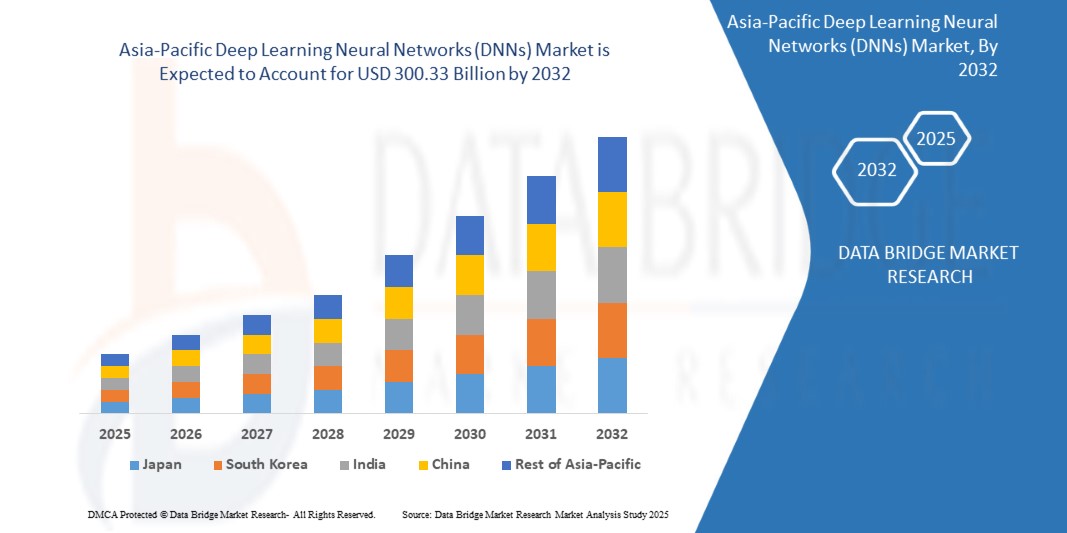
- The Asia-Pacific Deep Learning Neural Networks (DNNs) Market size was valued at USD 35.66 billion in 2024 and is expected to reach USD 300.33 billion by 2032, at a CAGR of 30.52% during the forecast period
- The remarkable market expansion is primarily driven by the accelerated adoption of artificial intelligence (AI) across multiple sectors, including smart home technology, healthcare, automotive, and manufacturing. The advancement in connected devices and IoT infrastructure is also a significant contributor to the increasing demand for DNNs in both residential and commercial applications.
- • Additionally, the growing need for intelligent, secure, and automated systems is establishing Deep Learning Neural Networks as a foundational technology for predictive analytics, pattern recognition, and intelligent decision-making. These factors are pushing DNNs into mainstream adoption, fueling rapid digital transformation across the Asia-Pacific region.
Deep Learning Neural Networks (DNNs) Market Analysis
- Deep Learning Neural Networks (DNNs) are becoming integral to the digital transformation of industries across the Asia-Pacific region, particularly in smart home automation, security systems, and intelligent surveillance. These advanced algorithms enable machines to perform tasks such as image and speech recognition, predictive analytics, and autonomous decision-making with human-like accuracy.
- The Asia-Pacific DNNs market is witnessing robust growth due to the rapid adoption of smart technologies in residential and commercial settings. Governments and enterprises across countries like China, Japan, South Korea, and India are heavily investing in AI-driven infrastructure, thereby accelerating the deployment of DNN-powered solutions across urban and semi-urban areas.
- Rising consumer demand for intelligent, secure, and remotely accessible solutions is also propelling the DNNs market. In smart home ecosystems, DNNs enhance capabilities such as facial recognition for access control, voice command integration, and behavioral pattern monitoring, offering a new level of automation, personalization, and convenience.
- Furthermore, the proliferation of IoT devices, improvements in computational power, and expanding 5G infrastructure across Asia-Pacific are fostering the seamless integration of DNNs into daily life applications. These trends are significantly reshaping sectors like healthcare, retail, finance, and transportation, establishing DNNs as the core of Asia-Pacific’s next-gen digital economy.
- China is a major driver behind the rapid expansion of the Asia-Pacific Deep Learning Neural Networks (DNNs) Market, contributing significantly to the region’s projected CAGR of 33.12% from 2025 to 2032.
- The hardware segment accounted for the largest market revenue share in 2024, driven by the increasing deployment of high-performance computing (HPC) hardware such as GPUs, TPUs, and FPGAs for training and inference in DNN models.
Report Scope and Deep Learning Neural Networks (DNNs) Market Segmentation
|
Attributes |
Deep Learning Neural Networks (DNNs) Key Market Insights |
|
Segments Covered |
|
|
Countries Covered |
Asia-Pacific
|
|
Key Market Players |
|
|
Market Opportunities |
|
|
Value Added Data Infosets |
In addition to the insights on market scenarios such as market value, growth rate, segmentation, geographical coverage, and major players, the market reports curated by the Data Bridge Market Research also include in-depth expert analysis, pricing analysis, brand share analysis, consumer survey, demography analysis, supply chain analysis, value chain analysis, raw material/consumables overview, vendor selection criteria, PESTLE Analysis, Porter Analysis, and regulatory framework. |
Deep Learning Neural Networks (DNNs) Market Trends
“Accelerating AI Integration and Demand for Real-Time Data Processing”
- The rising integration of artificial intelligence (AI) across multiple sectors such as finance, healthcare, retail, and manufacturing is significantly boosting the demand for Deep Learning Neural Networks (DNNs). Businesses are increasingly leveraging DNNs for tasks such as predictive analytics, customer behavior modeling, fraud detection, and personalized recommendation systems, which require real-time, high-accuracy data interpretation.
- For instance, in March 2024, IBM enhanced its Watsonx AI and data platform to support more sophisticated DNN models for intelligent automation and customer engagement in the BFSI sector. This advancement enables financial institutions to enhance real-time risk assessment and improve customer experience through AI-driven insights.
- Furthermore, the ability of DNNs to process unstructured data such as images, speech, and video in real time makes them indispensable in modern AI applications. As companies focus on digital transformation, the adoption of scalable, cloud-integrated DNN solutions is becoming essential for maintaining competitiveness and achieving operational efficiency.
Deep Learning Neural Networks (DNNs) Market Dynamics
Driver
“Expansion of Smart Devices and IoT Ecosystems”
- The proliferation of Internet of Things (IoT) devices and the growing use of smart infrastructure are accelerating the deployment of DNNs at the edge. DNNs enable real-time decision-making in connected devices such as autonomous vehicles, smart home systems, and industrial automation setups by reducing latency and enabling localized processing.
- For instance, in April 2024, Qualcomm Technologies, Inc. launched an AI-enabled edge computing platform integrated with advanced DNN models to enhance responsiveness in smart city applications like traffic control and energy management.
- The convergence of DNNs with IoT and edge computing is expected to drive robust demand across various sectors, particularly in regions with strong smart infrastructure investments like Asia-Pacific, the U.S., and parts of Europe.
Restraint/Challenge
“High Computational Costs and Energy Consumption”
- A major challenge faced by the Deep Learning Neural Networks (DNNs) market is the significant computational power and energy required to train and deploy complex models. These requirements often necessitate the use of high-performance GPUs, large-scale data storage, and advanced cooling systems, which drive up operational costs.
- This poses a barrier for small- and medium-sized enterprises (SMEs), especially in developing countries where access to infrastructure and funding may be limited. Additionally, as environmental sustainability becomes a global priority, the high carbon footprint associated with training large DNNs is drawing scrutiny from regulators and stakeholders.
- Consequently, the industry faces pressure to develop more efficient algorithms and low-power AI hardware to make DNN adoption more sustainable and accessible across all economic strata.
Deep Learning Neural Networks (DNNs) Market Scope
The market is segmented on the basis of component, application, and end-user.
- By Component
On the basis of component, the Deep Learning Neural Networks (DNNs) Market is segmented into hardware, software, and services. The hardware segment accounted for the largest market revenue share in 2024, driven by the increasing deployment of high-performance computing (HPC) hardware such as GPUs, TPUs, and FPGAs for training and inference in DNN models. The growing need for scalable infrastructure in deep learning workloads across enterprises and research institutions further boosts demand for AI-specific hardware.
The software segment is projected to witness the fastest CAGR from 2025 to 2032, owing to advancements in deep learning frameworks (like TensorFlow, PyTorch, and MXNet) and increased use of pre-trained models and libraries for natural language processing, computer vision, and recommendation systems. Cloud-based AI platforms are also fueling this growth through simplified model development and deployment.
- By Application
On the basis of application, the Deep Learning Neural Networks (DNNs) Market is segmented into image recognition, speech recognition, natural language processing (NLP), and data mining. The image recognition segment held the largest market share in 2024, fueled by extensive adoption in autonomous vehicles, healthcare diagnostics, facial recognition, and surveillance systems. The increasing use of convolutional neural networks (CNNs) for visual data analysis and real-time image processing significantly drives growth in this segment.
The natural language processing (NLP) segment is expected to witness the fastest growth from 2025 to 2032, driven by rapid advancements in generative AI, virtual assistants, chatbots, sentiment analysis tools, and AI-powered translation services. NLP's expanding utility across customer service, education, and enterprise automation continues to drive market traction.
- By End-User
On the basis of end-user, the Deep Learning Neural Networks (DNNs) Market is segmented into banking, financial services and insurance (BFSI), IT and telecommunication, healthcare, retail, automotive, manufacturing, aerospace and defence, security, and others. The IT and telecommunication segment dominated the market in 2024, driven by the need for real-time network optimization, anomaly detection, and predictive maintenance. Telecom operators are leveraging DNNs for improving customer experience and automating service delivery through intelligent virtual agents and data analytics.
The healthcare segment is anticipated to grow at the fastest CAGR during 2025–2032, propelled by the growing deployment of DNNs in medical imaging, drug discovery, diagnostics, and patient risk assessment. Deep learning models’ ability to process large volumes of unstructured medical data is revolutionizing personalized medicine and accelerating R&D workflows.
Deep Learning Neural Networks (DNNs) Market Regional Analysis
- China is a major driver behind the rapid expansion of the Asia-Pacific Deep Learning Neural Networks (DNNs) Market, contributing significantly to the region’s projected CAGR of 33.12% from 2025 to 2032.
- The country's growth is powered by substantial government investments in artificial intelligence through national strategies like "Next Generation Artificial Intelligence Development Plan," promoting widespread integration of DNNs across industries.
- China’s massive consumer base and smart city initiatives are encouraging the proliferation of DNN-powered solutions in facial recognition, intelligent surveillance, autonomous vehicles, and personalized e-commerce experiences.
- Furthermore, strong domestic players such as Baidu, Alibaba, Tencent, and Huawei are actively developing AI chipsets, cloud platforms, and deep learning frameworks, facilitating faster, localized deployment of DNN applications.
- The country's low-cost electronics manufacturing ecosystem, combined with widespread 5G infrastructure rollout, is also lowering barriers to entry and enabling adoption of DNN-based systems across both urban and rural markets.
- As China positions itself as a global AI superpower, the local Deep Learning Neural Networks (DNNs) market is benefiting from aggressive innovation, favorable policy frameworks, and increasing enterprise and government collaborations, further cementing its leadership within the Asia-Pacific region.
Japan Deep Learning Neural Networks (DNNs) Market Insight
The Japan Deep Learning Neural Networks (DNNs) Market is witnessing substantial growth driven by its advanced technological landscape, increasing demand for automation, and a highly urbanized society. The country's strong focus on robotics and AI-driven systems complements the rising deployment of DNNs in real-time analytics, healthcare diagnostics, automotive systems, and smart home applications. Japan's aging population is also creating opportunities for AI-powered assistive technologies that rely on DNN algorithms to enhance safety, convenience, and care quality.
India Deep Learning Neural Networks (DNNs) Market Insight
The India Deep Learning Neural Networks (DNNs) Market is projected to grow rapidly due to an expanding digital ecosystem, booming tech start-up environment, and increasing government focus on AI through initiatives like the National AI Strategy and Digital India. As industries such as healthcare, BFSI, and e-commerce rapidly digitalize, the demand for DNN-based tools for fraud detection, customer analytics, and personalized recommendations is surging. Moreover, India’s cost-sensitive market is benefiting from the rise of cloud-based and open-source DNN frameworks, promoting widespread experimentation and adoption.
Deep Learning Neural Networks (DNNs) Market Share
The Deep Learning Neural Networks (DNNs) industry is primarily led by well-established companies, including:
- LYUDA RESEARCH, LLC(United States)
- Alphabet Inc. (Google) (United States)
- IBM(United States)
- Micron Technologies, Inc.(United States)
- Neural Technologies Limited(United Kingdom)
- NEURODIMENSION, INC.(United States)
- NEURALWARE(United States)
- NVIDIA Corporation(United States)
- Skymind Inc.(United States)
- Samsung(South Korea)
- Qualcomm Technologies, Inc.(United States)
- Intel Corporation(United States)
- Amazon Web Services, Inc.(United States)
- Microsoft(United States)
- GMDH LLC.(United States)
- Sensory Inc.(United States)
- Ward Systems Group, Inc.(United States)
- Xilinx Inc.(United States)
- Starmind(Switzerland)
Latest Developments in Asia-Pacific Deep Learning Neural Networks (DNNs) Market
- In February 2025, China’s NDRC and semiconductor firms unveiled landmark regulation reforms to support open-source, domain-specific DNN models. This initiative aims to democratize advanced AI development by enabling training on affordable GPU setups, promoting local innovation and reducing reliance on foreign infrastructure
- In 2024, Huawei completely overhauled its open‑source deep learning framework MindSpore (v2.3), optimized for ARM‑based NPUs on HarmonyOS and Ascend chips. This update bolsters on‑device DNN performance in smartphones, IoT devices, and edge computing platforms across Asia‑Pacific
- In February 2025, the Nature journal reported accelerating competition between Chinese and Western AI models, with Chinese small‑scale DNNs narrowing the performance gap. This reflects APAC’s maturing ecosystem of high‑quality, locally developed neural network models
- In early 2025, Origin Quantum partnered with Phoenix to leverage its “Wukong” superconducting quantum chips in DNN training. This cutting‑edge collaboration in China signifies emerging interest in integrating quantum computing with neural network workflows
- In June 2025, the MLANN 2025 conference was hosted in Xiamen, China, bringing together leading researchers and industry practitioners in machine learning and neural networks. The event showcased new architectures, optimization techniques, and real-world DNN applications across healthcare, robotics, and smart manufacturing

- Interactive Data Analysis Dashboard
- Company Analysis Dashboard for high growth potential opportunities
- Research Analyst Access for customization & queries
- Competitor Analysis with Interactive dashboard
- Latest News, Updates & Trend analysis
- Harness the Power of Benchmark Analysis for Comprehensive Competitor Tracking
Data collection and base year analysis are done using data collection modules with large sample sizes. The stage includes obtaining market information or related data through various sources and strategies. It includes examining and planning all the data acquired from the past in advance. It likewise envelops the examination of information inconsistencies seen across different information sources. The market data is analysed and estimated using market statistical and coherent models. Also, market share analysis and key trend analysis are the major success factors in the market report. To know more, please request an analyst call or drop down your inquiry.
The key research methodology used by DBMR research team is data triangulation which involves data mining, analysis of the impact of data variables on the market and primary (industry expert) validation. Data models include Vendor Positioning Grid, Market Time Line Analysis, Market Overview and Guide, Company Positioning Grid, Patent Analysis, Pricing Analysis, Company Market Share Analysis, Standards of Measurement, Global versus Regional and Vendor Share Analysis. To know more about the research methodology, drop in an inquiry to speak to our industry experts.
Data Bridge Market Research is a leader in advanced formative research. We take pride in servicing our existing and new customers with data and analysis that match and suits their goal. The report can be customized to include price trend analysis of target brands understanding the market for additional countries (ask for the list of countries), clinical trial results data, literature review, refurbished market and product base analysis. Market analysis of target competitors can be analyzed from technology-based analysis to market portfolio strategies. We can add as many competitors that you require data about in the format and data style you are looking for. Our team of analysts can also provide you data in crude raw excel files pivot tables (Fact book) or can assist you in creating presentations from the data sets available in the report.