


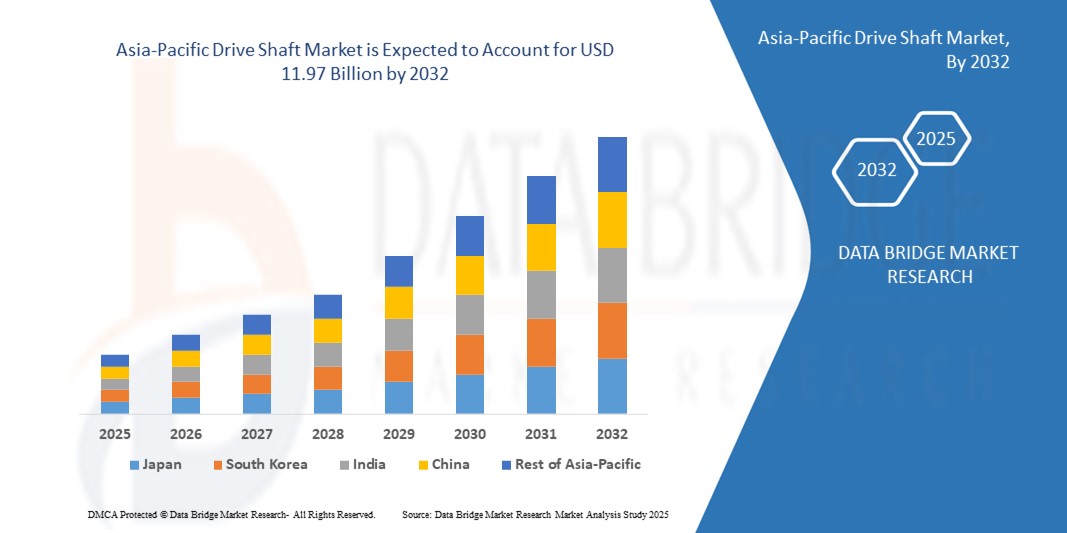
Asia-Pacific Drive Shaft Market Size
- The Asia-Pacific drive shaft market size was valued at USD 7.34 billion in 2024 and is expected to reach USD 11.97 billion by 2032, at a CAGR of 6.3% during the forecast period
- The market growth is largely fueled by the increasing production of passenger cars and commercial vehicles, coupled with the rising adoption of lightweight and high-performance driveline components to improve fuel efficiency and reduce emissions. Advancements in materials such as aluminum, composites, and carbon fiber are driving innovation, enabling manufacturers to deliver durable yet efficient drive shafts across diverse vehicle categories
- Furthermore, the rapid transition toward electric and hybrid vehicles is establishing advanced drive shafts as a critical component in modern mobility solutions. These vehicles demand driveline systems with high torque capacity, reduced vibration, and enhanced efficiency, which is accelerating the integration of innovative drive shaft technologies and significantly boosting market expansion
Asia-Pacific Drive Shaft Market Analysis
- Drive shafts are mechanical components designed to transmit torque from the engine, transmission, or motor to the axles, ensuring smooth and efficient power delivery to the wheels. They play a pivotal role in maintaining stability, performance, and drivability across passenger and commercial vehicles, with applications extending from conventional drivetrains to advanced EV architectures
- The growing demand for drive shafts is primarily fueled by rising vehicle production, stricter emission standards driving lightweight component adoption, and increasing penetration of electrified vehicles. Continuous innovations in design and materials, along with strong OEM and aftermarket demand, are reinforcing the growth trajectory of the drive shaft market worldwide
- China dominated the drive shaft market in 2024, due to its massive automotive manufacturing base, strong domestic demand, and growing exports of passenger cars and commercial vehicles
- India is expected to be the fastest growing country in the drive shaft market during the forecast period due to rapid automotive production growth, rising disposable incomes, and expanding demand for both passenger and commercial vehicles
- Rear axle segment dominated the market with a market share of 64% in 2024, due to its primary role in transmitting engine torque to the wheels in rear-wheel-drive and all-wheel-drive vehicles. Rear axle drive shafts are engineered to handle higher torque loads and longer operational lifespans, making them critical for commercial vehicles and high-performance passenger cars. The growing preference for rear-wheel-drive platforms in sports and luxury vehicles also supports strong demand for rear axle components
Report Scope and Asia-Pacific Drive Shaft Market Segmentation
|
Attributes |
Asia-Pacific Drive Shaft Key Market Insights |
|
Segments Covered |
|
|
Countries Covered |
Asia-Pacific
|
|
Key Market Players |
|
|
Market Opportunities |
|
|
Value Added Data Infosets |
In addition to the market insights such as market value, growth rate, market segments, geographical coverage, market players, and market scenario, the market report curated by the Data Bridge Market Research team includes in-depth expert analysis, import/export analysis, pricing analysis, production consumption analysis, and pestle analysis. |
Asia-Pacific Drive Shaft Market Trends
Rising Demand for Drive Shafts in Electric and Hybrid Vehicles
- The increasing adoption of artificial intelligence for real-time fraud detection is reshaping the fraud detection transaction monitoring market. Financial institutions and enterprises are leveraging AI-powered systems to identify suspicious activities instantly, reduce false positives, and improve overall detection accuracy in increasingly complex transaction networks
- For instance, Mastercard employs AI-driven fraud detection tools that analyze transaction patterns in real time to intercept fraudulent activities before they are completed. Similarly, Featurespace uses adaptive behavioral analytics powered by machine learning to enable banks and payment companies to identify anomalies across large-scale financial transactions with greater precision
- The use of AI significantly enhances fraud detection capabilities by analyzing enormous volumes of structured and unstructured data in seconds, something that traditional rule-based systems struggle to achieve. This allows organizations to counter advanced fraud tactics such as synthetic identities, account takeover, and cross-border transaction fraud effectively
- AI technologies also help reduce the rate of false declines which can negatively impact customer experience in the financial sector. By improving detection accuracy, real-time AI systems protect institutions from monetary losses and also safeguard consumer trust and loyalty
- The expansion of digital payment ecosystems including mobile wallets, e-commerce platforms, and peer-to-peer transfers has heightened the need for instant fraud prevention. AI-based transaction monitoring systems provide adaptive, real-time capabilities that allow seamless integration with high-speed financial networks
- In conclusion, the adoption of AI for real-time fraud detection is driving rapid transformation in the industry. This trend underscores the growing necessity for agile, intelligent, and predictive monitoring frameworks that can adapt to evolving fraud tactics and deliver secure, seamless financial transactions worldwide
Asia-Pacific Drive Shaft Market Dynamics
Driver
Increasing Automotive Production
- The rising emphasis on identity verification and authentication is a key driver accelerating the adoption of transaction monitoring systems. With the surge in digital transactions, financial institutions are prioritizing advanced identity authentication methods to protect users from identity theft, account takeover fraud, and unauthorized access
- For instance, Experian has integrated advanced identity verification tools within its fraud detection solutions, utilizing biometric authentication and multi-factor verification to strengthen transaction security. Similarly, companies such as LexisNexis Risk Solutions use AI and big data to enable financial organizations to validate customer identities in real time while reducing friction in user experience
- The integration of biometric factors such as facial recognition, fingerprint scanning, and behavioral analytics further enhances risk mitigation across banking, e-commerce, and telecommunication services. These measures provide strong verification capabilities to complement transaction monitoring and reduce vulnerabilities in user accounts
- The regulatory landscape, particularly with frameworks such as Know Your Customer (KYC) and Anti-Money Laundering (AML) requirements, is also reinforcing the need for robust identity verification and authentication tools. Financial organizations must adopt advanced monitoring solutions to remain compliant and minimize regulatory fines
- Overall, increased emphasis on identity verification and authentication is reinforcing trust in digital channels. This driver ensures that fraud detection transaction monitoring systems continue to evolve as indispensable tools for securing financial services and protecting customer relationships
Restraint/Challenge
High Costs of Advanced Materials
- A significant challenge in the fraud detection transaction monitoring market is the high financial investment required for implementation and ongoing maintenance. Deploying advanced AI-powered monitoring systems demands substantial capital investment in software platforms, integration technologies, and skilled personnel, which creates barriers for smaller financial institutions and enterprises
- For instance, large banks such as JPMorgan Chase can afford to implement AI-driven, real-time fraud monitoring platforms with predictive capabilities. However, mid-sized and regional institutions often struggle with high implementation costs and find it difficult to justify expenses, particularly in markets with thin profit margins
- The complexity of managing and maintaining these systems further adds to long-term costs. Continuous updates are required to keep threat models current, while operational expenses such as system tuning, cloud storage capacity, and advanced analytics tools increase the financial burden on organizations
- In addition, scalability challenges arise when transaction volumes surge, requiring institutions to invest further in infrastructure and support systems. This impacts organizations with limited budgets that are already balancing compliance costs and profit pressures
- As a result, high initial costs combined with ongoing maintenance expenditures limit the widespread adoption of fraud detection transaction monitoring solutions. Overcoming this challenge will require the development of cost-efficient platforms, cloud-based subscription models, and shared service offerings to expand accessibility for institutions of all sizes
Asia-Pacific Drive Shaft Market Scope
The market is segmented on the basis of component, design type, drive shaft type, position type, material type, vehicle type, and sales channel.
- By Component
On the basis of component, the drive shaft market is segmented into slip yokes, yoke shafts, end yokes, companion flanges, flange yokes, weld yokes, center yokes, splined slip stubs, midship stubs, and others. The yoke shafts segment dominated the largest market revenue share in 2024, driven by their critical role in transferring torque efficiently and maintaining rotational stability across driveline systems. Automotive manufacturers prefer yoke shafts for their proven durability, ease of assembly, and compatibility with multiple vehicle driveline configurations. The segment also benefits from the growing adoption of high-performance vehicles requiring precision-engineered components for better power transmission and reduced vibrations.
The slip yokes segment is anticipated to witness the fastest growth rate from 2025 to 2032, fueled by rising demand in both passenger and commercial vehicles for improved driveline flexibility. Slip yokes allow for axial movement, accommodating vehicle suspension travel and reducing stress on other driveline components. Their adaptability in different mounting configurations and ability to handle torque fluctuations make them a preferred choice for modern driveline systems, particularly in off-road and heavy-duty applications.
- By Design Type
On the basis of design type, the drive shaft market is segmented into hollow shaft and solid shaft. The hollow shaft segment dominated the largest market revenue share in 2024 due to its lightweight construction, which helps reduce overall vehicle weight and improves fuel efficiency. Hollow shafts are highly favored in passenger cars and high-performance vehicles where balancing strength and weight is crucial. Their ability to withstand torsional stress while maintaining rigidity makes them a key choice for modern driveline systems, supporting smoother power transmission and reduced mechanical wear.
The solid shaft segment is expected to witness the fastest growth from 2025 to 2032, driven by applications in commercial vehicles and heavy-duty trucks. Solid shafts provide enhanced strength and durability for high-torque applications, making them suitable for demanding operational conditions. The increasing need for robust components in logistics, construction, and agricultural vehicles is further accelerating the adoption of solid drive shafts across diverse vehicle platforms.
- By Drive Shaft Type
On the basis of drive shaft type, the market is segmented into Hotchkiss drive shaft, torque tube drive shaft, flexible drive shaft, and slip-in-tube drive shaft. The Hotchkiss drive shaft segment dominated the largest market revenue share in 2024, owing to its widespread use in rear-wheel-drive vehicles and trucks. Known for its simple design, durability, and effective power transfer, the Hotchkiss drive shaft is a preferred choice for both passenger and commercial vehicles. Its compatibility with leaf spring suspension systems and ability to handle high torque make it highly reliable in conventional driveline architectures.
The slip-in-tube drive shaft segment is anticipated to witness the fastest growth rate from 2025 to 2032, driven by increasing demand for high-performance and all-wheel-drive vehicles. Slip-in-tube designs allow for easier length adjustment during assembly and maintenance, providing better adaptability across various vehicle platforms. The design’s efficiency in absorbing torsional vibrations and enhancing driveline smoothness has led to rising adoption in modern passenger and commercial vehicles.
- By Position Type
On the basis of position type, the market is segmented into front axle and rear axle. The rear axle segment dominated the largest market revenue share of 64% in 2024 due to its primary role in transmitting engine torque to the wheels in rear-wheel-drive and all-wheel-drive vehicles. Rear axle drive shafts are engineered to handle higher torque loads and longer operational lifespans, making them critical for commercial vehicles and high-performance passenger cars. The growing preference for rear-wheel-drive platforms in sports and luxury vehicles also supports strong demand for rear axle components.
The front axle segment is expected to witness the fastest growth from 2025 to 2032, fueled by the increasing penetration of front-wheel-drive and all-wheel-drive vehicles. Front axle drive shafts require advanced engineering to handle steering angles and torque simultaneously, which has driven the adoption of more sophisticated materials and designs. Rising production of SUVs and crossover vehicles with front-axle power distribution is further accelerating market growth.
- By Material Type
On the basis of material type, the drive shaft market is segmented into carbon steel, aluminum, stainless steel, composite materials, carbon fiber, and others. The carbon steel segment dominated the largest market revenue share in 2024 due to its high strength, durability, and cost-effectiveness, making it the standard choice for most passenger and commercial vehicles. Carbon steel drive shafts offer excellent torsional rigidity and resistance to fatigue, supporting long service life even under demanding load conditions.
The composite materials segment is anticipated to witness the fastest growth rate from 2025 to 2032, driven by the automotive industry’s focus on lightweighting and fuel efficiency. Composite drive shafts offer superior strength-to-weight ratios, reduced vibration, and corrosion resistance, making them ideal for electric vehicles and high-performance cars. Increasing adoption of advanced composites in vehicle driveline systems is fueling growth in this segment globally.
- By Vehicle Type
On the basis of vehicle type, the drive shaft market is segmented into passenger cars and commercial vehicles. The passenger car segment dominated the largest market revenue share in 2024, owing to the growing production of sedans, SUVs, and luxury vehicles worldwide. Passenger car drive shafts are designed for smooth performance, reduced NVH (noise, vibration, and harshness), and compatibility with modern suspension and drivetrain systems, supporting enhanced driving comfort and safety.
The commercial vehicle segment is expected to witness the fastest growth from 2025 to 2032, driven by rising demand for logistics, transportation, and construction vehicles. Commercial vehicle drive shafts are engineered for high torque capacity, durability, and robustness, supporting heavy payloads and extended operational cycles. Expansion in e-commerce and infrastructure projects further accelerates the demand for commercial vehicle driveline components.
- By Sales Channel
On the basis of sales channel, the drive shaft market is segmented into OEM and aftermarket. The OEM segment dominated the largest market revenue share in 2024, driven by strong partnerships between drive shaft manufacturers and vehicle producers. OEM components are preferred for their guaranteed quality, precise engineering, and compatibility with new vehicle models, ensuring optimal performance and safety.
The aftermarket segment is expected to witness the fastest growth from 2025 to 2032, fueled by increasing vehicle age, rising vehicle repair and replacement trends, and growing adoption of performance upgrades. Aftermarket drive shafts offer flexibility in material selection, customization, and cost-effective replacement options, supporting a wide range of passenger and commercial vehicles.
Asia-Pacific Drive Shaft Market Regional Analysis
- China dominated the drive shaft market with the largest revenue share in 2024, driven by its massive automotive manufacturing base, strong domestic demand, and growing exports of passenger cars and commercial vehicles
- Rising consumer demand for fuel-efficient and durable vehicles, along with continuous investments by global and domestic automakers, strengthens China’s leadership in the regional market. The integration of aluminum and composite materials into drive shaft production, alongside innovations in EV-compatible driveline systems, further consolidates its dominant position
- The presence of well-established domestic suppliers and global OEMs, combined with rapid advancements in automotive technology and a robust supply chain, ensures China’s continued dominance in the forecast period
Japan Drive Shaft Market Insight
The Japan market is anticipated to grow steadily from 2025 to 2032, supported by its strong automotive industry, focus on technological innovation, and high consumer preference for advanced mobility solutions. Japanese automakers prioritize lightweight driveline systems and precision engineering, boosting demand for hollow and composite drive shafts. A mature domestic market, combined with the country’s leadership in hybrid and electric vehicle production, supports steady growth. Continuous R&D investments and collaborations between local suppliers and global automakers further reinforce Japan’s innovation-driven position in the drive shaft market.
India Drive Shaft Market Insight
India is projected to register the fastest CAGR in the Asia Pacific drive shaft market during 2025–2032, fueled by rapid automotive production growth, rising disposable incomes, and expanding demand for both passenger and commercial vehicles. The government’s push for electric mobility, infrastructure development, and local manufacturing under the “Make in India” initiative is accelerating adoption of advanced driveline technologies. Increasing demand for affordable yet durable drive shafts, coupled with rising investments from global OEMs and Tier-1 suppliers, positions India as the fastest-growing market. The country’s expanding aftermarket sector and growing adoption of lightweight materials further strengthen its growth trajectory.
Asia-Pacific Drive Shaft Market Share
The drive shaft industry is primarily led by well-established companies, including:
- Schaeffler Technologies AG & Co. KG (Germany)
- Welte Rohrbiegetechnik GmbH (Germany)
- American Axle & Manufacturing, Inc. (U.S.)
- Bailey Morris (U.K.)
- D&F Propshafts (U.K.)
- Cummins Inc. (U.S.)
- Neapco Inc. (U.S.)
- Nexteer Automotive (U.S.)
- HYUNDAI WIA CORP (South Korea)
- JTEKT Corporation (Japan)
- THE TIMKEN COMPANY (U.S.)
- Aequita SE&Co. KGaA (Germany)
- Hitachi Astemo, Ltd. (Japan)
- GSP EUROPE GmbH (Germany)
- BG Automotive LTD (U.K.)
- TUNGALOY CORPORATION (Japan)
- GKN Automotive Limited (U.K.)
Latest Developments in Asia-Pacific Drive Shaft Market
- In September 2024, Cummins completed the acquisition of Jacobs Vehicle Systems, including the renowned Jake Brake technology originally conceived by Clessie Cummins. This strategic move strengthens Cummins’ position in the commercial vehicle market by integrating advanced engine braking solutions that enhance vehicle safety, efficiency, and reliability. The acquisition expands Cummins’ technology portfolio and also reinforces its commitment to innovation in powertrain systems, positioning the company strongly in the global drive shaft and driveline component ecosystem
- In August 2024, Nexteer Automotive introduced a modular pinion-assist Electric Power Steering (EPS) system designed to be compatible across all EPS architectures. This development increases flexibility for OEMs by offering a cost-effective yet high-performance steering solution adaptable to various vehicle categories. By broadening its product reach and improving vehicle handling and efficiency, Nexteer enhances its competitive advantage in the driveline and steering systems market, addressing growing demand for lightweight, efficient, and scalable solutions
- In September 2023, JTEKT unveiled significant advancements in steering and driveline technologies at the Tokyo Motor Show, showcasing innovations aimed at improving vehicle comfort, safety, and performance. These developments highlight JTEKT’s focus on next-generation mobility solutions, particularly in electric and connected vehicles, positioning the company as a leading innovator in steering and driveline markets. The showcase elevates its global brand visibility and also underscores its long-term commitment to shaping the future of mobility through advanced automotive systems
- In May 2023, American Axle & Manufacturing (AAM) secured a major contract to supply e-Beam axles for Stellantis’ upcoming electric vehicle program. Featuring integrated 3-in-1 e-Drive technology, this contract highlights AAM’s leadership in electrified driveline solutions and reflects the growing shift toward e-mobility. The deal solidifies AAM’s role as a key supplier for EV platforms, enhancing its market position in the transition from conventional to electrified powertrains and ensuring long-term revenue growth as Stellantis ramps up EV production
- In December 2021, AEQUITA SE & Co. KGaA finalized its acquisition of IFA Group, a specialist in drive shafts, thereby boosting its automotive sector sales beyond EUR 1 billion. The acquisition strengthens AEQUITA’s foothold in the global drive shaft market by leveraging IFA’s innovative technologies, strong OEM relationships, and established reputation for quality. This move diversifies AEQUITA’s automotive portfolio and also enhances its competitiveness in driveline systems, creating opportunities for sustained growth in an evolving industry

- Interactive Data Analysis Dashboard
- Company Analysis Dashboard for high growth potential opportunities
- Research Analyst Access for customization & queries
- Competitor Analysis with Interactive dashboard
- Latest News, Updates & Trend analysis
- Harness the Power of Benchmark Analysis for Comprehensive Competitor Tracking
Data collection and base year analysis are done using data collection modules with large sample sizes. The stage includes obtaining market information or related data through various sources and strategies. It includes examining and planning all the data acquired from the past in advance. It likewise envelops the examination of information inconsistencies seen across different information sources. The market data is analysed and estimated using market statistical and coherent models. Also, market share analysis and key trend analysis are the major success factors in the market report. To know more, please request an analyst call or drop down your inquiry.
The key research methodology used by DBMR research team is data triangulation which involves data mining, analysis of the impact of data variables on the market and primary (industry expert) validation. Data models include Vendor Positioning Grid, Market Time Line Analysis, Market Overview and Guide, Company Positioning Grid, Patent Analysis, Pricing Analysis, Company Market Share Analysis, Standards of Measurement, Global versus Regional and Vendor Share Analysis. To know more about the research methodology, drop in an inquiry to speak to our industry experts.
Data Bridge Market Research is a leader in advanced formative research. We take pride in servicing our existing and new customers with data and analysis that match and suits their goal. The report can be customized to include price trend analysis of target brands understanding the market for additional countries (ask for the list of countries), clinical trial results data, literature review, refurbished market and product base analysis. Market analysis of target competitors can be analyzed from technology-based analysis to market portfolio strategies. We can add as many competitors that you require data about in the format and data style you are looking for. Our team of analysts can also provide you data in crude raw excel files pivot tables (Fact book) or can assist you in creating presentations from the data sets available in the report.













