


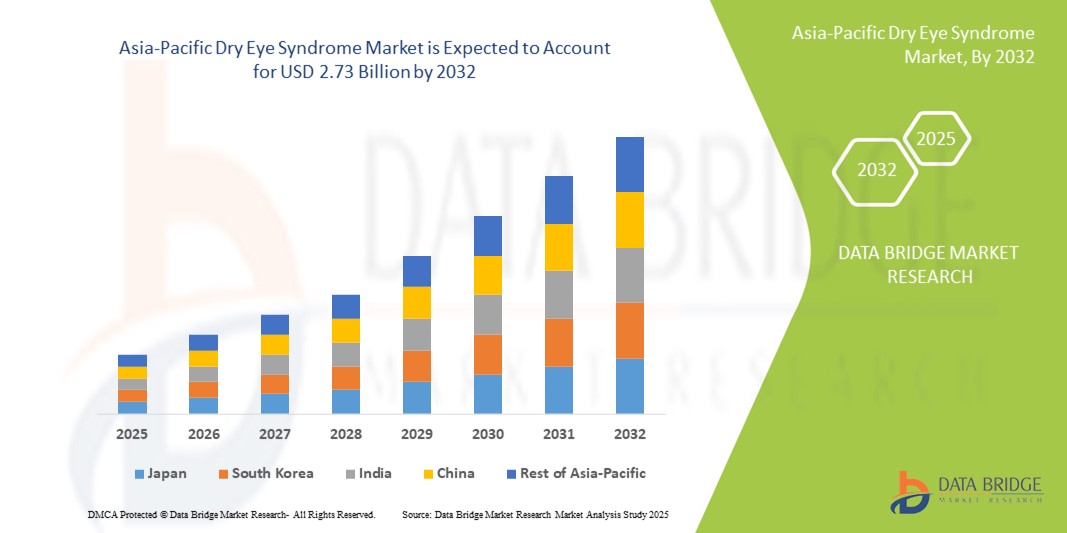
Dry Eye Syndrome Market Size
- The Asia-Pacific Dry Eye Syndrome market size was valued at USD 1.63 billion in 2024 and is expected to reach USD 2.73 billion by 2032, at a CAGR of 7.1% during the forecast period
- This growth is driven by rising prevalence of dry eye disease due to digital screen exposure, growing geriatric population, and increased awareness about ocular surface disorders among consumers.
Dry Eye Syndrome Market Analysis
- Dry Eye Syndrome (DES) is a multifactorial ocular surface disease characterized by loss of tear film homeostasis. Common symptoms include irritation, blurred vision, and discomfort. The Asia-Pacific region has experienced a surge in DES cases due to rising screen time, urban pollution, and hormonal changes.
- Non-invasive diagnostic technologies, increasing patient education campaigns, and widespread OTC availability of lubricating drops are enhancing early diagnosis and treatment rates. Major advances in lipid-based formulations and inflammation-targeted drugs are expected to reshape the treatment landscape.
- India and China are projected to lead market share owing to large population base, increasing healthcare expenditure, and robust local manufacturing of generics and ophthalmic solutions.
- Japan and South Korea are experiencing a rise in DES prevalence among aging and tech-savvy demographic
- In 2025, the Artificial Tears segment is expected to hold the largest share of 49.8%, due to their ease of availability, affordability, and established use in first-line therapy.
Report Scope and Dry Eye Syndrome Market Segmentation
|
Attributes |
Dry Eye Syndrome Key Market Insights |
|
Segments Covered |
By Type: Evaporative Dry Eye Syndrome and Aqueous Deficient Dry Eye Syndrome By Product: Artificial Tears, Anti-inflammatory Drugs, Punctal Plugs, Secretagogues, and Others By Dosage: Liquid Drops, Gel, Ointment, Emulsion, and Others By Formulation Type: Preservative Based, and Non-Preservative Based By Container Type: Single Dose, and Multi-Dose By Distribution Channel: Hospital Pharmacies, Retail Pharmacies, and Online Pharmacies By End User: Hospitals, Homecare, Specialty Clinics, and Others |
|
Countries Covered |
Asia-Pacific
|
|
Key Market Players |
|
|
Market Opportunities |
• Growth in dry eye disease linked to digitalization and screen exposure • Launch of preservative-free and lipid-based eye drops • Expansion of tele-ophthalmology and online pharmacies in APAC |
|
Value Added Data Infosets |
In addition to the insights on market scenarios such as market value, growth rate, segmentation, geographical coverage, and major players, the market reports curated by the Data Bridge Market Research also include import export analysis, production capacity overview, production consumption analysis, price trend analysis, climate change scenario, supply chain analysis, value chain analysis, raw material/consumables overview, vendor selection criteria, PESTLE Analysis, Porter Analysis, and regulatory framework. |
Dry Eye Syndrome Market Trends
"Shift Toward Personalized Ocular Therapies"
- The Asia-Pacific market is increasingly focused on personalized care strategies in DES management. Innovations in drug-delivery such as nanodrops, biodegradable punctal plugs, and gene-targeted anti-inflammatory therapies are advancing treatment precision.
- Moreover, companies are developing AI-driven diagnostic platforms and digital apps for real-time symptom tracking. Wearable blink sensors and environmental exposure monitors are also entering the market to offer holistic treatment insights. • This trend is especially prominent in urban markets of South Korea, Japan, and Singapore, where demand for premium and tech-integrated dry eye solutions is rising.
Dry Eye Syndrome Market Dynamics
Driver
"High Screen Time and Environmental Risk Factors"
• DES incidence is strongly correlated with lifestyle risk factors such as prolonged exposure
to digital devices, low blink rates, use of contact lenses, and exposure to urban pollutants
• Government initiatives, employer wellness programs, and ophthalmic associations are increasingly focusing on early intervention and public education, boosting diagnosis and treatment rates.
Opportunity
"Emergence of Advanced, Long-Lasting Eye Drop Formulations"
• Ongoing R&D in mucin-mimetic, lipid-layer stabilizing, and anti-inflammatory drug segments is opening new treatment pathways.
• Emerging countries in Southeast Asia are being targeted for clinical trials and low-cost access models by multinational ophthalmic companies.
Restraint/Challenge
"Affordability and Awareness Gaps in Tier-2 and Rural Areas"
- Despite the increase in product availability, high out-of-pocket expenses and poor awareness levels in semi-urban and rural Asia-Pacific remain barriers to market penetration.
- For example, a 2023 study by the Asia-Pacific Ocular Health Society found that 48% of rural DES patients in Indonesia delayed treatment due to cost and lack of diagnosis.
Dry Eye Syndrome Market Scope
The market is segmented on the basis of product type, formulation, distribution channel, indication, and end user.
|
Segmentation |
Sub-Segmentation |
|
By Type |
|
|
By Product |
• Artificial Tears • Anti-inflammatory Drugs • Punctal Plugs • Secretagogues • Others |
|
By Distribution Channel |
|
|
By Dosage |
• Liquid Drops • Gel • Ointment • Emulsion • Others |
|
By Formulation Type |
• Preservative Based • Non-Preservative |
|
By Container Type |
• Single Dose • Multi-Dose |
|
By End User
|
|
In 2025, the Artificial Tears segment is projected to dominate the market with the largest share in product segment
In 2025, the Artificial Tears segment is expected to hold the largest share of 49.8%, due to their ease of availability, affordability, and established use in first-line therapy.
The Evaporative Dry Eye Syndrome segment is expected to account for the largest share during the forecast period in type segment
In 2025, the Evaporative Dry Eye Syndrome segment is anticipated to capture a 58.6% share, driven by high prevalence due to screen-related eye fatigue and meibomian gland dysfunction.
Dry Eye Syndrome Market Regional Analysis
“India Holds the Largest Share in the Dry Eye Syndrome Market”
India dominates due to large unmet patient need, increased ophthalmologist availability, and rapid growth of digital device usage.
Dry Eye Syndrome Market Share
The market competitive landscape provides details by competitor. Details included are company overview, company financials, revenue generated, market potential, investment in research and development, new market initiatives, Asia-Pacific presence, production sites and facilities, production capacities, company strengths and weaknesses, product launch, product width and breadth, application dominance. The above data points provided are only related to the companies' focU.S. related to market.
The Major Market Leaders Operating in the Market Are:
- Santen Pharmaceutical Co., Ltd. (Japan)
- Sun Pharmaceutical Industries Ltd. (India)
- Allergan (U.S.)
- Otsuka Holdings Co., Ltd. (Japan)
- Novartis AG (Switzerland)
- Bausch Health Companies Inc. (Canada)
- Johnson & Johnson Vision (U.S.)
- Rohto Pharmaceutical Co., Ltd. (Japan)
- Sentiss Pharma Pvt. Ltd. (India)
- Alcon Inc. (Switzerland)
Latest Developments in Asia-Pacific Dry Eye Syndrome Market
- In February 2025, Rohto launched preservative-free dry eye drops in Thailand.
- In March 2025, Sentiss announced expansion of its dry eye product line in India.
- In January 2025, Santen received Japanese approval for its new lipid-layer targeting therapy.
- In April 2025, Alcon partnered with a Chinese health-tech firm to launch AI-based dry eye diagnostic solutions.

- Interactive Data Analysis Dashboard
- Company Analysis Dashboard for high growth potential opportunities
- Research Analyst Access for customization & queries
- Competitor Analysis with Interactive dashboard
- Latest News, Updates & Trend analysis
- Harness the Power of Benchmark Analysis for Comprehensive Competitor Tracking
Data collection and base year analysis are done using data collection modules with large sample sizes. The stage includes obtaining market information or related data through various sources and strategies. It includes examining and planning all the data acquired from the past in advance. It likewise envelops the examination of information inconsistencies seen across different information sources. The market data is analysed and estimated using market statistical and coherent models. Also, market share analysis and key trend analysis are the major success factors in the market report. To know more, please request an analyst call or drop down your inquiry.
The key research methodology used by DBMR research team is data triangulation which involves data mining, analysis of the impact of data variables on the market and primary (industry expert) validation. Data models include Vendor Positioning Grid, Market Time Line Analysis, Market Overview and Guide, Company Positioning Grid, Patent Analysis, Pricing Analysis, Company Market Share Analysis, Standards of Measurement, Global versus Regional and Vendor Share Analysis. To know more about the research methodology, drop in an inquiry to speak to our industry experts.
Data Bridge Market Research is a leader in advanced formative research. We take pride in servicing our existing and new customers with data and analysis that match and suits their goal. The report can be customized to include price trend analysis of target brands understanding the market for additional countries (ask for the list of countries), clinical trial results data, literature review, refurbished market and product base analysis. Market analysis of target competitors can be analyzed from technology-based analysis to market portfolio strategies. We can add as many competitors that you require data about in the format and data style you are looking for. Our team of analysts can also provide you data in crude raw excel files pivot tables (Fact book) or can assist you in creating presentations from the data sets available in the report.













