Asia-Pacific Elderly Care Market Size
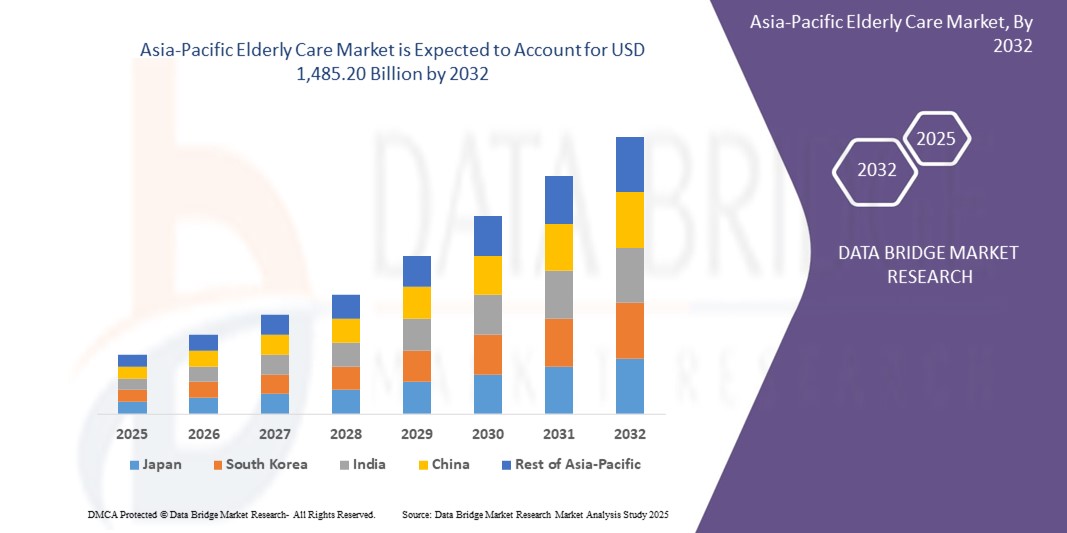
- The Asia-Pacific elderly care market size was valued at USD 975.12 billion in 2024 and is expected to reach USD 1,485.20 billion by 2032, at a CAGR of 5.40% during the forecast period
- The market growth is largely fueled by the growing adoption and technological progress within connected home devices and smart home technology, leading to increased digitalization in both residential and commercial settings.
- Furthermore, rising consumer demand for secure, user-friendly, and integrated solutions for their homes and businesses is establishing smart locks as the modern access control system of choice. These converging factors are accelerating the uptake of smart lock solutions, thereby significantly boosting the industry's growth.
Asia-Pacific Elderly Care Market Analysis
- Elderly care, encompassing a range of services and products designed to support the well-being of seniors, is an increasingly critical sector within the Asia Pacific region due to evolving demographics and healthcare needs. This includes home care, assisted living, nursing homes, and various assistive technologies
- The escalating demand for elderly care in Asia Pacific is primarily fueled by the rapidly aging populations in key countries such as Japan, China, South Korea, and Australia, coupled with increasing life expectancy and a decline in traditional family support structures across the region
- Japan dominates the Asia Pacific elderly care market at 33.5% in 2025. This is attributed to its status as a super-aged society with a well-established healthcare infrastructure and significant government support for elderly care services
- China is anticipated to be the fastest-growing country within the Asia Pacific elderly care market with a CAGR of 12.4% during the forecast period. This rapid growth is driven by its massive and rapidly aging population, increasing urbanization leading to changes in family structures, and rising disposable incomes enabling more people to afford professional care services. The government is also increasingly focusing on developing the elderly care sector
- Housing and assistive devices services are expected to dominate the elderly care market with a market share of 70.1%, driven by the preference for aging in place and the increasing availability of home care services and technologies
Report Scope and Asia-Pacific Elderly Care Market Segmentation
|
Attributes |
Asia-Pacific Elderly Care Key Market Insights |
|
Segments Covered |
|
|
Countries Covered |
North America
Europe
Asia-Pacific
Middle East and Africa
South America
|
|
Key Market Players |
|
|
Market Opportunities |
|
|
Value Added Data Infosets |
In addition to the insights on market scenarios such as market value, growth rate, segmentation, geographical coverage, and major players, the market reports curated by the Data Bridge Market Research also include in-depth expert analysis, pricing analysis, brand share analysis, consumer survey, demography analysis, supply chain analysis, value chain analysis, raw material/consumables overview, vendor selection criteria, PESTLE Analysis, Porter Analysis, and regulatory framework. |
Asia-Pacific Elderly Care Market Trends
“Enhanced Convenience Through Technology Integration"
- A significant and accelerating trend in the Asia Pacific elderly care market is the deepening integration with various technologies aimed at enhancing user convenience and the quality of care. This includes the adoption of telehealth platforms, remote monitoring devices, and smart home technologies to support the well-being of seniors
- For instance, in Japan, many elderly care facilities are implementing robotic assistants for tasks such as mobility support and companionship. Similarly, in South Korea, telehealth services are becoming increasingly common, allowing remote consultations and monitoring of elderly patients in their homes
- Technology integration in elderly care enables features such as remote health monitoring for early detection of health issues and providing more efficient communication between caregivers and patients. For instance, wearable sensors can track vital signs and send alerts to caregivers in case of anomalies. Furthermore, smart home devices can automate tasks and enhance the safety of elderly individuals living independently
- The seamless integration of elderly care technologies with broader healthcare ecosystems facilitates centralized monitoring and coordinated care delivery. Through unified platforms, caregivers can manage medication schedules, track health data, and communicate with family members, creating a more integrated and supportive care environment
- This trend towards more technologically advanced, user-friendly, and interconnected care systems is fundamentally reshaping how elderly care is delivered and experienced. Consequently, companies and healthcare providers across the Asia Pacific region are developing and adopting solutions with features such as AI-powered health assessments and remote monitoring capabilities
- The demand for technology-integrated elderly care solutions is growing rapidly across the residential and institutional sectors in Asia Pacific, as families and healthcare providers increasingly prioritize convenience, efficiency, and comprehensive care management
Asia-Pacific Elderly Care Market Dynamics
Driver
“Growing Need Due to Rising Geriatric Population and Healthcare Awareness”
- The increasing prevalence of a rapidly aging population across the Asia Pacific region, coupled with a growing awareness of the need for quality healthcare and specialized care for seniors, is a significant driver for the heightened demand for elderly care services and products
- For instance, in May 2024, the Japanese government increased its budget allocation for elderly care services to address the growing needs of its aging society. Such policy changes and increased investment by key stakeholders are expected to drive the elderly care industry growth in the forecast period
- As societies in the Asia Pacific region age and families face challenges in providing direct care, professional elderly care services offer advanced solutions such as skilled nursing, rehabilitation, and specialized care for chronic conditions, providing a crucial support system
- Furthermore, the growing awareness of the benefits of professional care, including improved health outcomes, social engagement, and enhanced quality of life for seniors, is making formal elderly care an increasingly integral component of healthcare systems
- The convenience of accessing a range of care options, from home healthcare to assisted living facilities, and the ability to tailor care plans to individual needs through professional services are key factors propelling the adoption of formal elderly care in both residential and institutional settings. The increasing availability of diverse care services and the growing understanding of the complexities of geriatric care further contribute to market growth
Restraint/Challenge
“Concerns Regarding Affordability and Availability of Skilled Caregiver”
- Concerns surrounding the affordability of quality elderly care services and the limited availability of adequately trained and skilled caregivers pose a significant challenge to broader market penetration in the Asia Pacific region
- For instance, the high cost of institutional care in countries such as Japan and Australia makes it inaccessible for a significant portion of the elderly population. Similarly, many developing countries in the region face a shortage of trained nurses and home healthcare aides specialized in geriatric care
- Addressing these affordability and caregiver availability concerns through government subsidies, innovative care models, and investments in training and education programs is crucial for ensuring equitable access to quality elderly care services. Organizations and governments are exploring options such as community-based care and leveraging technology to augment caregiver capacity. In addition, the perceived high cost of professional care compared to traditional family care can be a barrier for price-sensitive families, particularly in regions with lower average incomes. While more affordable home care options are emerging, comprehensive and specialized care often comes with a higher price tag
- While efforts are underway to increase the pool of trained caregivers and explore more cost-effective care delivery models, the financial burden and the scarcity of qualified personnel can still hinder widespread access to quality elderly care, especially for those with limited financial resources or in underserved areas
- Overcoming these challenges through strategic policy interventions, workforce development initiatives, and the development of affordable and accessible care solutions will be vital for ensuring that the growing elderly population in the Asia Pacific region receives the care they need
Asia-Pacific Elderly Care Market Scope
The market is segmented on the basis of product type, service, and application
- By Type
On the basis of product type, the elderly care market is segmented into pharmaceuticals, housing and assistive devices. The housing and assistive devices segment dominated the largest market revenue share of 70.1% in 2025, driven by the increasing need for aids supporting mobility, sensory functions, and daily living among the elderly population. This segment benefits from technological advancements and a growing focus on maintaining independence.
The housing and assistive devices segment is also anticipated to witness the fastest growth rate from 2025 to 2032, fueled by increasing demand for specialized senior living communities, assisted living facilities, and retirement homes that offer tailored care and support services. This growth is driven by urbanization and changing family structures.
- By Service
On the basis of service, the elderly care market is segmented into institutional care, homecare, and adult day care. The homecare segment held the largest market revenue share in 2025, driven by the preference of many elderly individuals to receive care in the comfort of their own homes and the increasing availability of professional home healthcare services. This segment is also supported by technological solutions for remote monitoring and care delivery
The institutional care segment is expected to witness the fastest CAGR from 2025 to 2032, driven by the rising need for specialized medical care, skilled nursing, and rehabilitation services for individuals with complex health conditions that cannot be adequately managed at home.
- By Application
On the basis of application, the elderly care market addresses various health conditions, including heart diseases, cancer, kidney diseases, diabetes, arthritis, osteoporosis, neurological disorders, respiratory issues, and others. The neurological disorders segment accounted for the largest market revenue share in 2025, driven by the increasing prevalence of neurodegenerative conditions such as dementia and Alzheimer's disease in the aging population, requiring specialized care and support
The diabetes segment is anticipated to witness the fastest CAGR from 2025 to 2032, driven by the rising incidence of diabetes among the elderly across the Asia Pacific region, leading to increased demand for diabetes management services and related care
Asia-Pacific Elderly Care Market Regional Analysis
- China dominates the Asia-Pacific elderly care market with the largest revenue share of 40.01% in 2024, driven by status as a super-aged society with a well-established healthcare infrastructure and significant government support for elderly care services
- Elderly individuals and their families in the region increasingly value the convenience, specialized medical support, and enhanced quality of life offered by professional elderly care services, including home healthcare and assisted living facilities.
- This growing adoption is further supported by rising disposable incomes enabling access to better healthcare options, increasing urbanization leading to changes in family support structures, and a growing preference for professional and reliable care solutions for their aging loved ones.
Japan Asia-Pacific Elderly Care Market Insight
The Japan elderly care market is experiencing significant growth with a market share of 33.5%, due to the country's rapidly aging population, a high focus on quality of life for seniors, and government support for long-term care services through its Long-Term Care Insurance (LTCI) system. There's an increasing demand for diverse care options, including home care, assisted living, and specialized medical treatments tailored to the needs of the elderly. Furthermore, advancements in technology and the integration of "agetech" (aging technology) are enhancing the quality and efficiency of care delivery in both residential and institutional settings
China Asia-Pacific Elderly Care Market Insight
The China elderly care market accounted for the fastest growing region in Asia Pacific in 2025 with a CAGR of 12.4%, attributed to the country's massive and rapidly aging population, increasing urbanization, and rising disposable incomes enabling access to better healthcare. The market is further propelled by increasing government initiatives to develop the elderly care sector, including the "90-7-3" model favoring home-based care and the development of smart elderly care technologies and services. The demand for both professional nursing and rehabilitation services, as well as smart products and solutions, is rapidly expanding across residential, community, and institutional setting
Asia-Pacific Elderly Care Market Share
The Asia-Pacific Elderly Care industry is primarily led by well-established companies, including:
- Nichiigakkan Co., Ltd. (Japan)
- Econ Healthcare Group (Singapore)
- NTUC Health Co-Operative Ltd (Singapore)
- ST LUKE'S ELDERCARE LTD (Singapore)
- Orange Valley (Singapore)
- Carewell-Service Co., Ltd. (Japan)
- Provectus Care (Hong Kong) Limited (Hong Kong)
- Antara Senior Living Limited (India)
- Emoha Elder Care (India)
- Health Care At Home Private Limited (India)
- Ashiana Housing Ltd (India)
- Epoch Elder Care (India)
- Benesse Corporation (Japan)
- Riei Co., Ltd. (Japan)
- Active Global Specialized Caregivers (Singapore)
- Homage (Singapore, Malaysia, Australia)
- iElder.asia (Malaysia)
- The Golden Concepts (Singapore)
Latest Developments in Asia-Pacific Elderly Care Market
- In April 2023, the Japanese government announced an expansion of its long-term care insurance benefits to cover a wider range of assistive technologies and home modifications aimed at supporting independent living for seniors. This initiative reflects the government's commitment to promoting aging in place and enhancing the quality of life for its large elderly population
- In March 2023, the Bengaluru Safe City Project in India expanded its scope to include monitoring the well-being of vulnerable elderly residents through wearable devices and integrated emergency response systems. This initiative underscores the growing recognition of the need to leverage technology for the safety and security of the aging population in urban environments
- In February 2023, leading real estate developers in Singapore announced partnerships with eldercare service providers to integrate senior-friendly design elements and on-demand care services into new residential projects. This trend reflects a growing awareness of the needs of an aging population in housing development and aims to create more inclusive and supportive living environments

- Interactive Data Analysis Dashboard
- Company Analysis Dashboard for high growth potential opportunities
- Research Analyst Access for customization & queries
- Competitor Analysis with Interactive dashboard
- Latest News, Updates & Trend analysis
- Harness the Power of Benchmark Analysis for Comprehensive Competitor Tracking
Data collection and base year analysis are done using data collection modules with large sample sizes. The stage includes obtaining market information or related data through various sources and strategies. It includes examining and planning all the data acquired from the past in advance. It likewise envelops the examination of information inconsistencies seen across different information sources. The market data is analysed and estimated using market statistical and coherent models. Also, market share analysis and key trend analysis are the major success factors in the market report. To know more, please request an analyst call or drop down your inquiry.
The key research methodology used by DBMR research team is data triangulation which involves data mining, analysis of the impact of data variables on the market and primary (industry expert) validation. Data models include Vendor Positioning Grid, Market Time Line Analysis, Market Overview and Guide, Company Positioning Grid, Patent Analysis, Pricing Analysis, Company Market Share Analysis, Standards of Measurement, Global versus Regional and Vendor Share Analysis. To know more about the research methodology, drop in an inquiry to speak to our industry experts.
Data Bridge Market Research is a leader in advanced formative research. We take pride in servicing our existing and new customers with data and analysis that match and suits their goal. The report can be customized to include price trend analysis of target brands understanding the market for additional countries (ask for the list of countries), clinical trial results data, literature review, refurbished market and product base analysis. Market analysis of target competitors can be analyzed from technology-based analysis to market portfolio strategies. We can add as many competitors that you require data about in the format and data style you are looking for. Our team of analysts can also provide you data in crude raw excel files pivot tables (Fact book) or can assist you in creating presentations from the data sets available in the report.