


Asia-Pacific Electromagnetic Tracking Systems Market Size
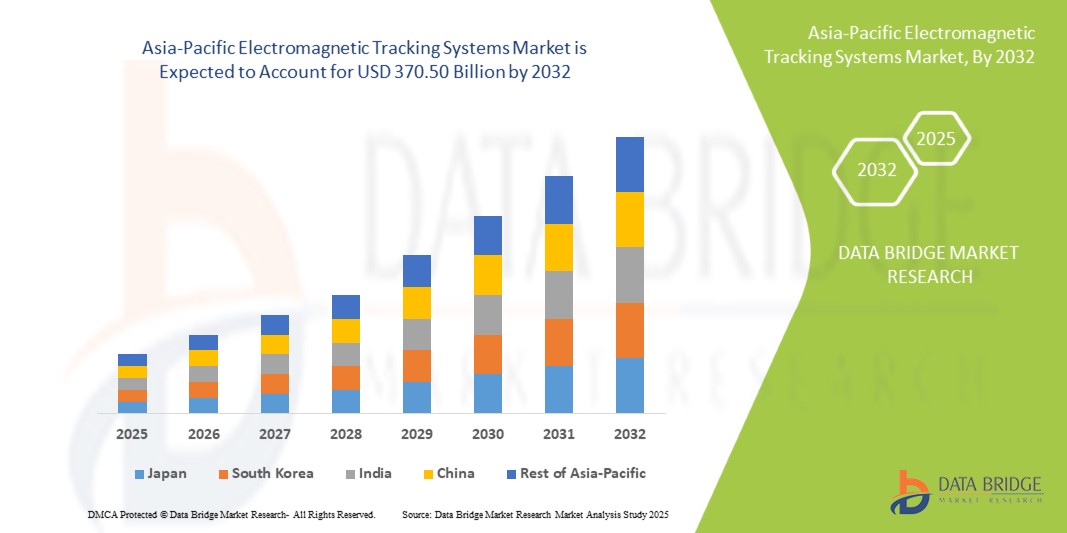
- The Asia-Pacific electromagnetic tracking systems market size was valued at USD 148.57 billion in 2024 and is expected to reach USD 370.50 billion by 2032, at a CAGR of12.10% during the forecast period
- The market growth is largely fueled by increasing adoption of minimally invasive and image-guided procedures in healthcare, which require precise navigation and real-time tracking of surgical instruments
- Furthermore, rising demand for advanced diagnostic and therapeutic procedures in neurosurgery, cardiology, and orthopedic surgeries is driving the adoption of electromagnetic tracking systems solutions
Asia-Pacific Electromagnetic Tracking Systems Market Analysis
- Electromagnetic Tracking Systems, providing precise real-time tracking and navigation for surgical instruments and medical devices, are increasingly crucial in modern operating rooms and interventional procedures due to their accuracy, reliability, and ability to enhance procedural outcomes
- The growing demand for electromagnetic tracking systems is primarily driven by the rising adoption of minimally invasive surgeries, increasing prevalence of chronic diseases, and the need for higher precision in diagnostic and therapeutic interventions
- China dominated the Asia-Pacific electromagnetic tracking systems market with the largest revenue share of 40.7% in 2024, attributed to the country’s expanding healthcare infrastructure, rising number of hospitals and specialty clinics, growing adoption of advanced surgical technologies, and strong government initiatives promoting healthcare modernization. Well-established domestic manufacturers and collaborations with international medical device companies further strengthen China’s leadership in the market
- India is expected to be the fastest-growing country in the Asia-Pacific electromagnetic tracking systems market during the forecast period, registering a CAGR of 11.2% from 2025 to 2032. Growth is fueled by rising investments in healthcare infrastructure, increasing awareness about minimally invasive procedures, expansion of surgical centers in urban and semi-urban areas, and the penetration of modern tracking technologies in both private and public hospitals
- The Wired Systems segment dominated the Asia-Pacific electromagnetic tracking systems market with a revenue share of 56.2% in 2024, primarily due to its capability to deliver stable and uninterrupted data transmission, which is critical for high-precision surgical procedures
Report Scope and Asia-Pacific Electromagnetic Tracking Systems Market Segmentation
|
Attributes |
Asia-Pacific Electromagnetic Tracking Systems Key Market Insights |
|
Segments Covered |
|
|
Countries Covered |
Asia-Pacific
|
|
Key Market Players |
|
|
Market Opportunities |
|
|
Value Added Data Infosets |
In addition to the insights on market scenarios such as market value, growth rate, segmentation, geographical coverage, and major players, the market reports curated by the Data Bridge Market Research also include in-depth expert analysis, pricing analysis, brand share analysis, consumer survey, demography analysis, supply chain analysis, value chain analysis, raw material/consumables overview, vendor selection criteria, PESTLE Analysis, Porter Analysis, and regulatory framework. |
Asia-Pacific Electromagnetic Tracking Systems Market Trends
Rising Adoption of Minimally Invasive Procedures and Surgical Precision
- A significant and accelerating trend in the Asia-Pacific Electromagnetic Tracking Systems market is the growing adoption of minimally invasive surgeries, image-guided interventions, and robotic-assisted procedures. This trend is driven by the demand for higher surgical precision, reduced patient recovery time, and improved procedural safety
- For instance, in 2023, several hospitals in China and India upgraded their surgical suites with advanced electromagnetic tracking solutions, enabling more accurate navigation of instruments during orthopedic and neurosurgical procedures. These installations highlight the emphasis on precision and patient outcomes in the region
- Electromagnetic tracking systems allow surgeons to visualize instrument positions in real time, reducing the likelihood of complications and enhancing operational efficiency. This feature is especially critical in complex procedures such as spine surgeries, cardiac interventions, and neuro-navigation
- The integration of these systems with imaging modalities, such as CT and MRI, provides a comprehensive view of anatomical structures, allowing for more accurate and safer surgical planning. Hospitals are increasingly investing in these technologies to stay at the forefront of surgical innovation
- Furthermore, the rising prevalence of chronic diseases and the growing geriatric population in Asia-Pacific are increasing the demand for precision-guided surgeries, which directly drives the adoption of electromagnetic tracking systems
- The ability of these systems to reduce operative time, improve accuracy, and minimize patient trauma is reshaping expectations for modern surgical procedures. Consequently, manufacturers are focusing on developing more intuitive, user-friendly, and adaptable electromagnetic tracking solutions suitable for diverse clinical applications
- Training and education programs in leading hospitals across Japan, China, and India are also supporting adoption by familiarizing surgeons and operating room staff with the benefits and operation of these systems, ensuring smoother implementation and better clinical outcomes
- This trend toward higher precision, safety, and minimally invasive approaches is expected to sustain strong growth in the Asia-Pacific electromagnetic tracking systems market throughout the forecast period
Asia-Pacific Electromagnetic Tracking Systems Market Dynamics
Driver
Growing Adoption Driven by Demand for Minimally Invasive and Image-Guided Procedures
- The increasing prevalence of complex surgeries and the rising adoption of minimally invasive procedures are significant drivers for the Asia-Pacific Electromagnetic Tracking Systems market. Hospitals and surgical centers are increasingly seeking solutions that improve procedural accuracy and patient safety
- For instance, in 2023, several leading hospitals in China and India implemented advanced electromagnetic tracking systems for orthopedic and neurosurgical procedures, enhancing navigation accuracy and reducing operative complications. Such initiatives by key healthcare institutions are expected to propel market growth during the forecast period
- These systems provide real-time tracking of surgical instruments and catheters, allowing surgeons to operate with higher precision and confidence, particularly in delicate or high-risk procedures
- The integration of electromagnetic tracking systems with imaging modalities such as MRI, CT, and fluoroscopy enhances visualization, enabling precise treatment planning and better clinical outcomes
- Furthermore, the rising prevalence of chronic conditions, trauma cases, and the expanding geriatric population in Asia-Pacific are increasing the need for advanced surgical interventions supported by these systems
- The ability of electromagnetic tracking solutions to reduce operative time, minimize patient trauma, and enhance overall procedural efficiency is making them a preferred choice in hospitals and specialty clinics
- Cost considerations, training, and technological complexity remain challenges; however, manufacturers are increasingly focusing on developing user-friendly, scalable, and cost-effective solutions to encourage adoption across a broader range of healthcare facilities
- Overall, the combination of clinical effectiveness, technological integration, and growing healthcare infrastructure is expected to drive sustained growth of the Electromagnetic Tracking Systems market in the Asia-Pacific region
Restraint/Challenge
High Costs and Implementation Challenge
- The relatively high cost of electromagnetic tracking systems compared to conventional surgical guidance methods poses a significant challenge for widespread adoption, especially in smaller hospitals and clinics in developing countries across Asia-Pacific
- Procurement, installation, and maintenance of these systems require substantial capital investment, which can be a barrier for healthcare providers with budget constraints
- In addition, the integration of electromagnetic tracking systems with existing imaging modalities and hospital IT infrastructure can be complex, requiring specialized training for surgeons and technical staff
- Inadequate training or lack of skilled personnel may lead to suboptimal system utilization, limiting clinical benefits and slowing adoption rates
- Concerns about system accuracy due to electromagnetic interference from metallic instruments or operating room equipment also present challenges that need to be mitigated through proper calibration and workflow optimization
- Regulatory approvals and compliance with regional medical device standards can be time-consuming, delaying the launch of new systems in certain countries
- While manufacturers are addressing these issues through cost-reduction strategies, user-friendly interfaces, and comprehensive training programs, overcoming these barriers is crucial for broader adoption
- Overall, high initial costs, technical complexity, and regulatory hurdles remain key restraints that could slow the growth of the Asia-Pacific Electromagnetic Tracking Systems market despite strong clinical demand
Asia-Pacific Electromagnetic Tracking Systems Market Scope
The market is segmented on the basis of product type, technology, connectivity, maneuverability, end user, application, and distribution channel.
- By Product Type
On the basis of product type, the electromagnetic tracking systems market is segmented into ENT tracking systems, orthopedics tracking systems, neuronavigation tracking systems, cardiac tracking systems, electrophysiology tracking systems, dental tracking systems, and others. The Neuronavigation Tracking Systems segment dominated with the largest market revenue share of 38.7% in 2024, owing to the increasing prevalence of neurological disorders and rising demand for minimally invasive neurosurgeries across Asia-Pacific. Hospitals and specialized neurosurgical centers prefer neuronavigation systems due to their high precision, reduced surgical risks, and ability to integrate with advanced imaging modalities such as MRI and CT. The dominance is further supported by improvements in software algorithms, enhanced visualization, and real-time tracking capabilities. Surgeons benefit from improved outcomes, reduced complications, and shorter procedure times. The segment’s importance in complex neurological interventions and increasing hospital adoption reinforce its market leadership.
The Cardiac Tracking Systems segment is expected to witness the fastest CAGR of 12.4% from 2025 to 2032, driven by the rising prevalence of cardiovascular diseases, growth in minimally invasive cardiac procedures, and increased adoption in urban hospitals. Cardiac tracking systems offer precise catheter navigation, reduce procedure risks, and improve patient recovery times. Technological innovations in catheter-based EM systems, including real-time mapping and enhanced software analytics, are further fueling adoption. Hospitals and specialty cardiac centers in China and India are increasingly procuring these systems. Awareness campaigns and rising healthcare infrastructure investments in the Asia-Pacific region also contribute to the rapid growth of this segment.
- By Technology
On the basis of technology, the market is segmented into optical navigation systems, electromagnetic (EM) navigation systems, hybrid navigation systems, fluoroscopy-based navigation systems, and others. The EM Navigation Systems segment dominated with a market share of 41.5% in 2024, attributed to its high accuracy, flexibility in operating rooms, and compatibility with various surgical instruments. It is preferred in neurosurgery, ENT, and orthopedic procedures where line-of-sight limitations of optical systems restrict their use. EM systems provide real-time feedback and improved precision, minimizing surgical errors. The ability to integrate with imaging modalities and track instruments in 3D space enhances its adoption. Hospitals value EM systems for their reliability, ease of use, and consistent performance across complex procedures.
Hybrid Navigation Systems are expected to witness the fastest CAGR of 11.8% from 2025 to 2032, as they combine the advantages of EM and optical systems. This hybrid approach allows surgeons to perform complex multi-disciplinary surgeries with enhanced accuracy and safety. The flexibility of hybrid systems supports both open and minimally invasive procedures. Hospitals and specialty clinics increasingly adopt hybrid systems to handle diverse surgical requirements. Innovations in software algorithms, image-guided navigation, and real-time tracking are boosting growth. Emerging markets such as India and Southeast Asia are seeing increasing adoption due to rising healthcare infrastructure investments.
- By Connectivity
On the basis of connectivity, the market is segmented into wired systems and wireless systems. The Wired Systems segment dominated with a revenue share of 56.2% in 2024, primarily due to its capability to deliver stable and uninterrupted data transmission, which is critical for high-precision surgical procedures. These systems are highly preferred in hospitals and surgical centers, particularly for neurosurgery, ENT, and orthopedic procedures, as they ensure consistent performance and minimal interference during complex operations. The segment benefits from well-established hospital infrastructure, robust operational reliability, and seamless integration with existing imaging modalities such as CT, MRI, and fluoroscopy systems. Surgeons rely on wired setups for precise, real-time instrument tracking, reducing the risk of errors and improving patient outcomes. Furthermore, the proven track record and durability of wired systems make them a trusted choice in both high-volume hospitals and specialized clinics, reinforcing their market dominance.
The wireless systems segment is expected to witness the fastest CAGR of 10.5% from 2025 to 2032, driven by an increasing demand for flexibility and mobility in surgical environments. Wireless systems minimize clutter in operating rooms and allow for mobile workflows, making them highly suitable for minimally invasive surgeries. Hospitals across China, India, and other Asia-Pacific countries are progressively adopting wireless solutions due to their portability, ease of installation, and reduced setup time. Technological advancements in signal stability, battery efficiency, and data transmission quality are further accelerating adoption. Wireless systems also enable smoother integration with modern surgical tools and instruments, enhancing procedural efficiency and supporting the expansion of healthcare services in emerging markets.
- By Maneuverability
On the basis of maneuverability, the market is segmented into 6-DOF, 5-DOF, and others. The 6-DOF segment dominated with a market share of 44.1% in 2024, offering superior precision and full spatial orientation for surgical instrument tracking. These systems allow surgeons to navigate intricate procedures with high degrees of freedom, which is especially critical in neurosurgery and orthopedic surgeries where precise instrument positioning is essential. The accuracy and reliability of 6-DOF systems reduce surgical complications and improve patient outcomes, making them a preferred choice for hospitals and specialty clinics. In addition, 6-DOF systems integrate seamlessly with imaging modalities and real-time navigation platforms, enhancing surgical efficiency and decision-making. Continuous technological advancements and the growing adoption in high-volume medical facilities reinforce the dominance of this segment.
The 5-DOF segment is expected to witness the fastest CAGR of 9.8% from 2025 to 2032, particularly in ENT and dental surgeries where slightly fewer degrees of freedom are sufficient. These systems are more compact, cost-effective, and easier to install, making them suitable for smaller clinics and emerging healthcare facilities. Despite offering fewer degrees of freedom than 6-DOF systems, 5-DOF solutions still provide adequate precision for a wide range of procedures. Rising investments in mid-sized hospitals, expanding surgical capabilities in emerging markets, and improvements in instrument tracking accuracy are driving rapid adoption of 5-DOF systems. The flexibility and lower operational complexity further contribute to the segment’s fast growth.
- By End User
On the basis of end user, the market is segmented into healthcare facilities, military and defense, industrial automation, and others. Healthcare facilities dominated the market with a revenue share of 62.3% in 2024, reflecting strong adoption of advanced tracking systems by hospitals, surgical centers, and specialty clinics aiming to enhance procedural precision and improve clinical outcomes. This segment’s growth is fueled by the increasing number of surgeries requiring accurate navigation, continuous investment in healthcare infrastructure, and a rising preference for minimally invasive procedures. Integration of tracking systems with imaging modalities allows hospitals to improve operational efficiency and patient safety. In addition, expanding healthcare access in urban and semi-urban regions of Asia-Pacific further strengthens the dominance of this segment.
The military and defense segment is expected to witness the fastest CAGR of 8.7% from 2025 to 2032, driven by the demand for portable and reliable surgical navigation solutions in field hospitals and trauma care units. Precision, flexibility, and mobility are critical for surgical procedures in challenging environments, which fuels adoption in this segment. Compact and mobile systems enable military medical personnel to perform critical surgeries with high accuracy in temporary or remote facilities. Technological advancements, including wireless connectivity and lightweight instrument tracking, are accelerating growth in this sector and supporting broader deployment across defense healthcare operations.
- By Application
On the basis of application, the market is segmented into ENT tracking systems, orthopedics tracking systems, neuronavigation tracking systems, cardiac tracking systems, electrophysiology tracking systems, dental tracking systems, and others. The Neuronavigation Tracking Systems segment dominated with a market share of 38.7% in 2024, owing to its indispensable role in neurosurgical procedures. Hospitals and specialized clinics rely heavily on these systems to enhance surgical precision, minimize complications, and improve overall patient safety. The integration of neuronavigation systems with advanced imaging modalities allows surgeons to visualize complex brain structures in real time, facilitating accurate instrument placement. Increasing investments in neurosurgical infrastructure across Asia-Pacific, coupled with a rising number of complex neurological procedures, further strengthen the dominance of this segment. Continuous technological innovations, such as enhanced tracking accuracy and software integration, also contribute to its sustained market leadership.
The cardiac tracking systems segment is expected to witness the fastest CAGR of 12.4% from 2025 to 2032, driven by the rising prevalence of cardiac disorders and the growing adoption of minimally invasive cardiac procedures. These systems enable precise catheter navigation and real-time visualization during complex cardiac interventions, reducing procedural risks and improving patient outcomes. Hospitals across China, India, and Japan are increasingly deploying cardiac tracking solutions to meet the demand for advanced cardiovascular care. Advancements in sensor technology, software integration, and workflow optimization are accelerating adoption. In addition, awareness programs on early cardiac intervention and improved access to specialized cardiac centers are supporting rapid growth in this segment.
- By Distribution Channel
On the basis of distribution channel, the market is segmented into direct tender, retail sales, and online sales. The direct tender segment dominated with a revenue share of 53.6% in 2024, primarily due to bulk procurement by hospitals, surgical centers, and specialty clinics. Long-term supply agreements with manufacturers and distributors ensure consistent product availability, cost advantages, and maintenance support, making direct tender the preferred channel for large healthcare facilities. Established relationships with key vendors and the ability to negotiate comprehensive service contracts further reinforce the dominance of this distribution method.
The online sales segment is expected to witness the fastest CAGR of 9.2% from 2025 to 2032, driven by the increasing adoption of digital procurement platforms by hospitals and clinics. Online channels offer convenience, transparency, and faster ordering processes, allowing smaller healthcare facilities and emerging clinics in remote areas to access high-quality tracking systems without geographic limitations. The growth of e-commerce in the medical devices sector, along with the expansion of logistics networks and secure payment solutions, further supports rapid adoption. In addition, manufacturers are increasingly promoting direct-to-customer digital sales strategies to complement traditional procurement methods.
Asia-Pacific Electromagnetic Tracking Systems Market Regional Analysis
- The Asia-Pacific electromagnetic tracking systems market is poised to grow at the fastest CAGR during the forecast period of 2025 to 2032, driven by increasing urbanization, rising disposable incomes, and technological advancements in countries such as China, Japan, and India
- The region’s expanding healthcare infrastructure, coupled with growing awareness of minimally invasive procedures and adoption of advanced surgical technologies, is boosting demand for Electromagnetic Tracking System
- Furthermore, as APAC emerges as a manufacturing and innovation hub for these systems, the accessibility and affordability of such solutions are increasing across hospitals, specialty clinics, and research institutes
Japan Electromagnetic Tracking Systems Market Insight
The Japan electromagnetic tracking systems market is gaining momentum due to the country’s high-tech culture, rapid urbanization, and emphasis on medical precision and safety. Rising adoption of advanced navigation and tracking technologies in neurosurgery, orthopedics, and ENT procedures is driving growth. Japanese healthcare providers are increasingly integrating Electromagnetic Tracking Systems with imaging and surgical platforms to enhance procedural accuracy. In addition, the aging population in Japan is likely to spur demand for safer, minimally invasive surgical solutions in both public and private healthcare facilities.
China Electromagnetic Tracking Systems Market Insight
The China electromagnetic tracking systems market dominated the Asia-Pacific market with the largest revenue share of 40.7% in 2024, attributed to the country’s expanding healthcare infrastructure, rising number of hospitals and specialty clinics, growing adoption of advanced surgical technologies, and strong government initiatives promoting healthcare modernization. Well-established domestic manufacturers and collaborations with international medical device companies further strengthen China’s leadership in the market.
India Electromagnetic Tracking Systems Market Insight
The India electromagnetic tracking systems market is expected to be the fastest-growing country in the Asia-Pacific market during the forecast period, registering a CAGR of 11.2% from 2025 to 2032. Growth is fueled by rising investments in healthcare infrastructure, increasing awareness about minimally invasive procedures, expansion of surgical centers in urban and semi-urban areas, and the penetration of modern tracking technologies in both private and public hospitals.
Asia-Pacific Electromagnetic Tracking Systems Market Share
The electromagnetic tracking systems industry is primarily led by well-established companies, including:
- TT Electronics (U.K.)
- Northern Digital Inc (Canada)
- Amfitech ApS (Denmark)
- Radwave Technologies Inc. (U.S.)
- Ommo Technologies (U.S.)
- Polhemus (U.S.)
- Stryker (U.S.)
- Medtronic (Ireland)
- Heal Force (China)
- Orthalign (U.S.)
- Koninklijke Philips N.V. (Netherlands)
Latest Developments in Asia-Pacific Electromagnetic Tracking Systems Market
- In September 2022, TT Electronics has announced the launch of TFHP Series thin film high power chip resistors. TFHP series thin film high power chip resistors are optimized for precision power supply, power amplifier, and process control applications, which all benefit from the enhanced heat transfer from element to terminals of this specialist design. This results in enhancing the product portfolio of the company
- In February 2022, TT Electronics announced that the company has extended its partnership and made an investment in Radwave Technologies Inc. This helps to bring an accurate, reliable, and customizable electromagnetic (EM) tracking platform to the surgical navigation market. This results in the expansion of the strategic partnership and provide Radwave with advanced manufacturing capability for its next-generation systems under an exclusive five-year contract
- In January 2023, Northern Digital Inc. (Canada) introduced the Polaris Lyra, an advanced electromagnetic tracking system optimized for navigated procedures within confined clinical or surgical suites. This system combines a small footprint, ease of integration, and exceptional performance, catering to the growing demand for precision in medical applications across the Asia-Pacific region
- In July 2023, Stryker (U.S.) launched the Q Guidance System along with Cranial Guidance Software, offering surgeons a comprehensive planning and guidance solution for complex cranial procedures. This system enhances the precision and efficiency of surgeries, aligning with the growing demand for advanced surgical technologies in the Asia-Pacific region
- In April 2025, Augmedics (U.S.) achieved a significant milestone by completing its 10,000th augmented reality spine surgery using the xvision Spine System®. This achievement underscores the increasing adoption of augmented reality in spine surgery, particularly in countries such as Japan and South Korea, where technological advancements in healthcare are rapidly progressing
- In May 2025, TT Electronics (U.K.) partnered with Radwave Technologies to develop an accurate, reliable, and customizable electromagnetic tracking platform for the surgical navigation market. This collaboration aims to address the increasing need for advanced tracking solutions in medical procedures across Asia-Pacific countries

- Interactive Data Analysis Dashboard
- Company Analysis Dashboard for high growth potential opportunities
- Research Analyst Access for customization & queries
- Competitor Analysis with Interactive dashboard
- Latest News, Updates & Trend analysis
- Harness the Power of Benchmark Analysis for Comprehensive Competitor Tracking
Data collection and base year analysis are done using data collection modules with large sample sizes. The stage includes obtaining market information or related data through various sources and strategies. It includes examining and planning all the data acquired from the past in advance. It likewise envelops the examination of information inconsistencies seen across different information sources. The market data is analysed and estimated using market statistical and coherent models. Also, market share analysis and key trend analysis are the major success factors in the market report. To know more, please request an analyst call or drop down your inquiry.
The key research methodology used by DBMR research team is data triangulation which involves data mining, analysis of the impact of data variables on the market and primary (industry expert) validation. Data models include Vendor Positioning Grid, Market Time Line Analysis, Market Overview and Guide, Company Positioning Grid, Patent Analysis, Pricing Analysis, Company Market Share Analysis, Standards of Measurement, Global versus Regional and Vendor Share Analysis. To know more about the research methodology, drop in an inquiry to speak to our industry experts.
Data Bridge Market Research is a leader in advanced formative research. We take pride in servicing our existing and new customers with data and analysis that match and suits their goal. The report can be customized to include price trend analysis of target brands understanding the market for additional countries (ask for the list of countries), clinical trial results data, literature review, refurbished market and product base analysis. Market analysis of target competitors can be analyzed from technology-based analysis to market portfolio strategies. We can add as many competitors that you require data about in the format and data style you are looking for. Our team of analysts can also provide you data in crude raw excel files pivot tables (Fact book) or can assist you in creating presentations from the data sets available in the report.













