


Asia-Pacific Flooring Materials Market Size
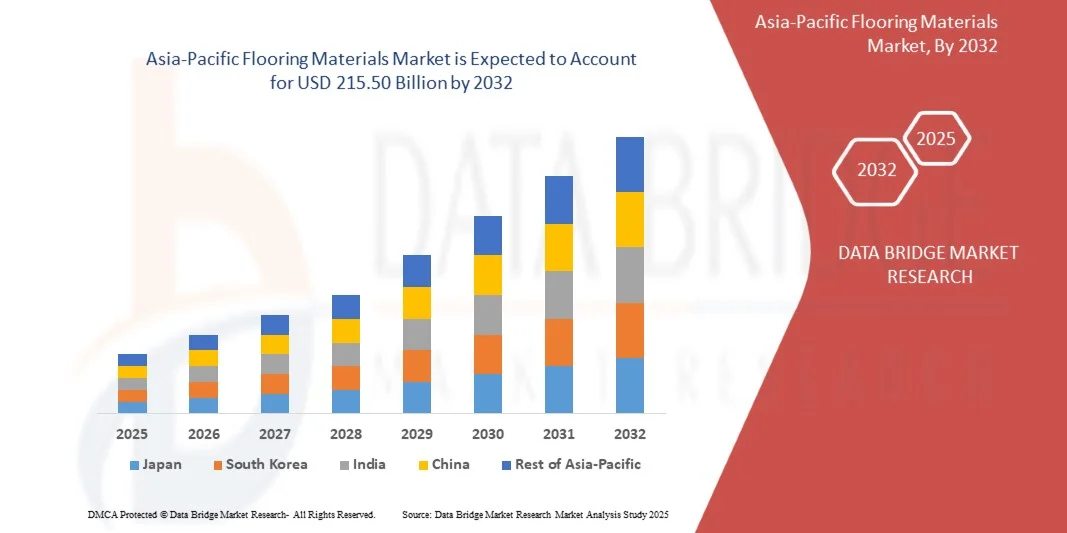
- The Asia-Pacific Flooring Materials Market size was valued at USD 135.21 billion in 2024 and is projected to reach USD 215.50 billion by 2032, growing at a CAGR of 6.00% during the forecast period
- Market expansion is primarily driven by rapid urbanization, increased construction activities, and rising investments in infrastructure development across residential and commercial sectors in the region
- Additionally, growing consumer preference for aesthetically appealing, durable, and sustainable flooring solutions is further propelling demand. These factors, coupled with technological innovations in eco-friendly materials, are significantly contributing to the market’s robust growth
Asia-Pacific Flooring Materials Market Analysis
- The Asia-Pacific Flooring Materials Market is becoming an essential segment within the construction and interior design industries, offering a wide range of products such as tiles, vinyl, laminate, carpet, and hardwood, which cater to both residential and commercial applications due to their durability, aesthetic appeal, and ease of maintenance
- Growing demand for flooring materials is primarily driven by rising urbanization, increasing investments in infrastructure and real estate development, and a surge in home renovation and remodeling projects across emerging economies in the region
- China dominated the Asia-Pacific flooring materials market with the largest revenue share of 36.6% in 2024, attributed to rapid construction growth, government-backed housing projects, and the presence of leading manufacturers focusing on cost-effective and innovative flooring solutions
- India s expected to be the fastest-growing regions in the flooring materials market during the forecast period, fueled by expanding middle-class populations, increasing disposable incomes, and heightened awareness of interior design trends
- The non-resilient flooring segment dominated the market with the largest revenue share of 47.8% in 2024, driven by strong demand for ceramic tiles and hardwood due to their long-lasting durability, aesthetic value, and suitability for high-traffic areas.
Report Scope and Asia-Pacific Flooring Materials Market Segmentation
|
Attributes |
Asia-Pacific Flooring Materials Key Market Insights |
|
Segments Covered |
|
|
Countries Covered |
Asia-Pacific
|
|
Key Market Players |
|
|
Market Opportunities |
|
|
Value Added Data Infosets |
In addition to the insights on market scenarios such as market value, growth rate, segmentation, geographical coverage, and major players, the market reports curated by the Data Bridge Market Research also include in-depth expert analysis, pricing analysis, brand share analysis, consumer survey, demography analysis, supply chain analysis, value chain analysis, raw material/consumables overview, vendor selection criteria, PESTLE Analysis, Porter Analysis, and regulatory framework. |
Asia-Pacific Flooring Materials Market Trends
“Rise of Sustainable and Smart Flooring Solutions”
- A significant and accelerating trend in the Asia-Pacific Flooring Materials Market is the growing integration of sustainable materials with smart and tech-enhanced flooring solutions. This shift is driven by increasing environmental regulations, consumer awareness of eco-friendly products, and the adoption of innovative technologies that enhance functionality and efficiency in both residential and commercial buildings.
- For instance, leading players like Forbo Flooring Systems and Tarkett are introducing bio-based and recyclable flooring products, such as linoleum and vinyl tiles made from renewable raw materials. These not only reduce environmental impact but also offer advanced features like anti-bacterial surfaces, acoustic insulation, and compatibility with underfloor heating systems, aligning with modern smart building requirements.
- Smart flooring technologies are also emerging, offering embedded sensors for applications in health monitoring, energy efficiency, and building automation. Some smart floor systems can track foot traffic, monitor indoor air quality, and adjust lighting or HVAC systems accordingly—integrating seamlessly with broader smart home or smart building ecosystems.
- Flooring solutions with digital printing and customization capabilities are gaining traction, enabling unique designs tailored to specific architectural and interior aesthetics. AI-powered design tools are also being employed by manufacturers to help clients visualize layouts and make informed purchasing decisions.
- This convergence of sustainability, design flexibility, and smart technology is reshaping how consumers and businesses approach flooring, transforming it from a passive surface to an active component of intelligent, environmentally responsible spaces.
- As a result, the demand for eco-conscious, functional, and tech-integrated flooring solutions is rapidly increasing across the Asia-Pacific region, particularly in urban centers and infrastructure projects where smart construction practices are being widely adopted.
Asia-Pacific Flooring Materials Market Dynamics
Driver
“Growing Demand Fueled by Urbanization, Aesthetic Preferences, and Infrastructure Growth”
- The rapid pace of urbanization across Asia-Pacific, coupled with growing investments in infrastructure, commercial buildings, and residential housing, is a key driver behind the expanding demand for modern flooring materials in the region.
- For Instance, India’s Smart Cities Mission and China’s large-scale urban development projects are fueling the demand for durable, cost-effective, and visually appealing flooring solutions in both public and private sector construction projects.
- Consumers are increasingly prioritizing aesthetic value, easy maintenance, and long-term performance, driving the popularity of materials such as vinyl, laminate, and engineered wood. These materials offer a wide variety of designs, textures, and finishes that mimic natural wood or stone at a more affordable price point.
- Moreover, rising awareness of sustainable living and the desire for eco-friendly building materials are influencing purchasing decisions, pushing manufacturers to innovate with recyclable, low-emission, and renewable flooring options.
- Technological advancements such as water-resistant vinyl flooring, digitally printed tiles, and smart flooring with embedded sensors are expanding the functional appeal of modern flooring systems in both residential and commercial segments.
- In parallel, the rise of e-commerce and digital platforms is making flooring products more accessible to consumers, allowing easier product comparison, visualization, and purchasing, thus contributing to market acceleration across urban and semi-urban areas.
Restraint/Challenge
“Volatile Raw Material Prices and Environmental Regulations”**
- A key challenge in the Asia-Pacific Flooring Materials Market is the volatility in raw material prices, particularly for PVC, wood, and petrochemical derivatives used in vinyl and laminate flooring. Fluctuating costs can disrupt supply chains and put pressure on manufacturer margins, making it harder to offer competitively priced products consistently.
- For instance, spikes in global oil prices or supply chain disruptions due to geopolitical tensions can directly impact the cost and availability of synthetic flooring materials.
- At the same time, strict environmental regulations in several countries are placing pressure on manufacturers to reduce emissions, improve energy efficiency, and limit the use of non-renewable materials. While this shift is positive for sustainability, it also introduces compliance costs and operational challenges, particularly for small and mid-sized manufacturers.
- Companies that fail to meet evolving environmental standards risk penalties, loss of market access, or reputational damage, especially as consumers and builders become more sustainability-conscious.
- Furthermore, the installation of certain flooring types, such as hardwood or large-format tiles, can require specialized labor and higher installation costs, potentially discouraging price-sensitive buyers or delaying project timelines.
- To overcome these restraints, industry players are increasingly investing in supply chain resilience, recycled content innovation, and compliance-driven manufacturing to balance environmental responsibility with competitive pricing and performance.
Asia-Pacific Flooring Materials Market Scope
The market is segmented on the basis of type, material type, distribution channel, and end use.
• By Type
On the basis of type, the North America flooring materials market is segmented into resilient flooring, non-resilient flooring, and soft covering. The non-resilient flooring segment dominated the market with the largest revenue share of 47.8% in 2024, driven by strong demand for ceramic tiles and hardwood due to their long-lasting durability, aesthetic value, and suitability for high-traffic areas. Non-resilient options are often preferred in both residential and commercial settings for their premium look and performance.
The resilient flooring segment is projected to grow at the fastest CAGR of 6.9% from 2025 to 2032, fueled by the rising adoption of luxury vinyl tiles (LVT), rubber, and linoleum. These materials offer superior flexibility, water resistance, and ease of installation, making them increasingly popular in healthcare, education, and hospitality sectors where hygiene, comfort, and safety are key considerations.
• By Material
Based on material, the market is segmented into vinyl, linoleum, rubber, carpet, ceramic tiles, wood, laminate, and others. The ceramic tiles segment held the largest market revenue share of 29.4% in 2024, attributed to its widespread use in kitchens, bathrooms, and commercial buildings. Ceramic tiles are valued for their durability, moisture resistance, and vast design options, making them a reliable choice for both aesthetic and functional purposes.
The vinyl segment is expected to grow at the fastest CAGR of 7.4% from 2025 to 2032, supported by increasing demand for luxury vinyl tiles (LVT) and planks in both new construction and renovation projects. Vinyl flooring is cost-effective, easy to maintain, and now offers high-end visual finishes resembling wood or stone, making it attractive for homeowners and developers seeking performance with design flexibility.
• By Distribution Channel
On the basis of distribution channel, the market is segmented into retail stores, online platforms, specialty stores, and others. The retail stores segment dominated the market with the largest revenue share of 52.1% in 2024, reflecting continued consumer preference for physical product evaluation, professional advice, and in-store installation services. Large home improvement chains and regional flooring retailers remain the primary channels for both residential and commercial buyers.
The online platforms segment is forecasted to register the fastest CAGR of 8.3% between 2025 and 2032, as digital transformation accelerates across the construction and home improvement industries. E-commerce platforms provide broader access to flooring materials, virtual visualization tools, and direct delivery, appealing especially to DIY consumers and price-sensitive buyers. Growth is also supported by an expanding presence of online-exclusive flooring brands and customization options.
• By End-Use
On the basis of end-use, the market is segmented into residential, commercial, industrial, institutional, and others. The residential segment held the largest market share of 44.6% in 2024, driven by strong demand from new housing developments, remodeling projects, and growing interest in interior aesthetics. The rising popularity of home improvement trends, coupled with investments in energy-efficient and smart homes, contributes to sustained residential demand for flooring upgrades across various material types.
The commercial segment is expected to grow at the fastest CAGR of 7.1% from 2025 to 2032, supported by construction in retail, office, and hospitality spaces. This growth is underpinned by the demand for durable, visually appealing, and easy-to-maintain flooring solutions. Additionally, sectors such as healthcare and education are increasingly investing in hygienic, slip-resistant flooring materials that meet regulatory standards while offering design flexibility.
Asia-Pacific Flooring Materials Market Regional Analysis
- China dominated the flooring materials market with the largest revenue share of 36.6% in 2024, driven by rapid urbanization, a construction boom, and rising demand for residential and commercial infrastructure across emerging economies like China, India, and Southeast Asia.
- Consumers in the region increasingly prioritize cost-effective, durable, and aesthetically appealing flooring solutions, with growing interest in materials such as ceramic tiles, vinyl, and laminate that offer both functionality and design versatility.
- This strong market growth is further fueled by rising disposable incomes, favorable government initiatives for housing and urban development, and the expansion of retail and hospitality sectors. Additionally, local manufacturing capabilities and rising awareness of eco-friendly building materials support continued demand, making Asia-Pacific a leading and high-potential region in the global flooring materials industry.
India Flooring Materials Market Insight
The India flooring materials market is projected to grow at a noteworthy CAGR during 2025–2032, driven by booming residential construction, a young population base, and increasing disposable incomes. Rapid urbanization and government initiatives like Pradhan Mantri Awas Yojana (PMAY) and Smart Cities Mission are significantly contributing to rising demand. The shift toward affordable housing, coupled with a growing middle class, is driving the popularity of ceramic tiles, vitrified tiles, and laminates. Additionally, the rising influence of interior design trends and e-commerce platforms is expanding product visibility and accessibility.
Japan Flooring Materials Market Insight
The Japan flooring materials market is witnessing steady growth, supported by a mature construction industry and increasing demand for technologically advanced, sustainable flooring options. The market is driven by renovation in residential units, the aging population’s need for safe and comfortable flooring, and demand for materials with acoustic and thermal insulation properties. Engineered wood, vinyl, and eco-friendly materials like linoleum are increasingly being adopted in both residential and commercial buildings, aligning with Japan’s strong focus on sustainability and precision engineering.
Asia-Pacific Flooring Materials Market Share
The Flooring Materials industry is primarily led by well-established companies, including:
- TOLI Corporation (Japan)
- AHF, LLC. (U.S.)
- Forbo Flooring Systems (Switzerland)
- Interface, Inc. (U.S.)
- Gerflor Group (France)
- RAK Ceramics (United Arab Emirates)
- Tarkett (France)
- Shaw Industries Group, Inc. (U.S.)
- Polyflor Ltd (U.K.)
- Karndean (U.K.)
- Carpet One Australasia Pty Ltd (Australia)
- Kajaria Ceramics Limited (India)
- Ceramiche Atlas Concorde S.p.A. (Italy)
- Milliken & Company (U.S.)
- EGGER (Austria)
- MOHAWK INDUSTRIES, INC. (U.S.)
What are the Recent Developments in Asia-Pacific Flooring Materials Market?
- In May 2024, Tarkett Asia Pacific, a global leader in sustainable and innovative flooring solutions, launched a new range of PVC-free vinyl flooring in India. Designed to meet rising environmental regulations and health-conscious consumer demand, this product line emphasizes low VOC emissions and recyclability. The launch aligns with Tarkett’s broader sustainability roadmap and reinforces its presence in fast-growing Asian markets by addressing both environmental concerns and modern design expectations in residential and commercial construction.
- In April 2024, Forbo Flooring Systems expanded its linoleum production capabilities in Southeast Asia through a strategic investment in a new manufacturing unit in Vietnam. The move supports increasing regional demand for eco-friendly flooring in healthcare, education, and public infrastructure projects. By boosting local supply and reducing lead times, Forbo is enhancing its competitive position while promoting the adoption of renewable flooring solutions across Asia-Pacific.
- In March 2024, RAK Ceramics opened its largest experience center in Jakarta, Indonesia, showcasing its premium range of ceramic and vitrified tiles tailored for Southeast Asian consumer preferences. This initiative marks RAK’s deepening engagement in the region's construction boom and its commitment to delivering high-performance, design-forward flooring materials. The center also serves as a hub for architects and designers to explore innovative flooring applications in both residential and commercial environments.
- In February 2024, Shaw Industries Group, Inc. announced the launch of its PET-based recyclable carpet tiles in the Asia-Pacific market, beginning with Australia and South Korea. These sustainable products target the commercial sector—especially offices, hospitality, and education—responding to increasing demand for circular materials and green building certifications. The launch reflects Shaw’s strategic focus on expanding its sustainable offerings and its footprint in environmentally conscious markets.
- In January 2024, Interface, Inc., a global modular flooring manufacturer, introduced its new carbon-negative carpet tile series across major Asia-Pacific markets, including Japan and Singapore. This innovation builds on Interface’s mission to reverse global warming and supports growing regional demand for net-zero construction materials. The collection is manufactured using carbon-negative materials and processes, providing architects and developers with both performance and environmental value

- Interactive Data Analysis Dashboard
- Company Analysis Dashboard for high growth potential opportunities
- Research Analyst Access for customization & queries
- Competitor Analysis with Interactive dashboard
- Latest News, Updates & Trend analysis
- Harness the Power of Benchmark Analysis for Comprehensive Competitor Tracking
Asia Pacific Flooring Materials Market, Supply Chain Analysis and Ecosystem Framework
To support market growth and help clients navigate the impact of geopolitical shifts, DBMR has integrated in-depth supply chain analysis into its Asia Pacific Flooring Materials Market research reports. This addition empowers clients to respond effectively to global changes affecting their industries. The supply chain analysis section includes detailed insights such as Asia Pacific Flooring Materials Market consumption and production by country, price trend analysis, the impact of tariffs and geopolitical developments, and import and export trends by country and HSN code. It also highlights major suppliers with data on production capacity and company profiles, as well as key importers and exporters. In addition to research, DBMR offers specialized supply chain consulting services backed by over a decade of experience, providing solutions like supplier discovery, supplier risk assessment, price trend analysis, impact evaluation of inflation and trade route changes, and comprehensive market trend analysis.
Data collection and base year analysis are done using data collection modules with large sample sizes. The stage includes obtaining market information or related data through various sources and strategies. It includes examining and planning all the data acquired from the past in advance. It likewise envelops the examination of information inconsistencies seen across different information sources. The market data is analysed and estimated using market statistical and coherent models. Also, market share analysis and key trend analysis are the major success factors in the market report. To know more, please request an analyst call or drop down your inquiry.
The key research methodology used by DBMR research team is data triangulation which involves data mining, analysis of the impact of data variables on the market and primary (industry expert) validation. Data models include Vendor Positioning Grid, Market Time Line Analysis, Market Overview and Guide, Company Positioning Grid, Patent Analysis, Pricing Analysis, Company Market Share Analysis, Standards of Measurement, Global versus Regional and Vendor Share Analysis. To know more about the research methodology, drop in an inquiry to speak to our industry experts.
Data Bridge Market Research is a leader in advanced formative research. We take pride in servicing our existing and new customers with data and analysis that match and suits their goal. The report can be customized to include price trend analysis of target brands understanding the market for additional countries (ask for the list of countries), clinical trial results data, literature review, refurbished market and product base analysis. Market analysis of target competitors can be analyzed from technology-based analysis to market portfolio strategies. We can add as many competitors that you require data about in the format and data style you are looking for. Our team of analysts can also provide you data in crude raw excel files pivot tables (Fact book) or can assist you in creating presentations from the data sets available in the report.













