


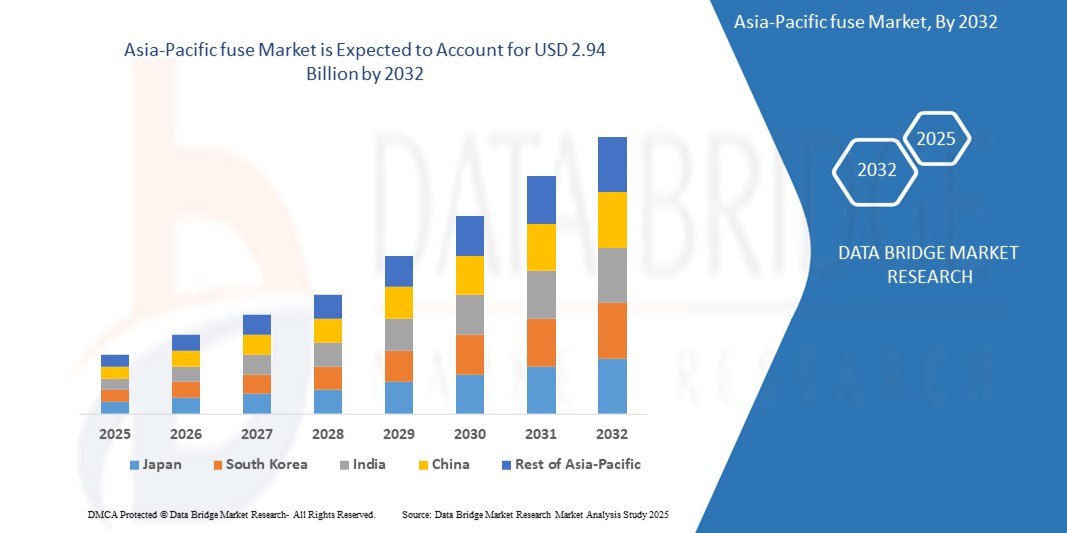
Asia-Pacific fuse Market Size
- The Asia-Pacific fuse market size was valued at USD 1.42 billion in 2024 and is expected to reach USD 2.94 billion by 2032, at a CAGR of 9.50% during the forecast period
- The market growth is largely fuelled by rising industrialization, expanding power infrastructure, and growing adoption of electric vehicles and renewable energy systems across the region
- Increasing investments in smart grid development and the demand for reliable overcurrent protection in consumer electronics and manufacturing facilities further contribute to the market expansion
Asia-Pacific Fuse Market Analysis
- The Asia-Pacific fuse market is gaining traction as manufacturers focus on developing compact, high-performance solutions for modern electrical systems
- Strong demand from power and electronics sectors is driving consistent growth, supported by innovations tailored to complex circuit protection needs
- China dominates the Asia-Pacific fuse market holding the largest market share in Asia-Pacific in 2024, owing to its vast industrial base and aggressive infrastructure expansion
- Japan is expected to witness the highest compound annual growth rate in the Asia-Pacific fuse market due to its strong focus on advanced industrial automation and smart manufacturing technologies
- The cartridge type Asia-Pacific fuses segment dominates the largest market revenue share in 2024, owing to its widespread application in industrial and residential electrical systems for effective overcurrent protection. These Asia-Pacific fuses are valued for their ability to safely interrupt fault currents and protect sensitive equipment, contributing to system reliability and safety
Report Scope and Asia-Pacific Fuse Market Segmentation
|
Attributes |
Asia-Pacific Fuse Key Market Insights |
|
Segments Covered |
|
|
Countries Covered |
Asia-Pacific
|
|
Key Market Players |
|
|
Market Opportunities |
|
|
Value Added Data Infosets |
In addition to the insights on market scenarios such as market value, growth rate, segmentation, geographical coverage, and major players, the market reports curated by the Data Bridge Market Research also include in-depth expert analysis, geographically represented company-wise production and capacity, network layouts of distributors and partners, detailed and updated price trend analysis and deficit analysis of supply chain and demand. |
Asia-Pacific Fuse Market Trends
“Shift Towards Compact and High-Performance Fuses in Industrial Applications”
- Compact fuses are being preferred for integration into miniaturized electronic assemblies used in smart manufacturing systems
- The automotive industry is using compact high-voltage fuses in electric vehicle platforms to safeguard batteries and control units
- For instance, leading fuse manufacturers in Japan and South Korea are launching miniature fuses with enhanced thermal and interrupting capabilities
- These fuses support high-speed circuit protection, crucial in robotics and automated production lines
- For instance, semiconductor manufacturing equipment increasingly incorporates micro fuses to prevent damage from power fluctuations
Asia-Pacific Fuse Market Dynamics
Driver
“Expansion of Industrial Automation and Smart Manufacturing”
- The rapid expansion of industrial automation and smart manufacturing in countries such as China, Japan, South Korea, and India is significantly boosting the demand for fuses as essential circuit protection components
- Adoption of Industry 4.0 technologies, including robotics and interconnected machines, requires high-performance fuses to safeguard against overcurrent and short circuits in advanced systems
- Fuses are increasingly preferred in modern automation environments due to their fast response times and compatibility with compact, high-efficiency designs
- The electronics and semiconductor sectors, especially in Taiwan and South Korea, are driving fuse demand with applications such as chip fabrication units that require precise, uninterrupted power protection
- For instance, Samsung’s fully automated manufacturing facility in South Korea integrates high-capacity fuses to protect critical robotic lines, ensuring operational safety and minimal downtime
- For instance, Taiwan’s semiconductor plants, such as those run by TSMC, use advanced fuses to safeguard cleanroom power systems and sensitive fabrication equipment against electrical faults
Restraint/Challenge
“Cost-Pressure and Availability of Alternatives”
- One major challenge for the Asia-Pacific fuse market is growing competition from alternative circuit protection devices such as resettable circuit breakers and solid-state protection systems that offer longer lifespans and reset capabilities
- Industries are increasingly adopting smart energy management and automation systems, which favour circuit breakers for their compatibility with remote monitoring and centralized control
- For instance, smart building projects in cities such as Tokyo and Shanghai prefer circuit breakers integrated with building management systems for enhanced efficiency and control
- While fuses provide fast-acting, simple protection, their need for manual replacement after faults results in higher downtime and maintenance costs compared to resettable alternatives
- Cost sensitivity in many Asia-Pacific markets encourages preference for long-term, low-maintenance protection solutions, challenging fuse manufacturers to innovate to maintain market relevance
Asia-Pacific Fuse Market Scope
The Asia-Pacific fuse market is segmented on the basis of product type, voltage type, and end user.
- By Product Type
On the basis of product type, the Asia-Pacific fuse market is segmented into cartridge type fuses, rewireable fuses, switch type fuses, drop out type fuses, striker type fuses, expulsion type high rupturing capacity fuses, liquid type-high rupturing capacity fuses, cartridge type high rupturing capacity fuses, and accessories. The cartridge type fuses segment dominates the largest market revenue share in 2024, owing to its widespread application in industrial and residential electrical systems for effective overcurrent protection. These fuses are valued for their ability to safely interrupt fault currents and protect sensitive equipment, contributing to system reliability and safety.
The expulsion types high rupturing capacity fuses segment is expected to witness the fastest growth rate from 2025 to 2032, due to their reliable performance in power distribution and transformer protection. The growing infrastructure projects boost the need for fuse accessories, supporting installation and maintenance activities. Moreover, increasing urbanization and industrialization are driving the expansion of electrical networks, which further fuels demand for durable and efficient fuse solutions. Advances in fuse technology, such as improved materials and design for higher breaking capacity, are also encouraging adoption across diverse applications. This combination of factors ensures sustained growth and innovation within the cartridge and expulsion Asia-Pacific fuse segments.
- By Type
On the basis of type, the Asia-Pacific fuse market is segmented into AC fuses and DC fuses. The AC fuses segment holds the largest market revenue share in 2024, driven by their widespread use in residential, commercial, and industrial electrical systems due to compatibility with standard alternating current applications. AC fuses are favoured for protecting circuits in power distribution and electrical equipment across various sectors, ensuring reliable overcurrent protection and system safety.
The DC fuses segment is expected to witness the fastest growth rate from 2025 to 2032, fuelled by increasing demand in emerging applications such as electric vehicles, renewable energy systems, and battery storage solutions. DC fuses are critical in these setups due to their ability to safely interrupt direct current, which is more challenging to manage than alternating current. Their growing adoption in automotive and solar power industries highlights their expanding role in the evolving energy landscape.
- By Voltage Type
On the basis of voltage type, the Asia-Pacific fuse market is segmented into low voltage, medium voltage, and high voltage. The low voltage segment holds the largest market revenue share in 2024, driven by extensive usage in consumer electronics, automotive, and building electrical systems requiring reliable protection. This segment benefits from the increasing demand for compact and efficient circuit protection solutions in household appliances and electric vehicles. In addition, the rise of smart homes and IoT devices further fuels the need for low voltage Asia-Pacific fuses that ensure safety and system integrity.
The medium voltage segment is expected to witness the fastest growth rate from 2025 to 2032, due to expanding power grids and industrial automation. Investments in upgrading aging electrical infrastructure and the integration of renewable energy sources contribute to this growth. High voltage fuses, although smaller in market size, are critical for protecting high-capacity electrical transmission and large industrial operations. They play a vital role in ensuring grid stability and preventing costly equipment failures in power plants and heavy industries. The rising focus on reliable energy distribution systems worldwide is expected to support steady demand in this segment.
- By End User
On the basis of end user, the market is segmented into transportation, construction, oil and gas, power generation, telecom, electrical and electronics, healthcare, mining, food and beverage, and others. The electrical and electronics segment accounts for the largest market revenue share in 2024, fuelled by the rising complexity and number of electronic devices requiring efficient circuit protection. Growth in consumer electronics, industrial automation, and communication devices further drives demand for reliable fuses to prevent damage from electrical faults. Continuous innovation in miniaturization and the integration of smart technology in electronics also contribute to this segment’s expansion.
The transportation and power generation segments is expected to witness the fastest growth rate from 2025 to 2032, supported by increased electrification and infrastructure modernization efforts worldwide. In transportation, the shift toward electric and hybrid vehicles is creating higher demand for specialized fuses designed to handle high voltages and currents. Similarly, power generation is evolving with the integration of renewable energy sources, requiring advanced fuse solutions for grid protection and stability. Government initiatives aimed at upgrading infrastructure and enhancing energy efficiency further accelerate market growth in these sectors.
Asia-Pacific Fuse Market Regional Analysis
- China dominates the Asia-Pacific fuse market holding the largest market share in Asia-Pacific in 2024, owing to its vast industrial base and aggressive infrastructure expansion.
- The country’s focus on upgrading its power grid and increasing electrical equipment manufacturing drives demand for advanced Asia-Pacific fuse technologies
- In addition, government initiatives promoting smart grid development and renewable energy integration further enhance market growth
Japan Asia-Pacific Fuse Market Insight
The Japan’s Asia-Pacific fuse market is expected to witness the fastest growth rate from 2025 to 2032, due to strong industrial demand and a focus on electrical safety and quality. The country’s investment in smart grid technology and renewable energy drives the need for advanced fuse solutions. Infrastructure upgrades and high adoption of electronics and automotive technologies also support market growth. Compact, high-performance fuses remain in demand across multiple sectors.
Asia-Pacific Fuse Market Share
The Asia-Pacific fuse industry is primarily led by well-established companies, including:
- Fuji Electric Co., Ltd. (Japan)
- HINODE ELECTRIC CO., LTD. (Japan)
- Pacific Engineering Corporation (Japan)
- Matsuo Electric Co., Ltd. (Japan)
- Panasonic Corporation (Japan)
- Lucy Group Ltd. (India)
Latest Developments in Asia-Pacific Fuse Market
- In March 2022, Mersen announced the launch of non-indicating versions of its A2D and A6D Series Asia-Pacific fuses as part of its product development efforts. These additions expand the Class RK1 Time Delay Asia-Pacific fuse lineup, now available in both indicating and non-indicating models with amperage ratings ranging from 8 to 600A. This development enhances flexibility for users by offering more options suited to diverse electrical protection needs. The new variants are expected to improve system customization and operational efficiency across industrial applications. This move strengthens Mersen's position in the Asia-Pacific fuse market and supports growing demand for versatile and reliable circuit protection solutions.

- Interactive Data Analysis Dashboard
- Company Analysis Dashboard for high growth potential opportunities
- Research Analyst Access for customization & queries
- Competitor Analysis with Interactive dashboard
- Latest News, Updates & Trend analysis
- Harness the Power of Benchmark Analysis for Comprehensive Competitor Tracking
Asia Pacific Fuse Market, Supply Chain Analysis and Ecosystem Framework
To support market growth and help clients navigate the impact of geopolitical shifts, DBMR has integrated in-depth supply chain analysis into its Asia Pacific Fuse Market research reports. This addition empowers clients to respond effectively to global changes affecting their industries. The supply chain analysis section includes detailed insights such as Asia Pacific Fuse Market consumption and production by country, price trend analysis, the impact of tariffs and geopolitical developments, and import and export trends by country and HSN code. It also highlights major suppliers with data on production capacity and company profiles, as well as key importers and exporters. In addition to research, DBMR offers specialized supply chain consulting services backed by over a decade of experience, providing solutions like supplier discovery, supplier risk assessment, price trend analysis, impact evaluation of inflation and trade route changes, and comprehensive market trend analysis.
Data collection and base year analysis are done using data collection modules with large sample sizes. The stage includes obtaining market information or related data through various sources and strategies. It includes examining and planning all the data acquired from the past in advance. It likewise envelops the examination of information inconsistencies seen across different information sources. The market data is analysed and estimated using market statistical and coherent models. Also, market share analysis and key trend analysis are the major success factors in the market report. To know more, please request an analyst call or drop down your inquiry.
The key research methodology used by DBMR research team is data triangulation which involves data mining, analysis of the impact of data variables on the market and primary (industry expert) validation. Data models include Vendor Positioning Grid, Market Time Line Analysis, Market Overview and Guide, Company Positioning Grid, Patent Analysis, Pricing Analysis, Company Market Share Analysis, Standards of Measurement, Global versus Regional and Vendor Share Analysis. To know more about the research methodology, drop in an inquiry to speak to our industry experts.
Data Bridge Market Research is a leader in advanced formative research. We take pride in servicing our existing and new customers with data and analysis that match and suits their goal. The report can be customized to include price trend analysis of target brands understanding the market for additional countries (ask for the list of countries), clinical trial results data, literature review, refurbished market and product base analysis. Market analysis of target competitors can be analyzed from technology-based analysis to market portfolio strategies. We can add as many competitors that you require data about in the format and data style you are looking for. Our team of analysts can also provide you data in crude raw excel files pivot tables (Fact book) or can assist you in creating presentations from the data sets available in the report.













