Gelcoat Market Size
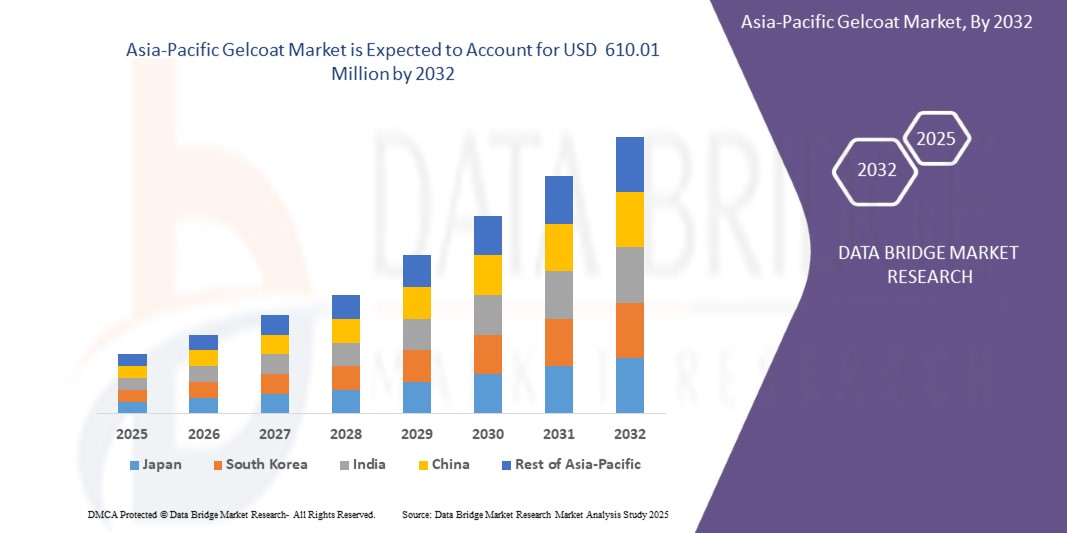
- The Asia-Pacific Gelcoat market size was valued at USD 287.78 Million in 2024 and is expected to reach USD 610.01 Million by 2032, at a CAGR of 13.3% during the forecast period
- The market growth is largely fueled by rising demand for high-performance, weather-resistant coatings in marine and automotive industries, increasing construction activities across Asia Pacific, technological advancements in gelcoat formulations, growing preference for corrosion-resistant materials, and expanding use of composites in infrastructure and consumer goods manufacturing.
- Furthermore, government initiatives promoting sustainable construction, increasing investments in renewable energy sectors, rising consumer awareness about product durability, and the growing trend of lightweight materials in automotive manufacturing are driving the accelerated adoption of gelcoat products across the Asia Pacific region.
Gelcoat Market Analysis
- The gelcoat market is expanding rapidly due to its essential role in protecting composite surfaces from environmental damage, UV exposure, and corrosion, especially in marine, automotive, and construction sectors, driving increased product demand globally.
- Technological innovations, such as eco-friendly and high-performance gelcoat formulations, coupled with rising infrastructure development and growing preference for durable, aesthetic finishes, are key factors shaping the competitive landscape and fueling market growth
- China dominates the Gelcoat market with a 40% revenue share in 2025, driven by its robust manufacturing and shipbuilding industries, significant government investments in infrastructure, rapid growth in wind energy projects, and increasing demand from automotive and construction sectors.
- Additionally, China’s expanding urbanization, rising disposable incomes, advancements in eco-friendly gelcoat technologies, and strong export activities further propel market growth, making it a central hub for gelcoat production and consumption in the Asia-Pacific region.
- The Standard Gelcoat segment is expected to dominate the Gelcoat market with a significant share of around 58% in 2025, driven by its high efficiency in aggregating suspended particles, wide application across industries, and cost-effectiveness in water treatment pro.
Report Scope and Gelcoat Market Segmentation
|
Attributes |
Gelcoat Key Market Insights |
|
Segments Covered |
|
|
Countries Covered |
Asia-Pacific
|
|
Key Market Players |
|
|
Market Opportunities |
|
|
Value Added Data Infosets |
In addition to the insights on market scenarios such as market value, growth rate, segmentation, geographical coverage, and major players, the market reports curated by the Data Bridge Market Research also include in-depth expert analysis, pricing analysis, brand share analysis, consumer survey, demography analysis, supply chain analysis, value chain analysis, raw material/consumables overview, vendor selection criteria, PESTLE Analysis, Porter Analysis, and regulatory framework. |
Gelcoat Market Trends
“Rising use of bio-based gelcoats”
- Increasing environmental regulations globally are compelling manufacturers to adopt bio-based gelcoats, which reduce harmful emissions and promote sustainability in industrial coatings. This shift aligns with corporate social responsibility goals and helps companies meet stringent ecological standards.
- Bio-based gelcoats use renewable raw materials like plant oils and natural resins, significantly lowering reliance on fossil fuels. This sustainable sourcing reduces the carbon footprint of manufacturing processes and supports circular economy principles.
- Growing consumer demand for eco-friendly and non-toxic products is driving industries to replace conventional gelcoats with biodegradable and safer alternatives. This trend is especially strong in markets with heightened environmental awareness and green purchasing behaviors.
- Advances in biotechnology and material science are improving the durability, chemical resistance, and overall performance of bio-based gelcoats, making them competitive with traditional petroleum-based options without compromising quality.
- Government incentives, subsidies, and environmental policies in various countries encourage research and commercialization of bio-based coatings. These supportive frameworks accelerate market adoption and innovation in sustainable gelcoat technologies across industries.
Gelcoat Market Dynamics
Driver
“Technological innovation enhances clarifier efficiency and market adoption”
- Stricter global environmental regulations are compelling industries to shift from traditional gelcoats to bio-based alternatives that emit fewer VOCs and reduce pollution, ensuring compliance with sustainability mandates and minimizing ecological impact across manufacturing processes.
- Rising consumer awareness about environmental sustainability is pushing manufacturers to offer greener products, leading to increased demand for bio-based gelcoats that use renewable resources and support eco-friendly product portfolios.
- Government incentives and subsidies for sustainable manufacturing encourage companies to invest in bio-based gelcoat R&D, accelerating market penetration and innovation of environmentally friendly coating solutions.
- Corporate sustainability commitments and green branding strategies are motivating industries to switch to bio-based gelcoats, aligning product offerings with market expectations and improving overall brand reputation among eco-conscious consumers.
- Increasing global focus on reducing carbon footprints and combating climate change is driving demand for bio-based gelcoats, as these products help manufacturers lower greenhouse gas emissions and meet international environmental targets.
Restraint/Challenge
“High costs and performance concerns limit bio-based gelcoat adoption”
- Bio-based gelcoats generally have higher production costs due to expensive raw materials and complex manufacturing processes, making them less competitive compared to conventional gelcoats in price-sensitive markets.
- Limited availability and supply chain challenges of sustainable raw materials can disrupt consistent production, restricting large-scale adoption of bio-based gelcoats in industrial applications.
- Some bio-based gelcoats currently exhibit lower mechanical strength and chemical resistance than traditional formulations, causing manufacturers to hesitate due to potential performance trade-offs.
- Lack of long-term durability data and standardized testing protocols for bio-based gelcoats generates uncertainty about their reliability in demanding applications like marine and automotive coatings.
- Higher costs of certification and regulatory approval for new bio-based formulations add barriers for manufacturers, slowing product launches and wider market acceptance despite environmental benefits.
Gelcoat Market Scope
The market is segmented on the basis of product type, resin, application method and end-user.
- By Product Type
On the basis of product type, the Gelcoat market is segmented into standard gelcoat and specialty gelcoat. The standard gelcoat segment dominates the largest market revenue share of approximately 55% in 2025, driven by their cost-effectiveness, wide applicability across marine and automotive industries, excellent surface protection, and strong demand for durable, high-quality finishes.
The standard gelcoat segment is anticipated to witness the fastest growth rate of around 6.2% CAGR from 2025 to 2032, fueled by increasing demand for affordable, versatile coatings in marine, automotive, and construction industries, alongside advancements enhancing durability and ease of application.
- By Resin
On the basis of resin, the Gelcoat market is segmented in to polyester, vinyl ester, epoxy and others. The polyester segment drives the Gelcoat market due to its excellent chemical resistance, cost-effectiveness, and ease of application. Its widespread use in marine, automotive, and construction industries for durable, weather-resistant coatings fuels demand. Additionally, continuous improvements in polyester formulations enhance performance, further boosting market growth.
The polyester segment is expected to witness the fastest CAGR from 2025 to 2032, driven by its affordability, versatility, and strong demand in marine and automotive industries, alongside innovations improving durability, chemical resistance, and environmental compliance, fueling broader adoption globally.
- By Application Method
On the basis of application method, the Gelcoat market is segmented in to spray, brush and roller. The spray segment drives the Gelcoat market due to its efficient application, uniform coating thickness, and suitability for large-scale manufacturing. It enables faster production, reduces material waste, and provides superior surface finish, making it preferred in marine, automotive, and construction industries.
The spray segment is expected to witness the fastest CAGR from 2025 to 2032, driven by its ability to deliver consistent, high-quality coatings efficiently, reduce labor costs, and support automation in manufacturing processes across marine, automotive, and industrial applications.
- By End-User
On the basis of end-user, the Gelcoat market is segmented in to Construction and Architecture, Healthcare and Medical, Hospitality, Retail, Automotive and Transportation, Food and Beverages, Electrical and Electronics, Sanitary Ware. The construction and architecture segment drives the Gelcoat market due to increasing demand for durable, weather-resistant, and aesthetically appealing surface coatings. Gelcoats offer excellent protection against corrosion, UV radiation, and wear, making them ideal for decorative panels, facades, and infrastructure components in modern construction projects.
The construction and architecture segment is expected to witness the fastest CAGR from 2025 to 2032, driven by rising urbanization, infrastructure development, and increasing preference for durable, low-maintenance, and visually appealing materials in modern building designs, particularly in emerging Asia-Pacific economies.
Gelcoat Market Regional Analysis
- China dominates the Gelcoat market with a 40% revenue share in 2025, driven by its robust manufacturing and shipbuilding industries, significant government investments in infrastructure, rapid growth in wind energy projects, and increasing demand from automotive and construction sectors.
- The country’s expanding wind energy sector drives demand for gelcoats in turbine blade manufacturing. Additionally, rising automotive production and modernization of construction industries contribute significantly to market growth, supported by technological advancements and increasing adoption of eco-friendly and efficient gelcoat solutions across various end-use sectors.
- China’s focus on research and development in advanced coating technologies enhances gelcoat quality and performance, attracting global manufacturers. Moreover, growing export activities and favorable trade policies strengthen China’s position as a key gelcoat supplier in the Asia-Pacific region, driving sustained market growth through increased production and innovation.
Japan Gelcoat Market Insight
The Japan Gelcoat market captured the largest revenue share of approximately 28% within Asia-Pacific (APAC) in 2025, driven by its advanced automotive and electronics manufacturing sectors, strong demand for high-performance coatings, and continuous innovation in gelcoat formulations to meet stringent quality and environmental standards.
South Korea Gelcoat Market Insight
The South Korea market is projected to expand at a substantial CAGR due to stringent environmental regulations, increasing investments in water and wastewater treatment infrastructure, technological advancements, and growing awareness about water conservation and pollution control across industrial and municipal sectors.
Gelcoat Market Share
The Gelcoat industry is primarily led by well-established companies, including:
- Ashland Global Holdings Inc. (United States)
- Axalta Coating Systems Ltd. (United States)
- RPM International Inc. (United States)
- PPG Industries, Inc. (United States)
- Sherwin-Williams Company (United States)
- Allnex (Germany)
- Valspar Corporation (United States)
- Jotun Group (Norway)
- BASF SE (Germany)
- Kansai Paint Co., Ltd. (Japan)
- Nippon Paint Holdings Co., Ltd. (Japan)
- Akzo Nobel N.V. (Netherlands)
- Axson Technologies (France)
- Chugoku Marine Paints, Ltd. (Japan)
- Hempel A/S (Denmark)
Latest Developments in Asia-Pacific Gelcoat Market
- In March 2024, INEOS Automotive and BASF's Coatings division entered a strategic partnership to enhance vehicle refinishing technologies globally. The collaboration focuses on sustainable refinishing solutions, advanced digital color-matching technologies, and comprehensive training programs, aiming to set new industry standards in vehicle body repair and paint refinishing.
- In June 2023, Scott Bader Australia Pty Ltd acquired Summit Composites Pty Ltd, expanding its distribution of gelcoats, high-performance resins, and adhesives in the Australian market. This strategic acquisition reinforces Scott Bader's commitment to maintaining a strong presence in the Australian composites industry.
- In January 2024, INEOS Automotive and BASF's Coatings division announced a global agreement to advance vehicle refinishing, bodywork, and paint technology. The partnership aims to provide sustainable refinishing solutions, innovative digital color-matching technologies, and training, enhancing the quality and efficiency of vehicle body repairs.
- In March 2024, A consortium of Toshiba, Hitachi, Zosen Corp, and JFE Steel initiated the construction of the world's largest offshore wind farm off the Fukushima coast in Japan. The project, featuring up to 143 floating turbines, is expected to boost demand for gelcoats used in turbine blade protection.
- In April 2024, At the I2U2 Summit, leaders announced the UAE's $2 billion investment to develop a network of food parks in India. Additionally, plans for a hybrid renewable energy project in Gujarat, encompassing 300 MW of wind and solar capacity with battery storage, are set to increase gelcoat demand in energy infrastructure.

- Interactive Data Analysis Dashboard
- Company Analysis Dashboard for high growth potential opportunities
- Research Analyst Access for customization & queries
- Competitor Analysis with Interactive dashboard
- Latest News, Updates & Trend analysis
- Harness the Power of Benchmark Analysis for Comprehensive Competitor Tracking
Data collection and base year analysis are done using data collection modules with large sample sizes. The stage includes obtaining market information or related data through various sources and strategies. It includes examining and planning all the data acquired from the past in advance. It likewise envelops the examination of information inconsistencies seen across different information sources. The market data is analysed and estimated using market statistical and coherent models. Also, market share analysis and key trend analysis are the major success factors in the market report. To know more, please request an analyst call or drop down your inquiry.
The key research methodology used by DBMR research team is data triangulation which involves data mining, analysis of the impact of data variables on the market and primary (industry expert) validation. Data models include Vendor Positioning Grid, Market Time Line Analysis, Market Overview and Guide, Company Positioning Grid, Patent Analysis, Pricing Analysis, Company Market Share Analysis, Standards of Measurement, Global versus Regional and Vendor Share Analysis. To know more about the research methodology, drop in an inquiry to speak to our industry experts.
Data Bridge Market Research is a leader in advanced formative research. We take pride in servicing our existing and new customers with data and analysis that match and suits their goal. The report can be customized to include price trend analysis of target brands understanding the market for additional countries (ask for the list of countries), clinical trial results data, literature review, refurbished market and product base analysis. Market analysis of target competitors can be analyzed from technology-based analysis to market portfolio strategies. We can add as many competitors that you require data about in the format and data style you are looking for. Our team of analysts can also provide you data in crude raw excel files pivot tables (Fact book) or can assist you in creating presentations from the data sets available in the report.