




Asia Pacific Gene Synthesis Market
Market Size in USD Billion
CAGR :
% 
 USD
1.03 Billion
USD
6.02 Billion
2025
2033
USD
1.03 Billion
USD
6.02 Billion
2025
2033
 Forecast Period Forecast Period |
2026 - 2033 |
 Market Size (Base Year) Market Size (Base Year) |
USD 1.03 Billion |
 Market Size (Forecast Year) Market Size (Forecast Year) |
USD 6.02 Billion |
 CAGR CAGR |
% |
| Major Markets Players |
|
Asia-Pacific Gene Synthesis Market Overview
The Asia-Pacific gene synthesis market was valued at USD 1.03 billion in 2025 and is projected to reach USD 6.02 billion by 2033, growing at a CAGR of 24.70% from 2026 to 2033. The market is witnessing strong expansion driven by rapid advancements in synthetic biology, increasing investments in genomics research, and the growing adoption of precision medicine across the region. Rising demand from pharmaceutical companies, biotechnology firms, and academic research institutions is further accelerating market development.
The increasing prevalence of genetic disorders, infectious diseases, and cancer across Asia-Pacific, combined with government initiatives supporting biotechnology innovation, is significantly boosting the adoption of gene synthesis technologies. In addition, the expansion of local biopharma manufacturing capabilities, cost advantages in outsourcing, and improving regulatory frameworks are encouraging both global and regional players to scale their operations in the market.
Key Market Trends & Insights
- China dominated the Asia-Pacific gene synthesis market with the largest revenue share of 42.18% in 2025, supported by strong government biotechnology funding, large-scale synthetic biology clusters, and rapid expansion of domestic biopharmaceutical companies.
- The Consumables segment led the market with a 46.82% share in 2025, driven by continuous and recurring demand for nucleotides, enzymes, primers, and reagents used in DNA synthesis workflows.
- India is expected to be the fastest-growing country at a CAGR of 13.4% from 2026 to 2033, fueled by rising genomic research activities, expanding biotech startup ecosystems, and increasing contract research and manufacturing outsourcing.
- Software & Services are the fastest-growing component type, projected to register a CAGR of 13.6%, reflecting the surge in adoption of AI-based gene design platforms and cloud-enabled bioinformatics tools.
- The Standard Gene segment dominated the gene type category with a 52.14% revenue share in 2025, led by high demand for routine DNA constructs used in basic research, cloning, and genetic engineering experiments.
- Synthetic Biology accounted for 38.67% of the market, preferred by extensive use of engineered DNA constructs in industrial biotechnology, healthcare innovation, and agricultural applications.
- The Therapeutic Antibodies segment is the fastest-growing application category, with a CAGR of 14.5%, driven by rising demand for biologics, monoclonal antibodies, and personalized immunotherapies.
Market Size & Forecast
- Global Market Value (2025): USD 1.03 Billion
- Expected Market Value (2033): USD 6.02 Billion
- Forecast CAGR (2026–2033): 24.70%
- Leading Country in 2025: China
- Fastest Growing Country: India
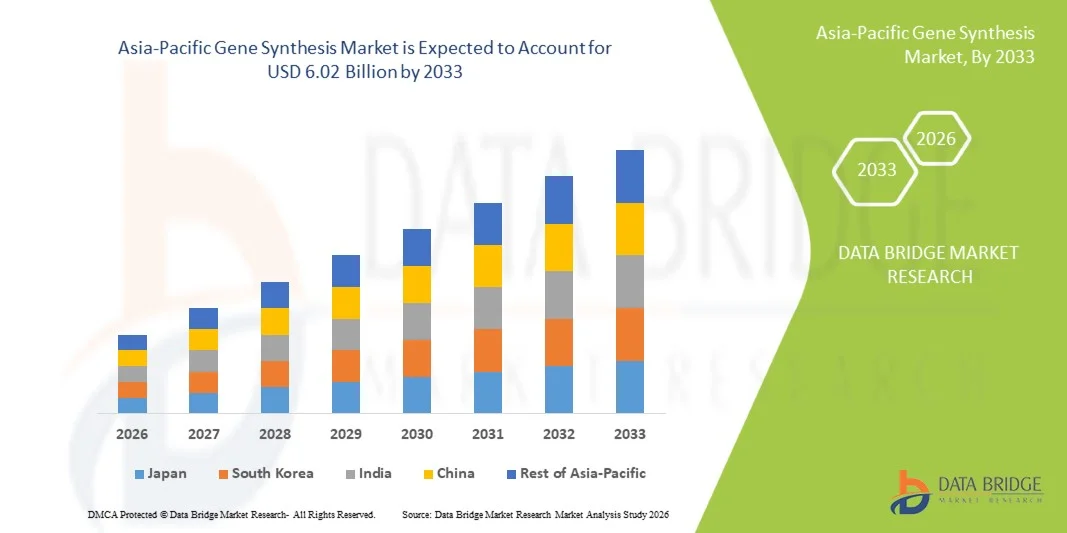
Report Scope and Asia-Pacific Gene Synthesis Market Segmentation
|
Attributes |
Asia-Pacific Gene Synthesis Key Market Insights |
|
Segments Covered |
|
|
Countries Covered |
Asia-Pacific · China · Japan · India · South Korea · Singapore · Malaysia · Australia · Thailand · Indonesia · Philippines · Rest of Asia-Pacific |
|
Key Market Players |
· GenScript Biotech Corporation (China) · BGI Genomics Co., Ltd. (China) · WuXi Biologics Inc. (China) · Thermo Fisher Scientific, Inc. (U.S.) · Takara Bio Inc. (Japan) · Sysmex Corporation (Japan) · Fujifilm Diosynth Biotechnologies (Japan) · Nippon Gene Co., Ltd. (Japan) · Synbio Technologies (China) · Sangon Biotech Co., Ltd. (China) · Shanghai GeneChem Co., Ltd. (China) · Origene Technologies (U.S.) · Integrated DNA Technologies (U.S.) · Eurofins Genomics (Luxembourg) · Bioneer Corporation (South Korea) · Macrogen Inc. (South Korea) · Cosmo Bio Co., Ltd. (Japan) · Novogene Co., Ltd. (China) · Azenta Life Sciences (U.S.) · WuXi AppTec Co., Ltd. (China) |
|
Market Opportunities |
· Expansion of personalized medicine programs · Increasing use of gene synthesis in next-generation vaccine development · Growing adoption of synthetic biology in industrial biotechnology |
|
Value Added Data Infosets |
In addition to the insights on market scenarios such as market value, growth rate, segmentation, geographical coverage, and major players, the market reports curated by the Data Bridge Market Research also include in-depth expert analysis, patient epidemiology, pipeline analysis, pricing analysis, and regulatory framework. |
Asia-Pacific Gene Synthesis Market Trends
Trend: Expansion of Synthetic Biology and Precision Medicine Applications
Biotechnology companies and research institutes across Asia-Pacific are increasingly adopting gene synthesis technologies to accelerate synthetic biology research, drug discovery, and precision medicine development. The integration of automated DNA assembly platforms and high-throughput synthesis systems is improving scalability, reducing turnaround time, and enabling complex genome engineering projects. Academic collaborations and cross-border research initiatives are further strengthening innovation ecosystems, while cloud-based bioinformatics tools support efficient gene design and data-driven experimentation workflows. For instance, in 2025, several genomics research centers in China and Japan expanded automated gene synthesis facilities to support large-scale synthetic biology and therapeutic research programs.
Asia-Pacific Gene Synthesis Market Dynamics
Key Market Driver: Rising Demand for Genomics Research and Biopharmaceutical Development
The rapid expansion of genomics research, personalized medicine, and biopharmaceutical development is significantly driving demand for gene synthesis services across Asia-Pacific. Pharmaceutical companies, biotechnology firms, and academic institutions are increasingly relying on synthetic DNA construction to accelerate drug discovery pipelines, vaccine development, and genetic engineering applications. Government funding and national genomics initiatives are further strengthening research capabilities and supporting commercialization of advanced genetic technologies. For instance, in 2024, India and South Korea increased public funding for national genomics and synthetic biology programs, boosting collaborations between biotech startups and research institutions.
Key Restraint/Challenge: High Cost and Technical Complexity of Advanced Gene Synthesis Platforms
A major restraint in the Asia-Pacific gene synthesis market is the high cost and technical complexity associated with advanced automated synthesis systems and large-scale DNA manufacturing platforms. These technologies require significant investment in instrumentation, bioinformatics infrastructure, skilled personnel, and regulatory compliance, which limits adoption among small and mid-sized research organizations. In addition, challenges related to synthesis accuracy, sequence errors, and intellectual property concerns further complicate widespread commercialization.
For instance, in 2023, several emerging biotech startups in Southeast Asia reported delays in scaling operations due to high costs of next-generation gene assembly systems and limited access to advanced infrastructure.
Key Market Opportunity: Integration of AI-Driven Gene Design and Cloud-Based Synthesis Platforms
The integration of artificial intelligence and cloud computing in gene synthesis presents a major growth opportunity in Asia-Pacific. AI-powered platforms enable optimized gene sequence design, predictive error correction, and faster synthesis workflows, while cloud-based systems allow remote access to scalable bioinformatics and DNA construction tools. This is enabling broader participation from research institutions and startups by reducing infrastructure dependency and improving operational efficiency across the value chain. For instance, in 2025, biotech companies in China and Singapore deployed AI-assisted gene design platforms integrated with cloud laboratories to streamline synthetic biology research and accelerate therapeutic development projects.
Asia-Pacific Gene Synthesis Market Scope
The Asia-Pacific gene synthesis market is segmented on the basis of component, gene type, gene synthesis type, application, method, end user, and distribution channel.
- By Component
On the basis of component, the Asia-Pacific gene synthesis market is segmented into synthesizer, consumables, and software & services. The Consumables segment dominated the market with a 46.82% share in 2025, driven by continuous and recurring demand for nucleotides, enzymes, primers, and reagents used in DNA synthesis workflows. These materials are essential for every synthesis cycle, ensuring steady revenue generation for suppliers. Increasing volume of gene synthesis experiments in pharmaceutical and academic research is further strengthening demand. Consumables also benefit from repeat purchasing behavior compared to capital equipment. Expanding synthetic biology research and biopharmaceutical pipelines is boosting consumption rates. Strong supply chain integration across biotech clusters in China, Japan, and India is reinforcing segment dominance.
The Software & Services segment is expected to witness the fastest growth at a CAGR of 13.6% from 2026 to 2033, driven by rising adoption of AI-based gene design platforms and cloud-enabled bioinformatics tools. These solutions improve sequence optimization, error correction, and workflow efficiency in gene construction. Increasing outsourcing of gene synthesis projects to specialized service providers is also fueling demand. Growing need for data-driven genetic engineering and automated design systems is accelerating adoption. Integration of machine learning in DNA assembly planning is enhancing accuracy and reducing turnaround time. Expansion of biotech startups relying on SaaS-based genomic platforms is further supporting growth.
- By Gene Type
On the basis of gene type, the market is segmented into standard gene, express gene, complex gene, and others. The Standard Gene segment dominated the market with a 52.14% share in 2025, driven by high demand for routine DNA constructs used in basic research, cloning, and genetic engineering experiments. These genes are widely used due to lower cost, faster turnaround time, and simpler synthesis requirements. Academic and research institutions extensively utilize standard genes for experimental reproducibility. Pharmaceutical companies also use them for early-stage drug discovery and validation studies. Strong availability of standardized synthesis protocols supports large-scale production. Continuous growth in life sciences research is sustaining segment leadership.
The Complex Gene segment is expected to register the fastest growth at a CAGR of 14.2% from 2026 to 2033, driven by rising demand for long, customized, and high-precision DNA sequences used in advanced synthetic biology and therapeutic development. These genes are critical for genome editing, cell therapy, and vaccine engineering applications. Increasing adoption of CRISPR and advanced genetic engineering techniques is boosting demand. Improvements in error correction technologies are enabling efficient synthesis of longer sequences. Rising biopharmaceutical R&D investments are further accelerating usage. Growing focus on personalized medicine is expanding application scope.
- By Gene Synthesis Type
On the basis of gene synthesis type, the market is segmented into gene library synthesis and custom gene synthesis. The Custom Gene Synthesis segment dominated the market with a 61.35% share in 2025, driven by increasing demand for tailor-made DNA sequences for pharmaceutical research, vaccine development, and synthetic biology applications. Custom synthesis allows precise control over gene design, enabling highly specific experimental outcomes. Biotech and pharma companies prefer this approach for targeted drug discovery programs. Growing complexity in genetic engineering projects is further boosting demand. Rising outsourcing of specialized gene construction tasks supports market leadership. Strong adoption in both academic and commercial research enhances segment dominance.
The Gene Library Synthesis segment is expected to witness the fastest growth at a CAGR of 13.9% from 2026 to 2033, driven by increasing use in high-throughput screening, functional genomics, and protein engineering studies. Gene libraries enable large-scale testing of genetic variations, accelerating discovery processes. Growing adoption in antibody development and synthetic biology research is fueling demand. Advances in automation and sequencing technologies are improving library construction efficiency. Expanding applications in drug discovery pipelines are further strengthening growth. Increasing use in AI-driven genomic analysis is also supporting adoption.
- By Application
On the basis of application, the market is segmented into synthetic biology, genetic engineering, vaccine design, therapeutics antibodies, and others. The Synthetic Biology segment dominated the market with a 38.67% share in 2025, driven by extensive use of engineered DNA constructs in industrial biotechnology, healthcare innovation, and agricultural applications. Synthetic biology enables creation of new biological systems for improved productivity and efficiency. Strong government and private investments in biotech innovation are boosting demand. Expanding research in metabolic engineering is further strengthening adoption. Pharmaceutical companies are using synthetic biology for drug discovery and development. Increasing cross-disciplinary research is reinforcing market leadership.
The Therapeutic Antibodies segment is expected to register the fastest growth at a CAGR of 14.5% from 2026 to 2033, driven by rising demand for biologics, monoclonal antibodies, and personalized immunotherapies. Gene synthesis plays a key role in antibody engineering and optimization. Increasing prevalence of chronic diseases and cancer is boosting demand. Advancements in precision medicine are accelerating adoption. Growing biopharmaceutical pipelines are further supporting expansion. Continuous innovation in antibody discovery platforms is strengthening growth momentum.
- By Method
On the basis of method, the market is segmented into solid phase synthesis, chip-based DNA synthesis, and PCR-based enzyme synthesis. The Solid Phase Synthesis segment dominated the market with a 48.92% share in 2025, driven by its high accuracy, reliability, and widespread use in standard DNA construction workflows. This method is well-established and preferred for routine gene synthesis due to consistent output quality. It is extensively used in academic and pharmaceutical research laboratories. Strong scalability and cost-effectiveness support its dominance. Continuous optimization of chemical synthesis processes enhances efficiency. Widespread availability of instrumentation further strengthens adoption.
The Chip-Based DNA Synthesis segment is expected to witness the fastest growth at a CAGR of 15.1% from 2026 to 2033, driven by high-throughput capabilities and miniaturized synthesis platforms enabling large-scale parallel DNA production. This technology significantly reduces cost per base pair and improves synthesis speed. Increasing demand for large gene libraries and complex constructs is fueling adoption. Integration with automation and AI-driven design tools is enhancing precision. Expanding applications in synthetic biology and genomics research are boosting growth. Rising investment in advanced biotechnology platforms is further supporting expansion.
- By End User
On the basis of end user, the market is segmented into academic & research institutes, diagnostics laboratories, biotech & pharmaceutical companies, and others. The Biotech & Pharmaceutical Companies segment dominated the market with a 54.28% share in 2025, driven by large-scale utilization of gene synthesis in drug discovery, vaccine development, and biologics production. These organizations require high-volume, high-precision DNA constructs for R&D pipelines. Strong investment in genomics and synthetic biology is reinforcing demand. Increasing outsourcing of synthesis services is further supporting growth. Continuous innovation in precision medicine and biologics is strengthening dominance. Strategic collaborations with service providers are also expanding usage.
The Academic & Research Institutes segment is expected to witness the fastest growth at a CAGR of 12.9% from 2026 to 2033, driven by rising government funding for genomics research and expanding university-led biotechnology programs. These institutions are increasingly adopting gene synthesis for experimental biology and genetic engineering studies. Growing international collaborations are enhancing research capabilities. Expansion of biotech education programs is increasing adoption. Availability of shared research infrastructure is supporting growth. Rising publication output in synthetic biology is further driving demand.
- By Distribution Channel
On the basis of distribution channel, the market is segmented into direct tender, online distributions, and third-party distributions. The Direct Tender segment dominated the market with a 58.41% share in 2025, driven by large-volume procurement contracts from pharmaceutical companies, government research institutions, and biotech firms. Direct procurement ensures better pricing, quality control, and long-term supplier relationships. It is widely used for bulk gene synthesis requirements in R&D programs. Strong institutional purchasing power supports dominance. Integration of long-term supply agreements enhances stability. Increasing demand for customized synthesis projects further reinforces this channel.
The Online Distributions segment is expected to witness the fastest growth at a CAGR of 14.8% from 2026 to 2033, driven by rising adoption of digital procurement platforms and cloud-based ordering systems. These platforms simplify ordering processes and improve accessibility for small and mid-sized research organizations. Increasing digitization of biotech supply chains is boosting growth. Faster turnaround times and transparent pricing models are attracting customers. Integration with AI-based product recommendation systems is enhancing user experience. Expanding biotech startup ecosystems are further accelerating adoption.
Asia-Pacific Gene Synthesis Market Regional Analysis
China dominated the Asia-Pacific gene synthesis market with the largest revenue share of 42.18% in 2025, supported by strong government biotechnology funding, large-scale synthetic biology clusters, and rapid expansion of domestic biopharmaceutical companies. The country also benefits from large-scale genomic research programs, increasing adoption of automated gene synthesis platforms, and strong presence of domestic and global biotech companies. Rising investments in precision medicine, genetic engineering, and industrial biotechnology continue to strengthen China’s leadership position in the regional market.
The China Gene Synthesis Market Insight
The China gene synthesis market is witnessing strong growth due to rising investments in synthetic biology, expanding biopharmaceutical manufacturing, and extensive government support for genomics research. The country’s rapidly developing biotechnology ecosystem, along with increasing adoption of automated and high-throughput gene synthesis platforms, is driving demand across pharmaceutical, industrial biotechnology, and academic applications. In addition, strong focus on precision medicine, genetic engineering, and large-scale research initiatives is accelerating gene synthesis adoption across research institutes and biotech companies.
India Gene Synthesis Market Insight
The India gene synthesis market is experiencing rapid growth, supported by increasing outsourcing of genomic services, expanding biotechnology startup activity, and rising government funding for life sciences research. The country’s cost-competitive research environment, along with growing collaboration between academic institutions and global pharmaceutical firms, is strengthening market expansion. Moreover, increasing focus on vaccine development, genetic research, and bio-manufacturing capabilities is further accelerating demand for gene synthesis technologies across the country.
Japan Gene Synthesis Market Insight
The Japan gene synthesis market is witnessing steady growth due to strong investments in advanced biotechnology, regenerative medicine, and precision healthcare solutions. Leading pharmaceutical companies and research institutes are increasingly adopting gene synthesis for drug discovery, genetic engineering, and therapeutic antibody development. Furthermore, integration of AI-driven bioinformatics tools and advanced laboratory automation is enhancing research efficiency, while Japan’s strong focus on innovation continues to support sustained market expansion.
South Korea Gene Synthesis Market Insight
The South Korea gene synthesis market is expanding steadily, driven by growing government investment in biotechnology innovation and increasing adoption of synthetic biology platforms. The country’s strong focus on genomics research, bio-pharmaceutical development, and digital healthcare transformation is supporting market growth. In addition, rising collaborations between biotech firms and academic institutions, along with increasing use of automated gene synthesis systems, is strengthening South Korea’s position in the regional market.
Asia-Pacific Gene Synthesis Market Share
The Asia-Pacific Gene Synthesis industry is primarily led by well-established companies, including:
- GenScript Biotech Corporation (China)
- BGI Genomics Co., Ltd. (China)
- WuXi Biologics Inc. (China)
- Thermo Fisher Scientific, Inc. (U.S.)
- Takara Bio Inc. (Japan)
- Sysmex Corporation (Japan)
- Fujifilm Diosynth Biotechnologies (Japan)
- Nippon Gene Co., Ltd. (Japan)
- Synbio Technologies (China)
- Sangon Biotech Co., Ltd. (China)
- Shanghai GeneChem Co., Ltd. (China)
- Origene Technologies (U.S.)
- Integrated DNA Technologies (U.S.)
- Eurofins Genomics (Luxembourg)
- Bioneer Corporation (South Korea)
- Macrogen Inc. (South Korea)
- Cosmo Bio Co., Ltd. (Japan)
- Novogene Co., Ltd. (China)
- Azenta Life Sciences (U.S.)
- WuXi AppTec Co., Ltd. (China)
Latest Developments in Asia-Pacific Gene Synthesis Market
- In June 2024, GenScript Biotech Corporation launched its FLASH Gene synthesis service, offering ultra-fast sequence-to-plasmid delivery within four business days, strengthening rapid DNA construct generation across Asia-Pacific biotech and pharmaceutical research. This development significantly improves turnaround time for gene synthesis workflows used in vaccine development, antibody discovery, and synthetic biology applications. It supports increasing demand for high-throughput and cost-efficient gene construction platforms across China, Singapore, and broader Asia-Pacific research hubs
- In May 2024, GenScript expanded its RNA synthesis portfolio by introducing self-amplifying RNA (saRNA) synthesis services, enhancing advanced therapeutic development capabilities across Asia-Pacific biotechnology and pharmaceutical industries. This expansion strengthens gene synthesis integration with next-generation RNA-based platforms used in vaccines, immunotherapy, and gene therapy applications. It enables higher protein expression efficiency while reducing RNA input requirements, improving research productivity
- In June 2023, GenScript expanded its oligonucleotide and gene synthesis manufacturing capabilities in China to meet rising Asia-Pacific demand for high-purity DNA and RNA synthesis services. The expansion increased cleanroom-based production capacity for oligos, DNA fragments, and RNA constructs used in molecular diagnostics, gene editing, and therapeutic research. It improves supply chain efficiency and supports large-scale demand from pharmaceutical and biotechnology companies
- In May 2023, GenScript introduced its GenTitan chip-based gene synthesis platform, enabling high-throughput and cost-efficient DNA fragment production across Asia-Pacific synthetic biology and genomics research sectors. This semiconductor-based technology improves scalability and reduces per-base synthesis costs, making large-scale DNA production more accessible for research institutions and biotech firms. It supports applications in synthetic biology, protein engineering, and genome editing workflows
- In February 2023, GenScript expanded its Singapore facility to strengthen gene synthesis production capacity and improve service delivery across Asia-Pacific life sciences markets. The expansion added significant infrastructure for high-throughput gene synthesis and recombinant protein production, supporting faster turnaround for research and clinical applications. It integrates advanced automation systems and skilled scientific teams to enhance efficiency and scalability
SKU-
Get online access to the report on the World's First Market Intelligence Cloud

- Interactive Data Analysis Dashboard
- Company Analysis Dashboard for high growth potential opportunities
- Research Analyst Access for customization & queries
- Competitor Analysis with Interactive dashboard
- Latest News, Updates & Trend analysis
- Harness the Power of Benchmark Analysis for Comprehensive Competitor Tracking
Research Methodology
Data collection and base year analysis are done using data collection modules with large sample sizes. The stage includes obtaining market information or related data through various sources and strategies. It includes examining and planning all the data acquired from the past in advance. It likewise envelops the examination of information inconsistencies seen across different information sources. The market data is analysed and estimated using market statistical and coherent models. Also, market share analysis and key trend analysis are the major success factors in the market report. To know more, please request an analyst call or drop down your inquiry.
The key research methodology used by DBMR research team is data triangulation which involves data mining, analysis of the impact of data variables on the market and primary (industry expert) validation. Data models include Vendor Positioning Grid, Market Time Line Analysis, Market Overview and Guide, Company Positioning Grid, Patent Analysis, Pricing Analysis, Company Market Share Analysis, Standards of Measurement, Global versus Regional and Vendor Share Analysis. To know more about the research methodology, drop in an inquiry to speak to our industry experts.
Customization Available
Data Bridge Market Research is a leader in advanced formative research. We take pride in servicing our existing and new customers with data and analysis that match and suits their goal. The report can be customized to include price trend analysis of target brands understanding the market for additional countries (ask for the list of countries), clinical trial results data, literature review, refurbished market and product base analysis. Market analysis of target competitors can be analyzed from technology-based analysis to market portfolio strategies. We can add as many competitors that you require data about in the format and data style you are looking for. Our team of analysts can also provide you data in crude raw excel files pivot tables (Fact book) or can assist you in creating presentations from the data sets available in the report.












