


What is the Asia-Pacific Health Tourism Market Size and Overview?
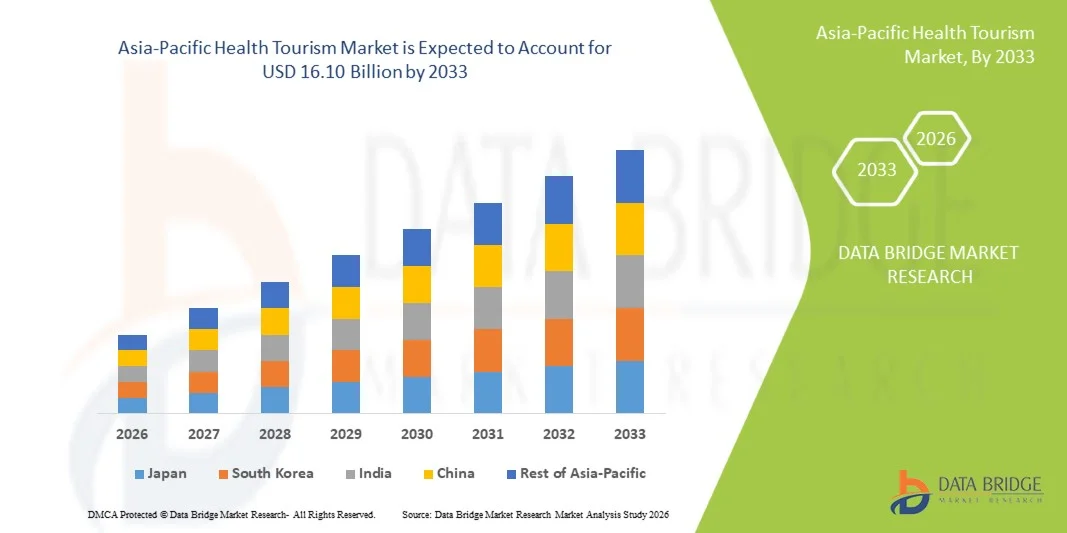
As per Data Bridge Market Research Analysis the Asia-Pacific Health Tourism market was valued at USD 6.32 billion in 2025 and is projected to reach USD 16.10 billion by 2033, growing at a CAGR of 12.40% from 2026 to 2033. The Health Tourism market is experiencing consistent growth driven by increasing demand for affordable and high-quality medical treatments, rising healthcare costs in developed economies, advancements in medical technology, and expanding cross-border healthcare services.
The growing burden of long waiting times, expensive healthcare procedures, and increasing availability of internationally accredited hospitals is encouraging patients to seek medical treatments abroad. Countries across Asia, the Middle East, and Asia-Pacific are strengthening healthcare infrastructure and promoting medical tourism by offering specialized treatments, advanced surgical procedures, wellness services, and personalized healthcare solutions at competitive costs. The integration of digital health platforms, telemedicine, international patient coordination services, and improvements in travel connectivity are further enhancing access to global healthcare services, supporting the expansion of health tourism worldwide.
Key Market Trends & Insights
- The China dominated the Asia-Pacific Health Tourism market with the largest revenue share of 36.12% in 2025, supported by its advanced healthcare infrastructure, rapidly expanding network of internationally accredited hospitals, strong government investment in medical tourism development, and growing demand for high-quality and affordable treatments. The country benefits from strong capabilities in specialized care areas such as oncology, cardiology, orthopedics, fertility treatment, and traditional Chinese medicine integration. In addition, rising medical tourism partnerships, improved international patient services, and increasing adoption of digital health platforms are further strengthening China’s position as a leading healthcare destination in the region.
- The Private segment dominated the market with a share of 71.38% in 2025, driven by superior healthcare infrastructure, advanced medical technologies, and high-quality patient services offered by private hospitals.
- India is expected to be the fastest-growing market in Asia-Pacific at a CAGR of 8.6% from 2026 to 2033, fueled by its rapidly expanding healthcare infrastructure, cost-effective treatment offerings, and strong reputation in specialized medical procedures such as cardiac surgery, fertility treatment, orthopedics, and organ transplantation. The country’s growing network of NABH-accredited hospitals, increasing adoption of digital health and telemedicine services, and government initiatives such as “Heal in India” are significantly boosting inbound medical tourism. In addition, strong clinical expertise, shorter waiting times, and availability of English-speaking medical professionals are further accelerating India’s position as a global medical tourism hub.
- Cosmetic Treatment segment dominated the Type of Treatment category with a 29.84% revenue share in 2025, driven by increasing demand for aesthetic procedures such as plastic surgery, dermatological treatments, and minimally invasive cosmetic enhancements across Europe.
- Adults segment led the Age Group category with share in 2025, supported by higher healthcare spending capacity, increased prevalence of lifestyle-related conditions, and strong demand for elective and preventive medical treatments among working-age populations.
Market Size & Forecast
- Asia-Pacific Market Value (2025): USD 6.32 Billion
- Expected Market Value (2033): USD 16.10 Billion
- Forecast CAGR (2026–2033): 12.40%
- Leading Region in 2025: China
- Fastest Growing Region: India
Report Scope and Asia-Pacific Health Tourism Market Segmentation
|
Attributes |
Health Tourism Key Market Insights |
|
Segments Covered |
|
|
Countries Covered |
Asia-Pacific
|
|
Key Market Players |
• Bupa Global (U.K.) |
|
Market Opportunities |
|
|
Value Added Data Infosets |
In addition to the insights on market scenarios such as market value, growth rate, segmentation, geographical coverage, and major players, the market reports curated by the Data Bridge Market Research also include in-depth expert analysis, geographically represented company-wise production and capacity, network layouts of distributors and partners, detailed and updated price trend analysis and deficit analysis of supply chain and demand. |
What is the Key Trend in the Asia-Pacific Health Tourism Market?
Trend: Growth in Cross-Border Medical Travel and Premium Elective Procedures
The Asia-Pacific Health Tourism market is witnessing strong growth as patients increasingly travel across borders for high-quality, affordable, and faster access to healthcare services. Demand is particularly rising for cosmetic surgery, dental care, fertility treatments, orthopaedic procedures, and cardiovascular care, driven by long waiting times in domestic public healthcare systems and higher affordability of private treatment options in select European destinations. Countries such as the U.K., Germany, Spain, Hungary, and Turkey are major hubs attracting international patients from the Middle East, Africa, and Asia. For instance, Hungary has become a leading destination for dental tourism, while Spain and Turkey are widely recognized for cosmetic and aesthetic procedures. The increasing availability of internationally accredited hospitals and JCI-certified healthcare facilities is further strengthening patient confidence in cross-border treatment. Digital platforms and medical travel facilitators are also playing a key role by connecting patients with hospitals, offering cost transparency, treatment comparisons, and end-to-end travel coordination.
Asia-Pacific Health Tourism Market Dynamics
Key Market Driver: Rising Demand for Specialized and High-Quality Healthcare Services Across Borders
The primary driver of the Asia-Pacific Health Tourism market is the increasing demand for specialized, high-quality, and cost-effective medical treatments. Patients are increasingly seeking advanced procedures such as fertility treatments (IVF), oncology care, cardiac surgeries, and orthopedic interventions in countries with superior clinical expertise and shorter waiting times. For instance, the U.K. and Germany attract international patients due to their advanced hospital infrastructure and strong clinical outcomes, while countries like Spain and Hungary offer cost-effective cosmetic and dental procedures. The growing presence of internationally recognized hospital networks such as Bupa Global healthcare facilities and Ramsay Santé is improving accessibility and trust in cross-border healthcare services. In addition, rising chronic disease prevalence and aging populations across Asia-Pacific are increasing outbound and inbound medical travel flows, strengthening market expansion.
Key Restraint/Challenge: High Treatment Costs and Complex Cross-Border Regulations
A major challenge in the Asia-Pacific Health Tourism market is the high overall cost of advanced medical procedures combined with complex regulatory and insurance frameworks across countries. Differences in healthcare standards, reimbursement policies, and legal requirements can create barriers for international patients seeking treatment abroad. In addition, post-treatment care continuity and legal liability issues can complicate patient experience, especially for complex procedures such as cancer treatment or cardiac surgery. Language barriers and lack of standardized pricing across hospitals also limit transparency in certain markets.
Even though private healthcare providers offer premium services, the high cost of advanced treatments in countries like Switzerland and Germany can restrict access for price-sensitive medical tourists.
Key Market Opportunity: Integration of Digital Health Platforms and AI-Enabled Medical Travel Ecosystems
A significant opportunity lies in the expansion of digital health platforms, telemedicine, and AI-driven patient matching systems. These technologies are simplifying cross-border healthcare by enabling remote consultations, digital second opinions, and personalized treatment planning before travel. Countries across Asia-Pacific are increasingly adopting integrated medical tourism platforms that combine hospital networks, travel logistics, insurance coverage, and post-care services into a single ecosystem. For example, teleconsultation services offered by leading private hospital groups in the U.K. and Germany are helping international patients access preliminary diagnosis before traveling. The growing use of AI in patient data analysis, treatment recommendation systems, and hospital matching is expected to further streamline medical tourism flows, particularly from emerging markets in Asia, the Middle East, and Africa.
How is the Asia-Pacific Health Tourism Market Segmented?
The Health Tourism market is segmented on the basis of **Service, Type of Treatment, Age Group, and Service Provider.
By Service
On the basis of service, the Health Tourism market is segmented into Transport, Accommodation, Hospitality and Others. The Transport segment dominated the market with a share of 34.62% in 2025, driven by rising international patient mobility, increasing cross-border medical travel, and strong demand for air ambulance and medical travel coordination services. Growing collaboration between hospitals and travel facilitators is further improving patient logistics and end-to-end care coordination. In addition, government-backed medical visa facilitation programs in several countries are supporting the dominance of this segment. Expanding partnerships between airlines, hospitals, and tourism agencies are enhancing accessibility and affordability of medical travel packages. The rising need for seamless travel assistance for complex treatments is also boosting segment growth across major destinations globally. Improved digital booking platforms and integrated travel-health services are further strengthening service adoption.
The Accommodation segment is expected to witness the fastest growth at a CAGR of 8.4% from 2026 to 2033, driven by increasing demand for long-stay medical recovery housing and patient-friendly lodging facilities near hospitals. Rising medical tourism inflow is encouraging hotel chains to develop healthcare-integrated accommodation services. Specialized recovery hotels with medical staff support are gaining popularity among international patients. In addition, partnerships between hospitals and hospitality providers are improving comfort and post-treatment care. Growth in elective surgeries and cosmetic procedures is further driving demand for premium accommodation services. Expanding wellness resorts offering post-treatment rehabilitation is also supporting segment expansion. Digital platforms enabling bundled treatment-plus-stay packages are accelerating adoption across global markets.
By Type of Treatment
On the basis of type of treatment, the Health Tourism market is segmented into Cosmetic Treatment, Dental Treatment, Cardiovascular Treatment, Orthopaedic Treatment, Bariatric Treatment, Fertility Treatment, Cancer Treatment, Ophthalmic Treatment, Neurological Treatment and Others. The Cosmetic Treatment segment dominated the market with a share of 28.91% in 2025, driven by rising demand for aesthetic procedures such as plastic surgery, skin treatments, and body contouring. Increasing affordability of cosmetic procedures in emerging destinations is attracting international patients. Growing social media influence and beauty awareness is further accelerating demand. Technological advancements in minimally invasive cosmetic procedures are improving patient outcomes and recovery times. In addition, availability of highly skilled cosmetic surgeons in countries like Turkey, India, and Thailand is strengthening market dominance. Expanding private healthcare infrastructure is also supporting segment growth. Rising medical tourism packages tailored for cosmetic enhancement are further boosting demand globally.
The Fertility Treatment segment is expected to witness the fastest growth at a CAGR of 9.1% from 2026 to 2033, driven by increasing infertility rates and delayed parenthood trends worldwide. Rising success rates of IVF and assisted reproductive technologies are attracting international patients. Countries offering cost-effective fertility solutions are becoming major medical tourism hubs. In addition, supportive regulatory frameworks in select destinations are encouraging cross-border fertility treatments. Growing emotional and social acceptance of assisted reproduction is further driving demand. Advancements in embryo freezing and genetic screening technologies are improving treatment success rates. Expanding fertility clinic networks and specialized reproductive centers are further accelerating segment growth.
By Age Group
On the basis of age group, the Health Tourism market is segmented into Senior Citizens, Minors and Adults. The Adults segment dominated the market with a share of 63.47% in 2025, owing to higher prevalence of elective surgeries, cosmetic treatments, and fertility procedures among working-age populations. Increasing disposable income and rising health awareness are driving international medical travel among adults. Greater adoption of preventive healthcare and wellness tourism is further supporting segment growth. Adults also represent the largest group seeking dental, orthopedic, and cosmetic treatments abroad. Strong corporate health insurance coverage in some regions is facilitating overseas treatment adoption. Expansion of affordable medical travel packages targeted at adults is further strengthening dominance. Increasing digital awareness and ease of booking cross-border treatments are also supporting growth.
The Senior Citizens segment is expected to witness the fastest growth at a CAGR of 8.6% from 2026 to 2033, driven by rising global aging population and increasing incidence of chronic diseases. Demand for cardiovascular, orthopedic, and neurological treatments among elderly patients is increasing significantly. Improved accessibility of international healthcare services is encouraging elderly medical travel. Growing availability of assisted travel and post-treatment care services is supporting adoption. Countries offering specialized geriatric care are attracting senior medical tourists. In addition, advancements in minimally invasive procedures are improving treatment safety for older patients. Rising healthcare costs in developed nations are also pushing senior citizens to seek affordable treatment abroad.
By Service Provider
On the basis of service provider, the Health Tourism market is segmented into Private and Public providers. The Private segment dominated the market with a share of 71.38% in 2025, driven by superior healthcare infrastructure, advanced medical technologies, and high-quality patient services offered by private hospitals. Increasing preference for personalized treatment and shorter waiting times is boosting private healthcare adoption. Strong international accreditation of private hospitals is attracting global patients. In addition, aggressive marketing and medical tourism partnerships are enhancing global reach. Private providers also offer bundled services including travel, accommodation, and treatment packages. Rising investments in premium healthcare facilities are further strengthening dominance. Expansion of international hospital chains is also supporting market growth.
The Public segment is expected to witness the fastest growth at a CAGR of 7.9% from 2026 to 2033, driven by increasing government investments in healthcare infrastructure and rising accessibility of affordable treatments. Expanding public hospital capabilities in emerging economies is attracting medical tourists. Government-led medical visa reforms are improving international patient inflow. In addition, public-private partnerships are enhancing service quality in public healthcare systems. Growing focus on universal healthcare coverage is also supporting adoption. Development of specialized treatment centers in public hospitals is further accelerating growth. Increasing trust in government-backed healthcare systems is contributing to segment expansion.
Which Region Holds the Largest Share of the Asia-Pacific Health Tourism Market?
The Asia-Pacific Health Tourism market remains a significant contributor to the regional healthcare economy, driven by strong healthcare infrastructure, rising demand for cross-border medical treatments, and increasing availability of internationally accredited hospitals. The market is supported by growing patient inflows from the Middle East, Africa, and Asia, particularly for elective and specialized treatments such as cosmetic surgery, dental care, fertility services, orthopedics, and cardiovascular procedures. Countries such as the U.K., Germany, Spain, and Switzerland continue to strengthen their position as key medical tourism destinations due to advanced clinical capabilities, reduced waiting times in private care systems, and high standards of patient safety and service quality.
U.K. Health Tourism Market Insight
The U.K. dominated the Asia-Pacific Health Tourism market with the largest revenue share of 34.18% in 2025, supported by strong international patient inflows, advanced healthcare infrastructure, globally accredited private hospitals, and high demand for elective and specialized treatments such as dental, cosmetic, and fertility care. The country benefits from well-established private healthcare networks, strong clinical expertise, and seamless integration of international patient services, making it a leading destination for high-quality and timely medical procedures. The increasing presence of private hospital groups and medical facilitators is further strengthening the U.K.’s position in Europe’s health tourism landscape.
Germany Health Tourism Market Insight
The Germany Health Tourism market is expected to be the fastest-growing market in Asia-Pacific at a CAGR of 8.6% from 2026 to 2033, fueled by its advanced healthcare system, strong reputation for clinical excellence, increasing investments in specialized medical centers, and growing demand for high-quality treatment services across cardiovascular, orthopedic, oncology, and fertility care segments. Germany’s well-developed hospital infrastructure, strong medical research ecosystem, and focus on precision medicine are attracting a rising number of international patients. The country’s emphasis on advanced diagnostics, surgical innovation, and high clinical standards continues to strengthen its position as a key destination for medical tourism in Europe.
Which are the Top Companies in Asia-Pacific Health Tourism Market?
The Health Tourism industry is primarily led by well-established companies, including:
- Bupa Global (U.K.)
- NHS Private Healthcare (U.K.)
- HCA Healthcare UK (U.K.)
- Spire Healthcare (U.K.)
- BMI Healthcare (U.K.)
- Helios Kliniken (Germany)
- Asklepios Kliniken (Germany)
- Fresenius Helios (Germany)
- Charité – Universitätsmedizin Berlin (Germany)
- Rhön-Klinikum AG (Germany)
- IHH Healthcare (Europe)
- Ramsay Santé (France)
- Groupe Elsan (France)
- Unilabs (Europe)
- Affidea (Europe)
- Fresenius Medical Care (Germany)
- Quirónsalud (Spain)
- Sanitas (Spain)
- Medicover (Europe)
- AMEOS Group (Germany/Europe)
- Penta Hospitals International (Central Europe)
- Lux Med (Poland)
- Cleveland Clinic London (U.K.)
- Hirslanden Private Hospital Group (Switzerland)
- Swiss Medical Network (Switzerland)
- VAMED (Austria)
- Generale de Santé (France)
- Mater Private Network (Ireland)
- Bon Secours Health System (Ireland)
- Adeslas (Spain)
- Barmenia Krankenversicherung (Germany)
What are Latest Developments in Asia-Pacific Health Tourism Market?
- In February 2021, Bumrungrad International Hospital (Thailand), one of Asia’s leading medical tourism destinations, announced the expansion of its international patient services program, enhancing telemedicine consultations and cross-border patient coordination. The expansion focused on improving digital access for overseas patients during the COVID-19 period, enabling remote diagnostics, pre-treatment planning, and post-treatment follow-ups. This development strengthened Thailand’s position as a key global medical tourism hub by integrating digital healthcare services with international patient care
- In July 2021, Apollo Hospitals (India), a major player in global healthcare and medical tourism, expanded its “Apollo Telehealth” platform to support international patients seeking second opinions and pre-travel consultations. The initiative enabled patients from Africa, the Middle East, and Southeast Asia to access specialist consultations before traveling for treatment. This development enhanced India’s competitiveness in the global health tourism market by improving accessibility and reducing travel uncertainty for foreign patients
- In March 2022, the Dubai Health Authority (UAE) launched expanded medical tourism facilitation services under its Dubai Health Experience (DXH) platform, aimed at streamlining treatment packages, visa processing, and hospital coordination for international patients. The initiative strengthened Dubai’s position as a leading medical tourism destination by integrating hospitals, hotels, and travel services into a unified digital ecosystem. This move reinforced the UAE’s strategy to attract high-value medical tourists across cosmetic, fertility, and advanced surgical treatments
- In September 2022, Bangkok Dusit Medical Services (BDMS), Thailand’s largest private hospital group, announced increased investment in international patient centers across Southeast Asia and the Middle East. The expansion included dedicated medical tourism coordinators, multilingual patient support services, and enhanced partnerships with global insurance providers. This initiative improved Thailand’s healthcare export capacity and strengthened its leadership in elective surgeries and wellness tourism
- In January 2023, Mayo Clinic (United States) expanded its international referral and concierge services program to better support overseas patients seeking specialized treatments in oncology, cardiology, and neurology. The initiative focused on reducing waiting times for international patients and improving coordination with global healthcare providers. This development reinforced the U.S. position as a high-end destination for complex medical treatments within the global health tourism market
- In June 2023, Turkey introduced enhanced incentives under its Health Tourism Development Program, supporting private hospitals in Istanbul and Ankara to expand international patient intake. The initiative included streamlined accreditation processes, marketing support, and improved medical visa facilitation. This boosted Turkey’s position as a leading destination for cosmetic surgery, dental tourism, and hair transplant procedures globally
- In April 2024, Singapore’s Ministry of Health supported the expansion of its “Healthier SG International Patient Program,” strengthening partnerships between public hospitals and private healthcare providers to attract medical tourists for advanced oncology and cardiovascular treatments. The initiative emphasized digital health integration and precision medicine services for international patients. This reinforced Singapore’s reputation as a premium destination for high-complexity medical tourism
- In November 2024, Medanta – The Medicity (India) expanded its international patient services network by launching new overseas liaison offices in Africa and the Middle East. The expansion aimed to simplify treatment access for foreign patients and improve post-operative care coordination. This development strengthened India’s position as a cost-effective global hub for cardiac, orthopedic, and organ transplant-related medical tourism

- Interactive Data Analysis Dashboard
- Company Analysis Dashboard for high growth potential opportunities
- Research Analyst Access for customization & queries
- Competitor Analysis with Interactive dashboard
- Latest News, Updates & Trend analysis
- Harness the Power of Benchmark Analysis for Comprehensive Competitor Tracking
Data collection and base year analysis are done using data collection modules with large sample sizes. The stage includes obtaining market information or related data through various sources and strategies. It includes examining and planning all the data acquired from the past in advance. It likewise envelops the examination of information inconsistencies seen across different information sources. The market data is analysed and estimated using market statistical and coherent models. Also, market share analysis and key trend analysis are the major success factors in the market report. To know more, please request an analyst call or drop down your inquiry.
The key research methodology used by DBMR research team is data triangulation which involves data mining, analysis of the impact of data variables on the market and primary (industry expert) validation. Data models include Vendor Positioning Grid, Market Time Line Analysis, Market Overview and Guide, Company Positioning Grid, Patent Analysis, Pricing Analysis, Company Market Share Analysis, Standards of Measurement, Global versus Regional and Vendor Share Analysis. To know more about the research methodology, drop in an inquiry to speak to our industry experts.
Data Bridge Market Research is a leader in advanced formative research. We take pride in servicing our existing and new customers with data and analysis that match and suits their goal. The report can be customized to include price trend analysis of target brands understanding the market for additional countries (ask for the list of countries), clinical trial results data, literature review, refurbished market and product base analysis. Market analysis of target competitors can be analyzed from technology-based analysis to market portfolio strategies. We can add as many competitors that you require data about in the format and data style you are looking for. Our team of analysts can also provide you data in crude raw excel files pivot tables (Fact book) or can assist you in creating presentations from the data sets available in the report.













