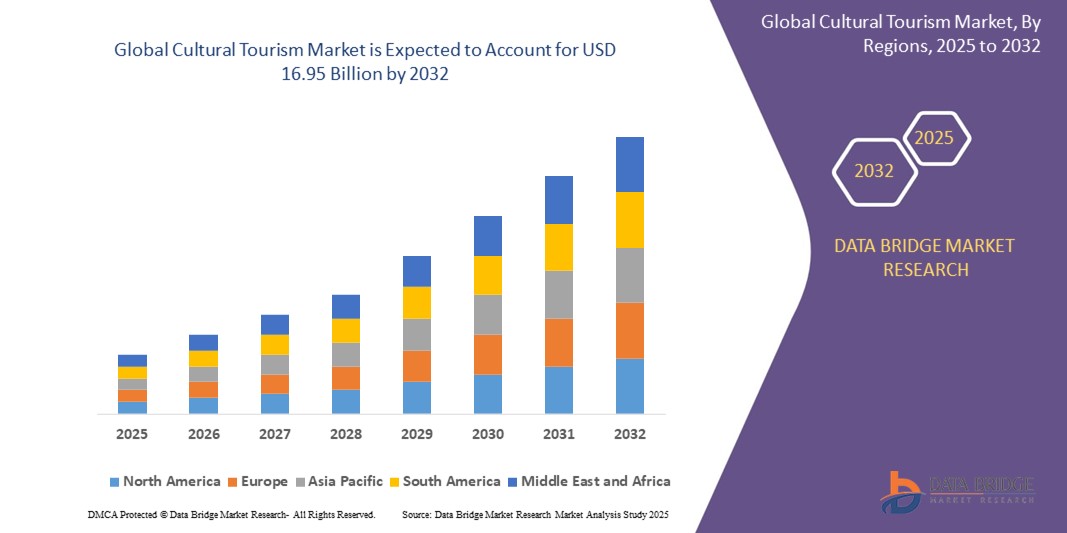
Cultural Tourism Market Size
- The global cultural tourism market was valued at USD 7.25 billion in 2024 and is expected to reach USD 16.95 billion by 2032
- During the forecast period of 2025 to 2032 the market is likely to grow at a CAGR of 11.20%, primarily driven by the by increasing global interest in heritage experiences
- This growth is driven by factors such as the rising demand for authentic cultural experiences, government support for heritage tourism, and the influence of social media in promoting cultural destinations
Cultural Tourism Market Analysis
- Cultural tourism is a rapidly growing segment of the travel industry, offering travellers immersive experiences in heritage sites, traditions, and local customs. It plays a crucial role in preserving cultural heritage while contributing significantly to local economies
- The demand for cultural tourism is significantly driven by increasing interest in authentic travel experiences, rising disposable incomes, and government initiatives to promote heritage tourism. In addition, digital platforms and social media have amplified awareness and accessibility to cultural destinations
- Europe stands out as one of the dominant regions for cultural tourism, driven by its rich historical heritage, well-preserved landmarks, and strong tourism infrastructures
- For instance, UNESCO World Heritage sites across Europe attract millions of tourists annually, with governments and private sectors investing heavily in heritage conservation and tourism promotion
- Globally, cultural tourism ranks as one of the top segments in the tourism industry, following leisure and adventure tourism, and plays a pivotal role in fostering cross-cultural exchange and sustainable economic growth
Report Scope and Cultural Tourism Market Segmentation
|
Attributes |
Cultural Tourism Key Market Insights |
|
Segments Covered |
|
|
Countries Covered |
North America
Europe
Asia-Pacific
Middle East and Africa
South America
|
|
Key Market Players |
|
|
Market Opportunities |
|
|
Value Added Data Infosets |
In addition to the insights on market scenarios such as market value, growth rate, segmentation, geographical coverage, and major players, the market reports curated by the Data Bridge Market Research also include in-depth expert analysis, pricing analysis, brand share analysis, consumer survey, demography analysis, supply chain analysis, value chain analysis, raw material/consumables overview, vendor selection criteria, PESTLE Analysis, Porter Analysis, and regulatory framework |
Cultural Tourism Market Trends
“Rise of Digital and Immersive Cultural Experiences”
- One prominent trend in the global cultural tourism market is the growing adoption of digital and immersive experiences, enhancing how travelers engage with historical and cultural sites
- These advancements leverage technologies such as augmented reality (AR), virtual reality (VR), and AI-powered guides to provide interactive storytelling and deeper insights into cultural heritage
- For instance, AR applications allow visitors to experience historical sites as they were in the past, while VR tours enable remote access to museums and ancient landmarks, expanding cultural tourism beyond physical travel
- Digital integration also facilitates personalized travel experiences through AI-driven recommendations, online booking platforms, and virtual tour planning, making cultural exploration more accessible and engaging
- This trend is transforming the cultural tourism industry by making heritage sites more appealing to tech-savvy travelers, driving engagement, and expanding the market for digital cultural experiences
Cultural Tourism Market Dynamics
Driver
“Growing Interest in Heritage and Authentic Travel Experiences”
- The increasing demand for authentic and immersive travel experiences is significantly contributing to the growth of the cultural tourism market
- As global travelers seek meaningful connections with history, traditions, and local communities, the appeal of cultural tourism has expanded beyond traditional sightseeing to include hands-on experiences, heritage walks, and participation in local festivals
- UNESCO World Heritage Sites, museums, and historical landmarks are witnessing a surge in visitors, highlighting the growing appreciation for cultural heritage
- Governments and tourism boards worldwide are investing in the preservation of cultural sites and promoting heritage tourism as a means of sustainable economic growth, further driving market expansion
- Digitalization and technology-driven storytelling, such as augmented reality (AR) and virtual reality (VR), are enhancing the cultural tourism experience by making history more accessible and engaging for travelers
For instance,
- In September 2022, according to a report by the United Nations World Tourism Organization (UNWTO), cultural tourism accounted for nearly 40% of global tourism, with strong growth driven by rising interest in heritage and experiential travel. This increasing demand is shaping policies and investments in tourism infrastructure worldwide
- In March 2023, a report by the European Travel Commission highlighted that over 60% of European travelers prioritize cultural experiences, such as visiting historical landmarks and engaging with local traditions, as key motivations for travel
- As the demand for heritage-based travel experiences grows, cultural tourism continues to expand, driving investments in infrastructure, conservation, and digital engagement to enhance traveler experiences
Opportunity
“Enhancing Cultural Tourism with Digital and AI-Powered Experiences”
- AI-powered tools and digital innovations are transforming cultural tourism by providing immersive, interactive, and personalized experiences for travelers. AI-driven applications can enhance storytelling, automate translations, and offer real-time recommendations, making cultural exploration more engaging and accessible
- Augmented reality (AR) and virtual reality (VR) experiences allow visitors to witness historical events, explore ancient civilizations, and interact with cultural artifacts in a highly engaging manner, even from remote locations
- AI-driven data analytics help tourism boards and operators understand visitor behavior, optimize travel routes, and develop personalized cultural itineraries, enhancing the overall tourism experience
For instance,
- In October 2024, according to a report by the World Travel & Tourism Council (WTTC), AI-driven chatbots and digital guides have significantly improved visitor engagement at heritage sites, offering multilingual support and detailed historical insights in real time, thereby increasing cultural site visits by 25%
- In June 2023, UNESCO launched an AI-powered digital archive initiative to preserve and promote endangered cultural sites, allowing global travelers to explore and learn about these heritage locations through interactive virtual tours and AI-generated content
- The integration of AI in cultural tourism enhances accessibility, engagement, and sustainability by digitizing heritage experiences and personalizing visitor interactions. These advancements not only attract tech-savvy travelers but also help in preserving and promoting cultural heritage on a global scale
Restraint/Challenge
“High Costs of Travel and Heritage Site Maintenance Hindering Market Accessibility”
- The high cost of cultural tourism, including travel expenses, accommodation, and entrance fees to heritage sites, poses a significant challenge, particularly for budget-conscious travelers and those from developing regions
- Maintaining and preserving historical landmarks and cultural heritage sites requires substantial financial investment, which can lead to increased ticket prices and tourism taxes, making cultural experiences less accessible to a broader audience
- This financial burden can limit the ability of governments and tourism boards to implement large-scale heritage restoration projects or invest in new tourism infrastructure, affecting the overall visitor experience
For instance,
- In August 2024, according to a report by the International Council on Monuments and Sites (ICOMOS), the rising costs of maintaining UNESCO World Heritage Sites have led to increased entrance fees and restrictions on tourist numbers, impacting the affordability and accessibility of cultural tourism
- In March 2023, a study by the European Tourism Association (ETOA) highlighted that rising airfare and accommodation costs in major cultural tourism destinations have deterred international visitors, leading to a decline in foot traffic at certain historical landmarks
- As a result, the high cost of cultural tourism can lead to disparities in access to heritage experiences, limiting market penetration and reducing the ability of some regions to fully capitalize on their cultural assets
Cultural Tourism Market Scope
The market is segmented on the basis of type, category and travel type.
|
Segmentation |
Sub-Segmentation |
|
By Type |
|
|
By Category |
|
|
By Travel Type |
|
Cultural Tourism Market Regional Analysis
“Europe is the Dominant Region in the Cultural Tourism Market”
- Europe dominates the cultural tourism market, driven by its rich historical heritage, well-preserved landmarks, and strong tourism infrastructure. The region is home to some of the world’s most visited cultural attractions, including UNESCO World Heritage Sites, museums, and historical cities
- Countries such as France, Italy, Spain, and the United Kingdom hold a significant share due to their globally renowned cultural destinations, such as the Louvre Museum, the Colosseum, Alhambra, and the British Museum
- Supportive government initiatives, such as cultural preservation programs and strategic tourism policies, have further strengthened Europe’s position as a leading cultural tourism hub
- In addition, Europe’s extensive high-speed rail network and seamless travel connectivity across countries make it easier for tourists to explore multiple cultural sites, boosting market growth across the region
“Asia-Pacific is Projected to Register the Highest Growth Rate”
- Asia-Pacific region is expected to witness the highest growth rate in the cultural tourism market, driven by increasing international and domestic travel, rising disposable income, and growing interest in heritage tourism
- Countries such as China, India, and Japan are emerging as key markets due to their diverse cultural heritage, ancient landmarks, and deep-rooted traditions that attract millions of tourists annually
- Japan, with its blend of historical sites, traditional festivals, and modern cultural experiences, remains a crucial market for cultural tourism. The country continues to see strong visitor inflows, particularly to destinations such as Kyoto, Nara, and Tokyo’s heritage districts
- China and India, with their vast number of UNESCO-listed sites, cultural festivals, and government-driven tourism initiatives, are experiencing rapid growth in cultural tourism. Increased efforts to promote heritage tourism through digital platforms and government-backed campaigns are further contributing to market expansion in the region
Cultural Tourism Market Share
The market competitive landscape provides details by competitor. Details included are company overview, company financials, revenue generated, market potential, investment in research and development, new market initiatives, global presence, production sites and facilities, production capacities, company strengths and weaknesses, product launch, product width and breadth, application dominance. The above data points provided are only related to the companies' focus related to market.
The Major Market Leaders Operating in the Market Are:
- Travel Leaders Group Holdings, LLC (U.S.)
- Aracari (Peru)
- Frosch International Travel (U.S.)
- SARL Undiscovered Mountains France (France)
- Adventure Alternative Ltd (U.K.)
- Intrepid Group (Australia)
- Rickshaw Travel (U.K.)
- Steppes Travel (U.K.)
- Australia's Guide Pty. Ltd. (Australia)
- Envoy Hostel (U.S.)
- ACE Cultural Tours (U.K.)
- Classic Journeys llc (U.S.)
- Exodus Travels Limited (U.S.)
- Kudu Travel Limited (U.K.)
- Martin Randall Travel (U.K.)
- Nature Quest Ltd (New zealand)
- G Adventures. (Canada)
- A&K Travel Group Ltd, (Monaco)
- Odyssey World (U.K.)
Latest Developments in Global Cultural Tourism Market
- In January 2025, UNESCO launched its Global Digital Heritage Initiative, aimed at digitally preserving endangered cultural sites using AI-powered 3D mapping and virtual reality technology. This initiative enables travellers and researchers to explore historical landmarks remotely while supporting global conservation efforts
- In October 2024, the European Commission introduced the "Smart Heritage Tourism Strategy," which integrates AI-driven tourism management, digital ticketing, and augmented reality experiences to enhance visitor engagement at cultural sites. This initiative seeks to boost tourism while ensuring sustainable preservation of heritage landmarks
- In September 2024, China announced its "Cultural Tourism Growth Plan 2030," which includes investments in smart tourism infrastructure, heritage site restoration, and AI-powered language translation services for international tourists. The plan aims to position China as a leading cultural tourism hub by leveraging digital innovations
- In September 2024, the Middle East Tourism Council launched the "Historic Arabia Experience," an immersive tourism initiative featuring augmented reality tours of ancient sites, interactive storytelling, and AI-curated travel itineraries. The project focuses on attracting global travellers while preserving and showcasing the region’s rich cultural heritage
- In August 2024, the United States National Park Service (NPS) partnered with Google Arts & Culture to launch an interactive virtual tour platform, allowing users to explore historical landmarks, indigenous heritage sites, and museums through high-resolution imagery, 360-degree videos, and AI-powered guided experiences. This initiative aims to expand access to cultural tourism and promote heritage education globally

- Interactive Data Analysis Dashboard
- Company Analysis Dashboard for high growth potential opportunities
- Research Analyst Access for customization & queries
- Competitor Analysis with Interactive dashboard
- Latest News, Updates & Trend analysis
- Harness the Power of Benchmark Analysis for Comprehensive Competitor Tracking
Data collection and base year analysis are done using data collection modules with large sample sizes. The stage includes obtaining market information or related data through various sources and strategies. It includes examining and planning all the data acquired from the past in advance. It likewise envelops the examination of information inconsistencies seen across different information sources. The market data is analysed and estimated using market statistical and coherent models. Also, market share analysis and key trend analysis are the major success factors in the market report. To know more, please request an analyst call or drop down your inquiry.
The key research methodology used by DBMR research team is data triangulation which involves data mining, analysis of the impact of data variables on the market and primary (industry expert) validation. Data models include Vendor Positioning Grid, Market Time Line Analysis, Market Overview and Guide, Company Positioning Grid, Patent Analysis, Pricing Analysis, Company Market Share Analysis, Standards of Measurement, Global versus Regional and Vendor Share Analysis. To know more about the research methodology, drop in an inquiry to speak to our industry experts.
Data Bridge Market Research is a leader in advanced formative research. We take pride in servicing our existing and new customers with data and analysis that match and suits their goal. The report can be customized to include price trend analysis of target brands understanding the market for additional countries (ask for the list of countries), clinical trial results data, literature review, refurbished market and product base analysis. Market analysis of target competitors can be analyzed from technology-based analysis to market portfolio strategies. We can add as many competitors that you require data about in the format and data style you are looking for. Our team of analysts can also provide you data in crude raw excel files pivot tables (Fact book) or can assist you in creating presentations from the data sets available in the report.