


What is the Asia-Pacific Healthcare Disposable PPE Market Size and Growth Rate?
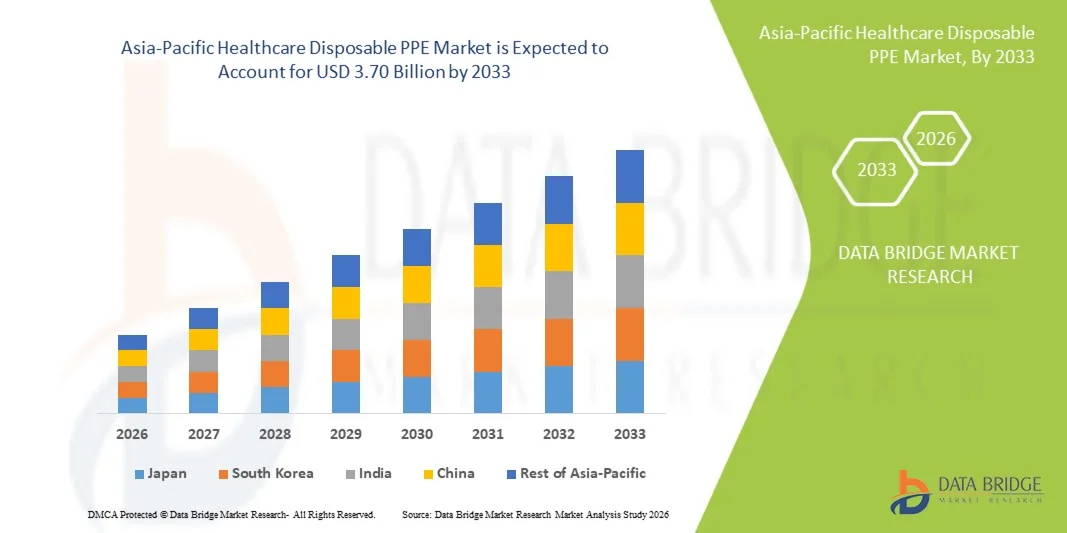
- As per Data Bridge Market Research Analysis the Asia-Pacific Healthcare Disposable PPE Market size was valued at USD 1.90 billion in 2025 and is expected to reach USD 3.70 billion by 2033, at a CAGR of 8.70% during the forecast period
- The market growth is largely fueled by the increasing emphasis on infection prevention and control, coupled with continuous technological advancements in healthcare manufacturing processes, leading to improved quality, efficiency, and widespread adoption of disposable personal protective equipment across hospitals, clinics, and other healthcare settings
- Furthermore, rising awareness regarding occupational safety, growing demand for cost-effective and easy-to-use protective solutions, and strict regulatory guidelines are establishing healthcare disposable PPE as an essential component of modern healthcare systems. These converging factors are accelerating the uptake of Healthcare Disposable PPE solutions, thereby significantly boosting the industry’s growth
Market Size & Forecast
- Asia-Pacific Market Value (2025): USD 1.90 billion
- Expected Market Value (2033): USD 3.70 billion
- Forecast CAGR (2026–2033): 8.70%
What are the Major Takeaways of Asia-Pacific Healthcare Disposable PPE Market?
- Healthcare disposable PPE, including gloves, masks, gowns, and face shields, has become an essential component of healthcare delivery across hospitals, clinics, and diagnostic centers due to its critical role in infection prevention, occupational safety, and patient protection
- The escalating demand for healthcare disposable PPE is primarily driven by heightened awareness of hygiene and infection control, increasing incidence of infectious diseases, stricter regulatory requirements, and growing preparedness initiatives across healthcare facilities
- China dominated the Asia-Pacific Healthcare Disposable PPE Market with the largest revenue share of approximately 34.5% in 2025, supported by large-scale manufacturing capacity, strong domestic demand, well-established supply chains, and the country’s position as a global export hub for disposable medical products
- India is expected to be the fastest-growing country in the Asia-Pacific Healthcare Disposable PPE Market during the forecast period, driven by rapid expansion of healthcare infrastructure, rising healthcare expenditure, increasing awareness of infection control, and strong government support for domestic medical manufacturing
- The Acute Application segment dominated the market with a revenue share of 57.2% in 2025, driven by high PPE consumption in emergency care, intensive care units, surgical procedures, and trauma management
Report Scope and Asia-Pacific Healthcare Disposable PPE Market Segmentation
|
Attributes |
Healthcare Disposable PPE Key Market Insights |
|
Segments Covered |
|
|
Countries Covered |
Asia-Pacific
|
|
Key Market Players |
|
|
Market Opportunities |
|
|
Value Added Data Infosets |
|
What is the Key Trend in the Asia-Pacific Healthcare Disposable PPE Market?
“Rising Emphasis on Infection Control and Single-Use Protective Solutions”
- A significant and accelerating trend in the Asia-Pacific Healthcare Disposable PPE Market is the growing emphasis on infection prevention, hygiene compliance, and single-use protective solutions across hospitals, clinics, laboratories, and long-term care facilities
- This trend is being driven by heightened awareness of healthcare-associated infections (HAIs), pandemic preparedness, and stricter occupational safety regulations across the region
- For instance, during 2023, several Asia-Pacific countries including India and Japan significantly increased procurement of disposable gloves, surgical masks, and isolation gowns for public hospitals, following updated infection control guidelines issued by national health authorities to strengthen frontline worker protection
- Manufacturers are increasingly focusing on lightweight, breathable, and skin-friendly materials to improve comfort for healthcare workers who must wear disposable PPE for extended durations, particularly in high-intensity clinical environments such as emergency departments and intensive care units
- The adoption of color-coded and task-specific disposable PPE, such as procedure-specific gowns and contamination-resistant gloves, is gaining momentum as healthcare facilities seek to minimize cross-contamination and streamline workflow efficiency
- In addition, sustainability considerations are beginning to influence product development, with companies exploring biodegradable materials and eco-friendly disposable PPE alternatives to address environmental concerns without compromising safety standards
- This trend toward standardized, high-quality, and application-specific disposable PPE is reshaping procurement strategies across the Asia-Pacific healthcare sector, reinforcing disposable PPE as a core component of infection control infrastructure
Asia-Pacific Healthcare Disposable PPE Market Dynamics
Driver
“Rising Healthcare Expenditure and Growing Patient Footfall”
- The increasing burden on healthcare systems across the Asia-Pacific region, driven by population growth, aging demographics, and rising incidence of infectious and chronic diseases, is a major driver for the growing demand for Healthcare Disposable PPE
- For instance, in April 2024, China’s National Health Commission announced increased funding allocations for hospital safety supplies, leading to higher procurement volumes of disposable masks, gloves, and protective apparel across public healthcare institutions
- Expanding hospital infrastructure, increased surgical procedures, and growing diagnostic testing volumes are directly contributing to higher consumption of disposable PPE products across inpatient and outpatient settings
- The growing emphasis on worker safety regulations and mandatory PPE usage for healthcare professionals, laboratory technicians, and support staff is further accelerating market growth across the region
- Rising awareness among patients and healthcare providers regarding hygiene standards and infection prevention is also driving consistent demand for disposable PPE in private clinics and ambulatory care centers
- Collectively, increasing healthcare investments, regulatory enforcement, and expanding clinical services are sustaining long-term growth of the Asia-Pacific Healthcare Disposable PPE Market in Asia-Pacific
Restraint/Challenge
“Supply Chain Disruptions and Environmental Concerns”
- One of the key challenges facing the Asia-Pacific Healthcare Disposable PPE Market is vulnerability to supply chain disruptions, particularly for raw materials such as nonwoven fabrics, melt-blown polypropylene, and synthetic rubbers, which can impact production timelines and pricing stability
- For instance, in late 2022, several Southeast Asian PPE manufacturers reported production slowdowns due to shortages of melt-blown fabric, highlighting the market’s dependence on a limited number of raw material suppliers
- Fluctuating raw material prices and logistics constraints can lead to inconsistent product availability, affecting procurement planning for hospitals and healthcare distributors
- In addition, growing concerns over medical waste generation and environmental impact of single-use PPE are prompting scrutiny from regulators and environmental groups across the region
- Compliance with evolving waste management regulations and sustainability mandates can increase operational costs for manufacturers and healthcare facilities
- Addressing these challenges through supply diversification, material innovation, and improved waste management practices will be critical for ensuring sustainable growth of the Asia-Pacific Healthcare Disposable PPE Market
How is the Asia-Pacific Healthcare Disposable PPE Market Segmented?
The market is segmented on the basis of product, application, end-use industry, and distribution channel.
• By Product
On the basis of product, the Asia-Pacific Healthcare Disposable PPE Market is segmented into Facial Protection, Non-Sterile Apparel, and Gloves. The Gloves segment dominated the largest market revenue share of 44.6% in 2025, driven by their mandatory use across hospitals, clinics, laboratories, and diagnostic centers to prevent cross-contamination and hospital-acquired infections. Disposable gloves are extensively used in surgical procedures, patient examinations, and routine clinical practices. Rising awareness regarding infection control and occupational safety significantly supports demand. High consumption volumes due to single-use requirements generate continuous revenue streams. Latex, nitrile, and vinyl gloves are widely adopted depending on clinical needs. Increasing outpatient visits and diagnostic testing volumes contribute to sustained demand. Regulatory mandates enforcing PPE compliance in healthcare settings strengthen market penetration. Expanding healthcare infrastructure in emerging economies further supports adoption. The availability of cost-effective gloves boosts procurement across public hospitals. Continuous innovation in material quality enhances durability and comfort. Strong supply chains and large-scale manufacturing support dominance. The gloves segment remains integral to daily healthcare operations worldwide.
The Facial Protection segment is anticipated to witness the fastest growth, registering a CAGR of 18.9% from 2026 to 2033, driven by increasing focus on respiratory protection and infection prevention. Rising adoption of face masks, face shields, and respirators across hospitals and outpatient facilities fuels growth. Growing prevalence of airborne diseases and preparedness for future pandemics support demand. Healthcare workers increasingly prefer high-filtration and breathable facial PPE. Government stockpiling initiatives accelerate procurement. Advancements in mask design improve comfort and extended usage. Expansion of ambulatory care and home healthcare settings boosts adoption. Increased patient awareness enhances usage compliance. Online availability and improved distribution channels support accessibility. Cost-effective disposable solutions attract emerging markets. Regulatory emphasis on workplace safety strengthens demand. These factors collectively drive rapid segment growth.
• By Application
On the basis of application, the Asia-Pacific Healthcare Disposable PPE Market is segmented into Acute Application and Non-Acute Application. The Acute Application segment dominated the market with a revenue share of 57.2% in 2025, driven by high PPE consumption in emergency care, intensive care units, surgical procedures, and trauma management. Acute healthcare settings require strict infection control measures, leading to continuous and large-volume PPE usage. High patient turnover increases single-use PPE demand. Rising incidences of infectious diseases and surgical interventions support growth. Hospitals prioritize disposable PPE to minimize contamination risks. Regulatory standards mandate PPE usage in acute care environments. Increased ICU capacity expansion post-pandemic sustains demand. Availability of advanced PPE tailored for critical care enhances adoption. Government funding for acute care facilities strengthens procurement. High frequency of procedures ensures recurring consumption. Skilled healthcare workforce reliance further supports usage. The segment maintains dominance due to its critical role in patient safety.
The Non-Acute Application segment is expected to grow at the fastest CAGR of 17.3% from 2026 to 2033, driven by expanding outpatient clinics, diagnostic centers, and home healthcare services. Rising demand for routine examinations and preventive care increases PPE usage. Growth in telehealth-supported physical visits supports non-acute consumption. Aging populations require frequent non-acute medical interventions. Cost-effective disposable PPE is preferred in non-critical settings. Expansion of primary healthcare infrastructure fuels adoption. Improved awareness of hygiene standards boosts PPE compliance. Growing use in long-term care facilities supports growth. Increasing private clinic penetration in emerging markets enhances demand. Simplified procurement channels improve accessibility. Favorable pricing encourages widespread usage. These factors collectively accelerate segment growth.
• By End-Use Industry
On the basis of end-use industry, the Asia-Pacific Healthcare Disposable PPE Market is segmented into Automotive, Food Processing, Construction, Oil and Gas, Chemical, and Others. The Food Processing segment dominated the market revenue share at 39.8% in 2025, driven by strict hygiene regulations and safety standards across food manufacturing and processing facilities. Disposable PPE is widely used to prevent contamination during handling and packaging. Increasing global food demand supports high PPE consumption. Regulatory bodies enforce protective gear compliance. Gloves, masks, and protective apparel are essential in daily operations. Rising automation still requires human intervention with PPE usage. High employee density increases safety requirements. Expanding processed food markets support growth. Large-scale production facilities ensure bulk procurement. Cost-effective disposable solutions encourage adoption. Frequent replacement cycles generate recurring revenue. The segment’s regulatory dependency sustains dominance.
The Chemical segment is projected to witness the fastest CAGR of 19.6% from 2026 to 2033, driven by rising emphasis on worker safety and hazardous material handling. Increasing chemical manufacturing activities fuel PPE demand. Disposable protective apparel and gloves are critical for chemical exposure prevention. Stricter occupational safety regulations support growth. Expansion of specialty chemicals and pharmaceuticals enhances usage. Growing investments in industrial safety infrastructure boost adoption. Employee awareness regarding personal protection is increasing. Global supply chain expansion supports PPE procurement. High-risk environments require frequent PPE replacement. Innovation in chemical-resistant disposable PPE enhances appeal. Regulatory audits reinforce compliance. These drivers accelerate rapid growth.
• By Distribution Channel
On the basis of distribution channel, the Asia-Pacific Healthcare Disposable PPE Market is segmented into Direct Tender, Retail Sales, and Online Sales. The Direct Tender segment dominated the market with a revenue share of 52.4% in 2025, driven by bulk procurement by government hospitals, public healthcare institutions, and large industrial buyers. Long-term supply contracts ensure stable demand. Cost advantages through large-volume purchasing support dominance. Government healthcare programs rely heavily on tender-based sourcing. Reliable supply assurance strengthens preference. Hospitals prioritize standardized PPE through approved vendors. Pandemic preparedness stockpiling sustains procurement. Tender channels support consistent quality compliance. High purchasing power reinforces adoption. Established vendor relationships improve supply continuity. Budget-controlled procurement enhances preference. The segment remains dominant due to institutional reliance.
The Online Sales segment is expected to register the fastest CAGR of 21.2% from 2026 to 2033, driven by growing digitalization and ease of access. Healthcare professionals increasingly purchase PPE through e-commerce platforms. Expansion of B2B healthcare marketplaces supports growth. Faster delivery and transparent pricing attract buyers. SMEs prefer online channels for flexibility. Rising adoption of home healthcare boosts online demand. Improved logistics infrastructure enhances distribution efficiency. Wider product availability increases customer reach. Competitive pricing accelerates adoption. Growing internet penetration supports growth. Post-pandemic purchasing behavior favors digital platforms. These factors drive strong CAGR expansion.
Which Region Holds the Largest Share of the Asia-Pacific Healthcare Disposable PPE Market?
- The Asia-Pacific Healthcare Disposable PPE Market is poised to grow at the fastest CAGR during the forecast period of 2026 to 2033, driven by rapid expansion of healthcare infrastructure, increasing healthcare expenditure, and rising awareness regarding infection prevention and occupational safety across the region
- Countries such as China, Japan, and India are witnessing strong demand for disposable gloves, masks, gowns, and face shields due to growing urban populations, higher patient volumes, and improved access to healthcare services
- The region benefits from a strong manufacturing ecosystem and cost-efficient production capabilities, positioning Asia-Pacific as both a major consumer and global supplier of healthcare disposable PPE. Government initiatives focused on strengthening healthcare systems, improving emergency preparedness, and promoting domestic medical manufacturing are further accelerating market growth. In addition, the increasing focus on hospital hygiene standards, pandemic preparedness, and protection of healthcare workers continues to drive consistent demand across public and private healthcare facilities
China Asia-Pacific Healthcare Disposable PPE Market Insight
The China Asia-Pacific Healthcare Disposable PPE Market accounted for the largest revenue share of approximately 34.5% in Asia-Pacific in 2025, supported by the country’s large-scale manufacturing capacity, strong domestic demand, and well-established supply chains. China’s position as a global export hub for disposable medical products has significantly strengthened its dominance in the regional market. Rapid urbanization, increasing healthcare access, and rising investments in hospital infrastructure continue to fuel domestic consumption of disposable PPE. In addition, strong government support for healthcare modernization and emergency preparedness, along with the presence of numerous domestic manufacturers, has enabled large-scale production at competitive costs. These factors collectively position China as both a leading producer and consumer of healthcare disposable PPE in the Asia-Pacific region.
India Asia-Pacific Healthcare Disposable PPE Market Insight
India Asia-Pacific Healthcare Disposable PPE Market is expected to be the fastest-growing country in the Asia-Pacific Healthcare Disposable PPE Market during the forecast period, driven by the rapid expansion of healthcare infrastructure, rising healthcare expenditure, and increasing awareness of infection control practices. Growth in public and private hospitals, diagnostic laboratories, and ambulatory care centers is significantly boosting demand for disposable PPE products. Strong government support for domestic medical manufacturing, including initiatives such as Make in India and healthcare self-reliance programs, is encouraging local production of disposable PPE. In addition, improved regulatory frameworks and heightened focus on healthcare worker safety are accelerating adoption across urban and semi-urban healthcare facilities. These factors collectively support India’s rapid growth trajectory within the Asia-Pacific Healthcare Disposable PPE Market.
Which are the Top Companies in Asia-Pacific Healthcare Disposable PPE Market?
The Healthcare Disposable PPE industry is primarily led by well-established companies, including:
- Honeywell International (U.S.)
- Ansell (Australia)
- Kimberly-Clark (U.S.)
- Cardinal Health (U.S.)
- Medline Industries (U.S.)
- Mölnlycke Health Care (Sweden)
- Hartalega Holdings (Malaysia)
- Top Glove Corporation (Malaysia)
- Kossan Rubber Industries (Malaysia)
- Supermax Corporation (Malaysia)
- Halyard Health (U.S.)
- DuPont (U.S.)
- Alpha Pro Tech (U.S.)
- Lakeland Industries (U.S.)
- Semperit AG Holding (Austria)
- Shandong Weigao Group (China)
- Winner Medical (China)
- Zhende Medical (China)
- Narang Medical (India)
Which are the Top Companies in Asia-Pacific Healthcare Disposable PPE Market?
- In January 2021, Honeywell International Inc. donated 225 million N95 and surgical masks for healthcare and government use, significantly boosting the availability of disposable respiratory PPE and enhancing its product portfolio to meet urgent demand during the COVID-19 pandemic. This donation helped secure timely supply for frontline healthcare workers and strengthened regional PPE distribution
- In April 2022, Honeywell launched new NIOSH-certified respiratory devices aimed at healthcare professionals, expanding its PPE offerings in Asia-Pacific by introducing advanced respiratory protection options to support ongoing infection control efforts in hospitals and clinics
- In February 2022, market reports indicated that Honeywell International Inc. and DuPont emerged as key leaders in the Asia-Pacific Healthcare Disposable PPE Market, actively increasing supply and targeting key growth countries such as India, Japan, and Australia, reflecting strategic regional focus for product distribution
- In May 2024, KARAM Safety, a major India-based PPE manufacturer, acquired Midas Safety India, a prominent hand protection products player, to strengthen its leadership position and broaden its portfolio to include more hand protection PPE solutions in the Asia-Pacific region. This strategic acquisition supports expanded product offerings and market reach amid rising demand for healthcare and industrial PPE
- In May 2025, Honeywell completed the sale of its Personal Protective Equipment business to Protective Industrial Products, Inc. (PIP) for USD 1.325 billion, marking a major industry shift that could influence PPE supply dynamics in Asia-Pacific as PIP takes on legacy Honeywell PPE operations and continues serving regional demand

- Interactive Data Analysis Dashboard
- Company Analysis Dashboard for high growth potential opportunities
- Research Analyst Access for customization & queries
- Competitor Analysis with Interactive dashboard
- Latest News, Updates & Trend analysis
- Harness the Power of Benchmark Analysis for Comprehensive Competitor Tracking
Data collection and base year analysis are done using data collection modules with large sample sizes. The stage includes obtaining market information or related data through various sources and strategies. It includes examining and planning all the data acquired from the past in advance. It likewise envelops the examination of information inconsistencies seen across different information sources. The market data is analysed and estimated using market statistical and coherent models. Also, market share analysis and key trend analysis are the major success factors in the market report. To know more, please request an analyst call or drop down your inquiry.
The key research methodology used by DBMR research team is data triangulation which involves data mining, analysis of the impact of data variables on the market and primary (industry expert) validation. Data models include Vendor Positioning Grid, Market Time Line Analysis, Market Overview and Guide, Company Positioning Grid, Patent Analysis, Pricing Analysis, Company Market Share Analysis, Standards of Measurement, Global versus Regional and Vendor Share Analysis. To know more about the research methodology, drop in an inquiry to speak to our industry experts.
Data Bridge Market Research is a leader in advanced formative research. We take pride in servicing our existing and new customers with data and analysis that match and suits their goal. The report can be customized to include price trend analysis of target brands understanding the market for additional countries (ask for the list of countries), clinical trial results data, literature review, refurbished market and product base analysis. Market analysis of target competitors can be analyzed from technology-based analysis to market portfolio strategies. We can add as many competitors that you require data about in the format and data style you are looking for. Our team of analysts can also provide you data in crude raw excel files pivot tables (Fact book) or can assist you in creating presentations from the data sets available in the report.













