


Asia-Pacific Hepatitis Delta Virus (HDV) Infection Market Size
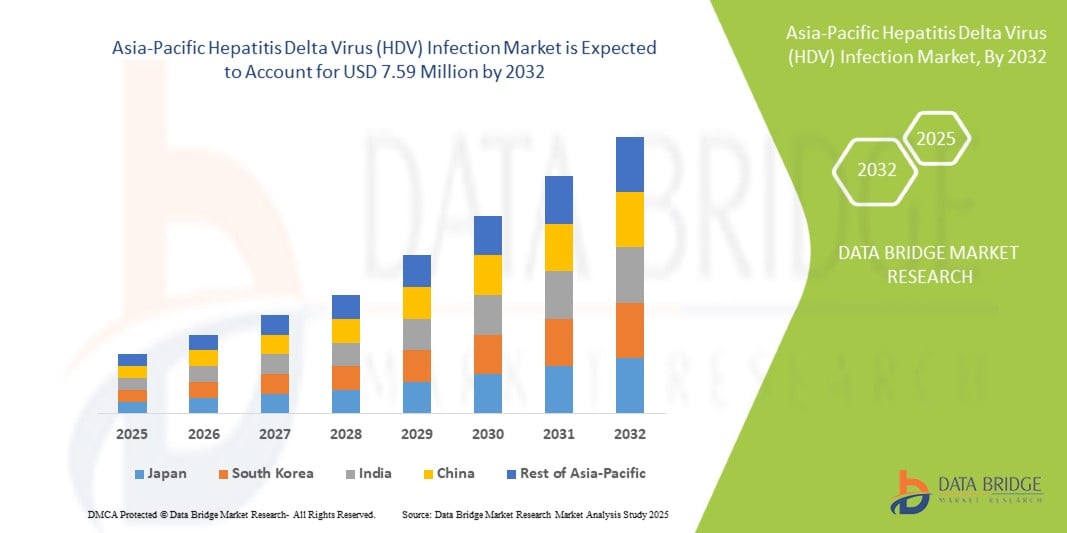
- The Asia-Pacific hepatitis delta virus (HDV) infection market size was valued at USD 5.50 million in 2024 and is expected to reach USD 7.59 million by 2032, at a CAGR of 4.10% during the forecast period
- The market growth is largely fueled by the rising prevalence of co-infection with hepatitis B virus (HBV) and the increasing awareness regarding liver health, especially in endemic countries across the Asia-Pacific region. Government-led public health initiatives and improved diagnostic capabilities are enabling early detection and treatment of HDV, thus accelerating market expansion
- Furthermore, growing investment in antiviral research and the launch of advanced therapeutics—including RNA-targeted agents and novel interferon therapies—are establishing HDV-targeted treatments as a critical segment within the broader hepatology space. These converging factors are accelerating the uptake of Asia-Pacific hepatitis delta virus (HDV) infection solutions, thereby significantly boosting the industry's growth across emerging and developed healthcare markets in the region
Asia-Pacific Hepatitis Delta Virus (HDV) Infection Market Analysis
- The Asia-Pacific hepatitis delta virus (HDV) infection market is experiencing significant growth due to increasing awareness, improved diagnostic capabilities, and enhanced access to healthcare services across developing countries in the region
- The growing burden of liver-related diseases, rising healthcare expenditures, and government-led hepatitis elimination programs are the primary factors driving market expansion in Asia-Pacific
- China dominated the Asia-Pacific hepatitis delta virus (HDV) infection market with the largest revenue share of 36.84% in 2024, driven by its large patient population, government-supported hepatitis elimination programs, and increased adoption of advanced diagnostic and therapeutic solutions
- India is expected to witness the fastest-growing CAGR of 6.9% in the Asia-Pacific hepatitis delta virus (HDV) infection market during the forecast period, fueled by rising healthcare awareness, expanding diagnostic infrastructure, and growing government and private sector investments in infectious disease management
- The Parenteral route of administration segment dominated the Asia-Pacific HDV market with a share of 66.5% in 2024, supported by the widespread use of injectable pegylated interferon as the standard treatment, ensuring effective viral suppression and alignment with established clinical protocols
Report Scope and Asia-Pacific Hepatitis Delta Virus (HDV) Infection Market Segmentation
|
Attributes |
Asia-Pacific Hepatitis Delta Virus (HDV) Infection Key Market Insights |
|
Segments Covered |
By End User: Hospitals, Specialty Clinics, Home Care Setting, Research Institutes and Academic Centers, Ambulatory Surgical Centers, and Others
|
|
Countries Covered |
Asia-Pacific
|
|
Key Market Players |
|
|
Market Opportunities |
|
|
Value Added Data Infosets |
In addition to the insights on market scenarios such as market value, growth rate, segmentation, geographical coverage, and major players, the market reports curated by the Data Bridge Market Research also include in-depth expert analysis, pricing analysis, brand share analysis, consumer survey, demography analysis, supply chain analysis, value chain analysis, raw material/consumables overview, vendor selection criteria, PESTLE Analysis, Porter Analysis, and regulatory framework. |
Asia-Pacific Hepatitis Delta Virus (HDV) Infection Market Trends
“Increasing Adoption of Advanced Diagnostic and Monitoring Technologies”
- A significant and accelerating trend in the Asia-Pacific hepatitis delta virus (HDV) infection market is the deepening integration of advanced diagnostic platforms and digital health ecosystems, aimed at improving early detection, disease monitoring, and patient compliance
- For instance, leading diagnostic manufacturers are launching HDV-specific test kits and real-time PCR-based solutions that enable faster and more accurate detection of HDV in co-infected hepatitis B patients. These advancements are being increasingly adopted across hospitals and diagnostic centers in countries such as China, India, and Japan
- Digital health platforms are also enabling more efficient disease tracking, patient education, and follow-up care. Some mobile health apps now assist healthcare professionals in monitoring liver function, treatment adherence, and patient-reported outcomes, thereby facilitating more personalized HDV care pathways
- The seamless integration of diagnostic tools with electronic medical records (EMRs) and national hepatitis registries is further enhancing surveillance capabilities, enabling policymakers to allocate resources effectively and target high-risk populations
- This trend toward more intelligent, data-driven, and interconnected disease management solutions is fundamentally reshaping expectations around HDV care and treatment. As a result, companies and healthcare systems across the Asia-Pacific region are investing in scalable diagnostic innovations and telemedicine platforms to extend their reach
- The demand for reliable, fast, and integrated diagnostic tools is growing rapidly across both public and private healthcare sectors, as stakeholders increasingly prioritize early intervention, efficient patient tracking, and comprehensive infectious disease management
Asia-Pacific Hepatitis Delta Virus (HDV) Infection Market Dynamics
Driver
“Growing Need Due to Increasing Disease Burden and Unmet Medical Needs”
- The Asia-Pacific hepatitis delta virus (HDV) Infection market is witnessing accelerated growth due to the rising prevalence of hepatitis B and D co-infections, which contribute to the growing demand for effective diagnostics and therapeutics in the region
- For instance, countries such as China, India, and Pakistan report high HBV carrier rates, increasing the risk of HDV superinfections. This has prompted regional governments and health agencies to prioritize hepatitis screening and treatment programs, thereby boosting the HDV market
- Furthermore, increasing healthcare expenditure, expanding access to diagnostic testing, and heightened awareness campaigns regarding viral hepatitis are contributing significantly to the region’s demand for HDV treatment solutions
- Advancements in antiviral therapies and liver disease management, alongside partnerships between global pharmaceutical companies and local healthcare providers, are expected to accelerate HDV drug development and distribution across Asia-Pacific
- The emergence of new therapeutic approaches—such as bulevirtide and other entry inhibitors—and rising participation in clinical trials are strengthening the treatment landscape in the region
Restraint/Challenge
“Limited Access to Specialized Diagnostics and Cost Constraints”
- Despite growing demand, several countries across Asia-Pacific face challenges in diagnosing and treating Hepatitis D due to the limited availability of HDV-specific testing kits and the need for advanced laboratory infrastructure
- Delayed diagnosis due to low awareness among healthcare professionals and patients continues to be a major barrier, especially in rural or low-resource settings
- In addition, the high cost of HDV therapeutics, such as emerging biologics or entry inhibitors, limits affordability for a large segment of the population
- Reimbursement limitations and the absence of targeted national strategies in some APAC countries also hinder access to standardized HDV treatment pathways
- To overcome these challenges, increased funding for liver disease screening programs, development of affordable biosimilars, and stronger healthcare infrastructure are essential to unlock the full potential of the Asia-Pacific HDV Infection market
Asia-Pacific Hepatitis Delta Virus (HDV) Infection Market Scope
The market is segmented on the basis of type, treatment, drug type, route of administration, age group, gender, transmission, end user, and distribution channel.
• By Type
On the basis of type, the Asia-Pacific hepatitis delta virus (HDV) infection market is segmented into Acute Hepatitis D and Chronic Hepatitis D. The chronic hepatitis D segment dominated the largest market revenue share of 71.3% in 2024, driven by the higher burden of long-term infections, the need for extended treatment duration, and increased risk of liver complications such as cirrhosis and hepatocellular carcinoma. Chronic HDV cases are more frequently diagnosed due to improved testing among hepatitis B carriers.
The acute hepatitis D segment is anticipated to witness the fastest growth rate of 6.7% from 2025 to 2032, fueled by better disease surveillance, public health initiatives, and improved early-stage screening technologies.
• By Treatment
On the basis of treatment, the Asia-Pacific hepatitis delta virus (HDV) infection market is segmented into surgery (liver transplant) and medication. The medication segment dominated the market with the largest revenue share of 88.6% in 2024, primarily due to the widespread use of antiviral agents and pegylated interferon therapies as the first line of treatment. Increased R&D efforts targeting HDV-specific viral mechanisms further boost this segment.
The surgery (liver transplant) segment is expected to grow with the fastest CAGR of 5.1% from 2025 to 2032, largely used in cases with end-stage liver failure where medical therapy is no longer effective.
• By Drug Type
On the basis of drug type, the Asia-Pacific hepatitis delta virus (HDV) infection market is segmented into branded and generic drugs. The branded drug segment accounted for the largest revenue share of 63.8% in 2024, owing to the presence of patented therapies such as bulevirtide, with high efficacy and specialist prescribing patterns across tertiary care centers.
The generic segment is anticipated to register the fastest CAGR of 7.4% from 2025 to 2032, driven by affordability, increased local manufacturing, and inclusion in national drug lists in developing countries.
• By Route of Administration
On the basis of route of administration, the Asia-Pacific hepatitis delta virus (HDV) infection market is segmented into oral and parenteral. The parenteral segment held the largest market revenue share of 66.5% in 2024, supported by the standard use of injectable pegylated interferon in HDV treatment.
The oral segment is expected to witness the fastest CAGR of 8.3% from 2025 to 2032, with the emergence of promising oral antiviral agents under clinical trials and rising demand for non-invasive, patient-compliant therapies.
• By Age Group
On the basis of age group, the Asia-Pacific hepatitis delta virus (HDV) infection market is segmented into adults, geriatric, and pediatric. The adult segment held the dominant market share of 61.9% in 2024, attributed to higher prevalence of HBV-HDV co-infections among individuals in their working-age population and middle-aged adults.
The geriatric segment is anticipated to grow at the fastest CAGR of 7.1% from 2025 to 2032, as aging populations experience a higher risk of liver complications and more frequent healthcare access.
• By Gender
On the basis of gender, the Asia-Pacific hepatitis delta virus (HDV) infection market is segmented into male and female. The male segment captured the largest market share of 58.2% in 2024, reflecting the higher incidence rates due to behavioral risk factors and higher HBV prevalence in men.
The female segment is expected to grow with the fastest CAGR of 6.5%, supported by increasing awareness, improved maternal health programs, and gender-focused screening in reproductive health services.
• By Transmission
On the basis of transmission, the Asia-Pacific market is segmented into contaminated needles, exposure to infected blood, blood and plasma product transfusion, and others. The contaminated needles segment held the largest market share of 38.6% in 2024, due to unsafe injection practices and rising intravenous drug use in parts of the region.
The blood and plasma product transfusion segment is expected to register the fastest CAGR of 7.9% from 2025 to 2032, driven by increased testing accuracy and gaps in screening protocols in some healthcare facilities.
• By End User
On the basis of end user, the Asia-Pacific hepatitis delta virus (HDV) infection market is segmented into hospitals, specialty clinics, home care settings, research institutes and academic centers, ambulatory surgical centers, and others. The hospital segment dominated the market with a revenue share of 47.4% in 2024, backed by integrated diagnostics, inpatient treatment, and transplant infrastructure.
The specialty clinics segment is projected to witness the fastest CAGR of 7.6% from 2025 to 2032, supported by rising demand for outpatient liver care, availability of HDV-focused treatment, and urban expansion.
• By Distribution Channel
On the basis of distribution channel, the Asia-Pacific hepatitis delta virus (HDV) infection market is segmented into direct tender, retail sales, and others. The direct tender segment held the highest market share of 54.3% in 2024, owing to government procurement, hospital supplies, and public health agency partnerships for hepatitis programs.
The retail sales segment is expected to grow at the fastest CAGR of 7.8%, driven by increasing over-the-counter availability and expanded distribution through e-pharmacies and private clinics.
Asia-Pacific Hepatitis Delta Virus (HDV) Infection Market Regional Analysis
- The Asia-Pacific hepatitis delta virus (HDV) infection market is poised to grow at the fastest CAGR of 31.7% during the forecast period of 2025 to 2032, driven by increasing urbanization, rising disposable incomes, and technological advancements in countries such as China, Japan, and India
- The region's growing inclination towards public health awareness, supported by government initiatives promoting hepatitis B and D control, is accelerating the adoption of diagnostic and therapeutic solutions
- Moreover, local manufacturing capabilities and expanding screening efforts are further contributing to market growth
China Hepatitis Delta Virus (HDV) Infection Market Insight
The China hepatitis delta virus (HDV) infection market dominated the Asia-Pacific market with the largest revenue share of 36.84% in 2024, attributed to the country's expanding middle class, increasing prevalence of hepatitis infections, and government-supported vaccination and screening programs. The nation’s large patient population, active clinical trials, and robust domestic pharmaceutical industry are key drivers. In addition, ongoing digital healthcare advancements and telemedicine accessibility are further boosting early diagnosis and treatment rates for HDV.
Japan Hepatitis Delta Virus (HDV) Infection Market Insight
The Japan hepatitis delta virus (HDV) infection market is gaining momentum due to the country’s advanced medical infrastructure, proactive public health policies, and growing elderly population vulnerable to liver diseases. Japan’s emphasis on early diagnosis, integrated HDV testing, and its focus on targeted therapeutics are fostering sustained market growth. Additionally, strong partnerships between research institutions and pharmaceutical companies continue to advance HDV care and innovation.
India Hepatitis Delta Virus (HDV) Infection Market Insight
The India hepatitis delta virus (HDV) infection market is expected to register the fastest CAGR of 6.9% during the forecast period, driven by the rising prevalence of hepatitis B and D, increasing public health campaigns, and government initiatives to improve diagnostic outreach. The country’s expanding diagnostic network, combined with local drug manufacturing capabilities, is increasing affordability and access to HDV management. Improved awareness and adoption of co-infection screening protocols are expected to significantly boost early detection rates across both urban and rural regions.
South Korea Hepatitis Delta Virus (HDV) Infection Market Insight
The South Korea hepatitis delta virus (HDV) infection market is expanding steadily, supported by a well-developed healthcare infrastructure, national hepatitis immunization programs, and growing demand for comprehensive liver health management. Increased emphasis on disease prevention, early screening, and R&D efforts for hepatitis therapies are enabling consistent growth in HDV diagnosis and treatment services.
Asia-Pacific Hepatitis Delta Virus (HDV) Infection Market Share
The Asia-Pacific hepatitis delta virus (HDV) Infection industry is primarily led by well-established companies, including:
- Gilead Sciences, Inc. (U.S.)
- Genentech, Inc. (U.S.)
- Alnylam Pharmaceuticals, Inc. (U.S.)
- Assembly Biosciences, Inc. (U.S.)
- Eiger BioPharmaceuticals (U.S.)
- GlobeImmune Inc. (U.S.)
- Huahui Health Ltd. (China)
- Johnson & Johnson Services, Inc. (U.S.)
- PharmaEssentia Corporation (Taiwan)
- Replicor (Canada)
- Vir Biotechnology, Inc. (U.S.)
Latest Developments in Asia-Pacific Hepatitis Delta Virus (HDV) Infection Market
- In September 2024, Gilead Sciences, Inc. and Genesis Therapeutics have formed a strategic collaboration to discover and develop novel therapies using advanced AI-driven drug discovery technologies. This partnership aims to accelerate the creation of innovative treatments, enhancing Gilead's pipeline and strengthening its position in the competitive biopharma industry
- In March 2024, Gilead Sciences Inc. completed the acquisition of CymaBay Therapeutics, gaining access to innovative therapies for liver and rare diseases. This acquisition expands Gilead’s research portfolio and strengthens its pipeline, enhancing its capacity to address unmet medical needs. The acquisition of CymaBay provides Gilead with promising new drug candidates and expertise in liver and rare diseases, boosting its research capabilities and expanding its therapeutic offerings
- In March 2024, Gilead Sciences, Inc. and Merus have announced a collaboration to discover novel antibody-based trispecific T-cell engagers, aiming to enhance cancer immunotherapy. This partnership combines Gilead’s expertise with Merus’ innovative technology to develop advanced treatments for cancer
- In March 2024, Alnylam Pharmaceuticals launched the Family Health History Road Trip to promote discussions on hereditary ATTR (hATTR) amyloidosis. Genealogist Bernice Bennett traveled cross-country to highlight the importance of family health history for earlier diagnosis

- Interactive Data Analysis Dashboard
- Company Analysis Dashboard for high growth potential opportunities
- Research Analyst Access for customization & queries
- Competitor Analysis with Interactive dashboard
- Latest News, Updates & Trend analysis
- Harness the Power of Benchmark Analysis for Comprehensive Competitor Tracking
Data collection and base year analysis are done using data collection modules with large sample sizes. The stage includes obtaining market information or related data through various sources and strategies. It includes examining and planning all the data acquired from the past in advance. It likewise envelops the examination of information inconsistencies seen across different information sources. The market data is analysed and estimated using market statistical and coherent models. Also, market share analysis and key trend analysis are the major success factors in the market report. To know more, please request an analyst call or drop down your inquiry.
The key research methodology used by DBMR research team is data triangulation which involves data mining, analysis of the impact of data variables on the market and primary (industry expert) validation. Data models include Vendor Positioning Grid, Market Time Line Analysis, Market Overview and Guide, Company Positioning Grid, Patent Analysis, Pricing Analysis, Company Market Share Analysis, Standards of Measurement, Global versus Regional and Vendor Share Analysis. To know more about the research methodology, drop in an inquiry to speak to our industry experts.
Data Bridge Market Research is a leader in advanced formative research. We take pride in servicing our existing and new customers with data and analysis that match and suits their goal. The report can be customized to include price trend analysis of target brands understanding the market for additional countries (ask for the list of countries), clinical trial results data, literature review, refurbished market and product base analysis. Market analysis of target competitors can be analyzed from technology-based analysis to market portfolio strategies. We can add as many competitors that you require data about in the format and data style you are looking for. Our team of analysts can also provide you data in crude raw excel files pivot tables (Fact book) or can assist you in creating presentations from the data sets available in the report.












