


Asia-Pacific Hernia Mesh Repair Devices Market Size
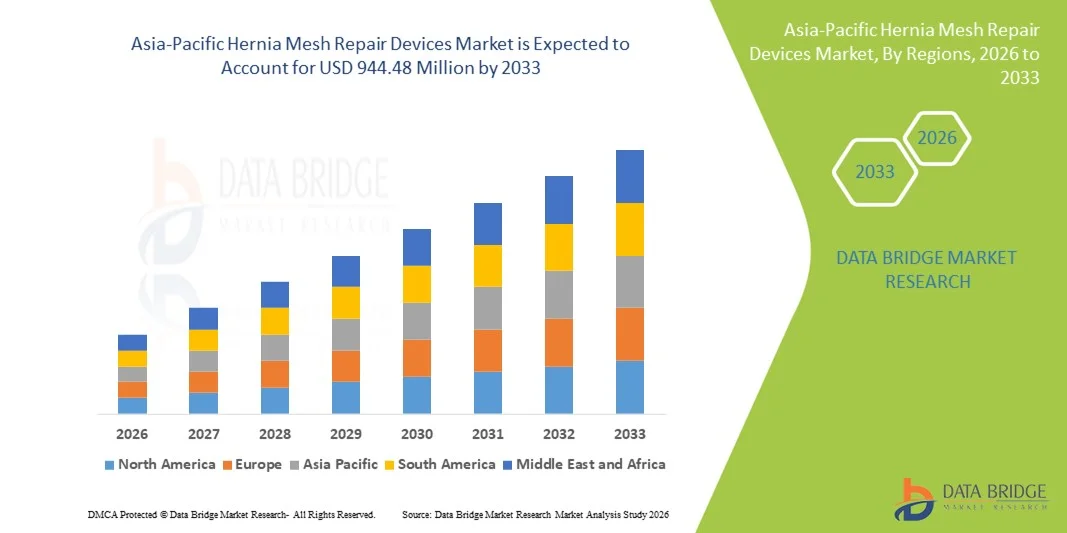
- The Asia-Pacific hernia mesh repair devices market size was valued at USD 714.49 million in 2025 and is expected to reach USD 944.48 million by 2033, at a CAGR of 3.55% during the forecast period
- The market growth is primarily driven by the rising prevalence of hernia cases, increasing geriatric population, and growing awareness about minimally invasive surgical procedures across the region
- Moreover, advancements in surgical mesh technology, such as biocompatible and absorbable materials, along with expanding healthcare infrastructure in emerging economies such as China, India, and Southeast Asia, are supporting higher adoption of hernia mesh repair devices, thereby accelerating the market’s growth
Asia-Pacific Hernia Mesh Repair Devices Market Analysis
- Hernia mesh repair devices, used in surgical procedures to reinforce weakened or damaged abdominal walls, are becoming increasingly critical in modern healthcare due to their ability to reduce recurrence rates, enable minimally invasive surgeries, and improve patient recovery outcomes in both public and private healthcare settings
- The rising demand for hernia mesh devices is primarily driven by the increasing prevalence of hernia cases, aging populations, growing awareness of minimally invasive surgical options, and enhanced access to quality healthcare services across the region
- Japan dominated the Asia-Pacific hernia mesh market with the largest revenue share of 28.9% in 2025, supported by advanced healthcare infrastructure, widespread adoption of laparoscopic procedures, and strong investments in medical device innovations
- China is expected to be the fastest-growing country in the Asia-Pacific hernia mesh market during the forecast period due to expanding healthcare facilities, rising surgical procedures, growing healthcare expenditure, and government initiatives to improve access to quality surgical care
- Mesh segment dominated the Asia-Pacific hernia mesh market with a market share of 70.4% in 2025, driven by its proven clinical effectiveness, versatility across different hernia types, and widespread surgeon preference
Report Scope and Asia-Pacific Hernia Mesh Repair Devices Market Segmentation
|
Attributes |
Asia-Pacific Hernia Mesh Repair Devices Key Market Insights |
|
Segments Covered |
|
|
Countries Covered |
Asia-Pacific
|
|
Key Market Players |
|
|
Market Opportunities |
|
|
Value Added Data Infosets |
In addition to the insights on market scenarios such as market value, growth rate, segmentation, geographical coverage, and major players, the market reports curated by the Data Bridge Market Research also include in-depth expert analysis, patient epidemiology, pipeline analysis, pricing analysis, and regulatory framework |
Asia-Pacific Hernia Mesh Repair Devices Market Trends
Advancements in Minimally Invasive and Robotic-Assisted Surgeries
- A significant and accelerating trend in the Asia-Pacific hernia mesh market is the growing adoption of minimally invasive laparoscopic procedures and robotic-assisted hernia surgeries, improving precision and reducing patient recovery time
- For instance, surgeons in Japan and South Korea are increasingly using robotic-assisted platforms for complex hernia repairs, enabling more precise mesh placement and reduced post-operative complications
- Innovative mesh materials, such as biodegradable and composite meshes, are also being integrated into these procedures, enhancing surgical outcomes and reducing recurrence rates over time
- The integration of advanced imaging and navigation tools with mesh implantation procedures allows surgeons to plan and execute hernia repairs with higher accuracy, improving patient safety and efficiency
- This trend towards technologically advanced, precise, and patient-friendly procedures is reshaping surgical standards, prompting manufacturers to develop meshes compatible with robotic systems and laparoscopic instruments
- The demand for hernia mesh products optimized for minimally invasive and robotic-assisted procedures is growing rapidly across hospitals and surgical centers in Asia-Pacific, as healthcare providers prioritize better outcomes and faster patient recovery
- Growing awareness campaigns by surgical societies and government programs highlighting early diagnosis and repair of hernias are encouraging higher uptake of modern hernia mesh solutions
Asia-Pacific Hernia Mesh Repair Devices Market Dynamics
Driver
Increasing Hernia Prevalence and Geriatric Population
- The rising prevalence of hernia cases across the Asia-Pacific region, coupled with the growing geriatric population, is a significant driver for the heightened demand for hernia mesh repair devices
- For instance, in 2025, India reported increasing elective hernia surgeries in both public and private hospitals, reflecting higher awareness and access to surgical care, driving mesh adoption
- Hernia mesh devices offer advanced surgical solutions for various types of hernias, improving repair durability and reducing recurrence rates, providing a strong rationale for their adoption
- Furthermore, expanding healthcare infrastructure and government initiatives to improve surgical care access in countries such as China and Indonesia are making hernia mesh procedures more widely available
- Increased awareness among patients and healthcare professionals regarding minimally invasive surgery benefits, faster recovery, and lower post-operative complications is further boosting demand for hernia mesh devices
- Rising medical tourism in countries such as India and Thailand is driving demand for high-quality hernia mesh products as international patients seek advanced surgical care at competitive costs
- Technological partnerships between mesh manufacturers and surgical equipment companies are enabling the development of procedure-specific meshes, increasing clinical adoption
Restraint/Challenge
High Device Cost and Regulatory Approval Hurdles
- The relatively high cost of advanced hernia mesh products, especially those used in minimally invasive or robotic-assisted procedures, poses a significant challenge to broader market penetration in price-sensitive countries
- For instance, in Southeast Asia, many smaller hospitals face budget constraints that limit the adoption of premium mesh products, impacting market growth
- Strict regulatory requirements for approval of surgical mesh devices, including safety and clinical efficacy testing, can delay product launches and limit the introduction of new technologies
- In addition, complications related to mesh implantation, such as infection or adhesion formation, create cautious adoption among surgeons and patients, restraining growth
- Overcoming these challenges through cost-effective product innovations, faster regulatory approvals, and improved clinical outcomes will be crucial for sustained market expansion in the Asia-Pacific region
- Limited local manufacturing capabilities in several countries increase reliance on imported mesh products, which can raise costs and limit accessibility
- Variations in clinical guidelines and surgeon preferences across Asia-Pacific countries make standardization of mesh usage challenging, slowing uniform adoption
Asia-Pacific Hernia Mesh Repair Devices Market Scope
The market is segmented on the basis of product, surgery type, and end users
- By Product
On the basis of product, the market is segmented into mesh and mesh fixators. The Mesh segment dominated the market with the largest revenue share of 70.4% in 2025, driven by its proven clinical effectiveness, versatility across different hernia types, and widespread surgeon preference. Surgeons prefer mesh due to its ability to reduce hernia recurrence rates and compatibility with both open and laparoscopic procedures. In addition, hospitals and surgical centers prioritize mesh products that can be easily customized to fit patient anatomy, improving post-operative outcomes. The segment also benefits from ongoing innovations, such as composite and biodegradable meshes, which further enhance adoption. High patient demand for minimally invasive and effective hernia repair procedures has reinforced the Mesh segment’s dominance.
The Mesh Fixators segment is anticipated to witness the fastest growth rate of 9% CAGR from 2026 to 2033, fueled by their increasing adoption in laparoscopic and robotic-assisted surgeries. Mesh fixators simplify the implantation process, improve mesh stability, and reduce operative time. Their compatibility with advanced surgical instruments makes them attractive for hospitals upgrading to minimally invasive techniques. Growing awareness among surgeons about procedure-specific fixation devices is further driving adoption. The development of disposable and cost-effective fixators for ambulatory and smaller surgical centers also contributes to the rapid growth of this segment.
- By Surgery Type
On the basis of surgery type, the market is segmented into inguinal hernia, incisional/ventral hernia, umbilical hernia, femoral hernia, hiatal hernia, parastomal hernia, and others. The Inguinal Hernia segment held the largest market revenue share of 40% in 2025, due to the high prevalence of inguinal hernias among adults in the Asia-Pacific region. Surgical repairs for inguinal hernias are often performed using mesh, which lowers recurrence rates and allows minimally invasive techniques. The segment’s dominance is also supported by increasing awareness among patients and surgeons regarding laparoscopic approaches, leading to higher procedure volumes. Countries such as Japan, China, and India are investing in healthcare infrastructure and training programs, which further boosts inguinal hernia repairs. Ongoing research into mesh materials optimized for inguinal hernias strengthens the segment’s position.
The Incisional/Ventral Hernia segment is expected to witness the fastest CAGR from 2026 to 2033, driven by the rising number of post-surgical hernias and increasing hospitalizations due to abdominal surgeries. Advanced surgical techniques and the adoption of reinforced mesh systems make ventral hernia repairs safer and more effective. Surgeons are increasingly preferring mesh-based solutions over traditional suturing for complex ventral hernias, further accelerating growth. Growing medical tourism in countries such as India and Thailand, where patients seek advanced surgical care, also contributes to the rapid expansion of this segment.
- By End Users
On the basis of end users, the market is segmented into ambulatory surgical centres, clinics, hospitals, and others. The Hospitals segment dominated the market with the largest revenue share of 65% in 2025, owing to their well-established surgical infrastructure, trained personnel, and high surgical volumes. Hospitals are equipped to handle complex hernia cases requiring advanced mesh devices and laparoscopic or robotic-assisted procedures. The segment also benefits from increasing investments in modern surgical equipment and adoption of advanced surgical protocols. Surgeons in hospitals often prefer high-quality mesh and fixation systems to ensure consistent clinical outcomes. Moreover, hospitals in Japan, China, and India are expanding surgical capacities, further strengthening the segment’s dominance
The Ambulatory Surgical Centres segment is expected to witness the fastest growth rate of 10% CAGR from 2026 to 2033, due to rising outpatient surgical procedures and the growing preference for minimally invasive surgeries in day-care settings. These centers provide cost-effective and efficient solutions for patients, driving the adoption of ready-to-use mesh and fixator systems. Technological advancements in portable laparoscopic instruments and patient awareness about fast recovery times are further fueling segment growth. The increasing number of smaller surgical centers in urban and semi-urban regions of Asia-Pacific also contributes to rapid adoption.
Asia-Pacific Hernia Mesh Repair Devices Market Regional Analysis
- Japan dominated the Asia-Pacific hernia mesh market with the largest revenue share of 28.9% in 2025, supported by advanced healthcare infrastructure, widespread adoption of laparoscopic procedures, and strong investments in medical device innovations
- Surgeons and hospitals in the region prioritize high-quality mesh products due to their proven clinical effectiveness, reduced hernia recurrence rates, and compatibility with laparoscopic and open surgical techniques
- This widespread adoption is further supported by skilled healthcare professionals, increasing government initiatives to improve surgical care, and a technologically advanced patient population seeking faster recovery and improved surgical outcomes
The China Hernia Mesh Repair Devices Market Insight
The China hernia mesh repair devices market accounted for a significant revenue share in 2025, fueled by the rising prevalence of hernia cases, expanding healthcare infrastructure, and increasing adoption of minimally invasive surgical procedures. Hospitals and surgical centers are investing in advanced mesh and mesh fixator products to improve clinical outcomes and reduce recovery times. Government initiatives to improve access to quality surgical care and growing awareness among patients about laparoscopic and robotic-assisted surgeries are driving market growth. In addition, China’s growing medical tourism sector is encouraging hospitals to adopt high-quality hernia mesh devices to meet international patient standards. The increasing availability of locally manufactured and cost-effective mesh products is further supporting market expansion.
Japan Hernia Mesh Repair Devices Market Insight
The Japan hernia mesh repair devices market is experiencing steady growth due to the country’s advanced healthcare system, high adoption of laparoscopic and robotic-assisted surgeries, and strong focus on medical innovation. Surgeons prioritize mesh products that reduce recurrence rates and improve patient recovery outcomes. The integration of advanced surgical tools and high-tech operating rooms enhances procedural efficiency and accuracy. Japan’s aging population and rising elective hernia procedures are fueling demand across hospitals. Moreover, training programs for surgeons on new mesh technologies are increasing adoption rates. Government support for minimally invasive surgeries also contributes to the market’s expansion in the country.
India Hernia Mesh Repair Devices Market Insight
The India hernia mesh repair devices market accounted for the largest market revenue share in Asia-Pacific in 2025, attributed to the rising number of hernia surgeries, expanding healthcare facilities, and growing patient awareness of minimally invasive procedures. Rapid urbanization and increasing healthcare expenditure are driving the adoption of advanced mesh products in hospitals and clinics. Medical tourism is boosting demand as India becomes a preferred destination for cost-effective, high-quality hernia repairs. The presence of domestic manufacturers providing affordable mesh and fixator solutions further accelerates growth. Government initiatives promoting surgical care access and training programs for laparoscopic procedures are additional factors supporting the market.
Southeast Asia Hernia Mesh Repair Devices Market Insight
The Southeast Asia hernia mesh repair devices market is expected to grow at a rapid CAGR during the forecast period, driven by rising healthcare infrastructure investments, increasing surgical volumes, and growing patient awareness of minimally invasive hernia repair options. Countries such as Thailand, Malaysia, and Indonesia are upgrading hospitals with laparoscopic and robotic-assisted surgery facilities. Surgeons are increasingly adopting advanced mesh and fixator products to improve procedural efficiency and clinical outcomes. Affordable and ready-to-use mesh systems are enabling smaller clinics and ambulatory surgical centers to perform hernia repairs effectively. Government initiatives to improve surgical care and training programs for surgeons are further accelerating market adoption.
Australia Hernia Mesh Repair Devices Market Insight
The Australia hernia mesh repair devices market is witnessing steady growth, fueled by advanced healthcare infrastructure, high adoption of minimally invasive surgeries, and patient preference for faster recovery procedures. Hospitals and surgical centers prioritize high-quality mesh products to ensure low recurrence rates and improved post-operative outcomes. Increasing awareness among patients and surgeons regarding laparoscopic and robotic-assisted hernia repairs is boosting demand. The country’s well-regulated medical device environment ensures adoption of safe and clinically validated mesh products. In addition, rising elective hernia surgeries among the aging population contribute to market expansion. Collaboration between mesh manufacturers and surgical institutions also enhances accessibility and training.
Asia-Pacific Hernia Mesh Repair Devices Market Share
The Asia-Pacific Hernia Mesh Repair Devices industry is primarily led by well-established companies, including:
- Medtronic (Ireland)
- W. L. Gore & Associates, Inc. (U.S.)
- B. Braun SE (Germany)
- Cook (U.S.)
- Baxter (U.S.)
- Integra LifeSciences Holdings Corporation (U.S.)
- Herniamesh S.r.l. (Italy)
- Meril Life Sciences Pvt. Ltd. (India)
- Samyang Holdings Corporation (South Korea)
- Atrium Medical (Getinge AB) (Sweden)
- LifeCell Corporation (U.S.)
- Betatech Medical (Turkey)
- Deep Blue Medical Inc. (U.S.)
- Sinolinks Medical Innovation Inc. (China)
- Aspide Medical S.A.S (France)
- Primequal SA (Switzerland)
- Dipromed S.r.l. (Italy)
- Novus Scientific AB (Sweden)
- GEM S.r.l. (Italy)
What are the Recent Developments in Asia-Pacific Hernia Mesh Repair Devices Market?
- In October 2025, TI Medical, a surgical device innovator in India, officially launched its next‑generation hernia repair mesh called HIPOM‑AB Mesh, designed with a large‑pore flexible structure, soft absorbable edges to reduce tissue irritation, and surgeon‑friendly features such as pre‑attached sutures and improved visibility aimed at enhancing procedural precision and patient recovery in laparoscopic hernia surgeries
- In October 2025, TI Medical unveiled the HIPOM hernia repair mesh at an industry event in Kolkata, marking a strategic move to elevate surgical standards in the region with patient‑centric mesh design that supports smoother recoveries, thereby expanding India’s footprint in advanced hernia repair technologies
- In September 2025, at the 20th Annual Congress of the Asia Pacific Hernia Society (APHS) held in New Delhi, industry leaders including Medtronic showcased breakthrough technologies and next‑gen fixation devices, with sessions highlighting innovations in synthetic and resorbable meshes, reinforcing the regional clinical focus on advanced hernia repair solutions
- In April 2025, BD (Becton, Dickinson and Company) announced the FDA 510(k) clearance and commercial launch of the Phasix™ ST Umbilical Hernia Patch, the first fully bioabsorbable hernia mesh specifically designed for umbilical hernia repair, offering surgeons a resorbable alternative while using familiar surgical techniques and expanding treatment options in abdominal wall reconstruction
- In April 2024, TI Medical launched its next‑generation hernia mesh device called HIPOM‑AB Mesh, designed to improve procedural efficiency and patient outcomes with a large‑pore flexible design that aids accurate placement and reduced tissue irritation across laparoscopic hernia repairs, reflecting continued innovation in surgical mesh technology

- Interactive Data Analysis Dashboard
- Company Analysis Dashboard for high growth potential opportunities
- Research Analyst Access for customization & queries
- Competitor Analysis with Interactive dashboard
- Latest News, Updates & Trend analysis
- Harness the Power of Benchmark Analysis for Comprehensive Competitor Tracking
Data collection and base year analysis are done using data collection modules with large sample sizes. The stage includes obtaining market information or related data through various sources and strategies. It includes examining and planning all the data acquired from the past in advance. It likewise envelops the examination of information inconsistencies seen across different information sources. The market data is analysed and estimated using market statistical and coherent models. Also, market share analysis and key trend analysis are the major success factors in the market report. To know more, please request an analyst call or drop down your inquiry.
The key research methodology used by DBMR research team is data triangulation which involves data mining, analysis of the impact of data variables on the market and primary (industry expert) validation. Data models include Vendor Positioning Grid, Market Time Line Analysis, Market Overview and Guide, Company Positioning Grid, Patent Analysis, Pricing Analysis, Company Market Share Analysis, Standards of Measurement, Global versus Regional and Vendor Share Analysis. To know more about the research methodology, drop in an inquiry to speak to our industry experts.
Data Bridge Market Research is a leader in advanced formative research. We take pride in servicing our existing and new customers with data and analysis that match and suits their goal. The report can be customized to include price trend analysis of target brands understanding the market for additional countries (ask for the list of countries), clinical trial results data, literature review, refurbished market and product base analysis. Market analysis of target competitors can be analyzed from technology-based analysis to market portfolio strategies. We can add as many competitors that you require data about in the format and data style you are looking for. Our team of analysts can also provide you data in crude raw excel files pivot tables (Fact book) or can assist you in creating presentations from the data sets available in the report.













