


Asia-Pacific Home Healthcare Market Size
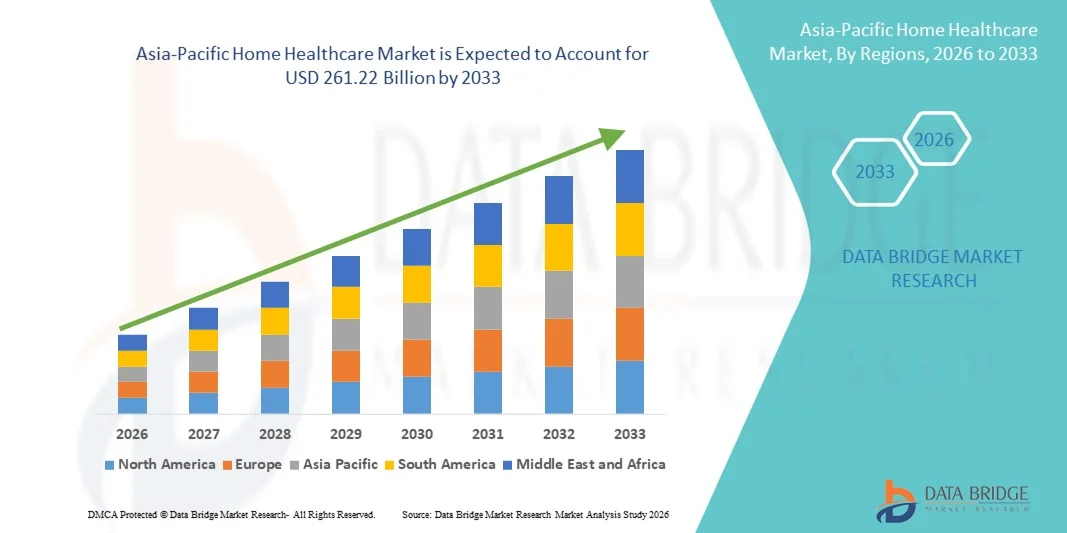
- The Asia-Pacific home healthcare market size was valued at USD 137.02 billion in 2025 and is expected to reach USD 261.22 billion by 2033, at a CAGR of 8.40% during the forecast period
- The market growth is largely fueled by the rising geriatric population, increasing prevalence of chronic diseases, and the growing adoption of remote patient monitoring and telehealth technologies, driving digital healthcare delivery across the region
- Furthermore, expanding government initiatives, rising awareness of home-based care solutions, and increasing preference for cost-effective, patient-centric care models are positioning home healthcare as a preferred alternative to traditional hospital-based treatment. These converging factors are accelerating the adoption of home healthcare services, thereby significantly boosting the industry's growth
Asia-Pacific Home Healthcare Market Analysis
- Home healthcare services, offering medical care and monitoring in patients’ residences, are increasingly vital components of the healthcare ecosystem in both urban and rural settings due to their convenience, personalized care delivery, and integration with telehealth and remote monitoring technologies
- The escalating demand for home healthcare is primarily fueled by the rising geriatric population, growing prevalence of chronic diseases, and increasing adoption of digital health solutions and home-based care models
- Japan dominated the Asia-Pacific home healthcare market with the largest revenue share of 35.8% in 2025, driven by an advanced healthcare infrastructure, a rapidly aging population, and well-established home healthcare service providers
- China is expected to be the fastest-growing country in the Asia-Pacific home healthcare market during the forecast period due to increasing healthcare awareness, rising disposable incomes, and government initiatives promoting home-based care
- Skilled nursing segment dominated the Asia-Pacific home healthcare market with a market share of 42.3% in 2025, driven by its critical role in providing post-acute care, chronic disease management, and professional medical support within the home setting
Report Scope and Asia-Pacific Home Healthcare Market Segmentation
|
Attributes |
Asia-Pacific Home Healthcare Key Market Insights |
|
Segments Covered |
|
|
Countries Covered |
Asia-Pacific
|
|
Key Market Players |
|
|
Market Opportunities |
|
|
Value Added Data Infosets |
In addition to the insights on market scenarios such as market value, growth rate, segmentation, geographical coverage, and major players, the market reports curated by the Data Bridge Market Research also include in-depth expert analysis, patient epidemiology, pipeline analysis, pricing analysis, and regulatory framework |
Asia-Pacific Home Healthcare Market Trends
Digital Health Integration and Remote Monitoring Adoption
- A significant and accelerating trend in the Asia-Pacific home healthcare market is the increasing integration of digital health platforms and remote patient monitoring devices, enhancing convenience, real-time care, and proactive health management
- For instance, Philips’ remote patient monitoring solutions in China allow healthcare providers to track vital signs and chronic disease metrics from patients’ homes, reducing hospital visits and enabling timely interventions
- Mobile health apps and wearable devices are increasingly linked with home healthcare services, allowing caregivers to receive alerts, monitor medication adherence, and track recovery progress remotely. For instance, iHealth wearable devices in Japan transmit glucose and blood pressure data to cloud-based platforms for healthcare providers
- The seamless integration of home healthcare with telemedicine platforms and electronic health records enables a centralized approach to patient care, allowing providers to coordinate treatments, monitor multiple patients, and adjust care plans from a single interface
- This trend towards connected, data-driven, and patient-centric home healthcare is reshaping expectations for care delivery in Asia-Pacific. For instance, Medtronic’s integrated remote care programs in India offer continuous monitoring and follow-up for cardiac patients
- The demand for digital and remote monitoring-enabled home healthcare services is growing rapidly across the region, as consumers increasingly prioritize convenience, personalized care, and timely medical intervention
- Integration with smart home devices and IoT-enabled medical equipment is creating a more comprehensive home care environment, where health monitoring and daily living support are combined. For instance, Japan’s IoT-enabled homes assist elderly patients with medication reminders and mobility tracking
Asia-Pacific Home Healthcare Market Dynamics
Driver
Rising Chronic Disease Burden and Aging Population
- The increasing prevalence of chronic diseases and the growing geriatric population in Asia-Pacific are major drivers of home healthcare demand, as these populations require continuous monitoring and personalized care
- For instance, China has implemented large-scale home care programs for elderly patients with cardiovascular and respiratory disorders, supporting the expansion of professional home healthcare services
- Home healthcare provides patients with professional care in familiar environments, reducing hospital visits, preventing complications, and improving quality of life. For instance, Japan’s skilled nursing services allow elderly patients to receive post-acute care at home
- Government initiatives promoting home-based care and reimbursement policies are encouraging private sector adoption of home healthcare solutions, particularly for chronic disease management. For instance, India’s National Programme for Health Care of the Elderly supports home visits by trained nurses and caregivers
- The convenience, cost-effectiveness, and personalized nature of home healthcare compared to traditional hospital care are key factors driving growth in both urban and semi-urban Asia-Pacific regions. For instance, South Korea’s integrated home care services provide multidisciplinary support at home
- Increasing penetration of health insurance coverage for home healthcare services is enabling broader adoption among middle-income households. For instance, some private insurers in Australia now reimburse skilled nursing visits at home for chronic disease patients
- Growing awareness of preventive care and rehabilitation at home is driving demand for specialized services such as wound care, physiotherapy, and respiratory therapy. For instance, Thailand’s home rehab programs for post-surgical patients reduce hospital readmission rates
Restraint/Challenge
Workforce Shortages and Infrastructure Limitations
- Limited availability of trained home healthcare professionals and caregivers poses a significant challenge to scaling home healthcare services across Asia-Pacific, particularly in rural and semi-urban areas
- For instance, reports in India indicate a shortage of skilled nurses and rehabilitation therapists, slowing the expansion of home-based care programs
- Insufficient healthcare infrastructure and uneven distribution of digital health technology can hinder the effective delivery of home healthcare services. For instance, remote monitoring devices may be inaccessible in less developed regions of Southeast Asia
- High initial costs for advanced home healthcare equipment, such as telehealth-enabled devices or mobility aids, can be a barrier to adoption for price-sensitive households. For instance, premium wearable monitoring devices in Japan and Australia are often beyond the reach of lower-income patients
- Addressing workforce gaps, expanding infrastructure, and improving affordability through subsidies, training programs, and scalable technology solutions will be essential for sustaining long-term growth in Asia-Pacific home healthcare
- Regulatory inconsistencies across countries in Asia-Pacific can delay approvals and adoption of home healthcare devices and digital health platforms. For instance, some IoT medical devices face long approval cycles in Indonesia and the Philippines
- Limited digital literacy among elderly patients and caregivers can reduce the effectiveness of telehealth and remote monitoring solutions. For instance, some older patients in rural India struggle to use mobile health apps and wearable devices without guidance
Asia-Pacific Home Healthcare Market Scope
The market is segmented on the basis of product type, indication, and service.
- By Product Type
On the basis of product type, the Asia-Pacific home healthcare market is segmented into therapeutic, diagnostic, and mobility assist. The therapeutic segment dominated the market in 2025 with the largest revenue share, driven by the high demand for products that aid in disease management, rehabilitation, and long-term care. Therapeutic devices such as infusion pumps, respiratory support devices, and wound care systems are widely used across hospitals and home care settings. Their established role in improving patient outcomes, particularly for chronic disease management and post-surgical recovery, contributes to their market dominance. Moreover, rising awareness among caregivers and patients regarding home-based therapy solutions strengthens the segment’s adoption. Countries such as Japan and South Korea exhibit strong uptake due to government initiatives promoting home therapy and aging population care. The segment also benefits from innovations in portable and user-friendly therapeutic devices, which enhance convenience for patients and caregivers.
The mobility assist segment is expected to witness the fastest growth rate from 2026 to 2033, driven by increasing demand among the elderly and patients with mobility disorders or post-operative limitations. Products such as wheelchairs, walking aids, and mobility scooters are gaining popularity due to their role in improving independence and quality of life. Rising urbanization, growing disposable incomes, and supportive government policies in China, India, and Australia are fueling adoption. Technological advancements, including lightweight, foldable, and smart mobility devices, further contribute to segment growth. Increased awareness of rehabilitation at home and integration with telehealth services also supports this rapid expansion.
- By Indication
On the basis of indication, the Asia-Pacific home healthcare market is segmented into cancer, respiratory diseases, mobility disorders, cardiovascular disorders, pregnancy, wound care, diabetes, and other indications. The cardiovascular disorders segment dominated the market in 2025, due to the high prevalence of heart diseases and related complications in the region. Home healthcare devices such as blood pressure monitors, ECG devices, and cardiac rehabilitation equipment are widely adopted to manage chronic cardiovascular conditions. Rising awareness among patients and caregivers for early detection, continuous monitoring, and post-hospital care drives demand. Japan, China, and India represent key markets, with large patient populations requiring consistent monitoring and home-based intervention. The segment benefits from integration with digital health platforms, mobile apps, and telehealth services that facilitate real-time tracking and proactive management. Cardiovascular monitoring devices are also increasingly supported by insurance reimbursement, further promoting adoption.
The respiratory diseases segment is expected to witness the fastest growth rate from 2026 to 2033, fueled by the rising incidence of chronic respiratory conditions such as COPD and asthma. Home healthcare solutions including oxygen concentrators, nebulizers, and ventilators are becoming increasingly common, particularly in urban and semi-urban areas. Technological advancements in portable, energy-efficient respiratory devices enhance patient comfort and mobility. Government initiatives in countries such as China and India to expand access to home-based respiratory care are accelerating adoption. Rising environmental pollution and increasing awareness of preventive respiratory care further contribute to rapid market growth.
- By Service
On the basis of service, the Asia-Pacific home healthcare market is segmented into skilled nursing, rehabilitation therapy, hospice and palliative care, unskilled care, respiratory therapy, infusion therapy, and pregnancy care. The skilled nursing segment dominated the market in 2025 with a market share of 42.3%, owing to its essential role in providing professional medical care at home for patients with chronic, post-surgical, or complex healthcare needs. Skilled nurses administer medication, monitor vital signs, assist in therapy routines, and provide patient education, making this service critical for effective home healthcare delivery. High adoption in Japan, Australia, and South Korea is driven by the aging population and government support for home care programs. The segment benefits from technological integration such as telehealth supervision and electronic health record management, which enhances care quality and operational efficiency. Patients and caregivers increasingly rely on skilled nursing services for consistent, high-quality medical support at home.
The rehabilitation therapy segment is expected to witness the fastest growth rate from 2026 to 2033, driven by rising demand for physiotherapy, occupational therapy, and post-operative rehabilitation at home. Growth is supported by increasing incidences of mobility disorders, orthopedic surgeries, and chronic conditions requiring long-term rehabilitation. Innovations in remote therapy, app-based exercise monitoring, and wearable feedback devices improve patient compliance and outcomes. Rising awareness among patients and caregivers about the benefits of home-based rehabilitation, coupled with government initiatives in India, China, and Thailand, further accelerates adoption. The segment also benefits from cost-effectiveness, convenience, and the ability to integrate therapy with telehealth consultations, making it a rapidly expanding area of the home healthcare market.
Asia-Pacific Home Healthcare Market Regional Analysis
- Japan dominated the Asia-Pacific home healthcare market with the largest revenue share of 35.8% in 2025, driven by an advanced healthcare infrastructure, a rapidly aging population, and well-established home healthcare service providers
- Consumers in the country highly value professional in-home care, skilled nursing services, and technologically advanced remote monitoring solutions that allow continuous health tracking and timely intervention
- This widespread adoption is further supported by government initiatives promoting home-based care, strong healthcare reimbursement policies, and rising awareness of chronic disease management, establishing home healthcare as a preferred care model for elderly and chronically ill patients
The Japan Home Healthcare Market Insight
The Japan home healthcare market is gaining momentum due to the country’s rapidly aging population, advanced healthcare infrastructure, and strong preference for home-based care solutions. Japanese consumers highly value professional skilled nursing, rehabilitation therapy, and remote monitoring services, which allow elderly patients to maintain independence while receiving continuous medical support. The adoption of digital health tools and IoT-enabled devices, such as wearable vital sign monitors, is enhancing the efficiency and quality of home healthcare services. Government initiatives supporting aging-in-place policies and long-term care programs further stimulate market growth. In addition, Japan’s high healthcare awareness and technological culture drive demand for user-friendly, integrated home healthcare solutions in both residential and commercial care facilities.
China Home Healthcare Market Insight
The China home healthcare market is witnessing rapid expansion due to rising chronic disease prevalence, urbanization, and growing awareness of preventive and post-acute care. Consumers increasingly prefer home-based care for cardiovascular, respiratory, and mobility-related conditions, supported by technological solutions such as telehealth platforms and remote monitoring devices. Government policies promoting digital health and community-based care programs are boosting adoption, particularly in Tier-1 and Tier-2 cities. China’s growing manufacturing capabilities for medical devices and affordability of home healthcare equipment make services accessible to a broader population. Integration of mobile health apps with professional nursing services enhances patient engagement and adherence to treatment protocols. Furthermore, rising disposable incomes and increasing acceptance of modern healthcare models are key factors driving market growth.
India Home Healthcare Market Insight
The India home healthcare market accounted for a significant revenue share in 2025, driven by the country’s expanding middle-class population, rising incidence of chronic diseases, and rapid urbanization. Consumers are increasingly adopting home-based care for conditions such as diabetes, cardiovascular disorders, and post-surgical rehabilitation, supported by affordable devices and skilled nursing services. Government initiatives promoting home care and telemedicine adoption, alongside the growth of private healthcare providers, are accelerating market penetration. India’s focus on smart cities and digital healthcare platforms enhances access to professional care and remote monitoring solutions. The increasing availability of cost-effective medical devices and mobility aids is further encouraging the shift from hospital-based care to home-based healthcare services. Rising awareness among caregivers and patients regarding long-term care benefits contributes to sustained market growth.
South Korea Home Healthcare Market Insight
The South Korea home healthcare market is growing steadily due to advanced healthcare infrastructure, rising geriatric population, and increasing prevalence of chronic diseases. Consumers are prioritizing services such as skilled nursing, rehabilitation therapy, and remote monitoring solutions to maintain independence and reduce hospital visits. Technological adoption, including wearable devices and telehealth platforms, enhances real-time patient monitoring and data-driven care decisions. Government support through long-term care programs and reimbursement policies for home-based services accelerates market growth. South Korean consumers value convenience, accessibility, and high-quality home healthcare solutions, particularly in urban centers. Integration of digital health platforms with traditional nursing services is driving both adoption and innovation in the market.
Asia-Pacific Home Healthcare Market Share
The Asia-Pacific Home Healthcare industry is primarily led by well-established companies, including:
- Koninklijke Philips N.V. (Netherlands)
- OMRON Healthcare, Inc. (U.S.)
- Abbott (U.S.)
- Baxter (U.S.)
- BD (U.S.)
- Fresenius SE & Co. KGaA (Germany)
- Medtronic (Ireland)
- Johnson & Johnson Services, Inc. (U.S.)
- Invacare Corporation (U.S.)
- Hill Rom Holdings, Inc. (U.S.)
- ResMed Inc. (U.S.)
- Sunrise Medical (U.S.)
- ConvaTec Group plc (U.K.)
- CAIRE Inc. (U.S.)
- Stryker (U.S.)
- A&D Company, Limited (Japan)
- NIPRO Corporation (Japan)
- Meril Life Sciences (India)
- Bayada Home Health Care (U.S.)
What are the Recent Developments in Asia-Pacific Home Healthcare Market?
- In December 2025, the Smart Health Asia 2026 forum highlighted the continued expansion and formalization of telemedicine and virtual care models across Asia, which are reshaping how home healthcare services reach patients, especially in underserved regions
- In December 2025, a Times of India feature documented the real‑world application of home healthcare services in India, showing patients with acute illnesses successfully treated at home with remote monitoring, structured care models, and teleconsultations
- In December 2025, Global Health Connector expanded its reach with the launch of Global Health Connector APAC to strengthen health innovation and connected care ecosystems across the Asia‑Pacific region, aiming to accelerate collaboration, scale health solutions, and drive impact in home and community care settings
- In September 2025, industry analysts reported that Asia‑Pacific was projected to achieve the fastest growth in the global home healthcare market, reflecting rising adoption of decentralized, tech‑enabled care models across the region
- In October 2023, Dozee, an Indian health‑tech provider, launched a new AI‑powered connected ambulatory patient monitoring solution designed to support India’s growing home healthcare market, enabling continuous vital sign tracking and early alert systems for remote patient management

- Interactive Data Analysis Dashboard
- Company Analysis Dashboard for high growth potential opportunities
- Research Analyst Access for customization & queries
- Competitor Analysis with Interactive dashboard
- Latest News, Updates & Trend analysis
- Harness the Power of Benchmark Analysis for Comprehensive Competitor Tracking
Data collection and base year analysis are done using data collection modules with large sample sizes. The stage includes obtaining market information or related data through various sources and strategies. It includes examining and planning all the data acquired from the past in advance. It likewise envelops the examination of information inconsistencies seen across different information sources. The market data is analysed and estimated using market statistical and coherent models. Also, market share analysis and key trend analysis are the major success factors in the market report. To know more, please request an analyst call or drop down your inquiry.
The key research methodology used by DBMR research team is data triangulation which involves data mining, analysis of the impact of data variables on the market and primary (industry expert) validation. Data models include Vendor Positioning Grid, Market Time Line Analysis, Market Overview and Guide, Company Positioning Grid, Patent Analysis, Pricing Analysis, Company Market Share Analysis, Standards of Measurement, Global versus Regional and Vendor Share Analysis. To know more about the research methodology, drop in an inquiry to speak to our industry experts.
Data Bridge Market Research is a leader in advanced formative research. We take pride in servicing our existing and new customers with data and analysis that match and suits their goal. The report can be customized to include price trend analysis of target brands understanding the market for additional countries (ask for the list of countries), clinical trial results data, literature review, refurbished market and product base analysis. Market analysis of target competitors can be analyzed from technology-based analysis to market portfolio strategies. We can add as many competitors that you require data about in the format and data style you are looking for. Our team of analysts can also provide you data in crude raw excel files pivot tables (Fact book) or can assist you in creating presentations from the data sets available in the report.













