


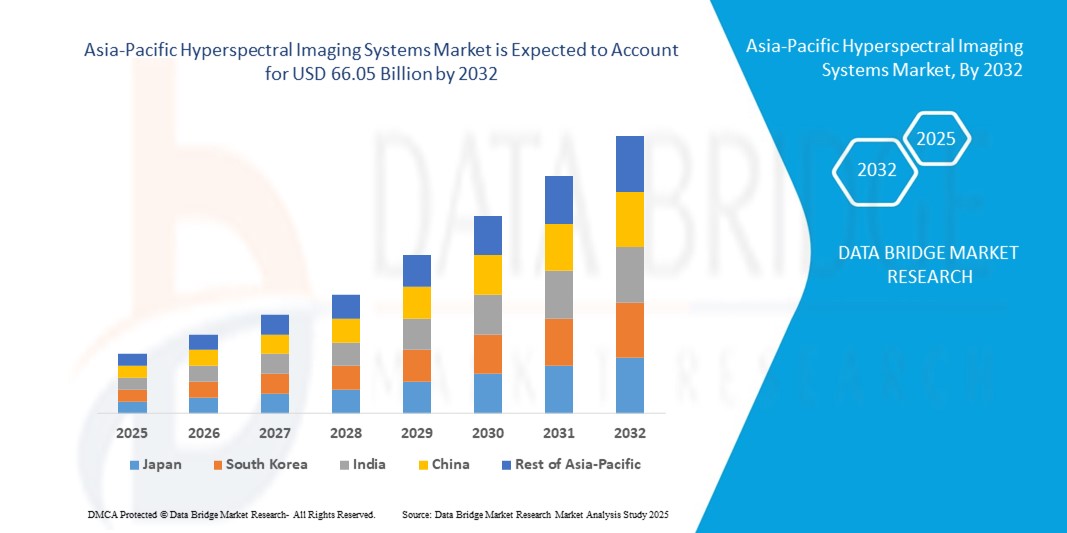
Asia-Pacific Hyperspectral Imaging Systems Market Size
- The Asia-Pacific hyperspectral imaging systems market size was valued at USD 18.43 billion in 2024 and is expected to reach USD 66.05 billion by 2032, at a CAGR of 17.3% during the forecast period
- The market growth is largely fueled by the increasing adoption of advanced imaging technologies across industries such as agriculture, mining, environmental monitoring, defense, and healthcare, driving demand for high-resolution hyperspectral imaging systems
- Furthermore, rising investments in research and development, along with the integration of hyperspectral imaging with drones, UAVs, and industrial automation platforms, are enabling faster, more accurate data acquisition and analysis. These converging factors are accelerating the adoption of hyperspectral imaging solutions, thereby significantly boosting the industry’s growth
Asia-Pacific Hyperspectral Imaging Systems Market Analysis
- Hyperspectral imaging systems capture and process light across a wide spectrum of wavelengths, enabling precise material identification, quality assessment, and environmental monitoring. These systems include cameras, sensors, and analytical software, which together provide detailed spectral and spatial information for industrial, research, and commercial applications
- The escalating demand for hyperspectral imaging is primarily fueled by the need for accurate, non-destructive analysis, growing adoption of UAV-based remote sensing, and increasing reliance on data-driven decision-making in precision agriculture, mineral exploration, and medical diagnostics
- China dominated the hyperspectral imaging systems market in 2024, due to its expansive industrial and research infrastructure, rapid adoption of advanced imaging technologies, and increasing investments in agriculture, mining, and remote sensing applications
- India is expected to be the fastest growing country in the hyperspectral imaging systems market during the forecast period due to rising adoption of advanced imaging technologies across agriculture, mining, food processing, and environmental monitoring sectors
- Camera segment dominated the market with a market share of 72.3% in 2024, due to their critical role in capturing high-resolution spectral data across a wide range of wavelengths. Cameras are preferred for their advanced sensor capabilities, enabling accurate detection, imaging, and analysis in diverse applications such as agriculture, remote sensing, and medical diagnostics. The segment also benefits from continuous technological advancements, including higher spatial and spectral resolutions, which improve imaging precision and usability across industries. Compatibility with different software and analytical tools further enhances demand. Moreover, the integration of portable and miniaturized cameras has increased adoption in field-based and mobile applications, consolidating their market dominance
Report Scope and Hyperspectral Imaging Systems Market Segmentation
|
Attributes |
Hyperspectral Imaging Systems Key Market Insights |
|
Segments Covered |
|
|
Countries Covered |
Asia-Pacific
|
|
Key Market Players |
|
|
Market Opportunities |
|
|
Value Added Data Infosets |
In addition to the insights on market scenarios such as market value, growth rate, segmentation, geographical coverage, and major players, the market reports curated by the Data Bridge Market Research also include in-depth expert analysis, geographically represented company-wise production and capacity, network layouts of distributors and partners, detailed and updated price trend analysis and deficit analysis of supply chain and demand. |
Asia-Pacific Hyperspectral Imaging Systems Market Trends
Growing Demand for Remote Sensing
- The rising adoption of remote sensing technologies across agriculture, defense, mining, and environmental monitoring is a major trend driving hyperspectral imaging systems. By capturing a wide spectrum of data beyond the visible range, these systems can provide highly detailed and accurate information critical for analysis in complex fields
- For instance, Headwall Photonics has collaborated with NASA to supply hyperspectral sensors for Earth observation applications. Such partnerships highlight the increasing reliance on remote sensing for monitoring land use, vegetation health, and climate changes, thus solidifying the role of hyperspectral imaging in advanced research programs
- The ability of hyperspectral imaging to uncover insights that multispectral systems cannot achieve makes it indispensable for precision agriculture. In crop health monitoring, for instance, hyperspectral data helps farmers detect nutrient deficiencies, pest infestations, and soil conditions at early stages, supporting sustainable farming practices
- Environmental management is another application benefitting from remote sensing through hyperspectral imaging. These systems are used to track water quality, detect pollution levels, and study ecosystem dynamics, offering governments and organizations better tools for conservation and sustainable development goals
- Defense and security are seeing rapid integration of hyperspectral imaging for surveillance, target detection, and material identification. The technology improves accuracy in differentiating between natural and man-made objects, serving as a game-changer for modern intelligence operations
- Overall, the soaring demand for remote sensing applications across diverse industries is establishing hyperspectral imaging systems as a core technology for informed decision-making. This trend reinforces its prominence in both scientific research and practical on-ground applications across global markets
Asia-Pacific Hyperspectral Imaging Systems Market Dynamics
Driver
Government Initiatives and Funding
- Government initiatives, grants, and research funding are playing a pivotal role in accelerating the adoption of hyperspectral imaging technologies. Public sector investments are enabling innovation, infrastructure development, and collaboration between academia and industry to push the boundaries of this technology
- For instance, the European Space Agency has funded hyperspectral programs such as the Copernicus Imaging Mission, which leverages hyperspectral sensors for Earth observation. This demonstrates the scale at which government support is fostering breakthroughs in environmental management and defense applications
- Increased government interest in food security, environmental sustainability, and defense preparedness has led to targeted funding in these areas. Hyperspectral imaging is gaining prominence as it provides more accurate and granular data compared to conventional imaging methods, addressing critical national objectives
- Governments are also encouraging partnerships that involve universities, research labs, and private technology companies. Such collaborations are enabling faster commercialization of hyperspectral advancements, bridging the gap between research prototypes and industrial applications
- Together, government-driven funding and initiatives are ensuring the long-term adoption of hyperspectral imaging. By creating favorable conditions for R&D and establishing advanced deployment programs, public sector involvement is driving consistent uptake of these systems globally
Restraint/Challenge
Integrating Hyperspectral Imaging Systems
- The integration of hyperspectral imaging systems into existing workflows is a major challenge due to their complexity, high cost, and data management requirements. Organizations often struggle with the specialized hardware and software needed to process and interpret hyperspectral data effectively
- For instance, in the healthcare sector, companies such as Specim have faced challenges while introducing hyperspectral solutions for medical diagnostics. Ensuring compatibility with existing systems and training medical staff on data interpretation has proven to be a hurdle in achieving seamless integration
- The enormous datasets generated by hyperspectral imaging require advanced computational infrastructure and skilled personnel. Many industries lack both the processing capabilities and trained professionals to handle the storage, analysis, and interpretation of large volumes of data
- High costs associated with integrating hyperspectral systems, including sensor acquisition, calibration, and maintenance, pose further challenges. This makes it difficult for mid-scale enterprises or developing regions to adopt such solutions on a large scale
- To overcome integration challenges, standardization of protocols, cost-reduction initiatives, and user-friendly interfaces are essential. Progress in these areas will support scalable adoption and help ensure that hyperspectral imaging systems can deliver their full potential across various industries
Asia-Pacific Hyperspectral Imaging Systems Market Scope
The market is segmented on the basis of product, scanning techniques, range, technology, and application.
- By Product
On the basis of product, the hyperspectral imaging systems market is segmented into cameras and accessories. The cameras segment dominated the largest market revenue share of 72.3% in 2024, owing to their critical role in capturing high-resolution spectral data across a wide range of wavelengths. Cameras are preferred for their advanced sensor capabilities, enabling accurate detection, imaging, and analysis in diverse applications such as agriculture, remote sensing, and medical diagnostics. The segment also benefits from continuous technological advancements, including higher spatial and spectral resolutions, which improve imaging precision and usability across industries. Compatibility with different software and analytical tools further enhances demand. Moreover, the integration of portable and miniaturized cameras has increased adoption in field-based and mobile applications, consolidating their market dominance.
The accessories segment is expected to witness the fastest growth rate from 2025 to 2032, driven by the rising demand for lens modules, calibration targets, filters, and mounting systems. These accessories enhance the performance and flexibility of hyperspectral imaging setups, enabling custom configurations for specific industrial or research requirements. In addition, growing interest in modular systems that allow upgrades without replacing the entire camera is supporting accessory market expansion. The trend of integrating accessories with drones and robotic platforms is further accelerating adoption.
- By Scanning Techniques
On the basis of scanning techniques, the hyperspectral imaging systems market is segmented into spatial scanning, spectral scanning, non-scanning, and spatiospectral scanning. The spatial scanning segment dominated the largest market revenue share in 2024 due to its ability to capture high-resolution images over a defined spatial area with precise spectral information. Spatial scanning systems are widely adopted in agriculture, remote sensing, and environmental monitoring for mapping and analyzing complex surfaces. The technique’s accuracy, reproducibility, and adaptability to various wavelengths make it the preferred choice for both research and industrial applications. The availability of mature technologies and ease of integration with analytical software further reinforce its market position.
The spatiospectral scanning segment is anticipated to witness the fastest growth rate from 2025 to 2032, fueled by increasing demand for simultaneous spatial and spectral data acquisition in real-time. This scanning method reduces processing time and allows high-throughput analysis, particularly beneficial in industrial automation, food processing, and mineral exploration. The rising adoption of compact and portable spatiospectral systems for field applications is further driving growth.
- By Range
On the basis of range, the hyperspectral imaging systems market is segmented into less than 400 Nm, 400 Nm to 1700 Nm, and more than 1700 Nm. The 400 Nm to 1700 Nm segment dominated the largest market revenue share in 2024 due to its broad applicability across visible to near-infrared (VNIR) and shortwave infrared (SWIR) imaging. This wavelength range is ideal for agriculture, mineral mapping, environmental monitoring, and food inspection as it provides critical information on material composition, moisture content, and chemical properties. The maturity of sensor technologies and widespread industrial adoption further strengthen its dominance.
The more than 1700 Nm segment is expected to witness the fastest CAGR from 2025 to 2032, driven by increasing interest in midwave and longwave infrared imaging for advanced applications such as military surveillance, chemical detection, and environmental analysis. Advances in sensor sensitivity, cooling technologies, and analytical software are enhancing usability, while rising demand for high-performance SWIR and LWIR systems in industrial and scientific sectors is accelerating growth.
- By Technology
On the basis of technology, the hyperspectral imaging systems market is segmented into pushbroom, snapshot, whiskbroom, and others. The pushbroom (line scanning) segment dominated the largest market revenue share in 2024 due to its capability to acquire high-resolution spectral data along a line, which is then compiled into a complete image. Pushbroom technology is widely used in remote sensing, agriculture, and mineralogy because of its high spectral and spatial resolution, stability, and reliability. Its compatibility with satellite, aerial, and drone platforms enhances its adoption in large-scale mapping and monitoring projects. Continuous sensor and software improvements also contribute to its leading market position.
The snapshot (single shot) segment is expected to witness the fastest growth rate from 2025 to 2032, driven by demand for real-time hyperspectral imaging in industrial automation, medical diagnostics, and machine vision. Snapshot systems capture the entire scene in a single acquisition, reducing motion artifacts and processing time. Increasing adoption in robotics, quality inspection, and precision agriculture is fueling market growth, along with advancements in compact, high-speed snapshot sensors.
- By Application
On the basis of application, the hyperspectral imaging systems market is segmented into civil engineering, military surveillance, remote sensing, agriculture, mining/mineral mapping, environmental monitoring, life sciences and medical diagnostics, machine vision and optical sorting, food processing, mineralogy, and other applications. The agriculture segment dominated the largest market revenue share in 2024 due to the increasing need for crop monitoring, disease detection, and precision farming. Hyperspectral imaging enables accurate assessment of plant health, nutrient content, and yield prediction, improving efficiency and sustainability. Government initiatives supporting smart agriculture and the adoption of drone-mounted imaging systems further contribute to its market leadership.
The food processing segment is expected to witness the fastest CAGR from 2025 to 2032, driven by the rising demand for quality control, contamination detection, and automated sorting in the food industry. Hyperspectral imaging allows rapid, non-destructive inspection of food products for chemical composition, freshness, and safety. The integration of these systems into production lines and robotic platforms is enhancing operational efficiency, while increasing consumer awareness of food safety standards is further accelerating adoption.
Asia-Pacific Hyperspectral Imaging Systems Market Regional Analysis
- China dominated the hyperspectral imaging systems market with the largest revenue share in 2024, driven by its expansive industrial and research infrastructure, rapid adoption of advanced imaging technologies, and increasing investments in agriculture, mining, and remote sensing applications
- Strong government support for technological innovation, coupled with national initiatives promoting smart agriculture, environmental monitoring, and industrial automation, reinforces China’s leadership in the regional market
- The presence of leading domestic manufacturers, collaborations with global hyperspectral imaging technology providers, and the introduction of cost-effective, high-performance systems continue to consolidate China’s dominant position. Expanding R&D centers, integration of imaging systems with drones and robotics, and rising demand from commercial and research applications further strengthen market penetration across urban and semi-urban industrial hubs
Japan Hyperspectral Imaging Systems Market Insight
The Japan market is anticipated to grow steadily from 2025 to 2032, supported by its advanced industrial and research sectors and strong emphasis on precision technology adoption. Japanese enterprises and research institutions are increasingly deploying hyperspectral imaging systems for applications in agriculture, medical diagnostics, environmental monitoring, and manufacturing quality control. Compact, high-resolution, and real-time imaging systems are in demand due to limited space and high efficiency requirements in industrial and laboratory setups. Continuous investments in R&D and collaborations between Japanese manufacturers and global technology providers reinforce the market’s steady growth outlook. Japan’s focus on innovation, precision, and technological reliability underpins its strong regional positioning.
India Hyperspectral Imaging Systems Market Insight
India is projected to register the fastest CAGR in the Asia-Pacific hyperspectral imaging systems market during 2025–2032, fueled by rising adoption of advanced imaging technologies across agriculture, mining, food processing, and environmental monitoring sectors. Increasing government initiatives supporting precision agriculture, smart mining, and sustainable development drive adoption, alongside growing awareness of technology’s benefits in research and industrial applications. Demand for affordable, easy-to-deploy, and versatile hyperspectral imaging systems is particularly strong among small and medium enterprises and research institutions. Expanding distribution networks, rising collaborations with global technology providers, and growth of technology-driven startups are enhancing market accessibility. Policy support, urbanization, and rapid digitalization ensure India’s emergence as the fastest-growing market in the region.
Asia-Pacific Hyperspectral Imaging Systems Market Share
The hyperspectral imaging systems industry is primarily led by well-established companies, including:
- Headwall Photonics Asia Pte Ltd. (Singapore)
- NITTO DENKO CORPORATION (Japan)
- Satake Corporation (Japan)
- Tattile S.r.l. (Italy)
- DAEIL SYSTEMS Co., Ltd. (South Korea)
- XIMEA Corp. (South Korea)
- TOSHIBA TELI CORPORATION (Japan)
- HinaLea Imaging (Japan)
- Specim, Spectral Imaging Ltd. (Finland)
- Beijing Huaqiang Zongheng Technology Co., Ltd. (China)
- Spectral Technologies Co., Ltd. (South Korea)
- LightPath Technologies, Inc. (China)
- InnoSpectra Pte Ltd. (Singapore)
- Zolix Instruments Co., Ltd. (China)
- BMT Co., Ltd. (South Korea)
Latest Developments in Asia-Pacific Hyperspectral Imaging Systems Market
- In January 2025, Pixxel, an Indian space tech startup, successfully launched three of its six hyperspectral imaging satellites aboard a SpaceX rocket from California. This milestone strengthens India’s private space sector and enhances the availability of high-resolution hyperspectral data for agriculture, mining, environmental monitoring, and defense applications. The company plans to deploy the remaining three satellites and expand its constellation with 18 additional spacecraft, positioning itself to capture significant market share and accelerate adoption of hyperspectral imaging solutions globally
- In November 2024, Pixxel secured $24 million in Series B funding, bringing its total Series B funding to $60 million. This investment accelerates the launch of six commercial 5-meter resolution hyperspectral Earth observation satellites, with 18 more planned by 2026. Pixxel’s satellites provide detailed multispectral data across wide electromagnetic ranges, supporting agriculture, mining, environmental monitoring, and defense sectors, and reinforcing the company’s leadership in high-resolution hyperspectral imaging solutions
- In January 2024, Specim, Spectral Imaging Ltd., entered into a partnership with GEONA hyperspectral. Specim endorsed GEONA as its preferred standalone processing solution for the complete range of SPECIM airborne hyperspectral sensors. This collaboration strengthens data processing capabilities, enhances workflow efficiency, and expands the usability of Specim’s sensors across commercial, industrial, and research applications, reinforcing its market position
- In April 2023, Headwall Photonics and K8 appointed Aermatica3D srl as an authorized reseller of their remote sensing products in Italy. Leveraging Aermatica3D’s engineering expertise, the partnership enables the development of custom hyperspectral imaging solutions tailored for companies, professional firms, and research institutes, expanding market reach and adoption across Europe
- In June 2022, Resonon Inc. launched its Pika IR-L and IR-L+ hyperspectral cameras (925 - 1700 nm). These instruments offer high spectral and spatial resolution in a compact and lightweight design, making them ideal for UAV-based remote sensing applications. The launch facilitates precise data collection for agriculture, environmental monitoring, and industrial inspection, driving broader adoption of portable hyperspectral imaging technologies

- Interactive Data Analysis Dashboard
- Company Analysis Dashboard for high growth potential opportunities
- Research Analyst Access for customization & queries
- Competitor Analysis with Interactive dashboard
- Latest News, Updates & Trend analysis
- Harness the Power of Benchmark Analysis for Comprehensive Competitor Tracking
Asia Pacific Hyperspectral Imaging Systems Market, Supply Chain Analysis and Ecosystem Framework
To support market growth and help clients navigate the impact of geopolitical shifts, DBMR has integrated in-depth supply chain analysis into its Asia Pacific Hyperspectral Imaging Systems Market research reports. This addition empowers clients to respond effectively to global changes affecting their industries. The supply chain analysis section includes detailed insights such as Asia Pacific Hyperspectral Imaging Systems Market consumption and production by country, price trend analysis, the impact of tariffs and geopolitical developments, and import and export trends by country and HSN code. It also highlights major suppliers with data on production capacity and company profiles, as well as key importers and exporters. In addition to research, DBMR offers specialized supply chain consulting services backed by over a decade of experience, providing solutions like supplier discovery, supplier risk assessment, price trend analysis, impact evaluation of inflation and trade route changes, and comprehensive market trend analysis.
Data collection and base year analysis are done using data collection modules with large sample sizes. The stage includes obtaining market information or related data through various sources and strategies. It includes examining and planning all the data acquired from the past in advance. It likewise envelops the examination of information inconsistencies seen across different information sources. The market data is analysed and estimated using market statistical and coherent models. Also, market share analysis and key trend analysis are the major success factors in the market report. To know more, please request an analyst call or drop down your inquiry.
The key research methodology used by DBMR research team is data triangulation which involves data mining, analysis of the impact of data variables on the market and primary (industry expert) validation. Data models include Vendor Positioning Grid, Market Time Line Analysis, Market Overview and Guide, Company Positioning Grid, Patent Analysis, Pricing Analysis, Company Market Share Analysis, Standards of Measurement, Global versus Regional and Vendor Share Analysis. To know more about the research methodology, drop in an inquiry to speak to our industry experts.
Data Bridge Market Research is a leader in advanced formative research. We take pride in servicing our existing and new customers with data and analysis that match and suits their goal. The report can be customized to include price trend analysis of target brands understanding the market for additional countries (ask for the list of countries), clinical trial results data, literature review, refurbished market and product base analysis. Market analysis of target competitors can be analyzed from technology-based analysis to market portfolio strategies. We can add as many competitors that you require data about in the format and data style you are looking for. Our team of analysts can also provide you data in crude raw excel files pivot tables (Fact book) or can assist you in creating presentations from the data sets available in the report.













