


Asia-Pacific Image-Guided Surgery Equipment and Robot-Assisted Surgical Equipment Market Size
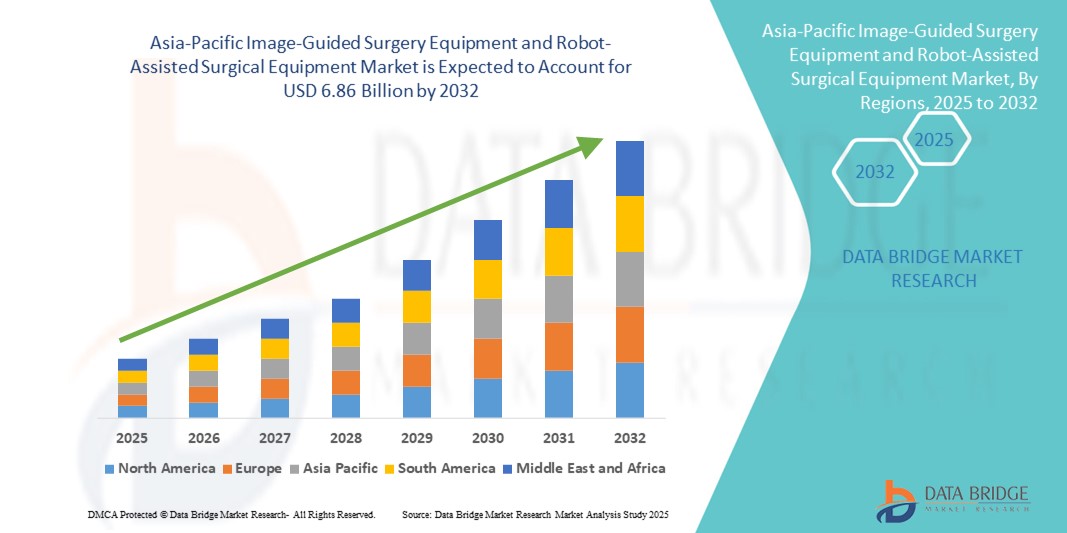
- The Asia-Pacific image-guided surgery equipment and robot-assisted surgical equipment market size was valued at USD 2.93 billion in 2024 and is expected to reach USD 6.86 billion by 2032, at a CAGR of 11.20% during the forecast period
- The market growth is primarily driven by increasing adoption of minimally invasive surgeries, rising prevalence of chronic and complex diseases, and rapid technological advancements in surgical robotics and navigation systems across the region
- Moreover, growing investments in healthcare infrastructure, rising healthcare awareness, and demand for precision-driven, efficient, and safer surgical procedures are positioning image-guided and robot-assisted surgical solutions as preferred choices in hospitals and surgical centers
Asia-Pacific Image-Guided Surgery Equipment and Robot-Assisted Surgical Equipment Market Analysis
- Image-guided surgery and robot-assisted surgical equipment, providing precision navigation and robotic assistance during complex procedures, are increasingly essential components in modern surgical setups due to their enhanced accuracy, reduced invasiveness, and seamless integration with advanced imaging and hospital IT systems
- The escalating demand for these surgical solutions is primarily fueled by the rising prevalence of chronic and complex diseases, growing adoption of minimally invasive procedures, and continuous technological advancements in surgical robotics and interventional imaging systems
- Japan dominated the Asia-Pacific image-guided surgery equipment and robot-assisted surgical equipment market with the largest revenue share of 36.1% in 2024, driven by advanced healthcare infrastructure, high adoption of surgical systems, and a strong presence of leading medical device manufacturers, with hospitals witnessing substantial growth in precision-guided procedures across urology, oncology, and orthopedic surgeries
- China is expected to be the fastest-growing country in the Asia-Pacific image-guided surgery equipment and robot-assisted surgical equipment market during the forecast period due to increasing healthcare infrastructure investments, expanding hospital networks, and rising patient awareness regarding minimally invasive and image-guided surgeries
- The Robotic Systems segment dominated the Asia-Pacific image-guided surgery equipment and robot-assisted surgical equipment market with a share of 41.7% in 2024, supported by their high adoption in minimally invasive procedures and growing surgeon preference for precision-assisted surgeries
Report Scope and Asia-Pacific Image-Guided Surgery Equipment and Robot-Assisted Surgical Equipment Market Segmentation
|
Attributes |
Asia-Pacific Image-Guided Surgery Equipment and Robot-Assisted Surgical Equipment Key Market Insights |
|
Segments Covered |
|
|
Countries Covered |
Asia-Pacific
|
|
Key Market Players |
|
|
Market Opportunities |
|
|
Value Added Data Infosets |
In addition to the insights on market scenarios such as market value, growth rate, segmentation, geographical coverage, and major players, the market reports curated by the Data Bridge Market Research also include in-depth expert analysis, pricing analysis, brand share analysis, consumer survey, demography analysis, supply chain analysis, value chain analysis, raw material/consumables overview, vendor selection criteria, PESTLE Analysis, Porter Analysis, and regulatory framework. |
Asia-Pacific Image-Guided Surgery Equipment and Robot-Assisted Surgical Equipment Market Trends
Advancements Through AI, Robotics, and Real-Time Imaging
- A significant and accelerating trend in the Asia-Pacific image-guided surgery and robot-assisted surgical equipment market is the integration of artificial intelligence (AI), robotic assistance, and real-time imaging technologies into surgical procedures. These innovations are enhancing surgical precision, reducing invasiveness, and improving patient outcomes
- For instance, Japan’s latest robotic surgical platforms incorporate AI-assisted motion guidance and high-definition imaging, allowing surgeons to perform complex urological and oncological procedures with increased accuracy. Similarly, Chinese hospitals are adopting systems that integrate preoperative imaging with intraoperative navigation, enabling more precise interventions
- AI integration enables features such as predictive surgical planning, error reduction, and automated instrument adjustments based on patient anatomy. For instance, some advanced robotic systems in South Korea can adapt tool movement in real time to improve procedural accuracy while minimizing tissue damage
- The seamless integration of robotic systems with imaging and hospital IT platforms allows centralized control over surgical workflows, data management, and post-operative monitoring. Surgeons can now combine navigation, real-time imaging, and robotic assistance through a unified interface, improving efficiency and workflow standardization
- This trend towards more intelligent, precise, and interconnected surgical systems is reshaping expectations for surgical care. Consequently, companies such as Olympus and Intuitive Surgical are developing AI-enabled and robot-assisted platforms with enhanced imaging, motion guidance, and multi-procedure capabilities
- The demand for advanced image-guided and robotic-assisted systems is growing rapidly across hospitals, specialty surgical centers, and academic institutions, as healthcare providers prioritize precision, safety, and minimally invasive surgical approaches
Asia-Pacific Image-Guided Surgery Equipment and Robot-Assisted Surgical Equipment Market Dynamics
Driver
Rising Adoption of Minimally Invasive Procedures and Advanced Surgical Technologies
- The Increasing prevalence of chronic and complex diseases, along with rising adoption of minimally invasive procedures, is a major driver for the heightened demand for image-guided and robotic-assisted surgical equipment
- For instance, in March 2024, a leading hospital in China implemented AI-enabled robotic systems for orthopedic and spinal surgeries, resulting in reduced operative time and improved post-operative outcomes. Such initiatives by hospitals and healthcare providers are expected to drive market growth
- As surgical centers focus on improving precision, reducing complications, and shortening recovery times, image-guided and robotic systems offer tangible benefits over conventional surgical methods
- Moreover, government support, investments in healthcare infrastructure, and growing awareness of advanced surgical techniques are accelerating adoption across Asia-Pacific
- The increasing preference for high-precision, minimally invasive procedures in both private and public healthcare facilities is propelling the market’s growth
Restraint/Challenge
High Costs and Regulatory Compliance Hurdles
- The High initial investment costs of advanced robotic and image-guided surgical systems present a significant challenge to market penetration, particularly for smaller hospitals and clinics in developing Asia-Pacific countries
- For instance, in 2023, a South Korean hospital had to postpone its robotic spine surgery program due to delayed approval of key AI-integrated robotic instruments, highlighting regulatory bottlenecks
- In addition, stringent regulatory requirements and certification processes for medical devices in countries such as Japan, India, and Australia can delay product approvals and adoption. For instance, in 2023, a South Korean hospital had to postpone its robotic spine surgery program due to delayed approval of key AI-integrated robotic instruments, highlighting regulatory bottlenecks
- Ensuring system safety, precision, and reliability through rigorous clinical trials and compliance with local medical standards is crucial but resource-intensive for manufacturers
- While costs are gradually declining and modular systems are becoming more accessible, the perceived premium of robotic and image-guided systems may still hinder adoption in cost-sensitive healthcare settings
- Overcoming these challenges through cost optimization, scalable solutions, and streamlined regulatory pathways will be vital for sustained market growth in the Asia-Pacific region
Asia-Pacific Image-Guided Surgery Equipment and Robot-Assisted Surgical Equipment Market Scope
The market is segmented on the basis of type, application, procedure type, end user, and distribution channel.
- By Type
On the basis of type, the Asia-Pacific image-guided surgery equipment and robot-assisted surgical equipment market is segmented into robotic systems, instruments and accessories, and interventional imaging systems and services. The Robotic Systems segment dominated the market with the largest revenue share of 41.7% in 2024, driven by increasing adoption of robotic-assisted surgeries in urology, oncology, and orthopedic procedures. Hospitals prefer robotic systems for their precision, minimally invasive capabilities, and enhanced patient safety. These systems also reduce human error during complex surgical interventions and provide enhanced visualization and dexterity. Additionally, robotic systems are increasingly being integrated with advanced imaging and AI-assisted planning tools, further improving surgical outcomes. The segment’s dominance is also supported by continuous innovations by leading manufacturers offering modular and scalable robotic platforms.
The Instruments and Accessories segment is anticipated to witness the fastest growth from 2025 to 2032, fueled by recurring demand for compatible surgical tools and consumables required for robotic and image-guided procedures. Growing surgical volumes across specialty hospitals and clinics are driving this demand. Instruments such as robotic arms, end-effectors, surgical staplers, and accessory kits are critical for the success of minimally invasive procedures. Furthermore, the growing focus on personalized surgeries and procedure-specific consumables is boosting the market. The segment’s growth is also supported by advancements in ergonomic designs, precision instruments, and disposable accessory components that improve procedural efficiency. Rising adoption of these systems in emerging APAC markets with expanding hospital infrastructure contributes to robust growth.
- By Application
On the basis of application, the Asia-Pacific image-guided surgery equipment and robot-assisted surgical equipment market is segmented into abdominal surgery, urology, otorhinolaryngology, orthopedic trauma surgery, oncology, gynaecology, neurology, spine surgery, cardiology, respiratory, thoracic surgery, and others. The Urology segment dominated with the largest market share of 21.5% in 2024, owing to the high volume of prostate and kidney surgeries adopting robotic-assisted interventions. Hospitals in Japan, China, and India are increasingly leveraging robotic systems to improve surgical precision and reduce post-operative complications in urological procedures. The adoption is also driven by the improved ergonomics for surgeons, reduced procedure times, and patient preference for minimally invasive options. Integration with imaging systems ensures better tumor localization and tissue preservation. Furthermore, reimbursement policies and government healthcare programs are supporting the expansion of robotic urology procedures. The segment is expected to remain dominant due to continuous technological advancements in urological robotic instruments and systems.
The Oncology segment is expected to witness the fastest growth during the forecast period due to rising prevalence of cancer in Asia-Pacific, increasing demand for precise and minimally invasive tumor resections, and the adoption of advanced image-guided and robotic-assisted surgical systems in hospitals and specialty cancer centers. Robotic-assisted oncology procedures provide surgeons with high-definition 3D visualization and improved instrument dexterity, enabling complex tumor resections with minimal collateral damage. Growing cancer awareness and early diagnosis programs are contributing to increased surgical interventions. Hospitals are increasingly investing in hybrid operating rooms equipped with imaging systems for real-time tumor mapping. Additionally, government initiatives promoting advanced cancer treatment facilities are accelerating adoption. Technological enhancements such as AI-assisted tumor detection and navigation systems are expected to further drive growth in this segment.
- By Procedure Type
On the basis of procedure type, the Asia-Pacific image-guided surgery equipment and robot-assisted surgical equipment market is segmented into open surgery and minimally invasive surgery (MIS). The Minimally Invasive Surgery segment dominated with a share of 62.4% in 2024, driven by advantages such as reduced recovery times, smaller incisions, and improved procedural accuracy. MIS procedures reduce patient trauma and hospital stays, leading to increased demand in both public and private hospitals. These procedures are particularly favored in urology, gynecology, and oncology, where precision is critical. Integration with robotic systems enhances surgeon dexterity and visualization, further improving outcomes. The segment’s growth is supported by rising patient awareness about the benefits of MIS over traditional open surgery. Additionally, hospitals are increasingly prioritizing MIS to improve operational efficiency and patient throughput.
The Open Surgery segment is anticipated to witness the fastest growth during the forecast period, as it remains essential for complex procedures requiring traditional surgical approaches, particularly in tertiary hospitals. Open surgeries are still preferred for major tumor resections, complex spine procedures, and trauma cases where MIS is not feasible. Surgeons rely on traditional approaches for maximum exposure and better control in complicated cases. Growth in this segment is also supported by improvements in surgical instruments, lighting, and imaging integration for open procedures. Furthermore, the expansion of tertiary care centers in emerging APAC countries is increasing the demand for open surgery systems. Hospitals continue to invest in hybrid operating rooms to accommodate both MIS and open surgical procedures efficiently.
- By End User
On the basis of end user, the Asia-Pacific image-guided surgery equipment and robot-assisted surgical equipment market is segmented into hospitals, ambulatory surgical centers, clinics, and others. Hospitals held the dominant market share of 70.2% in 2024, owing to their large surgical volumes, advanced infrastructure, and higher adoption rates of robotic and image-guided systems. Hospitals prefer these systems due to the need for multi-specialty surgical solutions, high patient throughput, and advanced clinical capabilities. Integration with hospital IT systems and electronic health records further enhances procedural planning and workflow efficiency. The segment’s dominance is also supported by government and private investments in high-end surgical technologies. Large hospitals often collaborate with manufacturers for pilot programs, training, and technology demonstrations. Additionally, hospitals drive demand for long-term service contracts, system upgrades, and modular equipment expansions.
Ambulatory Surgical Centers are expected to witness the fastest growth during the forecast period due to increasing adoption of robotic and image-guided systems in specialized and outpatient facilities. These centers are focusing on minimally invasive procedures for higher patient satisfaction and faster recovery. Growing healthcare awareness and preference for outpatient surgeries are driving adoption in this segment. The compact and modular design of robotic and imaging systems makes them ideal for smaller facilities. Furthermore, training programs for surgeons in outpatient centers are boosting system utilization. Increasing investments from private healthcare providers are expected to accelerate the growth of this segment across APAC.
- By Distribution Channel
On the basis of distribution channel, the Asia-Pacific image-guided surgery equipment and robot-assisted surgical equipment market is segmented into direct tender and retail sales. The Direct Tender segment dominated with a share of 58.6% in 2024, driven by bulk procurement by hospitals and government health systems. Direct tenders enable hospitals to negotiate pricing, acquire comprehensive service packages, and standardize equipment across multiple facilities. Large-scale hospital networks and government hospitals often prefer this method due to long-term maintenance and warranty benefits. The segment’s dominance is further supported by strategic partnerships between manufacturers and healthcare providers. Government-backed initiatives for modernizing surgical infrastructure are also increasing direct tender purchases. Additionally, direct tender procurement ensures timely delivery and installation of high-value robotic and imaging systems, reducing operational delays.
The Retail Sales segment is anticipated to witness the fastest growth during the forecast period, catering to increasing adoption of image-guided and robotic-assisted surgical systems by private clinics, specialty surgical centers, and smaller healthcare facilities that prefer direct purchasing for flexible procurement and quicker access to advanced surgical technologies. Retail sales provide smaller hospitals and clinics with the ability to acquire systems without lengthy tender processes. They allow healthcare providers to access modular or scalable systems based on immediate needs. The growing number of outpatient procedures and specialty clinics is boosting demand. Retail channels also facilitate faster technology adoption and upgrades for new surgical innovations. Additionally, manufacturers are offering bundled packages, financing options, and on-site support to attract private buyers, further accelerating segment growth.
Asia-Pacific Image-Guided Surgery Equipment and Robot-Assisted Surgical Equipment Market Regional Analysis
- Japan dominated the Asia-Pacific image-guided surgery equipment and robot-assisted surgical equipment market with the largest revenue share of 36.1% in 2024, driven by advanced healthcare infrastructure, high adoption of surgical systems, and a strong presence of leading medical device manufacturers, with hospitals witnessing substantial growth in precision-guided procedures across urology, oncology, and orthopedic surgeries
- Healthcare providers in the region highly value the precision, minimally invasive capabilities, and enhanced patient safety offered by robotic and image-guided surgical systems. Hospitals are increasingly integrating these technologies with imaging and IT platforms to optimize surgical outcomes and workflow efficiency
- This widespread adoption is further supported by government investments in healthcare, rising awareness of advanced surgical procedures, and the growing demand for high-quality, minimally invasive surgeries, establishing robotic and image-guided systems as preferred solutions in hospitals and specialty surgical centers across the Asia-Pacific region
The Japan Image-Guided Surgery Equipment and Robot-Assisted Surgical Equipment Market Insight
The Japan image-guided surgery equipment and robot-assisted surgical equipment market dominated the Asia-Pacific region with the largest revenue share in 2024, driven by advanced healthcare infrastructure, high adoption of robotic-assisted surgeries, and a strong focus on precision medicine. Japanese hospitals prioritize robotic and image-guided systems for urology, oncology, and orthopedic procedures, integrating them with advanced imaging and AI-driven surgical planning tools. The growing number of specialty centers and connected hospital systems is supporting sustained market growth.
China Image-Guided Surgery Equipment and Robot-Assisted Surgical Equipment Market Insight
The China image-guided surgery equipment and robot-assisted surgical equipment market is expected to witness the fastest growth during the forecast period due to rising investments in healthcare infrastructure, expanding hospital networks, and growing patient awareness of minimally invasive procedures. Hospitals are increasingly adopting image-guided and robotic-assisted surgical systems to improve precision and reduce post-operative complications. Government initiatives supporting advanced medical technologies and local manufacturing capabilities are further enhancing affordability and accessibility across public and private healthcare facilities.
India Image-Guided Surgery Equipment and Robot-Assisted Surgical Equipment Market Insight
The India image-guided surgery equipment and robot-assisted surgical equipment market accounted for a rapidly growing share in Asia-Pacific in 2024, driven by urbanization, rising disposable incomes, and the expansion of private and multi-specialty hospitals. Increasing awareness of minimally invasive surgeries and robot-assisted procedures, combined with government initiatives promoting smart hospital infrastructure, is encouraging adoption. The availability of cost-effective systems from domestic and international manufacturers is further boosting market penetration across tier-1 and tier-2 cities.
Australia Image-Guided Surgery Equipment and Robot-Assisted Surgical Equipment Market Insight
The Australia image-guided surgery equipment and robot-assisted surgical equipment market is witnessing steady growth, supported by well-developed healthcare infrastructure, high healthcare expenditure, and increasing adoption of advanced surgical technologies. Hospitals are implementing image-guided and robotic-assisted systems to enhance surgical accuracy, reduce complications, and improve patient outcomes, particularly in oncology and orthopedic procedures. Integration with AI and advanced imaging platforms is driving operational efficiency and procedural precision.
Asia-Pacific Image-Guided Surgery Equipment and Robot-Assisted Surgical Equipment Market Share
The Asia-Pacific image-guided surgery equipment and robot-assisted surgical equipment industry is primarily led by well-established companies, including:
- Brainlab AG (Germany)
- General Electric Company (U.S.)
- Medrobotics Corporation (U.S.)
- Medion (Germany)
- Stereotaxis, Inc. (U.S.)
- Titan Medical Inc. (Canada)
- PS-Medtech (Netherlands)
- Renishaw plc (U.K.)
- Intuitive Surgical, Inc. (U.S.)
- Zimmer Biomet (U.S.)
- Siemens Healthineers AG (Germany)
- Medtronic (Ireland)
- Hitachi Ltd. (Japan)
- Integra LifeSciences (U.S.)
- Smith + Nephew (U.K.)
- Koninklijke Philips N.V. (Netherlands)
- ICU Medical, Inc. (U.S.)
- Stryker (U.S.)
- Johnson & Johnson and its affiliates (U.S.)
- Olympus Corporation (Japan)
What are the Recent Developments in Asia-Pacific Image-Guided Surgery Equipment and Robot-Assisted Surgical Equipment Market?
- In August 2025, the state of Himachal Pradesh in India inaugurated its first robotic surgery facility at the Atal Institute of Medical Super Specialties. The Chief Minister officially launched the service and witnessed the first successful procedure, a prostate-related surgery. This development makes high-end robotic surgery accessible in a government medical institution for the first time in the state, with plans to expand the technology to other medical colleges
- In July 2025, Olympus announced a strategic partnership with Revival Healthcare Capital to develop endoluminal gastrointestinal robotics. This new collaboration aims to create an innovative robotic system for less invasive therapeutic treatments within the gastrointestinal tract. By enabling more precise and efficient procedures, this development has the potential to expand the use of robotics and enhance patient outcomes for conditions such as GI tract cancer, avoiding the need for more invasive surgery
- In May 2025, MicroPort MedBot announced that its Toumai Tele-Robotic Surgical System had received market approval from China's National Medical Products Administration (NMPA). This made Toumai the first tele-operated surgical robotic system in the world to be approved for commercial clinical use. The system supports multiple communication infrastructures, including 5G, and enables highly flexible and cost-effective remote surgical connectivity, breaking down geographical barriers to advanced surgical care
- In August 2023, the South Korean government announced a new initiative to support the growth of the medical robotics industry. The initiative includes funding for research and development, subsidies for hospitals to purchase robotic surgical systems, and incentives for companies to commercialize innovative technologies. South Korea aims to become a global leader in medical robotics by fostering innovation and expanding the adoption of robotic-assisted surgeries
- In January 2023, Medicaroid Corporation introduced "Hinotori," Japan's first domestically produced surgical robot. Developed in collaboration with Kawasaki Heavy Industries and Osaka University, Hinotori aims to reduce Japan's reliance on foreign surgical robots and enhance the country's capabilities in robotic-assisted surgeries. The system is designed to perform minimally invasive procedures with high precision, addressing the growing demand for advanced surgical technologies in Japan's healthcare sector

- Interactive Data Analysis Dashboard
- Company Analysis Dashboard for high growth potential opportunities
- Research Analyst Access for customization & queries
- Competitor Analysis with Interactive dashboard
- Latest News, Updates & Trend analysis
- Harness the Power of Benchmark Analysis for Comprehensive Competitor Tracking
Data collection and base year analysis are done using data collection modules with large sample sizes. The stage includes obtaining market information or related data through various sources and strategies. It includes examining and planning all the data acquired from the past in advance. It likewise envelops the examination of information inconsistencies seen across different information sources. The market data is analysed and estimated using market statistical and coherent models. Also, market share analysis and key trend analysis are the major success factors in the market report. To know more, please request an analyst call or drop down your inquiry.
The key research methodology used by DBMR research team is data triangulation which involves data mining, analysis of the impact of data variables on the market and primary (industry expert) validation. Data models include Vendor Positioning Grid, Market Time Line Analysis, Market Overview and Guide, Company Positioning Grid, Patent Analysis, Pricing Analysis, Company Market Share Analysis, Standards of Measurement, Global versus Regional and Vendor Share Analysis. To know more about the research methodology, drop in an inquiry to speak to our industry experts.
Data Bridge Market Research is a leader in advanced formative research. We take pride in servicing our existing and new customers with data and analysis that match and suits their goal. The report can be customized to include price trend analysis of target brands understanding the market for additional countries (ask for the list of countries), clinical trial results data, literature review, refurbished market and product base analysis. Market analysis of target competitors can be analyzed from technology-based analysis to market portfolio strategies. We can add as many competitors that you require data about in the format and data style you are looking for. Our team of analysts can also provide you data in crude raw excel files pivot tables (Fact book) or can assist you in creating presentations from the data sets available in the report.













