


What is the Asia-Pacific Industrial Boilers Market Size and Growth Rate?
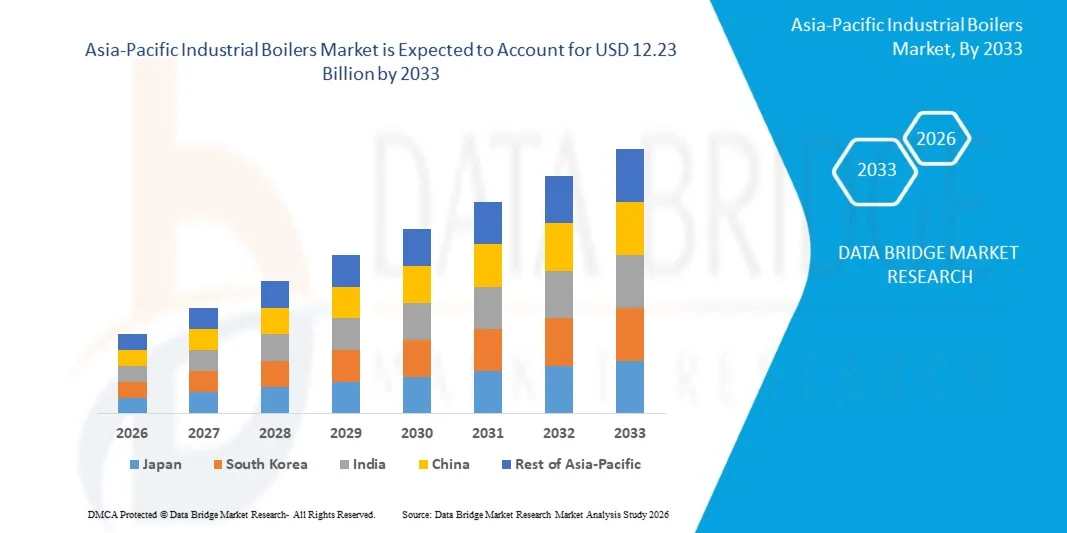
- As per Data Bridge Market Research analysis, the Asia-Pacific industrial boilers market was valued at USD 7.28 billion in 2025 and is projected to reach USD 12.23 billion by 2033, growing at a CAGR of 6.70% from 2026 to 2033.
- The market is experiencing consistent growth driven by rapid industrialization, expanding manufacturing activities, rising energy demand, and increasing investments in industrial infrastructure across major Asia-Pacific economies.
- The growing need for efficient steam and thermal-energy systems, combined with stricter environmental regulations and the modernization of aging boiler installations, is encouraging industries to adopt high-efficiency and cleaner boiler technologies. Chemicals and petrochemicals represented the largest application segment in 2025, while paper and pulp is projected to register the fastest growth during the forecast period.
Market Size & Forecast
- Global Market Value (2025): USD 7.28 Billion
- Expected Market Value (2033): USD 12.23 Billion
- Forecast CAGR (2026–2033): 6.70%
- Leading Country in 2025: China
- Fastest Growing Country: India
What are the Major Takeaways of the Asia-Pacific Industrial Boilers Market?
- China dominated the Asia-Pacific industrial boilers market with the largest revenue share of 34% in 2025, supported by its large manufacturing base, extensive industrial infrastructure, and high demand for steam and process heating systems.
- India is expected to be the fastest-growing country at a CAGR of 4.9% from 2026 to 2033, fueled by rapid industrialization, expanding manufacturing capacity, infrastructure development, and increasing investments in energy-efficient industrial heating systems.
- The water tube boilers segment led the market with a 55% share in 2025, driven by its suitability for high-pressure steam generation and large-scale industrial applications
- Carrier fire tube boilers are the fastest-growing tubing methods type, projected to register a CAGR of 5.5%, reflecting the surge in demand for compact and cost-efficient boiler systems across small and medium-sized industrial facilities
- The high pressure boilers segment dominated the steam pressure category with a 45% revenue share in 2025, led by strong demand from large-scale and energy-intensive industrial operations.
- Process boilers accounted for 55% of the market share in 2025, preferred by the extensive requirement for steam and thermal energy across manufacturing processes.
- The biomass boilers segment is the fastest-growing fuel type category, with a CAGR of 7.0%, driven by increasing efforts to reduce fossil-fuel dependence and utilize renewable industrial fuels.
Report Scope and Asia-Pacific Industrial Boilers Market Segmentation
|
Attributes |
Asia-Pacific Industrial Boilers Key Market Insights |
|
Segments Covered |
|
|
Countries Covered |
Asia-Pacific
|
|
Key Market Players |
|
|
Market Opportunities |
|
|
Value Added Data Infosets |
In addition to the insights on market scenarios such as market value, growth rate, segmentation, geographical coverage, and major players, the market reports curated by the Data Bridge Market Research also include in-depth expert analysis, geographically represented company-wise production and capacity, network layouts of distributors and partners, detailed and updated price trend analysis and deficit analysis of supply chain and demand. |
What is the Key Trend in the Asia-Pacific Industrial Boilers Market?
- Industrial boiler technology in Asia-Pacific is shifting toward higher efficiency and lower emissions, with operators increasingly replacing aging units and integrating cleaner fuels, heat recovery, and advanced combustion controls across Asia.
- For instance, in May 2024, Valmet announced an upgrade of the recovery boiler at Kuantum Papers Limited in Punjab, India. The modernization includes a lower-furnace rebuild, new economizer, redesigned air systems, and other boiler modifications intended to improve efficiency and steam generation, reflecting the growing shift toward upgrading existing industrial boilers rather than relying solely on new installations
- Digital monitoring and intelligent controls are becoming more important as manufacturers seek real-time efficiency, emissions, and safety management, supported by China’s renewal program, which upgraded 20 million equipment units in 2024 and saved in total 25 million tonnes of standard coal.
- For instance, in September 2024, Mitsubishi Heavy Industries reported successful development and testing of ammonia-firing technology for coal-fired boilers, including technology capable of converting more than 50% of boiler fuel to ammonia. The testing confirmed stable combustion and reduced NOx emissions compared with coal-only operation, demonstrating the industry's movement toward lower-carbon boiler technologies in Japan and oversea
- Low-temperature heat and steam processes represent roughly 70% of global industrial energy consumption, encouraging electrification across Asia.
- Biomass, waste-derived fuels, and cogeneration systems are expanding, using local residues and municipal waste to produce steam and power for industry.
What are the Key Drivers of the Asia-Pacific Industrial Boilers Market?
- The industrial expansion across Asia-Pacific is increasing steam and process-heat demand, particularly in chemicals, food processing, paper, textiles, metals, and automotive manufacturing, where boilers remain critical. China’s manufacturing value added rose 6.4% in 2025 alone.
- For instance, in September 2024, Valmet announced an automation-system order for a new 18 MW cogeneration plant for a major fertilizer company in western India. The project includes a circulating fluidized-bed boiler and integrated automation covering the boiler, turbine, and balance of plant, reflecting rising industrial demand for efficient cogeneration and reliable process-energy systems.
- Rising industrial electricity and heat requirements are supporting boiler demand, as low-temperature heat and steam processes represent roughly 70% of global industrial energy consumption. China, India, and ASEAN continue to show major increases.
- For instance, in February 2025, Bharat Heavy Electricals Limited (BHEL) secured an order from Damodar Valley Corporation for the Steam Generator (Boiler) Island package for the 2×660 MW Raghunathpur Thermal Power Station Phase-II in West Bengal, including supercritical boiler technology and high-efficiency SOx emission-control equipment. The project demonstrates continued investment in large-scale, higher-efficiency boiler infrastructure to meet India’s expanding electricity and industrial energy requirements.
- Government energy-efficiency programs cover 1,333 energy-intensive Indian industries and report 25.78 million toe of savings, encouraging modernization, efficiency, and cleaner industrial operations across manufacturing sectors.
Which Factors are Challenging the Growth of the Asia-Pacific Industrial Boilers Market?
- High capital costs and financing constraints can delay boiler modernization, especially where pollution-control, fuel-conversion, automation, and efficiency upgrades require simultaneous investment at scale
- For instance, in November 2025, the International Energy Agency reported that 2024 industrial energy prices were approximately USD 3–10/GJ for coal, USD 4–25/GJ for natural gas, and USD 20–60/GJ for electricity. The wide cost difference can make electric-boiler adoption less economically attractive for energy-intensive industrial users, particularly where electricity prices remain substantially above conventional boiler-fuel costs.
- Fuel economics can also discourage switching from coal to electricity or cleaner fuels in price-sensitive operations. The IEA reports 2024 industrial energy prices of USD 3–10/GJ for coal, USD 4–25/GJ for natural gas, and USD 20–60/GJ for electricity.
- For instance, in February 2026, the Commission for Air Quality Management (CAQM) issued stricter particulate-matter requirements for industries across Delhi-NCR, including industries operating boilers and thermic-fluid heaters. The direction sets a 50 mg/Nm³ PM emission limit for specified industries, with compliance beginning August 1, 2026, for large and medium industries, requiring affected facilities to install or retrofit air-pollution-control equipment. This regulatory requirement can increase the capital and compliance burden associated with industrial boiler operations and upgrades.
- Such retrofit requirements can increase project complexity and extend implementation periods, particularly for operating plants with limited shutdown windows and investment budgets.
How is the Asia-Pacific Industrial Boilers Market Segmented?
The Asia-Pacific industrial boilers market is segmented on the basis of tubing methods, steam pressure, steam usage, fuel type, product type, boiler horsepower, and industry.
- By Tubing Methods
On the basis of tubing methods, the Asia-Pacific industrial boilers market is segmented into carrier fire tube boilers and water tube boilers. The water tube boilers segment dominated the market with 55% share in 2025, owing to its suitability for high-pressure steam generation and large-scale industrial applications. These boilers are widely utilized across chemicals, petrochemicals, manufacturing, food processing, and other steam-intensive industries. Their configuration allows efficient heat transfer and supports high-capacity operations requiring continuous steam availability. Increasing industrial modernization is also encouraging replacement of older boiler systems with more efficient water-tube technologies. Their ability to integrate advanced combustion, heat-recovery, and emissions-control systems is further supporting adoption. The broad applicability of water-tube systems continues to reinforce their leading position in the regional market.
The carrier fire tube boilers segment is projected to register the fastest growth at CAGR of 5.5% during forecast period, driven by rising demand for compact and cost-efficient boiler systems across small and medium-sized industrial facilities. These boilers offer comparatively simple construction and straightforward installation. Their suitability for low- and medium-pressure applications makes them attractive for food processing, hospitals, laundries, and light manufacturing. Increasing replacement of aging boiler units is creating additional demand for packaged fire-tube systems. Improvements in burner technology and digital controls are also enhancing operating efficiency. Growing industrialization across emerging Asia-Pacific economies is expected to support continued adoption of this boiler configuration.
- By Steam Pressure
On the basis of steam pressure, the Asia-Pacific industrial boilers market is segmented into high pressure boilers, medium pressure boilers, and low pressure boilers. The high pressure boilers segment dominated the market with an 45% share in 2025, supported by strong demand from large-scale and energy-intensive industrial operations. High-pressure boilers are essential where production processes require substantial volumes of steam at elevated pressure and temperature. Chemicals, petrochemicals, refineries, metals, and large manufacturing facilities are important users of these systems. Their ability to deliver stable steam output supports continuous and demanding industrial processes. Industrial capacity expansion is further increasing the requirement for high-performance steam systems. Growing emphasis on thermal efficiency is also encouraging investment in advanced high-pressure boiler technologies.
The medium pressure boilers segment is projected to register the fastest growth at CAGR of 5.2% during forecast period, supported by increasing demand from expanding mid-sized manufacturing and processing facilities. These systems provide a balance between steam capacity, operating efficiency, and installation cost. They are well suited to industries that require reliable process steam without the higher pressure requirements of major power and petrochemical facilities. Growth in pharmaceuticals, food processing, textiles, and general manufacturing is creating new applications. Medium-pressure systems are also suitable for modernization projects involving replacement of older equipment. Their flexible operating characteristics are expected to support increasing adoption across the region.
- By Steam Usage
On the basis of steam usage, the Asia-Pacific industrial boilers market is segmented into process boilers, utility boilers, and marine boilers. The process boilers segment dominated the market with 55% share in 2025, driven by the extensive requirement for steam and thermal energy across manufacturing processes. Process boilers are widely used for heating, drying, cooking, sterilization, evaporation, and chemical processing. Food processing, pharmaceuticals, chemicals, pulp and paper, and textiles represent important applications. Continuous industrial production requires dependable steam availability, supporting investment in dedicated process-boiler systems. Increasing manufacturing activity across Asia-Pacific is further strengthening demand for process steam. Their broad application base makes process boilers the leading steam-usage category in the regional market.
The utility boilers segment is projected to register the fastest growth at CAGR of 5.0%, supported by increasing development of integrated industrial facilities and centralized utility systems. Utility boilers can supply steam and thermal energy to multiple processes within large manufacturing complexes. Expansion of industrial parks and processing clusters is creating additional requirements for centralized steam-generation infrastructure. Modern utility systems can incorporate automation, heat recovery, and improved emissions-control technologies. Growing demand for reliable and efficient plant utilities is supporting new installations and replacement projects. The development of large industrial facilities across emerging Asia-Pacific economies is expected to further strengthen this segment.
- By Fuel Type
On the basis of fuel type, the Asia-Pacific industrial boilers market is segmented into coal-fired boilers, oil fired boilers, gas fired boilers, biomass boilers, and others. The gas fired boilers segment dominated the market with 35% share in 2025, supported by increasing preference for cleaner combustion and efficient industrial steam generation. Gas-fired systems generally provide lower emissions than conventional coal and oil systems while allowing precise control of combustion. They are widely applied across food processing, chemicals, pharmaceuticals, manufacturing, and other industrial facilities. Expansion of gas infrastructure in major Asian economies is improving access to natural gas for industrial users. Environmental regulations are also encouraging industries to transition toward lower-emission fuels. These factors continue to strengthen the role of gas-fired boilers across the regional market.
The biomass boilers segment is projected to register the fastest growth at CAGR of 7.0% during forecast period, driven by increasing efforts to reduce fossil-fuel dependence and utilize renewable industrial fuels. Asia-Pacific has substantial agricultural and forestry residues suitable for industrial biomass combustion. Rice husks, bagasse, wood residues, and other biomass resources can provide locally available fuel for steam generation. Industrial companies are increasingly evaluating biomass as part of their decarbonization and energy-cost strategies. Improvements in combustion, fuel handling, and automated feeding technologies are also improving operating reliability. Growing government support for renewable energy and lower-carbon industrial operations is expected to accelerate biomass-boiler adoption.
- By Product Type
On the basis of product type, the Asia-Pacific industrial boilers market is segmented into condensing hot water boiler, integrated condensing hot water boiler, integrated condensing steam boiler, split condensing steam boiler, electric heated steam boiler, electric hot water boilers, and others. The condensing hot water boiler segment dominated the market with 30% share in 2025, supported by growing demand for efficient thermal-energy systems. Condensing technology enables recovery of heat from exhaust gases, improving fuel utilization and overall operating efficiency. These boilers are increasingly considered in modernization projects where industrial users seek to reduce energy consumption. Their compact configuration supports installation in facilities with limited equipment space. Advanced controls can further improve temperature management and system performance. The focus on energy efficiency and lower operating costs continues to support demand for condensing boiler solutions.
The electric heated steam boiler segment is projected to register the fastest growth at CAGR of 8.0%, driven by increasing industrial electrification and efforts to reduce on-site combustion emissions. Electric steam boilers can provide precise and rapidly controllable steam generation for selected industrial applications. They are particularly relevant where reliable electricity is available and direct fossil-fuel combustion is being reduced. Compact designs can also simplify installation compared with certain conventional fuel-fired systems. Integration with low-carbon electricity can further improve their environmental profile. Increasing industrial decarbonization initiatives are expected to support stronger adoption of electric steam-generation technologies.
- By Boiler Horsepower
On the basis of boiler horsepower, the Asia-Pacific industrial boilers market is segmented into 10-150 BHP, 151-300 BHP, and 301-600 BHP. The 10-150 BHP segment dominated the market with 45% share in 2025, supported by extensive demand from small and medium-sized industrial facilities. These systems are widely used for process heating, steam generation, sanitation, and hot-water applications. Food processing, pharmaceuticals, hospitals, laundries, and smaller manufacturing facilities represent important users. Their relatively compact configuration supports installation where space availability is constrained. Standardized designs can also simplify maintenance and replacement activities. The wide range of applications and comparatively manageable investment requirements continue to support the segment's leading position.
The 301-600 BHP segment is projected to register the fastest growth at CAGR of 5.8% during forecast period, driven by expansion of large-scale manufacturing and industrial processing facilities. These systems provide greater steam-generation capacity for operations with substantial and continuous thermal-energy requirements. Chemicals, food processing, pulp and paper, pharmaceuticals, and automotive manufacturing can require higher-capacity boilers to support expanding production. Industrial investments in emerging Asia-Pacific economies are creating additional opportunities for larger systems. Modernization of existing facilities is also generating replacement demand for higher-capacity equipment. Increasing emphasis on centralized and efficient steam generation is expected to accelerate adoption in this category.
- By Industry
On the basis of industry, the Asia-Pacific industrial boilers market is segmented into food industry, breweries, laundries and cleaning firm, construction, pharmaceutical, automotive, pulp and paper, hospitals, agriculture, packaging, and others. The food industry segment dominated the market with 25% share in 2025, supported by extensive use of steam and hot water for cooking, sterilization, drying, cleaning, and food-processing operations. Growing consumption of processed foods across Asia-Pacific is expanding production capacity and increasing demand for reliable thermal-energy systems. Food manufacturers require stable steam supply to maintain production efficiency and consistent product quality. Automation and modernization of processing facilities are further supporting boiler installations. Energy-efficient boiler technologies are also gaining attention as food producers seek to manage operating costs. The Food Industry therefore remains a major application area within the regional industrial-boiler market.
The pulp and paper segment is projected to register the fastest growth at CAGR of 6.0% during forecast period, driven by increasing demand for paper, tissue, specialty paper, and packaging products across Asia-Pacific. Paper production is highly dependent on steam for pulping, drying, evaporation, and other processing activities. Expansion of e-commerce and consumer-goods packaging is increasing regional demand for paper-based packaging materials. Modern paper mills are also investing in efficient boiler systems and heat-recovery solutions to reduce energy consumption. Biomass and recovery-boiler technologies are becoming increasingly important for mills seeking more sustainable energy sources. The continuing expansion and modernization of paper manufacturing capacity is expected to support rapid growth in this segment.
Which Country Holds the Largest Share of the Asia-Pacific Industrial Boilers Market?
- China dominated the Asia-Pacific industrial boilers market with the largest revenue share of 34% in 2025, supported by its large manufacturing base, extensive industrial infrastructure, and high demand for steam and process heating systems.
- The country also benefits from large-scale industrial infrastructure, continued expansion of manufacturing capacity, and modernization of aging boiler installations. Increasing adoption of energy-efficient and lower-emission boiler technologies, alongside growing demand for reliable process heating systems, continues to strengthen China’s leading position within the Asia-Pacific industrial boilers market
India Industrial Boilers Market Insight
The India industrial boilers market is expanding due to increasing industrialization, manufacturing activity, and rising demand for process heat across energy-intensive industries. Food processing, pharmaceuticals, chemicals, textiles, paper, and other manufacturing sectors require dependable steam-generation systems for continuous production operations. The country’s industrial energy-efficiency initiatives are also encouraging industries to modernize equipment and improve energy performance. India’s Perform, Achieve and Trade program currently covers energy-intensive industries and promotes reductions in industrial energy consumption. In addition, growing interest in cleaner fuels, biomass, and efficient boiler systems is supporting technology modernization across industrial facilities.
Japan Industrial Boilers Market Insight
The Japan industrial boilers market is witnessing consistent development due to strong emphasis on energy efficiency, industrial modernization, and lower-carbon thermal-energy technologies. Industrial companies are increasingly exploring advanced boiler systems and fuel-conversion technologies to improve energy performance while reducing emissions. Japan is also developing ammonia-firing technologies for coal-fired boilers as part of its broader transition toward lower-carbon energy systems. Mitsubishi Heavy Industries has been developing ammonia fuel-conversion technologies for coal-fired boilers and has reported progress toward practical boiler applications. These technological developments are contributing to the modernization of Japan’s boiler technology landscape and supporting demand for advanced industrial heating solutions.
South Korea Industrial Boilers Market Insight
The South Korea industrial boilers market is supported by the country’s advanced manufacturing sector, including chemicals, automotive, electronics, food processing, and other energy-intensive industries. Industrial facilities require reliable steam and hot-water systems for manufacturing and utility operations, sustaining demand for efficient boiler technologies. The Korea Energy Agency maintains dedicated boiler-efficiency standards covering boiler performance measurement, thermal-balance calculations, efficiency management, and performance testing. The agency also operates a high-efficiency certification program for industrial and building gas boilers, encouraging manufacturers to develop and commercialize more efficient equipment. These efficiency-focused standards and certification activities are supporting continued modernization of industrial boiler systems in South Korea.
Indonesia Industrial Boilers Market Insight
The Indonesia industrial boilers market is developing alongside the country’s manufacturing expansion and transition toward lower-carbon industrial energy systems. Industries including food processing, pulp and paper, chemicals, textiles, and other manufacturing activities rely on boilers for process steam and thermal energy. The government is also examining cleaner alternatives for boiler operations as part of its broader energy-transition agenda. In May 2025, Indonesia’s Ministry of Energy and Mineral Resources, together with JICA, organized a technical workshop specifically focused on ammonia and biomass co-firing for boilers, highlighting growing interest in lower-carbon boiler technologies. Such initiatives are increasing attention toward fuel diversification and more sustainable industrial steam generation in Indonesia.
Which are the Top Companies in Asia-Pacific Industrial Boilers Market?
The Asia-Pacific industrial boilers industry is primarily led by well-established companies, including:
- Thermax Limited (India)
- Forbes Marshall Pvt. Ltd. (India)
- Bharat Heavy Electricals Limited (India)
- Isgec Heavy Engineering Ltd. (India)
- Mitsubishi Heavy Industries, Ltd. (Japan)
- IHI Corporation (Japan)
- TAKUMA Co., Ltd. (Japan)
- MIURA CO., LTD. (Japan)
- Kawasaki Heavy Industries, Ltd. (Japan)
- Doosan Enerbility. (South Korea)
- Hangzhou Boiler Group Industrial Boiler Co., Ltd (China)
- ZOZEN boiler Co., Ltd. (China)
- Valmet (Finland)
- ANDRITZ (Austria)
- Bosch Industriekessel GmbH (Germany)
- Babcock & Wilcox Enterprises, Inc. (U.S.)
- Fulton (U.S.)
- Clayton Industries (U.S.)
- Hurst Boiler & Welding Company, Inc. (U.S.)
- Superior Boiler (U.S.)
What are Latest Developments in Asia-Pacific Industrial Boilers Market?
- In September 2025, Mitsubishi Heavy Industries (MHI) announced the completion of development of ammonia fuel-conversion technology for coal-fired boilers, including ammonia single-fuel burners designed for both circular- and opposed-firing boiler systems. The development is aimed at enabling higher ammonia fuel substitution while maintaining stable combustion and supporting lower-carbon operation of existing boiler infrastructure in Japan and overseas. This development highlights the growing focus on ammonia-based fuel conversion as a pathway for decarbonizing conventional boiler systems.
- In February 2025, Bharat Heavy Electricals Limited (BHEL) secured a major order from Damodar Valley Corporation for the Steam Generator (Boiler) Island package based on supercritical technology for the 2×660 MW Raghunathpur Thermal Power Station Phase-II in West Bengal, India. BHEL’s scope covers the design, engineering, manufacturing, supply, erection, testing, and commissioning of the boiler island and associated auxiliaries, along with highly efficient SOx emission-control equipment. The order highlights continued investment in high-efficiency, large-capacity boiler systems and emissions-control technologies in India’s power sector.
- In May 2024, Valmet announced an upgrade of the recovery boiler at Kuantum Papers Limited in Punjab, India. The project involves rebuilding the lower furnace, installing a new economizer, and upgrading air systems and other boiler auxiliaries to improve recovery-boiler performance and increase specific steam generation. The upgrade demonstrates the increasing modernization of existing industrial boiler assets in India's pulp and paper sector to improve efficiency and operating performance.
- In June 2023, Valmet announced an order to supply key pulp-mill technologies, including a recovery boiler, to Shandong Huatai Paper’s new pulp mill in Shandong Province, China. The facility is designed to produce substantial volumes of pulp and includes a recovery boiler as part of the integrated mill technology package. The project reflects continued investment in modern industrial boiler systems within China's expanding pulp and paper manufacturing sector, with emphasis on energy performance and compliance with stringent emission requirements.
- In December 2021, Valmet announced that it would supply a biomass-fired circulating fluidized bed boiler and flue-gas cleaning system to Tahara Biomass Power LLC in Japan. The new boiler is designed to provide stable power generation at high thermal efficiency while reducing carbon dioxide emissions, with wood pellets as the principal fuel. The project illustrates Japan’s expanding adoption of biomass-based boiler technology as part of its shift toward lower-emission energy generation.

- Interactive Data Analysis Dashboard
- Company Analysis Dashboard for high growth potential opportunities
- Research Analyst Access for customization & queries
- Competitor Analysis with Interactive dashboard
- Latest News, Updates & Trend analysis
- Harness the Power of Benchmark Analysis for Comprehensive Competitor Tracking
Asia Pacific Industrial Boilers Market, Supply Chain Analysis and Ecosystem Framework
To support market growth and help clients navigate the impact of geopolitical shifts, DBMR has integrated in-depth supply chain analysis into its Asia Pacific Industrial Boilers Market research reports. This addition empowers clients to respond effectively to global changes affecting their industries. The supply chain analysis section includes detailed insights such as Asia Pacific Industrial Boilers Market consumption and production by country, price trend analysis, the impact of tariffs and geopolitical developments, and import and export trends by country and HSN code. It also highlights major suppliers with data on production capacity and company profiles, as well as key importers and exporters. In addition to research, DBMR offers specialized supply chain consulting services backed by over a decade of experience, providing solutions like supplier discovery, supplier risk assessment, price trend analysis, impact evaluation of inflation and trade route changes, and comprehensive market trend analysis.
Data collection and base year analysis are done using data collection modules with large sample sizes. The stage includes obtaining market information or related data through various sources and strategies. It includes examining and planning all the data acquired from the past in advance. It likewise envelops the examination of information inconsistencies seen across different information sources. The market data is analysed and estimated using market statistical and coherent models. Also, market share analysis and key trend analysis are the major success factors in the market report. To know more, please request an analyst call or drop down your inquiry.
The key research methodology used by DBMR research team is data triangulation which involves data mining, analysis of the impact of data variables on the market and primary (industry expert) validation. Data models include Vendor Positioning Grid, Market Time Line Analysis, Market Overview and Guide, Company Positioning Grid, Patent Analysis, Pricing Analysis, Company Market Share Analysis, Standards of Measurement, Global versus Regional and Vendor Share Analysis. To know more about the research methodology, drop in an inquiry to speak to our industry experts.
Data Bridge Market Research is a leader in advanced formative research. We take pride in servicing our existing and new customers with data and analysis that match and suits their goal. The report can be customized to include price trend analysis of target brands understanding the market for additional countries (ask for the list of countries), clinical trial results data, literature review, refurbished market and product base analysis. Market analysis of target competitors can be analyzed from technology-based analysis to market portfolio strategies. We can add as many competitors that you require data about in the format and data style you are looking for. Our team of analysts can also provide you data in crude raw excel files pivot tables (Fact book) or can assist you in creating presentations from the data sets available in the report.













