


Asia-Pacific Infection Surveillance Solution System Market Size
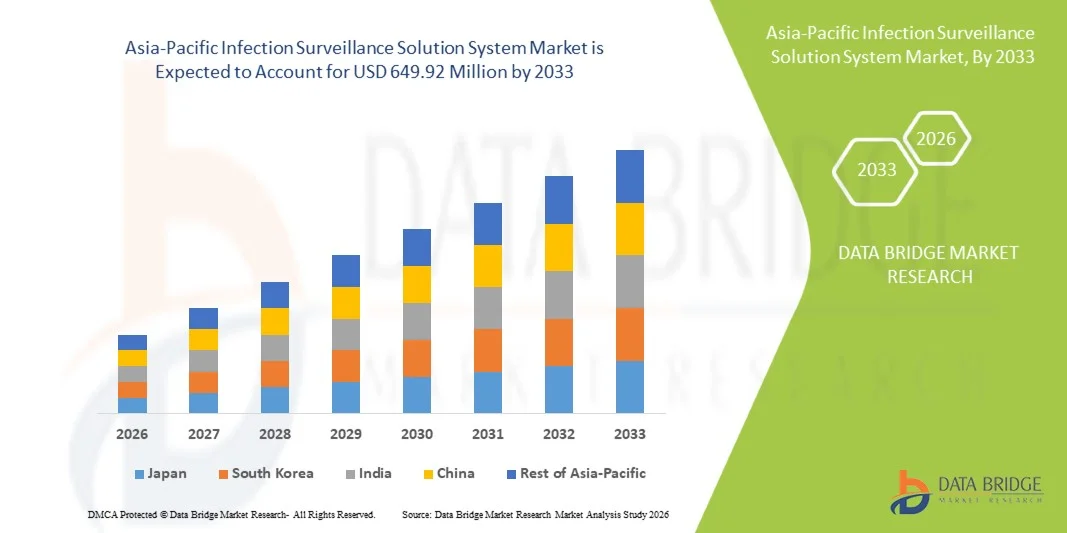
- The Asia-Pacific infection surveillance solution system market size was valued at USD 220.00 million in 2025 and is expected to reach USD 649.92 million by 2033, at a CAGR of 14.5% during the forecast period
- The market growth is largely driven by increasing adoption of advanced healthcare IT solutions and growing awareness of infection prevention and control across hospitals and clinical settings, leading to enhanced digital surveillance and reporting capabilities
- Furthermore, rising government initiatives, stringent regulatory frameworks, and the need for real-time infection monitoring in healthcare facilities are propelling demand for integrated infection surveillance systems. These factors are accelerating the deployment of such solutions, thereby significantly boosting the industry’s growth
Asia-Pacific Infection Surveillance Solution System Market Analysis
- Infection surveillance solution systems, providing real-time monitoring and reporting of hospital-acquired infections and infectious disease outbreaks, are becoming increasingly vital components of modern healthcare infrastructure in both clinical and public health settings due to their ability to enhance patient safety, ensure regulatory compliance, and support data-driven decision-making
- The escalating demand for infection surveillance solutions is primarily fueled by rising incidences of healthcare-associated infections, increasing awareness of infection prevention and control, and the growing adoption of digital healthcare technologies across hospitals and clinics
- Japan dominated the Asia-Pacific infection surveillance solution system market with the largest revenue share of 30.9% in 2025, supported by advanced healthcare IT infrastructure, strict regulatory frameworks, and early adoption of AI-driven infection monitoring and predictive analytics
- China is expected to be the fastest-growing country in the Asia-Pacific market during the forecast period due to rapid healthcare digitization, government initiatives to strengthen infection control, expanding hospital networks, and rising investments in advanced healthcare IT systems
- Software solutions dominated the market segment with a share of 60.2% in 2025, driven by their ability to provide automated infection tracking, real-time alerts, and integration with hospital information systems
Report Scope and Asia-Pacific Infection Surveillance Solution System Market Segmentation
|
Attributes |
Asia-Pacific Infection Surveillance Solution System Key Market Insights |
|
Segments Covered |
|
|
Countries Covered |
Asia-Pacific
|
|
Key Market Players |
|
|
Market Opportunities |
|
|
Value Added Data Infosets |
In addition to the insights on market scenarios such as market value, growth rate, segmentation, geographical coverage, and major players, the market reports curated by the Data Bridge Market Research also include in-depth expert analysis, patient epidemiology, pipeline analysis, pricing analysis, and regulatory framework |
Asia-Pacific Infection Surveillance Solution System Market Trends
“Enhanced Infection Monitoring Through AI and Cloud Integration”
- A significant and accelerating trend in the Asia-Pacific infection surveillance solution system market is the deepening integration of artificial intelligence (AI) and cloud-based platforms, enabling hospitals to monitor infections in real-time and predict potential outbreaks more accurately
- For instance, Cerner’s infection surveillance software leverages cloud infrastructure and AI algorithms to provide predictive alerts and automated reporting for multiple infection types, enhancing patient safety and operational efficiency
- AI integration in infection surveillance systems enables features such as identifying unusual infection patterns, predicting high-risk areas within hospitals, and sending real-time alerts for timely intervention. For instance, MedMined’s AI modules detect patterns in surgical site infections and bloodstream infections to support proactive control measures
- Cloud-enabled solutions facilitate centralized data management and seamless integration with hospital information systems, allowing healthcare administrators to monitor infection trends across multiple departments or facilities
- This trend toward intelligent, predictive, and connected infection monitoring is fundamentally reshaping hospital protocols for infection prevention. Consequently, companies such as Baxter and Philips are developing AI-powered surveillance solutions with features such as automated alerts and predictive analytics for surgical site infections
- The demand for advanced AI and cloud-enabled infection surveillance systems is growing rapidly across hospitals and healthcare networks, as administrators increasingly prioritize proactive infection management and compliance with regulatory standards
Asia-Pacific Infection Surveillance Solution System Market Dynamics
Driver
“Rising Need Due to Increasing Healthcare-Associated Infections and Digitalization”
- The rising prevalence of healthcare-associated infections (HAIs), coupled with increasing digitalization in hospitals, is a significant driver for the heightened demand for infection surveillance solutions
- For instance, in March 2025, GE Healthcare implemented AI-powered infection monitoring modules in major Japanese hospitals to enhance real-time detection and reporting of bloodstream infections and urinary tract infections
- As hospitals aim to reduce infection rates and improve patient outcomes, surveillance solutions provide features such as automated alerts, trend analysis, and integration with electronic health records, offering a clear advantage over manual monitoring
- Furthermore, government initiatives promoting infection control and hospital accreditation requirements are making these solutions essential for compliance, supporting adoption across both public and private healthcare facilities
- Increasing investment in hospital IT infrastructure and digital transformation programs is creating opportunities for deploying advanced infection surveillance systems. For instance, several Chinese hospitals are upgrading networks to support AI-based infection analytics
- Rising awareness and training of healthcare personnel regarding infection prevention are driving demand, as staff increasingly rely on digital tools to improve adherence to hygiene and monitoring protocols. For instance, infection control teams are leveraging AI dashboards to guide interventions in real time
Restraint/Challenge
“Data Privacy Concerns and Implementation Complexity”
- Concerns surrounding patient data privacy and regulatory compliance pose a significant challenge to broader adoption of infection surveillance solutions in the Asia-Pacific region
- For instance, reports of data breaches in hospital networks have made some administrators hesitant to deploy cloud-based infection monitoring solutions, fearing violations of patient confidentiality
- Addressing these challenges through robust encryption, secure access protocols, and compliance with healthcare regulations is crucial for building trust. Companies such as Cerner and MedMined emphasize advanced security measures in their infection surveillance offerings to reassure healthcare providers
- In addition, the complexity of integrating surveillance solutions with existing hospital IT infrastructure and training staff for effective use can act as a barrier to adoption, particularly in smaller clinics or rural hospitals
- Overcoming these challenges through enhanced cybersecurity, streamlined integration, and training programs, along with promoting awareness of the clinical and operational benefits, will be vital for sustained growth in the Asia-Pacific infection surveillance solution system market
- High initial costs of advanced surveillance systems remain a restraint for smaller hospitals and clinics in developing countries, limiting adoption despite clear benefits. For instance, some hospitals delay procurement due to budget constraints
- Limited interoperability with legacy hospital IT systems can hinder deployment, requiring additional investment in system upgrades or middleware solutions. For instance, older electronic health record systems may need customization to integrate with AI-driven infection monitoring platforms
Asia-Pacific Infection Surveillance Solution System Market Scope
The market is segmented on the basis of products, infection type, and end user.
- By Products
On the basis of products, the Asia-Pacific infection surveillance solution system market is segmented into software and services. The Software segment dominated the market with the largest revenue share of 60.2% in 2025, driven by its ability to provide real-time infection monitoring, automated reporting, and integration with hospital information systems. Hospitals prioritize software solutions as they allow centralized tracking of multiple infection types such as SSI, BSI, and CAUTI, improving compliance with infection control protocols. The software segment is further supported by AI-powered predictive analytics, which can detect unusual patterns and alert healthcare teams proactively. Its compatibility with electronic health records (EHR) and cloud platforms also enhances operational efficiency. Hospitals and large healthcare networks prefer software solutions for scalability, remote monitoring, and data-driven decision-making. The growing focus on reducing healthcare-associated infections (HAIs) strengthens the demand for robust software solutions.
The Services segment is expected to witness the fastest growth from 2026 to 2033, fueled by increasing adoption in smaller clinics, long-term care facilities, and rural hospitals. Services include installation, system integration, training, maintenance, and ongoing support, which are essential for facilities lacking dedicated IT staff. Outsourced services also help healthcare providers comply with infection reporting requirements and optimize the use of surveillance software. The growth is further accelerated by managed service models that provide subscription-based access to AI analytics and cloud platforms. Consulting and implementation services enable hospitals to customize solutions for different infection types and workflows. As more healthcare facilities invest in digital infection control, services are becoming a critical enabler for successful deployment.
- By Infection Type
On the basis of infection type, the market is segmented into Surgical Site Infections (SSI), Blood Stream Infections (BSI), Urinary Tract Infections (UTI), Central Line-Associated Bloodstream Infections (CLABSI), Catheter-Associated Urinary Tract Infection (CAUTI), and Others. The Surgical Site Infections (SSI) segment dominated the market with the largest share of 35% in 2025, due to the high clinical and financial impact of post-operative infections. Hospitals focus on SSI surveillance to reduce patient morbidity, prevent extended hospital stays, and avoid penalties associated with HAIs. SSI-focused solutions often integrate AI and predictive analytics to identify high-risk patients and alert staff for preventive measures. Surgical departments rely on data dashboards to track infection trends and implement corrective actions promptly. The availability of SSI-specific modules in leading software solutions enhances accuracy and compliance. Furthermore, governments and accreditation bodies encourage rigorous SSI monitoring, driving adoption across hospitals and surgical centers.
The Blood Stream Infections (BSI) segment is expected to witness the fastest growth during 2026–2033, owing to increasing awareness of the risks associated with bloodstream infections and the need for rapid detection. BSI surveillance requires real-time monitoring, integration with laboratory information systems, and automated alerting for immediate intervention. AI-enabled analytics can detect subtle trends and correlations between device usage and infection risk, helping clinicians reduce incidence rates. The rise in central line procedures and ICU patient populations further boosts demand. Smaller hospitals and ambulatory surgical centers are increasingly investing in BSI monitoring modules. Enhanced reimbursement policies and government infection prevention initiatives in countries such as China and Japan also contribute to the segment’s rapid growth.
- By End User
On the basis of end user, the market is segmented into hospitals, long-term care facilities, clinics, ambulatory surgical centres, academic institutes, and others. The Hospitals segment dominated the market with the largest share of 50% in 2025, as they have the highest patient volumes and the greatest need for comprehensive infection surveillance. Hospitals implement systems across multiple departments including ICUs, surgical wards, and outpatient clinics to ensure compliance with infection prevention standards. AI and cloud-enabled solutions provide centralized dashboards for administrators to track infection trends and generate reports for regulatory bodies. Hospitals also benefit from predictive alerts that allow staff to intervene before infections spread. The segment’s dominance is reinforced by rising government mandates and accreditation requirements. Hospitals are increasingly adopting end-to-end solutions combining software, analytics, and services for better infection management.
The Long-Term Care Facilities segment is expected to witness the fastest growth from 2026 to 2033, driven by increasing awareness of infection risks among elderly residents and the need for real-time monitoring. Many long-term care facilities lack in-house IT expertise, making cloud-based software and managed services attractive. Infection surveillance solutions help reduce outbreaks of UTIs, CLABSI, and CAUTI, improving resident safety and facility ratings. Remote monitoring and alerting capabilities are particularly valuable for facilities with multiple wards or satellite locations. Government initiatives and funding support the adoption of advanced infection control systems in long-term care. The growing elderly population across Asia-Pacific further accelerates the segment’s expansion.
Asia-Pacific Infection Surveillance Solution System Market Regional Analysis
- Japan dominated the Asia-Pacific infection surveillance solution system market with the largest revenue share of 30.9% in 2025, supported by advanced healthcare IT infrastructure, strict regulatory frameworks, and early adoption of AI-driven infection monitoring and predictive analytics
- Hospitals and healthcare facilities in Japan highly value the ability of these systems to provide real-time infection monitoring, automated reporting, and predictive analytics for multiple infection types such as SSI, BSI, and CAUTI, enhancing patient safety and operational efficiency
- This widespread adoption is further supported by strong government initiatives, high investment in healthcare digitization, and a well-established hospital network, positioning infection surveillance solutions as essential tools for regulatory compliance and proactive infection management across clinical and public health settings
The Japan Infection Surveillance Solution System Market Insight
The Japan market holds a dominant position due to the country’s advanced healthcare IT infrastructure, strict regulatory requirements, and early adoption of AI-driven infection monitoring. Hospitals prioritize real-time surveillance and predictive analytics for multiple infection types, including SSI, BSI, and CAUTI, to comply with government mandates and accreditation standards. The adoption of cloud-based systems facilitates centralized monitoring across departments, while AI integration supports early detection of infection clusters. Japan’s well-established hospital network, focus on patient safety, and high healthcare expenditure are driving strong market growth. Furthermore, the need to manage infections in an aging population accelerates demand for intuitive, automated surveillance solutions.
China Infection Surveillance Solution System Market Insight
The China infection surveillance solution system market is expected to witness the fastest growth in APAC due to rapid healthcare digitization, expansion of hospital networks, and increasing regulatory emphasis on infection prevention. Hospitals are increasingly deploying AI-enabled and cloud-based surveillance solutions to track SSI, BSI, and CLABSI in real-time. Government initiatives to reduce healthcare-associated infections and improve hospital quality metrics are supporting adoption. The growing urban population and increasing healthcare IT budgets further enhance market growth. Integration with hospital information systems and predictive analytics enables better patient management and operational efficiency. In addition, private and public hospitals are investing in centralized dashboards for infection monitoring across multiple facilities.
India Infection Surveillance Solution System Market Insight
India accounted for a significant revenue share in the Asia-Pacific infection surveillance solution system market in 2025, driven by rapid urbanization, expanding hospital networks, and rising awareness of infection prevention. Infection surveillance systems are increasingly deployed in hospitals, clinics, and long-term care facilities to monitor SSI, UTI, and CAUTI. The push towards smart hospitals and digital healthcare initiatives supports adoption. Availability of affordable AI-enabled solutions and services, along with government support for infection control programs, further propels growth. Healthcare providers are focusing on reducing HAIs, improving patient outcomes, and ensuring compliance with accreditation standards. Strong domestic and regional solution providers also contribute to increasing market penetration.
Australia Infection Surveillance Solution System Market Insight
The Australia infection surveillance solution system market is witnessing steady growth due to a well-developed healthcare infrastructure, high adoption of healthcare IT, and stringent infection control regulations. Hospitals and clinics utilize software and service-based surveillance systems to monitor HAIs, including SSI and CLABSI. The integration of predictive analytics helps identify infection trends and facilitates early intervention. Government incentives for digital health adoption and quality improvement initiatives drive market expansion. Increasing awareness among healthcare professionals regarding infection prevention strengthens adoption rates. Furthermore, hospitals are upgrading legacy systems to integrated AI and cloud-based platforms for more efficient infection monitoring.
Asia-Pacific Infection Surveillance Solution System Market Share
The Asia-Pacific Infection Surveillance Solution System industry is primarily led by well-established companies, including:
- BD (U.S.)
- Premier, Inc. (U.S.)
- Wolters Kluwer N.V. (Netherlands)
- Cerner Corporation (U.S.)
- Baxter (U.S.)
- GOJO Industries, Inc. (U.S.)
- Clinisys (U.S.)
- Deb Group Ltd (U.K.)
- BioVigil Healthcare Systems (U.S.)
- RLDatix (U.K.)
- Merative (U.S.)
- Vecna Technologies, Inc. (U.S.)
- VigiLanz Corporation (U.S.)
- Ecolab Inc. (U.S.)
- Harris Healthcare (U.S.)
- PeraHealth (U.S.)
- Medexter Healthcare (Austria)
- CenTrak, Inc. (U.S.)
- PointClickCare (Canada)
- VIZZIA Technologies (U.S.)
What are the Recent Developments in Asia-Pacific Infection Surveillance Solution System Market?
- In August 2025, China issued a formal set of trial regulations on infectious disease outbreak early‑warning, standardizing procedures for data collection, risk assessment, outbreak classification, and triggers for alerts including for notifiable diseases, emerging infections, and illnesses of unknown origin. This regulatory step is intended to strengthen nationwide surveillance infrastructure and ensure timely public‑health responses
- February 2025, a technical meeting was held by China CDC to push forward integration of data from the national infectious‑disease monitoring software into provincial‑level “Coordinated Regional Infectious Disease Surveillance, Early Warning, and Emergency Command Information Platforms.” The initiative aims to standardize data‑sharing, implement uniform encrypted data protocols, and enable scalable, national‑level early‑warning and outbreak management across provinces
- In August 2024, 4D‑DOSS was operationalized at Singapore General Hospital (SGH) and National Heart Centre Singapore (NHCS), enabling automated contact tracing and spatial‑temporal mapping of infections for example carbapenemase‑producing Enterobacterales (CPE) dramatically reducing the time needed for outbreak investigation compared to traditional manual method
- In May 2024, National Disease Control and Prevention Administration (China) along with other government departments released a national disease control action plan aiming to build a modern infectious disease surveillance, early‑warning and emergency response system. The plan calls for systematic disease monitoring across institutions, rapid response capacities, and coordinated prevention efforts
- In July 2023, SingHealth (Singapore) announced expansion of its “digital twin”‑based outbreak‑surveillance platform, 4D‑DOSS (4‑Dimensional Disease Outbreak Surveillance System), to deliver near‑real‑time monitoring, analysis, prediction and simulation of disease outbreaks in hospital settings. This initiative builds on the prior 3D‑DOSS pilot and is meant to enhance infection outbreak detection and response across its network of hospitals

- Interactive Data Analysis Dashboard
- Company Analysis Dashboard for high growth potential opportunities
- Research Analyst Access for customization & queries
- Competitor Analysis with Interactive dashboard
- Latest News, Updates & Trend analysis
- Harness the Power of Benchmark Analysis for Comprehensive Competitor Tracking
Data collection and base year analysis are done using data collection modules with large sample sizes. The stage includes obtaining market information or related data through various sources and strategies. It includes examining and planning all the data acquired from the past in advance. It likewise envelops the examination of information inconsistencies seen across different information sources. The market data is analysed and estimated using market statistical and coherent models. Also, market share analysis and key trend analysis are the major success factors in the market report. To know more, please request an analyst call or drop down your inquiry.
The key research methodology used by DBMR research team is data triangulation which involves data mining, analysis of the impact of data variables on the market and primary (industry expert) validation. Data models include Vendor Positioning Grid, Market Time Line Analysis, Market Overview and Guide, Company Positioning Grid, Patent Analysis, Pricing Analysis, Company Market Share Analysis, Standards of Measurement, Global versus Regional and Vendor Share Analysis. To know more about the research methodology, drop in an inquiry to speak to our industry experts.
Data Bridge Market Research is a leader in advanced formative research. We take pride in servicing our existing and new customers with data and analysis that match and suits their goal. The report can be customized to include price trend analysis of target brands understanding the market for additional countries (ask for the list of countries), clinical trial results data, literature review, refurbished market and product base analysis. Market analysis of target competitors can be analyzed from technology-based analysis to market portfolio strategies. We can add as many competitors that you require data about in the format and data style you are looking for. Our team of analysts can also provide you data in crude raw excel files pivot tables (Fact book) or can assist you in creating presentations from the data sets available in the report.













