What is the Asia-Pacific Insect Protein Market Size and Growth Rate?
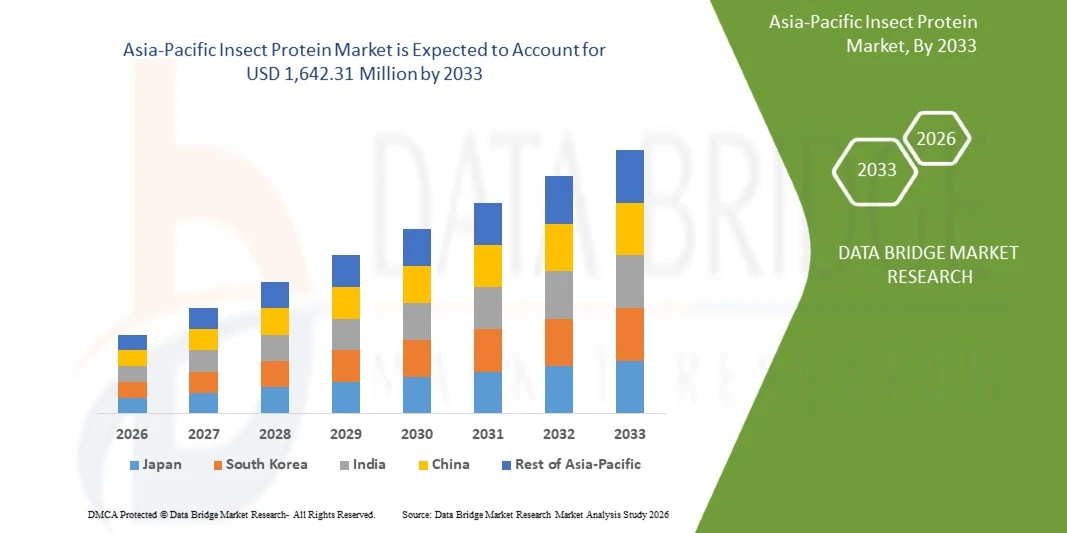
- As per Data Bridge Market Research analysis, the Asia-Pacific insect protein market was valued at USD 321.76 million in 2025 and is projected to reach USD 1,642.31 million by 2033, growing at a CAGR of 22.60% from 2026 to 2033.
- The market is experiencing rapid growth driven by rising demand for sustainable animal feed protein, increasing substitution of fishmeal and soybean meal, and expanding applications across aquaculture, poultry, pet food, and functional food products.
- The increasing shift toward circular agriculture, high-protein animal nutrition, and low-footprint food ingredients, combined with large aquaculture and livestock industries across the region, is supporting market adoption. Insect protein is being positioned across fish and shrimp feed, poultry rations, pet food, and snacks, offering producers greater flexibility in replacing conventional feed inputs used in aquaculture, supplying key amino acids, and creating new alternative protein sources for food manufacturers.
Market Size & Forecast
- Asia-Pacific Market Value (2025): USD 321.76 Million
- Expected Market Value (2033): USD 1,642.31 Million
- Forecast CAGR (2026–2033): 22.60%
- Leading Country in 2025: China
- Fastest Growing Country: India
What are the Major Takeaways of the Asia-Pacific Insect Protein Market?
- China dominated the Asia-Pacific insect protein market with the largest revenue share of 34.60% in 2025, supported by its large aquaculture and livestock feed industries, expanding insect rearing capacity, and supportive feed regulations.
- India is expected to be the fastest-growing country at a CAGR of 25.40% from 2026 to 2033, fueled by growing aquaculture output, rising feed demand, and expanding start-up investment in insect farming.
- The black soldier fly segment led the market with a 44.80% share in 2025, driven by efficient waste conversion, scalable rearing, and strong demand from aquafeed and pet food makers.
- Crickets are the fastest-growing insect type, projected to register a CAGR of 24.80%, reflecting rising demand for protein powders, snacks, and functional foods.
- The insect powder segment dominated the product form category with a 52.40% revenue share in 2025, led by its versatility in feed, food, and supplement formulations.
- The feed application accounted for 71.80% of the market share in 2025, preferred for fishmeal replacement, high digestibility, and sustainability benefits.
- The food & beverage segment is the fastest-growing application, with a CAGR of 26.30%, driven by rising protein snack demand, regulatory openings, and growing consumer curiosity.
Report Scope and Asia-Pacific Insect Protein Market Segmentation
|
Attributes |
Asia-Pacific Insect Protein Key Market Insights |
|
Segments Covered |
|
|
Countries Covered |
Asia-Pacific
|
|
Key Market Players |
|
|
Market Opportunities |
|
|
Value Added Data Infosets |
In addition to the insights on market scenarios such as market value, growth rate, segmentation, geographical coverage, and major players, the market reports curated by the Data Bridge Market Research also include in-depth expert analysis, pricing analysis, brand share analysis, consumer survey, demography analysis, supply chain analysis, value chain analysis, raw material/consumables overview, vendor selection criteria, PESTLE Analysis, Porter Analysis, and regulatory framework. |
What is the Key Trend in the Asia-Pacific Insect Protein Market?
- Insect protein production in Asia-Pacific is increasingly moving from small farms to industrial-scale facilities, combining automation, vertical rearing, waste upcycling, and standardized ingredients for feed and food manufacturers.
- For instance, in November 2023, Entobel opened its black soldier fly plant in Vung Tau, Vietnam, described as the largest insect protein facility in Asia, with an annual capacity of 10,000 metric tons, highlighting the shift toward industrial-scale insect protein production and rapid regional capacity expansion
- Regional producers are expanding black soldier fly operations in tropical countries, where warm climates and abundant organic waste streams lower energy costs and support continuous production of protein, oil, and fertilizer.
- Companies are increasingly developing differentiated ingredients such as defatted meal, insect oil, and protein concentrates, as buyers compare products on protein content, digestibility, consistency, and price against fishmeal and soybean meal.
- For instance, in July 2024, according to Food Ingredients First, the Singapore Food Agency approved 16 insect species for human consumption and as feed for food-producing animals, creating a regulatory framework that is expected to encourage investment in insect-based foods and farming across the region and beyond
- As industrial scale-up, regulatory clarity, feed demand, and consumer awareness continue to advance, insect protein is expected to expand beyond feed into pet food, protein snacks, and functional foods across Asia-Pacific.
What are the Key Drivers of the Asia-Pacific Insect Protein Market?
- The rapid growth of aquaculture, poultry farming, and pet food industries across Asia-Pacific is increasing demand for sustainable, high-protein ingredients that can reduce dependence on conventional fishmeal and soybean meal. Black soldier fly larvae protein is gaining traction as an alternative ingredient in aquafeed and animal nutrition due to its nutritional value and potential to support more sustainable feed production.
- Increasing investment in insect farming facilities, processing technologies, and large-scale production is supporting the commercialization of insect protein across the region.
- For instance, in June 2026, Innovafeed raised €51 million in funding backed by investors including Temasek and QIA, highlighting continued investor interest in expanding insect protein production and technology.
- The growing adoption of insect-derived ingredients by feed manufacturers and aquaculture producers is creating opportunities for commercial supply agreements and broader market penetration. Insect protein can help diversify feed ingredient sourcing, improve resource efficiency, and reduce reliance on conventional marine-based proteins.
- Government initiatives promoting food security, sustainable agriculture, and circular economy practices are supporting the development of insect farming by encouraging the conversion of suitable organic by-products into valuable feed ingredients. These initiatives can strengthen local supply chains, reduce waste, and create additional revenue opportunities for insect protein producers.
- For instance, in June 2025, Vinh Hoan partnered with Entobel through its subsidiary Feed One to purchase at least 15,000 metric tonnes of black soldier fly-derived insect protein between 2025 and 2027 for aquafeed applications, demonstrating growing commercial demand for alternative protein ingredients.
- Therefore, rising demand for sustainable and differentiated pet food products is expanding the use of insect protein beyond aquaculture and livestock feed.
What Factors Are Challenging the Growth of the Asia-Pacific Insect Protein Market?
- Insect protein remains costlier than soybean meal and many conventional feed inputs, and high capital costs for rearing and processing facilities can delay commercialization, especially for smaller producers.
- For instance, in July 2024, according to Malay Mail, a Singapore restaurant owner said insects made up 10% of his costs and were all imported, noting that cost remains a barrier to local adoption even after regulatory approval.
- These cost pressures can slow adoption among price-sensitive feed buyers and small farms, while limited consumer familiarity in some markets may restrict demand for insect-based foods beyond traditional consumption regions.
- Fragmented regulations, food safety requirements, and microbial and allergen concerns further restrict growth, requiring producers to invest in controlled rearing, testing, and traceability systems that may increase compliance and operating costs.
- For instance, in July 2024, according to Business Standard, the Singapore Food Agency said that insects for food or feed must be farmed in regulated establishments with food safety controls and cannot be harvested from the wild, underlining the compliance requirements that new producers must meet before entering regulated markets and supplying large buyers.
- The combination of high production costs, regulatory differences across countries, consumer acceptance barriers, and competition from soybean meal, fishmeal, and plant proteins can constrain adoption among cost-sensitive buyers and smaller producers, particularly where conventional ingredients already deliver adequate performance.
How is the Asia-Pacific Insect Protein Market Segmented?
The Asia-Pacific insect protein market is segmented on the basis of insect type, product form, application, and distribution channel.
- By Insect Type
On the basis of insect type, the Asia-Pacific insect protein market is segmented into black soldier flies, crickets, mealworms, and others. The black soldier fly segment dominated the market with 44.80% share in 2025, supported by efficient conversion of organic waste, scalable rearing, and strong demand from aquafeed and pet food makers. Larvae produce protein, oil, and frass fertilizer, creating several revenue streams. Tropical climates in Vietnam, Thailand, Malaysia, and Indonesia reduce energy costs. Large facilities with automation and vertical rearing are improving cost competitiveness. Regulatory acceptance of black soldier fly meal in feed further strengthens the segment’s leadership.
The cricket segment is projected to register the fastest growth at a CAGR of 24.80% from 2026 to 2033, driven by increasing demand for protein powders, snacks, and functional foods. Crickets have a long history of consumption in Thailand, Cambodia, Vietnam, and other countries, which supports consumer acceptance. Brands use cricket flour in bars, pasta, bakery products, and sports nutrition. Regulatory approvals for human consumption, such as Singapore’s approved species list, are creating new opportunities. Improvements in farming, processing, and flavor masking are enhancing quality, while investment in regional supply chains supports growth. Partnerships between farms and food brands are also expanding export-oriented production.
- By Product Form
On the basis of product form, the Asia-Pacific insect protein market is segmented into insect powder, whole insects, insect oil, and others. The insect powder segment dominated the market with 52.40% share in 2025, supported by its versatility in feed, food, and supplement formulations. Powders and meals are easy to store, transport, and blend into compound feed and food products. Defatted meals provide high protein levels, typically above 50% for premium grades. Standardized specifications help feed manufacturers adopt the ingredient without major process changes. Continued improvement in drying, milling, and quality testing further strengthens its leadership.
The insect oil segment is projected to register the fastest growth at a CAGR of 24.20% from 2026 to 2033, driven by rising demand for sustainable fats in aquafeed, pet food, and specialty nutrition. Black soldier fly oil is rich in lauric acid, which supports gut health and palatability in young animals. Producers are adding oil as a second revenue stream next to meal, improving plant economics. Growing interest in cosmetics and oleochemicals is creating additional opportunities. Advances in extraction and refining are improving yield and consistency, and long-term supply agreements with feed and pet food brands are supporting investment in dedicated oil lines.
- By Application
On the basis of application, the Asia-Pacific insect protein market is segmented into feed, food & beverage, and pharmaceuticals & cosmetics. The feed segment dominated the market with 71.80% share in 2025, driven by large aquaculture, poultry, and pet food industries and the need to replace fishmeal and soybean meal. Insect meal offers high digestibility, a favorable amino acid profile, and immune-supporting compounds. Feed regulations in several countries now allow insect ingredients for aquaculture and poultry. Established relationships with feed manufacturers, large production volumes, and growing sustainability targets continue to reinforce this segment's leadership.
The food & beverage segment is projected to register the fastest growth at a CAGR of 26.30% from 2026 to 2033, supported by rising demand for protein snacks, sports nutrition, and sustainable ingredients. Cricket and mealworm flours are being used in bars, noodles, baked goods, and beverages. Regulatory openings, such as Singapore’s approval of 16 species, are encouraging launches. Younger consumers are showing curiosity about novel proteins and environmental benefits. Education, taste improvement, and recipe development remain important for broader acceptance. Restaurants, cafés, and online brands are also introducing insect-based dishes and snacks to build awareness and trial among urban consumers.
- By Distribution Channel
On the basis of distribution channel, the Asia-Pacific insect protein market is segmented into direct and indirect. The direct segment dominated the market with 58.60% share in 2025, supported by large supply agreements between producers and feed manufacturers, aquaculture groups, and food companies. Direct sales allow better control over specifications, pricing, and logistics. Long-term contracts provide demand visibility and support investment in new capacity. Technical support and joint product development further strengthen buyer relationships. Established partnerships continue to reinforce this channel's leadership, especially for bulk feed ingredients delivered to large customers.
The indirect segment is projected to register the fastest growth at a CAGR of 24.10% from 2026 to 2033, driven by expansion of distributors, retailers, and online platforms that serve smaller feed buyers and consumers. Store-based retailers and e-commerce sites are adding insect-based snacks and pet foods. Distributors help reach farms and small manufacturers in remote areas. Online marketplaces and specialty stores improve access to novel foods. Branding, education, and certification support consumer trust. Smaller pack sizes, flexible ordering, and local technical advice are also helping new customers try insect-based products.
Which Country Holds the Largest Share of the Asia-Pacific Insect Protein Market?
- China dominated the Asia-Pacific insect protein market with the largest revenue share of 34.60% in 2025, supported by its large aquaculture and livestock feed industries, expanding insect rearing capacity, and supportive feed regulations.
- The country also benefits from large aquaculture output, growing domestic insect rearing capacity, and strong feed manufacturing networks, along with regulatory updates that allow insect protein in feed. Increasing investment in black soldier fly facilities and rising demand for sustainable protein continue to strengthen China’s position in the Asia-Pacific market.
China Insect Protein Market Insight
The China insect protein market is witnessing strong growth due to the country’s large aquaculture and livestock sectors, rising feed costs, and demand for alternative proteins. The country’s extensive feed manufacturing base, along with growing black soldier fly and mealworm production, is driving demand for insect meal and oil. In addition, supportive policy, large-scale facility investment, rising pet ownership, and growing use in pet food are accelerating adoption across feed and food applications.
Japan Insect Protein Market Insight
The Japan insect protein market is expected to witness steady growth, driven by interest in sustainable protein, a developing edible insect snack segment, and strong innovation in cricket-based foods. Growing demand for novel proteins in pet food and aquaculture, along with high quality standards, is supporting market expansion. In addition, start-ups, universities, and food companies are collaborating on farming, processing, and product development, and rising environmental awareness is accelerating availability and demand.
India Insect Protein Market Insight
The India insect protein market is witnessing rapid growth due to expanding aquaculture and poultry industries, rising feed demand, and active start-up investment in insect farming. Feed producers and farmers are increasingly testing insect-based ingredients for fish and shrimp. Moreover, strong demand for sustainable protein, waste upcycling, research collaboration, and government interest in aquaculture productivity is further contributing to market growth in India.
South Korea Insect Protein Market Insight
The South Korea insect protein market is growing steadily, driven by government support for novel foods, interest in sustainable protein, and a strong pet food industry. Growing research on edible insects is significantly boosting market awareness and consumer familiarity. In addition, established food manufacturers, advanced processing capabilities, rising demand for functional ingredients, and strong university research are positioning South Korea as an important niche market in Asia-Pacific.
Which are the Top Companies in Asia-Pacific Insect Protein Market?
The Asia-Pacific insect protein industry is primarily led by well-established companies, including:
- Entobel Holding Pte. Ltd. (Vietnam)
- Protenga Pte Ltd (Singapore)
- Nutrition Technologies (Sentara Group) (Singapore)
- Mukka Proteins Limited (India)
- Global Bugs (Thailand)
- Haocheng Mealworms Inc. (China)
- Thailand Unique (Thailand)
- CricketOne Asia (Vietnam)
- Entofood Sdn Bhd (Malaysia)
- Goterra (Australia)
- Insectika Biotech (India)
- Ynsect (France)
- Protix B.V. (Netherlands)
- Innovafeed SAS (France)
- Hexafly (Ireland)
- nextProtein (France)
- Aspire Food Group (Canada)
- Entomo Farms (Canada)
- Beta Hatch (U.S.)
- Insect Technology Group (South Africa)
What are Latest Developments in Asia-Pacific Insect Protein Market?
- In September 2025, Mukka Proteins Limited acquired a 51% stake in insect protein producer FABBCO, strengthening its black soldier fly waste-to-protein capabilities. The deal expands the Indian company’s sustainable feed ingredient portfolio and complements its insect protein venture, Ento Proteins, as consolidation and scale-up accelerate in the region.
- In February 2025, Insectika Biotech introduced insect protein-based fish feeds, Yum Pro and YuM ToM, formulated from black soldier fly larvae for aquaculture, developed with India’s Central Institute of Brackishwater Aquaculture. The products were presented to more than 500 aquaculture farmers at the Shrimp Farmers’ Conclave, supporting adoption in shrimp farming and helping demonstrate fishmeal replacement in practice.
- In July 2024, the Singapore Food Agency approved 16 insect species for use as food and as feed for food-producing animals, including crickets, grasshoppers, locusts, mealworms, and silkworms. The approval created a regulatory framework for imports and farming and encouraged restaurants and start-ups to launch insect-based dishes and snacks.
- In November 2023, Entobel opened its new black soldier fly production plant in Vung Tau, Vietnam, the largest of its kind in Asia, with an annual capacity of 10,000 metric tons of insect protein. The plant was supported by a USD 33 million Series B funding round backed by Mekong Capital, Dragon Capital, and the International Finance Corporation, and was built in 12 months, setting a record for construction speed.
- In July 2020, Singapore-based Protenga raised USD 1.6 million in funding from Roslin Technologies and Seeds Capital to scale its black soldier fly production and waste bioconversion operations. The investment supported the development of improved insect lines and a genetic nucleus facility, strengthening regional capabilities in insect farming and breeding.

- Interactive Data Analysis Dashboard
- Company Analysis Dashboard for high growth potential opportunities
- Research Analyst Access for customization & queries
- Competitor Analysis with Interactive dashboard
- Latest News, Updates & Trend analysis
- Harness the Power of Benchmark Analysis for Comprehensive Competitor Tracking
Asia Pacific Insect Protein Market, Supply Chain Analysis and Ecosystem Framework
To support market growth and help clients navigate the impact of geopolitical shifts, DBMR has integrated in-depth supply chain analysis into its Asia Pacific Insect Protein Market research reports. This addition empowers clients to respond effectively to global changes affecting their industries. The supply chain analysis section includes detailed insights such as Asia Pacific Insect Protein Market consumption and production by country, price trend analysis, the impact of tariffs and geopolitical developments, and import and export trends by country and HSN code. It also highlights major suppliers with data on production capacity and company profiles, as well as key importers and exporters. In addition to research, DBMR offers specialized supply chain consulting services backed by over a decade of experience, providing solutions like supplier discovery, supplier risk assessment, price trend analysis, impact evaluation of inflation and trade route changes, and comprehensive market trend analysis.
Data collection and base year analysis are done using data collection modules with large sample sizes. The stage includes obtaining market information or related data through various sources and strategies. It includes examining and planning all the data acquired from the past in advance. It likewise envelops the examination of information inconsistencies seen across different information sources. The market data is analysed and estimated using market statistical and coherent models. Also, market share analysis and key trend analysis are the major success factors in the market report. To know more, please request an analyst call or drop down your inquiry.
The key research methodology used by DBMR research team is data triangulation which involves data mining, analysis of the impact of data variables on the market and primary (industry expert) validation. Data models include Vendor Positioning Grid, Market Time Line Analysis, Market Overview and Guide, Company Positioning Grid, Patent Analysis, Pricing Analysis, Company Market Share Analysis, Standards of Measurement, Global versus Regional and Vendor Share Analysis. To know more about the research methodology, drop in an inquiry to speak to our industry experts.
Data Bridge Market Research is a leader in advanced formative research. We take pride in servicing our existing and new customers with data and analysis that match and suits their goal. The report can be customized to include price trend analysis of target brands understanding the market for additional countries (ask for the list of countries), clinical trial results data, literature review, refurbished market and product base analysis. Market analysis of target competitors can be analyzed from technology-based analysis to market portfolio strategies. We can add as many competitors that you require data about in the format and data style you are looking for. Our team of analysts can also provide you data in crude raw excel files pivot tables (Fact book) or can assist you in creating presentations from the data sets available in the report.