


Asia-Pacific Laparoscopic Instruments Market Size
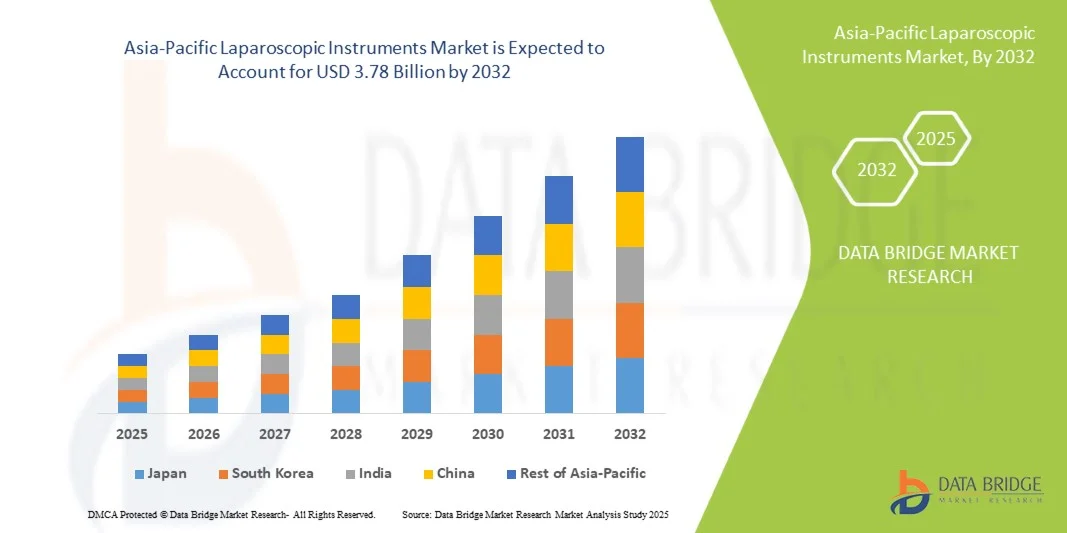
- The Asia-Pacific laparoscopic instruments market size was valued at USD 1.74 billion in 2024 and is expected to reach USD 3.78 billion by 2032, at a CAGR of 10.2% during the forecast period
- The market growth is largely driven by the rising prevalence of minimally invasive surgeries, increasing adoption of advanced laparoscopic technologies, and expanding healthcare infrastructure across emerging economies such as China, India, and Japan
- Furthermore, growing patient preference for shorter recovery times, reduced postoperative complications, and enhanced cosmetic outcomes is accelerating the transition toward laparoscopic procedures. These combined factors are propelling the demand for laparoscopic instruments, thereby significantly boosting the region’s market growth
Asia-Pacific Laparoscopic Instruments Market Analysis
- Laparoscopic instruments, used for minimally invasive surgical procedures, are increasingly vital in modern operating rooms across hospitals and specialty clinics in Asia-Pacific due to their precision, shorter recovery times, and reduced postoperative complications
- The market’s expansion is primarily driven by the growing adoption of minimally invasive techniques, the rising burden of lifestyle-related and chronic diseases, and ongoing advancements in energy-based and imaging technologies that enhance surgical outcomes
- China dominated the Asia-Pacific laparoscopic instruments market in 2024 with the largest revenue share of 38.5%, supported by rapid healthcare infrastructure development, strong government investments in medical device manufacturing, and a rising number of laparoscopic procedures in both public and private hospitals
- India is expected to be the fastest-growing market during the forecast period, driven by increasing access to advanced surgical care, the growth of medical tourism, and the adoption of affordable laparoscopic systems in emerging urban centers
- The energy devices segment dominated the market in 2024 with a share of 29.6%, owing to its crucial role in precise tissue dissection, reduced intraoperative bleeding, and improved safety and efficiency across a wide range of laparoscopic applications
Report Scope and Asia-Pacific Laparoscopic Instruments Market Segmentation
|
Attributes |
Asia-Pacific Laparoscopic Instruments Key Market Insights |
|
Segments Covered |
|
|
Countries Covered |
Asia-Pacific
|
|
Key Market Players |
|
|
Market Opportunities |
|
|
Value Added Data Infosets |
In addition to the insights on market scenarios such as market value, growth rate, segmentation, geographical coverage, and major players, the market reports curated by the Data Bridge Market Research also include in-depth expert analysis, patient epidemiology, pipeline analysis, pricing analysis, and regulatory framework |
Asia-Pacific Laparoscopic Instruments Market Trends
“Technological Advancements and Integration of Robotic-Assisted Laparoscopy”
- A significant and accelerating trend in the Asia-Pacific laparoscopic instruments market is the growing integration of robotic-assisted and image-guided technologies, enhancing surgical precision, control, and safety in minimally invasive procedures
- For instance, in September 2024, Intuitive Surgical expanded its da Vinci robotic systems’ availability across major hospitals in China and Japan, improving surgeons’ dexterity and accuracy during complex laparoscopic surgeries
- The combination of robotics, high-definition 3D visualization, and AI-driven imaging analytics is transforming traditional laparoscopic procedures into more data-driven and patient-specific interventions. For instance, Olympus and Karl Storz are developing advanced visualization systems that enable surgeons to view detailed anatomical structures in real time
- These advancements enable enhanced ergonomics, reduced surgeon fatigue, and improved outcomes for patients, particularly in gynecological, urological, and colorectal surgeries
- The seamless integration of robotic platforms with laparoscopic instruments allows surgeons to perform complex operations with greater consistency, precision, and reduced learning curves
- This trend toward technologically sophisticated, efficient, and precision-guided surgical systems is reshaping surgical standards across Asia-Pacific hospitals. Consequently, companies such as Medtronic and Stryker are investing heavily in developing hybrid systems that combine robotics and laparoscopic instrumentation to expand their footprint in emerging Asian markets
- The demand for robotic-assisted laparoscopic solutions is growing rapidly across China, Japan, and India as healthcare facilities prioritize advanced surgical capabilities and improved patient outcomes
Asia-Pacific Laparoscopic Instruments Market Dynamics
Driver
“Rising Prevalence of Minimally Invasive Surgeries and Expanding Healthcare Infrastructure”
- The increasing preference for minimally invasive procedures due to reduced postoperative pain, faster recovery, and shorter hospital stays is a major driver fueling the demand for laparoscopic instruments across Asia-Pacific
- For instance, in March 2024, Olympus Corporation announced the expansion of its minimally invasive surgical training centers in India and Singapore to enhance surgeon skills and promote wider adoption of laparoscopic procedures
- As healthcare providers emphasize cost-effective and patient-friendly surgical approaches, laparoscopic instruments offer high precision, reduced blood loss, and faster recovery times, making them the preferred choice for surgeons and patients likely as
- Furthermore, the rapid expansion of healthcare infrastructure, rising medical tourism, and increasing government investments in surgical equipment modernization are strengthening market growth
- The growing awareness of the benefits of minimally invasive surgery, supported by training programs and international collaborations, is encouraging hospitals and specialty clinics to adopt advanced laparoscopic technologies
- The growing demand from both public and private healthcare facilities for technologically advanced instruments that improve procedural efficiency continues to drive strong market momentum across China, India, and Southeast Asia
Restraint/Challenge
“High Equipment Cost and Limited Access to Skilled Professionals”
- The high upfront cost associated with advanced laparoscopic and robotic-assisted systems remains a major barrier, particularly for small and mid-sized hospitals in developing economies across Asia-Pacific
- For instance, many hospitals in India and Southeast Asia face financial constraints in adopting premium energy devices and high-end imaging systems, limiting access to advanced laparoscopic procedures in non-urban regions
- The shortage of adequately trained laparoscopic surgeons further compounds this challenge, as the complexity of advanced instruments requires extensive hands-on training and skill development
- In addition, the lack of standardized reimbursement frameworks and inconsistent insurance coverage for minimally invasive procedures in some countries hinders broader adoption
- The combination of financial and skill-based constraints restricts the penetration of next-generation laparoscopic instruments, particularly in low-resource healthcare settings
- Overcoming these challenges through cost-effective equipment manufacturing, surgeon training programs, and government-backed initiatives to subsidize advanced surgical technologies will be essential for sustaining long-term market growth
Asia-Pacific Laparoscopic Instruments Market Scope
The market is segmented on the basis of type, product type, application, and end user.
- By Type
On the basis of type, the Asia-Pacific laparoscopic instruments market is segmented into rigid laparoscopes and flexible laparoscopes. The rigid laparoscopes segment dominated the market with the largest revenue share of 67.3% in 2024, driven by their superior image quality, durability, and extensive use across general, gynecological, and urological surgeries. Rigid laparoscopes are widely preferred due to their precise optical clarity and compatibility with advanced high-definition cameras, making them indispensable in complex procedures. Their robust design and lower maintenance costs compared to flexible models have strengthened their adoption in hospitals and surgical centers. Moreover, increasing government funding for advanced surgical equipment in China and Japan has further boosted the installation of rigid laparoscopic systems across major healthcare facilities. Continuous technological upgrades, such as improved light transmission and enhanced visualization, also support the segment’s dominance in the regional market.
The flexible laparoscopes segment is anticipated to register the fastest CAGR of 9.4% from 2025 to 2032, driven by the growing demand for minimally invasive procedures in anatomically challenging areas. Their ability to navigate complex surgical sites with improved maneuverability is encouraging their use in colorectal, thoracic, and pediatric surgeries. The rising preference for flexible systems among surgeons, supported by advancements in fiber-optic technology and compact camera modules, is fueling adoption. Moreover, the growing number of specialized surgical centers across India, South Korea, and Southeast Asia offering advanced laparoscopic procedures is accelerating market growth for flexible laparoscopes.
- By Product Type
On the basis of product type, the market is segmented into laparoscopes, energy devices, insufflators, suction/irrigation systems, closure devices, hand instruments, access devices, laparoscopic scissors, laparoscopic hooks, and accessories. The energy devices segment dominated the Asia-Pacific market with a share of 28.6% in 2024, owing to their crucial role in tissue dissection, coagulation, and sealing during laparoscopic surgeries. These devices significantly reduce operative time and intraoperative bleeding, enhancing safety and efficiency. The segment’s growth is further supported by rapid technological developments, including ultrasonic and advanced bipolar energy systems from key players such as Olympus and Medtronic. Increasing demand from hospitals adopting integrated surgical platforms and the growing focus on precision energy delivery have strengthened this segment’s leadership. In addition, the increasing number of bariatric and gynecological surgeries in China and India is boosting the demand for high-performance energy devices.
The insufflators segment is projected to witness the fastest growth, registering a CAGR of 9.9% from 2025 to 2032, due to their critical role in maintaining optimal intra-abdominal pressure and visibility during laparoscopic procedures. The integration of smart insufflation systems with real-time pressure monitoring and automatic flow control is driving adoption. For instance, newer CO₂ insufflators by Karl Storz and Stryker provide enhanced safety and stability during prolonged surgeries. Rising procedural volumes in general and bariatric surgeries, coupled with the shift toward automated and digitally controlled insufflation systems, are fueling rapid growth in this segment.
- By Application
On the basis of application, the market is categorized into general surgery, bariatric surgery, gynecological surgery, urological surgery, colorectal surgery, pediatric surgery, and others. The general surgery segment dominated the market with a revenue share of 32.8% in 2024, primarily due to the rising volume of minimally invasive procedures for appendectomies, hernia repairs, and gallbladder removals. Laparoscopic instruments have become the standard of care in many general surgeries, improving patient outcomes and reducing hospital stays. The segment benefits from strong procedural demand across both public and private hospitals, particularly in China, India, and Japan. Growing investments in surgical training programs and the widespread availability of advanced visualization and energy devices are reinforcing this dominance. Moreover, continuous government efforts to promote minimally invasive surgical practices are sustaining the high market share of this segment.
The bariatric surgery segment is expected to grow at the fastest rate of 10.3% from 2025 to 2032, fueled by the increasing prevalence of obesity and lifestyle-related disorders across Asia-Pacific. Rising awareness of laparoscopic bariatric procedures, which offer lower complication rates and shorter recovery times, is driving strong demand. For instance, hospitals in South Korea and India are increasingly adopting advanced laparoscopic systems for sleeve gastrectomy and gastric bypass surgeries. The growing focus on surgical weight management programs and improved access to specialized equipment are contributing to this segment’s rapid growth.
- By End User
On the basis of end user, the market is segmented into hospitals, ambulatory surgical centers (ASCs), and specialty clinics. The hospitals segment held the largest revenue share of 58.6% in 2024, driven by the availability of advanced infrastructure, a wide range of surgical specialties, and high patient inflow. Large hospitals across China, Japan, and India continue to be primary adopters of laparoscopic technologies due to their strong capital budgets and multidisciplinary capabilities. The increasing adoption of robotic-assisted laparoscopic systems and government-backed initiatives for modernizing public hospitals are further propelling segment growth. In addition, hospitals’ preference for integrated operating rooms equipped with energy devices and 3D visualization systems reinforces their dominant position.
The ambulatory surgical centers (ASCs) segment is expected to record the fastest CAGR of 10.1% from 2025 to 2032, driven by the growing demand for cost-effective and same-day laparoscopic procedures. ASCs offer reduced operational costs, faster patient turnover, and shorter waiting times compared to traditional hospitals. The rising number of accredited ASCs across India, Australia, and Southeast Asia, coupled with growing surgeon preference for outpatient laparoscopic procedures, is accelerating market expansion. Technological miniaturization and portable laparoscopic device designs further enhance the suitability of these centers for complex minimally invasive surgeries.
Asia-Pacific Laparoscopic Instruments Market Regional Analysis
- China dominated the Asia-Pacific laparoscopic instruments market in 2024 with the largest revenue share of 38.5%, supported by rapid healthcare infrastructure development, strong government investments in medical device manufacturing, and a rising number of laparoscopic procedures in both public and private hospitals
- Surgeons and hospitals in the country are increasingly embracing advanced laparoscopic systems due to their precision, faster recovery outcomes, and reduced postoperative complications
- This growing adoption is further supported by government initiatives promoting healthcare modernization, rising disposable incomes, and expanding access to advanced surgical technologies, positioning China as a key hub for laparoscopic innovation and adoption across the Asia-Pacific region
The China Laparoscopic Instruments Market Insight
The China laparoscopic instruments market captured the largest revenue share of 38.5% in 2024 within Asia-Pacific, fueled by strong domestic manufacturing capabilities, rapid healthcare modernization, and a growing number of laparoscopic procedures in tertiary hospitals. Increasing adoption of high-definition and 3D laparoscopes in surgical departments is enhancing procedural precision and reducing recovery times. Government initiatives promoting advanced surgical technologies, coupled with rising disposable incomes, are further boosting adoption. In addition, strategic partnerships between Chinese hospitals and global medical device companies are expanding access to next-generation laparoscopic systems across the country.
Japan Laparoscopic Instruments Market Insight
The Japan laparoscopic instruments market is gaining momentum due to the nation’s advanced healthcare infrastructure, aging population, and preference for minimally invasive procedures. Surgeons in Japan are increasingly adopting robotic-assisted laparoscopic systems for precision and reduced postoperative complications. The presence of domestic innovators such as Olympus Corporation is driving continuous product innovation in visualization and energy devices. Furthermore, the growing demand for efficient and patient-friendly surgical techniques is encouraging hospitals and research centers to invest in new-generation laparoscopic technologies, reinforcing Japan’s leadership in surgical innovation within the region.
India Laparoscopic Instruments Market Insight
The India laparoscopic instruments market accounted for the fastest growth rate in Asia-Pacific in 2024, supported by rapid urbanization, increasing government investments in healthcare infrastructure, and the rising number of skilled laparoscopic surgeons. The country’s growing middle-class population and expanding network of multispecialty hospitals are fueling demand for cost-effective and reliable laparoscopic instruments. Medical tourism and the government’s “Make in India” initiative are attracting global manufacturers to establish local production facilities. Furthermore, rising awareness about minimally invasive surgeries and expanding access to affordable laparoscopic procedures in tier-2 and tier-3 cities are expected to further propel market growth.
Australia Laparoscopic Instruments Market Insight
The Australia laparoscopic instruments market is expected to grow steadily during the forecast period, driven by a strong preference for advanced surgical techniques and well-developed healthcare infrastructure. High adoption of minimally invasive procedures for bariatric and gynecological surgeries is promoting the use of energy devices and high-definition laparoscopes. Increasing collaborations between hospitals and technology providers to enhance surgical training and the availability of advanced operating room technologies are fueling adoption. In addition, the rise in chronic diseases requiring surgical intervention and the nation’s high healthcare expenditure continue to support consistent market growth.
Asia-Pacific Laparoscopic Instruments Market Share
The Asia-Pacific Laparoscopic Instruments industry is primarily led by well-established companies, including:
- Olympus Corporation (Japan)
- KARL STORZ SE & Co. KG (Germany)
- Stryker (U.S.)
- Medtronic (Ireland)
- Johnson & Johnson Services, Inc. (U.S.)
- CONMED Corporation (U.S.)
- B. Braun SE (Germany)
- Richard Wolf GmbH (Germany)
- Smith & Nephew (U.K.)
- Intuitive Surgical, Inc. (U.S.)
- Boston Scientific Corporation (U.S.)
- Cook (U.S.)
- Teleflex Incorporated (U.S.)
- Getinge AB (Sweden)
- FUJIFILM Holdings Corporation (Japan)
- HOYA Corporation (Japan)
- Erbe Elektromedizin GmbH (Germany)
- Applied Medical Resources Corporation (U.S.)
- Genesis MedTech Co., Ltd. (South Korea)
- Weigao Group Co., Ltd. (China)
What are the Recent Developments in Asia-Pacific Laparoscopic Instruments Market?
- In January 2025, Genesis MedTech announced that its iReach Omnia billed as the world’s first powered stapler with 90° articulation for confined laparoscopic spaces received Chinese NMPA approval for market release, offering surgeons improved access and precision for low-rectal and other challenging resections and signaling broader availability of advanced stapling solutions in Greater China
- In June 2024, Olympus Corporation announced the expansion of its R&D and innovation capabilities by establishing an R&D Offshore Development Center in Hyderabad, India (in partnership with HCLTech), aimed at strengthening regional development, engineering support and faster localization of endoscopy and minimally invasive surgical technologies for Asia-Pacific markets
- In July 2023, Genesis MedTech received NMPA approval in China to launch ArtiSential, an articulating laparoscopic instrument platform that mimics wrist articulation to enhance surgeon dexterity a notable addition to the APAC toolkit for complex minimally invasive procedures
- In September 2022, Japan’s Ministry of Health, Labour and Welfare cleared Intuitive’s da Vinci SP (single-port) robotic system for use in general and thoracic surgeries, marking a regulatory and clinical milestone that expanded single-port robotic-assisted options for minimally invasive surgical teams in Japan and influenced adoption patterns across the region
- In June 2021, Ethicon (Johnson & Johnson) launched the ENSEAL X1 Curved-Jaw Tissue Sealer, an advanced bipolar energy device indicated for colorectal, gynecological, bariatric and thoracic laparoscopic procedures a product introduction that reinforced demand for higher-performance energy devices across APAC surgical centers

- Interactive Data Analysis Dashboard
- Company Analysis Dashboard for high growth potential opportunities
- Research Analyst Access for customization & queries
- Competitor Analysis with Interactive dashboard
- Latest News, Updates & Trend analysis
- Harness the Power of Benchmark Analysis for Comprehensive Competitor Tracking
Data collection and base year analysis are done using data collection modules with large sample sizes. The stage includes obtaining market information or related data through various sources and strategies. It includes examining and planning all the data acquired from the past in advance. It likewise envelops the examination of information inconsistencies seen across different information sources. The market data is analysed and estimated using market statistical and coherent models. Also, market share analysis and key trend analysis are the major success factors in the market report. To know more, please request an analyst call or drop down your inquiry.
The key research methodology used by DBMR research team is data triangulation which involves data mining, analysis of the impact of data variables on the market and primary (industry expert) validation. Data models include Vendor Positioning Grid, Market Time Line Analysis, Market Overview and Guide, Company Positioning Grid, Patent Analysis, Pricing Analysis, Company Market Share Analysis, Standards of Measurement, Global versus Regional and Vendor Share Analysis. To know more about the research methodology, drop in an inquiry to speak to our industry experts.
Data Bridge Market Research is a leader in advanced formative research. We take pride in servicing our existing and new customers with data and analysis that match and suits their goal. The report can be customized to include price trend analysis of target brands understanding the market for additional countries (ask for the list of countries), clinical trial results data, literature review, refurbished market and product base analysis. Market analysis of target competitors can be analyzed from technology-based analysis to market portfolio strategies. We can add as many competitors that you require data about in the format and data style you are looking for. Our team of analysts can also provide you data in crude raw excel files pivot tables (Fact book) or can assist you in creating presentations from the data sets available in the report.













