




Asia Pacific Loyalty Management Market
Market Size in USD Billion
CAGR :
% 
 USD
3.77 Billion
USD
23.84 Billion
2025
2033
USD
3.77 Billion
USD
23.84 Billion
2025
2033
 Forecast Period Forecast Period |
2026 –2033 |
 Market Size (Base Year) Market Size (Base Year) |
USD 3.77 Billion |
 Market Size (Forecast Year) Market Size (Forecast Year) |
USD 23.84 Billion |
 CAGR CAGR |
% |
| Major Markets Players |
|
What is the Asia-Pacific Loyalty Management Market Size and Growth Rate?
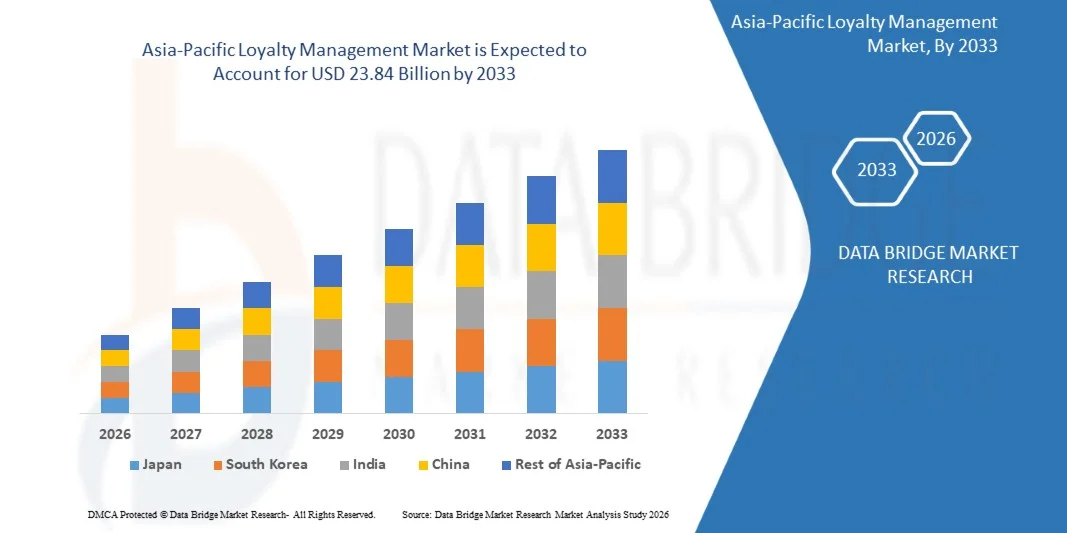
- The Asia-Pacific loyalty management market size was valued at USD 3.77 Billion in 2025 and is expected to reach USD 23.84 Billion by 2033, at a CAGR of 25.9% during the forecast period
- This growth is driven by factors such as the increasing adoption of digital technologies, rising customer retention efforts by businesses, and the expansion of e-commerce and mobile commerce platforms that leverage loyalty programs to boost customer engagement
What are the Major Takeaways of Loyalty Management Market?
- The loyalty management market is experiencing rapid growth, driven by the increasing demand for personalized customer experiences and the adoption of advanced technologies such as artificial intelligence and machine learning to enhance program effectiveness
- Businesses are shifting from traditional point-based systems to more sophisticated engagement mechanisms, incorporating gamification, social responsibility, and experiential rewards to strengthen customer loyalty and differentiate their offerings
- China dominated the Asia-Pacific loyalty management market with the largest revenue share of 35.56% in 2025, driven by rapid expansion of the retail, e-commerce, BFSI, telecom, and digital payments sectors
- India is projected to register the fastest CAGR of 7.69% from 2026 to 2033, driven by rapid growth in e-commerce, digital banking, retail modernization, and mobile-first consumer engagement strategies
- The Software segment dominated the market with a 46.8% share in 2025, driven by increasing adoption of customer engagement platforms, reward tracking systems, CRM integration tools, and campaign management software
Report Scope and Loyalty Management Market Segmentation
|
Attributes |
Loyalty Management Key Market Insights |
|
Segments Covered |
|
|
Countries Covered |
Asia-Pacific
|
|
Key Market Players |
|
|
Market Opportunities |
|
|
Value Added Data Infosets |
In addition to the insights on market scenarios such as market value, growth rate, segmentation, geographical coverage, and major players, the market reports curated by the Data Bridge Market Research also include in-depth expert analysis, pricing analysis, brand share analysis, consumer survey, demography analysis, supply chain analysis, value chain analysis, raw material/consumables overview, vendor selection criteria, PESTLE Analysis, Porter Analysis, and regulatory framework. |
What is the Key Trend in the Loyalty Management Market?
“Personalized Rewards Using Artificial Intelligence”
- Artificial intelligence is revolutionizing loyalty programs by enabling brands to offer tailored rewards based on individual customer preferences and behaviors
- For instance, Starbucks utilizes AI to analyze customer data and provide personalized offers, enhancing customer satisfaction and loyalty
- AI-driven personalization allows businesses to predict customer needs and deliver relevant rewards, increasing engagement and retention rates
- The integration of AI into loyalty programs also facilitates real-time adjustments to offers, ensuring they remain aligned with evolving customer preferences
- As consumer expectations for personalized experiences rise, businesses are increasingly adopting AI to stay competitive in the loyalty management market
What are the Key Drivers of Loyalty Management Market?
- Artificial intelligence and machine learning have transformed loyalty management by enabling businesses to analyze large volumes of customer data and uncover valuable behavioral insights
- For instance, AI helps brands understand when a customer is such asly to churn or what time they are most responsive to offers
- These technologies allow for the creation of highly personalized rewards and promotions that resonate with individual customers
- For instance, Starbucks uses AI to offer drink suggestions based on past orders and time of day preferences
- Predictive analytics powered by machine learning enhances a brand’s ability to anticipate customer needs and tailor loyalty strategies proactively
- Real-time data processing through AI enables businesses to make instant adjustments to loyalty campaigns, improving relevance and impact
- Overall, integrating AI and machine learning into loyalty programs increases customer satisfaction, boosts retention, and supports long-term revenue growth
Which Factor is Challenging the Growth of the Loyalty Management Market?
- As loyalty programs depend heavily on collecting and analyzing customer data, privacy and security have become critical concerns for both users and businesses
- For instance, Customers often share sensitive information such as purchasing habits, personal details, and location data
- Regulations such as the General Data Protection Regulation in Europe and the California Consumer Privacy Act in the US set strict rules on data usage
- For instance, companies must clearly disclose how data is collected, stored, and used to avoid legal consequences
- Non-compliance with these laws can result in heavy fines and severely damage a company’s brand reputation
- Data breaches and misuse of personal information can erode trust and reduce customer willingness to participate in loyalty programs
- To build and maintain trust, businesses must prioritize transparent practices and invest in advanced cybersecurity solutions to protect user data
How is the Loyalty Management Market Segmented?
The market is segmented on the basis of product, connectivity service, and industry.
• By Component
On the basis of component, the Loyalty Management market is segmented into Software, Services, and Solutions. The Software segment dominated the market with a 46.8% share in 2025, driven by increasing adoption of customer engagement platforms, reward tracking systems, CRM integration tools, and campaign management software. Enterprises across retail, BFSI, and hospitality sectors are increasingly deploying software-based loyalty platforms to improve customer retention, personalize promotions, and analyze consumer behavior in real time. The growing use of AI-driven recommendation engines and cloud-based dashboards further supports segment growth.
The Services segment is expected to grow at the fastest CAGR from 2026 to 2033, fueled by rising demand for consulting, system integration, maintenance, and managed loyalty program services. Organizations are increasingly outsourcing loyalty strategy execution, customer analytics, and platform optimization to specialized service providers, which is accelerating segment expansion.
• By Deployment Type
On the basis of deployment type, the market is segmented into On-Premises and On-Demand. The On-Demand segment dominated the market with a 61.3% share in 2025, supported by the rapid shift toward cloud-based loyalty management platforms. Businesses prefer on-demand solutions due to lower upfront infrastructure costs, easy scalability, remote accessibility, and seamless integration with digital channels such as mobile apps, websites, and e-commerce platforms. Growing demand for real-time customer insights and omnichannel engagement is further strengthening adoption.
The On-Demand segment is also projected to grow at the fastest CAGR from 2026 to 2033, driven by rising digital transformation initiatives, SaaS-based deployment models, and increasing demand from SMEs for cost-effective customer retention solutions. Meanwhile, on-premises solutions continue to witness stable demand among large enterprises requiring higher data control and security compliance.
• By Organization Size
On the basis of organization size, the market is segmented into Large Enterprise and Small and Medium-Sized Enterprise. The Large Enterprise segment dominated the market with a 64.7% share in 2025, driven by extensive investments in customer retention strategies, advanced CRM infrastructure, and multi-channel loyalty ecosystems. Large enterprises across retail, BFSI, telecom, and travel sectors are increasingly adopting sophisticated loyalty platforms to enhance customer lifetime value and strengthen brand loyalty. Their ability to invest in AI, predictive analytics, and personalized reward programs continues to support market dominance.
The Small and Medium-Sized Enterprise segment is expected to grow at the fastest CAGR from 2026 to 2033, propelled by rising awareness regarding customer retention benefits, growing digitalization, and increased availability of affordable cloud-based loyalty solutions. Flexible subscription pricing models and easy deployment are encouraging SMEs to rapidly adopt loyalty management systems.
• By Vertical
On the basis of vertical, the market is segmented into Banking Financial Services and Insurance, Retail and Consumer Goods, Healthcare and Life Sciences, Travel and Hospitality, IT and Telecommunication, Media and Entertainment, Manufacturing, and Others. The Retail and Consumer Goods segment dominated the market with a 29.8% share in 2025, owing to the widespread use of loyalty cards, reward points, cashback offers, and personalized promotional campaigns. Retailers are leveraging loyalty platforms to improve repeat purchases, strengthen brand engagement, and gather consumer insights for targeted marketing strategies.
The Banking Financial Services and Insurance segment is expected to grow at the fastest CAGR from 2026 to 2033, driven by increasing use of rewards-based credit cards, digital wallet incentives, cashback programs, and personalized financial service offerings. Rising competition among banks and fintech firms to improve customer retention is accelerating growth in this segment.
• By Type of Offering Capacity
On the basis of type of offering capacity, the market is segmented into Loyalty Management, Technology Capabilities Platform, Analytics and Measurement, Services Delivery Capabilities, Loyalty Strategy Design, and Loyalty Marketing. The Technology Capabilities Platform segment dominated the market with a 31.5% share in 2025, driven by the growing need for integrated digital infrastructure that supports omnichannel loyalty programs, customer data management, AI-based personalization, and campaign automation. Increasing deployment of cloud-based platforms and real-time engagement engines is further driving demand.
The Analytics and Measurement segment is expected to grow at the fastest CAGR from 2026 to 2033, fueled by increasing reliance on customer behavior analytics, predictive insights, ROI measurement tools, and performance dashboards. Companies are increasingly investing in analytics capabilities to optimize loyalty campaigns, improve conversion rates, and enhance customer lifetime value.
Which Country Holds the Largest Share of the Loyalty Management Market?
- China dominated the Asia-Pacific loyalty management market with the largest revenue share of 35.56% in 2025, driven by rapid expansion of the retail, e-commerce, BFSI, telecom, and digital payments sectors. The country’s large consumer base, high smartphone penetration, and increasing adoption of AI-driven customer engagement platforms continue to support strong market demand. Businesses across online marketplaces, retail chains, and financial institutions are increasingly investing in loyalty platforms to enhance customer retention, personalized rewards, and omnichannel engagement strategies. China also accounts for a major share of the Asia-Pacific market due to aggressive digital transformation initiatives and the expansion of branded retail networks
- Increasing deployment of cloud-based loyalty software, real-time analytics tools, and mobile reward applications across major enterprises continues to accelerate market growth. Rising consumer preference for cashback, reward points, and personalized promotional campaigns is further strengthening adoption across the country
India Loyalty Management Market Insight
India is projected to register the fastest CAGR of 7.69% from 2026 to 2033, driven by rapid growth in e-commerce, digital banking, retail modernization, and mobile-first consumer engagement strategies. Rising adoption of cloud-based loyalty management platforms among retailers, fintech companies, travel brands, and telecom providers is significantly supporting market expansion. Increasing internet penetration, growth in digital payments, and rising focus on customer lifetime value are accelerating demand across the country. Businesses are increasingly adopting loyalty management solutions to improve repeat purchases, strengthen brand engagement, and gain data-driven customer insights
Which are the Top Companies in Loyalty Management Market?
The Loyalty Management industry is primarily led by well-established companies, including:
- ABB Ltd (Switzerland)
- Eaton Corporation (Ireland)
- Emerson Electric Co. (U.S.)
- E2S Warning Signals (U.K.)
- Honeywell International Inc (U.S.)
- WERMA Signaltechnik GmbH + Co. KG (Germany)
- Patlite Corporation (Japan)
- Rockwell Automation Inc (U.S.)
- R. Stahl AG (Germany)
- Siemens AG (Germany)
What are the Recent Developments in Asia-Pacific Loyalty Management Market?
- In January 2025, SAP introduced a new data-driven loyalty management solution at the NRF event. This innovation integrates with SAP’s Commerce Cloud, Service Cloud, Emarsys, and S/4HANA, enabling personalized real-time offers and omnichannel loyalty programs. It allows businesses to manage multi-brand loyalty initiatives and provides real-time redemption and digital payment capabilities. The solution aims to improve customer loyalty by offering tailored experiences while tracking performance and ROI, with availability expected in the second half of 2025
- In January 2023, IBM launched the IBM Partner Plus program, designed to enhance collaboration with business partners. The program provides partners with access to resources, incentives, and tailored support, helping them accelerate time to market. It focuses on IBM's Hybrid Cloud and AI strategy, offering a transparent experience with three partnership tiers—Silver, Gold, and Platinum. The initiative aims to empower partners with specialized benefits and streamline tracking through the IBM Partner Portal
- In March 2023, Salesforce announced a strategic partnership with Polygon to launch an NFT-based loyalty program. This collaboration enables Salesforce clients to create token-based loyalty initiatives on the Polygon blockchain, integrating real-time blockchain data from Ethereum and Polygon into their CRM systems. The partnership aims to enhance customer engagement by leveraging Web3 technologies, allowing businesses to build digital communities and drive loyalty programs. Salesforce's expansion into NFT management reflects a growing interest in utilizing blockchain for customer retention strategies. This moves positions both companies at the forefront of the evolving intersection between customer relationship management and blockchain innovation
- In August 2023, Virgin Active announced the launch of its new loyalty program powered by Comarch's Loyalty Management platform. The program is integrated into the updated Virgin Active App, offering members a seamless experience that combines class bookings, expert advice, and online workouts. This initiative aims to enhance member engagement and retention by rewarding healthy lifestyle choices. The collaboration also includes hosting the program in one of Comarch's data centers, ensuring robust support and scalability. Virgin Active operates over 230 clubs across eight countries, providing access to exclusive classes and expert-led fitness sessions
SKU-
Get online access to the report on the World's First Market Intelligence Cloud

- Interactive Data Analysis Dashboard
- Company Analysis Dashboard for high growth potential opportunities
- Research Analyst Access for customization & queries
- Competitor Analysis with Interactive dashboard
- Latest News, Updates & Trend analysis
- Harness the Power of Benchmark Analysis for Comprehensive Competitor Tracking
Research Methodology
Data collection and base year analysis are done using data collection modules with large sample sizes. The stage includes obtaining market information or related data through various sources and strategies. It includes examining and planning all the data acquired from the past in advance. It likewise envelops the examination of information inconsistencies seen across different information sources. The market data is analysed and estimated using market statistical and coherent models. Also, market share analysis and key trend analysis are the major success factors in the market report. To know more, please request an analyst call or drop down your inquiry.
The key research methodology used by DBMR research team is data triangulation which involves data mining, analysis of the impact of data variables on the market and primary (industry expert) validation. Data models include Vendor Positioning Grid, Market Time Line Analysis, Market Overview and Guide, Company Positioning Grid, Patent Analysis, Pricing Analysis, Company Market Share Analysis, Standards of Measurement, Global versus Regional and Vendor Share Analysis. To know more about the research methodology, drop in an inquiry to speak to our industry experts.
Customization Available
Data Bridge Market Research is a leader in advanced formative research. We take pride in servicing our existing and new customers with data and analysis that match and suits their goal. The report can be customized to include price trend analysis of target brands understanding the market for additional countries (ask for the list of countries), clinical trial results data, literature review, refurbished market and product base analysis. Market analysis of target competitors can be analyzed from technology-based analysis to market portfolio strategies. We can add as many competitors that you require data about in the format and data style you are looking for. Our team of analysts can also provide you data in crude raw excel files pivot tables (Fact book) or can assist you in creating presentations from the data sets available in the report.












