


What is the Asia-Pacific Lumber Pallet Market Size and Growth Rate?
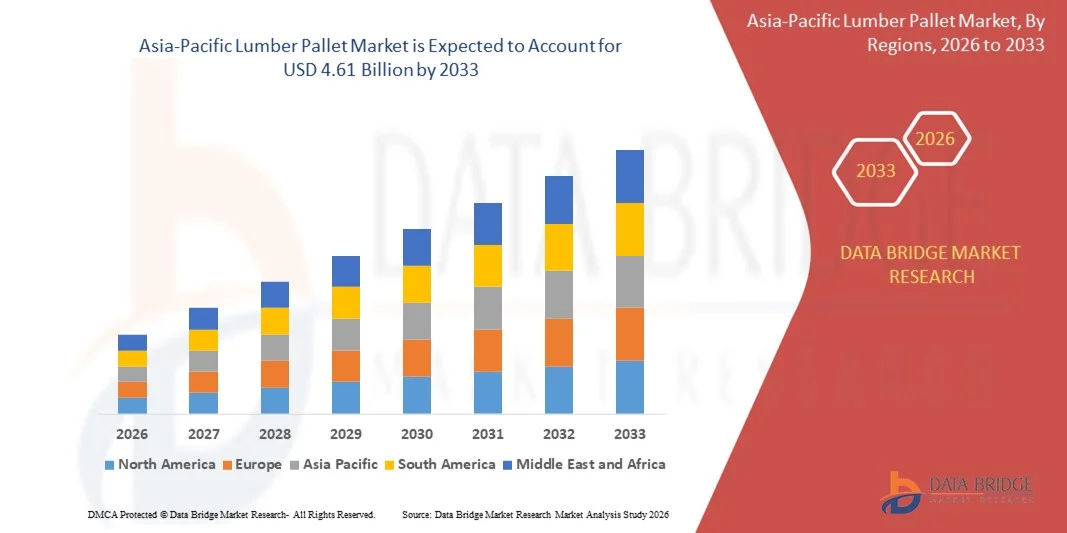
- As per Data Bridge Market Research Analysis, the Asia-Pacific lumber pallet market size was valued at USD 2.89 billion in 2025 and is expected to reach USD 4.61 billion by 2033, at a CAGR of 6.0% during the forecast period
- The market growth is largely driven by the steady expansion of global trade, warehousing, and logistics activities, which continues to increase demand for reliable and cost-effective material handling solutions across multiple industries
- Furthermore, rising pallet usage in food & beverages, retail, and manufacturing for safe storage and transportation of goods is strengthening market demand. These combined factors are supporting consistent consumption of lumber pallets and positively influencing overall market growth
Market Size & Forecast
- Asia-Pacific Market Value (2025): USD 2.89 billion in 2025
- Expected Market Value (2033): USD 4.61 billion by 2033
- Forecast CAGR (2026–2033): 6.0%
Asia-Pacific Lumber Pallet Market Analysis
- Lumber pallets, serving as essential load-bearing platforms for storage and transportation, remain critical to supply chain operations across domestic and international logistics due to their durability, reusability, and compatibility with standard handling equipment
- The increasing need for efficient bulk handling, growing emphasis on standardized packaging, and continuous movement of goods across industrial supply chains are collectively sustaining demand for lumber pallets and reinforcing their importance within the global logistics ecosystem
- China dominated the lumber pallet market in 2025, due to its vast manufacturing base, high export volumes, and extensive domestic logistics and warehousing networks supporting industrial and consumer goods distribution
- India is expected to be the fastest growing country in the lumber pallet market during the forecast period due to rapid expansion of manufacturing, retail, and e-commerce sectors along with significant growth in organized warehousing
- Stringer lumber pallets segment dominated the market with a market share of 58.5% in 2025, due to their low cost, simple construction, and wide use in warehousing and domestic logistics. These pallets are easy to repair and suitable for high-volume shipping with moderate load requirements. Their lightweight nature supports efficient handling and transportation. Standardized designs further enhance operational efficiency. Strong availability of softwood raw materials supports large-scale production. This sustained demand secures their leading market position
Report Scope and Lumber Pallet Market Segmentation
|
Attributes |
Lumber Pallet Key Market Insights |
|
Segments Covered |
|
|
Countries Covered |
Asia-Pacific
|
|
Key Market Players |
|
|
Market Opportunities |
|
|
Value Added Data Infosets |
In addition to the insights on market scenarios such as market value, growth rate, segmentation, geographical coverage, and major players, the market reports curated by the Data Bridge Market Research also include import export analysis, production capacity overview, production consumption analysis, price trend analysis, climate change scenario, supply chain analysis, value chain analysis, raw material/consumables overview, vendor selection criteria, PESTLE Analysis, Porter Analysis, and regulatory framework. |
What is the Key Trend in the Asia-Pacific Lumber Pallet Market?
Rising Adoption of Sustainable and Recycled Wood Pallets
- A key trend in the lumber pallet market is the growing adoption of sustainable and recycled wood pallets, driven by increasing environmental regulations and corporate sustainability commitments across global supply chains. Companies are prioritizing pallets manufactured from recycled wood and responsibly sourced lumber to reduce waste generation and carbon footprint associated with logistics operations
- For instance, UFP Industries has expanded its portfolio of pallets manufactured using recycled and reclaimed wood materials, supporting sustainability goals of large retail and food distribution customers. Such initiatives are strengthening circular economy practices within the pallet industry and encouraging wider adoption of eco-friendly pallet solutions
- Major pooling and pallet management companies are actively integrating recycled wood pallets into closed-loop systems to extend pallet life cycles and minimize raw material consumption. This approach supports cost optimization while aligning with sustainability reporting requirements imposed by global brands
- The food and beverage sector is increasingly favoring recycled wood pallets that comply with hygiene and safety standards while meeting sustainability targets. This shift is reinforcing demand for pallets that balance durability, compliance, and environmental responsibility
- Manufacturers are also investing in engineered and composite wood pallet solutions that utilize wood residues and by-products. This trend is improving material efficiency and reducing dependence on virgin lumber resources
- Overall, the rising emphasis on sustainable sourcing, waste reduction, and regulatory compliance is reshaping pallet manufacturing practices. This trend is strengthening the market transition toward environmentally responsible lumber pallet solutions across industries
Asia-Pacific Lumber Pallet Market Dynamics
Driver
Expansion of Global Logistics, Warehousing, and E-Commerce Activities
- The rapid expansion of global logistics networks, warehousing infrastructure, and e-commerce operations is a primary driver of the lumber pallet market, as pallets remain essential for efficient storage and transportation of goods. Increasing movement of consumer goods, industrial products, and raw materials is sustaining high demand for standardized pallet solutions
- For instance, CHEP continues to expand its pallet pooling and logistics services to support large-scale retail and e-commerce supply chains, enabling efficient material handling across distribution centers. This expansion highlights the critical role of pallets in high-throughput logistics environments
- Growth in organized retail and third-party logistics providers is further driving pallet consumption, as centralized warehouses rely heavily on pallets for inventory management and order fulfillment. This dependence supports consistent pallet usage across domestic and cross-border trade
- Manufacturing industries are also scaling production and distribution capacities, increasing the need for reliable load carriers that can withstand repeated handling. Lumber pallets offer durability and compatibility with automated handling systems, supporting their widespread adoption
- Collectively, the expansion of logistics, warehousing, and e-commerce infrastructure is reinforcing the fundamental role of lumber pallets within global supply chains and driving sustained market growth
Restraint/Challenge
Volatility in Lumber Prices and Raw Material Availability
- The lumber pallet market faces significant challenges due to volatility in lumber prices and fluctuations in raw material availability, which directly impact production costs and profit margins. Changes in timber supply, regulatory restrictions, and market demand create uncertainty for pallet manufacturers
- For instance, companies such as Greif have experienced cost pressures linked to fluctuating lumber prices, requiring pricing adjustments and operational efficiency measures to maintain margins. These cost variations make long-term pricing agreements with customers more complex
- Manufacturers must also manage rising competition for lumber from construction and furniture industries, which intensifies raw material procurement challenges. This competition places additional pressure on sourcing strategies
- Efforts to mitigate price volatility through recycled wood and composite pallet solutions require investment in new processing capabilities, adding to capital expenditure burdens. Balancing cost control with sustainability initiatives remains complex
- Overall, lumber price instability and raw material supply challenges continue to restrain market flexibility. These factors compel manufacturers to optimize sourcing, diversify materials, and adjust pricing strategies to sustain operations in a fluctuating cost environment
Asia-Pacific Lumber Pallet Market Scope
The market is segmented on the basis of product type, wood type, size, distribution channel, and end-user
- By Product Type
On the basis of product type, the lumber pallet market is segmented into stringer lumber pallets, block lumber pallets, double face pallets, double wing pallets, and others. The stringer lumber pallets segment dominated the market with the largest share of 58.5% in 2025 due to their low cost, simple construction, and wide use in warehousing and domestic logistics. These pallets are easy to repair and suitable for high-volume shipping with moderate load requirements. Their lightweight nature supports efficient handling and transportation. Standardized designs further enhance operational efficiency. Strong availability of softwood raw materials supports large-scale production. This sustained demand secures their leading market position.
The block lumber pallets segment is expected to witness the fastest growth from 2026 to 2033, driven by increasing demand for heavy-load and export applications. Block pallets offer four-way entry, improving material handling in automated warehouses. Their higher strength and stability suit international shipping needs. Rising use in pharmaceutical and food logistics supports adoption. Growth in warehouse automation further accelerates demand. These factors position block pallets as a key growth segment.
- By Wood Type
On the basis of wood type, the lumber pallet market is segmented into softwood and hardwood. The softwood segment dominated the market in 2025, supported by lower costs, lighter weight, and easy availability. Softwood pallets enable faster production and are widely used in retail and FMCG logistics. Their adequate load-bearing capacity meets most standard applications. Sustainability certifications further encourage adoption. High replacement cycles drive consistent demand. These factors maintain segment dominance.
The hardwood segment is projected to grow at the fastest rate during the forecast period, driven by demand for durable and long-lasting pallets. Hardwood offers higher strength and impact resistance for heavy industries. Longer service life reduces overall replacement costs. Growth in export-oriented shipments supports adoption. Automotive and industrial sectors increasingly prefer hardwood pallets. This drives faster growth for the segment.
- By Size
On the basis of size, the lumber pallet market is segmented into 800 x 1200 mm, 1000 x 1200 mm, 800 x 600 mm, 914 x 914 mm, 1118 x 1118 mm, 1200 x 1000 mm, and others. The 1200 x 1000 mm segment dominated the market in 2025 due to its compatibility with global shipping and container standards. This size supports efficient space utilization across warehouses and transport systems. It is widely used in food, beverage, and retail distribution. Standardization reduces handling complexity. High regional acceptance drives volume demand. These factors support its leading share.
The 800 x 1200 mm segment is expected to register the fastest growth from 2026 to 2033, driven by rising European trade and cross-border logistics. Alignment with Euro pallet standards enables smooth integration. Growth in organized retail and e-commerce boosts demand. Efficient load distribution improves safety. Expanding exports support adoption. This positions the segment for strong growth.
- By Distribution Channel
On the basis of distribution channel, the lumber pallet market is segmented into offline and online. The offline segment held the largest share in 2025, supported by established supplier relationships and bulk purchasing practices. Offline sourcing enables customization and quality inspection. Large manufacturers prefer direct procurement for supply reliability. Immediate availability supports uninterrupted operations. Long-term contracts stabilize pricing. These factors sustain offline dominance.
The online segment is expected to grow at the fastest rate during the forecast period, driven by digital procurement and B2B e-commerce expansion. Online platforms offer transparent pricing and wider supplier access. SMEs increasingly adopt digital sourcing to save time. Improved logistics reliability supports confidence. Supply chain digitalization accelerates adoption. This fuels rapid online growth.
- By End-User
On the basis of end-user, the lumber pallet market is segmented into food & beverages, pharmaceuticals, chemicals, retail, automotive, and others. The food & beverages segment dominated the market in 2025 due to high-volume movement of packaged and perishable goods. Pallets are critical for storage and transportation across cold chains. Continuous demand from processing and distribution centers supports volumes. Compliance with hygiene standards drives frequent replacement. Strong retail consumption sustains usage. These factors reinforce market leadership.
The pharmaceuticals segment is anticipated to grow at the fastest rate from 2026 to 2033, driven by expanding healthcare manufacturing and global drug distribution. Regulated supply chains require standardized and durable pallets. Growth in temperature-controlled logistics supports demand. Rising exports of medical products further boost adoption. Emphasis on safe handling accelerates usage. This positions pharmaceuticals as the fastest-growing end-user segment.
Which Region Holds the Largest Share of the Asia-Pacific Lumber Pallet Market?
- China dominated the lumber pallet market with the largest revenue share in 2025, driven by its vast manufacturing base, high export volumes, and extensive domestic logistics and warehousing networks supporting industrial and consumer goods distribution
- Strong growth in e-commerce, expanding third-party logistics services, and continuous movement of goods across ports and inland transportation systems reinforce China’s leadership in pallet demand across multiple industries
- The presence of large domestic pallet manufacturers, widespread pallet recycling operations, and strong adoption by food & beverages, retail, and manufacturing sectors continue to consolidate China’s dominant position. Ongoing investments in smart logistics parks and standardized material handling solutions further strengthen market penetration across industrial clusters
Japan Lumber Pallet Market Insight
The Japan lumber pallet market is anticipated to grow steadily from 2026 to 2033, supported by its highly organized logistics infrastructure and strong emphasis on efficiency and quality standards. Japanese manufacturers and distributors rely on durable and standardized pallets to support just-in-time manufacturing and automated warehouse operations. Rising demand from food processing, pharmaceuticals, and electronics industries is sustaining consistent pallet usage. Continuous improvements in pallet reuse systems and logistics optimization reinforce stable market growth. Japan’s focus on operational precision and supply chain reliability underpins its steady regional positioning.
India Lumber Pallet Market Insight
India is projected to register the fastest CAGR in the Asia Pacific lumber pallet market during 2026–2033, fueled by rapid expansion of manufacturing, retail, and e-commerce sectors along with significant growth in organized warehousing. Increasing adoption of palletized transportation in food & beverages, pharmaceuticals, and automotive supply chains is accelerating market demand. Investments in logistics parks, cold chain infrastructure, and third-party logistics services are improving pallet penetration across regions. Rising exports and growing emphasis on supply chain standardization further support adoption. These factors position India as the fastest-growing lumber pallet market in the Asia Pacific region.
Which are the Top Companies in Asia-Pacific Lumber Pallet Market?
The lumber pallet industry is primarily led by well-established companies, including:
- Greif (U.S.)
- UFP Industries, Inc. (U.S.)
- PALLETBIZ (Germany)
- PGS Group (France)
- UAB Vigidas Pack (Lithuania)
- LOSCAM (Australia)
- JGD Pallets (U.K.)
- Palcon LLC (U.S.)
- Falkenhahn AG (Germany)
- Conquest Joinery (U.K.)
- SandS Box and Pallet Manufacturers (U.S.)
- Imperial Timber (U.K.)
- HG Timber Ltd. (U.K.)
- Johannesburg Timber and Box (South Africa)
- Premier Pallets, Inc. (U.S.)
- Rowlinsons Packaging Ltd. (U.K.)
- Christies Industries (U.K.)
What are the Recent Developments in Asia-Pacific Lumber Pallet Market?
- In July 2024, WestRock expanded its sustainable packaging portfolio by increasing production capacity for wood-based pallets integrated with recycled fiber content, strengthening its position in eco-conscious logistics solutions. This development supports rising demand from retail and food supply chains seeking lower environmental impact, while reinforcing competition around sustainable pallet offerings and influencing purchasing decisions among large-volume buyers
- In September 2023, CHEP expanded its Asian footprint by opening a new distribution center in Vietnam, enhancing its ability to serve the fast-growing Southeast Asian logistics market. This move improves regional pallet availability and reduces transportation lead times, allowing CHEP to strengthen customer relationships and gain competitive advantage in a high-growth logistics hub
- In August 2023, UFP Industries announced the launch of a new range of eco-friendly pallets manufactured from recycled materials, directly addressing increasing sustainability requirements across industrial supply chains. This initiative positions the company as a leader in environmentally responsible pallet solutions, helping attract sustainability-focused clients and supporting long-term market share expansion
- In July 2023, Kamps Pallets entered into a strategic partnership with a major logistics provider to enhance supply chain efficiency and delivery performance. This collaboration improves service reliability and turnaround times, which are critical differentiators in the lumber pallet market, thereby supporting stronger customer retention and deeper market penetration
- In September 2022, ArbaBlox invested USD 51.34 million in a pallet block manufacturing facility in Winona, Mississippi, marking its first large-scale composite pallet block operation. By utilizing sawmill residuals, the project strengthens sustainable pallet material supply while supporting food service and industrial demand. Backed by state and local authorities, the facility enhances regional manufacturing capacity, supports job creation, and reinforces the shift toward engineered and composite wood pallet solutions in the market

- Interactive Data Analysis Dashboard
- Company Analysis Dashboard for high growth potential opportunities
- Research Analyst Access for customization & queries
- Competitor Analysis with Interactive dashboard
- Latest News, Updates & Trend analysis
- Harness the Power of Benchmark Analysis for Comprehensive Competitor Tracking
Asia Pacific Lumber Pallet Market, Supply Chain Analysis and Ecosystem Framework
To support market growth and help clients navigate the impact of geopolitical shifts, DBMR has integrated in-depth supply chain analysis into its Asia Pacific Lumber Pallet Market research reports. This addition empowers clients to respond effectively to global changes affecting their industries. The supply chain analysis section includes detailed insights such as Asia Pacific Lumber Pallet Market consumption and production by country, price trend analysis, the impact of tariffs and geopolitical developments, and import and export trends by country and HSN code. It also highlights major suppliers with data on production capacity and company profiles, as well as key importers and exporters. In addition to research, DBMR offers specialized supply chain consulting services backed by over a decade of experience, providing solutions like supplier discovery, supplier risk assessment, price trend analysis, impact evaluation of inflation and trade route changes, and comprehensive market trend analysis.
Data collection and base year analysis are done using data collection modules with large sample sizes. The stage includes obtaining market information or related data through various sources and strategies. It includes examining and planning all the data acquired from the past in advance. It likewise envelops the examination of information inconsistencies seen across different information sources. The market data is analysed and estimated using market statistical and coherent models. Also, market share analysis and key trend analysis are the major success factors in the market report. To know more, please request an analyst call or drop down your inquiry.
The key research methodology used by DBMR research team is data triangulation which involves data mining, analysis of the impact of data variables on the market and primary (industry expert) validation. Data models include Vendor Positioning Grid, Market Time Line Analysis, Market Overview and Guide, Company Positioning Grid, Patent Analysis, Pricing Analysis, Company Market Share Analysis, Standards of Measurement, Global versus Regional and Vendor Share Analysis. To know more about the research methodology, drop in an inquiry to speak to our industry experts.
Data Bridge Market Research is a leader in advanced formative research. We take pride in servicing our existing and new customers with data and analysis that match and suits their goal. The report can be customized to include price trend analysis of target brands understanding the market for additional countries (ask for the list of countries), clinical trial results data, literature review, refurbished market and product base analysis. Market analysis of target competitors can be analyzed from technology-based analysis to market portfolio strategies. We can add as many competitors that you require data about in the format and data style you are looking for. Our team of analysts can also provide you data in crude raw excel files pivot tables (Fact book) or can assist you in creating presentations from the data sets available in the report.













