


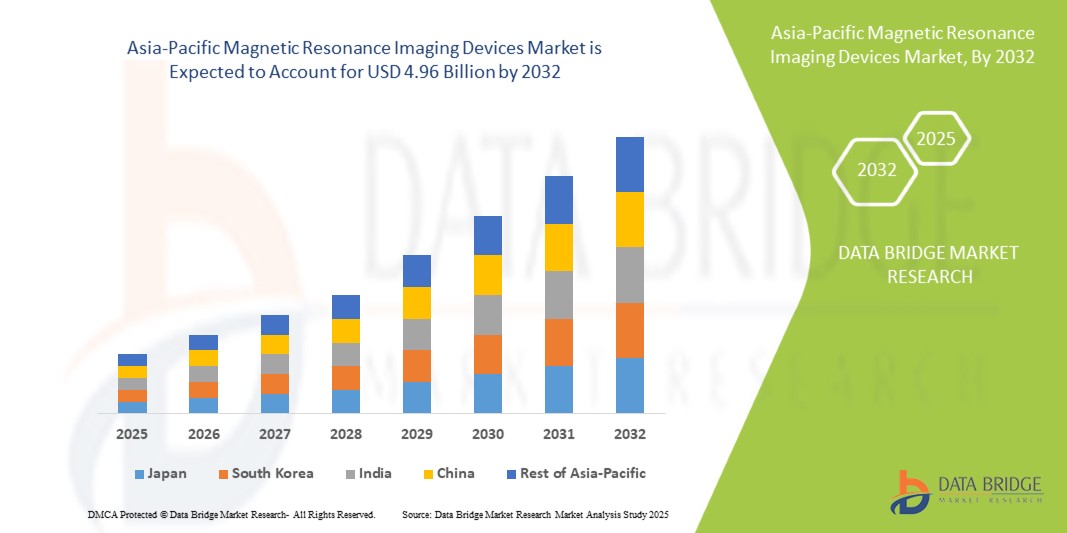
Asia-Pacific Magnetic Resonance Imaging Devices Market Size
- The global Asia-Pacific magnetic resonance imaging devices market size was valued at USD 3.79 billion in 2024 and is expected to reach USD 4.96 billion by 2032, at a CAGR of 3.41% during the forecast period
- This growth is driven by factors such as the increasing healthcare infrastructure investments, rising prevalence of chronic diseases, and growing aging population.
Asia-Pacific Magnetic Resonance Imaging Devices Market Analysis
- Magnetic resonance imaging (MRI) devices are essential diagnostic tools used to capture high-resolution images of the internal structures of the body, including the brain, spinal cord, muscles, and joints. They are critical for detecting a variety of conditions such as neurological disorders, cardiovascular diseases, and cancers
- The demand for MRI devices in the Asia-Pacific region is significantly driven by the rising prevalence of chronic diseases, an aging population, and increasing healthcare investments. In addition, advancements in MRI technology, such as the development of higher-field MRI systems and portable MRI devices, are further contributing to the market's growth
- China is expected to dominate the Asia-Pacific magnetic resonance imaging devices market with 19.98% of the market share in 2024, driven by a combination of factors, including a high prevalence of chronic diseases such as cancer and cardiovascular conditions, which affect hundreds of millions of people across the country
- India is expected to be the fastest growing region with CAGR of 11.91% in the Asia-Pacific magnetic resonance imaging devices market, driven by the rapid expansion of healthcare infrastructure, increasing awareness about early disease diagnosis, and a growing number of MRI procedures. The country’s large and aging population, coupled with the rising burden of chronic illnesses, is boosting the demand for advanced diagnostic technologies such as MRI
- The closed MRI systems segment is expected to dominate the Asia-Pacific magnetic resonance imaging devices market with the largest share of over 75.57% in 2024 due to its ability to deliver stronger magnetic fields and higher-resolution imaging. As the preferred choice for detailed diagnostics, the enclosed design of closed MRI systems enhances image quality and diagnostic accuracy, driving their widespread adoption
Report Scope and Asia-Pacific Magnetic Resonance Imaging Devices Market Segmentation
|
Attributes |
Asia-Pacific Magnetic Resonance Imaging Devices Market Insights |
|
Segments Covered |
|
|
Countries Covered |
Asia-Pacific
|
|
Key Market Players |
|
|
Market Opportunities |
|
|
Value Added Data Infosets |
In addition to the insights on market scenarios such as market value, growth rate, segmentation, geographical coverage, and major players, the market reports curated by the Data Bridge Market Research also include import export analysis, production capacity overview, production consumption analysis, price trend analysis, climate change scenario, supply chain analysis, value chain analysis, raw material/consumables overview, vendor selection criteria, PESTLE Analysis, Porter Analysis, and regulatory framework. |
Asia-Pacific Magnetic Resonance Imaging Devices Market Trends
“Advancements in MRI Technology & Integration with Artificial Intelligence in Diagnostics”
- One prominent trend in the evolution of MRI devices in the Asia-Pacific market is the increasing integration of artificial intelligence (AI) and machine learning (ML) technologies with MRI systems
- These innovations enhance diagnostic precision by enabling faster image processing, improved image quality, and more accurate disease detection, especially in complex conditions such as cancer, neurological disorders, and cardiovascular diseases
- For instance, AI-based algorithms can automatically analyze MRI images, helping radiologists detect anomalies such as tumors or lesions with greater efficiency and accuracy, reducing human error
- These advancements are transforming the way medical professionals approach diagnostics, improving patient outcomes, and driving the demand for more sophisticated and efficient MRI systems with AI-powered features
Asia-Pacific Magnetic Resonance Imaging Devices Market Dynamics
Driver
“Growing Demand Due to Rising Incidence of Chronic Diseases”
- The increasing prevalence of chronic diseases such as cancer, neurological disorders, and cardiovascular diseases is significantly driving the demand for MRI devices in the Asia-Pacific region
- As the region’s population ages and lifestyle-related diseases become more common, the need for advanced diagnostic tools such as MRI devices rises, as they are crucial for accurate and early detection of these conditions
- MRI’s ability to provide detailed and non-invasive imaging makes it indispensable for diagnosing and monitoring chronic conditions
For instance,
- In January 2024, the World Health Organization (WHO) reported that cancer rates in the Asia-Pacific region are expected to rise by 30% by 2030, further emphasizing the need for advanced imaging techniques such as MRI for early detection and treatment planning
- As a result, the demand for MRI systems is projected to continue increasing, driven by the need for high-resolution imaging and early disease detection
Opportunity
“Technological Advancements and Integration with Artificial Intelligence”
- The integration of artificial intelligence (AI) in MRI systems is creating substantial growth opportunities. AI-powered MRI devices can enhance image quality, automate analysis, and speed up diagnostic workflows, making them more efficient and accurate
- AI algorithms can help in image analysis by detecting abnormalities such as tumors, lesions, or vascular blockages with higher precision, improving diagnostic accuracy and helping doctors make better-informed decisions
For instance,
- In December 2024, a study published by the Asia-Pacific Radiology Society highlighted that AI algorithms could reduce MRI scan interpretation time by up to 40%, allowing for quicker diagnoses and enabling healthcare facilities to handle larger patient volumes
- The adoption of AI-powered MRI systems in hospitals and clinics could lead to faster diagnosis, better patient outcomes, and improved operational efficiency, presenting a major opportunity for growth in the market
Restraint/Challenge
“High Cost and Limited Accessibility in Developing Regions”
- The high upfront cost of MRI devices is a significant barrier to adoption, especially in developing regions of Asia-Pacific. These devices can cost millions of dollars, making them unaffordable for smaller healthcare facilities, particularly in rural or underserved areas
- The maintenance and operational costs of MRI systems, including specialized staff training, add to the financial burden, limiting their availability and accessibility
For instance,
- According to a report by the National Health Service of India in August 2024, the cost of purchasing and maintaining an MRI machine is one of the primary reasons many small hospitals in rural India lack access to advanced imaging systems. This limits their ability to provide timely diagnoses, contributing to disparities in healthcare access
- Consequently, the high cost of MRI systems poses a challenge to widespread market penetration in developing countries, hindering the overall growth potential of the MRI market in the Asia-Pacific region
Asia-Pacific Magnetic Resonance Imaging Devices Market Scope
The market is segmented on the basis of field strength, type, modality, indication, end user and distribution channel.
|
Segmentation |
Sub-Segmentation |
|
By Field Strength |
|
|
By Type |
|
|
By Modality |
|
|
By Indication
|
|
|
By End User |
|
|
By Distribution Channel |
|
In 2025, the closed MRI systems is projected to dominate the market with a largest share in type segment
The closed MRI systems segment is expected to dominate the Asia-Pacific magnetic resonance imaging devices market with the largest share of over 75.57% in 2024 due to its ability to deliver stronger magnetic fields and higher-resolution imaging. As the preferred choice for detailed diagnostics, the enclosed design of closed MRI systems enhances image quality and diagnostic accuracy, driving their widespread adoption. Advancements in MRI technology and the growing demand for precise, reliable imaging in clinical settings further contribute to the segment’s market dominance.
The mid-field MRI systems is expected to account for the largest share during the forecast period in field strength market
In 2025, the mid-field MRI systems segment is expected to dominate the Asia-Pacific magnetic resonance imaging devices market with the largest market share of 47.70% due to its optimal balance between image quality and cost-effectiveness. As a preferred choice for both clinical and diagnostic applications, mid-field MRI systems (typically operating between 1.5T and 3T) provide reliable imaging performance at a more accessible cost. Advancements in MRI technology, coupled with increasing healthcare investments and demand for affordable diagnostic solutions, further contribute to the segment’s market dominance.
Asia-Pacific Magnetic Resonance Imaging Devices Market Regional Analysis
“Asia-Pacific Holds the Largest Share in the Magnetic Resonance Imaging Devices Market”
- Asia-Pacific dominates the magnetic resonance imaging devices market, driven by rapid advancements in imaging technologies, increasing healthcare investments, and the growing demand for early and accurate diagnostic solutions.
- Countries such as China, Japan, and India hold significant shares, with Japan leading in the adoption of cutting-edge MRI technologies due to its advanced healthcare infrastructure and a high rate of integration of innovative imaging solutions by medical professionals
- The rising prevalence of chronic diseases such as cancer, neurological disorders, and cardiovascular conditions, combined with the increasing need for high-precision diagnostic imaging, further strengthens the market across the region. In addition, government initiatives to improve healthcare access and the rising number of MRI installations in both urban and rural healthcare facilities are contributing significantly to market growth
- India is projected to register the highest CAGR of 11.91% in the magnetic resonance imaging devices market in Asia-Pacific, driven by the rapid expansion of healthcare infrastructure, increasing awareness about early disease diagnosis, and a growing number of MRI procedures. The country’s large and aging population, coupled with the rising burden of chronic illnesses, is boosting the demand for advanced diagnostic technologies such as MRI
- China is anticipated to dominate the Asia-Pacific magnetic resonance imaging devices Market over the coming years. As of 2024, China held the largest revenue share in the Asia-Pacific medical imaging market, accounting for 19.98% of the market, driven by a combination of factors, including a high prevalence of chronic diseases such as cancer and cardiovascular conditions, which affect hundreds of millions of people across the country
Asia-Pacific Magnetic Resonance Imaging Devices Market Share
The market competitive landscape provides details by competitor. Details included are company overview, company financials, revenue generated, market potential, investment in research and development, new market initiatives, global presence, production sites and facilities, production capacities, company strengths and weaknesses, product launch, product width and breadth, application dominance. The above data points provided are only related to the companies' focus related to market.
The Major Market Leaders Operating in the Market Are:
- CANON MEDICAL SYSTEMS CORPORATION (Japan)
- Hitachi, Ltd. (Japan)
- Neusoft Corporation (China)
- AllTech Medical Systems, LLC (China)
- Shanghai United Imaging Healthcare Co., LTD (China)
- United Imaging Intelligence (China)
- Medonica Co. LTD (China)
- SGHealthCare (China)
- BJ wandong (China)
- Sysmex Corporation (Japan)
- JEOL Ltd. (Japan)
- Shimadzu Corporation (Japan)
- Shenzhen Mindray Bio-Medical Electronics Co., Ltd. (China)
- Samsung Medicine Co., Ltd. (South Korea)
Latest Developments in Global Asia-Pacific Magnetic Resonance Imaging Devices Market
- In February 2025, Siemens Healthineers announced the launch of its Magnetom Viato.Mobile MRI system in Asia-Pacific markets. Designed to expand access to high-quality imaging in remote and underserved regions, the system offers a 1.5T magnet in a mobile unit with advanced AI-powered imaging software for faster and more accurate diagnoses. The mobile platform aims to bridge the gap in healthcare accessibility across rural and suburban areas in countries such as India, China, and Southeast Asia
- In January 2025, Philips introduced its new BlueSeal MR Mobile system in select Asia-Pacific countries, featuring the world’s first helium-free, fully sealed MRI technology. This innovation addresses the rising concerns about helium scarcity and sustainability while offering excellent imaging performance, low operating costs, and increased environmental friendliness, making it ideal for healthcare providers across Asia-Pacific
- In October 2024, GE HealthCare showcased its SIGNA Victor 1.5T MRI system at the Asian Oceanian Congress of Radiology (AOCR 2024) held in Tokyo, Japan. The system features advanced AI integration, a 70cm wide bore for enhanced patient comfort, and optimized imaging sequences for faster exams. These developments aim to enhance clinical efficiency and improve patient throughput in the region’s rapidly growing diagnostic imaging sector
- In September 2024, Canon Medical Systems Corporation unveiled the Vantage Fortian 1.5T MRI system in Asia-Pacific markets, highlighting its advancements in workflow automation, patient comfort, and high-resolution imaging. With its Eco Mode for energy saving and new Pianissimo Zen technology to significantly reduce noise during scans, the system is designed to meet the increasing demand for patient-friendly and sustainable MRI solutions across the Asia-Pacific region

- Interactive Data Analysis Dashboard
- Company Analysis Dashboard for high growth potential opportunities
- Research Analyst Access for customization & queries
- Competitor Analysis with Interactive dashboard
- Latest News, Updates & Trend analysis
- Harness the Power of Benchmark Analysis for Comprehensive Competitor Tracking
Data collection and base year analysis are done using data collection modules with large sample sizes. The stage includes obtaining market information or related data through various sources and strategies. It includes examining and planning all the data acquired from the past in advance. It likewise envelops the examination of information inconsistencies seen across different information sources. The market data is analysed and estimated using market statistical and coherent models. Also, market share analysis and key trend analysis are the major success factors in the market report. To know more, please request an analyst call or drop down your inquiry.
The key research methodology used by DBMR research team is data triangulation which involves data mining, analysis of the impact of data variables on the market and primary (industry expert) validation. Data models include Vendor Positioning Grid, Market Time Line Analysis, Market Overview and Guide, Company Positioning Grid, Patent Analysis, Pricing Analysis, Company Market Share Analysis, Standards of Measurement, Global versus Regional and Vendor Share Analysis. To know more about the research methodology, drop in an inquiry to speak to our industry experts.
Data Bridge Market Research is a leader in advanced formative research. We take pride in servicing our existing and new customers with data and analysis that match and suits their goal. The report can be customized to include price trend analysis of target brands understanding the market for additional countries (ask for the list of countries), clinical trial results data, literature review, refurbished market and product base analysis. Market analysis of target competitors can be analyzed from technology-based analysis to market portfolio strategies. We can add as many competitors that you require data about in the format and data style you are looking for. Our team of analysts can also provide you data in crude raw excel files pivot tables (Fact book) or can assist you in creating presentations from the data sets available in the report.













