


Asia-Pacific Mass Spectrometry Devices Market Size
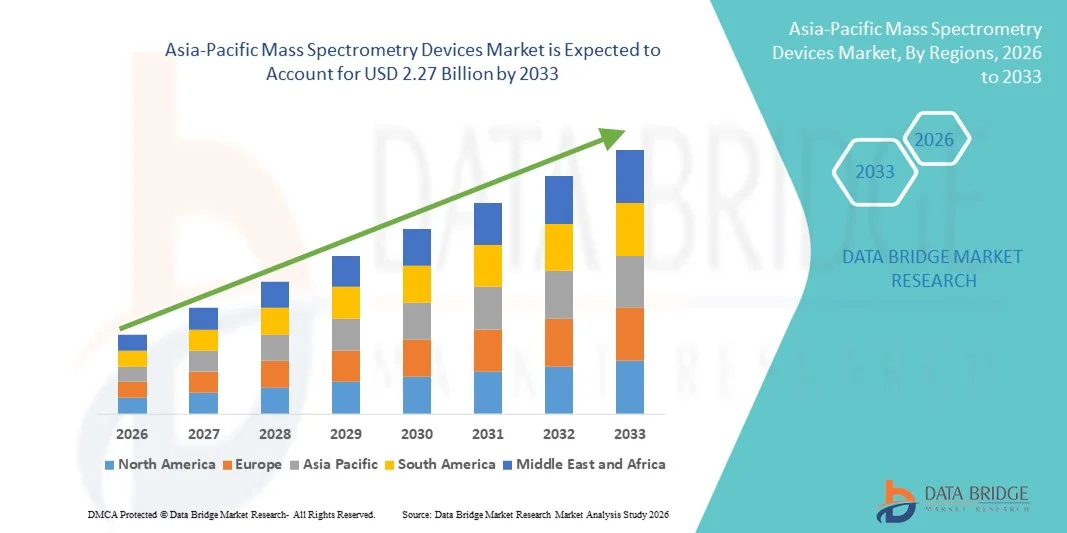
- The Asia-Pacific mass spectrometry devices market size was valued at USD 1.41 billion in 2025 and is expected to reach USD 2.27 billion by 2033, at a CAGR of 6.19% during the forecast period
- The market growth is largely fueled by the increasing adoption of advanced analytical technologies across pharmaceutical, biotechnology, clinical, and environmental laboratories, along with continuous technological advancements in mass spectrometry devices that enable higher sensitivity, accuracy, and throughput
- Furthermore, rising demand for precise molecular analysis, growing applications in proteomics, metabolomics, drug discovery, and clinical diagnostics, as well as the need for high-throughput and automated analytical solutions, are establishing mass spectrometry devices as essential tools in modern laboratory workflows. These converging factors are accelerating the uptake of Mass Spectrometry Devices solutions, thereby significantly boosting the industry’s growth
Asia-Pacific Mass Spectrometry Devices Market Analysis
- Mass spectrometry devices, including LC-MS, GC-MS, MALDI-TOF, and ICP-MS systems, are increasingly vital in modern laboratories due to their high sensitivity, precision, and ability to perform complex molecular, proteomic, metabolomic, and clinical analyses across pharmaceuticals, biotechnology, environmental, and clinical diagnostics
- The escalating demand for mass spectrometry devices is primarily fueled by growing applications in drug discovery, clinical diagnostics, food safety, and environmental monitoring, along with the need for rapid, high-throughput, and automated analytical solutions in research and industrial laboratories
- China dominated the mass spectrometry devices market with the largest revenue share of 38.4% in 2025, driven by rapid expansion of pharmaceutical and biotechnology industries, increasing laboratory infrastructure investments, and adoption of advanced analytical technologies in research and clinical laboratories
- India is expected to be the fastest-growing region in the mass spectrometry devices market during the forecast period, expanding at a CAGR of 11.2% from 2026 to 2033, supported by growing research and development activities, government initiatives to strengthen analytical capabilities, and increasing demand from pharmaceutical, clinical, and food testing laboratories
- The Hybrid Mass Spectrometry segment dominated the largest market revenue share of 44.5% in 2025, driven by its versatility in combining multiple mass analyzers to deliver high-resolution, accurate mass measurements across complex sample types
Report Scope and Mass Spectrometry Devices Market Segmentation
|
Attributes |
Mass Spectrometry Devices Key Market Insights |
|
Segments Covered |
|
|
Countries Covered |
Asia-Pacific
|
|
Key Market Players |
|
|
Market Opportunities |
|
|
Value Added Data Infosets |
In addition to the insights on market scenarios such as market value, growth rate, segmentation, geographical coverage, and major players, the market reports curated by the Data Bridge Market Research also include in-depth expert analysis, patient epidemiology, pipeline analysis, pricing analysis, and regulatory framework. |
Asia-Pacific Mass Spectrometry Devices Market Trends
Enhanced Analytical Precision and High-Throughput Capabilities
- A significant and accelerating trend in the global mass spectrometry devices market is the growing adoption of high-resolution, high-throughput instruments in pharmaceutical, clinical, and research laboratories. These devices allow researchers to analyze complex biological and chemical samples with exceptional accuracy, enabling precise quantification and identification of molecules at very low concentrations
- For instance, in March 2024, Thermo Fisher Scientific launched its Orbitrap Exploris 480 mass spectrometer, offering ultra-high resolution proteomics and enhanced sensitivity, supporting drug discovery, biomarker analysis, and clinical diagnostics
- Increasing integration of mass spectrometry with complementary technologies, such as liquid chromatography (LC-MS) and gas chromatography (GC-MS), is expanding analytical capabilities and improving workflow efficiency in laboratories
- There is a growing trend toward miniaturization and benchtop mass spectrometry systems, allowing laboratories with limited space and budgets to adopt advanced analytical solutions without sacrificing performance
- The rise of automated sample preparation, robotic handling systems, and cloud-based data analysis platforms is further accelerating the demand for mass spectrometry instruments by enabling higher throughput and faster turnaround times for large-scale studies
Asia-Pacific Mass Spectrometry Devices Market Dynamics
Driver
Rising Demand in Pharmaceutical and Clinical Research
- The increasing need for precise molecular characterization in drug development, proteomics, metabolomics, and biomarker discovery is driving the adoption of mass spectrometry devices. Laboratories are investing in advanced instruments to improve the reliability, speed, and reproducibility of results
- For instance, in July 2023, Bruker Corporation launched the timsTOF Pro 2 system for proteomics research, enabling faster protein profiling with high sensitivity, which has been widely adopted in pharmaceutical R&D and clinical laboratories globally
- Rising investment in healthcare infrastructure and R&D expenditure in both developed and emerging markets is supporting the deployment of advanced mass spectrometry platforms in hospitals, academic institutions, and research centers
- The growing prevalence of chronic and complex diseases, including cancer, cardiovascular disorders, and metabolic conditions, is increasing the demand for mass spectrometry-based diagnostic and therapeutic solutions
- Expansion of regulatory frameworks and quality control requirements in pharmaceutical manufacturing is encouraging laboratories to implement high-precision mass spectrometry instruments to ensure compliance with stringent standards
Restraint/Challenge
High Costs and Operational Complexity
- The high initial cost of mass spectrometry instruments, including purchase price, installation, and maintenance, continues to be a major barrier to adoption, particularly for smaller laboratories and institutions in developing regions
- For instance, the Orbitrap Fusion Lumos Tribrid system costs several hundred thousand dollars and requires specialized training, calibration, and dedicated technical personnel for proper operation, limiting accessibility in resource-constrained settings
- Operational complexity and the need for trained staff to handle sample preparation, method development, and data interpretation further restrict widespread adoption
- Ongoing expenses, including consumables, software upgrades, and regular maintenance, contribute to the total cost of ownership, which may deter budget-conscious institutions from investing in advanced systems
- Variations in infrastructure and laboratory capabilities across regions make it challenging to implement mass spectrometry devices uniformly, highlighting the need for simplified, cost-effective, and user-friendly systems to broaden market reach
Asia-Pacific Mass Spectrometry Devices Market Scope
The market is segmented on the basis of technology, application and end user.
- By Technology
On the basis of technology, the Mass Spectrometry Devices market is segmented into Hybrid Mass Spectrometry, Single Mass Spectrometry, and Others. The Hybrid Mass Spectrometry segment dominated the largest market revenue share of 44.5% in 2025, driven by its versatility in combining multiple mass analyzers to deliver high-resolution, accurate mass measurements across complex sample types. This technology is widely preferred in clinical research, metabolomics, and pharmaceutical analysis due to its enhanced sensitivity and precision. Its ability to handle a wide dynamic range and compatibility with advanced separation techniques like LC and GC enhances its adoption. Hybrid systems also facilitate multiplexed analysis, improving laboratory efficiency. Laboratories and research institutes prioritize hybrid systems for high-throughput workflows and comprehensive profiling. The strong presence of leading manufacturers offering innovative hybrid systems further fuels growth. In addition, regulatory acceptance and proven performance in diagnostic and drug discovery applications increase demand. Continuous upgrades and integration with informatics solutions enhance user convenience. The segment’s dominance is supported by rising R&D spending, expanding biotechnology research, and growing investment in proteomics and metabolomics. High reliability, reproducibility, and robust service support also reinforce adoption in key markets.
The Single Mass Spectrometry segment is expected to witness the fastest CAGR of 11.2% from 2026 to 2033, fueled by its cost-effectiveness, simpler operation, and adaptability for targeted applications such as environmental testing, clinical diagnostics, and quality control in pharmaceutical industries. Single MS systems are increasingly favored in emerging markets due to affordability and ease of maintenance. These systems are ideal for labs requiring rapid results with limited resources, supporting routine analysis and smaller-scale research studies. Integration with basic LC and GC workflows allows single MS devices to provide accurate detection at a lower cost, expanding adoption. Growing awareness of mass spectrometry applications in developing countries supports demand growth. Lightweight, portable, and energy-efficient designs further increase appeal. Training and support from manufacturers enable smooth deployment in clinical and academic labs. Rising adoption in small-scale pharmaceutical companies, diagnostics centers, and universities also contributes to market expansion. In addition, government and institutional initiatives promoting analytical research drive uptake. The segment benefits from ongoing innovation in compact instrumentation, reducing operational barriers for end-users.
- By Application
On the basis of application, the Mass Spectrometry Devices market is segmented into Biotechnology, Clinical Research, Diagnostics and Environmental Testing, Drug Discovery, Metabolomics, Pharmaceutical, Proteomics, and Others. The Clinical Research segment dominated the largest market revenue share of 42.8% in 2025, fueled by increasing demand for precision medicine, biomarker discovery, and high-throughput screening. Clinical research laboratories rely on mass spectrometry for quantification of proteins, metabolites, and drug compounds with high accuracy. The integration of MS with separation techniques enables detailed pharmacokinetic and pharmacodynamic studies. Hospitals and research institutions prioritize MS systems for translational research and patient-centered studies. Strong funding for clinical trials in oncology, neurology, and infectious diseases supports growth. The segment benefits from regulatory acceptance for validated analytical methods. Rising collaborations between pharma companies and clinical research organizations further enhance adoption. Increased awareness of personalized medicine, early disease detection, and omics technologies drives the market. High reproducibility, sensitivity, and automation capabilities make MS systems integral to clinical workflows. Ongoing innovation in high-resolution instruments strengthens segment dominance. Expansion of clinical research centers in North America, Europe, and Asia-Pacific further supports market share.
The Drug Discovery segment is expected to witness the fastest CAGR of 10.8% from 2026 to 2033, propelled by the growing need for novel therapeutics, early-stage drug profiling, and high-throughput screening of chemical libraries. Pharmaceutical and biopharmaceutical companies increasingly utilize mass spectrometry to identify lead compounds, study metabolic pathways, and perform structure elucidation. Advanced mass analyzers enable accurate characterization of complex molecules, accelerating drug development timelines. The rise of personalized medicine and biologics fuels demand for MS applications in drug discovery. Cost-effective workflow integration and rapid data acquisition make single and hybrid MS systems suitable for screening laboratories. Investments in research automation and informatics tools further enhance efficiency. Emerging markets with growing pharmaceutical manufacturing capacity are adopting MS systems to streamline discovery pipelines. Regulatory requirements for robust analytical data reinforce market growth. The segment benefits from increasing partnerships between research institutes and pharma companies, strengthening the innovation ecosystem.
- By End-User
On the basis of end-user, the Mass Spectrometry Devices market is segmented into Institutes and Research Centers, Medical, Pharmaceutical and Biopharmaceutical Companies, Suppliers and Distributors of Mass Spectrometry Systems, and Others. The Pharmaceutical and Biopharmaceutical Companies segment dominated the largest market revenue share of 46% in 2025, driven by the increasing adoption of mass spectrometry for drug discovery, formulation, and quality control. These companies leverage MS technology for accurate characterization of drug compounds, protein therapeutics, and small molecules. The growth is further supported by expanding R&D expenditure, stringent regulatory compliance requirements, and the need for faster product development cycles. Pharmaceutical companies prefer hybrid MS systems for high-throughput screening and complex analysis. MS integration with bioinformatics enhances data analysis and accelerates pipeline decisions. Large-scale production, contract research services, and personalized medicine initiatives also boost adoption. Leading pharma players continue to invest in mass spectrometry infrastructure, strengthening market share. Continuous innovation and collaborations with MS vendors enhance capabilities for drug characterization and regulatory reporting.
The Institutes and Research Centers segment is expected to witness the fastest CAGR of 11.5% from 2026 to 2033, fueled by the growing demand for advanced analytical tools in academic research, biotechnology studies, and environmental analysis. These centers prioritize MS systems for teaching, experimentation, and translational research. The increasing establishment of research-focused universities, government-funded labs, and private research institutes expands the potential user base. Rising awareness of omics technologies, metabolomics, and proteomics research drives adoption. Lightweight and modular MS systems enable flexible deployment in multiple lab settings. Collaboration with pharmaceutical and clinical research organizations enhances access to advanced MS technology. Government initiatives promoting science and technology, along with grants for analytical infrastructure, encourage system acquisitions. The segment benefits from the increasing availability of cost-effective MS instruments, training programs, and local technical support.
Asia-Pacific Mass Spectrometry Devices Market Regional Analysis
- The Asia-Pacific mass spectrometry devices market is projected to witness the fastest growth globally during the forecast period of 2026 to 2033, driven by expanding pharmaceutical manufacturing, increasing investments in life sciences research, and rapid modernization of laboratory infrastructure across emerging economies
- Governments across the region are actively strengthening healthcare and research ecosystems through funding initiatives, regulatory reforms, and the establishment of advanced analytical laboratories. Rising demand for high-precision analytical technologies in drug discovery, clinical diagnostics, food safety testing, and environmental analysis is significantly contributing to regional market expansion
- Furthermore, the presence of a strong manufacturing base, improving technical expertise, and growing collaborations between academic institutions and biotechnology firms are accelerating the adoption of advanced mass spectrometry platforms across Asia-Pacific
China Mass Spectrometry Devices Market Insight
China mass spectrometry devices market dominated the Asia-Pacific mass spectrometry devices market with the largest revenue share of 38.4% in 2025, driven by the rapid expansion of its pharmaceutical and biotechnology industries, increasing investments in laboratory infrastructure, and widespread adoption of advanced analytical technologies in research and clinical laboratories. The country has emerged as a global hub for drug development and contract research activities, significantly boosting demand for high-resolution mass spectrometry systems. Strong government support for scientific innovation, expansion of domestic biotechnology companies, and the presence of local manufacturers offering cost-competitive solutions are further propelling market growth. Moreover, increasing regulatory focus on drug safety, food quality testing, and environmental monitoring is accelerating the deployment of advanced analytical platforms across public and private laboratories.
India Mass Spectrometry Devices Market Insight
India mass spectrometry devices market is expected to be the fastest-growing market in the Asia-Pacific mass spectrometry devices sector, expanding at a CAGR of 11.2% from 2026 to 2033. Growth is supported by rising research and development activities, increasing pharmaceutical production, and government initiatives aimed at strengthening analytical and testing capabilities across the country. The expansion of contract research organizations (CROs), growing clinical trial activity, and rising demand for advanced diagnostic solutions are contributing to the increased adoption of mass spectrometry systems. Furthermore, investments in food safety laboratories, environmental monitoring agencies, and academic research institutions are creating additional growth opportunities. As India continues to enhance its healthcare infrastructure and scientific research capacity, the demand for cost-effective, high-performance mass spectrometry devices is expected to increase significantly during the forecast period.
Asia-Pacific Mass Spectrometry Devices Market Share
The Mass Spectrometry Devices industry is primarily led by well-established companies, including:
- Thermo Fisher Scientific Inc. (U.S.)
- Agilent Technologies, Inc. (U.S.)
- Waters Corporation (U.S.)
- Bruker Corporation (U.S.)
- Shimadzu Corporation (Japan)
- Danaher Corporation (U.S.)
- PerkinElmer, Inc. (U.S.)
- JEOL Ltd. (Japan)
- LECO Corporation (U.S.)
- Rigaku Corporation (Japan)
- Bio-Rad Laboratories, Inc. (U.S.)
- SCIEX (U.S.)
- Hitachi High-Tech Corporation (Japan)
- Analytik Jena GmbH (Germany)
- Kore Technology Ltd. (U.K.)
- Hiden Analytical Ltd. (U.K.)
- Extrel CMS, LLC (U.S.)
- MKS Instruments, Inc. (U.S.)
- Advion Interchim Scientific (U.S.)
- Tosoh Corporation (Japan)
Latest Developments in Asia-Pacific Mass Spectrometry Devices Market
- In June 2023, Thermo Fisher Scientific launched the Thermo Scientific™ Orbitrap™ Astral mass spectrometer, a high‑performance system designed for precise protein identification and advanced proteomics research — marking a major innovation in mass spectrometry for clinical biomarkers, disease research and therapeutic development
- In June 2023, Agilent Technologies introduced new Inspirational LC/TQ and LC/Q‑TOF mass spectrometry solutions, including the Agilent 6495 Triple Quadrupole LC/MS and the Agilent Revident Quadrupole Time‑of‑Flight LC/MS, offering enhanced sensitivity and operational efficiency for high‑performance mass spectrometry applications
- In February 2024, SCIEX launched the Echo MS+ system, which integrates proprietary Acoustic Ejection Mass Spectrometry (AEMS) and Open Port Interface (OPI) sampling with high‑throughput capabilities to deliver precise qualitative and quantitative mass spectrometry results
- In January 2024, Shimadzu Scientific Instruments introduced the GC‑MS‑QP2050 gas chromatograph mass spectrometer and the ICPMS‑2040/2050 series of inductively coupled plasma mass spectrometers, bringing advanced automation, improved resolution, and enhanced sensitivity to routine analytical testing workflows
- In June 2024, Thermo Fisher Scientific unveiled its Stellar mass spectrometer platform at the American Society for Mass Spectrometry (ASMS) conference, emphasizing fast throughput, high sensitivity and streamlined workflows for translational omics research
- In June 2024, Agilent Technologies showcased next‑generation instrumentation at ASMS 2024, including the ultra‑high‑performance 7010D Triple Quadrupole GC/MS System and the ExD Cell for the 6545XT AdvanceBio LC/Q‑TOF system, designed to broaden analytical capabilities for food safety and biopharmaceutical research
- In December 2024, Roche Diagnostics received CE mark approval and launched its cobas Mass Spec solution, including the cobas i 601 Analyzer and Ionify reagent pack, enabling fully automated, integrated and standardized clinical mass spectrometry testing across a wide menu of analytes for routine laboratory diagnostics
- In May 2025, Agilent Technologies unveiled the Agilent InfinityLab Pro iQ Series, a next‑generation LC‑mass detection platform aimed at enhancing sensitivity, intelligent data processing and sustainability in high‑resolution mass detection for pharmaceutical, environmental, food safety and research applications
- In June 2025, Thermo Fisher Scientific introduced the Orbitrap Astral Zoom MS and Orbitrap Excedion Pro MS at ASMS 2025, advancing mass spectrometry performance with increased analytical speed, broader dynamic range and enhanced capabilities for complex biological and biopharmaceutical research
- In July 2025, Astrotech Corporation’s subsidiary 1st Detect announced the first sale of its TRACER 1000 NTD system in Vietnam — a mass spectrometry‑based narcotics trace detection platform marking a key commercial deployment of MS‑based security and screening technology in Southeast Asia

- Interactive Data Analysis Dashboard
- Company Analysis Dashboard for high growth potential opportunities
- Research Analyst Access for customization & queries
- Competitor Analysis with Interactive dashboard
- Latest News, Updates & Trend analysis
- Harness the Power of Benchmark Analysis for Comprehensive Competitor Tracking
Data collection and base year analysis are done using data collection modules with large sample sizes. The stage includes obtaining market information or related data through various sources and strategies. It includes examining and planning all the data acquired from the past in advance. It likewise envelops the examination of information inconsistencies seen across different information sources. The market data is analysed and estimated using market statistical and coherent models. Also, market share analysis and key trend analysis are the major success factors in the market report. To know more, please request an analyst call or drop down your inquiry.
The key research methodology used by DBMR research team is data triangulation which involves data mining, analysis of the impact of data variables on the market and primary (industry expert) validation. Data models include Vendor Positioning Grid, Market Time Line Analysis, Market Overview and Guide, Company Positioning Grid, Patent Analysis, Pricing Analysis, Company Market Share Analysis, Standards of Measurement, Global versus Regional and Vendor Share Analysis. To know more about the research methodology, drop in an inquiry to speak to our industry experts.
Data Bridge Market Research is a leader in advanced formative research. We take pride in servicing our existing and new customers with data and analysis that match and suits their goal. The report can be customized to include price trend analysis of target brands understanding the market for additional countries (ask for the list of countries), clinical trial results data, literature review, refurbished market and product base analysis. Market analysis of target competitors can be analyzed from technology-based analysis to market portfolio strategies. We can add as many competitors that you require data about in the format and data style you are looking for. Our team of analysts can also provide you data in crude raw excel files pivot tables (Fact book) or can assist you in creating presentations from the data sets available in the report.













