


Asia-Pacific Medical Clothing Market Overview
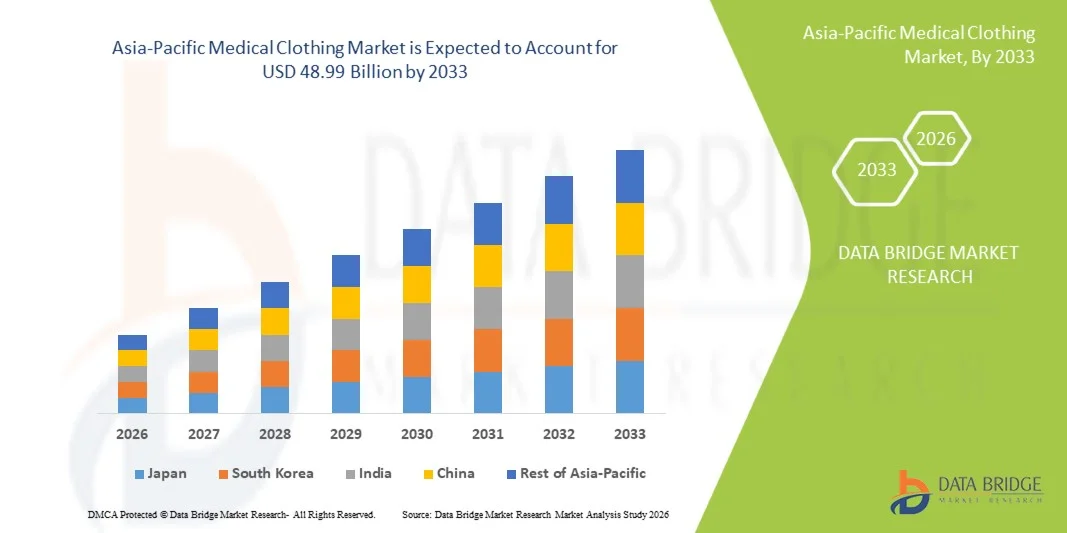
The Asia-Pacific medical clothing market was valued at USD 28.79 billion in 2025 and is projected to reach USD 48.99 billion by 2033, growing at a CAGR of 6.87% from 2026 to 2033. Market growth is supported by the rising prevalence of infectious diseases, expanding healthcare infrastructure across developing economies, and increasing emphasis on infection prevention and control protocols in clinical settings.
The surge in surgical procedures, coupled with heightened awareness regarding hygiene and safety standards in healthcare environments, is driving increased adoption of professional apparel, patient apparel, and specialty protective clothing among hospitals, clinics, and ambulatory care centers. Ongoing regulatory initiatives mandating standardized medical clothing across healthcare facilities, along with the growing healthcare workforce in countries such as China, India, and Japan, are expanding the addressable market for medical clothing manufacturers. In addition, rapid urbanization, increasing medical tourism, and the expansion of private healthcare networks are creating new opportunities for stakeholders across the forecast period.
Key Market Trends & Insights
- China dominated the Asia-Pacific medical clothing market with the largest revenue share of 38.4% in 2025, supported by extensive healthcare infrastructure development, large-scale hospital construction programs, and the presence of leading domestic manufacturers.
- India is expected to be the fastest-growing country at a CAGR of 9.12% from 2026 to 2033, driven by expanding healthcare access, rising surgical volumes, and government initiatives to strengthen public health systems.
- The Professional Apparel segment led the market with a 34.2% market share in 2025, reflecting the essential role of scrubs, lab coats, and medical uniforms in daily healthcare operations and infection control compliance.
- The Disposable segment is anticipated to be the fastest-growing usage category, driven by increasing demand for single-use protective clothing to minimize cross-contamination risks and support high patient turnover in acute care settings.
- The Hospitals segment dominated the end-user category with a 52.1% market share in 2025, supported by high procedural volumes, comprehensive infection prevention programs, and centralized procurement of standardized medical apparel.
- The Third Party Distributor segment is expected to witness strong growth during the forecast period, driven by expanding distribution networks, efficient supply chain logistics, and increasing partnerships between manufacturers and regional healthcare providers.
Market Size & Forecast
- Asia-Pacific Market Value (2025): USD 28.79 Billion
- Expected Market Value (2033): USD 48.99 Billion
- Forecast CAGR (2026–2033): 6.87%
Report Scope and Medical Clothing Market Segmentation
|
Attributes |
Medical Clothing Key Market Insights |
|
Segments Covered |
|
|
Countries Covered |
Asia-Pacific · China · Japan · India · South Korea · Singapore · Malaysia · Australia · Thailand · Indonesia · Philippines · Rest of Asia-Pacific |
|
Key Market Players |
· Cardinal Health, Inc. (U.S.) · Mölnlycke Health Care AB (Sweden) · 3M (U.S.) · Smith+Nephew (U.K.) · Ansell Ltd. (Australia) · Medline Industries, LP (U.S.) · Owens & Minor, Inc. (U.S.) · Barco Uniforms, Inc. (U.S.) · Superior Group of Companies, Inc. (U.S.) · Winner Medical Co., Ltd. (China) · Xinlong Holding (Group) Co., Ltd. (China) · Zhende Medical Co., Ltd. (China) |
|
Market Opportunities |
· Expansion of domestic nonwoven textile manufacturing clusters in China, Vietnam, and India enabling cost-competitive production · Development of sustainable and antimicrobial medical clothing solutions aligned with evolving regulatory standards and environmental mandates |
|
Value Added Data Infosets |
In addition to the insights on market scenarios such as market value, growth rate, segmentation, geographical coverage, and major players, the market reports curated by the Data Bridge Market Research also include depth expert analysis, patient epidemiology, pipeline analysis, pricing analysis, and regulatory framework. |
Asia-Pacific Medical Clothing Market Trends
Trend: Growing Adoption of Sustainable and Antimicrobial Medical Textiles
Clinical adoption of medical clothing incorporating sustainable and antimicrobial materials continues to accelerate as healthcare facilities prioritize infection prevention and environmental responsibility. Eco-friendly fabrics such as organic cotton, recycled polyester, and bamboo fibers are gaining traction among environmentally conscious healthcare providers seeking to reduce their carbon footprint while maintaining comfort and durability. Antimicrobial technologies integrated into scrub fabrics help inhibit bacterial growth, supporting cleaner clinical environments and reducing healthcare-associated infections.
For instance,
The demand for scrubs made from recycled polyester and organic cotton increased by approximately 22% across major Asia-Pacific markets in 2024, driven by hospital sustainability initiatives and changing procurement policies favoring eco-friendly suppliers.
In addition, manufacturers are investing in advanced finishing technologies that enhance fabric breathability, moisture-wicking capabilities, and antimicrobial performance, enabling healthcare workers to maintain comfort during extended shifts while adhering to stringent hygiene standards.
The growing emphasis on sustainable and antimicrobial medical clothing is expected to drive product innovation and expand market opportunities across the Asia-Pacific region throughout the forecast period.
Asia-Pacific Medical Clothing Market Dynamics
Key Market Driver: Expanding Healthcare Infrastructure and Rising Surgical Volumes
The rapid expansion of healthcare infrastructure across the Asia-Pacific region is a primary driver of market growth. Government-funded hospital construction programs in China and India, combined with increasing investments in private healthcare networks, are substantially expanding the demand for standardized medical clothing. Rising surgical volumes driven by the growing prevalence of chronic diseases, including cardiovascular conditions, cancer, and diabetes, are further amplifying the need for professional apparel, surgical gowns, and protective clothing.
For instance,
According to industry estimates, surgical procedure volumes across Asia-Pacific increased by over 8% annually between 2022 and 2025, with hospitals in China and India accounting for the largest share of regional growth. This expansion directly correlates with increased procurement of disposable surgical gowns, drapes, and sterile apparel to support infection control protocols.
The continued investment in healthcare infrastructure and rising procedural volumes are expected to strengthen adoption of medical clothing across hospitals, ambulatory centers, and specialty clinics throughout the forecast period.
Key Restraint/Challenge: Price Sensitivity and Cost Pressures in Emerging Markets
Price sensitivity among healthcare providers in emerging Asia-Pacific markets presents a significant challenge to market growth. Budget constraints, particularly in public healthcare systems and smaller clinical facilities, limit the adoption of premium medical clothing products. High-performance surgical gowns with advanced barrier protection can add 30–40% to unit costs compared to standard apparel, restricting procurement in cost-sensitive environments.
For instance,
Surveys of hospital procurement managers in India and Southeast Asia indicate that approximately 45% of facilities prioritize cost over advanced features when selecting medical clothing suppliers, often opting for basic disposable gowns over higher-specification alternatives.
Price pressures and the need to balance safety, comfort, and cost may constrain the adoption of advanced medical clothing products, particularly among budget-sensitive healthcare providers in developing economies.
Key Market Opportunity: Rise of Medical Tourism and Private Healthcare Expansion
The growth of medical tourism in countries such as Thailand, Singapore, Malaysia, and India is creating significant opportunities for medical clothing manufacturers. International patients seeking surgical and specialty care expect globally certified medical apparel that meets stringent safety and hygiene standards. Private hospital networks catering to medical tourists are increasingly investing in high-quality disposable gowns, scrubs, and patient apparel to enhance patient experience and comply with international accreditation requirements.
For instance,
Thailand's medical tourism sector served over 3.5 million international patients in 2024, with private hospitals reporting increased procurement of internationally certified surgical apparel to meet patient safety expectations and JCI accreditation standards.
The expansion of medical tourism and private healthcare networks is expected to drive demand for premium medical clothing solutions and support market growth across the Asia-Pacific region.
Asia-Pacific Medical Clothing Market Scope
The medical clothing market is segmented on the basis of product, usage, end user, and distribution channel.
By Product
On the basis of product, the Asia-Pacific medical clothing market is segmented into professional apparel, patient apparel, specialty apparel, first aid clothing, wraps and towels, and others. The Professional Apparel segment dominated the market with a 34.2% market share in 2025, reflecting the essential role of scrubs, lab coats, surgical caps, and medical uniforms in daily healthcare operations. Professional apparel is mandated across hospitals, clinics, and laboratories to ensure hygiene compliance and support infection control protocols. The large and growing healthcare workforce across Asia-Pacific, particularly in China, India, and Japan, contributes to sustained demand for standardized professional attire.
The First Aid Clothing segment is expected to witness the fastest growth from 2026 to 2033, registering a CAGR of 7.82%, driven by increasing awareness of emergency preparedness, expansion of first responder networks, and growing adoption of first aid training programs across corporate and institutional settings. Rising incidence of workplace injuries and natural disasters across the region is further propelling demand for first aid clothing and emergency medical kits.
By Usage
On the basis of usage, the Asia-Pacific medical clothing market is segmented into reusable and disposable. The Disposable segment dominated the market with a 58.4% market share in 2025, driven by increasing demand for single-use protective clothing to minimize cross-contamination risks and support high patient turnover in acute care settings. Disposable surgical gowns, drapes, and protective apparel are essential components of infection prevention programs, particularly in surgical suites, intensive care units, and emergency departments. The emphasis on hygiene compliance following the COVID-19 pandemic has further accelerated adoption of disposable medical clothing across the region.
The Disposable segment is also anticipated to be the fastest-growing usage category, recording a CAGR of 7.61% from 2026 to 2033, supported by expanding surgical volumes, regulatory mandates for single-use barrier protection, and growing preference for ready-to-use sterile clothing kits in high-volume healthcare environments.
By End User
On the basis of end user, the Asia-Pacific medical clothing market is segmented into hospitals, specialty clinics, ambulatory centres, home care settings, research & clinical laboratories, and others. The Hospitals segment dominated the market with a 52.1% market share in 2025, driven by high procedural volumes, comprehensive infection prevention programs, and centralized procurement of standardized medical apparel. Hospitals serve as primary centers for surgical, emergency, and inpatient care, requiring large volumes of professional apparel, surgical gowns, patient clothing, and protective equipment. The concentration of surgical and specialty care services within hospital systems contributes to high equipment utilization and consistent demand for medical clothing products.
The Ambulatory Centres segment is expected to witness the fastest growth from 2026 to 2033, registering a CAGR of 8.45%, driven by the expansion of outpatient surgical facilities, cost-effective procedural delivery, and increasing patient preference for same-day discharge options. The development of modular, transport-efficient medical clothing kits suitable for ambulatory settings is enabling broader adoption of standardized apparel across decentralized care facilities.
By Distribution Channel
On the basis of distribution channel, the Asia-Pacific medical clothing market is segmented into direct tender, retail sales, third party distributor, and others. The direct tender segment dominated the market with a 42.5% market share in 2025, reflecting the prevalence of government and institutional procurement systems across the Asia-Pacific region. Public healthcare systems in China, India, Australia, and Southeast Asian countries centralize bulk purchasing of standardized medical apparel through tender processes, ensuring compliance with regulatory standards and cost efficiency. Large integrated hospital networks and government health departments leverage direct tender mechanisms to secure volume discounts and maintain supply chain consistency.
The third party distributor segment is expected to witness the fastest growth from 2026 to 2033, registering a CAGR of 8.18%, driven by expanding distribution networks, efficient supply chain logistics, and increasing partnerships between manufacturers and regional healthcare providers. Third party distributors play a critical role in extending market reach to smaller clinics, ambulatory centers, and remote healthcare facilities, supporting broader product accessibility across diverse geographic markets.
Asia-Pacific Medical Clothing Market Regional Analysis
The Asia-Pacific medical clothing market is characterized by significant regional variation, with China, Japan, India, and South Korea representing the largest national markets. Expanding healthcare infrastructure, rising surgical volumes, and increasing regulatory emphasis on infection control are driving growth across the region. The presence of leading domestic manufacturers in China and India, combined with strong distribution networks, is supporting market accessibility and competitive pricing.
China Medical Clothing Market Insight
The China medical clothing market dominated the Asia-Pacific region with a revenue share of 38.4% in 2025, supported by extensive healthcare infrastructure development, large-scale hospital construction programs, and the presence of leading domestic manufacturers including Winner Medical and Xinlong Holding. Government initiatives such as the Healthy China 2030 program are driving investment in healthcare modernization and infection control, expanding demand for standardized medical apparel across public and private healthcare systems. The strong dominance of domestic nonwoven textile manufacturers enables ultra-low-cost, large-scale production of surgical gowns, drapes, and protective clothing, supporting both domestic consumption and export markets.
Japan Medical Clothing Market Insight
The Japan medical clothing market benefits from advanced healthcare infrastructure, strong regulatory frameworks, and high standards for infection prevention and control. Japanese hospitals and clinics prioritize quality and compliance, driving demand for premium medical apparel with advanced antimicrobial and barrier protection features. The aging population and rising chronic disease prevalence are contributing to sustained surgical volumes and consistent demand for professional and patient apparel. Japanese manufacturers are recognized for innovation in medical textiles, including development of eco-friendly and high-performance fabrics.
India Medical Clothing Market Insight
The India medical clothing market is expected to be the fastest-growing national market, recording a CAGR of 9.12% from 2026 to 2033, driven by expanding healthcare access, rising surgical volumes, and government initiatives to strengthen public health systems. The Ayushman Bharat program and National Health Mission are supporting hospital construction and standardization of infection control protocols, expanding demand for medical clothing across government and private healthcare facilities. Growth of domestic textile manufacturing clusters is enhancing regional supply capabilities and supporting cost-competitive production of medical apparel.
Asia-Pacific Medical Clothing Market Share
The medical clothing industry is primarily led by well-established companies, including:
- Cardinal Health, Inc. (U.S.)
- Mölnlycke Health Care AB (Sweden)
- 3M (U.S.)
- Smith+Nephew (U.K.)
- Ansell Ltd. (Australia)
- Medline Industries, LP (U.S.)
- Owens & Minor, Inc. (U.S.)
- Barco Uniforms, Inc. (U.S.)
- Superior Group of Companies, Inc. (U.S.)
- Winner Medical Co., Ltd. (China)
- Xinlong Holding (Group) Co., Ltd. (China)
- Zhende Medical Co., Ltd. (China)
Latest Developments in Asia-Pacific Medical Clothing Market
- In March 2026, Winner Medical Co., Ltd. announced the expansion of its nonwoven fabric production facility in Hubei Province, China, increasing annual capacity by 30% to meet rising domestic and international demand for surgical gowns and protective apparel. The expansion supports the company's strategy to strengthen its position as a leading supplier of medical textiles in the Asia-Pacific region.
- In January 2026, Mölnlycke Health Care AB launched its new line of sustainable surgical gowns featuring recycled polyester and reduced plastic packaging across select Asia-Pacific markets. The product launch aligns with the company's commitment to environmental sustainability and supports healthcare facilities seeking eco-friendly procurement options.
- In November 2025, Ansell Ltd. announced a strategic partnership with a leading Indian hospital network to supply antimicrobial medical apparel and protective clothing across over 50 facilities. The partnership supports Ansell's expansion in the Indian market and addresses growing demand for infection prevention solutions.
- In August 2025, 3M introduced its next-generation surgical drapes and gowns with enhanced fluid barrier protection to hospitals in Japan and South Korea. The product line incorporates advanced nonwoven technology designed to improve surgical team safety and patient outcomes.
- In May 2025, Cardinal Health, Inc. expanded its distribution network in Southeast Asia through a new partnership with a regional medical supply distributor, increasing product accessibility for hospitals and clinics in Thailand, Malaysia, and Indonesia.
- In February 2025, Zhende Medical Co., Ltd. received CE marking for its disposable surgical gown product line, enabling expanded export to European and Asia-Pacific markets with stringent regulatory requirements.
- In October 2024, Medline Industries, LP announced the opening of a new regional distribution center in Singapore to support faster delivery of medical apparel and surgical supplies across Southeast Asia.
- In July 2024, Barco Uniforms, Inc. launched its eco-friendly scrubs collection in Australia, featuring fabrics made from recycled plastic bottles and sustainable cotton blends, targeting environmentally conscious healthcare professionals.
- In April 2024, Winner Medical Co., Ltd. partnered with a major Chinese e-commerce platform to expand online retail sales of medical apparel and personal protective equipment to healthcare workers and institutions across China.
- In January 2024, Smith+Nephew announced the introduction of antimicrobial wound care apparel in India, supporting infection prevention in surgical and post-operative care settings.

- Interactive Data Analysis Dashboard
- Company Analysis Dashboard for high growth potential opportunities
- Research Analyst Access for customization & queries
- Competitor Analysis with Interactive dashboard
- Latest News, Updates & Trend analysis
- Harness the Power of Benchmark Analysis for Comprehensive Competitor Tracking
Data collection and base year analysis are done using data collection modules with large sample sizes. The stage includes obtaining market information or related data through various sources and strategies. It includes examining and planning all the data acquired from the past in advance. It likewise envelops the examination of information inconsistencies seen across different information sources. The market data is analysed and estimated using market statistical and coherent models. Also, market share analysis and key trend analysis are the major success factors in the market report. To know more, please request an analyst call or drop down your inquiry.
The key research methodology used by DBMR research team is data triangulation which involves data mining, analysis of the impact of data variables on the market and primary (industry expert) validation. Data models include Vendor Positioning Grid, Market Time Line Analysis, Market Overview and Guide, Company Positioning Grid, Patent Analysis, Pricing Analysis, Company Market Share Analysis, Standards of Measurement, Global versus Regional and Vendor Share Analysis. To know more about the research methodology, drop in an inquiry to speak to our industry experts.
Data Bridge Market Research is a leader in advanced formative research. We take pride in servicing our existing and new customers with data and analysis that match and suits their goal. The report can be customized to include price trend analysis of target brands understanding the market for additional countries (ask for the list of countries), clinical trial results data, literature review, refurbished market and product base analysis. Market analysis of target competitors can be analyzed from technology-based analysis to market portfolio strategies. We can add as many competitors that you require data about in the format and data style you are looking for. Our team of analysts can also provide you data in crude raw excel files pivot tables (Fact book) or can assist you in creating presentations from the data sets available in the report.













