


What is the Asia-Pacific Medicinal Chemistry for Drug Discovery Market Size and Growth Rate?
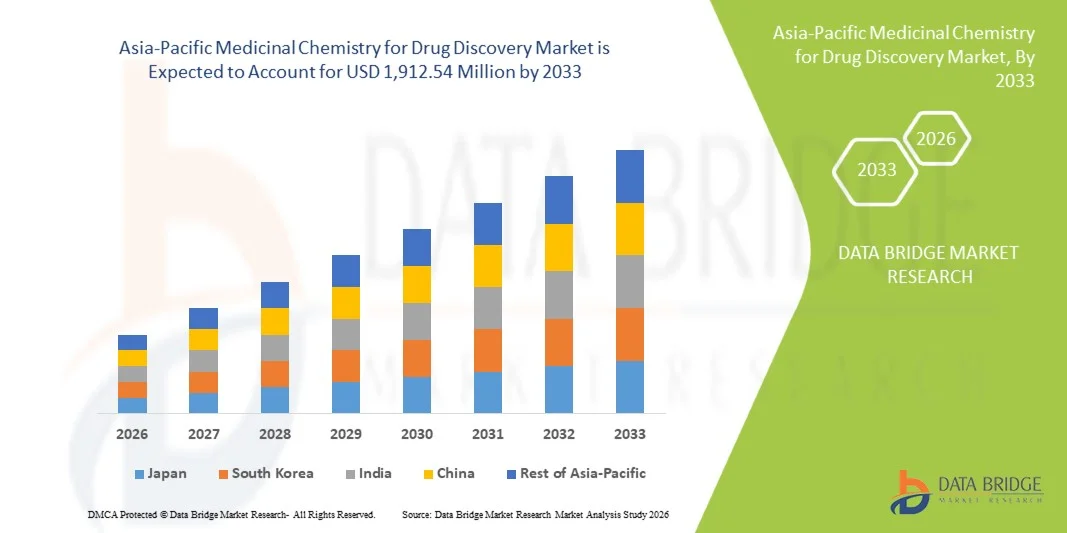
- As per Data Bridge Market Research Analysis the Asia-Pacific medicinal chemistry for drug discovery market size was valued at USD 783.57 million in 2025and is expected to reach USD 1,912.54 million by 2033, at a CAGR of 11.8% during the forecast period
- The market growth is largely fueled by increasing pharmaceutical R&D investments, expanding biotechnology sector, and rising focus on novel drug development across emerging economies such as China, India, and South Korea
- Furthermore, growing prevalence of chronic diseases, supportive government initiatives, and increasing collaborations between academic institutions and pharmaceutical companies are establishing medicinal chemistry as a critical component in early-stage drug discovery. These converging factors are accelerating the demand for advanced drug discovery solutions, thereby significantly boosting the region's market growth
Market Size & Forecast
Global Market Value (2025): USD 783.57 million
Expected Market Value (2033): USD 1,912.54 million
Forecast CAGR (2026–2033): 11.8%
What are the Major Takeaways of Asia-Pacific Medicinal Chemistry for Drug Discovery Market?
- Medicinal chemistry for drug discovery, involving the design, synthesis, and optimization of bioactive compounds, is a critical component of modern pharmaceutical R&D across the Asia-Pacific region, supporting the development of innovative therapeutics in both academic and commercial research settings
- The escalating demand for medicinal chemistry services is primarily fueled by increasing investments in pharmaceutical and biotechnology research, growing focus on precision medicine, and a rising need for novel drug candidates to address unmet medical needs and complex diseases
- China dominated the Asia-Pacific medicinal chemistry for drug discovery market with the largest revenue share of 31.3% in 2025, characterized by strong government support, rapid expansion of CROs, and a robust pharmaceutical manufacturing base, with significant growth driven by increasing outsourcing of drug discovery activities from global pharmaceutical companies
- India is expected to be the fastest growing country in the Asia-Pacific medicinal chemistry market during the forecast period due to its cost-effective research capabilities, skilled scientific workforce, and expanding presence of contract research organizations supporting global drug discovery pipelines
- Lead optimization segment dominated the market with a market share of 39.4% in 2025, driven by its critical role in refining drug candidates for improved efficacy, selectivity, and safety profiles before advancing into preclinical and clinical development stages
Report Scope and Asia-Pacific Medicinal Chemistry for Drug Discovery Market Segmentation
|
Attributes |
Asia-Pacific Medicinal Chemistry for Drug Discovery Key Market Insights |
|
Segments Covered |
|
|
Countries Covered |
Asia-Pacific · China · Japan · India · South Korea · Singapore · Malaysia · Australia · Thailand · Indonesia · Philippines · Rest of Asia-Pacific |
|
Key Market Players |
|
|
Market Opportunities |
· Growing integration of AI-driven drug design platforms with medicinal chemistry workflows · Increasing outsourcing of early-stage drug discovery to specialized CROs |
|
Value Added Data Infosets |
In addition to the insights on market scenarios such as market value, growth rate, segmentation, geographical coverage, and major players, the market reports curated by the Data Bridge Market Research also include in-depth expert analysis, patient epidemiology, pipeline analysis, pricing analysis, and regulatory framework |
What is the Key Trend in the Asia-Pacific Medicinal Chemistry for Drug Discovery Market?
“Advancement in AI-Driven Drug Design and Computational Chemistry”
- A significant and accelerating trend in the Asia-Pacific medicinal chemistry for drug discovery market is the increasing integration of artificial intelligence (AI) and advanced computational tools in drug design and molecular optimization processes. This convergence of technologies is significantly enhancing efficiency and precision in early-stage drug discovery workflows
- For instance, several pharmaceutical and biotechnology firms across China and Japan are leveraging AI-driven platforms to accelerate compound screening and predict molecular behavior, reducing time and cost associated with traditional discovery approaches. Similarly, contract research organizations are incorporating in silico modeling to improve hit-to-lead identification processes
- AI integration in medicinal chemistry enables features such as predictive modeling of drug-target interactions, optimization of pharmacokinetic properties, and identification of potential toxicity risks at early stages. For instance, machine learning algorithms are increasingly used to refine chemical structures and enhance compound efficacy while minimizing adverse effects. Furthermore, automation tools offer researchers the ability to process large datasets and generate insights with greater accuracy
- The seamless integration of computational chemistry with laboratory-based synthesis is facilitating a more streamlined and data-driven drug discovery ecosystem. Through unified platforms, researchers can manage compound libraries, simulation data, and experimental results, creating a cohesive and efficient research environment across institutions and organizations
- This trend towards more intelligent, data-driven, and integrated drug discovery approaches is fundamentally reshaping research methodologies in the region. Consequently, companies such as WuXi AppTec are developing AI-enabled drug discovery platforms with capabilities such as predictive analytics, automated synthesis, and enhanced collaboration tools for global clients
- The demand for AI-integrated medicinal chemistry solutions is growing rapidly across pharmaceutical companies and research institutions, as stakeholders increasingly prioritize faster drug development timelines and higher success rates in clinical outcomes
- Increasing investment in high-throughput screening technologies and automation infrastructure is also contributing to faster compound evaluation and optimization, strengthening the efficiency of medicinal chemistry workflows across the region
Asia-Pacific Medicinal Chemistry for Drug Discovery Market Dynamics
Driver
“Rising R&D Investments and Expanding Pharmaceutical Ecosystem”
- The increasing investment in pharmaceutical research and development across Asia-Pacific, coupled with the rapid expansion of biotechnology ecosystems, is a significant driver for the heightened demand for medicinal chemistry services
- For instance, in March 2025, WuXi AppTec announced expansion of its research capabilities to support global drug discovery programs, aiming to enhance integrated medicinal chemistry and laboratory services. Such strategies by key companies are expected to drive the medicinal chemistry market growth in the forecast period
- As pharmaceutical companies intensify efforts to develop novel therapeutics for chronic and rare diseases, medicinal chemistry plays a crucial role in optimizing drug candidates and improving clinical success rates, providing a strong foundation for innovation
- Furthermore, the growing collaboration between academic institutions, contract research organizations, and global pharmaceutical firms is accelerating the pace of drug discovery activities, enabling knowledge sharing and access to advanced technologies
- The increasing focus on outsourcing drug discovery processes, availability of skilled scientific talent, and supportive government initiatives are key factors propelling the adoption of medicinal chemistry services across the region. The trend towards integrated research platforms and cost-efficient development models further contributes to market growth
- The expansion of biopharmaceutical clusters and innovation hubs across countries such as China, India, and South Korea is fostering a conducive environment for drug discovery activities and strengthening regional competitiveness
- Rising participation of global pharmaceutical companies in Asia-Pacific through partnerships and joint ventures is further enhancing technology transfer, infrastructure development, and research capabilities within the region
Restraint/Challenge
“High Development Costs and Regulatory Complexity”
- Concerns surrounding the high cost and complexity of drug discovery processes, including medicinal chemistry, pose a significant challenge to broader market expansion. As drug development requires extensive research, validation, and regulatory approvals, it involves substantial financial and time investments, raising concerns among smaller firms and new entrants
- For instance, stringent regulatory frameworks across countries such as Japan and Australia have increased compliance requirements, leading to longer approval timelines and higher operational costs for pharmaceutical and biotechnology companies
- Addressing these challenges through streamlined regulatory pathways, increased funding support, and adoption of cost-efficient technologies is crucial for sustaining growth. Companies such as Syngene International Limited emphasize integrated service models and advanced research capabilities to optimize costs and improve efficiency. In addition, the complexity of managing multidisciplinary research processes can act as a barrier for organizations with limited expertise or infrastructure
- While technological advancements are improving efficiency, the high capital requirements and regulatory burden can still hinder widespread adoption, especially for smaller companies and emerging research institutions
- Overcoming these challenges through enhanced collaboration, regulatory harmonization, and continued investment in innovative technologies will be vital for long-term market growth
- Limited access to advanced research infrastructure and high-end analytical tools in certain developing economies within Asia-Pacific can further restrict the pace of drug discovery and innovation
- Intellectual property concerns and data protection issues across different regulatory jurisdictions may also create barriers for cross-border collaborations and slow down research commercialization efforts
How is the Asia-Pacific Medicinal Chemistry for Drug Discovery Market Segmented?
The market is segmented on the basis of process, design, drug type, therapeutic area, and end user.
- By Process
On the basis of process, the Asia-Pacific medicinal chemistry for drug discovery market is segmented into target selection, target validation, hit-to-lead identification, lead optimization, and candidate validation. The lead optimization segment dominated the market with the largest market revenue share of 39.4% in 2025, driven by its critical role in refining chemical compounds to enhance efficacy, selectivity, and safety before clinical progression. This stage involves iterative synthesis and testing, making it resource-intensive and central to successful drug development. The increasing use of computational tools and AI in optimizing molecular structures further strengthens its dominance. In addition, pharmaceutical companies prioritize this phase to reduce late-stage failures and improve drug success rates. The growing outsourcing of optimization activities to CROs in countries such as China and India also contributes to segment growth.
The hit-to-lead identification segment is anticipated to witness the fastest growth rate of 22.1% from 2026 to 2033, fueled by advancements in high-throughput screening and computational chemistry technologies. This phase plays a crucial role in identifying promising compounds from large libraries, accelerating early-stage drug discovery. Increasing adoption of AI-driven screening platforms is significantly improving hit identification efficiency. Furthermore, rising R&D investments and the need to shorten drug discovery timelines are boosting demand for this process. Expansion of compound libraries and automation in screening processes are also supporting segment growth.
- By Design
On the basis of design, the market is segmented into fragment-based variation, structure-based drug design, diversity oriented synthesis, chemogenomics, natural products, and others. The structure-based drug design segment dominated the market in 2025 due to its precision in designing molecules based on the 3D structure of biological targets. This approach enhances drug efficacy and reduces off-target effects, making it highly valuable in modern drug discovery. Increasing use of advanced imaging technologies such as X-ray crystallography and cryo-EM is further strengthening this segment. Pharmaceutical companies across Asia-Pacific are heavily investing in structure-based approaches to accelerate innovation. In addition, integration with AI tools for predictive modeling is enhancing efficiency and accuracy.
The fragment-based variation segment is expected to be the fastest growing during the forecast period, driven by its ability to identify smaller, high-quality lead compounds with improved binding efficiency. This method requires fewer compounds compared to traditional screening techniques, making it cost-effective. Increasing adoption by biotech firms and CROs is supporting growth. Furthermore, advancements in screening technologies and computational modeling are improving fragment identification processes. The growing focus on precision medicine is also contributing to the segment’s expansion.
- By Drug Type
On the basis of drug type, the market is segmented into small molecules and biologics. The small molecules segment dominated the market with the largest revenue share in 2025, driven by their well-established development pathways and widespread application across multiple therapeutic areas. These drugs are easier to manufacture, have better stability, and are more cost-effective compared to biologics. The strong presence of generic drug manufacturers in Asia-Pacific further supports this segment’s dominance. In addition, medicinal chemistry plays a central role in small molecule optimization, increasing its demand. Continued innovation in chemical synthesis techniques is also boosting segment growth.
The biologics segment is anticipated to witness the fastest growth rate during the forecast period, fueled by increasing demand for targeted therapies and personalized medicine. Biologics offer higher specificity and effectiveness for complex diseases such as cancer and autoimmune disorders. Rising investments in biotechnology and biosimilar development across countries such as China and South Korea are driving growth. Furthermore, advancements in protein engineering and molecular biology are expanding biologics research. Growing collaboration between pharmaceutical companies and research institutions is also supporting this segment.
- By Therapeutic Area
On the basis of therapeutic area, the market is segmented into oncology, neurology, infectious and immune system diseases, cardiovascular diseases, digestive system diseases, and others. The oncology segment dominated the market in 2025 due to the high prevalence of cancer and increasing focus on developing targeted anticancer therapies. Medicinal chemistry plays a crucial role in designing molecules that specifically target cancer cells while minimizing side effects. Significant R&D investments and clinical trials in oncology are further strengthening this segment. In addition, rising adoption of precision medicine approaches is boosting demand for innovative cancer treatments. The presence of strong pharmaceutical pipelines in oncology across Asia-Pacific also contributes to growth.
The infectious and immune system diseases segment is expected to witness the fastest growth rate during the forecast period, driven by increasing incidence of infectious diseases and rising awareness of immune-related conditions. The need for rapid drug development in response to emerging pathogens is accelerating research activities. Government initiatives and funding for vaccine and antiviral drug development are supporting growth. Furthermore, advancements in immunology and molecular research are enabling the development of more effective therapies. Increasing global collaboration in infectious disease research is also boosting this segment.
- By End User
On the basis of end user, the market is segmented into contract research organizations, pharmaceuticals and biotechnology companies, academic and research institutes, and others. The contract research organizations segment dominated the market with the largest revenue share in 2025, driven by the growing trend of outsourcing drug discovery activities to reduce costs and improve efficiency. CROs offer specialized expertise, advanced infrastructure, and integrated services across the drug development pipeline. Countries such as China and India have emerged as major hubs for CRO services due to cost advantages and skilled workforce availability. Increasing partnerships between global pharmaceutical companies and regional CROs are further strengthening this segment. In addition, CROs are rapidly adopting AI and automation technologies to enhance research capabilities.
The pharmaceuticals and biotechnology companies segment is anticipated to be the fastest growing during the forecast period, fueled by increasing in-house R&D investments and expansion of drug pipelines. Companies are focusing on developing innovative therapies to address unmet medical needs and gain competitive advantage. Rising adoption of advanced technologies such as AI and genomics is accelerating drug discovery processes. Furthermore, growing collaborations with academic institutions and CROs are enhancing research efficiency. The expansion of biotech startups across Asia-Pacific is also contributing to segment growth.
Which Region Holds the Largest Share of the Asia-Pacific Medicinal Chemistry for Drug Discovery Market?
- China dominated the Asia-Pacific medicinal chemistry for drug discovery market with the largest revenue share of 31.3% in 2025, characterized by strong government support, rapid expansion of CROs, and a robust pharmaceutical manufacturing base, with significant growth driven by increasing outsourcing of drug discovery activities from global pharmaceutical companies
- Organizations in the region highly prioritize cost-effective drug discovery solutions, skilled scientific talent, and advanced research infrastructure offered by medicinal chemistry services across academic institutions and contract research organizations
- This widespread growth is further supported by strong government initiatives, expanding CRO presence, and the rising trend of outsourcing drug discovery activities, establishing Asia-Pacific as a key hub for pharmaceutical and biotechnology research and development
The China Medicinal Chemistry for Drug Discovery Market Insight
The China medicinal chemistry for drug discovery market captured the largest revenue share of 31.3% in 2025 within Asia-Pacific, fueled by the rapid expansion of pharmaceutical research and the strong presence of contract research organizations. Companies are increasingly prioritizing cost-efficient and high-quality drug discovery services to accelerate global pipelines. The growing preference for outsourcing early-stage drug development, combined with robust demand for integrated research platforms and advanced computational tools, further propels the market. Moreover, the increasing government support and investments in biotechnology innovation are significantly contributing to the market's expansion.
Japan Medicinal Chemistry for Drug Discovery Market Insight
The Japan medicinal chemistry for drug discovery market is anticipated to grow at a noteworthy CAGR during the forecast period, driven by the country’s strong focus on innovation and advanced pharmaceutical research. In addition, the increasing burden of chronic diseases is encouraging pharmaceutical companies to invest in novel drug discovery approaches. Japan’s adoption of advanced technologies, alongside its well-established healthcare and research infrastructure, is expected to continue to stimulate market growth.
Australia Medicinal Chemistry for Drug Discovery Market Insight
The Australia medicinal chemistry for drug discovery market is expected to expand at a considerable CAGR during the forecast period, fueled by increasing research funding and the demand for innovative therapeutic solutions. Australia’s strong academic research base, combined with its emphasis on clinical trials and translational research, promotes the adoption of medicinal chemistry services. The integration of advanced research technologies is also becoming increasingly prevalent, with a strong focus on efficient and high-quality drug development processes aligning with industry needs.
India Medicinal Chemistry for Drug Discovery Market Insight
The India medicinal chemistry for drug discovery market is gaining momentum due to the country’s expanding pharmaceutical industry, skilled workforce, and cost-effective research capabilities. The Indian market places a significant emphasis on generic and innovative drug development, and the adoption of medicinal chemistry is driven by the increasing number of CROs and biotech startups. The integration of medicinal chemistry with advanced computational tools is fueling growth. Moreover, India’s growing role as a global outsourcing hub is likely to spur demand for comprehensive drug discovery solutions in both domestic and international markets.
Which are the Top Companies in Asia-Pacific Medicinal Chemistry for Drug Discovery Market?
The Asia-Pacific Medicinal Chemistry for Drug Discovery industry is primarily led by well-established companies, including:
- Pfizer Inc. (U.S.)
- Merck & Co., Inc. (U.S.)
- AbbVie Inc. (U.S.)
- Amgen Inc. (U.S.)
- Gilead Sciences, Inc. (U.S.)
- Bristol-Myers Squibb Company (U.S.)
- Eli Lilly and Company (U.S.)
- Biogen Inc. (U.S.)
- Regeneron Pharmaceuticals, Inc. (U.S.)
- Vertex Pharmaceuticals Incorporated (U.S.)
- Agios Pharmaceuticals, Inc. (U.S.)
- Schrödinger, Inc. (U.S.)
- Certara, Inc. (U.S.)
- Charles River Laboratories International, Inc. (U.S.)
- IQVIA Inc. (U.S.)
- Thermo Fisher Scientific Inc. (U.S.)
- Danaher Corporation (U.S.)
- Illumina, Inc. (U.S.)
- Labcorp (U.S.)
What are Latest Developments in Asia-Pacific Medicinal Chemistry for Drug Discovery Market?
- In March 2026, WuXi AppTec reported record financial performance for 2025, with revenue from continuing operations growing by over 21% year-over-year, driven by strong demand for drug discovery and medicinal chemistry services. The company highlighted significant backlog growth and increasing global partnerships, reflecting rising outsourcing trends in early-stage drug development
- In July 2025, WuXi AppTec, a leading biotechnology and medicinal chemistry services provider, announced plans to raise approximately USD 980 million through a share placement to accelerate its global expansion strategy. The company stated that the majority of the funds would be used to enhance its research, development, and manufacturing capabilities, including medicinal chemistry and drug discovery services
- In June 2025, Asia-Pacific pharmaceutical and biotechnology companies, including major Chinese drug discovery firms, began restructuring supply chains and research strategies in response to global trade tensions and regulatory uncertainties. Companies increased localization of research activities and explored domestic alternatives for materials and testing processes
- In December 2024, WuXi AppTec agreed to sell its advanced therapies manufacturing unit to a U.S.-based private equity firm as part of strategic restructuring amid regulatory pressures. The move reflects evolving global dynamics affecting drug discovery operations, while allowing the company to refocus on core areas such as medicinal chemistry and early-stage drug development services
- In October 2024, WuXi AppTec announced plans to raise USD 500 million through a convertible bond offering to fund expansion and strengthen its global drug discovery capabilities. The initiative aimed to support ongoing investments in medicinal chemistry, cell and gene therapy, and integrated pharmaceutical services. This development highlights continued capital inflow into Asia-Pacific’s drug discovery ecosystem despite geopolitical challenges

- Interactive Data Analysis Dashboard
- Company Analysis Dashboard for high growth potential opportunities
- Research Analyst Access for customization & queries
- Competitor Analysis with Interactive dashboard
- Latest News, Updates & Trend analysis
- Harness the Power of Benchmark Analysis for Comprehensive Competitor Tracking
Data collection and base year analysis are done using data collection modules with large sample sizes. The stage includes obtaining market information or related data through various sources and strategies. It includes examining and planning all the data acquired from the past in advance. It likewise envelops the examination of information inconsistencies seen across different information sources. The market data is analysed and estimated using market statistical and coherent models. Also, market share analysis and key trend analysis are the major success factors in the market report. To know more, please request an analyst call or drop down your inquiry.
The key research methodology used by DBMR research team is data triangulation which involves data mining, analysis of the impact of data variables on the market and primary (industry expert) validation. Data models include Vendor Positioning Grid, Market Time Line Analysis, Market Overview and Guide, Company Positioning Grid, Patent Analysis, Pricing Analysis, Company Market Share Analysis, Standards of Measurement, Global versus Regional and Vendor Share Analysis. To know more about the research methodology, drop in an inquiry to speak to our industry experts.
Data Bridge Market Research is a leader in advanced formative research. We take pride in servicing our existing and new customers with data and analysis that match and suits their goal. The report can be customized to include price trend analysis of target brands understanding the market for additional countries (ask for the list of countries), clinical trial results data, literature review, refurbished market and product base analysis. Market analysis of target competitors can be analyzed from technology-based analysis to market portfolio strategies. We can add as many competitors that you require data about in the format and data style you are looking for. Our team of analysts can also provide you data in crude raw excel files pivot tables (Fact book) or can assist you in creating presentations from the data sets available in the report.












