


Asia-Pacific Menopausal Disorder Treatment Market Overview
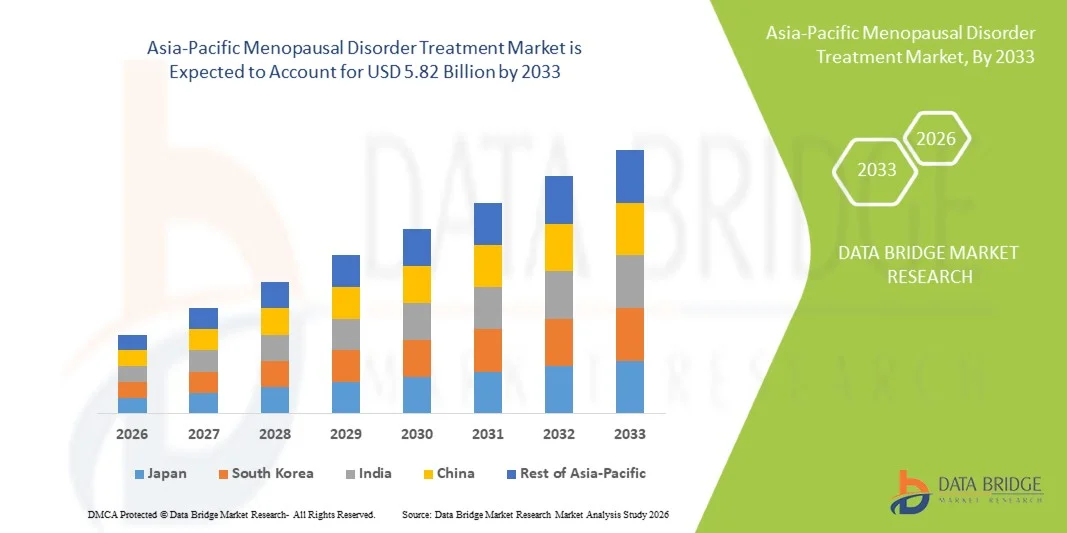
The Asia-Pacific menopausal disorder treatment market was valued at USD 2.88 billion in 2025 and is projected to reach USD 5.82 billion by 2033, growing at a CAGR of 9.20% from 2026 to 2033. The market is witnessing steady expansion driven by a rapidly aging female population, increasing awareness of menopause-related health issues, and growing acceptance of hormone replacement and non-hormonal therapies. Rising healthcare expenditure and improved access to gynecology and women’s health services across emerging economies are further supporting market growth.
The increasing prevalence of menopausal symptoms such as hot flashes, osteoporosis risk, mood disorders, and cardiovascular complications is pushing demand for effective long-term management solutions. In addition, expanding adoption of personalized treatment approaches, including bioidentical hormone therapy, herbal supplements, and digital health platforms for women’s wellness, is reshaping the treatment landscape. Government initiatives focused on women’s health, along with the growth of private healthcare infrastructure in countries such as China, India, Japan, and South Korea, are accelerating the uptake of advanced menopausal disorder treatment options.
Key Market Trends & Insights
- Japan dominated the menopausal disorder treatment market with the largest revenue share of 29.84% in 2025, supported by one of the world’s fastest-aging female populations and advanced menopause care infrastructure.
- The Menopause segment led the market with a 46.38% share in 2025, driven by the high prevalence of moderate to severe symptoms such as hot flashes, hormonal imbalance, and sleep disturbances during this stage.
- India is expected to be the fastest-growing country at a CAGR of 7.9% from 2026 to 2033, fueled by rising awareness of women’s health, expanding gynecology services, and increasing urban healthcare penetration.
- Perimenopause is the fastest-growing stages type, projected to register a CAGR of 7.8%, reflecting the surge in rising early screening and awareness of hormonal changes before full menopause onset.
- The Hormonal Therapy segment dominated the type category with a 52.64% revenue share in 2025, led by its high effectiveness in managing severe menopausal symptoms such as vasomotor instability, osteoporosis risk, and urogenital atrophy.
- Vasomotor Symptoms accounted for 39.82% of the market, preferred by hot flashes and night sweats are the most commonly reported and disruptive menopausal symptoms.
- The Transdermal segment is the fastest-growing route of administration category, with a CAGR of 7.5%, driven by rising demand for safer and controlled hormone delivery.
Market Size & Forecast
- Global Market Value (2025): USD 2.88 Billion
- Expected Market Value (2033): USD 5.82 Billion
- Forecast CAGR (2026–2033): 9.20%
- Leading Region in 2025: Japan
- Fastest Growing Region: India
Report Scope and Asia-Pacific Menopausal Disorder Treatment Market Segmentation
|
Attributes |
Asia-Pacific Menopausal Disorder Treatment Key Market Insights |
|
Segments Covered |
|
|
Countries Covered |
Asia-Pacific · China · Japan · India · South Korea · Singapore · Malaysia · Australia · Thailand · Indonesia · Philippines · Rest of Asia-Pacific |
|
Key Market Players |
· Pfizer Inc. (U.S.) · Bayer AG (Germany) · Eli Lilly and Company (U.S.) · Abbott (U.S.) · Novartis AG (Switzerland) · Novo Nordisk A/S (Denmark) · Merck & Co., Inc. (U.S.) · F. Hoffmann-La Roche Ltd (Switzerland) · AstraZeneca (U.K.) · GSK plc (U.K.) · AbbVie Inc. (U.S.) · Teva Pharmaceutical Industries Ltd. (Israel) · Ipsen Pharma (France) · Dr. Reddy’s Laboratories Ltd. (India) · Theramex (U.K.) · Besins Healthcare (Belgium) · Gedeon Richter Plc (Hungary) · Emcure Pharmaceuticals Ltd (India) · Cipla Ltd (India) |
|
Market Opportunities |
· Expansion of telemedicine-based menopause care platforms · Rising demand for personalized hormone replacement therapies · Growing adoption of nutraceuticals and phytoestrogen-based supplements |
|
Value Added Data Infosets |
In addition to the insights on market scenarios such as market value, growth rate, segmentation, geographical coverage, and major players, the market reports curated by the Data Bridge Market Research also include in-depth expert analysis, patient epidemiology, pipeline analysis, pricing analysis, and regulatory framework. |
Asia-Pacific Menopausal Disorder Treatment Market Trends
Trend: Rising Adoption of Personalized and Preventive Women’s Health Solutions
Healthcare providers across Asia-Pacific are increasingly shifting toward personalized menopause management, including biomarker-based hormone assessment and individualized therapy plans. Growing awareness of long-term risks such as osteoporosis and cardiovascular complications is driving demand for preventive care approaches. In addition, the integration of digital women’s health platforms and teleconsultation services is improving access to specialized menopause care, particularly in urban areas of China, India, and Japan, while supporting continuous symptom tracking and treatment adherence.
Asia-Pacific Menopausal Disorder Treatment Market Dynamics
Key Market Driver: Rapid Growth in Aging Female Population and Healthcare Awareness
The increasing proportion of women aged 45+ across Asia-Pacific is significantly expanding the patient pool for menopausal disorder treatments. Combined with rising health literacy, improved gynecology infrastructure, and government-led women’s health initiatives, this is accelerating diagnosis rates and treatment adoption. Pharmaceutical companies and healthcare providers are also expanding hormone therapy and non-hormonal treatment availability, improving accessibility across both urban and semi-urban regions. Pharmaceutical companies are responding by expanding their portfolios of hormone replacement therapies (HRT), selective estrogen receptor modulators (SERMs), and non-hormonal drugs, making treatment more widely available across urban and semi-urban regions.
Key Restraint/Challenge: Safety Concerns and Low Treatment Adoption in Rural Areas
A major challenge in the market is the persistent hesitation toward hormone replacement therapy due to perceived risks such as breast cancer and cardiovascular side effects. In many developing parts of Asia-Pacific, cultural stigma around menopause and limited awareness further restrict treatment-seeking behavior. In addition, inadequate access to gynecological specialists and uneven healthcare infrastructure in rural areas continues to limit early diagnosis and consistent long-term management of menopausal symptoms.
Another challenge is the uneven healthcare infrastructure across the region. While countries such as Japan and South Korea have advanced menopause care systems, large populations in developing economies still rely on general practitioners or traditional remedies, delaying effective treatment initiation.
Key Market Opportunity: Expansion of Non-Hormonal and Natural Therapy-Based Solutions
The growing preference for safer, plant-based, and non-hormonal alternatives presents a significant market opportunity, particularly in countries such as China, India, and South Korea. Increasing demand for phytoestrogen supplements, nutraceuticals, and traditional medicine-based formulations is driving innovation in natural menopause management. Pharmaceutical and wellness companies are also investing in hybrid solutions that combine clinical efficacy with herbal ingredients, expanding market penetration across health-conscious consumer segments.
Asia-Pacific Menopausal Disorder Treatment Market Scope
The Asia-Pacific menopausal disorder treatment market is segmented on the basis of stages, type, symptoms, dosage form, route of administration, end-users, and distribution channel.
- By Stages
On the basis of stages, the market is segmented into menopause, perimenopause, and postmenopause. The Menopause segment dominated the market with the highest share of 46.38% in 2025, primarily due to the high prevalence of moderate to severe symptoms such as hot flashes, hormonal imbalance, and sleep disturbances during this stage. Women in this phase actively seek medical intervention, making it the most treatment-intensive stage. Increasing diagnosis rates and rising gynecology consultations in urban healthcare systems are further strengthening this segment. Hormonal therapy and symptom-specific medications are widely prescribed during this stage, boosting market demand. Awareness campaigns targeting mid-life women are also improving treatment adoption. The segment continues to benefit from structured clinical management guidelines across hospitals and specialty clinics.
The Perimenopause segment is expected to register the fastest growth at a CAGR of 7.8% from 2026 to 2033, driven by rising early screening and awareness of hormonal changes before full menopause onset. Women are increasingly seeking preventive care to manage irregular cycles, mood swings, and early vasomotor symptoms. Digital health platforms and teleconsultations are playing a key role in early diagnosis and intervention. Growing focus on preventive women’s healthcare in countries such as India and China is accelerating adoption. Physicians are also recommending early-stage hormone balancing therapies and lifestyle-based interventions. This shift toward early management is expanding the treatment window significantly.
- By Type
On the basis of type, the market is segmented into hormonal therapy and non-hormonal therapy. The Hormonal Therapy segment dominated the market with a 52.64% share in 2025, due to its high effectiveness in managing severe menopausal symptoms such as vasomotor instability, osteoporosis risk, and urogenital atrophy. Estrogen-based therapies and combination hormone treatments are widely prescribed in hospital and clinical settings. Strong clinical evidence supporting symptom relief and quality-of-life improvement continues to reinforce its dominance. Japan and South Korea show particularly high adoption due to advanced healthcare systems. Pharmaceutical companies are continuously improving safety profiles through low-dose and transdermal formulations. Despite safety concerns, it remains the most clinically preferred treatment option.
The Non-Hormonal Therapy segment is expected to witness the fastest growth at a CAGR of 7.4% from 2026 to 2033, driven by rising concerns regarding hormone therapy side effects. Patients are increasingly opting for safer alternatives such as SSRIs, herbal formulations, phytoestrogens, and lifestyle-based therapies. Growing acceptance of nutraceuticals in China and India is further accelerating demand. Physicians are also recommending non-hormonal options for patients with contraindications to HRT. Increased investment in plant-based pharmaceutical research is expanding product availability. This segment is strongly supported by consumer preference for natural and preventive healthcare solutions.
- By Menopause Symptoms
On the basis of symptoms, the market is segmented into vasomotor symptoms, atrophic vaginitis, osteoporosis, joint pain, weight gain, dyspareunia, depression, and others. The Vasomotor Symptoms segment dominated the market with a 38.92% share in 2025, as hot flashes and night sweats are the most commonly reported and disruptive menopausal symptoms. These symptoms significantly impact sleep quality and daily productivity, driving high treatment-seeking behavior. Hormonal and non-hormonal therapies are widely used for symptom relief. Increased awareness campaigns and clinical diagnosis rates are improving management. Pharmaceutical companies focus heavily on this symptom category due to high demand for fast-acting relief solutions. It remains the primary driver of treatment initiation.
The Osteoporosis segment is expected to register the fastest growth at a CAGR of 7.6% from 2026 to 2033, driven by increasing postmenopausal bone density loss and fracture risk awareness. Governments and healthcare providers are emphasizing early bone health screening and calcium-vitamin D supplementation programs. Rising aging population across Asia-Pacific is significantly expanding patient numbers. Physicians are increasingly recommending long-term preventive therapies. Advanced diagnostic imaging availability is improving detection rates. This segment is gaining strong traction in hospital-based preventive care programs.
- By Dosage Form
On the basis of dosage form, the market is segmented into tablets, creams, gels, rings/inserts, patches/films, injections, sprays, and others. The Tablet segment dominated the market with a 49.71% share in 2025, due to ease of administration, high patient compliance, and widespread prescription availability. Oral hormone therapy and non-hormonal medications are most commonly delivered in tablet form. Cost-effectiveness and convenience make it the preferred choice across hospitals and retail pharmacies. Strong distribution networks in China and India further support availability. Tablets are also widely used in long-term treatment regimens. Pharmaceutical companies continue to prioritize oral formulations due to high demand.
The Patch/Film segment is expected to witness the fastest growth at a CAGR of 7.2% from 2026 to 2033, driven by increasing demand for transdermal hormone delivery systems. These systems offer steady hormone release with fewer gastrointestinal side effects compared to oral medications. Improved safety perception is boosting adoption among patients concerned about oral HRT risks. Technological advancements in skin absorption and drug delivery systems are enhancing effectiveness. Physicians are increasingly recommending patches for long-term hormone regulation. This segment is gaining strong traction in developed healthcare markets such as Japan and South Korea.
- By Route of Administration
On the basis of route of administration, the market is segmented into oral, vaginal, transdermal, and parenteral. The Oral segment dominated the market with a 55.13% share in 2025, driven by convenience, affordability, and strong availability across pharmacies. Oral medications are widely prescribed for both hormonal and non-hormonal therapies. High patient familiarity and ease of long-term use support dominance. Large-scale pharmaceutical production also favors oral formulations. Hospital and retail pharmacy channels ensure consistent distribution. This segment remains the primary entry point for menopause treatment.
The Transdermal segment is expected to register the fastest growth at a CAGR of 7.5% from 2026 to 2033, driven by rising demand for safer and controlled hormone delivery. Patches and gels provide stable hormone absorption with reduced systemic side effects. Increasing preference among patients with chronic conditions is accelerating adoption. Physicians favor transdermal therapy for improved safety profiles. Technological advancements are improving absorption efficiency. This segment is gaining strong momentum in advanced healthcare systems.
- By End-Users
On the basis of end-users, the market is segmented into hospitals, specialty clinics, homecare, and others. The Hospitals segment dominated the market with a 48.26% share in 2025, due to high patient inflow, access to diagnostic facilities, and specialist-led treatment. Hospitals serve as primary centers for hormone therapy prescription and monitoring. Availability of advanced diagnostic tools improves treatment accuracy. Government healthcare systems in countries such as China and Japan strongly support hospital-based care. Multidisciplinary teams ensure comprehensive menopause management. This segment remains the backbone of clinical treatment delivery.
The Homecare segment is expected to register the fastest growth at a CAGR of 7.9% from 2026 to 2033, driven by increasing demand for convenient and long-term treatment management. Rising adoption of telemedicine and digital health platforms is supporting remote consultations. Patients prefer home-based therapy due to privacy and comfort. Growth in oral and transdermal treatments supports self-administration. Aging populations and chronic treatment needs further enhance demand. This segment is rapidly expanding across urban Asia-Pacific regions.
- By Distribution Channel
On the basis of distribution channel, the market is segmented into hospital pharmacy, retail pharmacy, online pharmacy, and others. The Hospital Pharmacy segment dominated the market with a 51.87% share in 2025, driven by physician-prescribed treatments and strong integration with hospital care systems. Most hormonal therapies are dispensed directly through hospital pharmacies. This ensures better compliance and monitoring of treatment outcomes. Strong trust in hospital-based prescriptions supports dominance. Government healthcare infrastructure further strengthens this channel. It remains the primary distribution pathway for prescription-based menopause treatments.
The Online Pharmacy segment is expected to witness the fastest growth at a CAGR of 8.1% from 2026 to 2033, driven by rising digital adoption and increasing demand for convenience. Teleconsultation-based prescriptions are boosting online medicine purchases. Growing internet penetration in India and Southeast Asia is accelerating growth. Discreet purchasing options for menopause-related treatments are increasing user acceptance. Subscription-based medicine delivery models are also emerging. This channel is becoming a key driver of future market expansion.
Asia-Pacific Menopausal Disorder Treatment Market Regional Analysis
Japan dominated the menopausal disorder treatment market with the largest revenue share of 29.84% in 2025, supported by one of the world’s fastest-aging female populations and advanced menopause care infrastructure. The country also benefits from well-established hospital systems, high adoption of hormone replacement therapy and preventive care practices, and strong integration of specialty clinics focused on women’s health. Increasing focus on osteoporosis prevention, cardiovascular risk management, and quality-of-life improvement further strengthens treatment uptake. Continuous innovation in safer hormone formulations and growing acceptance of structured menopause care programs continue to reinforce Japan’s leadership position in the regional market.
The Japan Menopausal Disorder Treatment Market Insight
The Japan menopausal disorder treatment market is witnessing strong growth due to one of the world’s fastest-aging female populations and highly advanced healthcare infrastructure. Increasing adoption of hormone replacement therapy, preventive bone health management, and structured menopause care programs is driving market demand across hospitals and specialty clinics. The country also benefits from high awareness of menopause-related health risks, early diagnosis practices, and strong physician-led treatment protocols. In addition, rising integration of safer hormone formulations and long-term wellness monitoring solutions is further strengthening treatment adoption across the population.
China Menopausal Disorder Treatment Market Insight
The China menopausal disorder treatment market is expanding rapidly due to a large aging female population, improving access to urban healthcare services, and rising awareness of menopause-related conditions. Growing adoption of hormone therapy, non-hormonal medications, and traditional herbal-based treatments is significantly contributing to market growth. The country is also witnessing increasing investment in women’s health infrastructure and pharmaceutical innovation, which is improving treatment availability. In addition, expanding use of preventive healthcare programs and rising focus on chronic disease management are accelerating diagnosis and treatment rates.
India Menopausal Disorder Treatment Market Insight
The India menopausal disorder treatment market is growing steadily due to rising awareness of women’s health, increasing urbanization, and expanding access to gynecology services. Growing acceptance of hormone replacement therapy and strong demand for herbal and nutraceutical-based alternatives are driving treatment adoption. The country also benefits from a rapidly expanding middle-class population and increasing healthcare expenditure. In addition, telemedicine platforms and digital health solutions are improving access to menopause care in both urban and semi-urban regions.
South Korea Menopausal Disorder Treatment Market Insight
The South Korea menopausal disorder treatment market is witnessing consistent growth due to advanced healthcare infrastructure and strong emphasis on preventive women’s health management. High adoption of hormone replacement therapy, non-hormonal treatments, and aesthetic-wellness-linked menopause care solutions is supporting market expansion. The country also benefits from strong pharmaceutical innovation and widespread access to specialist clinics. In addition, increasing awareness of aging-related health risks and integration of digital health monitoring systems are further driving treatment adoption.
Asia-Pacific Menopausal Disorder Treatment Market Share
The Asia-Pacific menopausal disorder treatment industry is primarily led by well-established companies, including:
- Pfizer Inc. (U.S.)
- Bayer AG (Germany)
- Eli Lilly and Company (U.S.)
- Abbott (U.S.)
- Novartis AG (Switzerland)
- Novo Nordisk A/S (Denmark)
- Merck & Co., Inc. (U.S.)
- Hoffmann-La Roche Ltd (Switzerland)
- AstraZeneca (U.K.)
- GSK plc (U.K.)
- AbbVie Inc. (U.S.)
- Teva Pharmaceutical Industries Ltd. (Israel)
- Ipsen Pharma (France)
- Reddy’s Laboratories Ltd. (India)
- Theramex (U.K.)
- Besins Healthcare (Belgium)
- Gedeon Richter Plc (Hungary)
- Emcure Pharmaceuticals Ltd (India)
- Cipla Ltd (India)
Latest Developments in Asia-Pacific Menopausal Disorder Treatment Market
- In October 2025, Bayer expanded the availability of its non-hormonal menopause therapy Lynkuet in the Asia-Pacific region, including regulatory progress in Australia, marking a significant step toward improving treatment options for vasomotor symptoms. The launch supports growing demand for safer alternatives to hormone replacement therapy (HRT) and reflects increasing pharmaceutical focus on targeted menopause symptom relief solutions. This development is expected to enhance access to advanced non-hormonal treatments across developed Asia-Pacific healthcare systems. It also strengthens competition in the menopause therapeutics pipeline, particularly for hot flash and sleep disorder management. The move highlights the region’s shift toward innovative, patient-specific menopause care approaches
- In April 2025, regional clinical stakeholders in Asia-Pacific updated menopause management guidelines through professional medical associations, promoting standardized treatment protocols across countries such as Japan, India, and South Korea. The update emphasizes individualized hormone therapy use, risk-based prescribing, and broader integration of non-hormonal therapies. It aims to reduce inconsistencies in clinical practice and improve early diagnosis rates of menopausal disorders. The guidelines also support safer prescribing practices for long-term women’s health management. This development is strengthening structured menopause care across hospitals and specialty clinics in the region
- In June 2024, China and Japan expanded specialized menopause clinics within hospital networks, strengthening structured women’s health services for aging populations. These clinics focus on comprehensive care including hormone therapy, osteoporosis management, and psychological support for menopausal symptoms. The expansion is improving early diagnosis and long-term treatment adherence among patients. It also reflects increasing government and institutional focus on women’s preventive healthcare. The development is enhancing accessibility of standardized menopause care across urban healthcare systems
- In September 2023, China increased integration of traditional Chinese medicine (TCM) with conventional menopause treatments in public hospital systems to address symptoms such as hot flashes, fatigue, and mood disorders. This approach combines herbal therapies with modern hormonal and non-hormonal medications. It is improving patient acceptance in culturally diverse populations. Hospitals are increasingly offering hybrid treatment models to expand therapeutic options. This development is strengthening the role of natural and alternative therapies in the Asia-Pacific menopause treatment landscape
- In May 2021, India and China significantly expanded telemedicine adoption for women’s health, including menopause-related consultations, during and after the COVID-19 pandemic. Digital health platforms enabled remote symptom tracking, prescription access, and follow-up consultations for menopausal patients. This improved healthcare access in semi-urban and rural regions with limited specialist availability. The shift also accelerated awareness of menopause as a treatable medical condition rather than a natural limitation. It laid the foundation for the rapid growth of online pharmacy and digital menopause care services in the region

- Interactive Data Analysis Dashboard
- Company Analysis Dashboard for high growth potential opportunities
- Research Analyst Access for customization & queries
- Competitor Analysis with Interactive dashboard
- Latest News, Updates & Trend analysis
- Harness the Power of Benchmark Analysis for Comprehensive Competitor Tracking
Data collection and base year analysis are done using data collection modules with large sample sizes. The stage includes obtaining market information or related data through various sources and strategies. It includes examining and planning all the data acquired from the past in advance. It likewise envelops the examination of information inconsistencies seen across different information sources. The market data is analysed and estimated using market statistical and coherent models. Also, market share analysis and key trend analysis are the major success factors in the market report. To know more, please request an analyst call or drop down your inquiry.
The key research methodology used by DBMR research team is data triangulation which involves data mining, analysis of the impact of data variables on the market and primary (industry expert) validation. Data models include Vendor Positioning Grid, Market Time Line Analysis, Market Overview and Guide, Company Positioning Grid, Patent Analysis, Pricing Analysis, Company Market Share Analysis, Standards of Measurement, Global versus Regional and Vendor Share Analysis. To know more about the research methodology, drop in an inquiry to speak to our industry experts.
Data Bridge Market Research is a leader in advanced formative research. We take pride in servicing our existing and new customers with data and analysis that match and suits their goal. The report can be customized to include price trend analysis of target brands understanding the market for additional countries (ask for the list of countries), clinical trial results data, literature review, refurbished market and product base analysis. Market analysis of target competitors can be analyzed from technology-based analysis to market portfolio strategies. We can add as many competitors that you require data about in the format and data style you are looking for. Our team of analysts can also provide you data in crude raw excel files pivot tables (Fact book) or can assist you in creating presentations from the data sets available in the report.












