


Asia Pacific Microsurgery Market Size
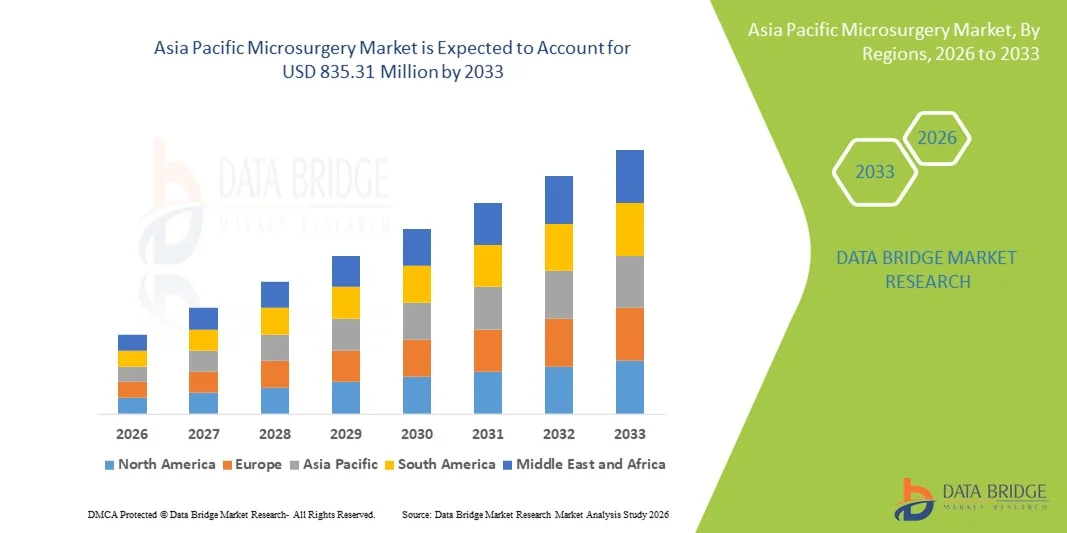
- The Asia Pacific microsurgery market size was valued at USD 508.53 million in 2025 and is expected to reach USD 835.31 million by 2033, at a CAGR of 6.4% during the forecast period
- The market growth is largely fueled by the rising prevalence of chronic diseases, increasing demand for minimally invasive surgical procedures, and expanding applications of microsurgery in specialties such as neurosurgery, ophthalmology, plastic & reconstructive surgery, and oncology across emerging and developed economies in the region
- Furthermore, continuous technological advancements in surgical microscopes, micro-instruments, and robotic-assisted systems, along with improving healthcare infrastructure and growing medical tourism in countries such as China, India, Japan, and South Korea, are accelerating the adoption of microsurgical procedures, thereby significantly boosting the market’s growth trajectory
Asia Pacific Microsurgery Market Analysis
- Microsurgery, involving highly precise surgical procedures performed using advanced microscopes, specialized microsurgical instruments, and fine suturing materials, is increasingly becoming a critical component of complex surgical interventions across multiple specialties due to its ability to enhance visualization, improve surgical precision, and minimize postoperative complications in both adult and pediatric populations
- The escalating demand for microsurgical procedures is primarily fueled by the rising burden of neurological disorders, trauma cases, cancer incidence, congenital abnormalities, and infertility treatments, along with the growing preference for minimally invasive and tissue-preserving surgical approaches across developing and developed countries in the Asia Pacific region
- China dominated the Asia Pacific microsurgery market with the largest revenue share of 38.76% in 2025, characterized by expanding tertiary care infrastructure, high surgical volumes in neurosurgery and oncology, increasing government healthcare expenditure, and rapid adoption of advanced microsurgical equipment across leading urban hospitals
- India is expected to be the fastest growing country in the Asia Pacific microsurgery market during the forecast period due to rising healthcare investments, growing medical tourism, increasing availability of skilled microsurgeons, and expanding specialty hospitals offering complex reconstructive and transplantation procedures
- Neurosurgery segment dominated the Asia Pacific microsurgery market with a market share of 34.8% in 2025, driven by the increasing incidence of brain tumors, spinal disorders, and traumatic brain injuries, along with the critical need for high-precision surgical visualization and micro-instrumentation in complex neurological procedures
Report Scope and Asia Pacific Microsurgery Market Segmentation
|
Attributes |
Asia Pacific Microsurgery Key Market Insights |
|
Segments Covered |
|
|
Countries Covered |
Asia-Pacific
|
|
Key Market Players |
|
|
Market Opportunities |
|
|
Value Added Data Infosets |
In addition to the insights on market scenarios such as market value, growth rate, segmentation, geographical coverage, and major players, the market reports curated by the Data Bridge Market Research also include in-depth expert analysis, patient epidemiology, pipeline analysis, pricing analysis, and regulatory framework |
Asia Pacific Microsurgery Market Trends
Technological Advancements and Robotic-Assisted Precision Integration
- A significant and accelerating trend in the Asia Pacific microsurgery market is the rapid integration of advanced surgical visualization systems, robotic-assisted platforms, and digital imaging technologies across tertiary care hospitals and specialty centers, significantly enhancing surgical precision, workflow efficiency, and patient outcomes across complex procedures
- For instance, leading hospitals in China and Japan have increasingly adopted high-definition 3D surgical microscopes and robot-assisted systems to improve accuracy in neurosurgical and reconstructive procedures, enabling surgeons to perform delicate operations with greater confidence and control
- Integration of fluorescence-guided imaging, augmented reality overlays, and AI-assisted navigation in microsurgical systems enables improved identification of critical anatomical structures, optimized intraoperative decision-making, and enhanced postoperative recovery rates; for instance, certain advanced microscope platforms provide real-time vascular flow visualization during free tissue transfer procedures
- The seamless incorporation of digital documentation, image-guided navigation, and minimally invasive microsurgical tools facilitates coordinated multidisciplinary care, allowing surgeons to manage complex cases across neurosurgery, oncology, and plastic surgery within integrated hospital ecosystems
- This trend toward more precise, minimally invasive, and technology-driven surgical solutions is fundamentally reshaping treatment standards and physician expectations across the region; consequently, companies are developing next-generation microsurgical instruments and microscopes with enhanced ergonomics, robotic compatibility, and AI-supported visualization features
- The demand for technologically advanced microsurgical systems is growing rapidly across both public and private healthcare institutions, as healthcare providers increasingly prioritize improved surgical outcomes, reduced complication rates, and faster patient recovery times
- Increasing cross-border collaborations, medical tourism growth, and participation in international surgical training programs are contributing to faster technology diffusion and standardization of advanced microsurgical practices across the Asia Pacific region
Asia Pacific Microsurgery Market Dynamics
Driver
Rising Surgical Volumes and Expanding Healthcare Infrastructure
- The increasing prevalence of neurological disorders, cancer cases, trauma injuries, and congenital abnormalities, coupled with expanding healthcare infrastructure investments across emerging Asia Pacific economies, is a significant driver for the heightened demand for microsurgical procedures
- For instance, in March 2025, a major tertiary hospital network in India announced the expansion of its advanced neurosurgery and organ transplantation units with upgraded microsurgical microscope systems, aiming to improve precision and surgical capacity, which is expected to support regional market growth during the forecast period
- As patients and healthcare providers become more aware of the clinical benefits of microsurgery, including reduced tissue damage, lower infection risks, and shorter hospital stays, microsurgical interventions are increasingly preferred over conventional open surgical approaches
- Furthermore, government initiatives focused on hospital modernization, rising healthcare expenditure, and the expansion of specialty surgical departments are making advanced microsurgical equipment more accessible across both urban and semi-urban medical centers
- The growing demand for organ transplantation, free tissue transfer, infertility treatment procedures, and complex oncological surgeries are key factors propelling the adoption of microsurgical instruments, microscopes, and microsuture materials across hospitals and academic research centers. The increasing availability of skilled microsurgeons and structured training programs further contributes to market expansion
- Increasing private sector investments and the entry of multinational medical device manufacturers into Asia Pacific markets are further strengthening product availability and competitive innovation within the regional microsurgery landscape
- Expanding health insurance coverage and reimbursement support for advanced surgical procedures in select countries are encouraging greater patient access to high-cost microsurgical interventions, thereby supporting overall market growth
Restraint/Challenge
High Equipment Costs and Skilled Workforce Limitations
- Concerns surrounding the high capital investment required for advanced surgical microscopes, robotic-assisted systems, and precision microsurgical instruments pose a significant challenge to broader adoption, particularly among small and mid-sized healthcare facilities
- For instance, budget constraints in certain Southeast Asian healthcare institutions have delayed procurement of high-end microscope platforms and specialized microsurgical toolkits, limiting access to advanced procedures in secondary care settings
- Addressing cost-related barriers through strategic procurement models, public–private partnerships, and local manufacturing initiatives is crucial for expanding accessibility; companies are increasingly offering modular microscope systems and flexible financing options to support wider adoption
- In addition, the limited availability of highly trained microsurgeons and specialized training infrastructure in certain developing regions can restrict procedural volumes and slow technology uptake despite growing clinical demand
- While investments in medical education and skill development are gradually increasing, disparities in expertise and equipment availability between metropolitan and rural hospitals may hinder uniform market penetration
- Regulatory complexities, import dependency for high-end microsurgical equipment, and variations in approval timelines across different Asia Pacific countries can further delay product commercialization and adoption
- Economic fluctuations, currency volatility, and constrained healthcare budgets in certain developing economies may limit procurement capacity for premium microsurgical technologies, thereby impacting short-term market expansion
Asia Pacific Microsurgery Market Scope
The market is segmented on the basis of application, procedure, equipment type, and end user.
- By Application
On the basis of application, the Asia Pacific microsurgery market is segmented into general surgery, neurosurgery, ophthalmology, orthopedic surgery, plastic surgery, oncology, gynecological surgery, oral surgery, and pediatric surgery. The Neurosurgery segment dominated the market with the largest revenue share of 34.8% in 2025, primarily driven by the rising incidence of brain tumors, spinal disorders, aneurysms, and traumatic brain injuries across densely populated countries in the region. Microsurgical techniques are critical in neurosurgery due to the need for extreme precision while operating on delicate neural structures. Increasing investments in advanced neuro-navigation systems and high-definition surgical microscopes in tertiary hospitals further support segment growth. Expanding specialized neurosurgical centers in China, India, Japan, and South Korea also contribute significantly to procedural volumes. In addition, the growing aging population, which is more susceptible to neurological disorders, continues to strengthen demand for microsurgical neurosurgical interventions.
The Plastic Surgery segment is anticipated to witness the fastest growth rate from 2026 to 2033, fueled by the rising demand for reconstructive and aesthetic procedures across emerging economies. Increasing cases of trauma injuries, burn treatments, and post-oncologic reconstruction are significantly contributing to the adoption of microsurgical free tissue transfer techniques. Growing medical tourism in countries such as Thailand, India, and South Korea further supports procedural growth. Technological advancements in microsurgical instruments and suturing materials enhance surgical outcomes in complex reconstructive procedures. Rising disposable incomes and increasing awareness regarding cosmetic enhancements are also driving the expansion of microsurgery applications in plastic and reconstructive surgery.
- By Procedure
On the basis of procedure, the market is segmented into transplantation, replantation, treatment of infertility, and free tissue transfer. The Transplantation segment dominated the Asia Pacific microsurgery market in 2025 due to the increasing number of organ transplant procedures, including kidney and liver transplants, requiring advanced microsurgical vascular anastomosis techniques. Improvements in donor-recipient matching systems and post-operative care infrastructure have supported higher transplant success rates. Expanding transplant centers and government initiatives promoting organ donation awareness further contribute to the segment’s dominance. Microsurgical precision plays a critical role in minimizing graft rejection risks and improving long-term patient survival outcomes. The rising burden of chronic diseases leading to organ failure continues to strengthen demand within this segment.
The Free Tissue Transfer segment is projected to register the fastest growth during the forecast period, driven by increasing reconstructive surgeries following trauma and cancer resections. Free flap procedures rely heavily on microsurgical expertise to reconnect blood vessels and restore functional tissue. Growing advancements in intraoperative imaging technologies are enhancing flap survival rates and surgical efficiency. Expanding oncology surgical volumes across Asia Pacific are further accelerating demand for microsurgical reconstruction techniques. Increasing training programs focused on complex reconstructive microsurgery are also supporting segment expansion.
- By Equipment Type
On the basis of equipment type, the market is segmented into microsurgical instruments, microscope, and microsutures materials. The Microscope segment dominated the market in 2025, owing to its essential role in providing magnified visualization and illumination during delicate procedures. Advanced operating microscopes equipped with fluorescence imaging and 3D visualization capabilities are increasingly adopted in leading hospitals. Continuous innovation in ergonomic designs and digital integration further enhances surgeon efficiency and procedural accuracy. Rising demand for minimally invasive and high-precision surgeries across multiple specialties strengthens the dominance of this segment. In addition, increased capital expenditure in tertiary healthcare institutions supports procurement of advanced microscope systems.
The Microsurgical Instruments segment is expected to witness the fastest growth rate from 2026 to 2033, driven by growing procedural volumes across neurosurgery, plastic surgery, and transplantation. Instruments such as micro forceps, needle holders, and scissors are critical consumables and require periodic replacement, ensuring steady demand. Expanding local manufacturing capabilities in Asia Pacific are improving product accessibility and affordability. Technological advancements in lightweight and precision-engineered instruments are enhancing surgical performance. Increasing surgeon preference for specialized instrument sets tailored to specific procedures further contributes to rapid segment growth.
- By End User
On the basis of end user, the Asia Pacific microsurgery market is segmented into hospitals, clinics, research organization, ambulatory surgery centres, and academic & research centres. The Hospitals segment dominated the market in 2025, supported by the presence of advanced infrastructure, multidisciplinary surgical teams, and higher patient inflow for complex procedures. Large hospitals are primary centers for organ transplantation, neurosurgery, and oncology surgeries requiring microsurgical expertise. Government and private sector investments in hospital modernization further strengthen segment leadership. Availability of advanced imaging systems and integrated operating rooms enhances procedural efficiency. The concentration of skilled microsurgeons in major hospital networks also drives segment growth.
The Ambulatory Surgery Centres segment is anticipated to witness the fastest growth during the forecast period, driven by the increasing shift toward outpatient surgical care and cost-effective treatment settings. Rising adoption of minimally invasive microsurgical procedures supports the expansion of day-care surgical facilities. Improved recovery times and reduced hospitalization costs make ambulatory centers attractive to both patients and insurers. Growing private healthcare investments across urban regions are expanding the number of specialized surgical centers. Technological advancements enabling compact and efficient microsurgical equipment further facilitate the growth of this segment.
Asia Pacific Microsurgery Market Regional Analysis
- China dominated the Asia Pacific microsurgery market with the largest revenue share of 38.76% in 2025, characterized by expanding tertiary care infrastructure, high surgical volumes in neurosurgery and oncology, increasing government healthcare expenditure, and rapid adoption of advanced microsurgical equipment across leading urban hospitals
- Healthcare providers in the region highly prioritize precision-based surgical techniques, improved patient outcomes, and the integration of advanced microscopes and microsurgical instruments across specialties such as neurosurgery, oncology, and reconstructive surgery
- This widespread adoption is further supported by a growing aging population, increasing healthcare expenditure, rapid modernization of hospital facilities, and the rising demand for minimally invasive and high-precision surgical procedures, establishing microsurgery as a critical component of advanced surgical care across the region
The China Microsurgery Market Insight
The China microsurgery market captured the largest revenue share in 2025 within Asia Pacific, fueled by rapid expansion of tertiary healthcare infrastructure and rising volumes of complex surgical procedures. Hospitals are increasingly prioritizing high-precision surgical interventions supported by advanced microscopes and microsurgical instruments. The growing burden of neurological disorders, cancer cases, and trauma injuries is significantly strengthening demand for microsurgical applications. Moreover, strong government investments in hospital modernization, medical technology upgrades, and specialist training programs are substantially contributing to market expansion across major metropolitan regions.
Japan Microsurgery Market Insight
The Japan microsurgery market is projected to expand at a substantial CAGR throughout the forecast period, primarily driven by its advanced healthcare system and strong adoption of innovative surgical technologies. The country’s aging population has led to an increased incidence of neurological, ophthalmic, and oncologic conditions requiring precision-based interventions. Japanese healthcare institutions emphasize minimally invasive techniques that improve recovery times and surgical outcomes. In addition, continuous technological advancements in robotic-assisted microsurgery and high-definition imaging systems are fostering steady market growth across specialized hospitals.
India Microsurgery Market Insight
The India microsurgery market is anticipated to grow at a noteworthy CAGR during the forecast period, driven by improving healthcare infrastructure and rising access to specialized surgical care. Increasing cases of trauma, congenital abnormalities, and organ failure are encouraging the adoption of microsurgical procedures. The country’s expanding network of multi-specialty hospitals and medical tourism industry further stimulates demand for advanced surgical equipment. Furthermore, growing investments in surgeon training programs and the availability of cost-effective microsurgical instruments are supporting market development across urban and semi-urban regions.
South Korea Microsurgery Market Insight
The South Korea microsurgery market is expected to expand at a considerable CAGR during the forecast period, fueled by strong expertise in reconstructive and aesthetic surgical procedures. The country’s technologically advanced hospitals and high patient awareness regarding surgical precision are promoting the use of advanced microscopes and microsurgical tools. Increasing demand for reconstructive surgeries following oncology treatments and trauma cases further strengthens adoption. Integration of digital imaging systems and minimally invasive approaches continues to enhance procedural efficiency and patient satisfaction.
Asia Pacific Microsurgery Market Share
The Asia Pacific Microsurgery industry is primarily led by well-established companies, including:
- Leica Microsystems (Germany)
- Carl Zeiss Meditec AG (Germany)
- Karl Storz SE & Co. KG (Germany)
- B. Braun SE (Germany)
- Olympus Corporation (Japan)
- Danaher (U.S.)
- Beaver-Visitec International Inc. (U.S.)
- Scanlan International (U.S.)
- KLS Martin Group (Germany)
- Topcon Corporation (Japan)
- Stryker (U.S.)
- Medtronic (Ireland)
- Global Surgical Corporation (U.S.)
- Haag-Streit Group (Switzerland)
- Microsurgery Instruments Inc. (U.S.)
- Becker Dominique International (Canada)
- Integra LifeSciences Corporation (U.S.)
- Nikon Corporation (Japan)
- Johnson & Johnson Services, Inc. (U.S.)
- Zimmer Biomet (U.S.)
What are the Recent Developments in Asia Pacific Microsurgery Market?
- In December 2025, AUO Display Plus and partners showcased a 3D Microsurgery Imaging Solution at the 2025 Healthcare+ Expo in Taiwan, integrating high-definition 3D visualization with AI support to enhance complex microsurgical procedures involving nerves, blood vessels, and lymphatics. The solution aims to improve surgical precision and clinical outcomes across advanced surgical centers in the Asia Pacific
- In July 2025, the Postgraduate Institute of Medical Education and Research (PGIMER) in Chandigarh, India, performed the country’s first robot-assisted reverse vasectomy (vasovasostomy) using the da Vinci Surgical System, showcasing the adoption of robotics in reproductive microsurgery to enhance precision and reduce tremor compared with traditional microscope-assisted methods
- In October 2024, St Vincent’s Hospital Melbourne became the first hospital in the Asia-Pacific region to successfully perform a complex microsurgery using the Symani Robotic Surgical System, marking a major technological milestone. This advancement enhances surgical precision in delicate procedures such as cancer reconstruction, trauma repair, and digit replantations, and positions the hospital as a regional training hub for robotic microsurgery
- In October 2023, MMI (Medical Microinstruments, Inc.) announced partnerships with Device Technologies (Australia) and TRM Korea to expand distribution of the Symani Surgical System across key Asia Pacific countries (including Hong Kong, Singapore, Thailand, Malaysia, Indonesia, and South Korea). This development helped introduce robotic microsurgical capabilities to new regional markets and enabled surgeon training in multiple APAC locations
- In September 2021, Medtronic’s Hugo™ robotic-assisted surgery system was used to perform the first robotic prostatectomy procedure in the Asia-Pacific region at Apollo Hospitals in Chennai, India. While focused on robotic surgery more broadly, this development marked early regional adoption of advanced surgical robotics that underpins later microsurgical robotic innovations

- Interactive Data Analysis Dashboard
- Company Analysis Dashboard for high growth potential opportunities
- Research Analyst Access for customization & queries
- Competitor Analysis with Interactive dashboard
- Latest News, Updates & Trend analysis
- Harness the Power of Benchmark Analysis for Comprehensive Competitor Tracking
Data collection and base year analysis are done using data collection modules with large sample sizes. The stage includes obtaining market information or related data through various sources and strategies. It includes examining and planning all the data acquired from the past in advance. It likewise envelops the examination of information inconsistencies seen across different information sources. The market data is analysed and estimated using market statistical and coherent models. Also, market share analysis and key trend analysis are the major success factors in the market report. To know more, please request an analyst call or drop down your inquiry.
The key research methodology used by DBMR research team is data triangulation which involves data mining, analysis of the impact of data variables on the market and primary (industry expert) validation. Data models include Vendor Positioning Grid, Market Time Line Analysis, Market Overview and Guide, Company Positioning Grid, Patent Analysis, Pricing Analysis, Company Market Share Analysis, Standards of Measurement, Global versus Regional and Vendor Share Analysis. To know more about the research methodology, drop in an inquiry to speak to our industry experts.
Data Bridge Market Research is a leader in advanced formative research. We take pride in servicing our existing and new customers with data and analysis that match and suits their goal. The report can be customized to include price trend analysis of target brands understanding the market for additional countries (ask for the list of countries), clinical trial results data, literature review, refurbished market and product base analysis. Market analysis of target competitors can be analyzed from technology-based analysis to market portfolio strategies. We can add as many competitors that you require data about in the format and data style you are looking for. Our team of analysts can also provide you data in crude raw excel files pivot tables (Fact book) or can assist you in creating presentations from the data sets available in the report.













