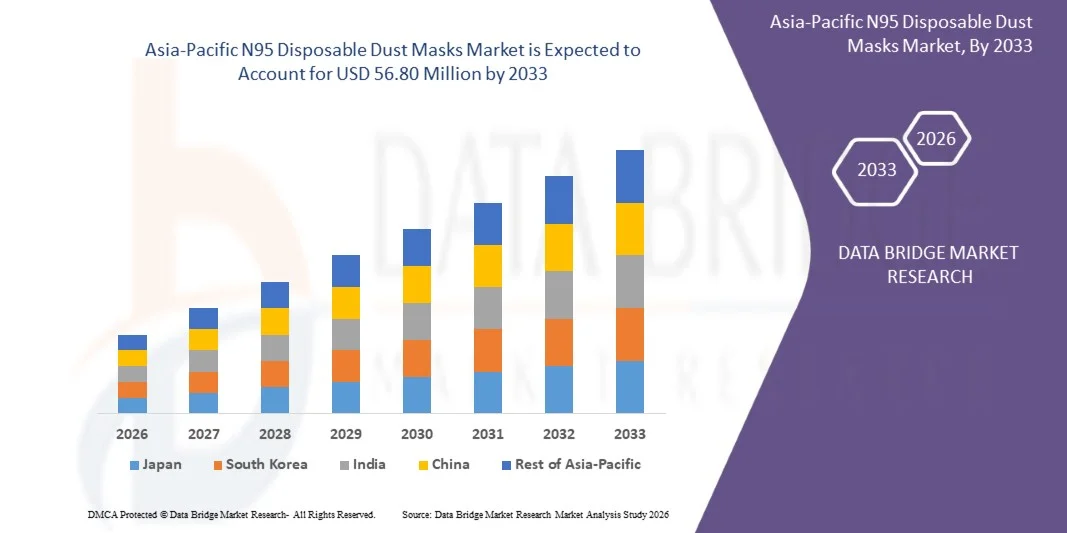
Asia-Pacific N95 Disposable Dust Masks Market Size
- The Asia-Pacific N95 Disposable Dust Masks Market is expected to reach USD 56.80 million by 2033 from USD 27.34 billion in 2025, growing with a substantial CAGR of 9.7% in the forecast period of 2026 to 2033
- The Asia-Pacific N95 Disposable Dust Masks Market is experiencing strong growth, driven primarily by expanding industrial activity, rising urban pollution levels, and increased awareness of worker safety across manufacturing, construction, mining, and chemical processing sectors. The region’s large population base and heightened focus on healthcare preparedness especially post-pandemic continue to accelerate the adoption of certified respiratory protection equipment such as N95 disposable masks.
- Market expansion is further supported by government-mandated workplace safety regulations, rising investments in healthcare infrastructure, and increasing demand from industries requiring high-filtration dust protection. Additionally, cost-effective large-scale production capabilities in countries like Indonesia, Vietnam, Thailand, combined with the growing presence of regional PPE manufacturers, strengthen Asia-Pacific’s competitive position in the global market. Continuous advancements in filtration efficiency, comfort design, and material technology are also contributing to sustained market growth in the region.
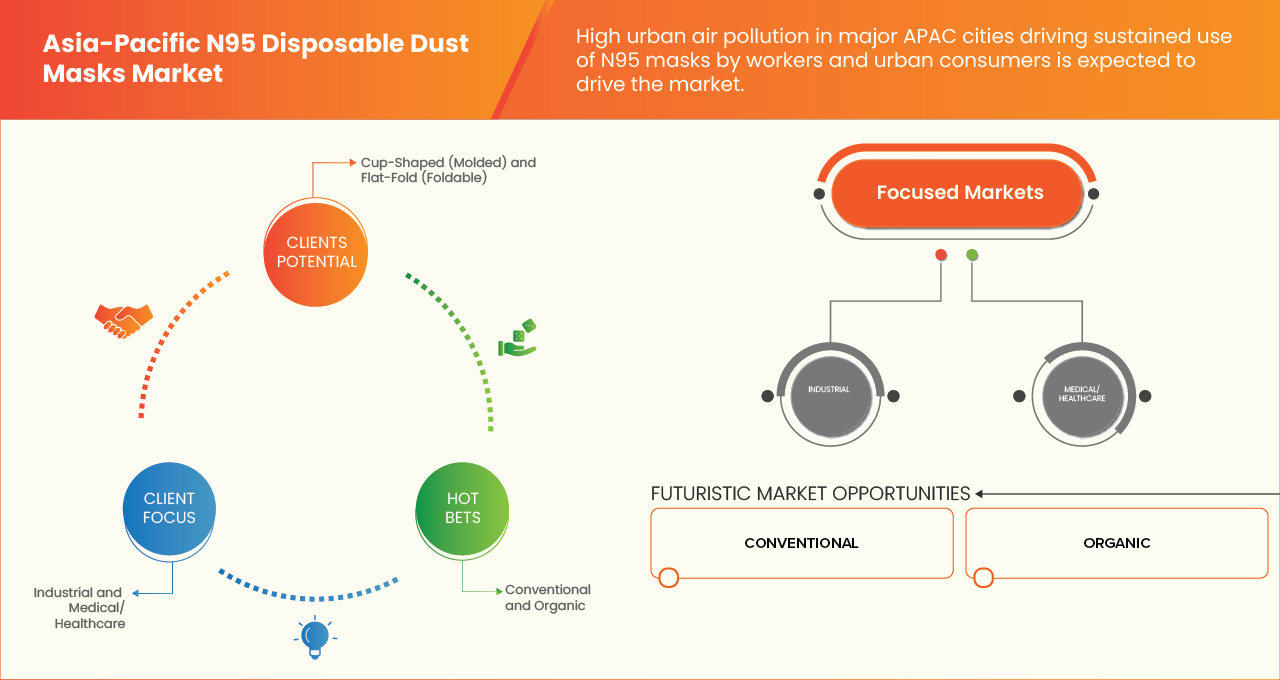
Asia-Pacific N95 Disposable Dust Masks Market Analysis
- N95 disposable dust masks play a critical role in protecting workers in high-dust and high-pollution settings, making them essential PPE across sectors such as infrastructure development, metalworking, transportation, and heavy industry. Their high filtration efficiency supports safe and sustainable industrial operations.
- The cup-shaped (molded) segment dominates the Asia-Pacific N95 Disposable Dust Masks Market, capturing 41.34% market share, driven by its superior fit, higher structural durability, and widespread use in manufacturing, construction, mining, and pollution-intensive industries. Its molded design offers better seal performance, making it the preferred choice for high-risk industrial environments.
- Rising industrial expansion, rapid urbanization, and increasing workplace safety compliance across Asia-Pacific are significantly boosting the demand for N95 disposable masks. Industries such as construction, chemicals, manufacturing, and mining rely heavily on molded N95 masks for reliable respiratory protection against hazardous particulates.
- The growing focus on occupational health regulations, pollution control measures, and improved air quality standards continues to drive market demand, particularly for high-performance molded N95 masks that provide enhanced fit, filtration, and long-duration comfort compared to flat-fold alternatives.
- Indonesia leads the Asia-Pacific N95 Disposable Dust Masks Market with a dominant 41.34% market share in 2025, propelled by strong industrial activity, expanding construction projects, and increasing adoption of protective equipment in factories and hazardous work zones. Government initiatives promoting workplace safety and pollution reduction further reinforce Indonesia’s leadership position.
Report Scope and Asia-Pacific N95 Disposable Dust Masks Market Segmentation
|
Attributes |
N95 Disposable Dust Masks Key Market Insights |
|
Segments Covered |
|
|
Countries Covered |
Asia-Pacific
|
|
Key Market Players |
|
|
Market Opportunities |
|
|
Value Added Data Infosets |
In addition to the insights on market scenarios such as market value, growth rate, segmentation, geographical coverage, and major players, the market reports curated by the Data Bridge Market Research also include in-depth expert analysis, pricing analysis, brand share analysis, consumer survey, demography analysis, supply chain analysis, value chain analysis, raw material/consumables overview, vendor selection criteria, PESTLE Analysis, Porter Analysis, and regulatory framework. |
Asia-Pacific N95 Disposable Dust Masks Market Trends
“Growing use of disposable N95 dust masks in non-medical sectors”
- The rapid expansion of industrial activities across construction, mining, manufacturing, and metalworking is a major trend driving the increased use of disposable N95 dust masks in the Asia-Pacific region. As these sectors intensify operations, the need for reliable respiratory protection against dust, fumes, and particulate hazards has significantly grown.
- N95 disposable masks play a critical role in safeguarding workers from high-particulate industrial environments, helping reduce respiratory risks and supporting safe, uninterrupted operations across heavy industries, fabrication workshops, chemical facilities, and large-scale construction sites.
- The growing adoption of advanced industrial processes such as welding, abrasive blasting, cement handling, and machining has increased demand for high-performance N95 masks capable of filtering fine dust, metal particulates, and industrial pollutants. These masks enhance workplace safety and operational efficiency.
- Countries such as Indonesia, Thailand, and Vietnam are heavily investing in infrastructure development and manufacturing expansion, which fuels the need for certified dust-protection equipment. Their large labor-intensive industries depend on N95 masks to meet regulatory safety standards and minimize occupational health risks.
- The continued growth of non-medical industries positions N95 disposable dust masks as an essential component of Asia-Pacific’s industrial safety ecosystem, supporting worker protection, ensuring compliance with evolving occupational health regulations, and enabling sustainable industrial development.
Asia-Pacific N95 Disposable Dust Masks Market Dynamics
Driver
“The rising incidence of airborne infectious diseases is sustaining baseline N95 demand in hospitals and clinics”
- The increasing frequency of airborne infectious diseases such as influenza, tuberculosis, RSV, and emerging viral outbreaks continues to drive consistent baseline demand for N95 disposable masks in hospitals and clinics, where high-filtration respiratory protection is essential for preventing disease transmission.
- Healthcare workers across emergency departments, ICUs, outpatient clinics, and diagnostic centers rely on N95 masks as a primary line of defense, ensuring protection during aerosol-generating procedures and direct patient interactions, thereby supporting steady annual procurement regardless of outbreak cycles.
- Heightened infection-control protocols implemented after COVID-19 have become a permanent part of healthcare operations, making N95 masks a standard requirement in hospitals, laboratories, and primary care facilities to safeguard staff and reduce nosocomial (hospital-acquired) infections.
- The rise of antimicrobial-resistant pathogens and persistent regional outbreaks in Asia-Pacific and other high-population areas reinforce the need for reliable high-filtration respirators, ensuring that healthcare systems maintain strong stockpiles and continuous mask replenishment.
- Government health agencies and hospital administrators are increasingly mandating strategic reserves and minimum PPE inventory levels, ensuring stable, recurring demand for N95 disposable masks as part of routine public-health preparedness and emergency response planning.
- For instance, in November 2025, the WHO Tuberculosis fact sheet reiterated that TB is an airborne infection that primarily affects the lungs and spreads through the air, highlighted that the largest share of new TB cases occurs in the WHO South-East Asia and Western Pacific regions, and stressed that special measures such as respirators and well-ventilated spaces are essential to reduce infection in healthcare facilities, confirming a persistent structural driver for respirator use in Asia-Pacific health systems.
Restraint/Challenge
“Navigating heterogeneous regulatory and certification frameworks”
- The Asia-Pacific N95 disposable dust mask market faces significant challenges due to the complexity and heterogeneity of regulatory and certification frameworks across countries in the region.
- Each jurisdiction enforces its own standards for respiratory protection, certification, labeling, and testing, which can differ substantially in technical specifications and approval procedures.
- Manufacturers must navigate multiple regulatory landscapes to achieve compliance, often requiring additional testing, documentation, and certification for each market.
- These requirements increase operational costs, prolong time-to-market, and may create barriers for smaller suppliers, ultimately limiting market expansion and slowing the introduction of innovative or specialized N95 mask variants.
- For instance, In March 2024, the authorities in China published an updated national standard GB 19083 2023 titled ‘Protective Face Mask for Medical Use’, which revises and expands technical requirements including filtration efficiency, inhalation/exhalation resistance, leakage, biocompatibility and synthetic blood penetration superseding the previous 2010 version and becoming effective from December 1, 2025, indicating significant regulatory overhaul that mask manufacturers must adapt regulations requirements

Asia-Pacific N95 Disposable Dust Masks Market Scope
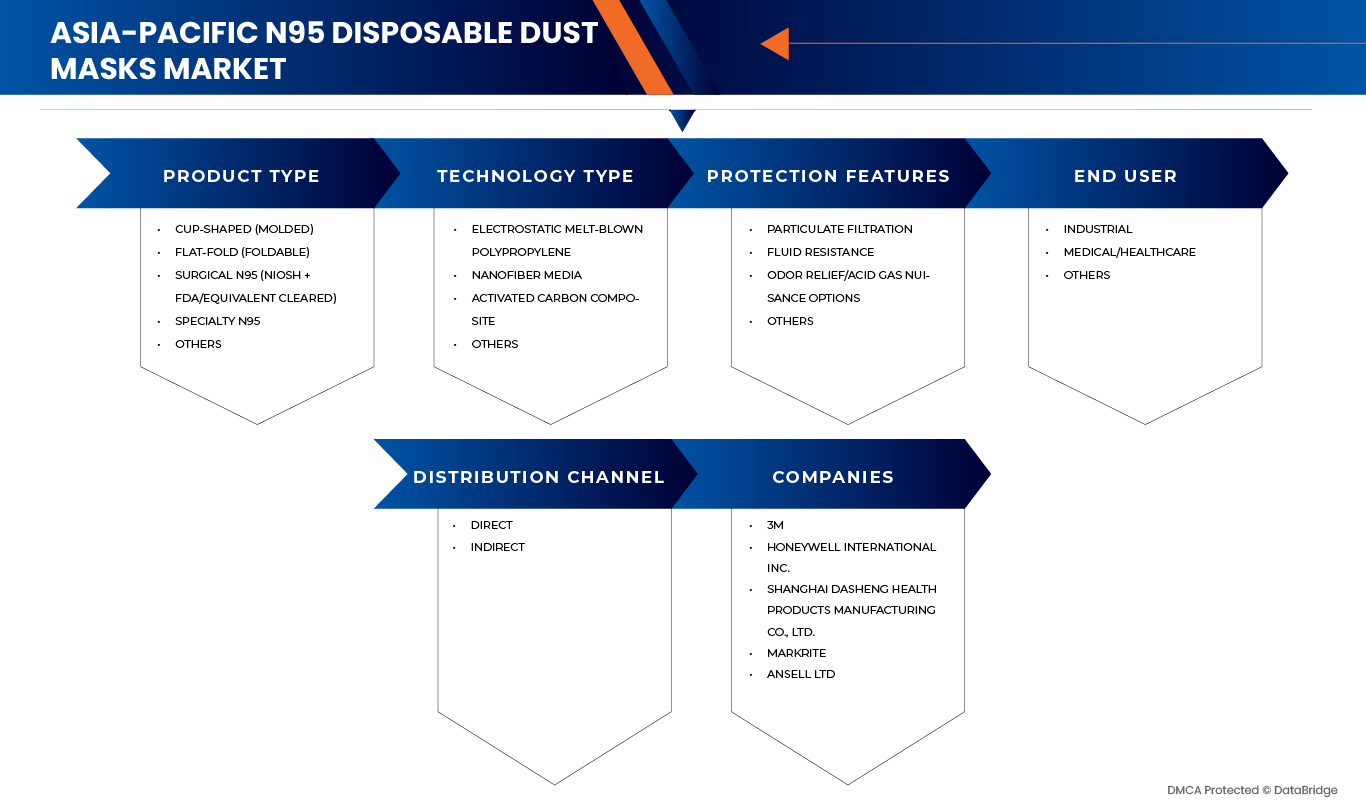
The Asia-Pacific N95 Disposable Dust Masks Market is segmented into product type, technology, protection features, end user, distribution channel.
• By Product Type
On the basis of product type, the Asia-Pacific N95 Disposable Dust Masks Market is segmented into cup-shaped (molded), flat-fold (foldable), surgical N95 (NIOSH + FDA/equivalent cleared), specialty N95, and others. In 2026, the cup-shaped (molded) segment is expected to dominate the Asia-Pacific N95 Disposable Dust Masks Market with a 41.60% share, due to its superior structural rigidity, consistent fit, higher durability, and widespread acceptance across industrial and healthcare environments.
The cup-shaped (molded) segment is expected to grow at a CAGR of 10.4%, due to increasing industrial safety regulations, rising air pollution levels, growing construction and manufacturing activities, and sustained demand for high-filtration respiratory protection across emerging Asia-Pacific economies.
• By Technology
On the basis of technology, the Asia-Pacific N95 Disposable Dust Masks Market is segmented into electrostatic melt-blown polypropylene, nanofiber media, activated carbon composite, and others. In 2026, the electrostatic melt-blown polypropylene segment is expected to dominate the market with a 70.55% share, due to its high filtration efficiency, cost-effectiveness, proven performance in capturing fine particulate matter, and established manufacturing scalability.
The electrostatic melt-blown polypropylene segment is expected to grow at a CAGR of 9.9%, due to continued technological optimization, mass adoption by leading manufacturers, regulatory compliance advantages, and sustained demand from both industrial and healthcare sectors.
• By Protection Features
On the basis of protection features, the Asia-Pacific N95 Disposable Dust Masks Market is segmented into particulate filtration, fluid resistance, odor relief/acid gas nuisance options, and others. In 2026, the particulate filtration segment is expected to dominate the market with a 64.53% share, due to its core role in meeting N95 certification standards, high effectiveness against airborne particulates, and widespread usage across industrial, construction, and medical applications.
The particulate filtration segment is expected to grow at a CAGR of 9.9%, due to rising awareness of occupational respiratory hazards, increasing pollution exposure, and stricter workplace safety and health regulations across the Asia-Pacific region.
• By End User
On the basis of end user, the Asia-Pacific N95 Disposable Dust Masks Market is segmented into industrial, medical/healthcare, and others. In 2026, the industrial segment is expected to dominate the market with a 62.35% share, due to extensive usage in construction, mining, manufacturing, oil & gas, and chemical industries where exposure to dust, fumes, and airborne particles is high.
The industrial segment is expected to grow at a CAGR of 9.9%, due to expanding industrialization, infrastructure development, enforcement of occupational safety norms, and increased adoption of personal protective equipment (PPE) across developing Asia-Pacific economies.
• By Distribution Channel
On the basis of distribution channel, the Asia-Pacific N95 Disposable Dust Masks Market is segmented into direct and indirect channels. In 2026, the direct segment is expected to dominate the market with a 58.57% share, due to strong manufacturer–enterprise relationships, bulk procurement by industrial and healthcare organizations, better pricing control, and assured product authenticity.
The direct segment is expected to grow at a CAGR of 9.9%, due to increasing preference for long-term supply contracts, streamlined logistics, reduced intermediary costs, and growing demand from large-scale industrial and institutional buyers.
Asia-Pacific N95 Disposable Dust Masks Market Regional Analysis
- Indonesia is recognized as one of the most significant markets for N95 disposable dust masks in Asia-Pacific, supported by rapid industrial expansion, sustained construction activity, and growing manufacturing output. The country’s large workforce, increasing pollution levels in major cities, and strict enforcement of workplace safety regulations continue to drive strong and consistent demand for high-performance N95 dust masks across mining, cement, construction, and heavy-industrial sectors.
- Vietnam is witnessing growing adoption of N95 disposable dust masks as the country accelerates its manufacturing and export-oriented industries, particularly electronics, textile processing, metal fabrication, and industrial assembly operations. Rising industrial automation, expanding industrial parks, and stronger occupational health compliance are increasing the use of protective respiratory equipment to ensure worker safety in high-particulate environments.
- Thailand’s expanding automotive, electronics, and construction sectors are further fueling demand for N95 disposable dust masks, as industrial modernization and infrastructure development intensify across the country. The ongoing build-out of logistics hubs, industrial estates, and urban projects requires reliable respiratory protection solutions, positioning N95 dust masks as essential PPE for maintaining safe and regulated working conditions
Indonesia Asia-Pacific N95 Disposable Dust Masks Market Insight
Indonesia’s Asia-Pacific N95 Disposable Dust Masks Market is witnessing robust growth, driven by rapid industrialization, expanding construction and manufacturing activities, and heightened occupational safety regulations. Rising awareness of workplace health, coupled with increasing pollution levels in urban areas, is fueling consistent demand for high-performance N95 masks across mining, automotive, electronics, and heavy-industrial sectors, positioning Indonesia as a key market in the Asia-Pacific region.
Vietnam Asia-Pacific N95 Disposable Dust Masks Market Insight
Vietnam’s Asia-Pacific N95 Disposable Dust Masks Market is expanding steadily, driven by rapid growth in manufacturing, electronics, textile, and industrial sectors. Increasing industrial automation, stricter occupational health regulations, and rising awareness of workplace safety are boosting demand for high-quality N95 masks. The country’s focus on export-oriented industries further reinforces the need for reliable respiratory protection in industrial operations.
Asia-Pacific N95 Disposable Dust Masks Market Share
The N95 disposable dust masks industry is primarily led by well-established companies, including:
- 3M (U.S.)
- Honeywell International Inc. (U.S.)
- Shanghai Dasheng Health Products Manufacturing Co., Ltd. (China)
- Markrite (U.S.)
- Ansell Ltd (Australia)
- Cardinal Health (U.S.)
- Dr. Hygiene Medical Products Co., Ltd. (Thailand)
- Jinfuyu Industrial Co., Ltd. (China)
- Primamedix (Indonesia)
- Quasmo (India)
- Shigematsu Works Co., Ltd. (Japan)
- Suzhou Sanical Protective Product Manufacturing Co., Ltd. (China)
- GUANGZHOU ZIO CHEMICAL CO., LTD. (China)
- JINAN FUTURE CHEMICAL CO., LTD. (China)
- Kawaguchi Chemical Industry Co., LTD (Japan)
- SILVERLINE CHEMICALS (India)
- MP BIOMEDICALS (U.S.)
Latest Developments in Asia-Pacific N95 Disposable Dust Masks Market
- In May 2022, Honeywell launched two new NIOSH-certified N95 respiratory offerings to help meet the needs of healthcare workers. The new products expand Honeywell’s Personal Protective Equipment (PPE) portfolio for healthcare professionals, incorporating the company’s decades of expertise producing respiratory-protection solutions.
- In October 2025, an NDTV news article reported that air-quality monitors recorded “Poor” AQI levels across large parts of Delhi-NCR. A pulmonologist then issued a public statement advising all citizens, including those without prior respiratory conditions, to wear properly fitted N95 (or equivalent particulate-filter) masks during outdoor exposure to mitigate pollution-related health risks.
- In November 2023, World Resources Institute news article highlighted abput a regional environmental analysis for major Southeast Asian cities explicitly noted that during high-pollution days driven by vehicular emissions and industrial activity — health agencies in cities such as Jakarta and Bangkok routinely issue public advisories urging residents to remain indoors where possible or use masks when outdoors, underscoring that respirator use has become a recurring protective behaviour.
- In November 2024, the Ministry of Health, Labour and Welfare issued an English-language update to its Technical Guideline for Preventing Health Impairment of Workers Handling Indium-Tin Oxide, specifying the need for certified dust respirators with defined protection factors, creating opportunities for highly specialized N95-class devices for electronics and semiconductor industries.
- In March 2025, the health authority in New South Wales, Australia, published updated public guidance confirming that P2/N95-rated masks are recommended for individuals returning to fire-damaged homes after bushfires to protect against inhaling fine particulate matter. The guidance explicitly recommends the use of P2/N95 face masks in post-fire clean-up operations

- Interactive Data Analysis Dashboard
- Company Analysis Dashboard for high growth potential opportunities
- Research Analyst Access for customization & queries
- Competitor Analysis with Interactive dashboard
- Latest News, Updates & Trend analysis
- Harness the Power of Benchmark Analysis for Comprehensive Competitor Tracking
Table of Content
1 INTRODUCTION
1.1 OBJECTIVES OF THE STUDY
1.2 MARKET DEFINITION
1.3 OVERVIEW OF ASIA-PACIFIC N95 DISPOSABLE DUST MASKS MARKET
1.4 LIMITATIONS
1.5 MARKETS COVERED
2 MARKET SEGMENTATION
2.1 MARKETS COVERED
2.2 GEOGRAPHICAL SCOPE
2.3 YEARS CONSIDERED FOR THE STUDY
2.4 CURRENCY AND PRICING
2.5 DBMR TRIPOD DATA VALIDATION MODEL
2.6 MULTIVARIATE MODELLING
2.7 PRIMARY INTERVIEWS WITH KEY OPINION LEADERS
2.8 DBMR MARKET POSITION GRID
2.9 MARKET END USE GRID
2.1 SECONDARY SOURCES
2.11 ASSUMPTIONS
3 EXECUTIVE SUMMARY
4 PREMIUM INSIGHTS
4.1 PORTERS FIVE FORCES ANALYSIS
4.2 CLIMATE CHANGE SCENARIO
4.2.1 ENVIRONMENTAL CONCERNS
4.2.2 INDUSTRY RESPONSE
4.2.3 GOVERNMENTS ROLES
4.2.4 ANALYST RECOMMENDATIONS
4.3 CONSUMER BUYING BEHAVIOUR ASIA-PACIFIC N95 DISPOSABLE DUST MASKS MARKET
4.3.1 INTRODUCTION:
4.3.2 FOUNDATIONS OF CONSUMER AWARENESS & RISK PERCEPTION
4.3.2.1 HEIGHTENED HEALTH SENSITIVITY
4.3.2.2 INFLUENCE OF PUBLIC ANNOUNCEMENTS & INSTITUTIONAL MESSAGING
4.3.3 DETAILED PRODUCT EVALUATION CRITERIA THAT SHAPE PURCHASE DECISIONS
4.3.3.1 CERTIFICATION & FILTRATION RELIABILITY
4.3.3.2 COMFORT, FIT & WEARABILITY
4.3.3.3 SKIN COMPATIBILITY & CLIMATE SUITABILITY
4.3.3.4 PRICING EXPECTATIONS & PERCEIVED VALUE
4.3.4 CONSUMER SEGMENTATION & USAGE BEHAVIOUR ACROSS ASIA-PACIFIC
4.3.4.1 INDUSTRIAL & WORKPLACE USERS
4.3.4.2 HEALTHCARE PROFESSIONALS
4.3.4.3 GENERAL CONSUMERS & URBAN USERS
4.3.4.4 POLLUTION-SENSITIVE CONSUMERS
4.3.5 PURCHASE CHANNELS & HOW BUYING JOURNEYS ARE FORMED
4.3.5.1 DIGITAL & E-COMMERCE PLATFORMS
4.3.5.2 PHARMACIES, CLINICS & MEDICAL STORES
4.3.5.3 INDUSTRIAL SUPPLY CHAINS
4.3.5.4 RETAIL CHAINS & CONVENIENCE STORES
4.3.6 FORMATION OF BRAND TRUST & DIFFERENTIATION CUES
4.3.6.1 AUTHENTICITY & TRACEABILITY
4.3.6.2 TRANSPARENT COMMUNICATION & EDUCATION
4.3.7 POST-PURCHASE BEHAVIOUR, USER EXPERIENCE & RETENTION TRIGGERS
4.3.7.1 USAGE PATTERNS
4.3.7.2 DISPOSAL PRACTICES & HYGIENE AWARENESS
4.3.7.3 6.3 DRIVERS OF REPEAT PURCHASES
4.3.8 REGIONAL & CULTURAL NUANCES ACROSS THE ASIA-PACIFIC LANDSCAPE
4.3.8.1 EAST ASIA
4.3.8.2 SOUTH ASIA
4.3.8.3 SOUTHEAST ASIA
4.4 VENDOR SELECTION CRITERIA (ASIA-PACIFIC N95 DISPOSABLE DUST MASKS MARKET)
4.4.1 PRODUCT QUALITY & PERFORMANCE ASSURANCE
4.4.2 REGULATORY COMPLIANCE & CERTIFICATION INTEGRITY
4.4.3 SUPPLY CHAIN STRENGTH & REGIONAL DISTRIBUTION CAPABILITY
4.4.4 PRICING STRUCTURE & COST COMPETITIVENESS
4.4.5 INNOVATION CAPABILITY & PRODUCT DEVELOPMENT STRENGTH
4.4.6 BRAND REPUTATION & MARKET TRUSTWORTHINESS
4.4.7 SUSTAINABILITY & ENVIRONMENTAL RESPONSIBILITY
4.4.8 AFTER-SALES SUPPORT & SERVICE RELIABILITY
4.4.9 FINANCIAL STABILITY & PARTNERSHIP ORIENTATION
4.4.10 C.ONCLUSION
4.5 RAW MATERIAL COVERAGE (ASIA-PACIFIC N95 DISPOSABLE DUST MASKS MARKET)
4.5.1 INTRODUCTION:
4.5.2 POLYPROPYLENE (PP)
4.5.3 MELT-BLOWN NONWOVEN FABRIC
4.5.4 SPUN-BOND NONWOVEN FABRIC
4.5.5 NOSE CLIPS (ALUMINUM OR PLASTIC)
4.5.6 ELASTIC BANDS AND HEAD STRAPS
4.5.7 EXHALATION VALVE COMPONENTS
4.5.8 ADHESIVES AND BONDING AGENTS
4.5.9 PACKAGING MATERIALS
4.5.10 SUSTAINABILITY-ORIENTED MATERIALS
4.6 BRAND OUTLOOK: ASIA-PACIFIC N95 DISPOSABLE DUST MASKS MARKET
4.6.1 BRAND POSITIONING AND RECOGNITION
4.6.2 INNOVATION AND PRODUCT DIFFERENTIATION
4.6.3 MARKETING, AWARENESS, AND BRAND COMMUNICATION
4.6.4 REGIONAL ADAPTATION AND LOCALIZATION
4.6.5 BRAND LOYALTY AND CONSUMER BEHAVIOR
4.6.6 STRATEGIC OUTLOOK FOR BRANDS
4.7 TECHNOLOGICAL ADVANCEMENTS IN THE ASIA-PACIFIC N95 DISPOSABLE DUST MASKS MARKET
4.7.1 INTRODUCTION
4.7.2 ADVANCEMENTS IN FILTRATION MATERIALS AND LAYER ENGINEERING
4.7.3 INNOVATIONS IN MASK DESIGN, COMFORT, AND ERGONOMICS
4.7.4 MANUFACTURING AND PROCESS AUTOMATION ADVANCEMENTS
4.7.5 SMART AND CONNECTED MASK TECHNOLOGIES
4.7.6 ADVANCES IN ANTIMICROBIAL AND SURFACE-PROTECTION TECHNOLOGIES
4.7.7 ENVIRONMENTAL AND SUSTAINABILITY-FOCUSED INNOVATIONS
4.7.8 REGULATORY AND COMPLIANCE-DRIVEN TECHNOLOGY ENHANCEMENTS
4.7.9 MARKET-SPECIFIC CUSTOMIZATION TECHNOLOGIES
4.7.10 KEY RISKS AND ADOPTION CHALLENGES
4.7.11 PRACTICAL NEXT STEPS FOR BUYERS OR MANUFACTURERS
4.8 PROFIT MARGIN SCENARIO
4.8.1 INTRODUCTION
4.8.2 COST STRUCTURE AND MARGIN SENSITIVITY
4.8.2.1 RAW MATERIAL DYNAMICS
4.8.2.2 MANUFACTURING OVERHEADS
4.8.3 REGULATORY COMPLIANCE AND CERTIFICATION COSTS
4.8.3.1 STANDARDS AND QUALITY REQUIREMENTS
4.8.3.2 ENVIRONMENTAL AND OPERATIONAL COMPLIANCE
4.8.4 COMPETITIVE DYNAMICS AND PRICING PRESSURES
4.8.4.1 FRAGMENTATION OF THE MANUFACTURING BASE
4.8.4.2 SUPPLY CHAIN ORIENTATION
4.8.5 DEMAND-DRIVEN MARGIN VARIABILITY
4.8.5.1 INSTITUTIONAL PROCUREMENT
4.8.5.2 CONSUMER MARKET DYNAMICS
4.8.6 MARGIN ENHANCEMENT THROUGH INNOVATION
4.8.6.1 PRODUCT DIFFERENTIATION
4.8.6.2 SUSTAINABILITY AND DESIGN IMPROVEMENTS
4.8.7 OUTLOOK FOR PROFIT MARGINS
4.9 SUPPLY CHAIN ANALYSIS
4.9.1 OVERVIEW
4.9.2 LOGISTIC COST SCENARIO
4.9.3 INBOUND LOGISTICS FOR RAW MATERIALS
4.9.3.1 DOMESTIC DISTRIBUTION OF FINISHED MASKS
4.9.3.2 EXPORT LOGISTICS AND INTERNATIONAL SHIPPING CONDITIONS
4.9.4 IMPORTANCE OF LOGISTIC SERVICE PROVIDERS
4.9.4.1 SPECIALIZED HANDLING AND QUALITY ASSURANCE SUPPORT
4.9.4.2 NETWORK DESIGN, ROUTING, AND INVENTORY POSITIONING
4.9.4.3 CUSTOMS, CERTIFICATION, AND COMPLIANCE MANAGEMENT
4.9.4.4 RISK MITIGATION AND SUPPLY-CHAIN RESILIENCE
4.9.4.5 ENHANCED SERVICE LEVELS FOR HEALTHCARE AND INDUSTRIAL USERS
4.9.5 CONCLUSION
4.1 VALUE CHAIN ANALYSIS
4.10.1 VALUE CHAIN OVERVIEW
4.10.2 UPSTREAM STAGE: RAW MATERIALS AND SPECIALIZED INPUTS
4.10.2.1 POLYMER RESINS AND ADDITIVES
4.10.2.2 MELT-BLOWN AND SPUNBOND NONWOVEN FABRIC PRODUCTION
4.10.2.3 ANCILLARY COMPONENTS AND PACKAGING
4.10.3 MIDSTREAM STAGE: MASK CONVERSION AND ASSEMBLY
4.10.3.1 AUTOMATED MANUFACTURING MACHINERY
4.10.3.2 PROCESS FLOW AND FACTORY-LEVEL QUALITY CONTROLS
4.10.4 REGULATORY, TESTING, AND CERTIFICATION LAYER
4.10.4.1 KEY STANDARDS AND EQUIVALENCES IN APAC
4.10.4.2 LABORATORY TESTING AND CONFORMITY PROCESSES
4.10.5 DOWNSTREAM STAGE: DISTRIBUTION AND END-USE MARKETS
4.10.5.1 HEALTHCARE AND PUBLIC HEALTH AGENCIES
4.10.6 INDUSTRIAL, CONSTRUCTION, AND MINING APPLICATIONS
4.10.7 CONSUMER AND RETAIL CHANNELS
4.10.8 CROSS-CUTTING CONSIDERATIONS
4.10.8.1 SUPPLY CHAIN RESILIENCE
4.10.8.2 ENVIRONMENTAL MANAGEMENT AND WASTE
4.1 COST ANALYSIS BREAKDOWN
4.1.1 KEY COST COMPONENTS
4.1.1.1 RAW MATERIALS
4.1.1.2 LABOR COSTS
4.1.1.3 CAPITAL AND EQUIPMENT DEPRECIATION
4.1.1.4 ENERGY AND UTILITY COSTS
4.1.1.5 QUALITY CONTROL, COMPLIANCE, AND TESTING
4.1.1.6 PACKAGING, LOGISTICS, SHIPPING, AND DISTRIBUTION
4.1.1.7 SUPPLY CHAIN VOLATILITY AND ECONOMIES OF SCALE
4.1.1.8 PER-MASK COST BREAKDOWN
4.1.1.9 IMPLICATIONS FOR STAKEHOLDERS
4.2 INNOVATION TRACKER AND STRATEGIC ANALYSIS
4.2.1 MAJOR DEALS AND STRATEGIC ALLIANCES ANALYSIS
4.2.2 CTIVE DEVELOPMENT
4.2.3 STAGE OF DEVELOPMENT
4.2.4 TIMELINES AND MILESTONES
4.2.5 INNOVATION STRATEGIES AND METHODOLOGIES
4.2.6 RISK ASSESSMENT AND MITIGATION
4.2.7 FUTURE OUTLOOK
4.3 TARIFFS & IMPACT ON THE MARKET
4.3.1 CURRENT TARIFF RATE(S)
4.3.2 OUTLOOK: LOCAL PRODUCTION VS IMPORT RELIANCE
4.3.3 VENDOR SELECTION CRITERIA DYNAMICS
4.3.4 IMPACT ON SUPPLY CHAIN
4.3.4.1 RAW MATERIAL PROCUREMENT
4.3.5 MANUFACTURING AND PRODUCTION
4.3.5.1 LOGISTICS AND DISTRIBUTION
4.3.5.2 PRICE PITCHING AND POSITION OF MARKET
4.3.6 INDUSTRY PARTICIPANTS: PROACTIVE MOVES
4.3.6.1 SUPPLY CHAIN OPTIMIZATION
4.3.6.2 JOINT VENTURE ESTABLISHMENTS
4.3.7 IMPACT ON PRICES
4.3.8 REGULATORY INCLINATION
4.3.8.1 GEOPOLITICAL SITUATION
4.3.8.2 TRADE PARTNERSHIPS BETWEEN COUNTRIES
4.3.8.2.1 FREE TRADE AGREEMENTS
4.3.8.2.2 ALLIANCES ESTABLISHMENTS
4.3.8.3 STATUS ACCREDITATION (INCLUDING MFN)
4.3.8.4 DOMESTIC COURSE OF CORRECTION
4.3.8.4.1 INCENTIVE SCHEMES TO BOOST PRODUCTION OUTPUTS
4.3.8.4.2 ESTABLISHMENT OF SEZS/INDUSTRIAL PARKS
4.4 REGULATION COVERAGE
4.4.1 PRODUCT CODES
4.4.2 CERTIFIED STANDARDS
4.4.3 SAFETY STANDARDS
4.4.3.1 MATERIAL HANDLING & STORAGE
4.4.3.2 TRANSPORT & PRECAUTIONS
4.4.3.3 HAZARD IDENTIFICATION
4.5 TABLE
5 MARKET OVERVIEW
5.1 DRIVER
5.1.1 THE RISING INCIDENCE OF AIRBORNE INFECTIOUS DISEASES IS SUSTAINING BASELINE N95 DEMAND IN HOSPITALS AND CLINICS
5.1.2 HIGH URBAN AIR POLLUTION IN MAJOR APAC CITIES IS DRIVING SUSTAINED USE OF N95 MASKS BY WORKERS AND URBAN CONSUMERS
5.1.3 STRENGTHENING OCCUPATIONAL SAFETY REGULATIONS IN CONSTRUCTION AND MINING, MANDATING CERTIFIED RESPIRATORY PROTECTION
5.2 RESTRAINT
5.2.1 ENVIRONMENTAL CONCERNS ASSOCIATED WITH DIPOSAL OF N95 MASKS
5.2.2 THE PRESENCE OF COUNTERFEIT PRODUCTS IS UNDERMINING TRUST AND SQUEEZING THE MARGINS OF COMPLIANT MANUFACTURERS
5.3 OPPORTUNITIES
5.3.1 DEVELOPMENT OF ECO-FRIENDLIER AND REUSABLE N95 DESIGNS TO ADDRESS WASTE CONCERNS
5.3.2 GROWTH OF HEALTHCARE INFRASTRUCTURE IN CHINA, INDIA, SOUTHEAST ASIA, AND INCREASING INSTITUTIONAL PROCUREMENT
5.3.3 EXPANSION INTO INDUSTRIAL-GRADE AND SPECIALIZED N95 VARIANTS FOR SPECIFIC SECTORS
5.4 CHALLENGES
5.4.1 NAVIGATING HETEROGENEOUS REGULATORY AND CERTIFICATION FRAMEWORKS
5.4.2 MANAGING INVENTORY PLANNING AND DEMAND VOLATILITY, WITH SUDDEN SPIKES DURING OUTBREAKS, POLLUTION EPISODES, OR DISASTERS
6 ASIA-PACIFIC N95 DISPOSABLE DUST MASK MARKET, BY PRODUCT TYPE
6.1 OVERVIEW
6.2 CUP-SHAPED (MOLDED)
6.2.1 WITHOUT EXHALATION VALVE
6.2.2 WITH EXHALATION VALVE
6.2.3 STANDARD
6.2.4 SMALL
6.2.5 LARGE
6.3 FLAT-FOLD (FOLDABLE)
6.3.1 WITHOUT EXHALATION VALVE
6.3.2 WITH EXHALATION VALVE
6.3.3 DUAL STRAP OVER-THE-HEAD
6.3.4 BEHIND-THE-HEAD SINGLE STRAP
6.3.5 SURGICAL N95 (NIOSH + FDA/EQUIVALENT CLEARED)
6.3.6 SPECIALTY N95
6.3.7 OTHERS
7 ASIA-PACIFIC N95 DISPOSABLE DUST MASK MARKET, BY TECHNOLOGY
7.1 OVERVIEW
7.2 ELECTROSTATIC MELT-BLOWN POLYPROPYLENE
7.3 NANOFIBER MEDIA
7.4 ACTIVATED CARBON COMPOSITE
7.5 OTHERS
8 ASIA-PACIFIC N95 DISPOSABLE DUST MASK MARKET, BY PROTECTION FEATURES
8.1 OVERVIEW
8.2 PARTICULATE FILTRATION
8.3 FLUID RESISTANCE
8.4 ODOR RELIEF/ACID GAS NUISANCE OPTIONS
8.5 OTHERS
9 ASIA-PACIFIC N95 DISPOSABLE DUST MASK MARKET, BY END USE
9.1 OVERVIEW
9.2 INDUSTRIAL
9.2.1 CONSTRUCTION
9.2.2 SHIPBUILDING
9.2.3 MINING
9.2.4 AUTOMOTIVE
9.2.5 SMELTING
9.2.6 OTHERS
9.3 MEDICAL/HEALTHCARE
9.4 OTHERS
10 ASIA-PACIFIC N95 DISPOSABLE DUST MASK MARKET, BY DISTRIBUTION CHANNEL
10.1 OVERVIEW
10.2 DIRECT
10.3 INDIRECT
10.3.1 INDUSTRIAL DISTRIBUTORS
10.3.2 E-COMMERCE
10.3.3 SPECIALTY RETAIL
11 ASIA-PACIFIC N95 DISPOSABLE DUST MASKS MARKET
11.1 ASIA-PACIFIC
11.1.1 INDONESIA
11.1.2 VIETNAM
11.1.3 THAILAND
12 ASIA-PACIFIC N95 DISPOSABLE DUST MASK MARKET, COMPANY LANDSCAPE
12.1 COMPANY SHARE ANALYSIS: ASIA-PACIFIC
13 SWOT ANALYSIS
14 COMAPANY PROFILES
14.1 3M
14.1.1 COMPANY SNAPSHOT
14.1.2 REVENUE ANALYSIS
14.1.3 PRODUCT PORTFOLIO
14.1.4 RECENT DEVELOPMENT
14.2 HONEYWELL INTERNATIONAL INC.
14.2.1 COMPANY SNAPSHOT
14.2.2 REVENUE ANALYSIS
14.2.3 PRODUCT PORTFOLIO
14.2.4 RECENT DEVELOPMENT
14.3 SHANGHAI DASHENG HEALTH PRODUCTS MANUFACTURING CO., LTD.
14.3.1 COMPANY SNAPSHOT
14.3.2 PRODUCT PORTFOLIO
14.3.3 RECENT DEVELOPMENT
14.4 MARKRITE
14.4.1 COMPANY SNAPSHOT
14.4.2 PRODUCT PORTFOLIO
14.4.3 RECENT DEVELOPMENT
14.5 ANSELL LTD
14.5.1 COMPANY SNAPSHOT
14.5.2 REVENUE ANALYSIS
14.5.3 PRODUCT PORTFOLIO
14.5.4 RECENT DEVELOPMENT
14.6 CARDINAL HEALTH
14.6.1 COMPANY SNAPSHOT
14.6.2 REVENUE ANALYSIS
14.6.3 PRODUCT PORTFOLIO
14.6.4 RECENT DEVELOPMENT
14.7 DR. HYGIENE MEDICAL PRODUCTS CO., LTD
14.7.1 COMPANY SNAPSHOT
14.7.2 PRODUCT PORTFOLIO
14.7.3 RECENT DEVELOPMENT
14.8 JINFUYU INDUSTRIAL CO., LTD.
14.8.1 COMPANY SNAPSHOT
14.8.2 PRODUCT PORTFOLIO
14.8.3 RECENT DEVELOPMENT
14.9 PRIMAMEDIX
14.9.1 COMPANY SNAPSHOT
14.9.2 PRODUCT PORTFOLIO
14.9.3 RECENT DEVELOPMENT
14.1 QUASMO
14.10.1 COMPANY SNAPSHOT
14.10.2 PRODUCT PORTFOLIO
14.10.3 RECENT DEVELOPMENT
14.11 SHIGEMATSU WORKS CO., LTD.
14.11.1 COMPANY SNAPSHOT
14.11.2 REVENUE ANALYSIS
14.11.3 PRODUCT PORTFOLIO
14.11.4 RECENT DEVELOPMENT
14.12 SUZHOU SANICAL PROTECTIVE PRODUCT MANUFACTURING CO., LTD
14.12.1 COMPANY SNAPSHOT
14.12.2 PRODUCT PORTFOLIO
14.12.3 RECENT DEVELOPMENT
15 QUESTIONNAIRE
16 RELATED REPORTS
List of Table
TABLE 1 COMPARATIVE BRAND POSITIONING LANDSCAPE (ASIA-PACIFIC)
TABLE 2 INDICATIVE PERCEIVED MARKET POSITION
TABLE 3 CONSUMER BUYING BEHAVIOUR – ASIA-PACIFIC N95 DISPOSABLE DUST MASKS MARKET
TABLE 4 VENDOR SELECTION CRITERIA: IMPORTANCE WEIGHTING FRAMEWORK FOR APAC N95 MASK SUPPLIERS
TABLE 5 BRAND OUTLOOK – ASIA-PACIFIC N95 DISPOSABLE DUST MASKS MARKET
TABLE 6 TYPICAL COST SHARES OF ASIA-PACIFIC N95 DISPOSABLE DUST MASKS:
TABLE 7 DETAILS ON MOST COMMON MASKED, BY COUNTRY, 2024
TABLE 8 PRICING/MARGIN ANALYSIS, AT MANUFACTURER’S & DISTRIBUTION LEVEL, BY COUNTRY, 2024
TABLE 9 DETAILS ON MOST COMMON MASKED, BY COUNTRY, 2024
TABLE 10 PRICING/MARGIN ANALYSIS, AT MANUFACTURER’S & DISTRIBUTION LEVEL, BY COUNTRY, 2024
TABLE 11 DETAILS ON MOST COMMON MASKED, BY COUNTRY, 2024
TABLE 12 PRICING/MARGIN ANALYSIS, AT MANUFACTURER’S & DISTRIBUTION LEVEL, BY COUNTRY, 2024
TABLE 13 ASIA-PACIFIC N95 DISPOSABLE DUST MASK MARKET, BY PRODUCT TYPE, 2018-2033 (USD THOUSAND)
TABLE 14 ASIA-PACIFIC CUP-SHAPED (MOLDED) IN N95 DISPOSABLE DUST MASKS MARKET, BY VALVE TYPE, 2018-2033 (USD THOUSAND)
TABLE 15 ASIA-PACIFIC CUP-SHAPED (MOLDED) IN N95 DISPOSABLE DUST MASKS MARKET, BY FIT SIZE, 2018-2033 (USD THOUSAND)
TABLE 16 ASIA-PACIFIC FLAT-FOLD (FOLDABLE) IN N95 DISPOSABLE DUST MASKS MARKET, BY VALVE TYPE, 2018-2033 (USD THOUSAND)
TABLE 17 ASIA-PACIFIC FLAT-FOLD (FOLDABLE) IN N95 DISPOSABLE DUST MASKS MARKET, BY HEADBAND STYLE, 2018-2033 (USD THOUSAND)
TABLE 18 ASIA-PACIFIC N95 DISPOSABLE DUST MASK MARKET, BY TECHNOLOGY, 2018-2033 (USD THOUSAND)
TABLE 19 ASIA-PACIFIC N95 DISPOSABLE DUST MASK MARKET, BY PROTECTION FEATURES, 2018-2033 (USD THOUSAND)
TABLE 20 ASIA-PACIFIC N95 DISPOSABLE DUST MASK MARKET, BY END USE, 2018-2033 (USD THOUSAND)
TABLE 21 ASIA-PACIFIC INDUSTRIAL IN N95 DISPOSABLE DUST MASKS MARKET, BY TYPE, 2018-2033 (USD THOUSAND)
TABLE 22 ASIA-PACIFIC N95 DISPOSABLE DUST MASK MARKET, BY DISTRIBUTION CHANNEL, 2018-2033 (USD THOUSAND)
TABLE 23 ASIA-PACIFIC INDIRECT IN N95 DISPOSABLE DUST MASKS MARKET, BY TYPE, 2018-2033 (USD THOUSAND)
TABLE 24 ASIA-PACIFIC N95 DISPOSABLE DUST MASKS MARKET, BY COUNTRY, 2018-2033 (USD THOUSAND)
TABLE 25 ASIA-PACIFIC N95 DISPOSABLE DUST MASKS MARKET, BY PRODUCT TYPE, 2018-2033 (USD THOUSAND)
TABLE 26 ASIA-PACIFIC CUP-SHAPED (MOLDED) IN N95 DISPOSABLE DUST MASKS MARKET, BY VALVE TYPE, 2018-2033 (USD THOUSAND)
TABLE 27 ASIA-PACIFIC CUP-SHAPED (MOLDED) IN N95 DISPOSABLE DUST MASKS MARKET, BY FIT SIZE, 2018-2033 (USD THOUSAND)
TABLE 28 ASIA-PACIFIC FLAT-FOLD (FOLDABLE) IN N95 DISPOSABLE DUST MASKS MARKET, BY VALVE TYPE, 2018-2033 (USD THOUSAND)
TABLE 29 ASIA-PACIFIC FLAT-FOLD (FOLDABLE) IN N95 DISPOSABLE DUST MASKS MARKET, BY HEADBAND STYLE, 2018-2033 (USD THOUSAND)
TABLE 30 ASIA-PACIFIC N95 DISPOSABLE DUST MASKS MARKET, BY TECHNOLOGY, 2018-2033 (USD THOUSAND)
TABLE 31 ASIA-PACIFIC N95 DISPOSABLE DUST MASKS MARKET, BY PROTECTION FEATURES, 2018-2033 (USD THOUSAND)
TABLE 32 ASIA-PACIFIC N95 DISPOSABLE DUST MASKS MARKET, BY END USE, 2018-2033 (USD THOUSAND)
TABLE 33 ASIA-PACIFIC INDUSTRIAL IN N95 DISPOSABLE DUST MASKS MARKET, BY TYPE, 2018-2033 (USD THOUSAND)
TABLE 34 ASIA-PACIFIC N95 DISPOSABLE DUST MASKS MARKET, BY DISTRIBUTION CHANNEL, 2018-2033 (USD THOUSAND)
TABLE 35 ASIA-PACIFIC INDIRECT IN N95 DISPOSABLE DUST MASKS MARKET, BY TYPE, 2018-2033 (USD THOUSAND)
TABLE 36 INDONESIA N95 DISPOSABLE DUST MASKS MARKET, BY PRODUCT TYPE, 2018-2033 (USD THOUSAND)
TABLE 37 INDONESIA CUP-SHAPED (MOLDED) IN N95 DISPOSABLE DUST MASKS MARKET, BY VALVE TYPE, 2018-2033 (USD THOUSAND)
TABLE 38 INDONESIA CUP-SHAPED (MOLDED) IN N95 DISPOSABLE DUST MASKS MARKET, BY FIT SIZE, 2018-2033 (USD THOUSAND)
TABLE 39 INDONESIA FLAT-FOLD (FOLDABLE) IN N95 DISPOSABLE DUST MASKS MARKET, BY VALVE TYPE, 2018-2033 (USD THOUSAND)
TABLE 40 INDONESIA FLAT-FOLD (FOLDABLE) IN N95 DISPOSABLE DUST MASKS MARKET, BY HEADBAND STYLE, 2018-2033 (USD THOUSAND)
TABLE 41 INDONESIA N95 DISPOSABLE DUST MASKS MARKET, BY TECHNOLOGY, 2018-2033 (USD THOUSAND)
TABLE 42 INDONESIA N95 DISPOSABLE DUST MASKS MARKET, BY PROTECTION FEATURES, 2018-2033 (USD THOUSAND)
TABLE 43 INDONESIA N95 DISPOSABLE DUST MASKS MARKET, BY END USE, 2018-2033 (USD THOUSAND)
TABLE 44 INDONESIA INDUSTRIAL IN N95 DISPOSABLE DUST MASKS MARKET, BY TYPE, 2018-2033 (USD THOUSAND)
TABLE 45 INDONESIA N95 DISPOSABLE DUST MASKS MARKET, BY DISTRIBUTION CHANNEL, 2018-2033 (USD THOUSAND)
TABLE 46 INDONESIA INDIRECT IN N95 DISPOSABLE DUST MASKS MARKET, BY TYPE, 2018-2033 (USD THOUSAND)
TABLE 47 VIETNAM N95 DISPOSABLE DUST MASKS MARKET, BY PRODUCT TYPE, 2018-2033 (USD THOUSAND)
TABLE 48 VIETNAM CUP-SHAPED (MOLDED) IN N95 DISPOSABLE DUST MASKS MARKET, BY VALVE TYPE, 2018-2033 (USD THOUSAND)
TABLE 49 VIETNAM CUP-SHAPED (MOLDED) IN N95 DISPOSABLE DUST MASKS MARKET, BY FIT SIZE, 2018-2033 (USD THOUSAND)
TABLE 50 VIETNAM FLAT-FOLD (FOLDABLE) IN N95 DISPOSABLE DUST MASKS MARKET, BY VALVE TYPE, 2018-2033 (USD THOUSAND)
TABLE 51 VIETNAM FLAT-FOLD (FOLDABLE) IN N95 DISPOSABLE DUST MASKS MARKET, BY HEADBAND STYLE, 2018-2033 (USD THOUSAND)
TABLE 52 VIETNAM N95 DISPOSABLE DUST MASKS MARKET, BY TECHNOLOGY, 2018-2033 (USD THOUSAND)
TABLE 53 VIETNAM N95 DISPOSABLE DUST MASKS MARKET, BY PROTECTION FEATURES, 2018-2033 (USD THOUSAND)
TABLE 54 VIETNAM N95 DISPOSABLE DUST MASKS MARKET, BY END USE, 2018-2033 (USD THOUSAND)
TABLE 55 VIETNAM INDUSTRIAL IN N95 DISPOSABLE DUST MASKS MARKET, BY TYPE, 2018-2033 (USD THOUSAND)
TABLE 56 VIETNAM N95 DISPOSABLE DUST MASKS MARKET, BY DISTRIBUTION CHANNEL, 2018-2033 (USD THOUSAND)
TABLE 57 VIETNAM INDIRECT IN N95 DISPOSABLE DUST MASKS MARKET, BY TYPE, 2018-2033 (USD THOUSAND)
TABLE 58 THAILAND N95 DISPOSABLE DUST MASKS MARKET, BY PRODUCT TYPE, 2018-2033 (USD THOUSAND)
TABLE 59 THAILAND CUP-SHAPED (MOLDED) IN N95 DISPOSABLE DUST MASKS MARKET, BY VALVE TYPE, 2018-2033 (USD THOUSAND)
TABLE 60 THAILAND CUP-SHAPED (MOLDED) IN N95 DISPOSABLE DUST MASKS MARKET, BY FIT SIZE, 2018-2033 (USD THOUSAND)
TABLE 61 THAILAND FLAT-FOLD (FOLDABLE) IN N95 DISPOSABLE DUST MASKS MARKET, BY VALVE TYPE, 2018-2033 (USD THOUSAND)
TABLE 62 THAILAND FLAT-FOLD (FOLDABLE) IN N95 DISPOSABLE DUST MASKS MARKET, BY HEADBAND STYLE, 2018-2033 (USD THOUSAND)
TABLE 63 THAILAND N95 DISPOSABLE DUST MASKS MARKET, BY TECHNOLOGY, 2018-2033 (USD THOUSAND)
TABLE 64 THAILAND N95 DISPOSABLE DUST MASKS MARKET, BY PROTECTION FEATURES, 2018-2033 (USD THOUSAND)
TABLE 65 THAILAND N95 DISPOSABLE DUST MASKS MARKET, BY END USE, 2018-2033 (USD THOUSAND)
TABLE 66 THAILAND INDUSTRIAL IN N95 DISPOSABLE DUST MASKS MARKET, BY TYPE, 2018-2033 (USD THOUSAND)
TABLE 67 THAILAND N95 DISPOSABLE DUST MASKS MARKET, BY DISTRIBUTION CHANNEL, 2018-2033 (USD THOUSAND)
TABLE 68 THAILAND INDIRECT IN N95 DISPOSABLE DUST MASKS MARKET, BY TYPE, 2018-2033 (USD THOUSAND)
List of Figure
FIGURE 1 ASIA-PACIFIC N95 DISPOSABLE DUST MASKS MARKET: SEGMENTATION
FIGURE 2 ASIA-PACIFIC N95 DISPOSABLE DUST MASKS MARKET: DATA TRIANGULATION
FIGURE 3 ASIA-PACIFIC N95 DISPOSABLE DUST MASKS MARKET: DROC ANALYSIS
FIGURE 4 ASIA-PACIFIC N95 DISPOSABLE DUST MASKS MARKET: GLOBAL VS REGIONAL ANALYSIS
FIGURE 5 ASIA-PACIFIC N95 DISPOSABLE DUST MASKS MARKET: COMPANY RESEARCH ANALYSIS
FIGURE 6 ASIA-PACIFIC N95 DISPOSABLE DUST MASKS MARKET: INTERVIEW DEMOGRAPHICS
FIGURE 7 ASIA-PACIFIC N95 DISPOSABLE DUST MASKS MARKET: DBMR MARKET POSITION GRID
FIGURE 8 ASIA-PACIFIC N95 DISPOSABLE DUST MASKS MARKET: MARKET END USE COVERAGE GRID
FIGURE 9 EXECUTIVE SUMMARY
FIGURE 10 FIVE SEGMENTS COMPRISE THE ASIA-PACIFIC N95 DISPOSABLE DUST MASKS MARKET, BY PRODUCT TYPE (2025)
FIGURE 11 ASIA-PACIFIC N95 DISPOSABLE DUST MASKS MARKET: SEGMENTATION
FIGURE 12 STRATEGIC DECISIONS
FIGURE 13 THE RISING INCIDENCE OF AIRBORNE INFECTIOUS DISEASES IS SUSTAINING BASELINE N95 DEMAND IN HOSPITALS AND CLINICS, EXPECTED TO DRIVE THE ASIA-PACIFIC N95 DISPOSABLE DUST MASKS MARKET IN THE FORECAST PERIOD OF 2026 TO 2033
FIGURE 14 CUP-SHAPED (MOLDED) SEGMENT IS EXPECTED TO ACCOUNT FOR THE LARGEST SHARE OF THE ASIA-PACIFIC N95 DISPOSABLE DUST MASKS MARKET IN 2026 & 2033
FIGURE 15 DRIVERS, RESTRAINTS, OPPORTUNITIES AND CHALLENGES OF THE ASIA-PACIFIC N95 DISPOSABLE DUST MASKS MARKET
FIGURE 16 ASIA-PACIFIC N95 DISPOSABLE DUST MASK MARKET, BY PRODUCT TYPE, 2025
FIGURE 17 ASIA-PACIFIC N95 DISPOSABLE DUST MASK MARKET, BY TECHNOLOGY, 2025
FIGURE 18 ASIA-PACIFIC N95 DISPOSABLE DUST MASK MARKET, BY PROTECTION FEATURES, 2025
FIGURE 19 ASIA-PACIFIC N95 DISPOSABLE DUST MASK MARKET, BY END USE, 2025
FIGURE 20 ASIA-PACIFIC N95 DISPOSABLE DUST MASK MARKET, BY DISTRIBUTION CHANNEL, 2025
FIGURE 21 ASIA-PACIFIC N95 DISPOSABLE DUST MASKS MARKET, SNAPSHOT (2025)
FIGURE 22 ASIA-PACIFIC N95 DISPOSABLE DUST MASK MARKET: COMPANY SHARE 2025 (%)
FIGURE 23 ASIA-PACIFIC N95 DISPOSABLE DUST MASKS MARKET, SWOT ANALYSIS

Data collection and base year analysis are done using data collection modules with large sample sizes. The stage includes obtaining market information or related data through various sources and strategies. It includes examining and planning all the data acquired from the past in advance. It likewise envelops the examination of information inconsistencies seen across different information sources. The market data is analysed and estimated using market statistical and coherent models. Also, market share analysis and key trend analysis are the major success factors in the market report. To know more, please request an analyst call or drop down your inquiry.
The key research methodology used by DBMR research team is data triangulation which involves data mining, analysis of the impact of data variables on the market and primary (industry expert) validation. Data models include Vendor Positioning Grid, Market Time Line Analysis, Market Overview and Guide, Company Positioning Grid, Patent Analysis, Pricing Analysis, Company Market Share Analysis, Standards of Measurement, Global versus Regional and Vendor Share Analysis. To know more about the research methodology, drop in an inquiry to speak to our industry experts.
Data Bridge Market Research is a leader in advanced formative research. We take pride in servicing our existing and new customers with data and analysis that match and suits their goal. The report can be customized to include price trend analysis of target brands understanding the market for additional countries (ask for the list of countries), clinical trial results data, literature review, refurbished market and product base analysis. Market analysis of target competitors can be analyzed from technology-based analysis to market portfolio strategies. We can add as many competitors that you require data about in the format and data style you are looking for. Our team of analysts can also provide you data in crude raw excel files pivot tables (Fact book) or can assist you in creating presentations from the data sets available in the report.