


Optical Fiber Monitoring Market Size
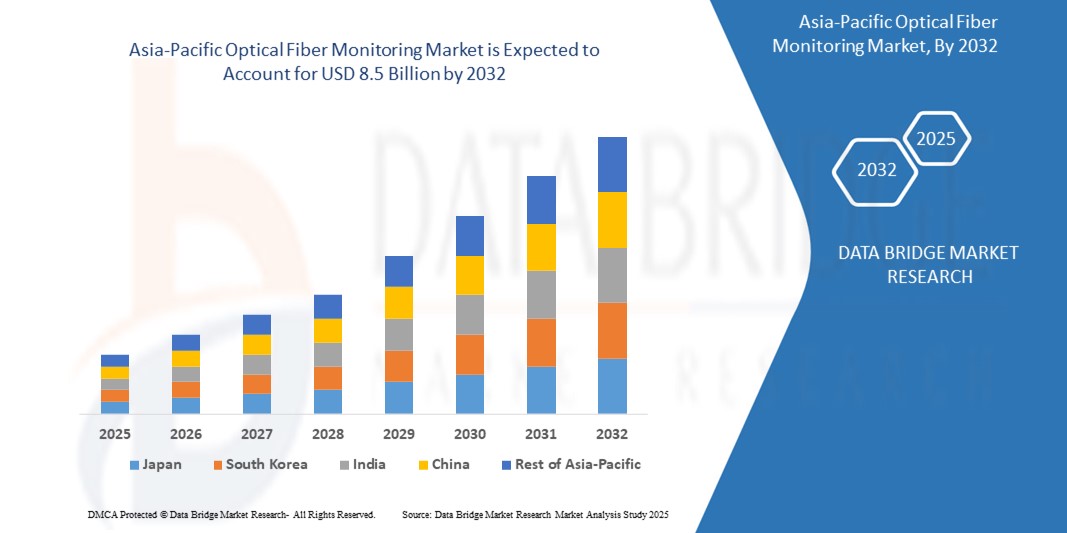
- The Asia-Pacific Optical Fiber Monitoring Market size was valued at USD 3.71 Billion in 2024 and is expected to reach USD 8.5 Billion by 2032, at a CAGR of 12.6% during the forecast period
- The accelerated rollout of 5G technology across Asia-Pacific is a major driver, as 5G infrastructure requires robust, real-time fiber monitoring to ensure high-speed, low-latency connectivity and uninterrupted service.
- Growing internet usage and higher broadband adoption rates, especially in populous countries like China and India, are fueling the need for reliable fiber optic monitoring solutions to support expanding networks.
Optical Fiber Monitoring Market Analysis
- Advancements in technologies such as Distributed Fiber Optic Sensing (DFOS), Active Fiber Monitoring, and Passive Fiber Monitoring are enhancing the capabilities of optical fiber monitoring systems. These technologies enable real-time monitoring, fault detection, and performance analysis, which are critical for maintaining the integrity of fiber optic networks.
- Collaborations between companies and governments are leading to significant infrastructure developments in the region. For instance, Singapore's Keppel and Vietnam's Sovico Group are in discussions to develop new undersea fiber-optic cables to enhance the region's data center industry. Vietnam plans to add 10 new submarine cables by 2030, aiming to become a regional data center hub.
- Despite the growth, the market faces challenges such as high initial investment and maintenance costs associated with fiber monitoring equipment. Additionally, a lack of skilled expertise and awareness regarding the benefits of real-time fiber monitoring solutions among telecom operators in developing nations may restrain market growth.
- China dominates the Optical Fiber Monitoring Market with the largest revenue share of 46.01% in 2024, due to proliferation of data centers driven by cloud computing and digital transformation initiatives has increased demand for advanced fiber monitoring systems to maintain network integrity and uptime.
- China is expected to be the fastest growing region in the Optical Fiber Monitoring Market due to urbanization and the rise of digital economies in countries such as China, India, and Japan are leading to higher deployment of fiber optics, necessitating advanced monitoring for network efficiency and reliability.
- Laser segment dominates the Optical Fiber Monitoring Market with a market share of 22.2% in 2024, driven by ternet usage and higher broadband adoption rates, especially in populous countries like China and India, are fueling the need for reliable fiber optic monitoring solutions to support expanding networks.
Report Scope and Optical Fiber Monitoring Market Segmentation
|
Attributes |
Optical Fiber Monitoring Market Insights |
|
Segments Covered |
|
|
Countries Covered |
Asia-Pacific
|
|
Key Market Players |
|
|
Market Opportunities |
|
|
Value Added Data Infosets |
In addition to the insights on market scenarios such as market value, growth rate, segmentation, geographical coverage, and major players, the market reports curated by the Data Bridge Market Research also include in-depth expert analysis, pricing analysis, brand share analysis, consumer survey, demography analysis, supply chain analysis, value chain analysis, raw material/consumables overview, vendor selection criteria, PESTLE Analysis, Porter Analysis, and regulatory framework. |
Optical Fiber Monitoring Market Trends
“Rapid Expansion Driven by Smart Infrastructure Initiatives”
- The Asia-Pacific optical fiber monitoring market is experiencing accelerated growth, fueled by large-scale investments in smart city projects and the ongoing expansion of telecommunications infrastructure. Countries such as China, Japan, South Korea, and India are prioritizing high-speed internet connectivity and robust network reliability, which is increasing demand for advanced fiber monitoring solutions.
- For instance, FFT, based in Melbourne, specializes in fiber optic intrusion detection systems for perimeters, pipelines, and data networks. Their patented Advanced Recognition and Discrimination (ARaD) technology reduces false alarms, enhancing security monitoring.
- A major trend is the integration of AI and machine learning into fiber monitoring systems. These technologies enable real-time fault detection, predictive maintenance, and automated network optimization, reducing downtime and operational costs. Telecom providers are increasingly adopting AI-powered monitoring to proactively address issues and ensure uninterrupted service.
- China currently leads the market, proliferation of data centers driven by cloud computing and digital transformation initiatives has increased demand for advanced fiber monitoring systems to maintain network integrity and uptime.
- China is emerging as the fastest-growing region fueled by urbanization and digital economy growth.
Optical Fiber Monitoring Market Dynamics
Driver
“Rising Demand for Real-Time, High-Precision Network Monitoring in Expanding”
- The Asia-Pacific region is experiencing rapid growth in digital infrastructure, driven by increasing investments in 5G networks, data centers, and smart city projects. This expansion necessitates advanced optical fiber monitoring solutions to ensure network reliability, minimize downtime, and support high-speed data transmission.
- For instance, the proliferation of Industry 4.0, the adoption of autonomous vehicles, and the surge in e-commerce are fueling demand for robust, real-time monitoring systems that can quickly detect and localize faults or degradations in fiber optic networks, thereby maintaining service quality and operational efficiency.
- Optical fiber monitoring technologies, which leverage distributed sensors and real-time analytics, enable operators to achieve high-precision fault detection, intrusion monitoring, and predictive maintenance—critical for mission-critical applications in telecommunications, energy, and transportation sectors.
- This trend is particularly pronounced in countries such as China, South Korea, Japan, and India, where large-scale deployments of fiber optic networks are underway to support growing urbanization, smart city initiatives, and the increasing use of connected devices.
Restraint/Challenge
“High Deployment Costs and Environmental Sensitivity”
- Implementing advanced optical fiber monitoring systems requires significant investment in both hardware (such as distributed acoustic sensors and high-speed data acquisition units) and software (for real-time analytics and visualization), which can be a barrier for network operators, especially in cost-sensitive or rural markets.
- For instance, the integration of sophisticated monitoring modules often increases the capital and operational expenditures for telecom providers and utilities, impacting the pace of adoption in emerging economies.
- Moreover, the performance of optical fiber monitoring can be affected by harsh environmental conditions—such as extreme temperatures, electromagnetic interference, or physical disturbances along the cable route—which may lead to false positives or reduced detection accuracy, particularly in outdoor or industrial deployments.
- These limitations highlight the need for ongoing innovation in sensor technology, signal processing algorithms, and cost-effective deployment strategies to ensure reliable performance across diverse environments in the Asia-Pacific region.
Optical Fiber Monitoring Market Scope
The market is segmented on the basis of Component, Monitoring Type, Technology, Mode Type, Vertical.
- By Component
On the basis of Component, the Optical Fiber Monitoring Market is segmented into Laser, Photodiode, 1xn Photonic Switch, Sub module, Controller, Display, Operator and Others. The Laser segment dominates the largest market revenue share of 22.2% in 2024, driven by Growing internet usage and higher broadband adoption rates, especially in populous countries like China and India.
The Photodiode segment is anticipated to witness the fastest growth rate of 11.7% from 2025 to 2032, fueled by growing importance of the Internet of Things (IoT) and connected devices increases the complexity and scale of networks, making continuous fiber monitoring essential for performance and security.
- By Monitoring Type
On the basis of Monitoring Type, the Optical Fiber Monitoring Market is segmented into Active Fiber Monitoring and Dark Fiber Monitoring. The Active Fiber Monitoring segment held the largest market revenue share in 2024 driven by Demand for Efficiency and Scalability.
The Active Fiber Monitoring segment is expected to witness the fastest CAGR from 2025 to 2032, driven by Need for Network Optimization and Efficiency.
- By Technology
On the basis of Technology, the Optical Fiber Monitoring Market is segmented into Distributed Acoustic Sensing, Distributed Temperature Sensing, Real Time Thermal Rating and Others. The Distributed Acoustic Sensing segment held the largest market revenue share in 2024, driven by Continuous innovation in monitoring technologies—such as distributed acoustic sensing, real-time thermal rating, and AI-powered analytics.
The Real Time Thermal Rating is expected to witness the fastest CAGR from 2025 to 2032, driven by Consumers and businesses demand uninterrupted, high-quality internet and communication services, pushing service providers to invest in advanced fiber monitoring for proactive maintenance and rapid fault localization.
Optical Fiber Monitoring Market Regional Analysis
- China dominates the Optical Fiber Monitoring Market with the largest revenue share of 46.01% in 2024, driven by Technological Advancements in Fiber Monitoring.
- Continuous innovation in monitoring technologies—such as distributed acoustic sensing, real-time thermal rating, and AI-powered analytics—enhances the effectiveness and adoption of fiber monitoring solutions.
- Diverse industries, including IT, BFSI, oil and gas, automotive, and food and beverage, are increasingly deploying fiber monitoring systems to support digital transformation and operational efficiency.
China Optical Fiber Monitoring Market Insight
The China Optical Fiber Monitoring Market captured the largest revenue share of 51% in 2024 within Asia-Pacific, fueled by Intense competition among telecom operators in Asia-Pacific compels them to adopt robust fiber monitoring to retain customer loyalty, reduce downtime, and differentiate their service offering.
Asia-Pacific Optical Fiber Monitoring Market Insight
The Asia-Pacific Optical Fiber Monitoring Market is poised to grow at the fastest CAGR of 12.6% during the forecast period of 2025 to 2032, driven by industries, including IT, BFSI, oil and gas, automotive, and food and beverage, are increasingly deploying fiber monitoring systems to support digital transformation and operational efficiency.
Japan Optical Fiber Monitoring Market Insight
The Japan Optical Fiber Monitoring Market is gaining momentum due to Government-led broadband and connectivity projects across the region are strengthening fiber infrastructure, driving the adoption of monitoring technologies to ensure quality and resilience in public and private networks.
India Optical Fiber Monitoring Market Insight
The India Optical Fiber Monitoring Market accounted for the largest market revenue share in Asia-Pacific in 2024, driven by The proliferation of data centers driven by cloud computing and digital transformation initiatives has increased demand for advanced fiber monitoring systems to maintain network integrity and uptime.
Optical Fiber Monitoring Market Share
The Optical Fiber Monitoring Market is primarily led by well-established companies, including:
- Fibersonics
- Hifi Engineering Inc.
- OptaSense
- NTest Inc.
- AP Sensing
- Ziebel, Silixa Ltd
- CommVerge Solutions
- DSIT Solutions Ltd.
- M2 Optics Inc.
- Fluke Corporation
- AFL
- Kingfisher International
- FiberStore Co.
- Yokogawa Electric Corporation
- EXFO Inc.
- VIAVI Solutions Inc.
- Fujikura Ltd
- Moog Inc.
- SQS Vláknova optika a.s.
- Anritsu Corporation
- VeEX Inc.
- ShinewayTech.
- II-VI Incorporated KomShine
Latest Developments in Asia-Pacific Optical Fiber Monitoring Market
- In July 2023, Kingfisher International, a Melbourne-based company, manufactures fiber optic test and measurement equipment. Their acquisition by Tempo Communications aims to expand their global reach in fiber optic testing solutions.
- In August 2014, KVH, headquartered in Tokyo, operates low-latency fiber optic networks and data centers across Asia-Pacific. Their services cater to financial services, media, and manufacturing sectors, providing high-speed connectivity solutions.
- In April 2024, based in Shenzhen, T&S Communications manufactures fiber optic connectors and ceramic ferrules. The company serves global markets, including Europe and the US, and has expanded into the metaverse communication network sector.
- In February 2025, Accelink, located in Wuhan, produces optical components and subsystems for telecommunications. Their products include optical fiber connectors, dispersion compensation modules, and optical amplifiers, serving clients worldwide.
- In January 2025, AP Sensing provides distributed fiber-optic sensing (DFOS) technology for monitoring power cables, pipelines, and seismic activity. Their solutions are utilized in countries like Japan and across the Asia-Pacific region.

- Interactive Data Analysis Dashboard
- Company Analysis Dashboard for high growth potential opportunities
- Research Analyst Access for customization & queries
- Competitor Analysis with Interactive dashboard
- Latest News, Updates & Trend analysis
- Harness the Power of Benchmark Analysis for Comprehensive Competitor Tracking
Data collection and base year analysis are done using data collection modules with large sample sizes. The stage includes obtaining market information or related data through various sources and strategies. It includes examining and planning all the data acquired from the past in advance. It likewise envelops the examination of information inconsistencies seen across different information sources. The market data is analysed and estimated using market statistical and coherent models. Also, market share analysis and key trend analysis are the major success factors in the market report. To know more, please request an analyst call or drop down your inquiry.
The key research methodology used by DBMR research team is data triangulation which involves data mining, analysis of the impact of data variables on the market and primary (industry expert) validation. Data models include Vendor Positioning Grid, Market Time Line Analysis, Market Overview and Guide, Company Positioning Grid, Patent Analysis, Pricing Analysis, Company Market Share Analysis, Standards of Measurement, Global versus Regional and Vendor Share Analysis. To know more about the research methodology, drop in an inquiry to speak to our industry experts.
Data Bridge Market Research is a leader in advanced formative research. We take pride in servicing our existing and new customers with data and analysis that match and suits their goal. The report can be customized to include price trend analysis of target brands understanding the market for additional countries (ask for the list of countries), clinical trial results data, literature review, refurbished market and product base analysis. Market analysis of target competitors can be analyzed from technology-based analysis to market portfolio strategies. We can add as many competitors that you require data about in the format and data style you are looking for. Our team of analysts can also provide you data in crude raw excel files pivot tables (Fact book) or can assist you in creating presentations from the data sets available in the report.













