


Asia-Pacific Orthopedic Soft Tissue Repair Market Size
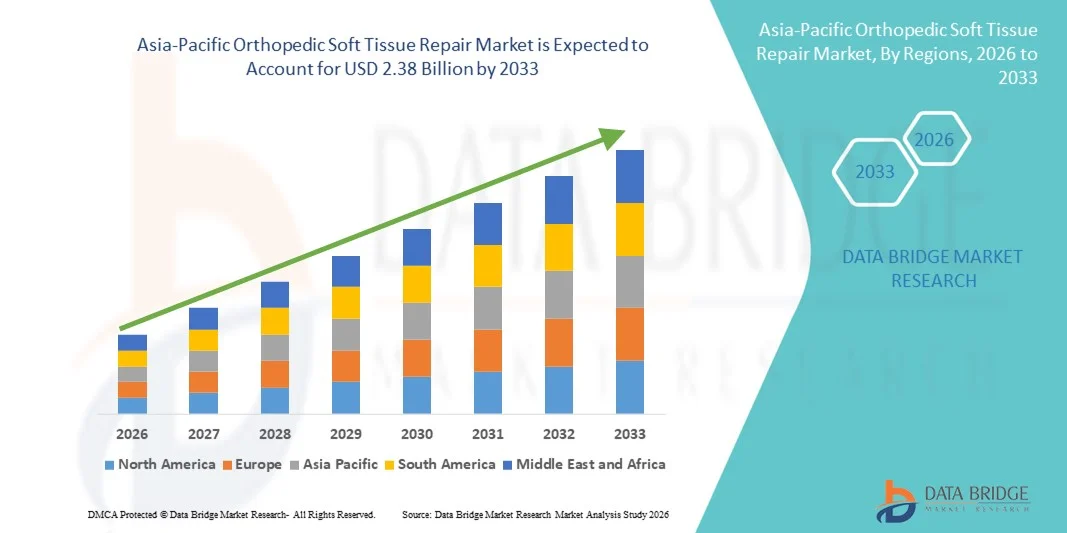
- The Asia-Pacific orthopedic soft tissue repair market size was valued at USD 1.26 billion in 2025 and is expected to reach USD 2.38 billion by 2033, at a CAGR of 8.30% during the forecast period
- The market growth is largely fueled by the rising incidence of sports injuries, increasing cases of ligament and tendon damage, and the growing aging population across the region, which is driving the demand for advanced orthopedic repair procedures
- Furthermore, expanding healthcare infrastructure, increasing adoption of minimally invasive orthopedic surgeries, and growing awareness about advanced soft tissue repair technologies among healthcare providers are establishing these solutions as a preferred treatment option. These converging factors are accelerating the uptake of orthopedic soft tissue repair devices, thereby significantly boosting the market’s growth
Asia-Pacific Orthopedic Soft Tissue Repair Market Analysis
- Orthopedic soft tissue repair solutions, including devices used for the repair of ligaments, tendons, and cartilage injuries, are increasingly essential components of modern orthopedic treatment across hospitals and specialty clinics due to their ability to restore joint stability, improve mobility, and support minimally invasive surgical procedures
- The escalating demand for orthopedic soft tissue repair products is primarily fueled by the rising incidence of sports-related injuries, increasing prevalence of musculoskeletal disorders, and a growing aging population that is more susceptible to ligament and tendon damage
- China dominated the Asia-Pacific orthopedic soft tissue repair market with the largest revenue share of 36.4% in 2025, characterized by expanding healthcare infrastructure, a large patient population, and increasing adoption of advanced orthopedic surgical technologies, with the country experiencing substantial growth in orthopedic procedures
- India is expected to be the fastest growing country in the Asia-Pacific orthopedic soft tissue repair market during the forecast period due to increasing healthcare investments, improving access to orthopedic care, and a rising number of sports and accident-related injuries
- Fixation Devices segment dominated the Asia-Pacific orthopedic soft tissue repair market with a market share of 41.7% in 2025, driven by their extensive use in stabilizing ligaments, tendons, and soft tissue grafts during orthopedic reconstruction procedures, along with increasing adoption in minimally invasive sports injury treatments
Report Scope and Asia-Pacific Orthopedic Soft Tissue Repair Market Segmentation
|
Attributes |
Asia-Pacific Orthopedic Soft Tissue Repair Key Market Insights |
|
Segments Covered |
|
|
Countries Covered |
Asia-Pacific
|
|
Key Market Players |
|
|
Market Opportunities |
|
|
Value Added Data Infosets |
In addition to the insights on market scenarios such as market value, growth rate, segmentation, geographical coverage, and major players, the market reports curated by the Data Bridge Market Research also include in-depth expert analysis, patient epidemiology, pipeline analysis, pricing analysis, and regulatory framework |
Asia-Pacific Orthopedic Soft Tissue Repair Market Trends
Advancements in Minimally Invasive and Biologic Repair Solutions
- A significant and accelerating trend in the Asia-Pacific orthopedic soft tissue repair market is the growing adoption of minimally invasive surgical techniques combined with biologic repair materials such as growth factors, collagen scaffolds, and platelet-rich plasma, enhancing patient recovery and procedural outcomes
- For instance, the BioAnchor system allows surgeons to perform tendon and ligament repairs using small incisions while incorporating biologic augmentation to promote faster tissue healing and reduce post-operative complications
- Innovations in implant design and materials enable better load distribution, improved fixation strength, and reduced surgery time, thereby enhancing procedural efficiency and patient satisfaction. For instance, Arthrex’s FiberTape and SwiveLock system combine mechanical fixation with biologic repair support for ligament reconstruction
- The integration of imaging technologies and computer-assisted surgical planning facilitates precise placement of soft tissue repair devices, minimizing tissue trauma and improving functional outcomes
- Use of smart surgical instruments and robotic-assisted procedures is gaining momentum, enabling enhanced precision and reproducibility in complex ligament and tendon repairs. For instance, Mako robotic systems are increasingly being used in orthopedic soft tissue procedures to improve surgical accuracy
- Growing collaboration between device manufacturers and research institutes is fostering the development of next-generation implants that combine mechanical strength with biologic compatibility. For instance, Medtronic has partnered with universities in Asia-Pacific to test novel composite scaffolds for tendon repair
- This trend toward more advanced, biologically integrated, and minimally invasive repair systems is fundamentally reshaping surgical standards in sports medicine and trauma care, with companies such as Smith & Nephew developing novel implants that support both mechanical and biologic tissue healing
- The demand for advanced, minimally invasive soft tissue repair solutions is growing rapidly across hospitals and specialty clinics, as orthopedic surgeons and patients increasingly prioritize faster recovery, reduced complications, and improved long-term joint function
Asia-Pacific Orthopedic Soft Tissue Repair Market Dynamics
Driver
Rising Incidence of Sports Injuries and Aging Population
- The increasing prevalence of sports-related injuries, road accidents, and an aging population with musculoskeletal disorders is a significant driver for the heightened demand for orthopedic soft tissue repair devices
- For instance, in March 2025, Smith & Nephew reported expanding use of its ACL reconstruction and tendon repair implants across Asia-Pacific hospitals, highlighting increased adoption driven by rising sports injury cases
- As the number of patients requiring ligament, tendon, and cartilage repair grows, the demand for high-performance fixation devices and biologically supportive implants continues to rise
- Furthermore, the growing awareness of early intervention and advanced repair techniques among healthcare providers is making soft tissue repair devices an integral part of orthopedic treatment protocols
- The availability of cost-effective, regionally tailored solutions and training programs for surgeons, along with hospital investments in modern orthopedic operating rooms, is propelling adoption across the Asia-Pacific region
- Increasing participation in professional and amateur sports across Asia-Pacific countries is creating a higher incidence of soft tissue injuries, driving hospital demand for repair solutions. For instance, rising football and cricket leagues in India and China are contributing to this trend
- Government initiatives to improve orthopedic healthcare infrastructure and provide subsidies for advanced surgical devices are also supporting market growth. For instance, Japan’s Ministry of Health has expanded funding for sports injury treatment programs in hospitals
Restraint/Challenge
High Cost and Limited Reimbursement in Certain Regions
- The high cost of advanced orthopedic soft tissue repair devices, including biologic implants and fixation systems, poses a significant challenge to broader market penetration, particularly in developing countries within Asia-Pacific
- For instance, the price of premium suture anchors or fixation systems may be prohibitive for smaller hospitals or clinics, limiting adoption despite clinical effectiveness
- Limited insurance coverage and variable reimbursement policies across countries in the region further restrict patient access to advanced repair procedures
- Additionally, a shortage of skilled surgeons trained in minimally invasive and biologic repair techniques can slow the adoption of novel devices in certain markets
- Overcoming these challenges through cost optimization, expanding training programs, and improving reimbursement frameworks will be vital for sustained growth in the Asia-Pacific orthopedic soft tissue repair market
- Regulatory approvals for novel biologic implants and fixation devices can be time-consuming, delaying product launches and adoption in certain countries. For instance, delays in approvals from China’s NMPA have impacted the availability of some advanced repair devices
- Supply chain disruptions and dependence on imported advanced implants may also affect market growth in emerging Asia-Pacific markets. For instance, reliance on U.S. and European manufacturers for high-end fixation devices can create delays and increase costs
Asia-Pacific Orthopedic Soft Tissue Repair Market Scope
The market is segmented on the basis of product, procedure, injury location, and end use.
- By Product
On the basis of product, the Asia-Pacific orthopedic soft tissue repair market is segmented into fixation devices, tissue patch, and laparoscopic instruments. The fixation devices segment dominated the market with the largest market revenue share of 41.7% in 2025, driven by their extensive use in stabilizing ligaments, tendons, and soft tissue grafts during orthopedic reconstruction procedures. Hospitals and orthopedic clinics often prioritize fixation devices for their mechanical strength, reliability, and ease of integration into minimally invasive surgical techniques. The market also sees strong demand for fixation devices due to their proven effectiveness in ACL, rotator cuff, and hip soft tissue repairs. Surgeons favor these devices for complex procedures requiring mechanical stability and compatibility with biologic grafts. Manufacturers continuously innovate fixation devices with bioresorbable materials and advanced designs to improve patient outcomes.
The tissue patch segment is anticipated to witness the fastest growth rate from 2026 to 2033, fueled by advancements in biologically active patches and scaffolds that support tendon and ligament regeneration. Tissue patches are increasingly adopted in rotator cuff repair, pelvic organ prolapse, and Achilles tendon surgeries, offering improved healing, reduced recovery time, and lower re-tear rates. Hospitals and specialty orthopedic centers prefer tissue patches for complex procedures requiring biologic augmentation. Surgeons adopt tissue patches to enhance soft tissue repair outcomes, particularly in minimally invasive surgeries. Rising awareness of regenerative therapy benefits among patients and healthcare providers is driving adoption across Asia-Pacific. Ongoing research collaborations are accelerating innovation in tissue patch solutions.
- By Procedure
On the basis of procedure, the market is segmented into anterior cruciate ligament, rotator cuff repair, vaginal prolapse, lateral epicondylitis, Achilles, gluteal tendon, biceps tenodesis, hip arthroscopy, cruciate ligament repair, and pelvic organ prolapse. The anterior cruciate ligament repair segment dominated the market with the largest market revenue share in 2025, driven by the high incidence of knee ligament injuries from sports and accidents. Hospitals and orthopedic clinics often prioritize ACL repair for both young athletes and aging populations with ligament tears. The market also sees strong demand due to the use of fixation devices and biologic grafts for restoring knee stability and functional mobility. Surgeons adopt advanced minimally invasive arthroscopic techniques to reduce recovery time. Continuous innovation in suture anchors, graft materials, and surgical techniques enhances clinical outcomes. Increasing sports participation across Asia-Pacific is driving procedural demand.
The rotator cuff repair segment is anticipated to witness the fastest growth rate from 2026 to 2033, fueled by rising shoulder injuries among aging populations and sports enthusiasts. Rotator cuff repair increasingly incorporates fixation devices and tissue patches to restore tendon integrity and reduce re-tear rates. Hospitals and specialized orthopedic centers are adopting arthroscopic techniques for minimally invasive repair. Surgeons value biologic augmentation in combination with mechanical fixation to improve functional outcomes. Awareness campaigns and professional sports injury clinics are boosting procedural adoption. Rising demand in India, Japan, and Southeast Asia contributes to regional growth.
- By Injury Location
On the basis of injury location, the market is segmented into knee, shoulder, hip, and others. The knee segment dominated the market with the largest market revenue share in 2025, driven by the high prevalence of ligament injuries, particularly ACL and cruciate ligament tears. Hospitals and orthopedic clinics prioritize knee surgeries due to high patient volumes and sports injury prevalence. The market also sees strong demand for fixation devices and tissue patches for knee repair procedures. Surgeons increasingly adopt minimally invasive and biologic augmentation techniques for improved outcomes. Advanced imaging and navigation systems support precision during knee repairs. Growing awareness among patients and sports academies further boosts demand.
The shoulder segment is anticipated to witness the fastest growth rate from 2026 to 2033, driven by rising cases of rotator cuff injuries, shoulder instability, and trauma. Shoulder repair procedures increasingly use tissue patches and fixation devices to restore tendon function. Hospitals and orthopedic specialty clinics adopt arthroscopic repair techniques. Surgeons prefer minimally invasive procedures combined with biologic augmentation to reduce recurrence rates. Growing sports participation and physically demanding occupations fuel shoulder injury prevalence. Patient awareness and regenerative repair technologies contribute to faster adoption.
- By End Use
On the basis of end use, the market is segmented into hospitals, orthopedic clinics, and ambulatory centers. The hospitals segment dominated the market with the largest market revenue share in 2025, driven by advanced infrastructure, higher patient throughput, and availability of specialized orthopedic surgeons. Hospitals prioritize fixation devices and tissue patches for complex soft tissue repairs. The market also sees strong demand due to investment in arthroscopic and laparoscopic instruments to improve procedural efficiency. Hospitals manage both acute trauma and elective sports injury cases, driving segment growth. Continuous training programs for surgical teams support adoption of advanced repair technologies. Strategic collaborations with manufacturers ensure access to innovative implants and instruments.
The orthopedic clinics segment is anticipated to witness the fastest growth rate from 2026 to 2033, fueled by rising demand for minimally invasive procedures and outpatient soft tissue repairs. Clinics increasingly adopt fixation devices, tissue patches, and laparoscopic instruments for rapid recovery procedures. Surgeons leverage these devices for sports injuries, ligament tears, and tendon repairs. Patients seeking faster recovery and reduced hospital stays are driving clinic adoption. Expanding specialty services and partnerships with device manufacturers support growth. Clinics focus on integrating biologic and mechanical repair solutions for optimal outcomes.
Asia-Pacific Orthopedic Soft Tissue Repair Market Regional Analysis
- China dominated the Asia-Pacific orthopedic soft tissue repair market with the largest revenue share of 36.4% in 2025, characterized by expanding healthcare infrastructure, a large patient population, and increasing adoption of advanced orthopedic surgical technologies, with the country experiencing substantial growth in orthopedic procedures
- Healthcare providers in China highly value advanced fixation devices, tissue patches, and minimally invasive surgical instruments for improving patient outcomes, reducing recovery time, and enhancing procedural efficiency
- This widespread adoption is further supported by increasing healthcare expenditure, expanding hospital infrastructure, rising awareness of orthopedic treatments, and the growing number of specialized orthopedic surgeons, establishing soft tissue repair solutions as a preferred choice for hospitals and orthopedic clinics across the country
The China Orthopedic Soft Tissue Repair Market Insight
China dominated the Asia-Pacific orthopedic soft tissue repair market with the largest revenue share of 36.4% in 2025, driven by the high prevalence of sports injuries, road accidents, and age-related musculoskeletal disorders. Hospitals and orthopedic clinics in China prioritize fixation devices, tissue patches, and laparoscopic instruments to improve patient outcomes, reduce recovery time, and enhance procedural efficiency. The market also sees strong demand due to the expansion of modern hospital infrastructure and government initiatives promoting advanced orthopedic care. Surgeons increasingly adopt minimally invasive and biologic augmentation techniques to improve recovery and reduce complications. Rising awareness of orthopedic treatments and the growing number of specialized surgeons are further driving market adoption. China’s strong manufacturing capabilities and domestic device suppliers also make advanced solutions more accessible and affordable.
Japan Orthopedic Soft Tissue Repair Market Insight
The Japan orthopedic soft tissue repair market is growing steadily due to the country’s aging population, increasing incidence of shoulder, hip, and tendon injuries, and preference for minimally invasive surgeries. Hospitals and specialty orthopedic centers highly value fixation devices and biologic tissue patches for their reliability and improved post-operative outcomes. The market also benefits from Japan’s emphasis on high-tech healthcare solutions and integration of advanced imaging and navigation systems during orthopedic procedures. Surgeons adopt arthroscopic and laparoscopic techniques to enhance procedural accuracy and reduce recovery times. Awareness of sports medicine and rehabilitation programs further boosts adoption. Japan’s healthcare infrastructure supports advanced orthopedic procedures, ensuring steady market growth.
India Orthopedic Soft Tissue Repair Market Insight
The India orthopedic soft tissue repair market accounted for the largest revenue share in South Asia within Asia-Pacific in 2025, driven by rising sports-related and trauma injuries, rapid urbanization, and growing healthcare expenditure. Hospitals, orthopedic clinics, and ambulatory centers increasingly adopt fixation devices, tissue patches, and laparoscopic instruments for ACL, rotator cuff, and other soft tissue repairs. The market also benefits from government initiatives promoting modern hospital development, affordable medical device options, and a growing pool of specialized surgeons. Patients increasingly prefer minimally invasive procedures due to shorter recovery times and reduced hospital stays. Domestic manufacturing capabilities and strong distribution networks further enhance accessibility of advanced orthopedic solutions across India.
Australia Orthopedic Soft Tissue Repair Market Insight
The Australia orthopedic soft tissue repair market is growing steadily due to increasing sports injuries, road accidents, and an aging population prone to tendon and ligament injuries. Hospitals and orthopedic clinics highly value fixation devices, tissue patches, and laparoscopic instruments for improving surgical outcomes and reducing recovery periods. The market also benefits from a well-developed healthcare infrastructure, strong insurance coverage, and rising awareness of minimally invasive orthopedic procedures. Surgeons increasingly adopt arthroscopic techniques and biologic augmentation for enhanced repair and functional recovery. Growing government support for advanced healthcare technologies and ongoing training programs for orthopedic professionals further drive market adoption. Australia’s strong focus on patient safety and quality outcomes ensures sustained demand for advanced soft tissue repair solutions.
Asia-Pacific Orthopedic Soft Tissue Repair Market Share
The Asia-Pacific Orthopedic Soft Tissue Repair industry is primarily led by well-established companies, including:
- Arthrex, Inc. (U.S.)
- Smith & Nephew (U.K.)
- Stryker (U.S.)
- Zimmer Biomet (U.S.)
- CONMED Corporation (U.S.)
- Integra LifeSciences Holdings Corporation (U.S.)
- Medtronic (Ireland)
- Orthofix Medical Inc. (U.S.)
- RTI Surgical Holdings, Inc. (U.S.)
- LifeNet Health, Inc. (U.S.)
- Parcus Medical, LLC (U.S.)
- Cayenne Medical, Inc. (U.S.)
- B. Braun SE (Germany)
- Tissue Regenix Group plc (U.K.)
- CO.DON AG (Germany)
- TETEC AG (Germany)
- DJO, LLC (U.S.)
- Corin Group (U.K.)
- OSSIO Ltd. (Ireland)
What are the Recent Developments in Asia-Pacific Orthopedic Soft Tissue Repair Market?
- In March 2026, Smith+Nephew unveiled an expanded rotator cuff repair portfolio featuring the new Tendon Seam™ Repair System alongside the REGENETEN Bioinductive Implant at the AAOS 2026 Annual Meeting, highlighting advanced biomechanical and biological soft tissue repair technologies aimed at improving repair strength and outcomes
- In September 2025, Meril announced the launch of the Mizzo Endo 4000 an AI‑enabled, 5G‑ready surgical robotic system in India, designed to advance soft tissue surgical precision and enable remote telesurgery, marking a significant technological leap in robotic‑assisted soft tissue procedures
- In September 2025, Yenepoya Specialty Hospital in India became the first in South Asia to launch the SkyWalker™ Orthopedic Robotic System for knee surgery, enhancing precision in soft tissue and joint surgeries with sub‑millimeter accuracy and real‑time data for ligament balancing, enabling smoother recoveries and improved functional outcomes in orthopedic procedures
- In August 2025, the Malaysian Orthopedic Association (MOA), Aclub Taiwan, and A Plus Biotechnology coordinated an academic conference in Kuala Lumpur to address precision orthopedic surgery needs, patient‑specific instrumentation, and minimally invasive solutions across Asia, fostering innovation and collaboration on personalized soft tissue repair approaches
- In July 2023, Smith+Nephew’s REGENETEN Bioinductive Implant showed significant clinical impact, with trial data demonstrating reduced re‑tear rates in rotator cuff surgery, underscoring the clinical validation of biologic augmentation approaches now influencing orthopedic soft tissue repair over traditional repair methods across the region

- Interactive Data Analysis Dashboard
- Company Analysis Dashboard for high growth potential opportunities
- Research Analyst Access for customization & queries
- Competitor Analysis with Interactive dashboard
- Latest News, Updates & Trend analysis
- Harness the Power of Benchmark Analysis for Comprehensive Competitor Tracking
Data collection and base year analysis are done using data collection modules with large sample sizes. The stage includes obtaining market information or related data through various sources and strategies. It includes examining and planning all the data acquired from the past in advance. It likewise envelops the examination of information inconsistencies seen across different information sources. The market data is analysed and estimated using market statistical and coherent models. Also, market share analysis and key trend analysis are the major success factors in the market report. To know more, please request an analyst call or drop down your inquiry.
The key research methodology used by DBMR research team is data triangulation which involves data mining, analysis of the impact of data variables on the market and primary (industry expert) validation. Data models include Vendor Positioning Grid, Market Time Line Analysis, Market Overview and Guide, Company Positioning Grid, Patent Analysis, Pricing Analysis, Company Market Share Analysis, Standards of Measurement, Global versus Regional and Vendor Share Analysis. To know more about the research methodology, drop in an inquiry to speak to our industry experts.
Data Bridge Market Research is a leader in advanced formative research. We take pride in servicing our existing and new customers with data and analysis that match and suits their goal. The report can be customized to include price trend analysis of target brands understanding the market for additional countries (ask for the list of countries), clinical trial results data, literature review, refurbished market and product base analysis. Market analysis of target competitors can be analyzed from technology-based analysis to market portfolio strategies. We can add as many competitors that you require data about in the format and data style you are looking for. Our team of analysts can also provide you data in crude raw excel files pivot tables (Fact book) or can assist you in creating presentations from the data sets available in the report.













