


Asia-Pacific Patient Handling Equipment Market Size
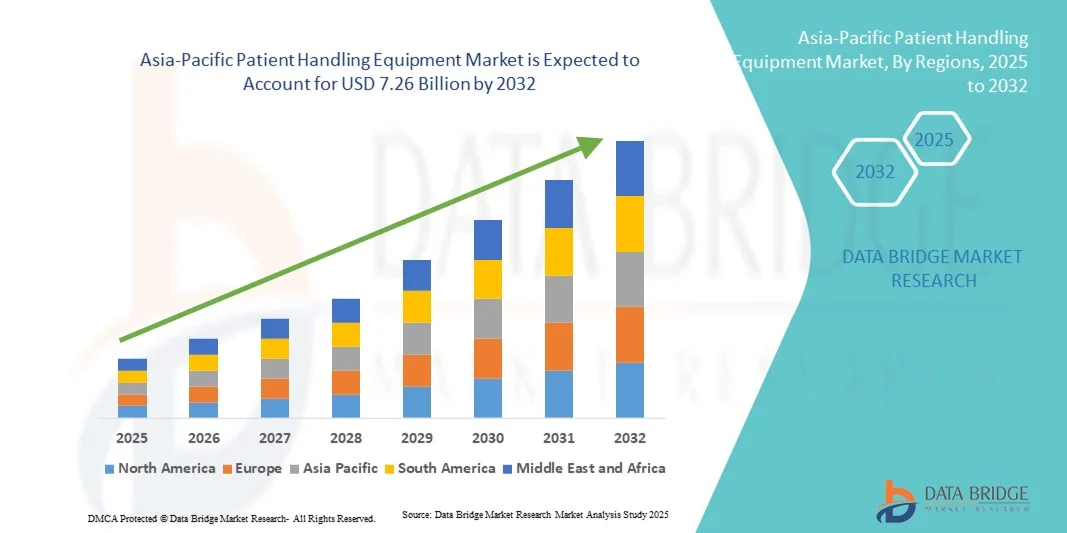
- The Asia-Pacific patient handling equipment market size was valued at USD 2.91 billion in 2024 and is expected to reach USD 7.26 billion by 2032, at a CAGR of 12.1% during the forecast period
- The market growth is primarily driven by the increasing geriatric population, rising prevalence of chronic diseases, and growing hospital admissions, which are creating a high demand for safe and efficient patient handling solutions across healthcare facilities
- Additionally, advancements in automated and ergonomic equipment, coupled with rising awareness of caregiver safety and patient comfort, are establishing modern patient handling systems as essential tools in hospitals and care centers. These converging factors are accelerating the adoption of patient handling equipment, thereby significantly boosting the industry's growth
Asia-Pacific Patient Handling Equipment Market Analysis
- Patient handling equipment, encompassing devices and tools designed to assist in the safe transfer, mobility, and care of patients, is becoming increasingly crucial in hospitals, long-term care facilities, and home care settings due to growing focus on patient safety, staff ergonomics, and operational efficiency
- The rising demand for patient handling equipment is primarily driven by the aging population, increasing prevalence of chronic diseases, and the need to reduce workplace injuries among healthcare staff, alongside the adoption of advanced healthcare infrastructure across the region
- China dominated the Asia-Pacific patient handling equipment market with the largest revenue share of 38.9% in 2024, supported by well-established healthcare systems, government initiatives for elderly care, and increasing investments in technologically advanced hospital equipment, with rapid adoption of motorized beds and mobility aids in urban hospitals
- India is expected to be the fastest growing country in the patient handling equipment market during the forecast period due to rising healthcare expenditure, improving hospital infrastructure, and increasing awareness about ergonomic solutions for healthcare workers
- Medical beds segment dominated the patient handling equipment market with a market share of 42.2% in 2024, driven by their critical role in patient comfort, adaptability across various care settings, and ease of integration with modern healthcare facility requirements
Report Scope and Asia-Pacific Patient Handling Equipment Market Segmentation
|
Attributes |
Asia-Pacific Patient Handling Equipment Key Market Insights |
|
Segments Covered |
|
|
Countries Covered |
Asia-Pacific
|
|
Key Market Players |
|
|
Market Opportunities |
|
|
Value Added Data Infosets |
In addition to the insights on market scenarios such as market value, growth rate, segmentation, geographical coverage, and major players, the market reports curated by the Data Bridge Market Research also include in-depth expert analysis, patient epidemiology, pipeline analysis, pricing analysis, and regulatory framework |
Asia-Pacific Patient Handling Equipment Market Trends
Advanced Ergonomic and AI-Enabled Solutions
- A significant and accelerating trend in the Asia-Pacific patient handling equipment market is the incorporation of ergonomic designs and AI-enabled automation, enhancing patient comfort, staff safety, and operational efficiency
- For instance, the Hill-Rom NaviCare Patient Lift incorporates AI-assisted positioning and movement tracking to reduce caregiver strain while improving patient safety during transfers
- AI integration in patient handling equipment enables features such as predicting patient movement to optimize lift or repositioning operations and providing intelligent alerts for fall prevention. For instance, the Arjo Sara Plus mobile lift can suggest optimal lifting angles based on patient weight distribution and historical data
- The seamless integration of patient handling devices with hospital information systems facilitates centralized monitoring of patient mobility, allowing staff to manage multiple devices and patient transfers efficiently, improving workflow and safety compliance
- This trend towards more intelligent, ergonomically designed, and interconnected equipment is fundamentally reshaping expectations for healthcare facilities. Consequently, companies such as Stryker are developing AI-assisted hospital beds and lifts with features such as automatic repositioning and load-sensing capabilities
- The demand for patient handling equipment that offers advanced ergonomic design and AI-assisted functionality is growing rapidly across both hospitals and long-term care facilities, as institutions increasingly prioritize patient safety and staff efficiency
Asia-Pacific Patient Handling Equipment Market Dynamics
Driver
Increasing Demand Due to Aging Population and Hospital Safety Focus
- The rising elderly population and increasing incidence of chronic diseases, coupled with a growing focus on reducing workplace injuries among healthcare staff, is a key driver for the heightened demand for patient handling equipment
- For instance, in March 2024, Arjo launched its new Smart Patient Lift system in India, featuring sensors that reduce caregiver strain and improve patient transfer safety, signaling rising adoption of advanced solutions in hospitals
- As healthcare facilities focus on patient safety and regulatory compliance, patient handling equipment provides advanced features such as weight monitoring, fall prevention alerts, and automated positioning, offering clear advantages over manual handling methods
- Furthermore, the growing awareness of occupational safety among caregivers and the need to optimize hospital workflows is making patient handling equipment an essential component of modern healthcare facilities
- The convenience of automated mobility aids, motorized beds, and easy-to-operate transfer systems, along with increased availability of cost-effective solutions, are key factors propelling the adoption of patient handling equipment in both public and private healthcare institutions
Restraint/Challenge
High Costs and Maintenance Requirements
- The relatively high initial investment required for advanced patient handling equipment, combined with ongoing maintenance needs, poses a challenge to broader market adoption across developing Asia-Pacific countries
- For instance, reports of high procurement and service costs for Stryker and Hill-Rom patient lift systems have made some smaller healthcare facilities hesitant to adopt these solutions
- Maintenance challenges, including the need for periodic calibration, software updates in AI-enabled beds, and replacement of mechanical parts, can increase operational costs and downtime, affecting adoption rates
- Furthermore, limited awareness of long-term benefits and the need for staff training to use advanced devices efficiently can hinder market penetration, especially in smaller or rural hospitals
- Overcoming these challenges through cost-effective leasing models, enhanced staff training programs, and partnerships with service providers for maintenance will be vital for sustained growth of the patient handling equipment market
Asia-Pacific Patient Handling Equipment Market Scope
The market is segmented on the basis of mode, product type, type of care, accessories, application, and end user.
- By Mode
On the basis of mode, the Asia-Pacific patient handling equipment market is segmented into mechanical equipment and non-mechanical equipment. The mechanical equipment segment dominated the market with the largest revenue share of 46.3% in 2024, driven by its wide adoption in hospitals and long-term care facilities for lifting, repositioning, and transporting patients. Mechanical devices, such as hydraulic lifts and manual hoists, are valued for their reliability, low maintenance requirements, and suitability in facilities with limited electrical infrastructure. Hospitals and elderly care centers often prioritize mechanical equipment for their robustness, safety features, and ease of use by caregivers with minimal training. The segment’s dominance is also supported by cost-effectiveness and proven performance in patient safety and staff ergonomics. Mechanical solutions continue to be favored in smaller clinics and rural healthcare setups due to simplicity and durability.
The non-mechanical equipment segment is expected to witness the fastest growth rate of 23.1% from 2025 to 2032, fueled by rising adoption of motorized beds, AI-enabled lifts, and automated transfer systems. These devices offer enhanced convenience, reduced caregiver strain, and seamless integration with hospital IT systems. Increasing investment in technologically advanced healthcare infrastructure in India, Australia, and Southeast Asia is contributing to rapid adoption of non-mechanical patient handling solutions. Non-mechanical equipment also enables remote operation and monitoring, which is increasingly preferred in modern smart hospitals and high-tech elderly care facilities.
- By Product Type
On the basis of product type, the market is segmented into medical beds, patient repositioning equipment, mobility aids, bathroom safety, and ambulatory aids. The medical beds segment dominated the market with a share of 42.2% in 2024, driven by their essential role in patient comfort, adaptability across various care settings, and compatibility with advanced monitoring systems. Hospitals and acute care facilities prioritize motorized and adjustable beds for their versatility in critical care, bariatric care, and long-term recovery scenarios. Demand for advanced features, such as AI-assisted positioning, pressure relief mattresses, and patient monitoring integration, is fueling growth. Medical beds are also widely used in rehabilitation centers and home care setups, where ergonomic design and patient safety are crucial. Manufacturers are increasingly offering modular and customizable beds to meet diverse care requirements.
The mobility aids segment is expected to witness the fastest CAGR of 22.4% from 2025 to 2032, supported by increasing geriatric population and rising prevalence of mobility-related disorders. Devices such as walkers, wheelchairs, and patient lifts are gaining traction in home care and elderly care facilities, driven by government initiatives promoting independent living and patient safety. Rising awareness about reducing caregiver strain and improving patient quality of life is further propelling demand for mobility aids. Technological advancements, such as foldable wheelchairs and AI-assisted lifts, are enhancing convenience and driving adoption.
- By Type of Care
On the basis of type of care, the market is segmented into long-term care, bariatric care, acute and critical care, wound care, fall prevention, and others. The acute and critical care segment dominated the market with a share of 38.9% in 2024, driven by high demand for patient handling solutions in hospitals and intensive care units. Equipment such as motorized beds, repositioning devices, and patient lifts are critical in ensuring patient safety and efficient care management in acute settings. Hospitals prioritize advanced features such as remote adjustment, pressure monitoring, and AI-assisted movement to reduce caregiver strain. Acute care settings also require robust devices that can withstand continuous daily use and heavy patient loads. The segment growth is supported by rising hospital investments in advanced ICU infrastructure.
The long-term care segment is expected to witness the fastest growth rate of 21.9% from 2025 to 2032, fueled by the rising aging population in countries such as Japan, India, and China. Long-term care facilities increasingly adopt ergonomic and automated patient handling solutions to ensure comfort, safety, and independence for elderly residents while minimizing staff injuries. Rising government support for elderly care programs and increasing private investments in long-term care infrastructure also contribute to growth. AI-enabled monitoring and lift devices are becoming common in long-term care centers, further driving adoption.
- By Accessories
On the basis of accessories, the market is segmented into hospital bed accessories, medical bed accessories, lifting accessories, transfer accessories, stretcher accessories, and others. The lifting accessories segment dominated the market with a share of 37.5% in 2024, due to its critical role in safe patient transfers and reducing caregiver injuries. Accessories such as slings, harnesses, and support belts are widely used across hospitals and home care settings. The focus on occupational safety and regulatory compliance drives continuous demand for high-quality lifting accessories. Lifting accessories also improve workflow efficiency and allow caregivers to handle patients with minimal physical strain. Continuous product innovations, such as adjustable and padded slings, are enhancing patient comfort and safety.
The transfer accessories segment is expected to witness the fastest CAGR of 23.7% from 2025 to 2032, supported by the growing use of slide boards, transfer sheets, and motorized transfer systems. These devices facilitate smooth patient repositioning and enhance workflow efficiency in hospitals and elderly care centers. Rising adoption of automated transfer devices in high-tech hospitals is further propelling growth. Improved design, durability, and ergonomics of transfer accessories are encouraging wider utilization across care settings.
- By Application
On the basis of application, the market is segmented into acute and critical care, long-term care, mobility assistance, fall prevention, and others. The mobility assistance segment dominated the market with a share of 39.2% in 2024, driven by rising patient demand for independent movement and enhanced safety in hospitals, home care, and elderly care facilities. Increasing prevalence of musculoskeletal and mobility-related conditions further fuels adoption of walking aids, lifts, and adjustable beds. Hospitals and rehabilitation centers prioritize mobility assistance devices to enhance patient recovery outcomes. Technological advancements such as foldable mobility aids and AI-assisted lifts are contributing to the segment’s growth. Continuous innovation in ergonomics and safety features is also boosting demand.
The fall prevention segment is expected to witness the fastest growth rate of 24.1% from 2025 to 2032, fueled by increasing awareness of patient safety, particularly among the elderly. Hospitals and long-term care facilities are investing in automated fall detection systems, bed alarms, and sensor-equipped mobility aids to reduce accident risks. Government regulations and patient safety standards are further driving adoption. Integration of IoT and AI in fall prevention devices is improving real-time monitoring and alert systems. Increasing insurance coverage for patient safety equipment is also supporting growth.
- By End User
On the basis of end user, the market is segmented into hospitals, home care settings, elderly care facilities, and others. The hospital segment dominated the market with a share of 44.6% in 2024, due to high demand for patient handling solutions in acute and critical care units, ICUs, and surgical departments. Hospitals require advanced equipment to improve patient safety, caregiver ergonomics, and operational efficiency. The need for compliance with safety regulations and quality standards further strengthens demand in this segment. Hospitals also prefer solutions that can integrate with monitoring systems for centralized control. Rising investments in modern hospital infrastructure in Asia-Pacific countries contribute to dominance.
The home care settings segment is expected to witness the fastest CAGR of 22.9% from 2025 to 2032, driven by rising preference for in-home patient care and the growing adoption of mobility aids, adjustable beds, and lifting devices in residential environments. Increasing awareness of patient safety and government support for home healthcare are accelerating this trend. Technologically advanced yet compact and easy-to-use devices are particularly popular in this segment. Growth is further supported by telehealth integration and remote monitoring capabilities.
Asia-Pacific Patient Handling Equipment Market Regional Analysis
- China dominated the Asia-Pacific patient handling equipment market with the largest revenue share of 38.9% in 2024, supported by well-established healthcare systems, government initiatives for elderly care, and increasing investments in technologically advanced hospital equipment, with rapid adoption of motorized beds and mobility aids in urban hospitals
- Hospitals and long-term care facilities in China prioritize advanced patient handling equipment such as motorized beds, patient lifts, and mobility aids to improve workflow efficiency, reduce staff injuries, and enhance patient comfort
- The widespread adoption is further supported by government initiatives for elderly care, increasing healthcare expenditure, and the growing trend of integrating AI and IoT-enabled devices for better monitoring and patient management, establishing patient handling equipment as a critical solution for hospitals, home care, and elderly care facilities
Japan Patient Handling Equipment Market Insight
The Japan patient handling equipment market is witnessing steady growth due to the country’s aging population, high healthcare standards, and adoption of high-tech solutions. Long-term care facilities, hospitals, and rehabilitation centers are increasingly implementing AI-enabled lifts, motorized beds, and mobility aids to enhance patient comfort and caregiver safety. Integration with hospital IT systems and smart monitoring platforms is further driving adoption. Japan’s healthcare policies promoting elderly care and safety compliance contribute to market expansion. Rising awareness about fall prevention and ergonomic patient handling equipment is also fueling demand. Additionally, technological innovation and quality-focused domestic manufacturers support the adoption of advanced patient handling devices.
India Patient Handling Equipment Market Insight
The India patient handling equipment market accounted for the largest revenue share in Asia-Pacific after China in 2024, driven by rapid urbanization, increasing middle-class population, and growing healthcare expenditure. Hospitals, rehabilitation centers, and home care services are adopting motorized beds, lifts, and mobility aids to improve patient safety and reduce caregiver strain. The government’s push toward smart hospitals and eldercare programs is accelerating adoption of advanced patient handling solutions. Affordable domestic manufacturing of ergonomic and AI-assisted devices further enhances accessibility. Rising awareness about occupational safety for healthcare staff and patient comfort is contributing to sustained growth. India’s expanding private healthcare sector and increasing adoption of long-term care services are key factors propelling the market.
Australia Patient Handling Equipment Market Insight
The Australia patient handling equipment market is experiencing steady growth due to increasing healthcare infrastructure development, rising elderly population, and growing awareness of patient safety and caregiver ergonomics. Hospitals, rehabilitation centers, and aged care facilities are adopting advanced solutions such as motorized beds, patient lifts, and mobility aids to improve patient comfort and reduce staff injuries. Government initiatives promoting eldercare, occupational safety, and hospital modernization are accelerating adoption. Technological advancements, including AI-assisted positioning systems and automated transfer devices, are enhancing operational efficiency and patient care quality. Rising healthcare expenditure and strong regulatory frameworks supporting safe patient handling are further driving market expansion. Additionally, the availability of both domestic and imported high-quality patient handling equipment is facilitating broader adoption across healthcare and home care settings.
Asia-Pacific Patient Handling Equipment Market Share
The Asia-Pacific Patient Handling Equipment industry is primarily led by well-established companies, including:
- Arjo (Sweden)
- Stryker (U.S.)
- Hill-Rom Holdings, Inc. (U.S.)
- Invacare International Holdings Corp. (U.S.)
- Getinge AB (Sweden)
- Joerns Healthcare (U.S.)
- Stiegelmeyer GmbH & Co. KG (Germany)
- Benmor Medical Ltd. (U.K.)
- Prism Medical Ltd. (Canada)
- Etac AB (Sweden)
- Mangar Health Ltd. (U.K.)
- LINET (Czech Republic)
- DJO Global, Inc. (U.S.)
- Sunrise Medical (U.S.)
- Medline Industries, Inc. (U.S.)
- Handicare Group AB (Sweden)
- Paramount Bed Co., Ltd. (Japan)
- Drive DeVilbiss Healthcare (U.S.)
- Owens & Minor, Inc. (U.S.)
- Meril Life Sciences (India)
What are the Recent Developments in Asia-Pacific Patient Handling Equipment Market?
- In June 2025, Stryker launched the APAISER X1, an advanced ICU air mattress designed specifically for the Indian market. This product, an important component of patient handling and pressure injury prevention, integrates seamlessly with Stryker's SmartMedic platform to enhance patient comfort and caregiver efficiency, indicating a localized product development strategy for the Asia-Pacific region
- In April 2025, Arjo introduced the Maxi Move® 5, an advanced patient floor lift designed to enhance caregiver safety and patient comfort. This new model incorporates features such as touch sensor–activated motion assist and ergonomic design to facilitate safer and more efficient patient transfers in hospitals and long-term care settings. The launch underscores Arjo's commitment to innovation in patient handling solutions
- In March 2025, Stryker launched the next generation "LIFEPAK CR2 AED" for enhanced cardiac care and an "Evacuation Chair" for a comprehensive evacuation solution at Criticare 2024 in India. The Evacuation Chair falls under patient handling for emergency situations, and its launch at a major Indian critical care event highlights its direct introduction and marketing for the Asia-Pacific region
- In October 2024, Hill-Rom announced a collaboration with EarlySense to integrate continuous monitoring sensors into their hospital beds. This partnership aims to enhance patient safety by enabling real-time monitoring of vital signs and movement, allowing for timely interventions. The integration of EarlySense's contact-free monitoring technology into Hill-Rom's beds represents a significant advancement in smart hospital bed technology
- In March 2024, Stryker Corporation expanded its research and development facility in India to accelerate innovation in patient handling technologies. This expansion aims to support global product development and enhance the company's presence in the Asia-Pacific region

- Interactive Data Analysis Dashboard
- Company Analysis Dashboard for high growth potential opportunities
- Research Analyst Access for customization & queries
- Competitor Analysis with Interactive dashboard
- Latest News, Updates & Trend analysis
- Harness the Power of Benchmark Analysis for Comprehensive Competitor Tracking
Data collection and base year analysis are done using data collection modules with large sample sizes. The stage includes obtaining market information or related data through various sources and strategies. It includes examining and planning all the data acquired from the past in advance. It likewise envelops the examination of information inconsistencies seen across different information sources. The market data is analysed and estimated using market statistical and coherent models. Also, market share analysis and key trend analysis are the major success factors in the market report. To know more, please request an analyst call or drop down your inquiry.
The key research methodology used by DBMR research team is data triangulation which involves data mining, analysis of the impact of data variables on the market and primary (industry expert) validation. Data models include Vendor Positioning Grid, Market Time Line Analysis, Market Overview and Guide, Company Positioning Grid, Patent Analysis, Pricing Analysis, Company Market Share Analysis, Standards of Measurement, Global versus Regional and Vendor Share Analysis. To know more about the research methodology, drop in an inquiry to speak to our industry experts.
Data Bridge Market Research is a leader in advanced formative research. We take pride in servicing our existing and new customers with data and analysis that match and suits their goal. The report can be customized to include price trend analysis of target brands understanding the market for additional countries (ask for the list of countries), clinical trial results data, literature review, refurbished market and product base analysis. Market analysis of target competitors can be analyzed from technology-based analysis to market portfolio strategies. We can add as many competitors that you require data about in the format and data style you are looking for. Our team of analysts can also provide you data in crude raw excel files pivot tables (Fact book) or can assist you in creating presentations from the data sets available in the report.













