


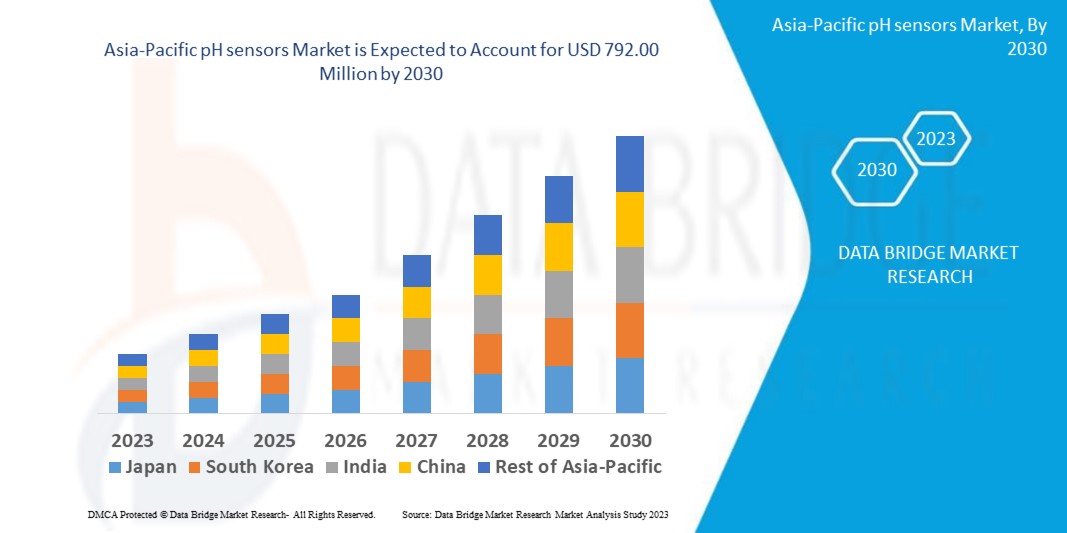
Asia-Pacific pH Sensors Market Analysis and Size
PH sensors typically consist of a sensing electrode and a reference electrode. The sensing electrode is sensitive to changes in hydrogen ion concentration and generates an electrical signal proportional to the pH of the solution. The reference electrode provides a stable reference point for the measurement.
Data Bridge Market Research analyses that the Asia-Pacific pH sensors market which was USD 396.00 million in 2022, would rocket up to USD 792.00 million by 2030, and is expected to undergo a CAGR of 8.84 % during the forecast period. This indicates the market value. PH sensors are devices used to measure the acidity or alkalinity of a solution. PH stands for "power of hydrogen" and is a measure of the concentration of hydrogen ions in a solution. The pH scale ranges from 0 to 14, with 7 being considered neutral. A pH value below 7 indicates acidity, while a pH value above 7 indicates alkalinity. In addition to the insights on market scenarios such as market value, growth rate, segmentation, geographical coverage, and major players, the market reports curated by the Data Bridge Market Research also include depth expert analysis, patient epidemiology, pipeline analysis, pricing analysis, and regulatory framework.
Asia-Pacific pH Sensors Market Scope and Segmentation
|
Report Metric |
Details |
|
Forecast Period |
2023 to 2030 |
|
Base Year |
2022 |
|
Historic Years |
2021 (Customizable to 2018-2020) |
|
Quantitative Units |
Revenue in USD Million, Volumes in Units, Pricing in USD |
|
Segments Covered |
Type (Process Sensors, Differential Sensors, Combination PH Sensors, and Laboratory Sensors), Component (Hardware and Services), Product Type (Digital and Analog), System Type (Benchtop and Portable), Vertical (Water and Wastewater Industry, Chemical Industry, Oil and Gas Industry, Food and Beverages Industry, Medical and Pharmaceutical Industry, Paper Industry, Metal, and Mining Industry, Agriculture Industry and Others) |
|
Countries Covered |
Japan, China, India, South Korea, Australia, Singapore, Thailand, Malaysia, Indonesia, Philippines, and rest of Asia-Pacific |
|
Market Players Covered |
Christian Burkert GmbH & Co. KG (Germany), Endress+Hauser Group Services AG (Switzerland), Knick Electronische Messgerate GmbH & Co. KG (Germany), Thermo Fisher Scientific Inc. (US), Yokogawa Electric Corporation (Japan), LTH Electronics Ltd. (UK), Omega Engineering Inc (US), Krohne Messtechnik GmbH (Germany), PreSens precision Sensing GmbH (Germany), Schneider Electric (France), Sea-Bird Scientific (US), Xylem Analytics UK Ltd. (UK), Chemitec (Italy), ABB (Switzerland), HACH (US), METTLER TOLEDO (US), Gf Piping systems (Switzerland) |
|
Market Opportunities |
|
Market Definition
The Asia-Pacific pH sensors market refers to the industry involved in the production, distribution, and sale of pH sensors, which are devices used to measure the acidity or alkalinity of a solution. The pH sensors are widely used in various industries, including water and wastewater treatment, chemical manufacturing, pharmaceuticals, food and beverage processing, environmental monitoring, and research laboratories. The pH sensors are designed to detect and quantify the concentration of hydrogen ions (H+) in a solution. They typically consist of a glass electrode and a reference electrode, which generates a voltage proportional to the pH of the solution being measured. This voltage is then converted into a pH reading that can be displayed and analyzed by pH meters or other measuring devices.
Asia-Pacific pH Sensors Market
Drivers
- Increasing demand for technological advancements
The pH sensor technology has been evolving, leading to the development of more accurate, reliable, and cost-effective sensors. Advancements such as solid-state pH sensors, miniaturization, wireless connectivity, and improved calibration techniques have expanded the application areas of pH sensors and increased their adoption.
- Advancements in automation and process control
Automation and process control systems are widely implemented across industries to improve efficiency, reduce costs, and enhance productivity. pH sensors play a crucial role in automated systems by providing real-time pH measurements, enabling precise control of chemical dosing, pH adjustments, and process optimization.
- Growing demand for quality control in the food and beverage industry
The food and beverage industry requires accurate pH monitoring to ensure product quality, shelf life, and safety. The pH sensors are used to monitor and control pH levels during food processing, fermentation, brewing, and other production processes, thereby driving their demand in this sector.
Opportunities
The increasing focus on environmental monitoring and sustainability presents a significant opportunity for pH sensors. As governments and organizations strive to monitor and control pollution levels in air, water, and soil, pH sensors can play a crucial role in assessing the acidity or alkalinity of these environments. This opens up avenues for the deployment of pH sensors in environmental monitoring networks, providing real-time data for better decision-making and proactive pollution control measures.
Restraints/Challenges
One of the primary restraints is the high cost associated with pH sensor technologies. Advanced pH sensing technologies often involve complex manufacturing processes, precision components, and calibration requirements, leading to higher production costs. The cost factor can pose a challenge, especially for small and medium-sized enterprises (SMEs) or industries operating on tight budgets, hindering their adoption of pH sensors is projected to challenge the market in the forecast period of 2023-2030.
This Asia-Pacific pH sensors market report provides details of new recent developments, trade regulations, import-export analysis, production analysis, value chain optimization, market share, the impact of domestic and localized market players, analyses opportunities in terms of emerging revenue pockets, changes in market regulations, strategic market growth analysis, market size, category market growths, application niches and dominance, product approvals, product launches, geographic expansions, technological innovations in the market. To gain more info on the Asia-Pacific pH sensors market contact Data Bridge Market Research for an Analyst Brief, our team will help you make an informed market decision to achieve market growth.
Recent Developments
- In May 2023, Endress+Hauser, a leading company in the field of innovation, recently celebrated its 300 innovators at the annual Innovators' Meeting, highlighting their commitment to fostering creative ideas and advancements. With increased investment in research and development, the company continues to prioritize innovation, recognizing the valuable contributions of its employees involved in patent filings. The event, held at the Freiburg Convention Center in Germany, brought together a diverse group of innovators and guests, showcasing Endress+Hauser's dedication to nurturing a culture of inventiveness and cutting-edge solutions
- In March 2023, Thermo Fisher Scientific Inc. and the University of California, San Francisco (UCSF), have opened a cGMP manufacturing facility to accelerate the development of advanced cell therapies for challenging medical conditions such as cancer and rare diseases. This partnership aims to leverage the proximity of scientists, clinicians, and patients to the manufacturing site to expedite the creation of breakthrough treatments. Initially focusing on glioblastoma, multiple myeloma, and other cancers, the facility will utilize updated CAR-T and CRISPR technologies, with plans to expand to other difficult-to-treat conditions in the future
Asia-Pacific pH Sensors Market Scope
The Asia-Pacific pH sensors market is segmented on the basis of type, component, product type, system type, and vertical. The growth amongst these segments will help you analyse meagre growth segments in the industries and provide the users with a valuable market overview and market insights to help them make strategic decisions for identifying core market applications.
Type
- Process Sensors
- Differential Sensors
- Combination PH Sensors
- Laboratory Sensors
Component
- Hardware
- Services
Product Type
- Digital
- Analog
System Type
- Benchtop
- Portable
Vertical
- Water and Wastewater Industry
- Chemical Industry
- Oil and Gas Industry
- Food and Beverages Industry
- Medical and Pharmaceutical Industry
- Paper Industry
- Metal and Mining Industry
- Agriculture Industry
- Others
Asia-Pacific pH Sensors Market Regional Analysis/Insights
Asia-Pacific pH sensors market is analysed and market size insights and trends are provided by type, component, product type, system type, and vertical as referenced above.
The countries covered in the Asia-Pacific pH sensors market are Japan, China, India, South Korea, Australia, Singapore, Thailand, Malaysia, Indonesia, Philippines, and rest of Asia-Pacific in the Asia-Pacific region.
Japan is expected to dominate the Asia-Pacific pH sensors market because of its technological advancements and expertise in various industries. The country has a robust research and development infrastructure, fostering innovation and driving advancements in sensor technologies, including pH sensors.
Asia-Pacific is expected to witness significant growth during the forecast period of 2023 to 2030 due to rapid urbanization, increasing infrastructure development, and the adoption of advanced technologies in countries like Japan and China. Additionally, strong industrial base, including sectors such as chemicals, pharmaceuticals, automotive, and manufacturing. The pH sensors play a crucial role in these industries, where precise monitoring and control of pH levels are essential for quality control, process optimization, and compliance with regulatory standards. Furthermore, favorable government initiatives and investments in smart city projects further drive market growth in the Asia-Pacific region.
The country section of the report also provides individual market impacting factors and changes in regulation in the market domestically that impact the current and future trends of the market. Data points like down-stream and upstream value chain analysis, technical trends, and porter's five forces analysis, and case studies are some of the pointers used to forecast the market scenario for individual countries. Also, the presence and availability of global brands and their challenges faced due to large or scarce competition from local and domestic brands, the impact of domestic tariffs, and trade routes are considered while providing forecast analysis of the country data.
PH Sensors Infrastructure growth Installed base and New Technology Penetration
The Asia-Pacific pH sensors market also provides you with a detailed market analysis for every country's growth in technology expenditure for capital equipment, installed base of different kinds of products for the Asia-Pacific pH sensors market, the impact of technology using lifeline curves, and changes in PH Sensors regulatory scenarios and their impact on the Asia-Pacific pH sensors market. The data is available for the historic period 2010-2020.
Competitive Landscape and Asia-Pacific pH sensors market Share Analysis
The Asia-Pacific pH sensors market competitive landscape provides details by competitors. Details included are company overview, company financials, revenue generated, market potential, investment in research and development, new market initiatives, global presence, production sites and facilities, production capacities, company strengths and weaknesses, product launch, product width, and breadth, application dominance. The above data points provided are only related to the companies' focus related to Asia-Pacific pH sensors market.
Some of the major players operating in the Asia-Pacific pH sensors market are:
- Christian Burkert GmbH & Co. KG (Germany)
- Endress+Hauser Group Services AG (Switzerland)
- Knick Electronische Messgerate GmbH & Co. KG (Germany)
- Thermo Fisher Scientific Inc. (US)
- Yokogawa Electric Corporation (Japan)
- LTH Electronics Ltd. (UK)
- Omega Engineering Inc (US)
- Krohne Messtechnik GmbH (Germany)
- PreSens precision Sensing GmbH (Germany)
- Schneider Electric (France)
- Sea-Bird Scientific (US)
- Xylem Analytics UK Ltd. (UK)
- Chemitec (Italy)
- ABB (Switzerland)
- HACH (US)
- METTLER TOLEDO (US)
- Gf Piping systems (Switzerland)

- Interactive Data Analysis Dashboard
- Company Analysis Dashboard for high growth potential opportunities
- Research Analyst Access for customization & queries
- Competitor Analysis with Interactive dashboard
- Latest News, Updates & Trend analysis
- Harness the Power of Benchmark Analysis for Comprehensive Competitor Tracking
Table of Content
1 INTRODUCTION
1.1 OBJECTIVES OF THE STUDY
1.2 MARKET DEFINITION
1.3 OVERVIEW OF ASIA-PACIFIC PH SENSORS MARKET
1.4 CURRENCY AND PRICING
1.5 LIMITATION
1.6 MARKETS COVERED
2 MARKET SEGMENTATION
2.1 KEY TAKEAWAYS
2.2 ARRIVING AT THE ASIA-PACIFIC PH SENSORS SIZE
2.2.1 VENDOR POSITIONING GRID
2.2.2 TECHNOLOGY LIFE LINE CURVE
2.2.3 TRIPOD DATA VALIDATION MODEL
2.2.4 MARKET GUIDE
2.2.5 MULTIVARIATE MODELLING
2.2.6 TOP TO BOTTOM ANALYSIS
2.2.7 CHALLENGE MATRIX
2.2.8 APPLICATION COVERAGE GRID
2.2.9 STANDARDS OF MEASUREMENT
2.2.10 VENDOR SHARE ANALYSIS
2.2.11 DATA POINTS FROM KEY PRIMARY INTERVIEWS
2.2.12 DATA POINTS FROM KEY SECONDARY DATABASES
2.3 ASIA-PACIFIC PH SENSORS MARKET: RESEARCH SNAPSHOT
2.4 ASSUMPTIONS
3 MARKET OVERVIEW
3.1 DRIVERS
3.2 RESTRAINTS
3.3 OPPORTUNITIES
3.4 CHALLENGES
4 EXECUTIVE SUMMARY
5 PREMIUM INSIGHTS
5.1 PESTEL ANALYSIS
5.2 PORTER’S FIVE FORCES MODEL
6 INDUSTRY INSIGHTS
6.1 MICRO AND MACRO ECONOMIC FACTORS
6.2 PENETRATION AND GROWTH PROSPECT MAPPING
6.3 KEY PRICING STRATEGIES
6.4 INTERVIEWS WITH SPECIALIST
6.5 ANALYIS AND RECOMMENDATION
7 INTELLECTUAL PROPERTY (IP) PORTFOLIO
7.1 PATENT QUALITY AND STRENGTH
7.2 PATENT FAMILIES
7.3 LICENSING AND COLLABORATIONS
7.4 COMPETITIVE LANDSCAPE
7.5 IP STRATEGY AND MANAGEMENT
7.6 OTHER
8 COST ANALYSIS BREAKDOWN
9 TECHNONLOGY ROADMAP
10 INNOVATION TRACKER AND STRATEGIC ANALYSIS
10.1 MAJOR DEALS AND STRATEGIC ALLIANCES ANALYSIS
10.1.1 JOINT VENTURES
10.1.2 MERGERS AND ACQUISITIONS
10.1.3 LICENSING AND PARTNERSHIP
10.1.4 TECHNOLOGY COLLABORATIONS
10.1.5 STRATEGIC DIVESTMENTS
10.2 NUMBER OF PRODUCTS IN DEVELOPMENT
10.3 STAGE OF DEVELOPMENT
10.4 TIMELINES AND MILESTONES
10.5 INNOVATION STRATEGIES AND METHODOLOGIES
10.6 RISK ASSESSMENT AND MITIGATION
10.7 FUTURE OUTLOOK
11 REGULATORY SCENARIO
12 VALUE CHAIN ANALYSIS
13 ASIA-PACIFIC PH SENSORS MARKET, BY TYPE
13.1 OVERVIEW
13.2 DIFFERENTIAL SENSORS
13.2.1 DIGITAL
13.2.2 ANALOG
13.3 COMBINATION PH SENSORS
13.3.1 DIGITAL
13.3.2 ANALOG
13.4 LABORATORY SENSORS
13.4.1 DIGITAL
13.4.2 ANALOG
13.5 PROCESS SENSORS
13.5.1 DIGITAL
13.5.2 ANALOG
14 ASIA-PACIFIC PH SENSORS MARKET, BY PRODUCT TYPE
14.1 OVERVIEW
14.2 DIGITAL
14.3 ANALOG
15 ASIA-PACIFIC PH SENSORS MARKET, BY TECHNOLOGY
15.1 OVERVIEW
15.2 OPTICAL SENSORS
15.3 ION-SELECTIVE FIELD EFFECT TRANSISTORS (ISFET)
15.4 AMPEROMETRIC DETECTORS
15.5 OTHERS
16 ASIA-PACIFIC PH SENSORS MARKET, BY APPLICATION
16.1 OVERVIEW
16.2 WATER AND WASTEWATER INDUSTRY
16.3 CHEMICAL INDUSTRY
16.4 OIL AND GAS INDUSTRY
16.5 FOOD AND BEVERAGES INDUSTRY
16.6 PHARMACEUTICAL INDUSTRY
16.7 PAPER INDUSTRY, METAL, AND MINING INDUSTRY
16.8 AGRICULTURE INDUSTRY
16.9 OTHERS
17 ASIA-PACIFIC PH SENSORS MARKET, BY DISTRIBUTION CHANNEL
17.1 OVERVIEW
17.2 DIRECT TENDER
17.3 RETAIL SALES
17.4 OTHERS
18 ASIA-PACIFIC PH SENSORS MARKET, SWOT AND DBMR ANALYSIS
19 ASIA-PACIFIC PH SENSORS MARKET, COMPANY LANDSCAPE
19.1 COMPANY SHARE ANALYSIS: ASIA-PACIFIC
19.2 MERGERS & ACQUISITIONS
19.3 NEW PRODUCT DEVELOPMENT & APPROVALS
19.4 EXPANSIONS
19.5 REGULATORY CHANGES
19.6 PARTNERSHIP AND OTHER STRATEGIC DEVELOPMENTS
20 ASIA-PACIFIC PH SENSORS MARKET, BY REGION
20.1 ASIA-PACIFIC PH SENSORS MARKET, (ALL SEGMENTATION PROVIDED ABOVE IS REPRESENTED IN THIS CHAPTER BY COUNTRY)
20.2 ASIA-PACIFIC
20.2.1 JAPAN
20.2.2 CHINA
20.2.3 SOUTH KOREA
20.2.4 INDIA
20.2.5 SINGAPORE
20.2.6 THAILAND
20.2.7 INDONESIA
20.2.8 MALAYSIA
20.2.9 PHILIPPINES
20.2.10 AUSTRALIA
20.2.11 NEW ZEALAND
20.2.12 VIETNAM
20.2.13 TAIWAN
20.2.14 REST OF ASIA-PACIFIC
20.3 KEY PRIMARY INSIGHTS: BY MAJOR COUNTRIES
21 ASIA-PACIFIC PH SENSORS MARKET, COMPANY PROFILE
21.1 ABB
21.1.1 COMPANY OVERVIEW
21.1.2 REVENUE ANALYSIS
21.1.3 GEOGRAPHIC PRESENCE
21.1.4 PRODUCT PORTFOLIO
21.1.5 RECENT DEVELOPMENTS
21.2 METTLER TOLEDO
21.2.1 COMPANY OVERVIEW
21.2.2 REVENUE ANALYSIS
21.2.3 GEOGRAPHIC PRESENCE
21.2.4 PRODUCT PORTFOLIO
21.2.5 RECENT DEVELOPMENTS
21.3 THERMO FISHER SCIENTIFIC INC
21.3.1 COMPANY OVERVIEW
21.3.2 REVENUE ANALYSIS
21.3.3 GEOGRAPHIC PRESENCE
21.3.4 PRODUCT PORTFOLIO
21.3.5 RECENT DEVELOPMENTS
21.4 ENDRESS+HAUSER GROUP SERVICES AG
21.4.1 COMPANY OVERVIEW
21.4.2 REVENUE ANALYSIS
21.4.3 GEOGRAPHIC PRESENCE
21.4.4 PRODUCT PORTFOLIO
21.4.5 RECENT DEVELOPMENTS
21.5 HONEYWELL INTERNATIONAL INC
21.5.1 COMPANY OVERVIEW
21.5.2 REVENUE ANALYSIS
21.5.3 GEOGRAPHIC PRESENCE
21.5.4 PRODUCT PORTFOLIO
21.5.5 RECENT DEVELOPMENTS
21.6 SCHNEIDER ELECTRIC
21.6.1 COMPANY OVERVIEW
21.6.2 REVENUE ANALYSIS
21.6.3 GEOGRAPHIC PRESENCE
21.6.4 PRODUCT PORTFOLIO
21.6.5 RECENT DEVELOPMENTS
21.7 EMERSON PROCESS MANAGEMENT ASIA PACIFIC PRIVATE LTD
21.7.1 COMPANY OVERVIEW
21.7.2 REVENUE ANALYSIS
21.7.3 GEOGRAPHIC PRESENCE
21.7.4 PRODUCT PORTFOLIO
21.7.5 RECENT DEVELOPMENTS
21.8 OBOLD MESSRING GMBH
21.8.1 COMPANY OVERVIEW
21.8.2 REVENUE ANALYSIS
21.8.3 GEOGRAPHIC PRESENCE
21.8.4 PRODUCT PORTFOLIO
21.8.5 RECENT DEVELOPMENTS
21.9 GF PIPING SYSTEMS
21.9.1 COMPANY OVERVIEW
21.9.2 REVENUE ANALYSIS
21.9.3 GEOGRAPHIC PRESENCE
21.9.4 PRODUCT PORTFOLIO
21.9.5 RECENT DEVELOPMENTS
21.1 YOKOGAWA ELECTRIC CORPORATION
21.10.1 COMPANY OVERVIEW
21.10.2 REVENUE ANALYSIS
21.10.3 GEOGRAPHIC PRESENCE
21.10.4 PRODUCT PORTFOLIO
21.10.5 RECENT DEVELOPMENTS
21.11 XYLEM
21.11.1 COMPANY OVERVIEW
21.11.2 REVENUE ANALYSIS
21.11.3 GEOGRAPHIC PRESENCE
21.11.4 PRODUCT PORTFOLIO
21.11.5 RECENT DEVELOPMENTS
21.12 CHRISTIAN BÜRKERT GMBH & CO. KG
21.12.1 COMPANY OVERVIEW
21.12.2 REVENUE ANALYSIS
21.12.3 GEOGRAPHIC PRESENCE
21.12.4 PRODUCT PORTFOLIO
21.12.5 RECENT DEVELOPMENTS
21.13 KNICK ELEKTRONISCHE MESSGERÄTE¬ GMBH & CO. KG
21.13.1 COMPANY OVERVIEW
21.13.2 REVENUE ANALYSIS
21.13.3 GEOGRAPHIC PRESENCE
21.13.4 PRODUCT PORTFOLIO
21.13.5 RECENT DEVELOPMENTS
21.14 LTH ELECTRONICS
21.14.1 COMPANY OVERVIEW
21.14.2 REVENUE ANALYSIS
21.14.3 GEOGRAPHIC PRESENCE
21.14.4 PRODUCT PORTFOLIO
21.14.5 RECENT DEVELOPMENTS
21.15 PRESENS
21.15.1 COMPANY OVERVIEW
21.15.2 REVENUE ANALYSIS
21.15.3 GEOGRAPHIC PRESENCE
21.15.4 PRODUCT PORTFOLIO
21.15.5 RECENT DEVELOPMENTS
21.16 KROHNE MESSTECHNIK GMBH
21.16.1 COMPANY OVERVIEW
21.16.2 REVENUE ANALYSIS
21.16.3 GEOGRAPHIC PRESENCE
21.16.4 PRODUCT PORTFOLIO
21.16.5 RECENT DEVELOPMENTS
21.17 SEA-BIRD SCIENTIFIC
21.17.1 COMPANY OVERVIEW
21.17.2 REVENUE ANALYSIS
21.17.3 GEOGRAPHIC PRESENCE
21.17.4 PRODUCT PORTFOLIO
21.17.5 RECENT DEVELOPMENTS
21.18 OMEGA ENGINEERING INC
21.18.1 COMPANY OVERVIEW
21.18.2 REVENUE ANALYSIS
21.18.3 GEOGRAPHIC PRESENCE
21.18.4 PRODUCT PORTFOLIO
21.18.5 RECENT DEVELOPMENTS
21.19 DKK-TOA CORPORATION
21.19.1 COMPANY OVERVIEW
21.19.2 REVENUE ANALYSIS
21.19.3 GEOGRAPHIC PRESENCE
21.19.4 PRODUCT PORTFOLIO
21.19.5 RECENT DEVELOPMENTS
21.2 DKK-TOA CORPORATION
21.20.1 COMPANY OVERVIEW
21.20.2 REVENUE ANALYSIS
21.20.3 GEOGRAPHIC PRESENCE
21.20.4 PRODUCT PORTFOLIO
21.20.5 RECENT DEVELOPMENTS
22 RELATED REPORTS
23 CONCLUSION
24 QUESTIONNAIRE
25 ABOUT DATA BRIDGE MARKET RESEARCH

Asia Pacific Ph Sensors Market, Supply Chain Analysis and Ecosystem Framework
To support market growth and help clients navigate the impact of geopolitical shifts, DBMR has integrated in-depth supply chain analysis into its Asia Pacific Ph Sensors Market research reports. This addition empowers clients to respond effectively to global changes affecting their industries. The supply chain analysis section includes detailed insights such as Asia Pacific Ph Sensors Market consumption and production by country, price trend analysis, the impact of tariffs and geopolitical developments, and import and export trends by country and HSN code. It also highlights major suppliers with data on production capacity and company profiles, as well as key importers and exporters. In addition to research, DBMR offers specialized supply chain consulting services backed by over a decade of experience, providing solutions like supplier discovery, supplier risk assessment, price trend analysis, impact evaluation of inflation and trade route changes, and comprehensive market trend analysis.
Data collection and base year analysis are done using data collection modules with large sample sizes. The stage includes obtaining market information or related data through various sources and strategies. It includes examining and planning all the data acquired from the past in advance. It likewise envelops the examination of information inconsistencies seen across different information sources. The market data is analysed and estimated using market statistical and coherent models. Also, market share analysis and key trend analysis are the major success factors in the market report. To know more, please request an analyst call or drop down your inquiry.
The key research methodology used by DBMR research team is data triangulation which involves data mining, analysis of the impact of data variables on the market and primary (industry expert) validation. Data models include Vendor Positioning Grid, Market Time Line Analysis, Market Overview and Guide, Company Positioning Grid, Patent Analysis, Pricing Analysis, Company Market Share Analysis, Standards of Measurement, Global versus Regional and Vendor Share Analysis. To know more about the research methodology, drop in an inquiry to speak to our industry experts.
Data Bridge Market Research is a leader in advanced formative research. We take pride in servicing our existing and new customers with data and analysis that match and suits their goal. The report can be customized to include price trend analysis of target brands understanding the market for additional countries (ask for the list of countries), clinical trial results data, literature review, refurbished market and product base analysis. Market analysis of target competitors can be analyzed from technology-based analysis to market portfolio strategies. We can add as many competitors that you require data about in the format and data style you are looking for. Our team of analysts can also provide you data in crude raw excel files pivot tables (Fact book) or can assist you in creating presentations from the data sets available in the report.













