


Asia-Pacific Pharmaceutical Excipients Market Overview
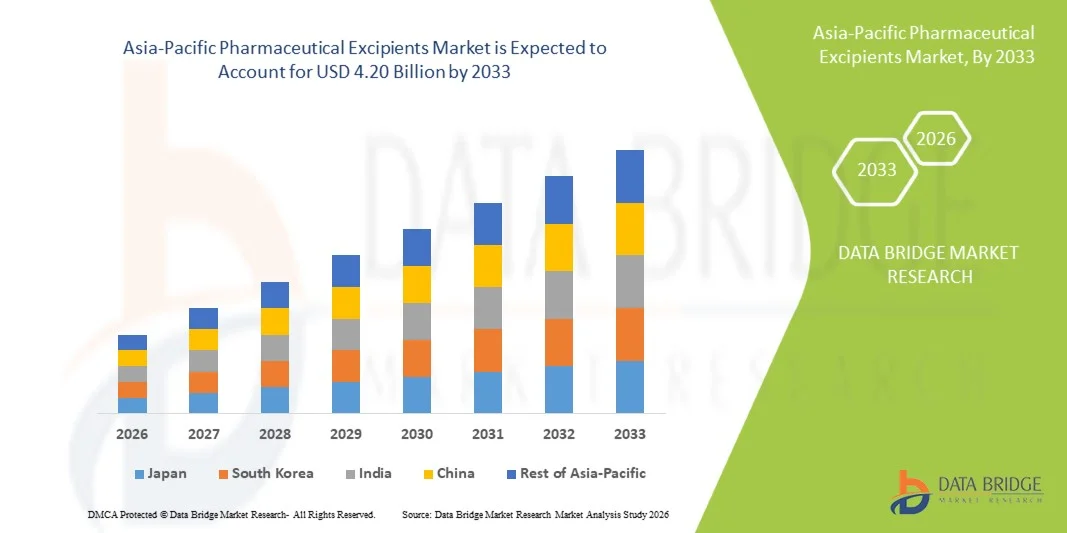
The Asia-Pacific Pharmaceutical Excipients market was valued at USD 2.41 billion in 2025 and is projected to reach USD 4.20 billion by 2033, growing at a CAGR of 7.21% from 2026 to 2033. The Asia-Pacific Pharmaceutical Excipients Market is experiencing consistent growth driven by the expanding pharmaceutical manufacturing sector, increasing demand for generic medicines, rising healthcare expenditures, and growing investments in drug development activities across the region. Rapid advancements in pharmaceutical formulations, increasing production of biologics and specialty drugs, and the growing adoption of multifunctional excipients are further supporting market expansion throughout Asia-Pacific.
The rising prevalence of chronic diseases, growing aging population, and increasing demand for effective and patient-friendly drug delivery systems are compelling pharmaceutical manufacturers to adopt advanced excipient technologies. Pharmaceutical excipients are increasingly being utilized to improve drug stability, bioavailability, solubility, taste masking, and controlled-release properties in a wide range of pharmaceutical formulations. In addition, the expansion of pharmaceutical production facilities, increasing research and development activities, and growing demand for high-quality excipients in oral, topical, injectable, and novel drug delivery applications are accelerating market growth. The continuous advancement of co-processed excipients, functional excipients, and specialty formulation technologies, coupled with strengthening regulatory frameworks and increasing healthcare access across emerging economies, is further enhancing the adoption of pharmaceutical excipients throughout the Asia-Pacific region.
Key Market Trends & Insights
- China dominated the Asia-Pacific Pharmaceutical Excipients market in 2025, driven by its large pharmaceutical manufacturing base, extensive API production capacity, strong domestic drug demand, and increasing investments in pharmaceutical innovation and healthcare infrastructure.
- The Solid dosage form segment dominated the market with a 61.27% share in 2025, driven by widespread use of tablets and capsules in global pharmaceutical production.
- India is expected to be the fastest-growing country in the Asia-Pacific Pharmaceutical Excipients market at a CAGR of 8.4% from 2026 to 2033, fueled by rapid expansion of the generic pharmaceutical sector, increasing contract manufacturing activities, and rising investments in biopharmaceutical and specialty drug development.
- The Solubilizers segment is the fastest-growing functionality category, projected to register a CAGR of 8.1%, reflecting increasing demand for enhanced bioavailability and improved drug delivery of poorly soluble active pharmaceutical ingredients.
- The Solid Dosage Form segment dominates the dosage form category with a 62.53% revenue share in 2025, led by the widespread use of tablets and capsules due to their convenience, stability, cost-effectiveness, and patient compliance.
- Oral Excipients accounted for 58.91% of the market in 2025, preferred by pharmaceutical manufacturers due to the high volume of orally administered medications and growing demand for solid oral dosage formulations.
- The Pharmaceutical and Biopharmaceutical Companies segment dominated the end-user category with a 54.36% share in 2025, driven by increasing drug production, expanding biologics pipelines, and growing investments in formulation development and pharmaceutical R&D.
- Direct Tender accounted for 49.82% of the market in 2025, supported by long-term supply agreements, bulk procurement strategies, and direct sourcing practices adopted by major pharmaceutical manufacturers.
- The Research Organizations and Academics segment is expected to witness significant growth during the forecast period, driven by increasing pharmaceutical research activities, formulation innovation, and growing collaboration between industry and academic institutions.
Market Size & Forecast
- Asia-Pacific Market Value (2025): USD 2.41 Billion
- Expected Market Value (2033): USD 4.20 Billion
- Forecast CAGR (2026–2033): 7.21%
- Leading Region in 2025: China
- Fastest Growing Region: India
Report Scope and Asia-Pacific Pharmaceutical Excipients Market Segmentation
|
Attributes |
Pharmaceutical Excipients Key Market Insights |
|
Segments Covered |
|
|
Countries Covered |
Asia-Pacific · China · Japan · India · South Korea · Singapore · Malaysia · Australia · Thailand · Indonesia · Philippines · Rest of Asia-Pacific |
|
Key Market Players |
• Ashland Inc. (U.S.) |
|
Market Opportunities |
· Expansion of AI-Powered Precision Medicine Applications · Rising Adoption of Cloud-Based Digital Pathology Platforms · Growth in Cancer Diagnostics and Increasing Demand for Early Detection |
|
Value Added Data Infosets |
In addition to the insights on market scenarios such as market value, growth rate, segmentation, geographical coverage, and major players, the market reports curated by the Data Bridge Market Research also include in-depth expert analysis, geographically represented company-wise production and capacity, network layouts of distributors and partners, detailed and updated price trend analysis and deficit analysis of supply chain and demand. |
Asia-Pacific Pharmaceutical Excipients Market Trends
Trend: Rising Demand for Multifunctional Excipients and Advanced Drug Formulations
The Asia-Pacific pharmaceutical excipients market is witnessing a strong shift toward multifunctional excipients that enhance drug stability, solubility, bioavailability, and manufacturing efficiency. Pharmaceutical manufacturers are increasingly adopting advanced excipient systems to support the development of complex generic drugs, biologics, controlled-release formulations, and orally disintegrating dosage forms. Growing demand for patient-centric formulations, coupled with increasing production of generic medicines across China and India, is accelerating the use of innovative excipients. In addition, excipient manufacturers are investing in high-performance products that simplify formulation processes and improve therapeutic outcomes, supporting the evolving needs of the pharmaceutical industry across the region.
Asia-Pacific Pharmaceutical Excipients Market Dynamics
Key Market Driver: Expansion of Pharmaceutical Manufacturing and Growing Generic Drug Production
The rapid growth of pharmaceutical manufacturing across Asia-Pacific is a major driver of the pharmaceutical excipients market. Countries such as China and India have established themselves as global pharmaceutical production hubs, supplying active pharmaceutical ingredients (APIs), generic medicines, and finished dosage forms to domestic and international markets. According to industry estimates, India accounts for a significant share of global generic drug supply, while China remains a leading producer of pharmaceutical ingredients and intermediates. The increasing production of tablets, capsules, injectables, and specialty formulations is generating substantial demand for binders, diluents, disintegrants, solubilizers, lubricants, and coating materials. Furthermore, rising healthcare expenditure, expanding access to medicines, and increasing prevalence of chronic diseases continue to support market growth throughout the region.
Key Restraint/Challenge: Stringent Regulatory Requirements and Raw Material Price Volatility
A significant challenge facing the Asia-Pacific pharmaceutical excipients market is the stringent regulatory environment governing excipient quality, safety, and manufacturing standards. Pharmaceutical excipients must comply with pharmacopeial requirements and regulatory guidelines established by authorities such as the U.S. FDA, EMA, CDSCO, NMPA, and PMDA, increasing compliance costs for manufacturers. Additionally, fluctuations in raw material prices, supply chain disruptions, and dependence on specialized chemical inputs can affect production costs and profitability.
For instance, pharmaceutical manufacturers and excipient suppliers have faced periodic supply chain disruptions affecting the availability of cellulose derivatives, specialty polymers, and other critical excipient materials, leading to increased procurement costs and formulation challenges across the pharmaceutical value chain.
Key Market Opportunity: Growing Demand for Biopharmaceuticals and Advanced Drug Delivery Systems
The increasing adoption of biologics, biosimilars, and advanced drug delivery technologies presents a significant opportunity for the Asia-Pacific pharmaceutical excipients market. Pharmaceutical and biopharmaceutical companies are investing heavily in innovative formulations that require specialized excipients for improved stability, solubility, controlled release, and targeted drug delivery. The growing development of complex generics, injectable therapeutics, and personalized medicines is further expanding demand for high-performance excipients.
In addition, advancements in nanotechnology-based drug delivery systems, orally disintegrating tablets, sustained-release formulations, and pediatric dosage forms are creating new growth avenues for excipient manufacturers. The expansion of pharmaceutical R&D activities, increasing contract manufacturing services, and rising investments in biologics production across China, India, Japan, and South Korea are expected to drive long-term growth opportunities in the Asia-Pacific pharmaceutical excipients market.
Asia-Pacific Pharmaceutical Excipients Market Scope
The Pharmaceutical Excipients market is segmented on the basis of functionality, dosage form, route of administration, end user, and distribution channel.
- By Functionality
On the basis of functionality, the Pharmaceutical Excipients market is segmented into binders and adhesives, disintegrants, coating materials, coloring agents, solubilizers, flavors, sweetening agents, diluents, lubricants, buffers, emulsifying agents, preservatives, antioxidants, sorbents, solvents, emollients, glidents, chelating agents, antifoaming agents, and others. The Binders and Diluents segment dominated the market with a 32.84% share in 2025, due to their essential role in tablet integrity, formulation stability, and large-scale solid dosage manufacturing. These excipients ensure uniform drug distribution and mechanical strength in tablets and capsules. Rising production of generic medicines globally is further strengthening demand. Increasing prevalence of chronic diseases is driving continuous oral solid drug consumption. Pharmaceutical manufacturers prefer binders due to cost efficiency and regulatory acceptance. Growth in contract manufacturing organizations is also boosting consumption. Technological advancements in direct compression techniques are supporting segment expansion. Increasing R&D in modified-release formulations is enhancing binder usage. Demand from emerging markets is significantly contributing to growth. Regulatory focus on drug safety and consistency further supports adoption. Expanding pharmaceutical pipelines worldwide continue to reinforce dominance of this segment.
The Solubilizers segment is expected to register the fastest CAGR of 7.4% from 2026 to 2033, driven by increasing demand for poorly water-soluble drug formulations. A large share of new chemical entities shows low solubility, requiring advanced excipient solutions. Growth in biologics and complex molecules is accelerating adoption of solubilizing agents. Pharmaceutical companies are investing heavily in bioavailability enhancement technologies. Increasing use of lipid-based drug delivery systems is supporting expansion. Nanotechnology-based formulation approaches are gaining strong traction. Rising demand for injectable and oral bioavailability improvement is fueling growth. Expansion of personalized medicine is further increasing need for advanced excipients. Strong pipeline of oncology and CNS drugs is boosting segment demand. Regulatory approvals for advanced formulations are increasing globally. Continuous innovation in surfactants and polymer-based solubilizers is accelerating market expansion.
- By Dosage Form
On the basis of dosage form, the market is segmented into solid, semi-solid, and liquid formulations. The Solid dosage form segment dominated the market with a 61.27% share in 2025, driven by widespread use of tablets and capsules in global pharmaceutical production. Solid formulations offer superior stability, long shelf life, and cost-effective manufacturing. High patient compliance compared to other dosage forms further supports dominance. Growing demand for generic drugs is significantly boosting solid dosage production. Expanding chronic disease burden is increasing long-term oral drug use. Pharmaceutical companies prefer solid dosage due to scalable manufacturing processes. Technological improvements in coating and compression are enhancing product efficiency. Increasing OTC drug consumption is further driving growth. Strong demand from emerging economies is supporting large-scale production. Contract manufacturing expansion is reinforcing supply capabilities. Regulatory approvals for oral formulations are consistently increasing. Global pharmaceutical production shift toward cost-efficient dosage forms continues to strengthen dominance.
The Liquid dosage form segment is expected to witness the fastest CAGR of 6.9% from 2026 to 2033, driven by rising demand for pediatric and geriatric-friendly formulations. Liquid excipients are essential for syrups, suspensions, and injectable solutions. Increasing biologics and vaccine production is boosting liquid formulation demand. Growth in hospital-based care is accelerating injectable drug adoption. Rising prevalence of infectious diseases is supporting liquid dosage expansion. Improved formulation technologies are enhancing stability of liquid excipients. Expanding vaccine distribution programs globally are contributing to growth. Demand for rapid-acting drug delivery systems is increasing adoption. Growth in personalized medicine is further supporting liquid formulations. Pharmaceutical companies are investing in advanced liquid drug delivery systems. Regulatory approvals for injectable biologics are increasing. Expanding healthcare access in emerging markets is further boosting demand.
- By Route of Administration
On the basis of route of administration, the market is segmented into oral excipients, topical excipients, parenteral excipients, and other excipients. The Oral excipients segment dominated the market with a 54.38% share in 2025, due to extensive use in tablets, capsules, and oral suspensions worldwide. Oral drugs remain the most preferred administration route due to ease of use and patient compliance. High production of generic oral medications is significantly supporting demand. Increasing prevalence of chronic diseases such as diabetes and cardiovascular disorders is boosting consumption. Pharmaceutical manufacturers rely heavily on oral formulations for cost efficiency. Expanding OTC drug market is further strengthening demand. Advancements in controlled-release formulations are enhancing oral drug effectiveness. Strong pipeline of oral therapeutics is supporting excipient usage. Regulatory acceptance of oral formulations is high globally. Growing self-medication trends are increasing oral drug consumption. Contract manufacturing expansion is further supporting segment dominance. Continuous innovation in oral drug delivery systems reinforces market leadership.
The Parenteral excipients segment is expected to register the fastest CAGR of 7.6% from 2026 to 2033, driven by rising demand for injectable biologics and vaccines. Increasing prevalence of cancer and autoimmune diseases is boosting injectable therapies. Growth in hospital-based critical care treatments is accelerating adoption. Expanding biologics pipeline is significantly supporting parenteral excipient demand. Vaccine development and distribution programs are contributing to growth. Rising demand for rapid-acting drug delivery is strengthening segment expansion. Technological advancements in sterile formulation are improving safety and stability. Increasing regulatory approvals for injectable drugs are supporting market growth. Growth in emergency care treatments is further boosting demand. Pharmaceutical companies are investing heavily in biologic injectables. Expansion of cold-chain infrastructure is enhancing distribution efficiency. Continuous innovation in parenteral delivery systems is driving strong CAGR growth globally.
- By End User
On the basis of end user, the market is segmented into pharmaceutical & biopharmaceutical companies, contract formulators, research organizations & academics, and others. The Pharmaceutical & Biopharmaceutical companies segment dominated the market with a 58.91% share in 2025, driven by large-scale drug manufacturing and high excipient consumption. These companies account for the majority of global formulation production. Increasing biologics and biosimilars development is strengthening demand. Strong R&D investments are supporting advanced excipient usage. Expansion of global pharmaceutical manufacturing facilities is boosting consumption. Rising chronic disease burden is increasing drug production volume. Regulatory compliance requirements are enhancing excipient quality demand. Growing personalized medicine adoption is supporting segment expansion. High investment in formulation innovation is further strengthening dominance. Increasing demand for cost-effective drug production is supporting large-scale procurement. Contract manufacturing partnerships are reinforcing supply chains. Global pharmaceutical expansion continues to support strong market leadership.
The Contract formulators (CMOs/CDMOs) segment is expected to witness the fastest CAGR of 7.2% from 2026 to 2033, driven by rising outsourcing trends in pharmaceutical manufacturing. Companies are increasingly outsourcing formulation activities to reduce cost and improve efficiency. Growing complexity of drug formulations is boosting reliance on specialized formulators. Expansion of global outsourcing networks is supporting strong growth. Increasing demand for generics and specialty drugs is accelerating adoption. Biopharmaceutical outsourcing is also contributing significantly. Contract formulators offer scalable production capabilities. Rising demand for flexible manufacturing solutions is boosting growth. Regulatory compliance support provided by CMOs is increasing adoption. Expansion of small and mid-sized pharma companies is supporting outsourcing demand. Increasing globalization of drug supply chains is further driving growth. Continuous capacity expansion of CMOs is strengthening market CAGR.
- By Distribution Channel
On the basis of distribution channel, the market is segmented into direct tender, retail sales, and others. The Direct tender segment dominated the market with a 63.45% share in 2025, driven by bulk procurement by pharmaceutical manufacturers and hospitals. Long-term supply contracts ensure cost efficiency and stable supply. Large-scale pharmaceutical production requires centralized procurement systems. Increasing demand for quality-controlled excipients is supporting direct sourcing. Strong regulatory requirements for pharmaceutical supply chains are reinforcing dominance. Global expansion of pharmaceutical companies is boosting tender-based procurement. Rising demand for standardized excipients is strengthening this channel. Contract manufacturing organizations heavily rely on direct procurement. Government healthcare procurement programs are also contributing significantly. Increasing hospital pharmaceutical usage is supporting bulk purchasing. Supply chain optimization trends are enhancing direct procurement efficiency. Strong global supplier networks are reinforcing this dominant channel.
The Retail sales segment is expected to witness the fastest CAGR of 6.8% from 2026 to 2033, driven by rising small-scale pharmacy and compounding pharmacy demand. Increasing OTC drug consumption is boosting retail excipient usage. Growth in personalized medicine is supporting small-batch formulations. Expanding healthcare access in emerging markets is increasing retail penetration. Digital pharmacy platforms are accelerating distribution growth. Rising demand for customized drug formulations is supporting adoption. Increasing self-medication trends are driving retail purchases. Growth in local pharmaceutical manufacturing is boosting availability. Regulatory relaxation in some regions is supporting retail expansion. Rising consumer awareness of healthcare products is contributing to growth. Expansion of e-pharmacy platforms is further accelerating CAGR. Continuous urbanization and healthcare infrastructure growth are supporting segment expansion.
Asia-Pacific Pharmaceutical Excipients Market Regional Analysis
The Asia-Pacific Pharmaceutical Excipients market is expected to witness rapid growth, driven by expanding pharmaceutical manufacturing capabilities, rising healthcare demand, increasing prevalence of chronic diseases, and growing investments in drug formulation technologies across China, India, Japan, and South Korea. The region benefits from a strong presence of generic drug manufacturers, increasing production of oral solid dosage forms, and rising adoption of advanced excipients such as solubilizers, binders, coating agents, and disintegrants. Additionally, growing investments in biopharmaceutical production, contract manufacturing organizations (CMOs), and formulation R&D are further supporting regional market expansion.
China Pharmaceutical Excipients Market Insight
China dominated the Asia-Pacific Pharmaceutical Excipients market in 2025, driven by its large pharmaceutical manufacturing base, extensive API production capacity, strong domestic drug demand, and increasing investments in pharmaceutical innovation and healthcare infrastructure. The country continues to play a central role in global pharmaceutical supply chains, supported by large-scale production of generic medicines and strong government backing for healthcare modernization. Furthermore, increasing demand for advanced formulations and growing focus on high-quality excipients are strengthening China’s leadership position in the regional market.
Japan Pharmaceutical Excipients Market Insight
The Japan Pharmaceutical Excipients market is witnessing steady growth due to its advanced pharmaceutical industry, strong regulatory framework, and increasing focus on precision medicine and high-quality drug formulations. Pharmaceutical companies in Japan are increasingly adopting specialized excipients to support controlled-release formulations, injectable drugs, and biologics. In addition, growing R&D activities, technological innovation in drug delivery systems, and rising demand for patient-centric formulations are contributing to market expansion in the country.
Asia-Pacific Pharmaceutical Excipients Market Share
The Pharmaceutical Excipients industry is primarily led by well-established companies, including:
- Ashland Inc. (U.S.)
- DuPont de Nemours, Inc. (U.S.)
- Roquette Frères (France)
- BASF SE (Germany)
- Evonik Industries AG (Germany)
- Croda International Plc (U.K.)
- Colorcon Inc. (U.S.)
- DFE Pharma GmbH & Co. KG (Germany)
- JRS Pharma GmbH & Co. KG (Germany)
- Merck KGaA (Germany)
- Kerry Group plc (Ireland)
- SPI Pharma, Inc. (U.S.)
- Lubrizol Corporation (U.S.)
- Gangwal Healthcare Pvt. Ltd. (India)
- Signet Excipients Pvt. Ltd. (India)
- Nitika Pharmaceutical Specialties Pvt. Ltd. (India)
- Vasa Pharmachem Pvt. Ltd. (India)
- Anhui Sunhere Pharmaceutical Excipients Co., Ltd. (China)
- Shin-Etsu Chemical Co., Ltd. (Japan)
- Freund Corporation (Japan)
- MEGGLE GmbH & Co. KG (Germany)
- The Dow Chemical Company (U.S.)
- Avantor, Inc. (U.S.)
- Wacker Chemie AG (Germany)
- Asahi Kasei Corporation (Japan)
- Corel Pharma Chem (India)
- Maple Biotech Pvt. Ltd. (India)
- NB Entrepreneurs (India)
- Chemfield Cellulose Pvt. Ltd. (India)
- Rettenmaier India Pvt. Ltd. (India)
- Huzhou Zhanwang Pharmaceutical Co., Ltd. (China)
- Jiangsu Jiaerke Pharmaceuticals Group Corp., Ltd. (China)
- FMC Corporation (U.S.)
- Associated Capsules Group (India)
Latest Developments in Asia-Pacific Pharmaceutical Excipients Market
- In March 2021, Roquette Frères announced the expansion of its pharmaceutical excipients production capacity in Asia to meet rising demand for oral solid dosage formulations. The company expanded its plant-based excipients portfolio, including cellulose derivatives and starch-based excipients, to support growing generic drug manufacturing in India and China. The expansion was aimed at improving supply reliability for pharmaceutical manufacturers in the Asia-Pacific region and strengthening Roqu ette’s position in high-growth emerging markets
- In June 2022, BASF SE announced increased production capacity for pharmaceutical-grade excipients at its Asia-Pacific manufacturing facilities, including sites serving China and India. The expansion focused on key excipients such as binders, polymers, and solubilizers used in tablets and injectable formulations. This initiative supported rising regional demand driven by the growth of contract manufacturing organizations (CMOs) and increasing production of generic medicines across Asia-Pacific
- In September 2022, Ashland Global Holdings Inc. expanded its pharmaceutical excipients distribution and technical support network in Asia-Pacific. The company strengthened its presence in India and Southeast Asia by enhancing supply chain capabilities for cellulose-based excipients and film coating systems. This move was aimed at supporting the rapid growth of pharmaceutical formulation development in the region
- In February 2023, DFE Pharma announced investment in capacity expansion for lactose-based pharmaceutical excipients to support growing demand from Asian pharmaceutical manufacturers. The expansion was designed to improve availability of key excipients used in solid oral dosage forms, particularly tablets and capsules, which dominate production in India and China
- In July 2023, Colorcon expanded its technical services and coating systems support for pharmaceutical manufacturers across Asia-Pacific. The company enhanced its film coating technologies used in modified-release tablets and partnered with regional pharmaceutical companies to improve drug stability and patient compliance in high-volume generic drug production markets
- In January 2024, Roquette announced advancements in co-processed excipients designed for improved drug delivery performance in Asia-Pacific pharmaceutical formulations. These multifunctional excipients were developed to improve compressibility, solubility, and bioavailability of active pharmaceutical ingredients (APIs), supporting increasing demand for advanced formulation technologies in India and China
- In May 2024, BASF expanded its collaboration with pharmaceutical manufacturers in China to support high-performance excipients for injectable and oral drug formulations. The initiative focused on improving supply chain resilience and accelerating the adoption of high-purity excipients used in critical care medicines and complex generics
- In March 2025, Evonik Industries announced expansion of its pharmaceutical excipients and drug delivery solutions portfolio in Asia-Pacific, with increased focus on solubilization technologies. The expansion targeted fast-growing pharmaceutical markets such as India and China, where demand for poorly soluble drug formulation solutions is increasing rapidly due to rising chronic disease burden and innovation in specialty medicines
- In August 2025, Meggle Pharma expanded lactose-based excipient production capabilities to support growing demand from India’s generic pharmaceutical industry. The company focused on improving supply stability for direct compression excipients used in tablet manufacturing, aligning with the rapid expansion of India’s contract manufacturing and export-driven pharmaceutical sector

- Interactive Data Analysis Dashboard
- Company Analysis Dashboard for high growth potential opportunities
- Research Analyst Access for customization & queries
- Competitor Analysis with Interactive dashboard
- Latest News, Updates & Trend analysis
- Harness the Power of Benchmark Analysis for Comprehensive Competitor Tracking
Data collection and base year analysis are done using data collection modules with large sample sizes. The stage includes obtaining market information or related data through various sources and strategies. It includes examining and planning all the data acquired from the past in advance. It likewise envelops the examination of information inconsistencies seen across different information sources. The market data is analysed and estimated using market statistical and coherent models. Also, market share analysis and key trend analysis are the major success factors in the market report. To know more, please request an analyst call or drop down your inquiry.
The key research methodology used by DBMR research team is data triangulation which involves data mining, analysis of the impact of data variables on the market and primary (industry expert) validation. Data models include Vendor Positioning Grid, Market Time Line Analysis, Market Overview and Guide, Company Positioning Grid, Patent Analysis, Pricing Analysis, Company Market Share Analysis, Standards of Measurement, Global versus Regional and Vendor Share Analysis. To know more about the research methodology, drop in an inquiry to speak to our industry experts.
Data Bridge Market Research is a leader in advanced formative research. We take pride in servicing our existing and new customers with data and analysis that match and suits their goal. The report can be customized to include price trend analysis of target brands understanding the market for additional countries (ask for the list of countries), clinical trial results data, literature review, refurbished market and product base analysis. Market analysis of target competitors can be analyzed from technology-based analysis to market portfolio strategies. We can add as many competitors that you require data about in the format and data style you are looking for. Our team of analysts can also provide you data in crude raw excel files pivot tables (Fact book) or can assist you in creating presentations from the data sets available in the report.












