


Asia-Pacific Polyglycerol Esters Market Size
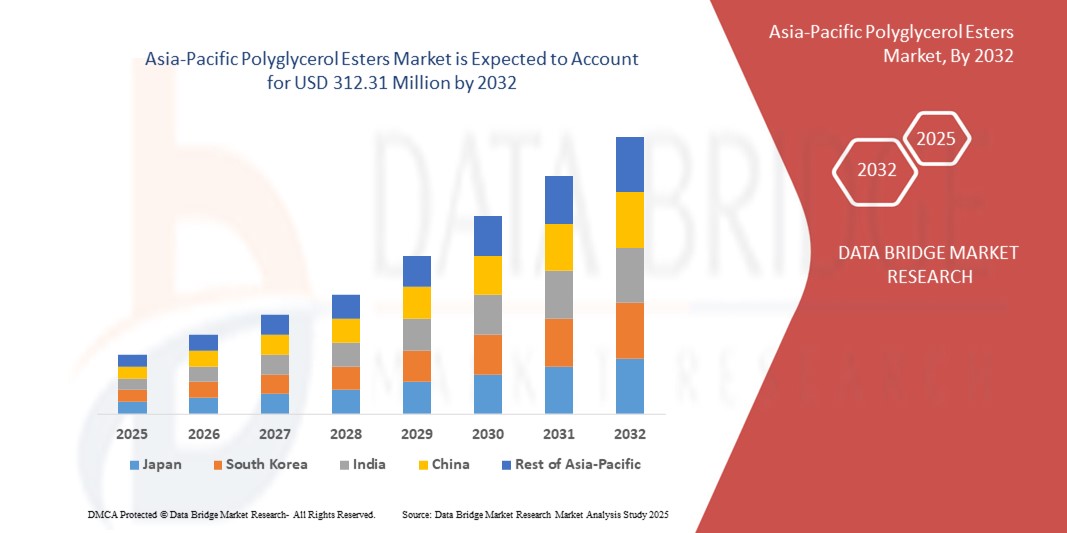
- The Asia-Pacific polyglycerol esters market size was valued at USD 251.38 million in 2024 and is expected to reach USD 312.31 million by 2032, at a CAGR of 2.75% during the forecast period
- The market growth is largely fuelled by the rising demand for clean-label food emulsifiers and stabilizers in bakery, confectionery, and dairy applications, as consumers increasingly prefer natural and plant-based ingredients
- Growing applications of polyglycerol esters in personal care, cosmetics, and pharmaceuticals for their multifunctional properties, such as emulsification, solubilization, and skin conditioning, are further propelling market expansion
Asia-Pacific Polyglycerol Esters Market Analysis
- The polyglycerol esters market is experiencing robust growth as manufacturers prioritize sustainable and multifunctional ingredients across food, personal care, and industrial sectors. Increasing consumer awareness toward healthier and environmentally friendly products is reinforcing demand
- Innovation in product formulations, coupled with regulatory support for bio-based ingredients, is expected to drive long-term opportunities. However, fluctuating raw material costs and the need for advanced processing technologies may pose challenges to wider adoption
- China dominated the Asia-Pacific polyglycerol esters market in 2024, fueled by its large food and beverage manufacturing sector. Growing demand for processed foods, bakery items, and plant-based alternatives has accelerated adoption of PGEs
- Japan is expected to witness the highest compound annual growth rate (CAGR) in the Asia-Pacific polyglycerol esters market due to rising demand for innovative food ingredients, increasing adoption of pharmaceutical-grade PGEs, and technological advancements in product formulation that enhance stability, texture, and functionality across applications
- The food grade segment held the largest market revenue share in 2024, driven by the rising demand for natural emulsifiers in bakery, confectionery, and dairy applications. Its ability to enhance texture, improve stability, and support clean-label product development has made it highly popular among food manufacturers
Report Scope and Asia-Pacific Polyglycerol Esters Market Segmentation
|
Attributes |
Asia-Pacific Polyglycerol Esters Key Market Insights |
|
Segments Covered |
|
|
Countries Covered |
Asia-Pacific
|
|
Key Market Players |
• Kao Corporation (Japan) |
|
Market Opportunities |
• Rising Adoption Of Bio-Based And Sustainable Ingredients |
|
Value Added Data Infosets |
In addition to the insights on market scenarios such as market value, growth rate, segmentation, geographical coverage, and major players, the market reports curated by the Data Bridge Market Research also include import export analysis, production capacity overview, production consumption analysis, price trend analysis, climate change scenario, supply chain analysis, value chain analysis, raw material/consumables overview, vendor selection criteria, PESTLE Analysis, Porter Analysis, and regulatory framework. |
Asia-Pacific Polyglycerol Esters Market Trends
Rising Demand For Clean-Label And Sustainable Food Ingredients
• The growing shift toward clean-label formulations is reshaping the PGE market, as food and beverage manufacturers increasingly prioritize natural, sustainable, and consumer-friendly emulsifiers. PGEs, derived from plant-based sources, are widely recognized for their safety and multifunctional properties, making them a preferred alternative to synthetic additives. This trend supports the rising demand for transparency and health-focused diets
• The adoption of PGEs is accelerating in bakery, confectionery, and dairy applications due to their ability to improve texture, stability, and shelf-life while meeting regulatory and consumer expectations for sustainability. The trend is further supported by global food companies reformulating products to reduce reliance on artificial emulsifiers and enhance brand credibility in health-conscious markets
• The affordability, versatility, and eco-friendly profile of PGEs are driving their uptake in packaged foods and beverages, particularly in markets where plant-derived solutions are gaining traction. Manufacturers benefit from cost-effective formulations that meet consumer demands without compromising on functionality or quality, enabling stronger market competitiveness
• For instance, in 2023, several bakery producers reformulated their bread and cake lines with polyglycerol esters, improving aeration, crumb softness, and shelf stability while aligning with consumer demand for natural and clean-label baked goods. This shift not only enhanced product appeal but also strengthened sustainability branding
• While PGEs are becoming increasingly popular in the global food and beverage industry, their broader impact depends on continued innovation, regional regulatory harmonization, and scalability. Manufacturers must focus on targeted R&D, consumer education, and sustainable sourcing to fully leverage this growing demand
Asia-Pacific Polyglycerol Esters Market Dynamics
Driver
Growing Demand For Natural, Plant-Based, And Multifunctional Emulsifiers
• Rising consumer preference for plant-based and natural food products is pushing food manufacturers to adopt PGEs as a clean-label emulsifier solution. With strong applications in bakery, confectionery, dairy, and processed foods, PGEs provide multiple benefits such as improved aeration, moisture retention, and extended shelf-life. This demand aligns with global health and wellness trends
• Food producers are increasingly aware of the competitive advantage offered by PGEs in meeting consumer demand for healthier, sustainable, and multifunctional ingredients. By replacing synthetic emulsifiers, PGEs not only improve food quality but also enhance product positioning in premium and mainstream markets alike
• Government initiatives and industry associations promoting natural food additives are further boosting the adoption of PGEs. From regulatory approvals to clean-label certification programs, these frameworks are encouraging food companies to expand their use of PGEs in new product development
• For instance, in 2022, multiple food manufacturers integrated PGEs into dairy alternatives, plant-based beverages, and frozen desserts, improving product stability and texture while aligning with rising consumer demand for sustainable, plant-based options
• While awareness and institutional support are driving adoption, challenges such as cost competitiveness, consumer awareness, and standardization across global markets still need to be addressed to ensure long-term sustainability of growth
Restraint/Challenge
Price Volatility Of Raw Materials And Limited Awareness In Emerging Markets
• The dependence of PGEs on raw materials such as glycerol and fatty acids exposes the industry to price fluctuations and supply chain vulnerabilities. Rising costs in plant-based feedstocks and global commodity uncertainty pose significant challenges for manufacturers in maintaining price competitiveness
• In many emerging markets, awareness of PGEs’ functional and clean-label benefits remains limited compared to traditional emulsifiers. The lack of technical knowledge and marketing emphasis hinders their adoption in local food industries, slowing down penetration in cost-sensitive regions
• Market growth is further restricted by inconsistent global regulatory frameworks governing food emulsifiers. Divergent approval processes and labeling requirements across countries create additional barriers for international expansion and product standardization
• For instance, in 2023, everal food processors reported difficulties in sourcing cost-effective PGEs due to raw material price spikes and regulatory complexities, which delayed product reformulations and limited broader adoption
• While PGEs present strong opportunities, overcoming raw material volatility, enhancing consumer education, and ensuring regulatory harmonization are crucial steps for unlocking their long-term market potential
Asia-Pacific Polyglycerol Esters Market Scope
The market is segmented on the basis of grade, form, hydroxyl value, color, and application.
- By Grade
On the basis of grade, the Asia-Pacific polyglycerol esters market is segmented into food grade, pharmaceutical grade, and industrial grade. The food grade segment held the largest market revenue share in 2024, driven by the rising demand for natural emulsifiers in bakery, confectionery, and dairy applications. Its ability to enhance texture, improve stability, and support clean-label product development has made it highly popular among food manufacturers.
The pharmaceutical grade segment is expected to witness the fastest growth rate from 2025 to 2032, fuelled by its increasing role as a safe excipient in drug formulations. Its use in solubilization, bioavailability enhancement, and controlled release systems makes it a preferred choice for pharmaceutical companies seeking reliable and multifunctional ingredients.
- By Form
On the basis of form, the Asia-Pacific polyglycerol esters market is segmented into thickeners, solubilizers, spreading agents, additives, waxy solids, and inert ingredients. The solubilizers segment held the largest market revenue share in 2024, driven by their widespread use in beverages, dairy alternatives, and personal care products where improved dispersion and stability are critical.
The spreading agents segment is expected to witness the fastest growth rate from 2025 to 2032, owing to their expanding applications in cosmetics and pharmaceuticals. Their ability to enhance sensory properties, improve application, and support active ingredient delivery is accelerating their adoption in premium formulations.
- By Hydroxyl Value
On the basis of hydroxyl value, the Asia-Pacific polyglycerol esters market is segmented into 50 to 150, 30 to 49, less than 30, and more than 150. The 50 to 150 segment held the largest market revenue share in 2024, as this range offers versatile performance in food emulsification, texture improvement, and stability across diverse formulations.
The less than 30 segment is expected to witness the fastest growth rate from 2025 to 2032, as these PGEs are increasingly utilized in specialized applications requiring high hydrophobicity. Their use in industrial lubricants, coatings, and certain personal care products is expanding steadily.
- By Color
On the basis of color, the Asia-Pacific polyglycerol esters market is segmented into light yellow, amber, light tan, and brown. The light yellow segment held the largest market revenue share in 2024, preferred by food and personal care manufacturers for its clean appearance and suitability in transparent or light-colored end products.
The amber segment is expected to witness the fastest growth rate from 2025 to 2032, with growing acceptance in processed foods, industrial uses, and formulations where natural variations in color do not impact performance. This trend reflects rising demand for minimally processed, sustainable emulsifiers.
- By Application
On the basis of application, the Asia-Pacific polyglycerol esters market is segmented into food, personal care, pharmaceuticals, surfactants & detergents, and others. The food segment held the largest market revenue share in 2024, driven by strong demand in bakery, confectionery, and dairy industries. PGEs are increasingly valued for improving aeration, stability, and overall product quality while supporting clean-label trends.
The personal care segment is expected to witness the fastest growth rate from 2025 to 2032, driven by the rising use of PGEs in creams, lotions, and cosmetics. Their multifunctional role as emulsifiers, stabilizers, and spreading agents is fueling growth in premium skincare and haircare products across the region.
Asia-Pacific Polyglycerol Esters Market Regional Analysis
- China dominated the Asia-Pacific polyglycerol esters market in 2024, fueled by its large food and beverage manufacturing sector. Growing demand for processed foods, bakery items, and plant-based alternatives has accelerated adoption of PGEs
- Local producers utilize PGEs for emulsification, stability, and improved sensory properties in products. The presence of major regional chemical manufacturers ensures a steady supply of high-quality PGEs. Rising consumer awareness of clean-label and natural ingredients drives market expansion
- Strong government support for the food processing and personal care industries further enhances growth. Overall, China remains the largest market for PGEs in the Asia-Pacific region
Japan Polyglycerol Esters Market Insights
Japan is expected to witness the fastest growth rate from 2025 to 2032 due to increasing adoption of PGEs in processed foods and personal care products. Manufacturers are focusing on improving texture, stability, and shelf life in bakery, dairy, and cosmetic formulations. Rising consumer preference for natural, safe, and functional ingredients is boosting demand. Technological advancements in ingredient formulations and collaborations with international suppliers support market growth. Expansion in food and pharmaceutical applications, along with regulatory support, contributes to rapid adoption. Overall, Japan is emerging as the fastest-growing PGE market in the region.
Asia-Pacific Polyglycerol Esters Market Share
The Asia-Pacific polyglycerol esters industry is primarily led by well-established companies, including:
- Kao Corporation (Japan)
- Mitsubishi Chemical Group Corporation (Japan)
- LG Chem Ltd. (South Korea)
- Wilmar International Limited (Singapore)
- Godrej Industries Limited (India)
- PTT Global Chemical Public Company Limited (Thailand)
- Sumitomo Chemical Co., Ltd. (Japan)
- IOI Corporation Berhad (Malaysia)
- Galaxy Surfactants Ltd. (India)
- SKC Co., Ltd. (South Korea)

- Interactive Data Analysis Dashboard
- Company Analysis Dashboard for high growth potential opportunities
- Research Analyst Access for customization & queries
- Competitor Analysis with Interactive dashboard
- Latest News, Updates & Trend analysis
- Harness the Power of Benchmark Analysis for Comprehensive Competitor Tracking
Asia Pacific Polyglycerol Esters Market, Supply Chain Analysis and Ecosystem Framework
To support market growth and help clients navigate the impact of geopolitical shifts, DBMR has integrated in-depth supply chain analysis into its Asia Pacific Polyglycerol Esters Market research reports. This addition empowers clients to respond effectively to global changes affecting their industries. The supply chain analysis section includes detailed insights such as Asia Pacific Polyglycerol Esters Market consumption and production by country, price trend analysis, the impact of tariffs and geopolitical developments, and import and export trends by country and HSN code. It also highlights major suppliers with data on production capacity and company profiles, as well as key importers and exporters. In addition to research, DBMR offers specialized supply chain consulting services backed by over a decade of experience, providing solutions like supplier discovery, supplier risk assessment, price trend analysis, impact evaluation of inflation and trade route changes, and comprehensive market trend analysis.
Data collection and base year analysis are done using data collection modules with large sample sizes. The stage includes obtaining market information or related data through various sources and strategies. It includes examining and planning all the data acquired from the past in advance. It likewise envelops the examination of information inconsistencies seen across different information sources. The market data is analysed and estimated using market statistical and coherent models. Also, market share analysis and key trend analysis are the major success factors in the market report. To know more, please request an analyst call or drop down your inquiry.
The key research methodology used by DBMR research team is data triangulation which involves data mining, analysis of the impact of data variables on the market and primary (industry expert) validation. Data models include Vendor Positioning Grid, Market Time Line Analysis, Market Overview and Guide, Company Positioning Grid, Patent Analysis, Pricing Analysis, Company Market Share Analysis, Standards of Measurement, Global versus Regional and Vendor Share Analysis. To know more about the research methodology, drop in an inquiry to speak to our industry experts.
Data Bridge Market Research is a leader in advanced formative research. We take pride in servicing our existing and new customers with data and analysis that match and suits their goal. The report can be customized to include price trend analysis of target brands understanding the market for additional countries (ask for the list of countries), clinical trial results data, literature review, refurbished market and product base analysis. Market analysis of target competitors can be analyzed from technology-based analysis to market portfolio strategies. We can add as many competitors that you require data about in the format and data style you are looking for. Our team of analysts can also provide you data in crude raw excel files pivot tables (Fact book) or can assist you in creating presentations from the data sets available in the report.













