


Asia-Pacific Prescription Digital Therapeutics (PDTx) Market Overview
The Asia-Pacific Prescription Digital Therapeutics (PDTx) market was valued at USD 229.33 million in 2025 and is projected to reach USD 1,298.47 million by 2033, growing at a CAGR of 24.20% from 2026 to 2033. The market is witnessing steady expansion driven by rising burden of chronic diseases, increasing mental health disorders, and growing adoption of digital health solutions across healthcare systems in the region. Expanding smartphone penetration, improving internet infrastructure, and supportive government initiatives for digital healthcare are further accelerating market adoption.
The growing shift toward value-based care, combined with rising healthcare costs and limited access to specialist care in rural areas, is encouraging the use of PDTx solutions as scalable and cost-effective treatment options. Increasing integration of artificial intelligence, real-world evidence generation, and regulatory progress in countries such as Japan, China, India, and Australia are strengthening clinical acceptance. In addition, partnerships between healthcare providers, insurers, and digital health companies are driving wider deployment of prescription-based software therapies across neurology, psychiatry, diabetes management, and substance use disorders.
.Key Market Trends & Insights
- China dominated the Asia-Pacific PDTx market with the largest country share of 42.15% in 2025, supported by strong government backing for digital health transformation, rapid AI integration in healthcare systems, and large-scale chronic disease management initiatives.
- The Input Mechanisms segment led the market with a 57.84% share in 2025, driven by its critical role in capturing patient-generated health data through sensors, mobile inputs, and wearable integration.
- India is expected to be the fastest-growing region at a CAGR of 8.1% from 2026 to 2033, fueled by expanding telehealth adoption, rising smartphone penetration, and increasing demand for affordable digital therapeutic solutions.
- Output Mechanisms are the fastest-growing mechanism type, projected to register a CAGR of 8.6%, reflecting the surge in demand for real-time therapeutic feedback, alerts, and behavioral intervention delivery.
- The Medication Augmentation segment dominated the category with a 63.21% revenue share in 2025, led by its widespread use alongside conventional pharmacological treatments.
- Outpatient Treatment accounted for 68.47% of the market, preferred by the increasing preference for home-based and remote care models
- The Monotherapy segment is the fastest-growing treatment category, with a CAGR of 8.8%, driven by the increasing clinical validation of standalone digital therapies.
Market Size & Forecast
- Global Market Value (2025): USD 229.33 Million
- Expected Market Value (2033): USD 1,298.47 Million
- Forecast CAGR (2026–2033): 24.20%
- Leading Country in 2025: China
- Fastest Growing Country: India
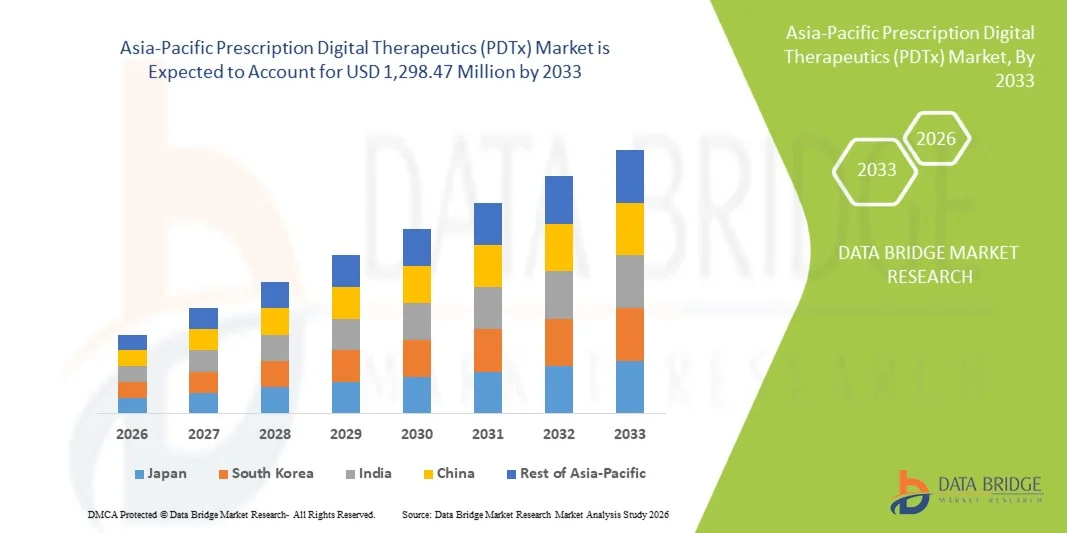
Report Scope and Asia-Pacific Prescription Digital Therapeutics (PDTx) Market Segmentation
|
Attributes |
Asia-Pacific Prescription Digital Therapeutics (PDTx) Key Market Insights |
|
Segments Covered |
|
|
Countries Covered |
Asia-Pacific · China · Japan · India · South Korea · Singapore · Malaysia · Australia · Thailand · Indonesia · Philippines · Rest of Asia-Pacific |
|
Key Market Players |
· CureApp Inc. (Japan) · Otsuka Pharmaceutical Co., Ltd. (Japan) · Astellas Pharma Inc. (Japan) · Mitsubishi Tanabe Pharma Corporation (Japan) · MICIN, Inc. (Japan) · Ubie, Inc. (Japan) · Medley, Inc. (Japan) · M3, Inc. (Japan) · SOMPO Light Vortex Inc. (Japan) · AIMMED Co., Ltd. (South Korea) · Lunit Inc. (South Korea) · WelTizen Co., Ltd. (South Korea) · Ping An Good Doctor (China) · WeDoctor (China) · MindRank AI (China) · Hangzhou NFH Medical Technology Co., Ltd. (China) · Holmusk Pte Ltd (Singapore) · Healint Pte Ltd (Singapore) · Wysa Ltd (India) · Tricog Health Services Pvt. Ltd. (India) |
|
Market Opportunities |
· Expansion of AI-driven personalized therapy platforms · Integration of PDTx solutions with hospital electronic health records (EHR) and telehealth systems · Growing adoption of PDTx for chronic disease management |
|
Value Added Data Infosets |
In addition to the insights on market scenarios such as market value, growth rate, segmentation, geographical coverage, and major players, the market reports curated by the Data Bridge Market Research also include in-depth expert analysis, patient epidemiology, pipeline analysis, pricing analysis, and regulatory framework. |
Asia-Pacific Prescription Digital Therapeutics (PDTx) Market Trends
Trend: Growth in Chronic Disease and Mental Health Digital Care Adoption
Prescription Digital Therapeutics (PDTx) are increasingly being adopted for chronic disease management and mental health disorders as healthcare systems shift toward scalable, software-based treatment models. Rising prevalence of diabetes, depression, and anxiety is accelerating demand for app-based therapeutic interventions that provide continuous monitoring, behavioral modification, and personalized treatment pathways. Integration of PDTx with telemedicine platforms and mobile health applications is improving patient engagement and adherence, while data-driven insights from real-world evidence are enhancing clinical decision-making. For instance, AI-powered mental health PDTx platforms in Japan and diabetes management apps in India are expanding remote patient care delivery across urban and semi-urban populations.
Asia-Pacific Prescription Digital Therapeutics (PDTx) Market Dynamics
Key Market Driver: Rising Integration of Digital Health and Telehealth Ecosystems
The rapid expansion of telehealth infrastructure and digital healthcare ecosystems is driving strong adoption of Prescription Digital Therapeutics across Asia-Pacific countries, as healthcare providers increasingly prescribe software-based interventions alongside conventional therapies. Government initiatives supporting digital health transformation, combined with rising smartphone penetration and internet connectivity, are enabling wider access to PDTx solutions in both urban and rural populations. Integration with electronic health records and remote monitoring systems is further improving treatment continuity and physician oversight. For instance, China’s national digital health initiatives and South Korea’s hospital-linked digital therapy programs are accelerating large-scale PDTx deployment.
Key Restraint/Challenge: Limited Awareness and Regulatory Fragmentation
A major restraint in the Asia-Pacific PDTx market is limited awareness among patients and healthcare professionals, coupled with fragmented regulatory frameworks across different countries, which slows adoption and reimbursement approval processes. Many healthcare systems still lack standardized guidelines for digital therapeutics prescription, creating uncertainty for providers and developers. In addition, variations in data privacy laws and reimbursement structures across markets increase compliance complexity and operational costs for PDTx companies. For instance, inconsistent approval pathways in emerging Southeast Asian countries and limited reimbursement coverage in India continue to restrict large-scale commercialization of PDTx solutions.
Key Market Opportunity: Expansion of AI-Driven Personalized Digital Therapeutics Platforms
The integration of artificial intelligence into Prescription Digital Therapeutics presents a significant market opportunity by enabling highly personalized, adaptive treatment plans based on patient behavior, clinical data, and real-time feedback loops. AI-driven PDTx platforms can improve treatment efficacy through predictive analytics, automated intervention adjustments, and continuous patient engagement, making them highly suitable for chronic disease and mental health management. Increasing investment in cloud-based healthcare infrastructure is further expanding access to scalable digital therapy solutions across cost-sensitive markets. For instance, AI-enabled cognitive behavioral therapy applications in China and cloud-based diabetes management platforms in India are demonstrating strong potential for large-scale adoption.
Asia-Pacific Prescription Digital Therapeutics (PDTx) Market Scope
The Asia-Pacific Prescription Digital Therapeutics (PDTx) market is segmented on the basis of mechanism, category, treatment type, software, services, app accessibility, app type, application, and patients.
- By Mechanism
On the basis of mechanism, the Asia-Pacific PDTx market is segmented into input mechanisms and output mechanisms. The Input Mechanisms segment dominated the market, accounting for a major share of 57.84% in 2025, due to its critical role in capturing patient-generated health data through sensors, mobile inputs, and wearable integrations. These mechanisms enable continuous monitoring of patient behavior, symptoms, and physiological parameters, improving treatment personalization. Increasing adoption of smartphones and connected devices across China, India, and Japan is strengthening data input efficiency. Healthcare providers rely heavily on input-driven PDTx systems for real-time patient tracking and clinical decision support. Integration with AI-based analytics further enhances therapeutic accuracy. Growing demand for remote patient monitoring is reinforcing dominance of this segment.
The Output Mechanisms segment is expected to be the fastest-growing, registering a CAGR of 8.6% from 2026 to 2033, driven by increasing demand for real-time therapeutic feedback, alerts, and behavioral intervention delivery. These systems play a key role in delivering personalized treatment recommendations and adaptive therapy modifications. Rising adoption of AI-powered coaching systems and digital behavioral nudges is accelerating segment growth. Expansion of mobile health applications is improving accessibility of output-driven interventions. Increasing use in mental health and chronic disease management is further boosting demand. Continuous improvements in algorithm-driven therapeutic responses are strengthening market penetration.
- By Category
On the basis of category, the market is segmented into medication augmentation and medication replacement. The Medication Augmentation segment dominated the market with a 63.21% share in 2025, driven by its widespread use alongside conventional pharmacological treatments. This approach is highly preferred in chronic disease and mental health management, where PDTx enhances drug efficacy and patient adherence. Healthcare providers favor augmentation models due to lower regulatory barriers and higher clinical acceptance. Increasing prevalence of depression, diabetes, and ADHD is strengthening adoption. Integration with hospital systems and physician-prescribed digital tools is expanding usage. Strong clinical validation studies are further reinforcing trust in augmentation-based PDTx solutions.
The Medication Replacement segment is projected to be the fastest-growing, with a CAGR of 9.1% from 2026 to 2033, driven by rising confidence in fully digital therapeutic interventions. These solutions are increasingly being used as standalone treatments for conditions such as insomnia, ADHD, and substance use disorders. Advancements in clinical validation and regulatory approvals are supporting broader adoption. Cost-effectiveness compared to traditional drug therapies is accelerating demand. Expansion of AI-driven personalized therapy platforms is improving treatment outcomes. Growing acceptance among younger, tech-savvy populations is further fueling segment growth.
- By Treatment
On the basis of treatment, the market is segmented into outpatient treatment and monotherapy. The Outpatient Treatment segment dominated the market with a 68.47% share in 2025, driven by increasing preference for home-based and remote care models. PDTx solutions are widely used in outpatient settings for continuous monitoring and behavioral intervention delivery. Expansion of telehealth infrastructure across Asia-Pacific is strengthening adoption. Hospitals and clinics are integrating PDTx into routine outpatient care pathways. Rising burden of chronic diseases requiring long-term management is further supporting dominance. Improved patient convenience and reduced healthcare costs are key growth drivers.
The Monotherapy segment is expected to be the fastest-growing, registering a CAGR of 8.8% from 2026 to 2033, driven by increasing clinical validation of standalone digital therapies. These treatments are gaining traction for mental health disorders and addiction management. Growing regulatory approvals for prescription-based digital-only interventions are accelerating adoption. Increased focus on non-pharmacological treatment alternatives is supporting demand. AI-based adaptive therapy systems are improving effectiveness of monotherapy solutions. Rising healthcare digitization is further strengthening this segment’s growth outlook.
- By Software
On the basis of software, the market is segmented into respiratory conditions, mental health, opioid use disorder, diabetes, and others. The Software for Mental Health segment dominated the market with a 44.92% share in 2025, driven by rising prevalence of depression, anxiety, and stress-related disorders across Asia-Pacific. Increasing acceptance of digital cognitive behavioral therapy (CBT) solutions is boosting adoption. Governments and healthcare providers are actively promoting mental health digitization programs. Integration with mobile apps and telepsychiatry platforms is expanding reach. Growing stigma reduction around mental health treatment is improving patient engagement. Strong clinical evidence supporting PDTx efficacy in psychiatry is reinforcing dominance.
The Software for Diabetes segment is expected to be the fastest-growing, with a CAGR of 9.3% from 2026 to 2033, driven by rising diabetic population and lifestyle-related disorders in Asia-Pacific. Countries such as India and China are witnessing rapid growth in digital diabetes management programs. AI-driven glucose monitoring and behavioral coaching tools are improving treatment outcomes. Increasing integration with wearable devices is enhancing real-time data tracking. Government-led chronic disease prevention initiatives are supporting adoption. Growing demand for preventive healthcare solutions is further accelerating segment expansion.
- By Services
On the basis of services, the market is segmented into behavioral microservices and medical microservices. The Behavioral Microservices segment dominated the market with a 61.38% share in 2025, driven by strong adoption of cognitive behavioral therapy (CBT), habit-forming interventions, and lifestyle modification programs delivered through digital platforms. These services are widely integrated into mental health and chronic disease PDTx solutions to improve patient adherence and long-term engagement. Increasing use of AI-driven behavioral nudges and personalized coaching tools is strengthening effectiveness. Healthcare providers prefer behavioral microservices due to their scalability and ease of integration into mobile applications. Rising prevalence of depression, insomnia, and substance use disorders is further supporting demand. Continuous real-time feedback systems are enhancing therapeutic outcomes across patient groups.
The Medical Microservices segment is expected to be the fastest-growing, registering a CAGR of 8.9% from 2026 to 2033, driven by increasing integration of clinical-grade monitoring, diagnostic support, and physician-linked digital interventions. These services enable tighter collaboration between healthcare professionals and digital therapeutic platforms. Expansion of remote patient monitoring systems is accelerating adoption in chronic disease management. Growing regulatory acceptance of clinically validated digital therapies is supporting growth. Increasing demand for hybrid care models combining digital and clinical oversight is further boosting the segment. Advancements in AI-powered clinical decision support systems are strengthening future scalability.
- By App Accessibility
On the basis of app accessibility, the market is segmented into Android, iOS, and Windows. The Android segment dominated the market with a 58.74% share in 2025, driven by its widespread usage across Asia-Pacific, particularly in emerging economies such as India, Indonesia, and China. Android-based PDTx applications benefit from high smartphone penetration and affordability of devices. Developers prefer Android due to its large user base and flexible deployment ecosystem. Increasing availability of low-cost smartphones is expanding access to digital therapeutics. Government-backed digital health initiatives are also leveraging Android platforms for mass adoption. Strong compatibility with telehealth and mobile health apps is further reinforcing dominance.
The iOS segment is expected to be the fastest-growing, with a CAGR of 8.3% from 2026 to 2033, driven by strong adoption among urban populations and premium healthcare users. iOS platforms are preferred for their high security, data privacy standards, and seamless integration with healthcare ecosystems. Increasing use of Apple HealthKit and digital wellness applications is supporting growth. Rising deployment of clinically validated PDTx apps on iOS is expanding adoption in developed Asia-Pacific markets such as Japan and Australia. Strong physician preference for secure patient data environments is further boosting demand. Continuous innovation in Apple’s health ecosystem is strengthening long-term growth potential.
- By App Type
On the basis of app type, the market is segmented into native apps and web apps. The Native Apps segment dominated the market with a 64.11% share in 2025, driven by superior performance, offline accessibility, and better integration with device hardware such as sensors and wearables. Native PDTx apps provide enhanced user experience, which is critical for long-term patient engagement in behavioral therapies. Healthcare providers prefer native apps for real-time monitoring and personalized intervention delivery. Increasing use in mental health and chronic disease management is strengthening adoption. Integration with push notifications and AI-driven feedback systems is improving treatment adherence. Strong compatibility with mobile operating systems is further supporting dominance.
The Web Apps segment is expected to be the fastest-growing, registering a CAGR of 8.7% from 2026 to 2033, driven by ease of access without installation and cross-platform compatibility. Web-based PDTx solutions are increasingly being used in cost-sensitive healthcare settings. Expansion of cloud-based healthcare infrastructure is enabling scalable deployment. These apps are particularly useful in rural and low-connectivity regions across Asia-Pacific. Growing preference for browser-based healthcare tools among providers is accelerating adoption. Continuous improvements in web security and responsiveness are further enhancing usability.
- By Application
On the basis of application, the market is segmented into substance use disorder (SUD), opioid use disorder (OUD), ADHD, Alzheimer’s disease, MDD, insomnia, epilepsy, movement disorder, multiple sclerosis, migraine, autism spectrum disorder, oncology, inflammation, respiratory, cardiovascular, pain management, metabolic conditions, and others. The Major Depressive Disorder (MDD) segment dominated the market with a 29.46% share in 2025, driven by rapidly increasing mental health burden across Asia-Pacific. Rising stress, urban lifestyle pressures, and growing awareness of mental health treatment are supporting adoption. PDTx solutions for MDD are widely used due to strong clinical validation of digital CBT programs. Expansion of telepsychiatry services is improving accessibility of treatment. Governments are actively promoting mental health digitalization initiatives. Strong patient acceptance of app-based therapy is reinforcing segment dominance.
The Diabetes (Metabolic Conditions) segment is expected to be the fastest-growing, with a CAGR of 9.4% from 2026 to 2033, driven by rising prevalence of lifestyle-related disorders in China, India, and Southeast Asia. Increasing use of AI-enabled glucose monitoring and behavioral modification apps is enhancing disease management. Growing integration with wearable devices and continuous glucose monitoring systems is accelerating adoption. Government-led chronic disease prevention programs are supporting expansion. Rising demand for preventive healthcare solutions is further boosting growth. Strong focus on reducing long-term healthcare costs is reinforcing market penetration.
- By Patients
On the basis of patients, the market is segmented into children and adults. The Adults segment dominated the market with a 74.62% share in 2025, driven by higher prevalence of chronic diseases, mental health disorders, and lifestyle-related conditions in the working-age population. Adults are the primary users of PDTx solutions for diabetes, depression, insomnia, and cardiovascular conditions. High smartphone penetration and digital literacy among adults are supporting adoption. Employers and healthcare providers are increasingly promoting digital wellness programs for adult populations. Strong insurance and reimbursement support for adult therapies is further strengthening dominance. Continuous engagement through mobile platforms is improving adherence rates.
The Children segment is expected to be the fastest-growing, registering a CAGR of 8.6% from 2026 to 2033, driven by rising diagnosis rates of ADHD, autism spectrum disorder, and behavioral conditions. Increasing parental acceptance of digital therapeutic interventions is supporting adoption. Schools and pediatric healthcare providers are integrating PDTx solutions into treatment plans. Growing awareness of early intervention benefits is accelerating usage. Development of gamified and interactive therapeutic apps is improving engagement among children. Expanding pediatric mental health initiatives across Asia-Pacific are further boosting growth.
Asia-Pacific Prescription Digital Therapeutics (PDTx) Market Regional Analysis
China dominated the Asia-Pacific PDTx market with the largest country share of 42.15% in 2025, supported by strong government backing for digital health transformation, rapid AI integration in healthcare systems, and large-scale chronic disease management initiatives. The country also benefits from advanced mobile health infrastructure, high smartphone penetration, and increasing adoption of prescription-based digital therapies across hospitals and telehealth networks. Expanding investments in mental health solutions, diabetes management apps, and remote patient monitoring systems continue to strengthen China’s leadership position in the regional PDTx market.
The China Prescription Digital Therapeutics (PDTx) Market Insight
The China Prescription Digital Therapeutics (PDTx) market is witnessing rapid growth, driven by strong government support for digital healthcare innovation, expanding AI integration in medical systems, and increasing prevalence of chronic diseases. Rising adoption of mobile health platforms and large-scale deployment of digital mental health and diabetes management solutions are further boosting market demand. Moreover, continuous investments in hospital digitalization and telemedicine infrastructure are positioning China as the leading market for PDTx adoption in Asia-Pacific.
India Prescription Digital Therapeutics (PDTx) Market Insight
The India Prescription Digital Therapeutics (PDTx) market is experiencing strong expansion, supported by rapid healthcare digitization, growing smartphone penetration, and increasing demand for affordable healthcare solutions. Rising burden of diabetes, cardiovascular diseases, and mental health disorders is driving adoption of app-based therapeutic interventions. In addition, government initiatives promoting digital health ecosystems and increasing use of telemedicine platforms are further accelerating PDTx uptake across urban and semi-urban populations.
Japan Prescription Digital Therapeutics (PDTx) Market Insight
The Japan Prescription Digital Therapeutics (PDTx) market is witnessing steady growth due to advanced healthcare infrastructure, strong focus on aging population care, and early adoption of digital health technologies. Increasing use of AI-enabled therapeutic platforms and integration of PDTx into clinical workflows are supporting market expansion. Furthermore, rising demand for mental health solutions and chronic disease management tools is strengthening adoption across hospitals and research institutions.
South Korea Prescription Digital Therapeutics (PDTx) Market Insight
The South Korea Prescription Digital Therapeutics (PDTx) market is expanding steadily, driven by strong digital health infrastructure, high smartphone penetration, and increasing government support for AI-based healthcare solutions. Growing adoption of digital mental health therapies and chronic disease management platforms is supporting market growth. In addition, integration of PDTx into hospital systems and rising focus on preventive healthcare are further accelerating demand across the country.
Asia-Pacific Prescription Digital Therapeutics (PDTx) Market Share
The Asia-Pacific Prescription Digital Therapeutics (PDTx) industry is primarily led by well-established companies, including:
- CureApp Inc. (Japan)
- Otsuka Pharmaceutical Co., Ltd. (Japan)
- Astellas Pharma Inc. (Japan)
- Mitsubishi Tanabe Pharma Corporation (Japan)
- MICIN, Inc. (Japan)
- Ubie, Inc. (Japan)
- Medley, Inc. (Japan)
- M3, Inc. (Japan)
- SOMPO Light Vortex Inc. (Japan)
- AIMMED Co., Ltd. (South Korea)
- Lunit Inc. (South Korea)
- WelTizen Co., Ltd. (South Korea)
- Ping An Good Doctor (China)
- WeDoctor (China)
- MindRank AI (China)
- Hangzhou NFH Medical Technology Co., Ltd. (China)
- Holmusk Pte Ltd (Singapore)
- Healint Pte Ltd (Singapore)
- Wysa Ltd (India)
- Tricog Health Services Pvt. Ltd. (India)
Latest Developments in Asia-Pacific Prescription Digital Therapeutics (PDTx) Market
- In March 2024, Otsuka Pharmaceutical and Click Therapeutics received U.S. FDA authorization for “Rejoyn,” a prescription digital therapeutic designed as an adjunct treatment for major depressive disorder (MDD), marking a major global milestone for clinically validated PDTx solutions linked to Asia-based pharmaceutical leadership. The smartphone-based therapy delivers cognitive emotional training exercises and structured behavioral interventions to improve depression symptoms alongside standard antidepressant treatment
- In January 2024, CureApp expanded real-world clinical use of its prescription digital therapeutic “CureApp SC” for smoking cessation in Japan, with hospitals including leading medical institutions formally beginning prescriptions under physician supervision. The solution delivers behavioral modification therapy through a regulated app-based treatment model, marking one of the most advanced PDTx implementations in Asia-Pacific. The rollout strengthened Japan’s position as a pioneer in reimbursed digital therapeutics and expanded clinical adoption beyond hypertension into addiction treatment
- In February 2023, South Korea’s Ministry of Food and Drug Safety (MFDS) granted its first-ever approval for a prescription digital therapeutic, “Somzz,” developed by AIMMED for insomnia treatment, marking a regulatory milestone for PDTx in the country. The app-based therapy uses cognitive behavioral techniques delivered digitally to improve sleep patterns and has been validated through clinical trials across multiple hospitals. This approval officially introduced prescription digital therapeutics into South Korea’s regulated medical device ecosystem
- In February 2023, South Korea’s AIMMED announced the commercialization rollout of its insomnia PDTx “Somzz” across major hospitals, including Seoul National University Hospital and Severance Hospital, following regulatory approval. The solution became one of the first clinically prescribed digital therapeutics in Asia-Pacific, enabling physician-directed digital CBT-based treatment. This development marked the transition of PDTx from regulatory approval to real-world clinical deployment in the region
- In October 2021, Otsuka Pharmaceutical expanded its collaboration with Click Therapeutics to develop prescription digital therapeutics targeting central nervous system disorders, including major depressive disorder. The initiative integrates pharmaceutical R&D with software-based behavioral therapy platforms to create hybrid treatment models. This partnership reflects increasing pharma-digital convergence in Japan’s PDTx ecosystem and supports global expansion of clinically validated software therapeutics

- Interactive Data Analysis Dashboard
- Company Analysis Dashboard for high growth potential opportunities
- Research Analyst Access for customization & queries
- Competitor Analysis with Interactive dashboard
- Latest News, Updates & Trend analysis
- Harness the Power of Benchmark Analysis for Comprehensive Competitor Tracking
Data collection and base year analysis are done using data collection modules with large sample sizes. The stage includes obtaining market information or related data through various sources and strategies. It includes examining and planning all the data acquired from the past in advance. It likewise envelops the examination of information inconsistencies seen across different information sources. The market data is analysed and estimated using market statistical and coherent models. Also, market share analysis and key trend analysis are the major success factors in the market report. To know more, please request an analyst call or drop down your inquiry.
The key research methodology used by DBMR research team is data triangulation which involves data mining, analysis of the impact of data variables on the market and primary (industry expert) validation. Data models include Vendor Positioning Grid, Market Time Line Analysis, Market Overview and Guide, Company Positioning Grid, Patent Analysis, Pricing Analysis, Company Market Share Analysis, Standards of Measurement, Global versus Regional and Vendor Share Analysis. To know more about the research methodology, drop in an inquiry to speak to our industry experts.
Data Bridge Market Research is a leader in advanced formative research. We take pride in servicing our existing and new customers with data and analysis that match and suits their goal. The report can be customized to include price trend analysis of target brands understanding the market for additional countries (ask for the list of countries), clinical trial results data, literature review, refurbished market and product base analysis. Market analysis of target competitors can be analyzed from technology-based analysis to market portfolio strategies. We can add as many competitors that you require data about in the format and data style you are looking for. Our team of analysts can also provide you data in crude raw excel files pivot tables (Fact book) or can assist you in creating presentations from the data sets available in the report.












