


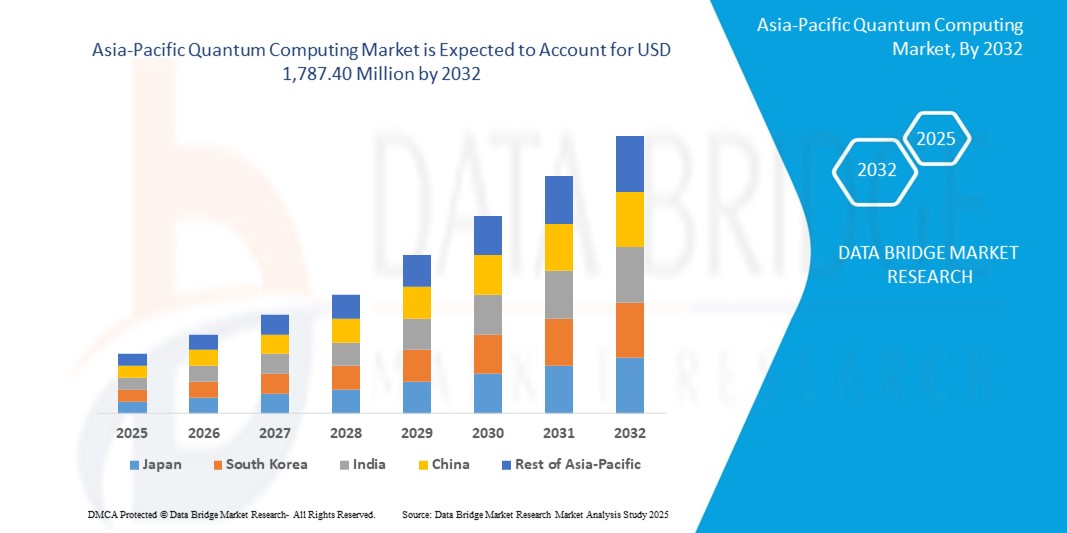
Asia-Pacific Quantum Computing Market Size
- The Asia-Pacific Quantum Computing Market size was valued at USD 392.1 Million in 2024 and is expected to reach USD 1,787.40 Million by 2032, at a CAGR of 24.20% during the forecast period
- Quantum computing is being increasingly adopted in the financial sector across Asia-Pacific, particularly for complex financial modeling and risk analysis, enabling faster and more accurate decision-making.
Asia-Pacific Quantum Computing Market Analysis
- Quantum computing is an area of advanced developing computer technology study that harnesses the phenomena of quantum mechanics that helps facilitate new discoveries in various sectors. Quantum computing technology processes information at atomic and sub atomic level through quantum computers and focuses on the development of technologies centered on the principles of quantum theory and quantum mechanics.
- Rising demand and application of this technology by the healthcare and pharmaceuticals industry will further aggravate the market growth rate. Surge in number of strategic partnerships and collaborations to carry out advancements, rising research and development proficiencies and early adoption of quantum computing in the banking and finance sector are other important market growth determinants.
- China dominates the Asia-Pacific Quantum Computing Market with the largest revenue share of 44.01% in 2025, CHINA quantum computing growth is driven by significant investments from both public and private sectors. Governments in countries such as China, Japan, and India are actively funding quantum research and establishing national strategies to accelerate development and commercialization.
- India is expected to be the fastest growing region in the Asia-Pacific Quantum Computing Market during the forecast period due to strong governmental support, investment in R&D, and institutions like the Technology Innovation Institute. The nation's tech-forward vision and strategic global collaborations position it as a quantum innovation hub focused on defense, cybersecurity, and financial modeling applications across public and private sectors.
- The Single Qubit Quantum System segment is anticipated to hold the largest market share of 62.9% in the Asia-Pacific Quantum Computing Market during the forecast period. The Single Qubit Quantum System segment in the Asia-Pacific market is driven by increasing investments in foundational quantum research and education. Early-stage adoption by academic institutions and startups fuels innovation, laying the groundwork for scalable quantum technologies and future multi-qubit system development in the region.
Report Scope and Asia-Pacific Quantum Computing Market Segmentation
|
Attributes |
Asia-Pacific Quantum Computing Key Market Insights |
|
Segments Covered |
|
|
Countries Covered |
Asia-Pacific
|
|
Key Market Players |
|
|
Market Opportunities |
|
|
Value Added Data Infosets |
In addition to the insights on market scenarios such as market value, growth rate, segmentation, geographical coverage, and major players, the market reports curated by the Data Bridge Market Research also include import export analysis, production capacity overview, production consumption analysis, price trend analysis, climate change scenario, supply chain analysis, value chain analysis, raw material/consumables overview, vendor selection criteria, PESTLE Analysis, Porter Analysis, and regulatory framework. |
Asia-Pacific Quantum Computing Market Trends
“Accelerating Quantum Adoption through Strategic Research and Partnerships”
- The Asia-Pacific region is witnessing growing investments in quantum computing research hubs, particularly in countries like the CHINA and Mexico, aiming to establish themselves as leaders in quantum technology innovation.
- Collaboration between governments, academic institutions, and private companies is fueling advancements in quantum algorithms, hardware development, and software applications tailored to regional needs.
- Increasing awareness of quantum computing’s potential in solving complex problems related to cryptography, materials science, and optimization is driving interest across sectors such as finance, healthcare, and energy.
- The emergence of cloud-based quantum computing services is making quantum resources accessible to startups and SMEs in the region, accelerating experimentation and application development.
- Focus on developing quantum-safe cryptography solutions is rising due to increasing cybersecurity threats, pushing demand for quantum-resistant encryption technologies in government and defense sectors.
- Growing adoption of hybrid quantum-classical computing models is facilitating gradual integration into existing IT infrastructures, reducing barriers to adoption.
Asia-Pacific Quantum Computing Market Dynamics
Driver
“Rising Demand for Quantum Computing in Advanced Industrial and Research Applications”
- The Asia-Pacific region is witnessing a surge in demand for quantum computing, driven by the need for advanced computational capabilities in sectors such as finance, pharmaceuticals, logistics, and materials science. Organizations are increasingly investing in quantum technologies to solve complex optimization, simulation, and cryptography challenges that are beyond the reach of classical computers.
- For example, leading technology companies and research institutions in China, Japan, and South Korea are accelerating quantum computing research and development, supported by significant government funding and strategic public-private partnerships.
- The increasing digitization of critical industries such as oil and gas, finance, and healthcare drives the need for quantum-powered analytics and optimization, enhancing operational efficiency and competitive advantage.
- Growing interest from financial institutions to utilize quantum algorithms for portfolio optimization and risk analysis is a significant growth factor.
- The strategic importance of quantum technology for national security and defense is leading to increased investments in quantum sensors and quantum cryptography solutions.
Restraint/Challenge
“High Technical Complexity and Infrastructure Requirements”
- Quantum computing technologies require highly specialized infrastructure, including cryogenic cooling systems, ultra-low-noise environments, and sophisticated error correction mechanisms, which significantly increase deployment costs and complexity.
- Building and maintaining quantum hardware require highly specialized infrastructure, such as cryogenic cooling systems and noise isolation, which increases deployment costs and complexity.
- Lack of standardized quantum computing frameworks and limited interoperability among various quantum platforms hinder seamless integration into existing systems.
- Quantum error correction and stability remain significant technical barriers, limiting practical applications and scalability in the near term.
- Regulatory uncertainties regarding data privacy and export controls on quantum technologies create additional risks for investors and companies operating in the region.
- High upfront capital expenditure for quantum hardware and associated infrastructure is a considerable hurdle for many enterprises and governments looking to adopt quantum computing solutions.
Asia-Pacific Quantum Computing Market Scope
The market is segmented on the system, qubits, offering, deployment model, component, application, logic gates and verticals.
|
Segmentation |
Sub-Segmentation |
|
By System |
|
|
By Qubits |
|
|
By Offering |
|
|
By Deployment Model |
|
|
By Component |
|
|
By Application |
|
|
By Logic Gates |
|
|
By Verticals |
|
Asia-Pacific Quantum Computing Market Scope
The market is segmented on the basis system, qubits, offering, deployment model, component, application, logic gates and verticals.
- By System
On the basis of system, the Asia-Pacific Quantum Computing Market is segmented into single qubit quantum system, multiple qubit system. The single qubit quantum system segment dominates the largest market revenue share of 52.1% in 2025, The single qubit segment is driven by growing academic and early-stage commercial interest. These systems serve as foundational platforms for research, enabling testing of algorithms and error correction techniques critical to developing scalable quantum computing in the Asia-Pacific region.
The multiple qubit system segment is anticipated to witness the fastest growth rate of 20.1% from 2025 to 2032, Demand for multiple qubit systems is rising as regional institutions aim to solve more complex computational problems. Their ability to handle larger datasets and run advanced algorithms makes them essential for simulations, optimization, and machine learning applications in Asia-Pacific industries.
- By Qubits
On the basis of qubits, the Asia-Pacific Quantum Computing Market is segmented into trapped ion qubits, semiconductor qubits and super conducting. The trapped ion qubits held the largest market revenue share in 2025, Trapped ion technology is gaining traction in Asia-Pacific due to its high fidelity and long coherence times. Government-backed research programs and international collaborations are encouraging adoption for secure communications, scientific simulations, and defense-related quantum advancements.
The semiconductor qubits segment is expected to witness the fastest CAGR from 2025 to 2032 Semiconductor qubits are driven by compatibility with existing fabrication technologies. Asia-Pacific countries investing in chip manufacturing and nanotechnology view this architecture as scalable, cost-effective, and suitable for commercial applications, making it attractive for future regional quantum development.
- By Offering
On the basis of offering, the Asia-Pacific Quantum Computing Market is segmented systems, services. The system held the largest market revenue share in 2025, Quantum systems are in demand across Asia-Pacific as nations look to build self-reliant quantum infrastructure. Investments focus on building quantum computers and processors for national labs, universities, and enterprise pilots addressing regional challenges in logistics, energy, and defense.
The services segment is expected to witness the fastest CAGR from 2025 to 2032, Growth in services is fueled by demand for consulting, training, and system integration support. Organizations require expertise to implement quantum solutions, driving service providers to deliver workshops, simulations, and managed access to hardware via cloud platforms in Asia-Pacific.
- By deployment model
On the basis of deployment model, the Asia-Pacific Quantum Computing Market is segmented into on-premises, cloud. The on-premises held the largest market revenue share in 2025, On-premises deployment is driven by the need for data control, security, and compliance, especially in sectors like defense and finance. Asia-Pacific governments prefer localized infrastructure to ensure sovereignty over sensitive quantum computing operations and research data.
The cloud segment is expected to witness the fastest CAGR from 2025 to 2032, Cloud-based quantum computing is accelerating adoption by offering flexible, low-barrier access. Startups, researchers, and SMEs in Asia-Pacific leverage cloud platforms to experiment with quantum algorithms without heavy infrastructure investments, fostering innovation and practical use-case testing.
- By Application
On the basis of application, the Asia-Pacific Quantum Computing Market is segmented cryptography, simulation, parallelism, machine learning, algorithms, others. The cryptography held the largest market revenue share in 2025, Rising cybersecurity threats are driving Asia-Pacific interest in quantum-safe cryptography. Governments and financial institutions seek encryption methods resistant to quantum attacks, positioning quantum cryptography as a strategic priority for national security and data protection in the digital age.
The simulation segment is expected to witness the fastest CAGR from 2025 to 2032, Quantum simulation is vital for solving regional challenges in energy, pharmaceuticals, and materials. Asia-Pacific institutions are adopting quantum systems to simulate molecular interactions and physical systems, enabling breakthroughs in sustainability, drug development, and industrial innovation.
- By logic gates
On the basis of logic gates, the Asia-Pacific Quantum Computing Market is segmented into toffoli gate, hadamard gate, pauli logic gates and others, aerospace and defense, pharmaceuticals, plastics and polymers, metals and machining, food and beverages, cosmetics and others. The toffoli gate segment accounted for the largest market revenue share in 2024 and it is expected to witness the fastest CAGR from 2025 to 2032. Toffoli gates, crucial for quantum error correction and reversible logic, are gaining research attention in Asia-Pacific. Their role in complex quantum circuits supports algorithm development, driving academic and experimental interest in creating more reliable quantum systems.
- By verticals
On the basis of verticals, the Asia-Pacific Quantum Computing Market is segmented into banking and finance, healthcare & pharmaceuticals, defense, automotive, chemical, utilities, others. The banking and finance segment accounted for the largest market revenue share in 2024 and it is expected to witness the fastest CAGR from 2025 to 2032. Asia-Pacific financial sector is exploring quantum computing for risk modeling, fraud detection, and portfolio optimization. As fintech grows, banks seek competitive advantage through faster data processing and secure transactions enabled by quantum technologies and encryption.
China Quantum Computing Market Insight
The China Asia-Pacific Quantum Computing Market captured the largest revenue share of 44.01% within China in 2025, CHINA is driving quantum computing adoption through Vision 2030, emphasizing technology diversification and innovation. Strategic partnerships, such as with Pasqal for the country’s first quantum computer, support national ambitions in energy, logistics, and AI. Government funding, research collaboration, and a growing tech ecosystem are positioning the Kingdom as a regional hub for quantum advancement.
India Quantum Computing Market Insight
The India Asia-Pacific Quantum Computing Market is poised to grow at the fastest CAGR of over 24.1% in 2025, The India is accelerating quantum computing development through strong governmental support and advanced research centers like the Technology Innovation Institute. Strategic investments, global partnerships, and initiatives like Qubits India highlight its commitment to leading in quantum science. The country focuses on real-world applications in finance, cybersecurity, and smart cities, aligning with its digital economy strategy.
Asia-Pacific Quantum Computing Market Share
The Asia-Pacific Quantum Computing industry is primarily led by well-established companies, including:
- Honeywell International, Inc.
- Accenture
- Fujitsu
- Rigetti & Co, Inc.
- 1QB Information Technologies, Inc.
- IonQ, Atom Computing, Inc.
- ID Quantique
- QuintessenceLabs
- Toshiba Research Europe Ltd.
- Microsoft
- The Xanadu
- Magiq Technologies, Inc.
- NEC Corporation
- Anyon System. Inc.
- CAMBRIDGE QUANTUM COMPUTING LTD
- QCWare
- Intel Corporation
Latest Developments in Asia-Pacific Quantum Computing Market
- In December 2023, IBM unveiled the Quantum System Two, a modular, utility-scale quantum computer. This system, featuring three Heron processors, aims to enhance quantum capabilities for scientific and industrial applications, marking a significant advancement in quantum computing infrastructure.
- In October 2023, Alice & Bob, a French quantum computing startup, opened a new office in Boston. This expansion aims to introduce their "cat qubits" technology to the CHINA market, leveraging Boston's rich quantum ecosystem and deep-tech venture capital community.
- In 2023, IonQ, based in Maryland, continues to develop general-purpose trapped ion quantum computers. Their advancements in quantum circuit optimization and execution are contributing to the growth of quantum computing capabilities in Asia-Pacific, supporting various scientific and industrial applications.
- In November 2022, QuEra Computing released its 256-qubit machine, Aquila, to the general public through Amazon's Braket cloud service. This release enables broader access to quantum computing resources, fostering innovation and research in the field.

- Interactive Data Analysis Dashboard
- Company Analysis Dashboard for high growth potential opportunities
- Research Analyst Access for customization & queries
- Competitor Analysis with Interactive dashboard
- Latest News, Updates & Trend analysis
- Harness the Power of Benchmark Analysis for Comprehensive Competitor Tracking
Table of Content
1 INTRODUCTION
1.1 OBJECTIVES OF THE STUDY
1.2 MARKET DEFINITION
1.3 OVERVIEW OF ASIA-PACIFIC QUANTUM COMPUTING MARKET
1.4 CURRENCY AND PRICING
1.5 LIMITATION
1.6 MARKETS COVERED
2 MARKET SEGMENTATION
2.1 KEY TAKEAWAYS
2.2 ARRIVING AT THE ASIA-PACIFIC QUANTUM COMPUTING MARKET
2.2.1 VENDOR POSITIONING GRID
2.2.2 TECHNOLOGY LIFE LINE CURVE
2.2.3 MARKET GUIDE
2.2.4 COMPANY POSITIONING GRID
2.2.5 COMAPANY MARKET SHARE ANALYSIS
2.2.6 MULTIVARIATE MODELLING
2.2.7 TOP TO BOTTOM ANALYSIS
2.2.8 STANDARDS OF MEASUREMENT
2.2.9 VENDOR SHARE ANALYSIS
2.2.10 DATA POINTS FROM KEY PRIMARY INTERVIEWS
2.2.11 DATA POINTS FROM KEY SECONDARY DATABASES
2.3 ASIA-PACIFIC QUANTUM COMPUTING MARKET: RESEARCH SNAPSHOT
2.4 ASSUMPTIONS
3 MARKET OVERVIEW
3.1 DRIVERS
3.2 RESTRAINTS
3.3 OPPORTUNITIES
3.4 CHALLENGES
4 EXECUTIVE SUMMARY
5 PREMIUM INSIGHT
5.1 PORTERS FIVE FORCES
5.2 REGULATORY STANDARDS
5.3 TECHNOLOGICAL TRENDS
5.4 PATENT ANALYSIS
5.5 CASE STUDY
5.6 VALUE CHAIN ANALYSIS
5.7 COMPANY COMPARITIVE ANALYSIS
5.8 BENEFITS OF QUANTUM COMPUTING
6 ASIA-PACIFIC QUANTUM COMPUTING MARKET, BY COMPONENT
6.1 OVERVIEW
6.2 HARDWARE
6.2.1 I/O SUBSYSTEM
6.2.2 QUANTUM PROCESSING UNITS (QPU)
6.2.3 DILUTION REFRIGERATOR
6.3 SOFTWARE
6.4 SERVICES
6.4.1 TRAINING & EDUCATION
6.4.2 CONSULTING
6.4.3 SUPPORT & MAINTENANCE
7 ASIA-PACIFIC QUANTUM COMPUTING MARKET, BY DEPLOYMENT MODE
7.1 OVERVIEW
7.2 ON-PREMISES
7.3 CLOUD
7.4 HYBRID
8 ASIA-PACIFIC QUANTUM COMPUTING MARKET, BY TECHNOLOGY
8.1 OVERVIEW
8.2 QUANTUM DOTS
8.3 TRAPPED IONS
8.3.1 BY APPROACH
8.3.1.1. PHOTONICS INTERCONNECTIONS
8.3.1.2. TILING CHIPS
8.3.2 BY TYPE
8.3.2.1. VACCUM SYSTEM
8.3.2.2. COHERENT ELECTRONIC CONTROLLER
8.3.2.3. OPTICAL
8.3.2.4. LASER
8.3.2.5. RADIO FREQUENCY
8.3.2.6. MICROWAVE TECHNOLOGY
8.4 QUANTUM ANNEALING
8.5 OTHERS
9 ASIA-PACIFIC QUANTUM COMPUTING MARKET, BY APPLICATION
9.1 OVERVIEW
9.2 SAMPLING
9.3 MACHINE LEARNING/ARTIFICIAL INTELLIGENCE
9.4 OPTIMIZATION
9.5 SIMULATION & DATA MODELLING
9.6 OTHERS
10 ASIA-PACIFIC QUANTUM COMPUTING MARKET, BY END USER
10.1 OVERVIEW
10.2 BFSI
10.2.1 BY COMPONENT
10.2.1.1. HARDWARE
10.2.1.2. SOFTWARE
10.2.1.3. SERVICES
10.3 GOVERNMENT
10.3.1 BY COMPONENT
10.3.1.1. HARDWARE
10.3.1.2. SOFTWARE
10.3.1.3. SERVICES
10.4 AEROSPACE & DEFENSE
10.4.1 BY COMPONENT
10.4.1.1. HARDWARE
10.4.1.2. SOFTWARE
10.4.1.3. SERVICES
10.5 MANUFACTURING
10.5.1 BY COMPONENT
10.5.1.1. HARDWARE
10.5.1.2. SOFTWARE
10.5.1.3. SERVICES
10.6 HEALTHCARE
10.6.1 BY COMPONENT
10.6.1.1. HARDWARE
10.6.1.2. SOFTWARE
10.6.1.3. SERVICES
10.7 IT & TELECOMMUNICATION
10.7.1 BY COMPONENT
10.7.1.1. HARDWARE
10.7.1.2. SOFTWARE
10.7.1.3. SERVICES
10.8 ENERGY & UTILITIES
10.8.1 BY COMPONENT
10.8.1.1. HARDWARE
10.8.1.2. SOFTWARE
10.8.1.3. SERVICES
10.9 TRANSPORTATION
10.9.1 BY COMPONENT
10.9.1.1. HARDWARE
10.9.1.2. SOFTWARE
10.9.1.3. SERVICES
10.1 DATA CENTER
10.10.1 BY COMPONENT
10.10.1.1. HARDWARE
10.10.1.2. SOFTWARE
10.10.1.3. SERVICES
10.11 OIL & GAS
10.11.1 BY COMPONENT
10.11.1.1. HARDWARE
10.11.1.2. SOFTWARE
10.11.1.3. SERVICES
10.12 CHEMICAL
10.12.1 BY COMPONENT
10.12.1.1. HARDWARE
10.12.1.2. SOFTWARE
10.12.1.3. SERVICES
10.13 OTHERS
11 ASIA-PACIFIC QUANTUM COMPUTING MARKET, BY GEOGRAPHY
ASIA-PACIFIC QUANTUM COMPUTING MARKET, (ALL SEGMENTATION PROVIDED ABOVE IS REPRESENTED IN THIS CHAPTER BY COUNTRY)
11.1 ASIA PACIFIC
11.1.1 JAPAN
11.1.2 CHINA
11.1.3 SOUTH KOREA
11.1.4 INDIA
11.1.5 AUSTRALIA
11.1.6 NEW ZEALAND
11.1.7 SINGAPORE
11.1.8 THAILAND
11.1.9 MALAYSIA
11.1.10 INDONESIA
11.1.11 PHILIPPINES
11.1.12 TAIWAN
11.1.13 VIETNAM
11.1.14 REST OF ASIA PACIFIC
11.2 KEY PRIMARY INSIGHTS: BY MAJOR COUNTRIES
12 ASIA-PACIFIC QUANTUM COMPUTING MARKET,COMPANY LANDSCAPE
12.1 COMPANY SHARE ANALYSIS: ASIA PACIFIC
12.2 MERGERS & ACQUISITIONS
12.3 NEW PRODUCT DEVELOPMENT AND APPROVALS
12.4 EXPANSIONS
12.5 REGULATORY CHANGES
12.6 PARTNERSHIP AND OTHER STRATEGIC DEVELOPMENTS
13 ASIA-PACIFIC QUANTUM COMPUTING MARKET, SWOT & DBMR ANALYSIS
14 ASIA-PACIFIC QUANTUM COMPUTING MARKET, COMPANY PROFILE
14.1 IBM
14.1.1 COMPANY SNAPSHOT
14.1.2 REVENUE ANALYSIS
14.1.3 GEOGRAPHIC PRESENCE
14.1.4 PRODUCT PORTFOLIO
14.1.5 RECENT DEVELOPMENT
14.2 MICROSOFT
14.2.1 COMPANY SNAPSHOT
14.2.2 REVENUE ANALYSIS
14.2.3 GEOGRAPHIC PRESENCE
14.2.4 PRODUCT PORTFOLIO
14.2.5 RECENT DEVELOPMENT
14.3 D-WAVE QUANTUM INC.
14.3.1 COMPANY SNAPSHOT
14.3.2 REVENUE ANALYSIS
14.3.3 GEOGRAPHIC PRESENCE
14.3.4 PRODUCT PORTFOLIO
14.3.5 RECENT DEVELOPMENT
14.4 AMAZON WEB SERVICES, INC.
14.4.1 COMPANY SNAPSHOT
14.4.2 REVENUE ANALYSIS
14.4.3 GEOGRAPHIC PRESENCE
14.4.4 PRODUCT PORTFOLIO
14.4.5 RECENT DEVELOPMENT
14.5 INTEL CORPORATION
14.5.1 COMPANY SNAPSHOT
14.5.2 REVENUE ANALYSIS
14.5.3 GEOGRAPHIC PRESENCE
14.5.4 PRODUCT PORTFOLIO
14.5.5 RECENT DEVELOPMENT
14.6 QC WARE
14.6.1 COMPANY SNAPSHOT
14.6.2 REVENUE ANALYSIS
14.6.3 GEOGRAPHIC PRESENCE
14.6.4 PRODUCT PORTFOLIO
14.6.5 RECENT DEVELOPMENT
14.7 HONEYWELL INTERNATIONAL INC.
14.7.1 COMPANY SNAPSHOT
14.7.2 REVENUE ANALYSIS
14.7.3 GEOGRAPHIC PRESENCE
14.7.4 PRODUCT PORTFOLIO
14.7.5 RECENT DEVELOPMENT
14.8 HUAWEI SERVICES (HONG KONG) CO., LIMITED.
14.8.1 COMPANY SNAPSHOT
14.8.2 REVENUE ANALYSIS
14.8.3 GEOGRAPHIC PRESENCE
14.8.4 PRODUCT PORTFOLIO
14.8.5 RECENT DEVELOPMENT
14.9 ROBERT BOSCH GMBH
14.9.1 COMPANY SNAPSHOT
14.9.2 REVENUE ANALYSIS
14.9.3 GEOGRAPHIC PRESENCE
14.9.4 PRODUCT PORTFOLIO
14.9.5 RECENT DEVELOPMENT
14.1 NEC CORPORATION
14.10.1 COMPANY SNAPSHOT
14.10.2 REVENUE ANALYSIS
14.10.3 GEOGRAPHIC PRESENCE
14.10.4 PRODUCT PORTFOLIO
14.10.5 RECENT DEVELOPMENT
14.11 HEWLETT PACKARD ENTERPRISE DEVELOPMENT LP
14.11.1 COMPANY SNAPSHOT
14.11.2 REVENUE ANALYSIS
14.11.3 GEOGRAPHIC PRESENCE
14.11.4 PRODUCT PORTFOLIO
14.11.5 RECENT DEVELOPMENT
14.12 HITACHI, LTD.
14.12.1 COMPANY SNAPSHOT
14.12.2 REVENUE ANALYSIS
14.12.3 GEOGRAPHIC PRESENCE
14.12.4 PRODUCT PORTFOLIO
14.12.5 RECENT DEVELOPMENT
14.13 ZAPATA COMPUTING
14.13.1 COMPANY SNAPSHOT
14.13.2 REVENUE ANALYSIS
14.13.3 GEOGRAPHIC PRESENCE
14.13.4 PRODUCT PORTFOLIO
14.13.5 RECENT DEVELOPMENT
14.14 ACCENTURE
14.14.1 COMPANY SNAPSHOT
14.14.2 REVENUE ANALYSIS
14.14.3 GEOGRAPHIC PRESENCE
14.14.4 PRODUCT PORTFOLIO
14.14.5 RECENT DEVELOPMENT
14.15 FUJITSU
14.15.1 COMPANY SNAPSHOT
14.15.2 REVENUE ANALYSIS
14.15.3 GEOGRAPHIC PRESENCE
14.15.4 PRODUCT PORTFOLIO
14.15.5 RECENT DEVELOPMENT
14.16 QUANTICA COMPUTACAO
14.16.1 COMPANY SNAPSHOT
14.16.2 REVENUE ANALYSIS
14.16.3 GEOGRAPHIC PRESENCE
14.16.4 PRODUCT PORTFOLIO
14.16.5 RECENT DEVELOPMENT
14.17 RIGETTI & CO, LLC.
14.17.1 COMPANY SNAPSHOT
14.17.2 REVENUE ANALYSIS
14.17.3 GEOGRAPHIC PRESENCE
14.17.4 PRODUCT PORTFOLIO
14.17.5 RECENT DEVELOPMENT
NOTE: THE COMPANIES PROFILED IS NOT EXHAUSTIVE LIST AND IS AS PER OUR PREVIOUS CLIENT REQUIREMENT. WE PROFILE MORE THAN 100 COMPANIES IN OUR STUDY AND HENCE THE LIST OF COMPANIES CAN BE MODIFIED OR REPLACED ON REQUEST
15 CONCLUSION
16 QUESTIONNAIRE
17 RELATED REPORTS
18 ABOUT DATA BRIDGE MARKET RESEARCH

Asia Pacific Quantum Computing Market, Supply Chain Analysis and Ecosystem Framework
To support market growth and help clients navigate the impact of geopolitical shifts, DBMR has integrated in-depth supply chain analysis into its Asia Pacific Quantum Computing Market research reports. This addition empowers clients to respond effectively to global changes affecting their industries. The supply chain analysis section includes detailed insights such as Asia Pacific Quantum Computing Market consumption and production by country, price trend analysis, the impact of tariffs and geopolitical developments, and import and export trends by country and HSN code. It also highlights major suppliers with data on production capacity and company profiles, as well as key importers and exporters. In addition to research, DBMR offers specialized supply chain consulting services backed by over a decade of experience, providing solutions like supplier discovery, supplier risk assessment, price trend analysis, impact evaluation of inflation and trade route changes, and comprehensive market trend analysis.
Data collection and base year analysis are done using data collection modules with large sample sizes. The stage includes obtaining market information or related data through various sources and strategies. It includes examining and planning all the data acquired from the past in advance. It likewise envelops the examination of information inconsistencies seen across different information sources. The market data is analysed and estimated using market statistical and coherent models. Also, market share analysis and key trend analysis are the major success factors in the market report. To know more, please request an analyst call or drop down your inquiry.
The key research methodology used by DBMR research team is data triangulation which involves data mining, analysis of the impact of data variables on the market and primary (industry expert) validation. Data models include Vendor Positioning Grid, Market Time Line Analysis, Market Overview and Guide, Company Positioning Grid, Patent Analysis, Pricing Analysis, Company Market Share Analysis, Standards of Measurement, Global versus Regional and Vendor Share Analysis. To know more about the research methodology, drop in an inquiry to speak to our industry experts.
Data Bridge Market Research is a leader in advanced formative research. We take pride in servicing our existing and new customers with data and analysis that match and suits their goal. The report can be customized to include price trend analysis of target brands understanding the market for additional countries (ask for the list of countries), clinical trial results data, literature review, refurbished market and product base analysis. Market analysis of target competitors can be analyzed from technology-based analysis to market portfolio strategies. We can add as many competitors that you require data about in the format and data style you are looking for. Our team of analysts can also provide you data in crude raw excel files pivot tables (Fact book) or can assist you in creating presentations from the data sets available in the report.













