


Asia-Pacific Respiratory Masks Market Size
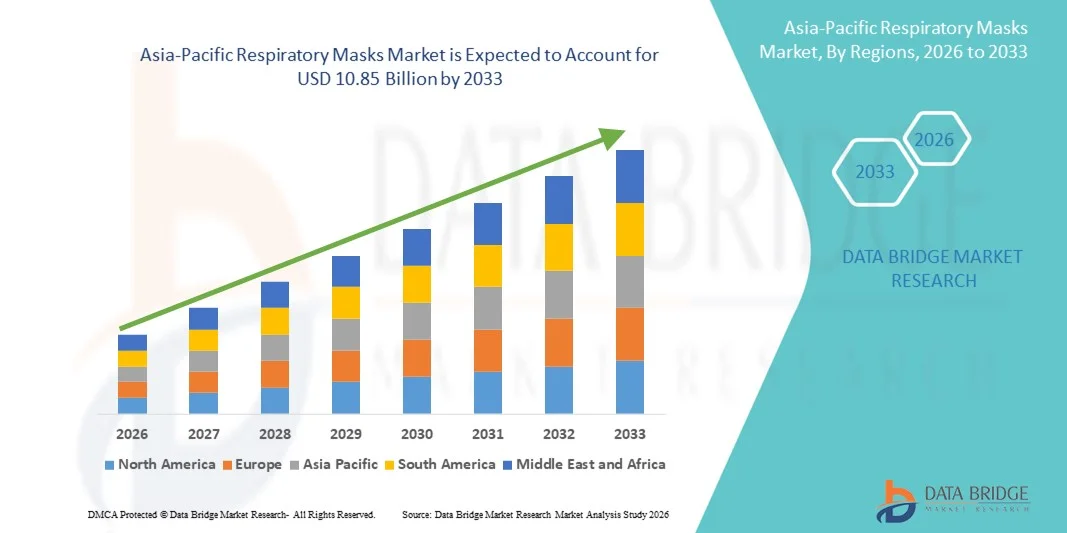
- The Asia-Pacific respiratory masks market size was valued at USD 5.29 billion in 2025 and is expected to reach USD 10.85 billion by 2033, at a CAGR of 9.4% during the forecast period
- The market growth is largely driven by increasing health awareness and safety concerns related to airborne infectious diseases, stringent occupational safety regulations, and heightened exposure to air pollution and particulate matter in rapidly urbanizing economies
- Moreover, rising consumer and institutional demand for comfortable, efficient, and regionally accessible respiratory masks spanning disposable, N95/KN95 and anti‑pollution variants is reinforcing the adoption of these protective products in both public and professional environments
Asia-Pacific Respiratory Masks Market Analysis
- Respiratory masks, providing protective barriers against airborne pollutants, pathogens, and particulate matter, are increasingly essential in both healthcare and industrial settings across the Asia-Pacific region due to heightened health awareness, regulatory mandates, and rising concerns over air quality and infectious diseases
- The escalating demand for respiratory masks is primarily driven by increasing incidences of respiratory illnesses, government initiatives promoting occupational safety, and growing consumer preference for high-efficiency masks such as FFP, common grade surgical masks, and non-medical grade respiratory masks
- China dominated the Asia-Pacific respiratory masks market with the largest revenue share of 42.5% in 2025, attributed to its dense population, rapid urbanization, extensive industrial activity, and large-scale government procurement for public health protection during pollution peaks and infectious disease outbreaks
- India is expected to be the fastest growing country in the market during the forecast period, due to rising industrialization, deteriorating urban air quality, and increasing awareness of respiratory health among the population
- The FFP segment dominated the market with a share of 38.7% in 2025, driven by its superior filtration efficiency, adoption in medical and industrial applications, and preference in highly polluted urban areas for adult users across both reusable and disposable categories
Report Scope and Asia-Pacific Respiratory Masks Market Segmentation
|
Attributes |
Asia-Pacific Respiratory Masks Key Market Insights |
|
Segments Covered |
|
|
Countries Covered |
Asia-Pacific
|
|
Key Market Players |
|
|
Market Opportunities |
|
|
Value Added Data Infosets |
In addition to the insights on market scenarios such as market value, growth rate, segmentation, geographical coverage, and major players, the market reports curated by the Data Bridge Market Research also include in-depth expert analysis, patient epidemiology, pipeline analysis, pricing analysis, and regulatory framework |
Asia-Pacific Respiratory Masks Market Trends
Rising Adoption of Smart and High-Efficiency Masks
- A significant and accelerating trend in the Asia-Pacific respiratory masks market is the growing adoption of high-efficiency masks such as FFP and KN95, coupled with innovative features such as antiviral coatings and ergonomic designs, enhancing protection and comfort for users
- For instance, 3M’s Aura FFP2 mask combines multi-layer filtration with a breathable design, allowing healthcare and industrial workers to maintain extended usage without discomfort
- Some manufacturers are integrating smart features such as reusable masks with embedded air quality sensors, alerting users to high pollution levels or pathogen exposure in real time, increasing user engagement and safety
- The trend towards comfortable, technologically advanced, and user-centric respiratory masks is shaping consumer expectations, particularly in urban centers with high pollution or industrial activity
- The demand for masks that combine high filtration efficiency, comfort, and intelligent functionality is increasing rapidly across healthcare, industrial, and public sectors in Asia-Pacific, driven by heightened health and safety awareness
- In addition, collaboration between mask manufacturers and e-commerce platforms is enabling faster distribution and wider accessibility, increasing overall market penetration
- For instance, online pharmacies in India and China now offer subscription-based mask delivery, ensuring consistent availability of high-quality protective masks for consumers
Asia-Pacific Respiratory Masks Market Dynamics
Driver
Increasing Health Awareness and Industrial Safety Regulations
- The rising health awareness among the general population and strict occupational safety regulations in healthcare and industrial sectors are significant drivers for the growth of respiratory masks
- For instance, in March 2025, the Indian Ministry of Health launched a nationwide initiative promoting high-filtration masks for public and healthcare workers to curb air pollution-related respiratory illnesses
- Consumers are increasingly seeking reliable protection against airborne diseases, pollution, and particulate matter, fueling demand for FFP, KN95, and surgical masks in urban and industrial environments
- For instance, China’s industrial safety authorities mandated mask usage in factories with high particulate emissions, driving large-scale adoption of certified respiratory masks
- Government-led public health campaigns and corporate compliance policies are reinforcing the use of high-quality masks, making them an essential protective tool across healthcare, industrial, and public sectors
- The increasing prevalence of respiratory illnesses, such as seasonal influenza and pollution-induced chronic conditions, is further pushing consumers and organizations to invest in advanced protective masks
- For instance, Japan’s healthcare facilities have mandated higher-grade masks for elderly care units, increasing demand for adult FFP2 and KN95 masks
Restraint/Challenge
High Cost and Limited Awareness of Advanced Mask Technologies
- The relatively high prices of high-efficiency and smart respiratory masks compared to standard disposable masks pose a barrier to widespread adoption, particularly in price-sensitive segments of Asia-Pacific markets
- For instance, premium KN95 masks with antiviral coatings are significantly costlier than common grade surgical masks, limiting access in rural or low-income areas
- Limited consumer awareness regarding the benefits of advanced mask types and proper usage techniques restricts market penetration, especially for reusable or sensor-integrated masks
- For instance, surveys in Southeast Asia indicate that many consumers continue using basic surgical or cloth masks without understanding the protection offered by FFP or smart masks
- Ensuring affordability, educating consumers about mask efficacy, and promoting proper usage are critical challenges that must be addressed to sustain market growth across both public and industrial sectors
- For instance, manufacturers such as 3M and Honeywell are conducting awareness campaigns and providing affordable options to expand adoption of advanced respiratory masks
- Supply chain disruptions, especially for imported high-efficiency materials, can affect mask availability and pricing, limiting consistent adoption across the region
- For instance, during high-demand periods in 2025, delayed polypropylene filter shipments in Vietnam temporarily increased costs for KN95 and FFP masks, affecting consumer access
Asia-Pacific Respiratory Masks Market Scope
The market is segmented on the basis of type, usability, age, material, application, end user, and distribution channels.
- By Type
On the basis of type, the Asia-Pacific respiratory masks market is segmented into FFP, common grade surgical masks, non-medical grade respiratory masks, and other. The FFP segment dominated the market with the largest market revenue share of 38.7% in 2025, driven by its superior filtration efficiency, compliance with international safety standards, and adoption in healthcare and industrial environments. FFP masks are preferred in hospitals, factories, and high-pollution urban areas due to their ability to filter fine particulate matter and pathogens effectively. Institutional procurement, government mandates, and hospital policies also contribute to the dominance. Consumers favor trusted brands offering comfort, durability, and consistent performance. The segment’s reliability in critical environments, including laboratories and industrial units, further reinforces its leadership in the market.
The Non-Medical Grade Respiratory Masks segment is anticipated to witness the fastest growth rate of 8.5% from 2026 to 2033, fueled by rising public awareness of air pollution, infectious diseases, and daily respiratory health. Non-medical masks, including cloth and reusable types, are increasingly used in urban commuting and community settings. Affordability, convenience, and eco-friendly designs drive consumer adoption. Social media and public awareness campaigns promote their usage for everyday protection. E-commerce availability and subscription models further accelerate penetration. Consumers’ desire for stylish and comfortable masks also supports rapid growth.
- By Usability
On the basis of usability, the market is segmented into reusable and disposable. The Disposable segment dominated the market with a share of 60% in 2025, owing to convenience, hygiene, affordability, and high adoption in hospitals, clinics, and public spaces. Disposable masks are widely used in daily life and industrial environments, where single-use reduces contamination risk. Bulk availability and retail presence support dominance. Healthcare workers and institutions prefer disposable masks for compliance with infection-control protocols. Their ease of use and regulatory approvals reinforce widespread adoption. Seasonal spikes in air pollution also increase short-term demand for disposable masks.
The Reusable segment is expected to witness the fastest CAGR of 9.2% from 2026 to 2033, driven by growing environmental consciousness and cost-effective alternatives. Reusable masks, often made of cotton or polyester with replaceable filters, appeal to eco-conscious urban consumers. Integration of features such as air-quality sensors or filter-life indicators enhances attractiveness. Increasing awareness of sustainable practices and government campaigns supporting reusable PPE contribute to growth. Consumers appreciate long-term cost savings and durability. E-commerce availability further expands the segment’s reach across urban and semi-urban areas.
- By Age
On the basis of age, the market is segmented into pediatric and adult. The Adult segment dominated the market with a 70% share in 2025, reflecting higher exposure of working-age populations to air pollution, occupational hazards, and crowded public spaces. Adults drive demand in healthcare, industrial, and public sectors. Government regulations for workplace safety reinforce consistent adoption. Hospitals, factories, and public transport users heavily rely on adult mask variants. Consumer preference for certified, comfortable masks strengthens the segment’s leadership. The segment also benefits from urban air pollution concerns and seasonal respiratory illnesses.
The Pediatric segment is anticipated to witness the fastest growth rate of 10.1% from 2026 to 2033, due to rising awareness among parents regarding child respiratory health. Schools, daycare centers, and public campaigns are promoting child-specific masks with comfortable fits and appealing designs. Certified pediatric masks ensure protection against particulate matter and pathogens. Increasing prevalence of childhood respiratory conditions boosts demand. Manufacturers are introducing adjustable and washable designs suitable for prolonged usage. Urbanization and pollution awareness drive rapid adoption in school-going populations.
- By Material
On the basis of material, the market is segmented into Polypropylene (PP), polyurethane, polyester, cotton, and others. the polypropylene (pp) segment dominated the market with a 55% share in 2025, owing to high filtration efficiency, light weight, and widespread use in FFP and surgical masks. PP masks are preferred in hospitals, industrial environments, and high-pollution urban areas. Ease of mass production and regulatory approvals support dominance. PP-based masks balance comfort and protection for long-duration use. Industrial safety compliance further drives adoption. Consumers trust PP masks for reliability and consistent performance in critical applications.
The Cotton segment is expected to witness the fastest CAGR of 9.5% from 2026 to 2033, driven by growing adoption of reusable and eco-friendly masks. Cotton masks are comfortable, breathable, and washable, making them suitable for daily outdoor use. Eco-conscious consumers prefer cotton for sustainability. Increasing awareness of reusable PPE and government campaigns for eco-friendly practices enhance growth. Online retail availability supports rapid penetration. Stylish designs and fabric customization attract young urban consumers, boosting adoption further.
- By Application
On the basis of application, the market is segmented into military, industrial, public, medical, and others. The Medical segment dominated the market with a 42% share in 2025, driven by hospitals, clinics, and healthcare centers requiring high-efficiency masks for staff and patients. Regulatory compliance and infection-control protocols reinforce demand. Hospitals and laboratories rely on FFP and surgical masks. Government health initiatives prioritize protective equipment in medical environments. High public health awareness during seasonal illnesses further increases consumption. Hospitals’ bulk procurement contracts support consistent revenue.
The Public segment is expected to witness the fastest CAGR of 8.8% from 2026 to 2033, fueled by growing urban population exposure to pollution and respiratory diseases. Daily commuters, office workers, and school children increasingly use masks for everyday protection. Government awareness campaigns support adoption. Online and retail channels enhance accessibility. Stylish and comfortable designs encourage consumer preference. Seasonal spikes in air pollution also boost short-term demand, accelerating growth.
- By End User
On the basis of end user, the market is segmented into hospitals and clinics, homecare setting, public safety service organizations, oil & gas companies, manufacturing companies, construction companies, and others. The Hospitals and Clinics segment dominated the market with a 45% share in 2025, owing to strict hygiene protocols and high demand for FFP and surgical masks for staff, patients, and visitors. Hospitals represent a consistent source of demand due to regulatory compliance. Bulk purchasing and institutional contracts reinforce dominance. Certified masks and infection-control standards drive segment leadership. The segment benefits from government healthcare programs. Continuous adoption in medical facilities ensures steady market growth.
The Manufacturing Companies segment is expected to witness the fastest CAGR of 9.0% from 2026 to 2033, driven by industrial safety regulations and rising workplace awareness. Industries such as chemicals, electronics, and pharmaceuticals require high-efficiency masks for employees. Institutional PPE programs boost adoption. E-commerce and direct tenders enhance accessibility. Industrial users increasingly invest in certified masks for regulatory compliance. Rising awareness of occupational health hazards accelerates segment growth.
- By Distribution Channels
On the basis of distribution channels, the market is segmented into direct tenders, retail, online pharmacies, and others. The Retail segment dominated the market with a 50% share in 2025, driven by accessibility through pharmacies, convenience stores, and hypermarkets. Retail provides immediate availability and brand visibility. Consumers prefer offline purchase for trusted brands. Bulk buying and seasonal demand spikes reinforce dominance. Retailers also provide certified mask options, ensuring compliance. Marketing campaigns in physical stores enhance consumer trust and uptake.
The Online Pharmacies segment is expected to witness the fastest CAGR of 11.2% from 2026 to 2033, fueled by increasing e-commerce penetration, home delivery convenience, and subscription models. Online platforms provide access to certified FFP, KN95, and reusable masks. Urban consumers increasingly prefer online ordering for bulk or specialty masks. Integration with mobile apps and notifications improves user convenience. E-commerce growth during pollution or disease outbreaks accelerates adoption. Promotional offers and direct-to-home delivery enhance segment growth.
Asia-Pacific Respiratory Masks Market Regional Analysis
- China dominated the Asia-Pacific respiratory masks market with the largest revenue share of 42.5% in 2025, attributed to its dense population, rapid urbanization, extensive industrial activity, and large-scale government procurement for public health protection during pollution peaks and infectious disease outbreaks
- Consumers and institutions in China prioritize high-efficiency masks, such as FFP and surgical masks, for daily protection against air pollution, occupational hazards, and infectious diseases. Hospitals, factories, and public institutions are major contributors to consistent demand
- The widespread adoption is further supported by strong manufacturing capabilities, increasing e-commerce penetration, and government-led campaigns promoting mask usage. Rising disposable incomes and heightened health consciousness establish respiratory masks as essential protective equipment for both adults and children across healthcare, industrial, and public sectors
China Respiratory Masks Market Insight
The China respiratory masks market captured the largest revenue share of 42.5% in 2025, driven by rapid urbanization, industrial expansion, and increasing public awareness of air pollution and respiratory health. Consumers prioritize high-efficiency masks such as FFP and surgical masks for daily protection, workplace safety, and healthcare settings. Government mandates and large-scale public health initiatives further support consistent demand across hospitals, factories, and public spaces. The widespread availability of certified masks through retail and online channels enhances accessibility. Rising disposable incomes and industrial safety regulations reinforce market growth. China’s strong manufacturing base for masks also helps maintain affordability and supply consistency.
Japan Respiratory Masks Market Insight
The Japan respiratory masks market is gaining momentum due to the country’s high awareness of pollution and hygiene, coupled with a technologically inclined population. The adoption of FFP and reusable masks is fueled by increasing urban air pollution and frequent seasonal respiratory illnesses. Integration of masks with smart features, such as reusable masks with air-quality sensors, is attracting tech-savvy consumers. Government campaigns promoting mask usage in schools and workplaces further drive demand. The healthcare sector’s reliance on certified masks ensures steady institutional adoption. An aging population also contributes to increased consumption of adult and pediatric masks for preventive health.
India Respiratory Masks Market Insight
The India respiratory masks market accounted for the largest revenue share in Asia-Pacific after China in 2025, owing to rapid urbanization, industrialization, and rising health consciousness among the middle class. Consumers increasingly adopt high-efficiency, reusable, and affordable masks for protection against pollution, occupational hazards, and seasonal illnesses. Government initiatives promoting public health and workplace safety enhance adoption across industrial and healthcare settings. E-commerce and retail channels facilitate easy access to certified masks, further boosting market growth. The rise of smart cities and domestic mask manufacturing contribute to affordability and supply availability. Awareness campaigns and school-based programs reinforce consistent usage across populations.
South Korea Respiratory Masks Market Insight
The South Korea respiratory masks market is experiencing strong growth due to high public awareness of pollution and seasonal respiratory illnesses. Consumers and institutions prefer FFP and surgical masks for both daily protection and workplace safety. Government initiatives promoting mask usage during fine dust seasons and viral outbreaks are driving demand. Retail and online platforms enhance accessibility for urban populations. Hospitals and industrial workplaces rely on certified masks for compliance with safety regulations. Rising disposable incomes and technological adoption, including smart reusable masks, further support market expansion across healthcare and public sectors.
Asia-Pacific Respiratory Masks Market Share
The Asia-Pacific Respiratory Masks industry is primarily led by well-established companies, including:
- 3M (U.S.)
- Honeywell International Inc. (U.S.)
- Medline Industries, Inc. (U.S.)
- Johnson & Johnson Services, Inc. (U.S.)
- Ansell Ltd (Australia)
- Cardinal Health (U.S.)
- KOKEN Ltd (Japan)
- DuPont (U.S.)
- Moldex-Metric, Inc. (U.S.)
- VENUS Safety & Health Pvt. Ltd. (India)
- Shanghai Dasheng Health Products Manufacturing Co., Ltd. (China)
- Markrite (U.S.)
- Shigematsu Works Co., Ltd. (Japan)
- Suzhou Sanical Protective Product Manufacturing (China)
- Jinfuyu Industrial Co., Ltd. (China)
- Primamedix (Indonesia)
- Quasmo (India)
- Kawasaki Chemical Industry Co., Ltd. (Japan)
- ResMed Inc. (U.S.)
- Kimberly-Clark Corporation (U.S.)
What are the Recent Developments in Asia-Pacific Respiratory Masks Market?
- In May 2025, researchers at the Institute of Industrial Science, University of Tokyo, announced the development of an advanced virus-capturing filter material designed to significantly improve respiratory mask efficiency without compromising breathability. The new technology enables the capture of nanoscale particles such as viruses while maintaining airflow, offering potential applications in next-generation medical and public-use respiratory masks
- In December 2025, Delhi NCR experienced hazardous air quality levels with dense smog, prompting health advisories for residents to limit outdoor activity and wear N95 masks to protect against severe pollution. The advisory came as AQI values soared to hazardous levels, significantly increasing health risks, especially for children, the elderly, and people with respiratory issues
- In April 2023, the Japanese government ended random COVID-19 testing for travelers arriving from China and relaxed official mask-wearing recommendations. Mask usage decisions were left to individuals and organizations, impacting public and commercial demand while preserving mask adoption in healthcare and elderly care settings. The move aligned Japan’s policy with broader regional reopening efforts
- In February 2023, the Hong Kong government announced the removal of one of the world’s longest-standing COVID-19 mask mandates, effective March 1. The decision ended compulsory mask-wearing in most public settings, signaling a normalization phase while still encouraging voluntary mask use in crowded and medical environments. This policy change significantly reshaped mask consumption behavior in the region
- In January 2023, the South Korean government officially lifted its indoor mask mandate for most public places as COVID-19 infections declined nationwide. This policy shift marked a major transition in respiratory mask usage across Asia-Pacific, influencing demand patterns while maintaining mask requirements in high-risk healthcare environments. The move reflected growing confidence in vaccination coverage and healthcare readiness

- Interactive Data Analysis Dashboard
- Company Analysis Dashboard for high growth potential opportunities
- Research Analyst Access for customization & queries
- Competitor Analysis with Interactive dashboard
- Latest News, Updates & Trend analysis
- Harness the Power of Benchmark Analysis for Comprehensive Competitor Tracking
Data collection and base year analysis are done using data collection modules with large sample sizes. The stage includes obtaining market information or related data through various sources and strategies. It includes examining and planning all the data acquired from the past in advance. It likewise envelops the examination of information inconsistencies seen across different information sources. The market data is analysed and estimated using market statistical and coherent models. Also, market share analysis and key trend analysis are the major success factors in the market report. To know more, please request an analyst call or drop down your inquiry.
The key research methodology used by DBMR research team is data triangulation which involves data mining, analysis of the impact of data variables on the market and primary (industry expert) validation. Data models include Vendor Positioning Grid, Market Time Line Analysis, Market Overview and Guide, Company Positioning Grid, Patent Analysis, Pricing Analysis, Company Market Share Analysis, Standards of Measurement, Global versus Regional and Vendor Share Analysis. To know more about the research methodology, drop in an inquiry to speak to our industry experts.
Data Bridge Market Research is a leader in advanced formative research. We take pride in servicing our existing and new customers with data and analysis that match and suits their goal. The report can be customized to include price trend analysis of target brands understanding the market for additional countries (ask for the list of countries), clinical trial results data, literature review, refurbished market and product base analysis. Market analysis of target competitors can be analyzed from technology-based analysis to market portfolio strategies. We can add as many competitors that you require data about in the format and data style you are looking for. Our team of analysts can also provide you data in crude raw excel files pivot tables (Fact book) or can assist you in creating presentations from the data sets available in the report.













