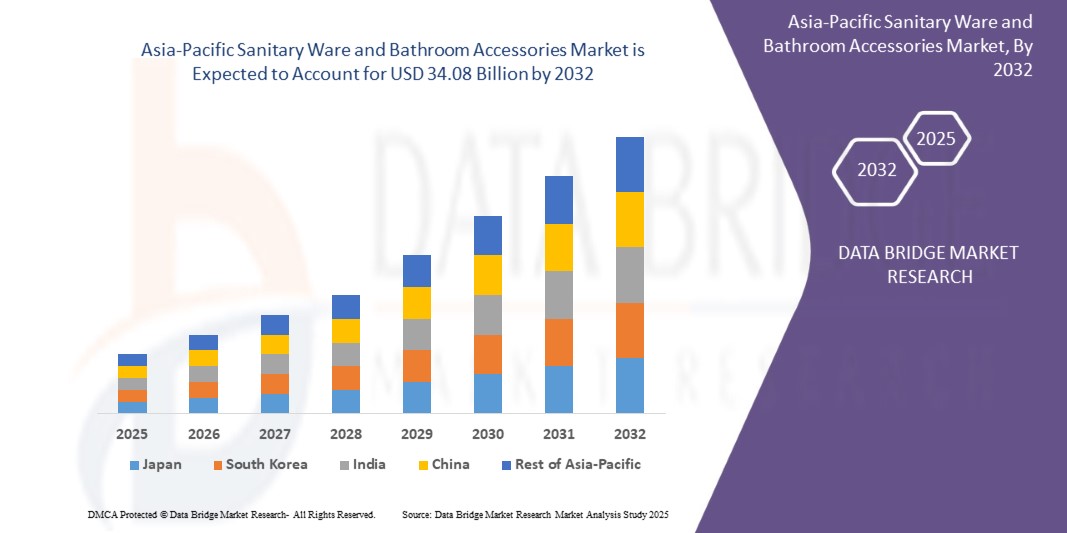
Asia-Pacific Sanitary Ware and Bathroom Accessories Market Size
- The Asia-Pacific Sanitary Ware and Bathroom Accessories Market size was valued at USD 19.42 billion in 2024 and is expected to reach USD 34.08 billion by 2032, at a CAGR of 7.28% during the forecast period
- The market growth is largely fueled by rising urbanization, increasing residential and commercial construction projects, and growing consumer inclination toward modern, stylish, and efficient bathroom solutions. Demand is further strengthened by heightened awareness of hygiene, water conservation, and sustainability, which is pushing consumers toward advanced sanitary ware products
- Furthermore, increasing adoption of smart and automated bathroom accessories, coupled with rising disposable incomes and lifestyle upgrades, is driving the preference for premium and technologically integrated solutions. These converging factors are accelerating the uptake of sanitary ware and bathroom accessories, thereby significantly boosting the industry's growth
Asia-Pacific Sanitary Ware and Bathroom Accessories Market Analysis
- Sanitary ware and bathroom accessories encompass a wide range of products such as toilets, basins, faucets, bathtubs, showers, and smart bathroom fittings, which are essential for residential, commercial, and institutional applications. These solutions are increasingly integrating design, functionality, and sustainability to meet evolving consumer expectations
- The escalating demand for sanitary ware is primarily fueled by rapid infrastructure development, government-led sanitation initiatives, and consumer preference for durable, water-efficient, and aesthetically appealing bathroom products. The integration of automation, touchless technologies, and eco-friendly materials further enhances the market’s growth trajectory
- China dominated Asia-Pacific Sanitary Ware and Bathroom Accessories Market in 2024, due to rapid urbanization, large-scale residential and commercial construction, and rising consumer demand for modernized bathrooms
- India is expected to be the fastest growing country in the Asia-Pacific Sanitary Ware and Bathroom Accessories Market during the forecast period due to rapid urbanization, rising middle-class incomes, and expanding infrastructure development across Tier 1 and Tier 2 cities
- Manual segment dominated the market with a market share of 61.9% in 2024, due to its affordability, easy installation, and strong presence in developing economies where cost-sensitive consumers prefer traditional products. Manual sanitary ware continues to be the preferred choice in residential projects, small commercial buildings, and rural infrastructure owing to its lower maintenance costs and longer lifecycle
Report Scope and Asia-Pacific Sanitary Ware and Bathroom Accessories Market Segmentation
|
Attributes |
Asia-Pacific Sanitary Ware and Bathroom Accessories Key Market Insights |
|
Segments Covered |
|
|
Countries Covered |
Asia-Pacific
|
|
Key Market Players |
|
|
Market Opportunities |
|
|
Value Added Data Infosets |
In addition to the insights on market scenarios such as market value, growth rate, segmentation, geographical coverage, and major players, the market reports curated by the Data Bridge Market Research also include in-depth expert analysis, pricing analysis, brand share analysis, consumer survey, demography analysis, supply chain analysis, value chain analysis, raw material/consumables overview, vendor selection criteria, PESTLE Analysis, Porter Analysis, and regulatory framework. |
Asia-Pacific Sanitary Ware and Bathroom Accessories Market Trends
Surge in Demand for Luxurious and Aesthetically Pleasing Products
- The Asia-Pacific Sanitary Ware and Bathroom Accessories Market is witnessing strong growth due to a rising consumer preference for products that combine functionality with luxury and modern aesthetics. Renovation and remodeling activities, particularly in urban areas, are driving demand for premium bathroom fittings that reflect personal taste and lifestyle aspirations
- For instance, Kohler Co. has introduced a wide range of luxury bathroom accessories and smart sanitary ware designed to enhance both aesthetics and convenience. Similarly, Roca Sanitario S.A. continues to expand its designer sanitary ware offerings, catering to rising demand for stylish, elegant, and customizable bathroom solutions
- The increasing influence of urban living standards and exposure to international design trends are reshaping expectations from sanitary ware. Consumers are increasingly opting for products that feature sleek designs, innovative materials, and multifunctionality, which enhance the overall value and appeal of bathrooms as lifestyle spaces rather than purely functional areas
- Smart bathroom technologies such as sensor-operated faucets, touchless flush systems, and digitally controlled showers are further fueling the market. These advanced solutions deliver comfort, water efficiency, and modern elegance, positioning them as essential features in luxury homes and high-end commercial establishments
- In addition, the growth of hospitality, premium residential projects, and commercial real estate has amplified demand for luxurious bathroom fittings. Developers and property owners are investing in aesthetic products to appeal to sophisticated customers and enhance property value in competitive markets
- Ultimately, the surge in demand for stylish, technologically advanced, and luxurious sanitary ware and bathroom accessories is redefining the dynamics of the industry. This trend is ensuring continued innovation and aligning the market with evolving consumer expectations focused on both design sophistication and functional excellence
Asia-Pacific Sanitary Ware and Bathroom Accessories Market Dynamics
Driver
Rising Investment in Construction Sector
- The growing investment in construction and infrastructure development is a primary driver of demand for sanitary ware and bathroom accessories. Rapid urbanization, housing projects, and modernization of public facilities are contributing to greater adoption of modern bathroom solutions across both residential and commercial establishments
- For instance, TOTO Ltd. has benefited from large-scale construction projects in Asia-Pacific, where governments and private developers are investing heavily in housing, hotels, and commercial complexes. With the rising construction pipeline, demand for advanced toilets, basins, and bathroom fittings has grown considerably, particularly in developing economies
- The demand is also supported by increasing disposable income levels and rising homeownership, which are leading to higher spending on interior aesthetics and bathroom remodeling. Customization and premium fittings are becoming commonplace as consumers focus on upgrading to modern lifestyle-oriented sanitary ware products
- In addition, the expansion of smart city initiatives and sustainable building practices is encouraging the adoption of water-efficient and eco-friendly sanitary ware. This is driving companies to innovate with energy-saving technologies, sustainable materials, and low-water consumption designs to align with construction and urban development goals
- Overall, the rising investment in the construction sector is strongly reinforcing market growth by boosting volume demand for sanitary ware and bathroom accessories. This driver ensures long-term sustainability as the industry aligns closely with global construction and real estate expansion
Restraint/Challenge
Stringent Mining Regulations
- A significant restraint for the Asia-Pacific Sanitary Ware and Bathroom Accessories Market is the impact of stringent mining regulations that affect the supply of raw materials used in production. Key raw materials such as clays, silica, and other minerals are subjected to strict environmental policies and extraction controls, which disrupt supply chains and raise production costs
- For instance, several countries in Asia and Europe have tightened regulations around mineral extraction to reduce environmental impact. Companies such as Roca Group and Duravit AG face increasing challenges in sourcing raw materials at competitive prices due to the rising cost of compliance and restricted availability
- In addition to higher extraction costs, regulatory delays in obtaining mineral sourcing licenses contribute to longer lead times and uncertainty for manufacturers. This volatility hampers companies from scaling up production to meet the surging demand driven by housing and infrastructure growth
- The push toward sustainable mining practices further requires manufacturers to invest in responsible sourcing initiatives, recycling, and alternative material innovations. While beneficial in the long run, these efforts increase operational complexity and add immediate cost burdens for businesses operating in highly competitive markets
- As a result, stringent mining regulations remain a structural challenge limiting the cost-efficiency and scalability of sanitary ware production. Addressing this will require industry collaboration, investment in alternative raw material technologies, and sustainability practices to balance regulatory compliance with market demand growth
Asia-Pacific Sanitary Ware and Bathroom Accessories Market Scope
The market is segmented on the basis of type, function, material, end-user, price range, distribution channel, shape, and color.
• By Type
On the basis of type, the Asia-Pacific Sanitary Ware and Bathroom Accessories Market is segmented into western toilet, wash basin, urinals, faucets, bathroom heaters, cistern, showers, bathroom accessories, bathtubs, medicine cabinets, bidets, vanities, mirror, and others. The western toilet segment dominated the largest market revenue share in 2024, supported by rapid urbanization, rising hygiene awareness, and government initiatives promoting modern sanitation infrastructure. Its dominance is further strengthened by its widespread adoption in both residential and commercial projects, along with product innovations such as water-saving dual-flush systems and rimless designs that improve hygiene and efficiency.
The faucets segment is anticipated to witness the fastest growth rate from 2025 to 2032, driven by increasing demand for modernized kitchens and bathrooms and the integration of smart and sensor-based faucet technologies. Rising consumer preference for touchless and water-efficient faucets, especially in commercial spaces such as hotels, airports, and corporate offices, is fueling this trend. The aesthetic variety and customizable design options in faucets also make them attractive for premium and luxury bathroom renovations.
• By Function
On the basis of function, the Asia-Pacific Sanitary Ware and Bathroom Accessories Market is segmented into manual and electric/automated. The manual segment dominated the market revenue share of 61.9% in 2024 due to its affordability, easy installation, and strong presence in developing economies where cost-sensitive consumers prefer traditional products. Manual sanitary ware continues to be the preferred choice in residential projects, small commercial buildings, and rural infrastructure owing to its lower maintenance costs and longer lifecycle.
The electric/automated segment is projected to grow at the fastest rate from 2025 to 2032, supported by rising adoption of smart bathrooms and IoT-enabled products. Increasing popularity of automated bidets, sensor faucets, and heated bathroom systems among premium consumers and luxury hotels is driving this trend. Moreover, heightened hygiene awareness post-pandemic has accelerated the demand for touchless and automated sanitary ware in public and high-traffic facilities.
• By Material
On the basis of material, the market is segmented into ceramic, metal, acrylic plastic and perspex, and others. The ceramic segment dominated the market revenue share in 2024 owing to its durability, smooth finish, cost-effectiveness, and wide usage across toilets, wash basins, and urinals. Ceramic products are highly preferred due to their stain resistance, ease of cleaning, and adaptability to diverse bathroom styles, making them the standard choice in both residential and commercial sectors.
The acrylic plastic and perspex segment is expected to witness the fastest CAGR from 2025 to 2032, propelled by its lightweight properties, cost-efficiency, and flexibility in design. Increasing consumer preference for modern bathtubs, shower enclosures, and vanity units crafted from acrylic plastics highlights the trend. Its versatility in molding into innovative shapes and colors is also boosting demand in the premium bathroom fittings category.
• By End-User
On the basis of end-user, the Asia-Pacific Sanitary Ware and Bathroom Accessories Market is segmented into residential, commercial buildings, supermarkets/hypermarkets, shopping malls, corporate offices, schools/universities, hospitals, banks, hotels and restaurants, government buildings, and others. The residential segment dominated the market revenue share in 2024, driven by rising urban housing projects, higher consumer spending on home renovation, and the adoption of stylish and efficient sanitary ware solutions. Increasing demand for water-saving fixtures and customized bathroom setups in households continues to boost this segment’s growth.
The hotel and restaurants segment is projected to be the fastest-growing from 2025 to 2032, attributed to the surge in tourism, hospitality investments, and the growing emphasis on luxurious bathroom experiences for guests. Hotels are increasingly adopting premium sanitary ware, automated faucets, and high-end shower systems to enhance customer satisfaction and align with sustainability goals. This focus on aesthetics and hygiene positions the segment for strong growth over the forecast period.
• By Price Range
On the basis of price range, the market is segmented into mass and premium. The mass segment held the largest market revenue share in 2024, supported by affordability, large-scale adoption in developing regions, and government-backed sanitation programs. Consumers in emerging economies favor mass-priced sanitary ware products due to their cost-effectiveness, availability, and compatibility with residential infrastructure.
The premium segment is anticipated to witness the fastest growth rate from 2025 to 2032, fueled by the rising trend of luxury housing, designer bathrooms, and hospitality sector upgrades. Increasing preference for high-quality, technologically advanced, and aesthetically appealing bathroom accessories among affluent consumers is driving this demand. Smart toilets, automated bidets, and luxury bathtubs are among the most sought-after products in this category.
• By Distribution Channel
On the basis of distribution channel, the market is segmented into direct sales and indirect sales. The indirect sales segment dominated the market revenue share in 2024, driven by the strong presence of multi-brand retail outlets, home improvement stores, and e-commerce platforms. Consumers often prefer indirect channels for the convenience of product comparison, price competitiveness, and availability of discounts and bundled offers.
The direct sales segment is projected to grow at the fastest CAGR from 2025 to 2032, as manufacturers increasingly establish exclusive brand outlets, showrooms, and direct-to-consumer online platforms. Direct channels allow companies to showcase their premium collections, provide customized solutions, and build brand loyalty by offering after-sales services. Growing consumer trust in official online portals is further fueling this segment.
• By Shape
On the basis of shape, the Asia-Pacific Sanitary Ware and Bathroom Accessories Market is segmented into curved, rectangle, circle, square, domed top, parallelogram, and others. The curved shape segment dominated the market revenue share in 2024, supported by its ergonomic design, modern aesthetics, and suitability across wash basins, bathtubs, and mirrors. Curved designs are highly favored in residential and hospitality projects due to their space-efficient structure and elegance.
The rectangle segment is expected to register the fastest growth from 2025 to 2032, driven by its versatile application in mirrors, vanities, and modern wash basins. The popularity of sleek and minimalistic bathroom designs has accelerated the adoption of rectangular sanitary ware, especially in urban households and commercial establishments. Its space-optimizing feature further adds to its demand.
• By Color
On the basis of color, the Asia-Pacific Sanitary Ware and Bathroom Accessories Market is segmented into white, black, grey, and others. The white segment dominated the market revenue share in 2024, as it remains the most classic and universally accepted choice for sanitary ware. White color symbolizes cleanliness, hygiene, and simplicity, making it the standard across residential, commercial, and institutional projects worldwide.
The black segment is projected to witness the fastest growth rate from 2025 to 2032, supported by rising consumer demand for modern, bold, and luxurious bathroom designs. Black-colored bathtubs, faucets, and vanities are gaining traction in premium residential and hospitality projects for their high aesthetic appeal and ability to stand out in contemporary interiors.
Asia-Pacific Sanitary Ware and Bathroom Accessories Market Regional Analysis
- China dominated the Asia-Pacific Sanitary Ware and Bathroom Accessories Market with the largest revenue share in 2024, driven by rapid urbanization, large-scale residential and commercial construction, and rising consumer demand for modernized bathrooms
- Increasing disposable incomes and government-backed housing projects have accelerated the adoption of premium sanitary ware. The presence of strong domestic manufacturers and international brands, coupled with well-established distribution networks, further strengthens China’s leadership in the regional market
- Growing preference for water-saving products, smart bathroom solutions, and designer accessories ensures continued dominance in the forecast period
Japan Asia-Pacific Sanitary Ware and Bathroom Accessories Market Insight
The Japan market is anticipated to grow steadily from 2025 to 2032, driven by strong consumer inclination toward technologically advanced and space-efficient bathroom solutions. Japanese consumers prioritize innovation, compact design, and sustainability, which boosts demand for smart toilets, sensor faucets, and automated accessories. A mature real estate market and high preference for premium home renovation projects further support growth. Continuous innovation by domestic players and emphasis on eco-friendly technologies position Japan as a stable and innovation-driven market for sanitary ware.
India Asia-Pacific Sanitary Ware and Bathroom Accessories Market Insight
India is projected to register the fastest CAGR in the Asia Pacific Asia-Pacific Sanitary Ware and Bathroom Accessories Market during 2025–2032. Growth is propelled by rapid urbanization, rising middle-class incomes, and expanding infrastructure development across Tier 1 and Tier 2 cities. Government initiatives such as Swachh Bharat Abhiyan and increasing investments in housing and sanitation projects are fueling demand. Domestic manufacturing capacity expansion, coupled with growing consumer preference for affordable yet modern sanitary ware, strengthens India’s position as the fastest-growing market. A rising hospitality sector and heightened demand for water-efficient and stylish bathroom solutions further accelerate growth.
Asia-Pacific Sanitary Ware and Bathroom Accessories Market Share
The sanitary ware and bathroom accessories industry is primarily led by well-established companies, including:
- Kohler Co. (U.S.)
- Jaquar India (India)
- Grohe AG (Germany)
- Roca Sanitario S.A.U. (Spain)
- Grohe AG (Switzerland)
- AQUACUBIC (China)
- TOTO Ltd. (Japan)
- Duravit AG (Germany)
- Villeroy & Boch AG (Germany)
- Hansgrohe SE (Germany)
- American Standard Brands (U.S.)
- Geberit AG (Switzerland)
- Ideal Standard International (Belgium)
- LIXIL Corporation (Japan)
- Hindware Limited (India)
Latest Developments in Asia-Pacific Sanitary Ware and Bathroom Accessories Market
- In June 2024, Roca Sanitario S.A.U. received the highest recognition at the prestigious Delta Awards. The company won the Gold Delta Award for its innovative Avant smart toilet and also secured two Bronze Delta Awards for its NU and Tura collections. This recognition reinforced Roca’s strong reputation for pioneering bathroom solutions that blend advanced design with functionality and sustainability. The accolades enhanced the company’s brand equity and also positioned it as a benchmark in premium bathroom innovation, further strengthening its competitive standing in the global market
- In February 2024, Kohler Co. introduced the Rista, a groundbreaking 3D-printed bathroom sink. The round vessel combined digital technology with Kohler’s traditional craftsmanship, manufactured through a 6.5-hour 3D-printing process and finished by artisans in Kohler, Wisconsin. This launch showcased how additive manufacturing can reshape the sanitary ware industry by enabling design personalization, premium aesthetics, and sustainable production practices. The Rista positioned Kohler at the forefront of innovation, underlining its ability to integrate cutting-edge technology with luxury craftsmanship
- In December 2023, Roca Group achieved a Gold Medal from EcoVadis, placing the company in the top 3% globally for sustainability performance. This recognition was based on evaluation across key pillars including Environment, Labor & Human Rights, Ethics, and Sustainable Procurement. It underscored Roca’s holistic approach to sustainability and its commitment to creating long-term value for stakeholders. The accolade reinforced consumer trust and provided a competitive edge in markets where environmental and ethical considerations increasingly influence purchasing decisions
- In October 2023, Duravit AG unveiled its new D-Neo bathroom series, designed in collaboration with renowned Belgian designer Bertrand Lejoly. The collection combined minimalist aesthetics with affordability, targeting younger demographics and first-time homeowners. By offering a balance between style and functionality at accessible price points, Duravit broadened its customer base and strengthened its presence in emerging markets. This development highlighted the growing importance of design-driven yet cost-conscious sanitary ware solutions in shaping consumer preferences
- In July 2023, TOTO Ltd. expanded its Washlet production capacity by opening a new manufacturing facility in Kitakyushu, Japan. This strategic move was aimed at meeting the rising global demand for smart toilets, particularly in Asia and North America. The investment underscored TOTO’s commitment to scaling innovation-driven sanitary ware while ensuring reliable supply chains. By boosting production, TOTO addressed growing consumer adoption of advanced hygiene products and also cemented its leadership in the smart bathroom solutions market

- Interactive Data Analysis Dashboard
- Company Analysis Dashboard for high growth potential opportunities
- Research Analyst Access for customization & queries
- Competitor Analysis with Interactive dashboard
- Latest News, Updates & Trend analysis
- Harness the Power of Benchmark Analysis for Comprehensive Competitor Tracking
Data collection and base year analysis are done using data collection modules with large sample sizes. The stage includes obtaining market information or related data through various sources and strategies. It includes examining and planning all the data acquired from the past in advance. It likewise envelops the examination of information inconsistencies seen across different information sources. The market data is analysed and estimated using market statistical and coherent models. Also, market share analysis and key trend analysis are the major success factors in the market report. To know more, please request an analyst call or drop down your inquiry.
The key research methodology used by DBMR research team is data triangulation which involves data mining, analysis of the impact of data variables on the market and primary (industry expert) validation. Data models include Vendor Positioning Grid, Market Time Line Analysis, Market Overview and Guide, Company Positioning Grid, Patent Analysis, Pricing Analysis, Company Market Share Analysis, Standards of Measurement, Global versus Regional and Vendor Share Analysis. To know more about the research methodology, drop in an inquiry to speak to our industry experts.
Data Bridge Market Research is a leader in advanced formative research. We take pride in servicing our existing and new customers with data and analysis that match and suits their goal. The report can be customized to include price trend analysis of target brands understanding the market for additional countries (ask for the list of countries), clinical trial results data, literature review, refurbished market and product base analysis. Market analysis of target competitors can be analyzed from technology-based analysis to market portfolio strategies. We can add as many competitors that you require data about in the format and data style you are looking for. Our team of analysts can also provide you data in crude raw excel files pivot tables (Fact book) or can assist you in creating presentations from the data sets available in the report.