


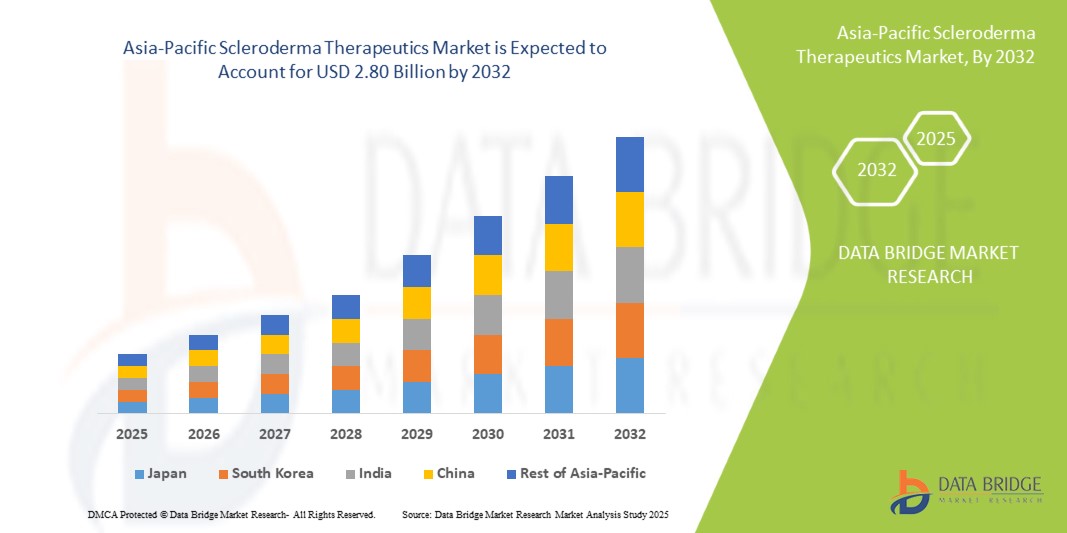
Scleroderma Therapeutics Market Size
- The Asia-Pacific Scleroderma Therapeutics market size was valued at USD 1.44 billion in 2024 and is expected to reach USD 2.80 billion by 2032, at a CAGR of 8.7% during the forecast period
- This growth is driven by increasing awareness about autoimmune disorders, rising incidence of systemic sclerosis, and improved access to targeted therapies across emerging Asian economies.
Scleroderma Therapeutics Market Analysis
- Scleroderma Therapeutics, also known as biotherapy or immunotherapy, uses living organisms or their components to treat diseases. These therapies have shown significant efficacy in managing cancer, autoimmune disorders, and genetic diseases due to their targeted action and reduced systemic side effects
- The demand for Scleroderma Therapeutics is significantly driven by rising incidences of cancer and autoimmune disorders, expanding approvals of biosimilars, and international investments in biotechnology innovation
- India is expected to dominate the Asia-Pacific Scleroderma Therapeutics market due to national rare disease programs, autoimmune disorder registries, and high treatment demand in systemic sclerosis.
- South Korea is expected to witness the highest CAGR in the Scleroderma Therapeutics market due to its growing biologics pipeline, clinical trial capacity, and government-backed healthcare innovation.
- Immunosuppressants segment is expected to hold the largest share of 42.5%, due to its widespread use in managing skin fibrosis and systemic complications. Expanding use of corticosteroids and methotrexate-based therapies is fueling demand in primary care settings.
Report Scope and Scleroderma Therapeutics Market Segmentation
|
Attributes |
Scleroderma Therapeutics Key Market Insights |
|
Segments Covered |
|
|
Countries Covered |
Asia-Pacific
|
|
Key Market Players |
|
|
Market Opportunities |
|
|
Value Added Data Infosets |
In addition to the insights on market scenarios such as market value, growth rate, segmentation, geographical coverage, and major players, the market reports curated by the Data Bridge Market Research also include import export analysis, production capacity overview, production consumption analysis, price trend analysis, climate change scenario, supply chain analysis, value chain analysis, raw material/consumables overview, vendor selection criteria, PESTLE Analysis, Porter Analysis, and regulatory framework. |
Scleroderma Therapeutics Market Trends
“Integration of Real-World Evidence in Drug Evaluation”
The use of real-world evidence (RWE) is increasingly influencing clinical and regulatory decisions in the Asia-Pacific Scleroderma Therapeutics market. Real-world data, derived from electronic health records, observational studies, and patient registries, provides critical insights into long-term treatment outcomes and safety profiles outside the controlled environment of clinical trials. Regulatory agencies in countries like Japan and South Korea are actively promoting the integration of patient-reported outcomes and RWE into therapeutic assessments to accelerate drug approval timelines, especially for rare and autoimmune conditions. These initiatives are enabling more accurate benefit-risk evaluations and paving the way for conditional approvals of novel biologics for scleroderma treatment.
Scleroderma Therapeutics Market Dynamics
Driver
“Growing Prevalence of Systemic Sclerosis and Early Diagnosis”
- The Asia-Pacific region is witnessing a growing burden of systemic sclerosis, driven by environmental triggers, genetic predispositions, and increased clinical awareness. Government bodies and rheumatology associations across India, China, and Australia are initiating early screening and referral programs to combat diagnostic delays. The rise in trained rheumatologists, along with improved access to autoimmune testing in tier 2 and 3 cities, has led to higher detection rates. Early diagnosis is crucial to initiating treatment before irreversible organ damage occurs.
- For instance,
In 2024, India’s Ministry of Health and Family Welfare launched a national autoimmune disorder registry to track conditions like systemic sclerosis. This initiative has enhanced the identification of early-stage patients, supported regional treatment planning, and promoted personalized medicine approaches across public healthcare facilities.
Opportunity
“Emergence of Biologics for Scleroderma Lung Complications”
- Lung-related complications such as interstitial lung disease (ILD) and pulmonary arterial hypertension (PAH) are among the leading causes of mortality in systemic sclerosis patients. The therapeutic landscape is rapidly evolving with the introduction of biologics that target fibrotic pathways, inflammatory cytokines, and vascular remodeling. Biologics like nintedanib and tocilizumab have shown promise in slowing lung function decline and are being incorporated into treatment protocols across Asia-Pacific.
- For instance,
In November 2024, Boehringer Ingelheim announced the expansion of its global ILD drug trial network to include clinical sites in India, South Korea, and Taiwan. This move aims to generate regional data to support regulatory approvals, improve representation of Asian patients in global trials, and enhance local treatment options.
Restraint/Challenge
“Limited Awareness and High Cost of Advanced Therapies”
- Despite advancements in therapeutics, awareness and accessibility remain major challenges, particularly in low- and middle-income countries across the Asia-Pacific region. Underdiagnosis of scleroderma in rural and semi-urban areas is common due to the lack of trained rheumatologists and limited availability of advanced diagnostic tools. Moreover, biologic therapies, while effective, are costly and often not covered under national insurance schemes, making them unaffordable for many patients.
- For instance,
In 2023, a study published in The Lancet Rheumatology focusing on scleroderma patients in India revealed that the median time from symptom onset to diagnosis was 18 months, primarily due to inadequate awareness and limited access to specialty care. Additionally, the high out-of-pocket expenses for biologics and immunomodulators have further hindered widespread adoption, necessitating policy reforms and the introduction of biosimilars to ensure affordability.
Scleroderma Therapeutics Market Scope
The market is segmented on the basis application, product type, technology, magnification type, end user, and distribution channel.
|
Segmentation |
Sub-Segmentation |
|
By Drug Class |
|
|
By Disease Type |
|
|
By Route of Administration |
|
|
By End User |
|
|
By Distribution Channel
|
|
In 2025, the Immunosuppressants segment is projected to dominate the market with the largest share in drug class segment
In 2025, the Immunosuppressants segment is expected to hold the largest share of 42.5%, due to its widespread use in managing skin fibrosis and systemic complications. Expanding use of corticosteroids and methotrexate-based therapies is fueling demand in primary care settings.
The Systemic Scleroderma segment is expected to account for the largest share during the forecast period in disease type segment
In 2025, the Systemic Scleroderma segment is anticipated to capture a 63.4% share, driven by growing diagnosis of internal organ involvement and increased availability of systemic treatment options.
Scleroderma Therapeutics Market Regional Analysis
“India Holds the Largest Share in the Scleroderma Therapeutics Market”
- India is expected to dominate the Asia-Pacific Scleroderma Therapeutics market due to national rare disease programs, autoimmune disorder registries, and high treatment demand in systemic sclerosis.
- Additionally, India's large public health infrastructure and increasing affordability of generic immunosuppressants are boosting access to first-line therapies across tier 2 and tier 3 cities.
“South Korea is Projected to Register the Highest CAGR in the Scleroderma Therapeutics Market”
- South Korea is expected to witness the highest CAGR in the Scleroderma Therapeutics market due to its growing biologics pipeline, clinical trial capacity, and government-backed healthcare innovation.
- The country also benefits from strong academic-industry partnerships and digital health integration, which are accelerating early diagnosis and patient recruitment for rare disease research.
Scleroderma Therapeutics Market Share
The market competitive landscape provides details by competitor. Details included are company overview, company financials, revenue generated, market potential, investment in research and development, new market initiatives, Asia-Pacific presence, production sites and facilities, production capacities, company strengths and weaknesses, product launch, product width and breadth, application dominance. The above data points provided are only related to the companies' focus related to market.
The Major Market Leaders Operating in the Market Are:
- Boehringer Ingelheim International GmbH (Germany)
- Pfizer Inc. (U.S.)
- Johnson & Johnson Services, Inc. (U.S.)
- Sanofi S.A. (France)
- F. Hoffmann-La Roche Ltd (Switzerland)
- Bayer AG (Germany)
- Teva Pharmaceutical Industries Ltd. (Israel)
- Gilead Sciences, Inc. (U.S.)
- Mitsubishi Tanabe Pharma Corporation (Japan)
- Actelion Pharmaceuticals Ltd (Switzerland)
Latest Developments in Asia-Pacific Scleroderma Therapeutics Market
- In February 2025, Mitsubishi Tanabe Pharma launched a new topical therapy for localized scleroderma in Japan, targeting pediatric patients.
- In January 2025, Roche expanded its Actemra (tocilizumab) scleroderma study to India and Indonesia as part of its APAC rare disease strategy.
- In October 2024, a multicenter trial evaluating sildenafil for digital ulcers in systemic sclerosis was launched across 5 Chinese hospitals.
- In March 2025, Pfizer Inc. partnered with the Japan Scleroderma Research Network (JSRN) to launch a post-marketing surveillance program evaluating long-term outcomes of immunosuppressants in systemic sclerosis patients, marking a strategic step towards real-world data collection and label expansion in the Japanese market.
- In April 2025, Roche initiated a multicenter Phase II clinical trial in Australia, Singapore, and South Korea for a novel antifibrotic monoclonal antibody targeting skin and lung fibrosis in systemic sclerosis, aiming to address unmet needs in severe scleroderma manifestations through precision biologics.

- Interactive Data Analysis Dashboard
- Company Analysis Dashboard for high growth potential opportunities
- Research Analyst Access for customization & queries
- Competitor Analysis with Interactive dashboard
- Latest News, Updates & Trend analysis
- Harness the Power of Benchmark Analysis for Comprehensive Competitor Tracking
Data collection and base year analysis are done using data collection modules with large sample sizes. The stage includes obtaining market information or related data through various sources and strategies. It includes examining and planning all the data acquired from the past in advance. It likewise envelops the examination of information inconsistencies seen across different information sources. The market data is analysed and estimated using market statistical and coherent models. Also, market share analysis and key trend analysis are the major success factors in the market report. To know more, please request an analyst call or drop down your inquiry.
The key research methodology used by DBMR research team is data triangulation which involves data mining, analysis of the impact of data variables on the market and primary (industry expert) validation. Data models include Vendor Positioning Grid, Market Time Line Analysis, Market Overview and Guide, Company Positioning Grid, Patent Analysis, Pricing Analysis, Company Market Share Analysis, Standards of Measurement, Global versus Regional and Vendor Share Analysis. To know more about the research methodology, drop in an inquiry to speak to our industry experts.
Data Bridge Market Research is a leader in advanced formative research. We take pride in servicing our existing and new customers with data and analysis that match and suits their goal. The report can be customized to include price trend analysis of target brands understanding the market for additional countries (ask for the list of countries), clinical trial results data, literature review, refurbished market and product base analysis. Market analysis of target competitors can be analyzed from technology-based analysis to market portfolio strategies. We can add as many competitors that you require data about in the format and data style you are looking for. Our team of analysts can also provide you data in crude raw excel files pivot tables (Fact book) or can assist you in creating presentations from the data sets available in the report.












