


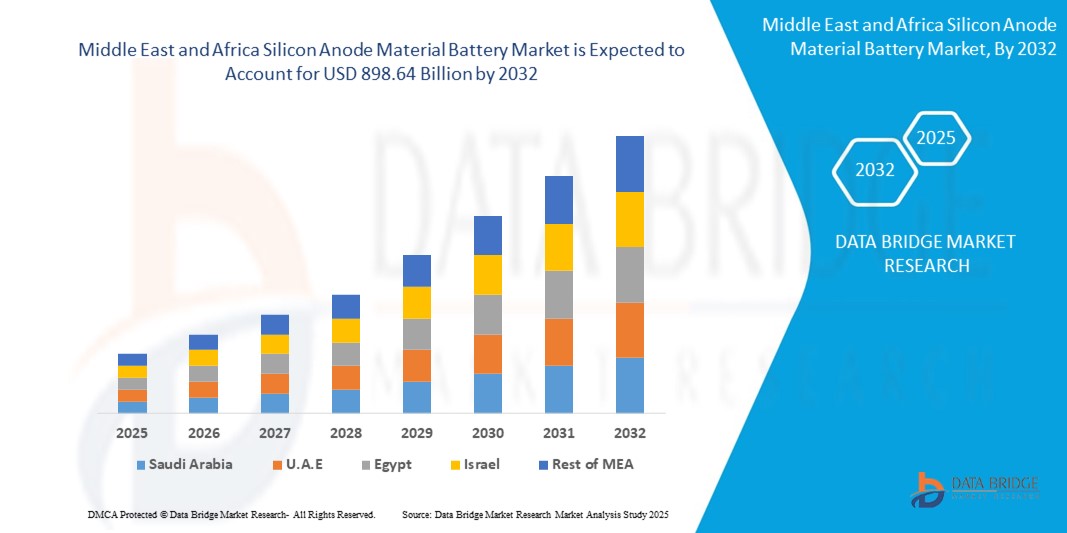
Silicon Anode Material Battery Market Size
- The Asia Pacific Silicon Anode Material Battery Market size was valued at USD 103.79 Million in 2024 and is expected to reach USD 2,505.22 Million by 2032, at a CAGR of48.88% during the forecast period
- The market growth is largely fueled by growing need for high-energy density batteries in various industries such as consumer electronics, automotive, and renewable energy
Silicon Anode Material Battery Market Analysis
- Silicon anode material batteries are emerging as a transformative solution in energy storage technology, offering significantly higher energy density compared to conventional graphite-based batteries. These materials enable longer battery life, faster charging capabilities, and increased performance, particularly in electric vehicles (EVs), consumer electronics, and grid storage applications.
- The market is primarily driven by the increasing demand for high-capacity lithium-ion batteries in the EV industry, as automakers prioritize extended driving range and faster charging. Silicon anodes can store up to 10 times more lithium than graphite, making them essential for next-generation EV batteries.
- Technological advancements in nanostructured silicon and composite materials are addressing the traditional limitations of silicon anodes, such as volume expansion and reduced cycle life. These innovations are helping manufacturers improve battery durability and commercial viability, spurring adoption across automotive and industrial sectors.
- China dominates the Asia Pacific Silicon Anode Material Battery Market with 58.90% in 2024, supported by strong R&D initiatives, robust presence of EV and battery manufacturers, and favorable government incentives for clean energy technologies. Companies like Tesla and Sila Nanotechnologies are leading developments in silicon anode commercialization.
- The India region is expected to register the fastest growth, driven by increasing EV production in Asia Pacific region. The region’s strong battery manufacturing ecosystem and significant investments in advanced material technologies are accelerating the deployment of silicon-based batteries.
- The automotive segment holds the largest market share of 67.09% in 2024, as OEMs seek high-performance batteries to meet strict emission targets and consumer demand for long-range EVs. Silicon anode technology is increasingly being integrated into premium EV models and hybrid vehicles to enhance energy efficiency.
Report Scope and Silicon Anode Material Battery Market Segmentation
|
Attributes |
Silicon Anode Material Battery Market Key Market Insights |
|
Segments Covered |
|
|
Countries Covered |
Asia-Pacific
|
|
Key Market Players |
|
|
Market Opportunities |
|
|
Value Added Data Infosets |
In addition to the insights on market scenarios such as market value, growth rate, segmentation, geographical coverage, and major players, the market reports curated by the Data Bridge Market Research also include in-depth expert analysis, pricing analysis, brand share analysis, consumer survey, demography analysis, supply chain analysis, value chain analysis, raw material/consumables overview, vendor selection criteria, PESTLE Analysis, Porter Analysis, and regulatory framework. |
Silicon Anode Material Battery Market Trends
“Adoption of Nanostructured Silicon and Composite Blends in Battery Manufacturing”
- A significant trend reshaping the silicon anode battery market is the growing use of nanostructured silicon materials and silicon-carbon composites to overcome issues related to expansion and cycle degradation.
- These advanced materials significantly improve the mechanical stability and conductivity of the anode, leading to longer cycle life and better battery performance in high-drain applications like EVs and drones.
For Instance,
- In April 2024, Sila Nanotechnologies began commercial production of its nano-engineered silicon anode material in its Moses Lake facility. The company partnered with automakers to integrate this material into next gen EV batteries, aiming for a 20% energy density increase and a 10–15% improvement in range. This trend is accelerating large-scale adoption of silicon-enhanced batteries in the automotive sector.
- These innovations are also attracting growing interest from wearable tech and aerospace industries, which require lightweight, high-capacity energy solutions.
Silicon Anode Material Battery Market Dynamics
Driver
“Soaring Demand for High-Energy-Density Batteries in Electric Vehicles”
- A significant trend reshaping the silicon anode battery market is the growing use of nanostructured silicon materials and silicon-carbon composites to overcome issues related to expansion and cycle degradation.
- These advanced materials significantly improve the mechanical stability and conductivity of the anode, leading to longer cycle life and better battery performance in high-drain applications like EVs and drones.
For Instance,
- In January 2025, Panasonic Energy partnered with Mazda to develop silicon-anode-based lithium-ion batteries aimed at increasing the range of electric vehicles by 30% without increasing battery size. The partnership focused on solidifying supply chains and accelerating innovation to meet surging EV demand
- With Asia Pacific emission mandates tightening and consumer expectations rising, automakers and battery manufacturers are heavily investing in silicon-based technologies to maintain competitiveness.
Restraint/Challenge
“Volume Expansion and Structural Degradation During Charge Cycles”
- A major challenge facing the market is the volume expansion of silicon during lithium-ion intercalation, which causes mechanical stress and leads to structural degradation, reducing battery lifespan.
- While composite and nano-engineered solutions are under development, scalability and cost-efficiency remain hurdles for mass-market deployment.
- For Instance, in December 2024, researchers at a Asia Pacific battery consortium reported a 25% drop in silicon anode battery capacity after 300 cycles due to unstable volume expansion. Despite improvements, the need for cost-effective binders and coatings to manage this expansion continues to hinder widespread commercialization.
- This challenge increases R&D and manufacturing costs and slows down adoption timelines, particularly in high-volume sectors like consumer electronics.
Silicon Anode Material Battery Market Scope
The market is segmented on the basis of Capacity, application.
- By Application
The automotive segment holds the largest market share of 67.09% in 2024, as OEMs seek high-performance batteries to meet strict emission targets and consumer demand for long-range EVs. Silicon anode technology is increasingly being integrated into premium EV models and hybrid vehicles to enhance energy efficiency.
The Medical Devices segment is expected to experience the fastest CAGR rate 21.08% from 2025 to 2032. Silicon anode batteries are being adopted in implantable and wearable medical devices due to their compact size, high energy capacity, and long operational life. Devices such as insulin pumps, neurostimulators, and remote patient monitoring tools benefit from the reliability and extended runtime offered by silicon-based batteries, especially as healthcare trends shift toward home-based and minimally invasive care solutions.
- By Capacity
On the basis of capacity, the Asia Pacific Silicon Anode Material Battery Market is segmented into <1,500 mAh, 1,500 to 2,500 mAh, and >2,500 mAh. The 1,500 to 2,500 mAh segment held the largest market revenue share in 2024, owing to its widespread use in portable consumer electronics such as smartphones, wearables, and tablets. These batteries strike a balance between energy density, compact size, and cost-effectiveness, making them ideal for everyday applications. The growing demand for longer-lasting batteries in mid-range and premium smartphones is contributing to this segment’s growth.
The >2,500 mAh segment is projected to witness the fastest growth from 2025 to 2032. This growth is driven by the surging demand for high-capacity batteries in electric vehicles (EVs) and energy storage systems. Silicon anode materials are especially attractive for this segment due to their ability to store up to ten times more lithium than traditional graphite anodes, enabling extended driving ranges and reduced charging frequency.
Silicon Anode Material Battery Market Regional Analysis
- China dominates the Asia Pacific Silicon Anode Material Battery Market with 58.90% in 2024, supported by strong R&D initiatives, robust presence of EV and battery manufacturers, and favorable government incentives for clean energy technologies. Companies like Tesla and Sila Nanotechnologies are leading developments in silicon anode commercialization.
- The presence of major battery innovators and strong government support for clean energy technologies continue to push adoption of silicon anode batteries in automotive and grid storage applications.
India Silicon Anode Material Battery Market Insight
The India is anticipated to grow at the fastest CAGR of over 23.03% in 2025, driven by rapid electrification, surging consumer electronics demand, and government-led battery innovation programs. The region benefits from a robust electronics manufacturing base, cost-effective production, and a booming EV market.
Japan Silicon Anode Material Battery Market Insight
Japan is witnessing steady growth due to its advanced material science ecosystem and emphasis on compact, high-efficiency batteries. With strong demand from premium electronics and medical device manufacturers, Japan is a key hub for developing miniaturized silicon anode solutions.
Silicon Anode Material Battery Market Share
The Silicon Anode Material Battery industry is primarily led by well-established companies, including:
- Panasonic Corporation (Japan)
- SAMSUNG SDI CO., LTD. (South Korea)
- LG Chem. (South Korea)
- NEXEON LTD. (U.K.)
- Los Angeles Cleantech Incubator (U.S.)
- Enevate Corporation (U.S.)
- Zeptor Corporation (U.S.)
- CONNEXX SYSTEMS Corp. (Japan)
- XGSciences (U.S.)
- California Lithium Battery (U.S.)
- City of Irvine (U.S.)
- Amprius Technologies (U.S.)
- Solid Energy A/S (Denmark)
- ActaCell, Inc. (U.S.)
- OneD Material, Inc. (U.S.)
- Hitachi Chemical Co., Ltd. (Japan)
- Huawei Technologies Co., Ltd. (China)
Latest Developments in Asia Pacific Silicon Anode Material Battery Market
-
In February 2025, Enevate Corporation announced the commercial launch of its Extreme Fast-Charge (XFC) silicon-dominant lithium-ion battery technology for electric vehicles. The new battery enables a 5-minute charge to 75% capacity and delivers energy densities of over 800 Wh/L. This launch marks a major step toward overcoming range anxiety and long charging times in EVs, helping automakers transition to high-performance battery systems using silicon anodes. The product is already being evaluated by several Asia Pacific EV manufacturers for integration into upcoming vehicle platforms.
- In January 2025, Sila Nanotechnologies entered a long-term strategic partnership with BMW Group to supply silicon-anode-based battery materials for next-generation electric vehicles. Sila's Titan Silicon™ technology will be used in BMW's Neue Klasse models starting in 2026. The collaboration aims to deliver up to a 20% increase in range and 50% faster charging times, emphasizing the role of silicon anodes in meeting premium EV performance targets. This partnership reflects the accelerating demand for advanced battery
- In October 2024, Group14 Technologies acquired Schmid Silicon, a German manufacturer of high-purity silicon, in a deal valued at approximately USD180 million. The acquisition enables Group14 to vertically integrate its supply chain for silicon anode production and accelerate its Asia Pacific capacity expansion plans. This strategic move strengthens Group14’s ability to meet rising demand from automotive and electronics OEMs while improving control over raw material sourcing and manufacturing scalability.
- In November 2024, Nexeon formed a joint venture with SKC, a South Korean chemical and materials company, to construct a 10,000-tonne silicon anode material plant by 2026. This facility, located in Gunsan, will supply battery manufacturers across Asia with advanced silicon materials aimed at enhancing energy density in consumer electronics and EV applications. The JV reflects strong regional interest in domesticizing high-performance battery components amid growing Asia Pacific competition for next-gen materials.
- In December 2024, Amprius Technologies unveiled its latest innovation: a silicon nanowire battery cell with a record-breaking energy density of 500 Wh/kg, targeted at aerospace and high-altitude drone applications. This milestone demonstrates the potential of silicon anodes in niche, weight-sensitive markets that require extreme energy performance. The innovation strengthens Amprius’ leadership in specialized battery tech and positions it to address both commercial aviation and defense sector needs in energy storage.

- Interactive Data Analysis Dashboard
- Company Analysis Dashboard for high growth potential opportunities
- Research Analyst Access for customization & queries
- Competitor Analysis with Interactive dashboard
- Latest News, Updates & Trend analysis
- Harness the Power of Benchmark Analysis for Comprehensive Competitor Tracking
Asia Pacific Silicon Anode Material Battery Market, Supply Chain Analysis and Ecosystem Framework
To support market growth and help clients navigate the impact of geopolitical shifts, DBMR has integrated in-depth supply chain analysis into its Asia Pacific Silicon Anode Material Battery Market research reports. This addition empowers clients to respond effectively to global changes affecting their industries. The supply chain analysis section includes detailed insights such as Asia Pacific Silicon Anode Material Battery Market consumption and production by country, price trend analysis, the impact of tariffs and geopolitical developments, and import and export trends by country and HSN code. It also highlights major suppliers with data on production capacity and company profiles, as well as key importers and exporters. In addition to research, DBMR offers specialized supply chain consulting services backed by over a decade of experience, providing solutions like supplier discovery, supplier risk assessment, price trend analysis, impact evaluation of inflation and trade route changes, and comprehensive market trend analysis.
Data collection and base year analysis are done using data collection modules with large sample sizes. The stage includes obtaining market information or related data through various sources and strategies. It includes examining and planning all the data acquired from the past in advance. It likewise envelops the examination of information inconsistencies seen across different information sources. The market data is analysed and estimated using market statistical and coherent models. Also, market share analysis and key trend analysis are the major success factors in the market report. To know more, please request an analyst call or drop down your inquiry.
The key research methodology used by DBMR research team is data triangulation which involves data mining, analysis of the impact of data variables on the market and primary (industry expert) validation. Data models include Vendor Positioning Grid, Market Time Line Analysis, Market Overview and Guide, Company Positioning Grid, Patent Analysis, Pricing Analysis, Company Market Share Analysis, Standards of Measurement, Global versus Regional and Vendor Share Analysis. To know more about the research methodology, drop in an inquiry to speak to our industry experts.
Data Bridge Market Research is a leader in advanced formative research. We take pride in servicing our existing and new customers with data and analysis that match and suits their goal. The report can be customized to include price trend analysis of target brands understanding the market for additional countries (ask for the list of countries), clinical trial results data, literature review, refurbished market and product base analysis. Market analysis of target competitors can be analyzed from technology-based analysis to market portfolio strategies. We can add as many competitors that you require data about in the format and data style you are looking for. Our team of analysts can also provide you data in crude raw excel files pivot tables (Fact book) or can assist you in creating presentations from the data sets available in the report.













