


What is the Asia-Pacific Small Scale Liquefied Natural Gas (LNG) Market Size and Growth Rate?
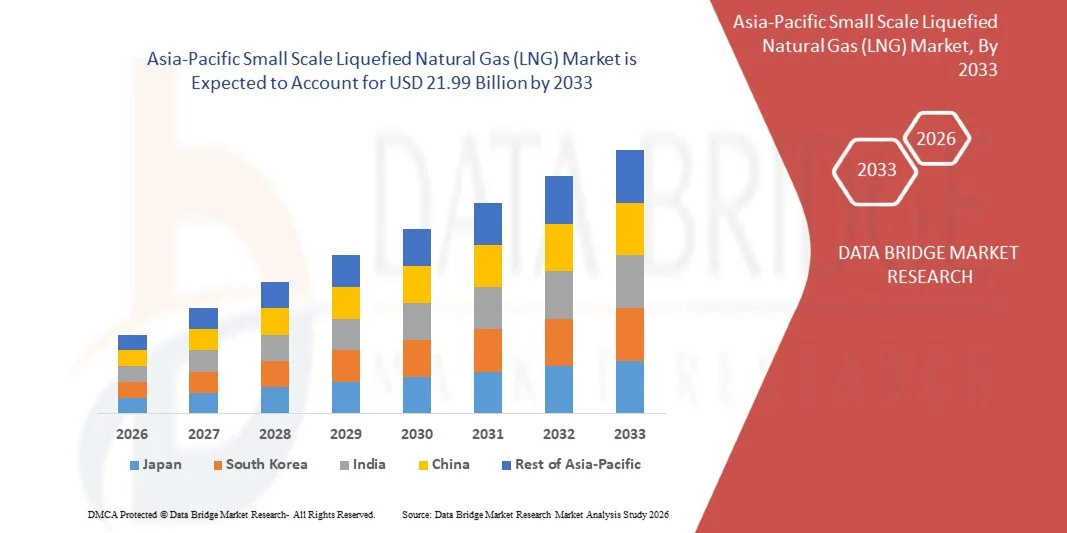
- As per Data Bridge Market Research analysis, the Asia-Pacific small scale liquefied natural gas (LNG) market was valued at USD 7.55 billion in 2025 and is projected to reach USD 21.99 billion by 2033, growing at a CAGR of 14.30% from 2026 to 2033.
- The market is experiencing consistent growth driven by rising demand for cleaner and flexible energy solutions, increasing LNG consumption across industrial and transportation sectors, and expanding investments in small-scale liquefaction, regasification, storage, and distribution infrastructure across Asia-Pacific.
- The growing adoption of LNG for road transportation, marine bunkering, off-grid power generation, and industrial applications, combined with increasing energy demand in emerging economies such as China and India, is accelerating the deployment of small-scale LNG infrastructure. Small-scale LNG provides a flexible and cost-effective energy supply option for remote locations and areas with limited pipeline infrastructure, supporting the region's transition toward cleaner fuels.
Market Size & Forecast
- Global Market Value (2025): USD 7.55 Billion
- Expected Market Value (2033): USD 21.99 Billion
- Forecast CAGR (2026–2033): 14.30%
- Leading Country in 2025: China
- Fastest Growing Country: India
What are the Major Takeaways of the Asia-Pacific Small Scale Liquefied Natural Gas (LNG) Market?
- China dominated the Asia-Pacific small-scale LNG market with the largest revenue share of 45% in 2025, supported by strong natural gas demand, expanding LNG infrastructure, and increasing adoption of LNG across industrial, transportation, and power generation applications.
- India is expected to be the fastest-growing region at a CAGR of 18.0% from 2026 to 2033, fueled by rising natural gas consumption, expansion of LNG distribution infrastructure, and government initiatives to increase the share of natural gas in the energy mix.
- The liquefaction terminal segment led the market with a 61% share in 2025, driven by the growing need to convert natural gas into LNG for flexible storage and transportation.
- Regasification terminal are the fastest-growing type, projected to register a CAGR of 14.6%, reflecting the surge in demand for flexible natural gas supplies across emerging Asian markets.
- The trucks segment dominated the mode of supply category with a 53.5% revenue share in 2025, led by its flexibility and suitability for last-mile LNG distribution
- Atmospheric accounted for 59.68% of the market share in 2025, preferred by its established use in LNG storage infrastructure.
- The shipment and bunkering segment is the fastest-growing mode of supply category, with a CAGR of 14.8%, driven by its increasing LNG use in maritime transportation
Report Scope and Asia-Pacific Small Scale Liquefied Natural Gas (LNG) Market Segmentation
|
Attributes |
Asia-Pacific Small Scale Liquefied Natural Gas (LNG) Key Market Insights |
|
Segments Covered |
|
|
Countries Covered |
Asia-Pacific
|
|
Key Market Players |
|
|
Market Opportunities |
|
|
Value Added Data Infosets |
In addition to the insights on market scenarios such as market value, growth rate, segmentation, geographical coverage, and major players, the market reports curated by the Data Bridge Market Research also include import export analysis, production capacity overview, production consumption analysis, price trend analysis, climate change scenario, supply chain analysis, value chain analysis, raw material/consumables overview, vendor selection criteria, PESTLE Analysis, Porter Analysis, and regulatory framework. |
What is the Key Trend in the Asia-Pacific Small Scale Liquefied Natural Gas (LNG) Market?
- Small-scale LNG is increasingly expanding as a flexible fuel distribution model across Asia-Pacific, particularly for marine bunkering, remote industries, and off-grid users where conventional pipeline infrastructure remains limited today.
- For instance, in December 2024, Singapore’s Maritime and Port Authority (MPA) reported that LNG bunkering had increased from just 16,000 tonnes in 2022 to more than 385,000 tonnes during January–October 2024, while the authority sought proposals for expanding sea-based LNG reloading and ship-to-bunker-barge operations. This demonstrates the rapid development of small-scale LNG distribution and marine-fuel infrastructure in Asia-Pacific.
- Demand for LNG bunkering is strengthening as ports expand cleaner-fuel infrastructure and shipping operators deploy LNG-fueled vessels, creating opportunities for small-scale storage, truck-to-ship, and ship-to-ship fuel supply networks regionally.
- China, Singapore, Japan, and South Korea are strengthening LNG bunkering ecosystems, while smaller regional markets are developing modular LNG facilities to serve islands, industrial clusters, and decentralized energy requirements.
- For instance, in January 2026, Singapore opened applications for additional LNG bunkering licences, as the country continued expanding its role as a multi-fuel maritime hub. The initiative supports further development of LNG marine-fuel supply networks and reflects the growing regional shift toward dedicated LNG bunkering infrastructure.
- Small-scale LNG is also gaining relevance in transportation, where LNG-powered heavy-duty vehicles require geographically distributed refueling infrastructure and reliable last-mile supply, supporting investments in satellite terminals and LNG stations.
What are the Key Drivers of the Asia-Pacific Small Scale Liquefied Natural Gas (LNG) Market?
- The rising LNG demand in Asian economies is supporting decentralized supply infrastructure, particularly where pipeline networks remain incomplete and LNG can provide flexible access to cleaner natural gas for commercial users.
- For instance, in July 2025, the International Energy Agency (IEA) reported that natural gas demand in Asia-Pacific is expected to account for around half of global gas demand growth through 2026, with China and emerging Asian markets driving the increase as additional LNG supply improves market availability. This expanding regional gas demand supports investment in LNG import, storage, regasification, and small-scale distribution infrastructure.
- Growing maritime decarbonization efforts are increasing demand for LNG bunkering infrastructure, as shipowners seek lower-emission alternatives and ports develop fuel storage, transfer, and distribution capabilities across major Asian shipping corridors.
- Expanding industrialization is encouraging factories, power generators, and commercial facilities to adopt LNG where pipeline gas is unavailable, creating demand for satellite terminals, trucking networks, storage tanks, and regasification equipment.
- For instance, in April 2025, construction began on the supporting wharf for Phase III of the Jiangsu LNG project in China, demonstrating continued investment in LNG receiving and supporting infrastructure to meet regional gas demand. The project expansion strengthens LNG supply capacity and connectivity within one of Asia-Pacific's largest natural gas markets.
- Government efforts to strengthen energy security and diversify gas supply are encouraging investments in LNG receiving, storage, and distribution infrastructure, particularly across China, India, Southeast Asia, and other growing markets.
Which Factors are Challenging the Growth of the Asia-Pacific Small Scale Liquefied Natural Gas (LNG) Market?
- High capital requirements for small-scale LNG terminals, storage tanks, cryogenic equipment, trucks, and bunkering vessels can significantly delay projects, especially for smaller operators facing uncertain demand and limited infrastructure financing.
- For instance, in March 2025, Indonesia launched a USD 1.5 billion small-scale LNG hub-and-spoke project to convert dozens of diesel-fired power plants to LNG. However, Reuters reported that high supply-chain costs can reach 30–40% of delivered gas prices, compared with 10–20% for typical LNG projects, while infrastructure underutilization and financing challenges also threaten project implementation.
- Volatile LNG prices can weaken demand from price-sensitive industrial and power customers, particularly when LNG becomes less competitive with coal, pipeline gas, renewable electricity, or alternative fuels across Asian markets.
- Limited LNG infrastructure outside major hubs can increase transportation distances and delivered costs, making small-scale LNG less economical in remote markets and complicating reliable supply for dispersed customers across Asia.
- For instance, in October 2025, the International Energy Agency (IEA) reported that gas prices remained well above historical levels, restraining demand particularly in price-sensitive Asian markets. The IEA forecast global gas-demand growth to slow from 2.8% in 2024 to below 1% in 2025, highlighting the impact of elevated gas prices on LNG consumption and investment across Asia-Pacific
- Environmental concerns, including methane leakage and lifecycle emissions, can create compliance requirements as governments and ports tighten standards, potentially increasing operating costs and reducing LNG's attractiveness as a transition fuel.
How is the Asia-Pacific Small Scale Liquefied Natural Gas (LNG) Market Segmented?
The Asia-Pacific small scale liquefied natural gas (LNG) market is segmented on the basis of type, mode of supply, storage tank capacity, and application.
- By Type
On the basis of type, the Asia-Pacific small-scale LNG market is segmented into liquefaction terminals and regasification terminals. The liquefaction terminal segment dominated the market with 61% share in 2025, supported by the growing need to convert natural gas into LNG for flexible storage and transportation. Liquefaction facilities are particularly important in countries with substantial natural gas resources and geographically dispersed demand centers. They enable LNG to be supplied to locations where conventional pipeline infrastructure is unavailable or economically difficult to develop. The segment is also benefiting from increasing investments in decentralized LNG production and distribution infrastructure. Growing demand for LNG from transportation, industrial users, and remote power-generation facilities is further supporting liquefaction capacity. The expansion of small-scale LNG infrastructure across China, Australia, Indonesia, and other Asian economies continues to reinforce the segment's leading position.
The regasification terminal segment is projected to register the fastest growth at 14.6% CAGR during forecast period, driven by increasing demand for flexible natural gas supplies across emerging Asian markets. Regasification facilities convert imported or transported LNG back into gaseous form for industrial, power-generation, and other end uses. Their deployment is particularly valuable in areas where conventional gas pipelines and large-scale terminals are limited. Growing LNG imports and decentralized energy requirements are creating additional opportunities for small-scale regasification infrastructure. Floating and modular regasification solutions are also helping reduce construction requirements and improve deployment flexibility. Increasing focus on energy security and reliable gas availability is encouraging investment in import-side infrastructure. These factors are expected to make regasification terminals the fastest-growing type segment.
- By Mode of Supply
On the basis of mode of supply, the Asia-Pacific small-scale LNG market is segmented into trucks, shipment and bunkering, rail tanks, pipeline, and others. The trucks segment dominated the market with 53.5% share in 2025, owing to its flexibility and suitability for last-mile LNG distribution. LNG trucks can transport fuel from liquefaction facilities or terminals to industrial plants, fueling stations, power facilities, and remote consumers. This mode is especially useful in areas where pipeline infrastructure is unavailable or costly to establish. The extensive road networks and large commercial transportation sectors in several Asian economies are supporting continued truck-based LNG distribution. China, in particular, has developed substantial LNG trucking and fueling infrastructure for heavy-duty transportation. The ability to provide flexible and relatively direct delivery makes trucks a critical component of the regional small-scale LNG supply chain.
The shipment and bunkering segment is projected to register the fastest growth at 14.8% CAGR during forecast period, supported by increasing LNG use in maritime transportation. LNG bunkering infrastructure is expanding as shipping operators seek cleaner alternatives to conventional marine fuels. Small-scale LNG shipment systems allow LNG to be moved efficiently between coastal terminals, ports, storage facilities, and bunkering locations. Growing maritime activity across China, Japan, South Korea, Singapore, and other Asian markets is creating additional demand for LNG marine-fuel infrastructure. Environmental requirements and decarbonization initiatives are further encouraging ship operators to adopt LNG-fueled vessels. Investments in port-based LNG storage and bunkering facilities are improving the availability of marine LNG. As a result, shipment and bunkering is expected to remain one of the fastest-expanding supply modes in the region.
- By Storage Tank Capacity
On the basis of storage tank capacity, the Asia-Pacific small-scale LNG market is segmented into atmospheric, pressurized, and floating storage (FSU). The atmospheric segment dominated the market with 69% share in 2025, supported by its established use in LNG storage infrastructure. Atmospheric storage tanks are suitable for maintaining LNG at very low temperatures under relatively low pressure. They are widely deployed at LNG terminals, distribution facilities, and industrial locations requiring dedicated LNG storage. Their established technology and operational reliability make them suitable for both existing and newly developed LNG infrastructure. Increasing construction of small-scale liquefaction and regasification facilities across Asia-Pacific is supporting demand for atmospheric storage. The segment is also benefiting from the growing requirement for buffer storage between LNG production, transportation, and consumption.
The floating storage (FSU) segment is projected to register the fastest growth at 10.5% CAGR during forecast period, driven by increasing demand for flexible and rapidly deployable LNG infrastructure across Asia-Pacific. FSUs provide storage capacity without requiring extensive onshore infrastructure, making them particularly suitable for island nations and remote coastal markets. Their integration with floating regasification systems allows LNG-importing regions to establish gas supply infrastructure with comparatively greater flexibility. Growing LNG demand in Southeast Asia is creating opportunities for floating storage solutions where conventional terminals can require significant investment. Increasing development of floating LNG and floating storage regasification infrastructure is further supporting adoption across the region.
- By Application
On the basis of application, the Asia-Pacific small-scale LNG market is segmented into transportation, heavy-duty vehicles, industrial and power, and others. The transportation segment dominated the market with 42% share in 2025, driven by increasing adoption of LNG as an alternative fuel for road and marine transportation. LNG is increasingly utilized where long-distance transportation requires high-energy-density fuels and efficient refueling capabilities. The expansion of LNG fueling infrastructure is supporting greater adoption among commercial transportation operators. Growing efforts to reduce emissions from conventional diesel-powered transportation are also encouraging the use of LNG. China and other major Asian transportation markets are contributing significantly to regional LNG vehicle adoption. Increasing demand for cleaner and cost-efficient transportation fuels is therefore supporting the leading position of the transportation segment.
The industrial and power segment is projected to register the fastest growth at 14.0% CAGR during forecast period, driven by increasing demand for flexible and cleaner energy supplies across industrial facilities and power-generation applications. Small-scale LNG provides an alternative source of natural gas for locations where conventional pipeline infrastructure is unavailable or uneconomical. Growing electricity demand and expansion of off-grid and distributed power generation are creating additional opportunities for LNG-based energy systems. Industrial users are also increasingly adopting LNG as a fuel for boilers, manufacturing processes, and other energy-intensive operations. The development of decentralized LNG infrastructure is improving access to natural gas across remote and infrastructure-limited areas. Increasing emphasis on cleaner fuels and energy diversification is expected to further support the growth of industrial and power applications across Asia-Pacific.
Which Country Holds the Largest Share of the Asia-Pacific Small Scale Liquefied Natural Gas (LNG) Market?
- China dominated the Asia-Pacific small-scale LNG market with the largest revenue share of 45% in 2025, supported by strong natural gas demand, expanding LNG infrastructure, and increasing adoption of LNG across industrial, transportation, and power generation applications.
- The country also benefits from substantial investments in liquefaction terminals, LNG storage, trucking networks, and localized distribution infrastructure, particularly for areas with limited pipeline access. Government initiatives supporting natural gas utilization, energy security, and emissions reduction are further strengthening China's position. Growing adoption of LNG-powered heavy-duty vehicles and continued development of LNG bunkering infrastructure are also contributing to market expansion.
The Japan Small Scale Liquefied Natural Gas (LNG) Market Insight
The Japan small-scale LNG market is witnessing consistent growth due to rising demand for reliable natural gas supplies, distributed energy solutions, and cleaner transportation fuels. Industrial facilities, power-generation operators, and marine transportation companies are increasingly utilizing small-scale LNG infrastructure to improve fuel flexibility and supply reliability. Moreover, increasing development of LNG bunkering facilities and advanced storage technologies is supporting market growth. Japan’s focus on energy security, maritime decarbonization, and efficient LNG utilization is further contributing to the expansion of small-scale LNG applications.
India Small Scale Liquefied Natural Gas (LNG) Market Insight
The India small-scale LNG market is experiencing strong growth due to rising natural gas demand, expanding gas distribution infrastructure, and increasing efforts to diversify the country's energy mix. Growing adoption of LNG for industrial operations, transportation, and remote power generation is creating new opportunities for small-scale LNG solutions. In addition, investments in LNG trucking, satellite terminals, storage facilities, and localized distribution networks are improving access to natural gas beyond conventional pipeline-connected areas. Increasing focus on cleaner fuels, energy security, and natural gas penetration is further supporting small-scale LNG market development in India.
South Korea Small Scale Liquefied Natural Gas (LNG) Market Insight
The South Korea small-scale LNG market is expanding steadily due to strong LNG demand, advanced maritime infrastructure, and increasing adoption of LNG as a cleaner transportation fuel. Industrial facilities, power-generation operators, and shipping companies are increasingly utilizing LNG solutions to improve fuel efficiency and reduce emissions. Moreover, investments in LNG bunkering infrastructure and small-scale distribution facilities are strengthening the country's LNG supply network. Growing maritime activity, environmental initiatives, and technological advancements in LNG storage and transportation are further supporting market expansion.
Indonesia Small Scale Liquefied Natural Gas (LNG) Market Insight
The Indonesia small-scale LNG market is witnessing increasing demand due to its geographically dispersed islands, growing energy requirements, and need for flexible natural gas distribution. Small-scale LNG provides an efficient solution for supplying gas to remote locations where conventional pipeline infrastructure is difficult to develop. Growing adoption across power generation, industrial facilities, and transportation is supporting market expansion. In addition, investments in small-scale liquefaction, LNG transportation, storage, and regasification infrastructure are improving access to natural gas across the country's island-based energy network.
Which are the Top Companies in Asia-Pacific Small Scale Liquefied Natural Gas (LNG) Market?
The Asia-Pacific small scale liquefied natural gas (LNG) industry is primarily led by well-established companies, including:
- Shell International Limited (U.K.)
- Petroliam Nasional Berhad (PETRONAS) (Malaysia)
- JERA Co., Inc. (Japan)
- Mitsui O.S.K.Lines (Japan)
- INPEX CORPORATION (Japan)
- TOKYO GAS Co., Ltd. (Japan)
- Osaka Gas Co., Ltd. (Japan)
- Chubu Electric Power Co., Inc. (Japan)
- KYUSHU ELECTRIC POWER CO., INC. (Japan)
- Nippon Yusen Kabushiki Kaisha (Japan)
- KOREA GAS CORPORATION (South Korea)
- SK Gas (South Korea)
- China National Offshore Oil Corporation (China)
- China Petrochemical Corporation (China)
- China National Petroleum Corporation (China)
- Indian Oil Corporation Ltd (India)
- Petronet LNG Limited (India)
- Woodside Energy Group Ltd (Australia)
- Santos Limited (Australia)
What are Latest Developments in Asia-Pacific Small Scale Liquefied Natural Gas (LNG) Market?
- In June 2025, Mitsui O.S.K. Lines and Samsung Heavy Industries received Approval in Principle for a new 174,000-cubic-meter LNG carrier equipped with solid oxide fuel cell technology. The vessel design incorporates a 300-kilowatt solid oxide fuel cell system supplied by Bloom Energy for auxiliary power generation. The project demonstrates the development of next-generation LNG carrier technology aimed at improving vessel efficiency and reducing emissions. The vessel is scheduled for delivery in 2027 and represents continued technological development within the Asian LNG shipping sector. The collaboration between Japanese and South Korean companies also highlights Asia-Pacific’s role in developing advanced LNG transportation technologies.
- In May 2025, Japan’s ASUKA III completed its inaugural LNG bunkering operation in Singapore, supplied by FueLNG. The operation marked an important LNG-fueling milestone for the Japanese cruise sector and demonstrated the availability of LNG bunkering services for large passenger vessels in Singapore. The vessel received LNG at the Port of Singapore as part of its operational deployment. The development highlights the growing integration between Japanese shipping companies and Singapore’s LNG bunkering infrastructure. It also demonstrates the expanding application of small-scale LNG distribution and marine-fuel supply systems in Asia-Pacific.
- In January 2025, Mitsui O.S.K. Lines announced a new LNG carrier contract with JERA, with the vessel scheduled for delivery in 2026. The LNG carrier will be built at Samsung Heavy Industries’ Geoje Shipyard in South Korea and will be managed by MOL for LNG transportation for JERA. The project represents continued investment in new LNG transportation capacity connecting major Asian LNG suppliers and consumers. The vessel is part of MOL’s expansion of its LNG carrier fleet and long-term LNG transportation business. The development strengthens the supporting infrastructure required for reliable LNG supply across Japan and the wider Asia-Pacific region.
- In July 2023, MOL and its partners launched Japan’s first dual-fuel LNG bunkering vessel, KEYS AZALEA, at Mitsubishi Heavy Industries’ Shimonoseki Shipyard. The vessel was designed with an LNG loading capacity of approximately 3,500 cubic meters and was developed to expand LNG bunkering services in Japan. Its launch represented an important addition to Japan’s small-scale LNG marine-fuel supply infrastructure. The vessel is capable of supplying LNG to LNG-fueled ships through ship-to-ship bunkering operations. The development supports the expansion of LNG as a marine fuel and strengthens Japan’s regional LNG bunkering capabilities.
- In January 2023, Mitsui O.S.K. Lines (MOL) and its partners introduced Japan’s first LNG-fueled ferry, Sunflower Kurenai, into commercial service. The ferry was developed as part of efforts to reduce the environmental impact of maritime transportation and promote LNG adoption in Japan. Its introduction demonstrated the practical deployment of LNG fuel in Japan’s domestic passenger and vehicle-ferry sector. The vessel uses LNG as its primary marine fuel and represents an important application of LNG bunkering and supply infrastructure. The launch also supports the broader development of LNG-based maritime transportation in Asia-Pacific.

- Interactive Data Analysis Dashboard
- Company Analysis Dashboard for high growth potential opportunities
- Research Analyst Access for customization & queries
- Competitor Analysis with Interactive dashboard
- Latest News, Updates & Trend analysis
- Harness the Power of Benchmark Analysis for Comprehensive Competitor Tracking
Asia Pacific Small Scale Lng Market, Supply Chain Analysis and Ecosystem Framework
To support market growth and help clients navigate the impact of geopolitical shifts, DBMR has integrated in-depth supply chain analysis into its Asia Pacific Small Scale Lng Market research reports. This addition empowers clients to respond effectively to global changes affecting their industries. The supply chain analysis section includes detailed insights such as Asia Pacific Small Scale Lng Market consumption and production by country, price trend analysis, the impact of tariffs and geopolitical developments, and import and export trends by country and HSN code. It also highlights major suppliers with data on production capacity and company profiles, as well as key importers and exporters. In addition to research, DBMR offers specialized supply chain consulting services backed by over a decade of experience, providing solutions like supplier discovery, supplier risk assessment, price trend analysis, impact evaluation of inflation and trade route changes, and comprehensive market trend analysis.
Data collection and base year analysis are done using data collection modules with large sample sizes. The stage includes obtaining market information or related data through various sources and strategies. It includes examining and planning all the data acquired from the past in advance. It likewise envelops the examination of information inconsistencies seen across different information sources. The market data is analysed and estimated using market statistical and coherent models. Also, market share analysis and key trend analysis are the major success factors in the market report. To know more, please request an analyst call or drop down your inquiry.
The key research methodology used by DBMR research team is data triangulation which involves data mining, analysis of the impact of data variables on the market and primary (industry expert) validation. Data models include Vendor Positioning Grid, Market Time Line Analysis, Market Overview and Guide, Company Positioning Grid, Patent Analysis, Pricing Analysis, Company Market Share Analysis, Standards of Measurement, Global versus Regional and Vendor Share Analysis. To know more about the research methodology, drop in an inquiry to speak to our industry experts.
Data Bridge Market Research is a leader in advanced formative research. We take pride in servicing our existing and new customers with data and analysis that match and suits their goal. The report can be customized to include price trend analysis of target brands understanding the market for additional countries (ask for the list of countries), clinical trial results data, literature review, refurbished market and product base analysis. Market analysis of target competitors can be analyzed from technology-based analysis to market portfolio strategies. We can add as many competitors that you require data about in the format and data style you are looking for. Our team of analysts can also provide you data in crude raw excel files pivot tables (Fact book) or can assist you in creating presentations from the data sets available in the report.













